STANDARD TEMPLATE
LIBRARY (STL)
Developed by Alexander Stepanov and Meng Lee of HP in
1979.
Standard template library accepted in July 1994 into C++
ANSI Standard
These are called as collection of General-purpose
template classes( data structures) and functions
1
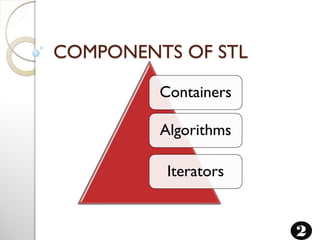
COMPONENTS OF STL
2
Containers
Algorithms
Iterators
COMPONENTS OF STL
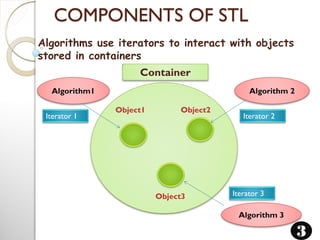
Algorithm1 Algorithm 2
Algorithm 3
Object1 Object2
Object3
Container
Iterator 1 Iterator 2
Iterator 3
3
Algorithms use iterators to interact with objects
stored in containers
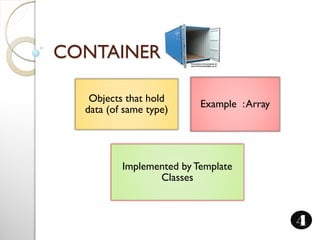
CONTAINER
Objects that hold
data (of same type)
Example :Array
Implemented by Template
Classes
4
ALGORITHM
These are procedures
used to process the data
contained in containers.
Example :
Searching, Sorting,
Merging, Copying,
Initializing
Implemented by
template functions
5
ITERATOR
It is an object that
points to an
element in a
container
Used to move
through the
contents of
container
They can be
incremented and
decremented
Connect Algorithms
with Containers
6
COMPONENTS OF STL
7
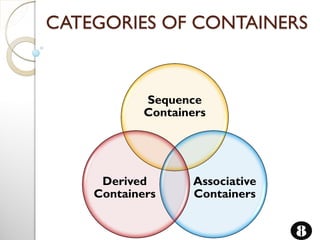
Containers
Sequence
Containers
Associative
Containers
Derived
Containers
CATEGORIES OF CONTAINERS
8
CONTAINERS
STL Defines 10 Containers
9
CATEGORIES OF CONTAINERS
10
Sequence
• vector
• deque
• list
Associative
• set
• multiset
• map
• multimap
Derived
• stack
• queue
• Priority_queue
SEQUENCE CONTAINERS
Stores elements in a linear sequence
Each element is related to other
elements by its position along the line
They allow insertion of elements
11
Element
0
Element
1
Element
2
……..
Last
element
Example
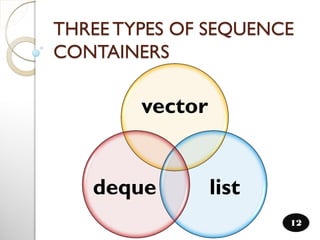
vector
list
deque
THREE TYPES OF SEQUENCE
CONTAINERS
12
Vector : Sequence Container
Expandable and dynamic array
Grows and shrinks in size
Insertion / Deletion of elements at
back
Permits direct access to any
element
13
Vector : Sequence Container
14
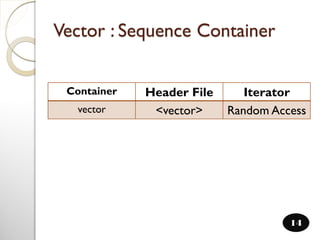
Container Header File Iterator
vector <vector> Random Access
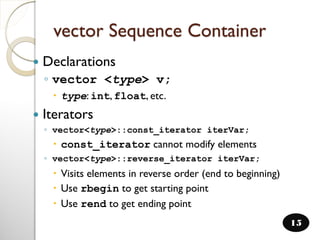
vector Sequence Container
 Declarations
◦ vector <type> v;
 type: int, float, etc.
 Iterators
◦ vector<type>::const_iterator iterVar;
 const_iterator cannot modify elements
◦ vector<type>::reverse_iterator iterVar;
 Visits elements in reverse order (end to beginning)
 Use rbegin to get starting point
 Use rend to get ending point
15
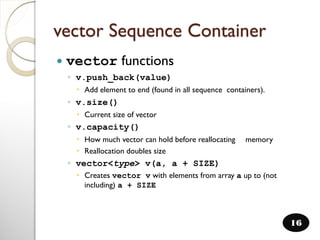
vector Sequence Container
 vector functions
◦ v.push_back(value)
 Add element to end (found in all sequence containers).
◦ v.size()
 Current size of vector
◦ v.capacity()
 How much vector can hold before reallocating memory
 Reallocation doubles size
◦ vector<type> v(a, a + SIZE)
 Creates vector v with elements from array a up to (not
including) a + SIZE
16
vector Sequence Container
 vector functions
◦ v.insert(iterator, value )
 Inserts value before location of iterator
◦ v.insert(iterator, array , array + SIZE)
 Inserts array elements (up to, but not including array + SIZE) into
vector
◦ v.erase( iterator )
 Remove element from container
◦ v.erase( iter1, iter2 )
 Remove elements starting from iter1 and up to (not including)
iter2
◦ v.clear()
 Erases entire container
17
vector Sequence Container
 vector functions operations
◦ v.front(), v.back()
 Return first and last element
◦ v.[elementNumber] = value;
 Assign value to an element
18
Vector : Sequence Container
19
int array[5] = {12, 7, 9, 21, 13 };
vector<int> v(array,array+5);
12 7 9 21 13
v.begin();
12 7 9 21
v.push_back(15);
12 7 9 21 15
v[3]
12 7 9 21 15
0 1 2 3 4
v.pop_back();
#include <vector>
#include <iostream>
using namespace std;
void main
{
int arr[] = {12, 7, 9, 21, 13 }; // standard C array
vector<int> v(arr, arr+5); // initialize vector with C array
while ( ) // until vector is empty
{
cout << << ” ”; // output last element of vector
// delete the last element
}
for(i=0; i<v.size(); ++i)
cout<<v[i]<<' ';
cout<<endl }
Vector : Sequence Container
20
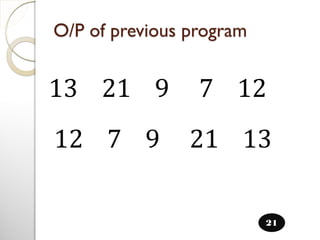
13 21 9 7 12
O/P of previous program
21
12 7 9 21 13
#include <vector>
#include <iostream>
using namespace std;
int main()
{
vector <int> vec1;
vector <int>::iterator vec1_Iter;
vector <int>::reverse_iterator vec1_rIter;
vec1.push_back(10);
vec1.push_back(7);
vec1.push_back(3);
Vector : Using Iterator
22
cout<<"vec1 data: ";
for(int i=0; i<vec1.size(); ++i)
cout<<vec1[i]<<' ';
cout<<endl;
cout<<"nOperation: vec1.begin()n";
vec1_Iter = vec1.begin();
cout<<"The first element of vec1 is "<<*vec1_Iter<<endl;
cout<<"nOperation: vec1.rbegin()n";
vec1_rIter = vec1.rbegin();
cout<<"The first element of the reversed vec1 is “;
cout<<*vec1_rIter<<endl;
return 0;
}
Vector : Using Iterator
23
vec1 data: 10 7 3
Operation: vec1.begin()
The first element of vec1 is10
Operation: vec1.rbegin()
The first element of the reversed vec1 is : 3
O/P of previous program
24
cout<<"Operation: vec1.rbegin() and vec1.rend()n";
cout<<"vec1 data: ";
For(key = vec1.rbegin(); key != vec1.rend();
key++)
cout<<*key<<' ';
cout<<endl;
return 0;
}
Vector : Using Iterator
26
Operation: vec1.begin() and vec1.rend()
vec1 data: 1 4 3 7
O/P of previous program
27
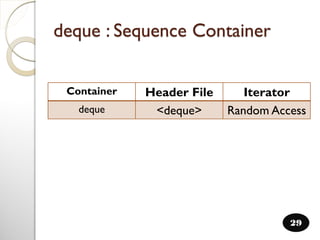
deque : Sequence Container
Double ended Queue
Insertion / Deletion of elements both
ends
Permits direct access to any
element
28
deque : Sequence Container
29
Container Header File Iterator
deque <deque> Random Access
#include <iostream>
#include <deque>
using namespace std;
int main ()
{
deque<int> mydeque;
mydeque.push_back (100);
mydeque.push_back (200);
mydeque.push_back (300);
cout << "nThe final size of mydeque is "
cout<<<< mydeque.size() << “n”;
Deque
30
cout << "Popping out the elements in mydeque:";
while (!mydeque.empty())
{
cout << mydeque.front();
mydeque.pop_front();
}
cout << "nThe final size of mydeque is "
cout<<<< mydeque.size() << “n”;
return 0;
}
Deque
31
The final size of mydeque is : 3
Popping out the elements in mydeque:
The final size of mydeque is : 0
O/P of previous program
32
100 200 300
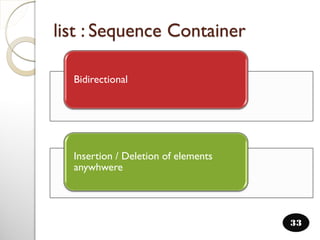
list : Sequence Container
Bidirectional
Insertion / Deletion of elements
anywhwere
33
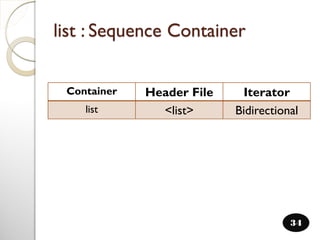
list : Sequence Container
34
Container Header File Iterator
list <list> Bidirectional
List
35
#include <iostream.h>
#include <list>
void print(list <char> );
main()
{
list <char> l;
list <char>::iterator p;
l.push_back('o');
l.push_back('a');
l.push_back('t');
p=l.begin();
List
36
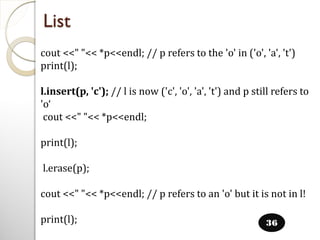
cout <<" "<< *p<<endl; // p refers to the 'o' in ('o', 'a', 't')
print(l);
l.insert(p, 'c'); // l is now ('c', 'o', 'a', 't') and p still refers to
'o‘
cout <<" "<< *p<<endl;
print(l);
l.erase(p);
cout <<" "<< *p<<endl; // p refers to an 'o' but it is not in l!
print(l);
l.erase(l.begin()); //removes front of l
print(l);
}
void print( list<char> a)
{
for(list<char>::iterator ai=a.begin(); ai!=a.end(); ++ai)
cout << *ai << " ";
cout << endl;
cout << "----------------"<<endl;
}
37
O/P of previous program
38
o
o a t
o
c o a t
null
c a t
a t
Comparison of sequence containers
39
Container Random
Access
Insertion
Deletion in
middle
Insertion or
Deletion at
the ends
vector Fast Slow Fast at Back
deque Fast Slow Fast at both
ends
list Slow Fast Fast at front
ASSOCIATIVE CONTAINERS
Non-sequential
Supports direct access to elements
using keys
The keys are typically numbers or
strings
40
set
Multiset
map
multimap
FOUR TYPES OF ASSOCIATIVE
CONTAINERS
41
All these
store data in
a structure
called tree
which
facilitates fast
searching
Set & Multiset :Associative
Container
Stores a number of items which contain key
Elements here are referenced by keys and not
their positions.
Example : Storing the objects of student class which are
ordered alphabetically using names as keys
Multiset allows duplicate items while set does
not
42
#include <iostream>
#include <string>
#include <set>
using namespace std;
int main()
{
string a[] = {"Alice", "Bob", "Carl", "Dick", "Eve", "Fred“} ;
set<string> s(a, a+6);
set<string>::iterator p = s.begin();
while (p != s.end())
cout << *p++ << endl;
cout<<_______________________”<<endl;
Set
43
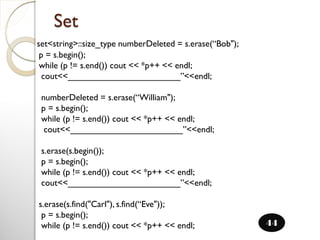
set<string>::size_type numberDeleted = s.erase(“Bob");
p = s.begin();
while (p != s.end()) cout << *p++ << endl;
cout<<_______________________”<<endl;
numberDeleted = s.erase(“William");
p = s.begin();
while (p != s.end()) cout << *p++ << endl;
cout<<_______________________”<<endl;
s.erase(s.begin());
p = s.begin();
while (p != s.end()) cout << *p++ << endl;
cout<<_______________________”<<endl;
s.erase(s.find("Carl"), s.find(“Eve"));
p = s.begin();
while (p != s.end()) cout << *p++ << endl;
Set
44
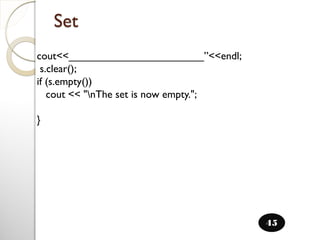
cout<<_______________________”<<endl;
s.clear();
if (s.empty())
cout << "nThe set is now empty.";
}
Set
45
O/P of previous program
46
Alice
Bob
Carl
Dick
Eve
Fred
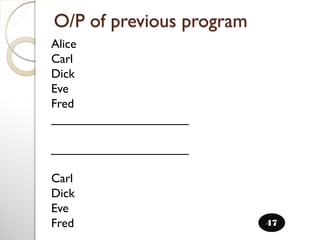
____________________
Alice
Carl
Dick
Eve
Fred
O/P of previous program
47
Alice
Carl
Dick
Eve
Fred
____________________
____________________
Carl
Dick
Eve
Fred
O/P of previous program
48
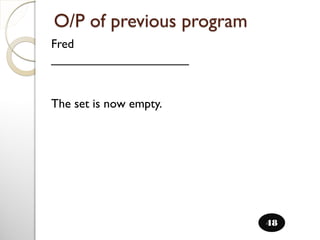
Fred
____________________
The set is now empty.
#include <iostream>
#include <string>
#include <set>
class Book
{
public :
Book()
{
title = author = publisher = date = "";
}
Book(string a)
{
author = a;
title = publisher = date = "";
}
MultiSet
49
Book(string t, string a, string p, string d)
{
title = t;
author = a;
publisher = p;
date = d;
}
string Author()
{
return author;
}
MultiSet
50
void GetInfo(string &t, string &a, string &p, string &d)
{
t = title;
a = author;
p = publisher;
d = date;
}
private:
string author;
string title;
string publisher;
string date;
};
MultiSet
51
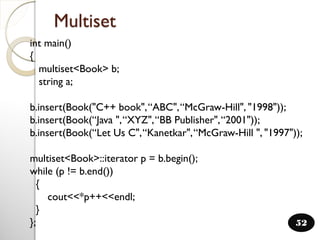
int main()
{
multiset<Book> b;
string a;
b.insert(Book("C++ book",“ABC",“McGraw-Hill", "1998"));
b.insert(Book(“Java ",“XYZ",“BB Publisher",“2001"));
b.insert(Book(“Let Us C",“Kanetkar",“McGraw-Hill ", "1997"));
multiset<Book>::iterator p = b.begin();
while (p != b.end())
{
cout<<*p++<<endl;
}
};
Multiset
52
O/P of previous program
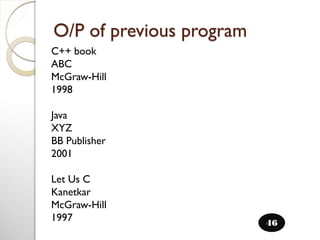
46
C++ book
ABC
McGraw-Hill
1998
Java
XYZ
BB Publisher
2001
Let Us C
Kanetkar
McGraw-Hill
1997
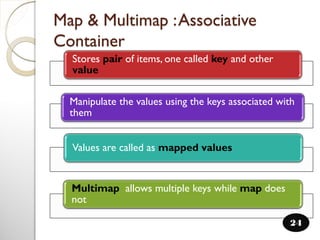
Map & Multimap :Associative
Container
Stores pair of items, one called key and other
value
Manipulate the values using the keys associated with
them
Values are called as mapped values
Multimap allows multiple keys while map does
not
24
16
Map
71
#include <map>
#include <algorithm>
#include <iostream>
#include <string>
int main() {
map<string,int> amap;
amap[”First”]=1;
amap[“Second”]=2;
cout << "Size : " << amap.size() << endl;
amap["Third"]=3;
amap[”Fourth"]=4;
cout << "Size : " << amap.size() << endl;
17
Map
71
map<string,int>::iterator it;
for ( it=amap.begin(); it!=amap.end(); it++)
cout << "map : " << it->first << " "
<< it->second << endl;
cout << amap.find("Third")->second << endl;
return 0;
}
stack
queue
priority_queue
THREE TYPES OF DERIVED
CONTAINERS
25
These are
known as
container
adaptors
#include <stack>
#include <queue>
using namespace std;
int main()
{
// STL Stack
stack<int, vector<int> > S; // Changing default container
for ( int i=0 ; i<10; i++ )
S.push(i);
for ( int i=0 ; i<10; i++ )
{
cout << S.top() << " ";
S.top() = 2 * S.top();
cout << S.top() << endl;
S.pop();
}
Stack, Queue, Priority_Queue
// STL Queue
queue<int> Q;
for ( int i=0 ; i<10; i++ )
Q.push(i);
for ( int i=0 ; i<10; i++ )
{
cout << Q.front() << endl;
Q.pop();
}
// STL Priority Queue
priority_queue<int> P;
for ( int i=0 ; i<10; i++ )
P.push(i);
for ( int i=0 ; i<10; i++ )
{
cout << P.top() << endl;
P.pop();
}
}
Stack , Queue , Priority_Queue :
Derived Containers
Can be created from different
sequence containers
These do not support Iterators
Therefore cannot be used for data
manipulation
Support two member functions :
push( ) and pop( )
26
COMPONENTS OF STL
27
Containers
Algorithms
Iterators
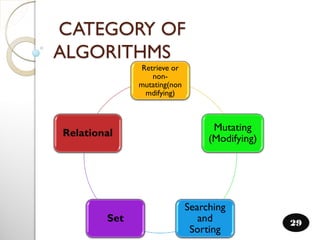
2.ALGORITMS
Generic functions that handle common tasks
such as searching, sorting, comparing,
and editing
More than 60 Algortihms exist
These are not member functions or friends of
containers but are standalone template functions
To use them we include<algorithm> in the program
28
Retrieve or
non-
mutating(non
mdifying)
Mutating
(Modifying)
Searching
and
Sorting
Set
Relational
CATEGORY OF
ALGORITHMS
29
Operations Description
search() Searches desired element from the
sequence
count() Count appearances of value in range
count_if Return number of elements in range
satisfying condition
equal() Test whether the elements in two ranges
are equal
find() Find position of desired element
Non-Mutating Algorithms
30
Non-Mutating Algorithms
31
Operations Description
find_end Find last subsequence in range
find_first_of() Find element from set in range
find_if() Find element in range
for_each() Apply function to range
mismatch() Return first position where two ranges
differ
Operations Description
copy() Copy sequence of elements
copy_backward( ) Copy range of elements backward
swap( ) Exchange values of two objects
fill() Fill range with value
generate ( ) Generate values for range with function
reverse() Reverse the given sequence
remove() Remove value from sequence
Mutating Algorithms
30
Operations Description
unique() Remove consecutive duplicates in
range
random_shuffle() Randomly rearrange elements
Mutating Algorithms
30
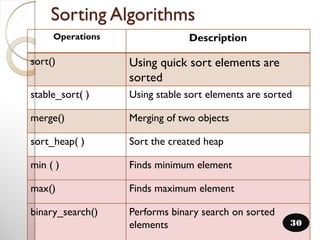
Operations Description
sort() Using quick sort elements are
sorted
stable_sort( ) Using stable sort elements are sorted
merge() Merging of two objects
sort_heap( ) Sort the created heap
min ( ) Finds minimum element
max() Finds maximum element
binary_search() Performs binary search on sorted
elements
Sorting Algorithms
30
Algorithms
#include<algorithm>
#include<iostream>
using namespace std;
int main()
{
vector<int> v;
vector<int>p;
v.push_back(10); v.push_back(20); v.push_back(10);
p.push_back(60); v.push_back(40); v.push_back(50);
swap(v,p);
int * ptr = find(a,a+6,20);
}
Algorithms
int n, value,arr[10],i;
int *Limit = arr + n;
cout<<“ Enter the numbers” ;
for(i =0; i< n;++i)
{
cin>>value;
arr[i] = value;
}
sort(arr, Limit);
Algorithms
cout<<“ Sorted List is” ;
for(i =0; i< n;++i)
{
cout<<arr[i];
cout<<endl;
}
return 0;
}
Algorithm…Searching Example
find , search , binary search
/ binary_search example
#include <iostream> // std::cout
#include <algorithm> // std::binary_search, std::sort
#include <vector> // std::vector
bool myfunction (int i,int j) { return (i<j); }
int main () {
int myints[] = {1,2,3,4,5,4,3,2,1};
int my2ints[] = {5,4,3,2};
vector<int> v(myints,myints+9); // 1 2 3 4 5 4 3 2 1
vector<int>::iterator it;
Algorithm…Searching Example
find , search , binary search
// using default comparison:
sort (v.begin(), v.end());
it = find(v.begin(), v.end(), 3);
cout<<“Item found at position “ <<(it-v.begin());
it = search (v.begin(), v.end(), my2ints, my2ints+4);
cout<<“Item found at position “ <<(it-v.begin());
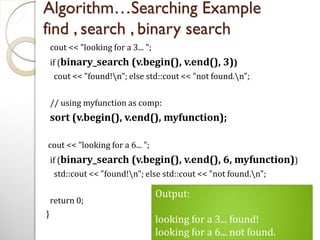
Algorithm…Searching Example
find , search , binary search
cout << "looking for a 3... ";
if (binary_search (v.begin(), v.end(), 3))
cout << "found!n"; else std::cout << "not found.n";
// using myfunction as comp:
sort (v.begin(), v.end(), myfunction);
cout << "looking for a 6... ";
if (binary_search (v.begin(), v.end(), 6, myfunction))
std::cout << "found!n"; else std::cout << "not found.n";
return 0;
}
Output:
looking for a 3... found!
looking for a 6... not found.
Algorithm…Min Max Example
/ min max example
#include <iostream> // std::cout
#include <algorithm>
int main ()
{
cout<<“n min(20,10) = “ <<min(20,10);
cout<<“n min(‘a’,’b) – “ <<min(‘a’,’b’);
cout<<“n max(‘e’, ‘f’) = <<max(‘e’,’f’);
}
Algorithm…Set Union Example
#include <iostream> // std::cout
#include <algorithm>
#include <vector> // std::vector
int main ()
{
int first[] = {5,10,15,20,25};
int second[] = {50,40,30,20,10};
vector<int> v(10); // 0 0 0 0 0 0 0 0 0 0
vector<int>::iterator it;
std::sort (first,first+5); // 5 10 15 20 25
std::sort (second,second+5); // 10 20 30 40 50
Algorithm…Set OperationsExample
it= set_union (first, first+5, second, second+5, v.begin());
// 5 10 15 20 25 30 40 50 0 0
v.resize(it-v.begin()); // 5 10 15 20 25 30 40 50
cout << "The union has " << (v.size()) << " elements:n";
for (it=v.begin(); it!=v.end(); ++it)
cout << ' ' << *it;
cout << 'n';
return 0;
} Output:
The union has 8 elements:
5 10 15 20 25 30 40 50
Algorithm…Set Intersection
Example
#include <iostream> // std::cout
#include <algorithm>
#include <vector> // std::vector
int main ()
{
int first[] = {5,10,15,20,25};
int second[] = {50,40,30,20,10};
vector<int> v(10); // 0 0 0 0 0 0 0 0 0 0
vector<int>::iterator it;
std::sort (first,first+5); // 5 10 15 20 25
std::sort (second,second+5); // 10 20 30 40 50
Algorithm…Set Intersection
Example
it= set_intersection (first, first+5, second, second+5, v.begin());
// 5 10 15 20 25 30 40 50 0 0
v.resize(it-v.begin()); // 5 10 15 20 25 30 40 50
cout << "The intersection has has " << (v.size()) << " elements:n";
for (it=v.begin(); it!=v.end(); ++it)
cout << ' ' << *it;
cout << 'n';
return 0;
} Output:
The intersection has 2 elements:
{10 20}
Algorithm…Set difference Example
it= set_difference (first, first+5, second, second+5, v.begin());
// 5 10 15 20 25 30 40 50 0 0
v.resize(it-v.begin()); // 5 10 15 20 25 30 40 50
cout << "The intersection has has " << (v.size()) << " elements:n";
for (it=v.begin(); it!=v.end(); ++it)
cout << ' ' << *it;
cout << 'n';
return 0;
} Output:
The difference has 3 elements:
{5 15 25}
Iterators
input
output
forward bidirectional
random
access
39
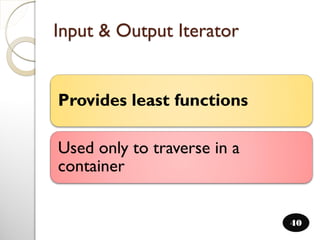
Input & Output Iterator
40
Provides least functions
Used only to traverse in a
container
Forward Iterator
41
Supports all functions of input
& output iterators
Retain its position in the container
Bi-directional Iterator
42
Supports all functions of
forward iterators
Provides ability to move in
backward direction in the container
Random – Access Iterator
43
Supports all functions of bi-
directional iterators
Has the ability to jump to any
arbirtary location
Iterators and their characteristics
Iterator Access
Method
Direction of
Movement
I/O
Capability
Input Linear Forward Read
Output Linear Forward Write
Forward Linear Forward Read/Write
Bi-
directional
Linear Forward &
Backward
Read/Write
Random
Access
Random Forward &
Backward
Read/Write
44
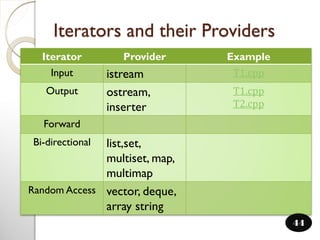
Iterators and their Providers
Iterator Provider Example
Input istream T1.cpp
Output ostream,
inserter
T1.cpp
T2.cpp
Forward
Bi-directional list,set,
multiset, map,
multimap
Random Access vector, deque,
array string
44
Operations Supported by Iterators
45
Iterator Elemen
t Access
Read Write Increme
nt
Compari
son
Input v=*p ++ ==, !=
Output *p=v ++
Forward v=*p *p=v ++ ==, !=
Bi-
direction
al
v=*p *p=v ++,-- ==, !=
Random
Access
& [ ]
v=*p *p=v ++,--,+,- ==,
!=,<,>,
<=,>=
Iterator
vector<int>
array_ 17
4
23
12
size_ 4
vector<int>::iterator
The iterator corresponding to
the class vector<int> is of
the type
vector<int>::iterator
46
Iterator
47
vector<int> v
array_ 17
4
23
12
size_ 4
v.end()
v.begin()
The member functions begin() and end() return an
iterator to the first and past the last element of a
container
Iterator
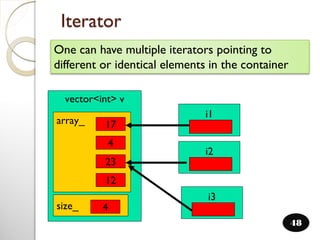
48
vector<int> v
array_ 17
4
23
12
size_ 4
i3
i1
i2
One can have multiple iterators pointing to
different or identical elements in the container
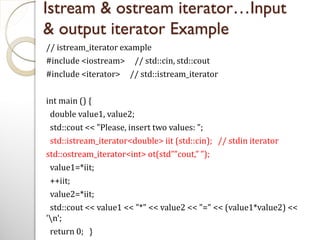
Istream & ostream iterator…Input
& output iterator Example
// istream_iterator example
#include <iostream> // std::cin, std::cout
#include <iterator> // std::istream_iterator
int main () {
double value1, value2;
std::cout << "Please, insert two values: ";
std::istream_iterator<double> iit (std::cin); // stdin iterator
std::ostream_iterator<int> ot(std””cout,” ”);
value1=*iit;
++iit;
value2=*iit;
std::cout << value1 << "*" << value2 << "=" << (value1*value2) <<
'n';
return 0; }
Inserter Example
#include <iostream> // std::cout
#include <iterator> // std::front_inserter
#include <list> // std::list
#include <algorithm> // std::copy
int main ()
{
list<int> l1, l2;
for (int i=1; i<=5; i++)
{
l1.push_back(i);
l2.push_back(i*10);
}
Inserter Example …Continued
list<int>::iterator it = l1.begin();
advance (it,3);
copy (l2.begin() , l2.end() , inserter(l1,it));
std::cout << “l1 contains:";
for ( it = l1.begin(); it!= l1.end(); ++it )
cout << ' ' << *it;
std::cout << 'n';
return 0;
}
1 2 3 10 20 30 40 50 4 5 …Output

Sppu University|BE|Computer Engineering|OOPs|unit 6 notes|ppt

  • 1.
    STANDARD TEMPLATE LIBRARY (STL) Developedby Alexander Stepanov and Meng Lee of HP in 1979. Standard template library accepted in July 1994 into C++ ANSI Standard These are called as collection of General-purpose template classes( data structures) and functions 1
  • 2.
  • 3.
    COMPONENTS OF STL Algorithm1Algorithm 2 Algorithm 3 Object1 Object2 Object3 Container Iterator 1 Iterator 2 Iterator 3 3 Algorithms use iterators to interact with objects stored in containers
  • 4.
    CONTAINER Objects that hold data(of same type) Example :Array Implemented by Template Classes 4
  • 5.
    ALGORITHM These are procedures usedto process the data contained in containers. Example : Searching, Sorting, Merging, Copying, Initializing Implemented by template functions 5
  • 6.
    ITERATOR It is anobject that points to an element in a container Used to move through the contents of container They can be incremented and decremented Connect Algorithms with Containers 6
  • 7.
  • 8.
  • 9.
  • 10.
    CATEGORIES OF CONTAINERS 10 Sequence •vector • deque • list Associative • set • multiset • map • multimap Derived • stack • queue • Priority_queue
  • 11.
    SEQUENCE CONTAINERS Stores elementsin a linear sequence Each element is related to other elements by its position along the line They allow insertion of elements 11 Element 0 Element 1 Element 2 …….. Last element Example
  • 12.
    vector list deque THREE TYPES OFSEQUENCE CONTAINERS 12
  • 13.
    Vector : SequenceContainer Expandable and dynamic array Grows and shrinks in size Insertion / Deletion of elements at back Permits direct access to any element 13
  • 14.
    Vector : SequenceContainer 14 Container Header File Iterator vector <vector> Random Access
  • 15.
    vector Sequence Container Declarations ◦ vector <type> v;  type: int, float, etc.  Iterators ◦ vector<type>::const_iterator iterVar;  const_iterator cannot modify elements ◦ vector<type>::reverse_iterator iterVar;  Visits elements in reverse order (end to beginning)  Use rbegin to get starting point  Use rend to get ending point 15
  • 16.
    vector Sequence Container vector functions ◦ v.push_back(value)  Add element to end (found in all sequence containers). ◦ v.size()  Current size of vector ◦ v.capacity()  How much vector can hold before reallocating memory  Reallocation doubles size ◦ vector<type> v(a, a + SIZE)  Creates vector v with elements from array a up to (not including) a + SIZE 16
  • 17.
    vector Sequence Container vector functions ◦ v.insert(iterator, value )  Inserts value before location of iterator ◦ v.insert(iterator, array , array + SIZE)  Inserts array elements (up to, but not including array + SIZE) into vector ◦ v.erase( iterator )  Remove element from container ◦ v.erase( iter1, iter2 )  Remove elements starting from iter1 and up to (not including) iter2 ◦ v.clear()  Erases entire container 17
  • 18.
    vector Sequence Container vector functions operations ◦ v.front(), v.back()  Return first and last element ◦ v.[elementNumber] = value;  Assign value to an element 18
  • 19.
    Vector : SequenceContainer 19 int array[5] = {12, 7, 9, 21, 13 }; vector<int> v(array,array+5); 12 7 9 21 13 v.begin(); 12 7 9 21 v.push_back(15); 12 7 9 21 15 v[3] 12 7 9 21 15 0 1 2 3 4 v.pop_back();
  • 20.
    #include <vector> #include <iostream> usingnamespace std; void main { int arr[] = {12, 7, 9, 21, 13 }; // standard C array vector<int> v(arr, arr+5); // initialize vector with C array while ( ) // until vector is empty { cout << << ” ”; // output last element of vector // delete the last element } for(i=0; i<v.size(); ++i) cout<<v[i]<<' '; cout<<endl } Vector : Sequence Container 20
  • 21.
    13 21 97 12 O/P of previous program 21 12 7 9 21 13
  • 22.
    #include <vector> #include <iostream> usingnamespace std; int main() { vector <int> vec1; vector <int>::iterator vec1_Iter; vector <int>::reverse_iterator vec1_rIter; vec1.push_back(10); vec1.push_back(7); vec1.push_back(3); Vector : Using Iterator 22
  • 23.
    cout<<"vec1 data: "; for(inti=0; i<vec1.size(); ++i) cout<<vec1[i]<<' '; cout<<endl; cout<<"nOperation: vec1.begin()n"; vec1_Iter = vec1.begin(); cout<<"The first element of vec1 is "<<*vec1_Iter<<endl; cout<<"nOperation: vec1.rbegin()n"; vec1_rIter = vec1.rbegin(); cout<<"The first element of the reversed vec1 is “; cout<<*vec1_rIter<<endl; return 0; } Vector : Using Iterator 23
  • 24.
    vec1 data: 107 3 Operation: vec1.begin() The first element of vec1 is10 Operation: vec1.rbegin() The first element of the reversed vec1 is : 3 O/P of previous program 24
  • 25.
    cout<<"Operation: vec1.rbegin() andvec1.rend()n"; cout<<"vec1 data: "; For(key = vec1.rbegin(); key != vec1.rend(); key++) cout<<*key<<' '; cout<<endl; return 0; } Vector : Using Iterator 26
  • 26.
    Operation: vec1.begin() andvec1.rend() vec1 data: 1 4 3 7 O/P of previous program 27
  • 27.
    deque : SequenceContainer Double ended Queue Insertion / Deletion of elements both ends Permits direct access to any element 28
  • 28.
    deque : SequenceContainer 29 Container Header File Iterator deque <deque> Random Access
  • 29.
    #include <iostream> #include <deque> usingnamespace std; int main () { deque<int> mydeque; mydeque.push_back (100); mydeque.push_back (200); mydeque.push_back (300); cout << "nThe final size of mydeque is " cout<<<< mydeque.size() << “n”; Deque 30
  • 30.
    cout << "Poppingout the elements in mydeque:"; while (!mydeque.empty()) { cout << mydeque.front(); mydeque.pop_front(); } cout << "nThe final size of mydeque is " cout<<<< mydeque.size() << “n”; return 0; } Deque 31
  • 31.
    The final sizeof mydeque is : 3 Popping out the elements in mydeque: The final size of mydeque is : 0 O/P of previous program 32 100 200 300
  • 32.
    list : SequenceContainer Bidirectional Insertion / Deletion of elements anywhwere 33
  • 33.
    list : SequenceContainer 34 Container Header File Iterator list <list> Bidirectional
  • 34.
    List 35 #include <iostream.h> #include <list> voidprint(list <char> ); main() { list <char> l; list <char>::iterator p; l.push_back('o'); l.push_back('a'); l.push_back('t'); p=l.begin();
  • 35.
    List 36 cout <<" "<<*p<<endl; // p refers to the 'o' in ('o', 'a', 't') print(l); l.insert(p, 'c'); // l is now ('c', 'o', 'a', 't') and p still refers to 'o‘ cout <<" "<< *p<<endl; print(l); l.erase(p); cout <<" "<< *p<<endl; // p refers to an 'o' but it is not in l! print(l);
  • 36.
    l.erase(l.begin()); //removes frontof l print(l); } void print( list<char> a) { for(list<char>::iterator ai=a.begin(); ai!=a.end(); ++ai) cout << *ai << " "; cout << endl; cout << "----------------"<<endl; } 37
  • 37.
    O/P of previousprogram 38 o o a t o c o a t null c a t a t
  • 38.
    Comparison of sequencecontainers 39 Container Random Access Insertion Deletion in middle Insertion or Deletion at the ends vector Fast Slow Fast at Back deque Fast Slow Fast at both ends list Slow Fast Fast at front
  • 39.
    ASSOCIATIVE CONTAINERS Non-sequential Supports directaccess to elements using keys The keys are typically numbers or strings 40
  • 40.
    set Multiset map multimap FOUR TYPES OFASSOCIATIVE CONTAINERS 41 All these store data in a structure called tree which facilitates fast searching
  • 41.
    Set & Multiset:Associative Container Stores a number of items which contain key Elements here are referenced by keys and not their positions. Example : Storing the objects of student class which are ordered alphabetically using names as keys Multiset allows duplicate items while set does not 42
  • 42.
    #include <iostream> #include <string> #include<set> using namespace std; int main() { string a[] = {"Alice", "Bob", "Carl", "Dick", "Eve", "Fred“} ; set<string> s(a, a+6); set<string>::iterator p = s.begin(); while (p != s.end()) cout << *p++ << endl; cout<<_______________________”<<endl; Set 43
  • 43.
    set<string>::size_type numberDeleted =s.erase(“Bob"); p = s.begin(); while (p != s.end()) cout << *p++ << endl; cout<<_______________________”<<endl; numberDeleted = s.erase(“William"); p = s.begin(); while (p != s.end()) cout << *p++ << endl; cout<<_______________________”<<endl; s.erase(s.begin()); p = s.begin(); while (p != s.end()) cout << *p++ << endl; cout<<_______________________”<<endl; s.erase(s.find("Carl"), s.find(“Eve")); p = s.begin(); while (p != s.end()) cout << *p++ << endl; Set 44
  • 44.
  • 45.
    O/P of previousprogram 46 Alice Bob Carl Dick Eve Fred ____________________ Alice Carl Dick Eve Fred
  • 46.
    O/P of previousprogram 47 Alice Carl Dick Eve Fred ____________________ ____________________ Carl Dick Eve Fred
  • 47.
    O/P of previousprogram 48 Fred ____________________ The set is now empty.
  • 48.
    #include <iostream> #include <string> #include<set> class Book { public : Book() { title = author = publisher = date = ""; } Book(string a) { author = a; title = publisher = date = ""; } MultiSet 49
  • 49.
    Book(string t, stringa, string p, string d) { title = t; author = a; publisher = p; date = d; } string Author() { return author; } MultiSet 50
  • 50.
    void GetInfo(string &t,string &a, string &p, string &d) { t = title; a = author; p = publisher; d = date; } private: string author; string title; string publisher; string date; }; MultiSet 51
  • 51.
    int main() { multiset<Book> b; stringa; b.insert(Book("C++ book",“ABC",“McGraw-Hill", "1998")); b.insert(Book(“Java ",“XYZ",“BB Publisher",“2001")); b.insert(Book(“Let Us C",“Kanetkar",“McGraw-Hill ", "1997")); multiset<Book>::iterator p = b.begin(); while (p != b.end()) { cout<<*p++<<endl; } }; Multiset 52
  • 52.
    O/P of previousprogram 46 C++ book ABC McGraw-Hill 1998 Java XYZ BB Publisher 2001 Let Us C Kanetkar McGraw-Hill 1997
  • 53.
    Map & Multimap:Associative Container Stores pair of items, one called key and other value Manipulate the values using the keys associated with them Values are called as mapped values Multimap allows multiple keys while map does not 24
  • 54.
    16 Map 71 #include <map> #include <algorithm> #include<iostream> #include <string> int main() { map<string,int> amap; amap[”First”]=1; amap[“Second”]=2; cout << "Size : " << amap.size() << endl; amap["Third"]=3; amap[”Fourth"]=4; cout << "Size : " << amap.size() << endl;
  • 55.
    17 Map 71 map<string,int>::iterator it; for (it=amap.begin(); it!=amap.end(); it++) cout << "map : " << it->first << " " << it->second << endl; cout << amap.find("Third")->second << endl; return 0; }
  • 56.
    stack queue priority_queue THREE TYPES OFDERIVED CONTAINERS 25 These are known as container adaptors
  • 57.
    #include <stack> #include <queue> usingnamespace std; int main() { // STL Stack stack<int, vector<int> > S; // Changing default container for ( int i=0 ; i<10; i++ ) S.push(i); for ( int i=0 ; i<10; i++ ) { cout << S.top() << " "; S.top() = 2 * S.top(); cout << S.top() << endl; S.pop(); } Stack, Queue, Priority_Queue
  • 58.
    // STL Queue queue<int>Q; for ( int i=0 ; i<10; i++ ) Q.push(i); for ( int i=0 ; i<10; i++ ) { cout << Q.front() << endl; Q.pop(); }
  • 59.
    // STL PriorityQueue priority_queue<int> P; for ( int i=0 ; i<10; i++ ) P.push(i); for ( int i=0 ; i<10; i++ ) { cout << P.top() << endl; P.pop(); } }
  • 60.
    Stack , Queue, Priority_Queue : Derived Containers Can be created from different sequence containers These do not support Iterators Therefore cannot be used for data manipulation Support two member functions : push( ) and pop( ) 26
  • 61.
  • 62.
    2.ALGORITMS Generic functions thathandle common tasks such as searching, sorting, comparing, and editing More than 60 Algortihms exist These are not member functions or friends of containers but are standalone template functions To use them we include<algorithm> in the program 28
  • 63.
  • 64.
    Operations Description search() Searchesdesired element from the sequence count() Count appearances of value in range count_if Return number of elements in range satisfying condition equal() Test whether the elements in two ranges are equal find() Find position of desired element Non-Mutating Algorithms 30
  • 65.
    Non-Mutating Algorithms 31 Operations Description find_endFind last subsequence in range find_first_of() Find element from set in range find_if() Find element in range for_each() Apply function to range mismatch() Return first position where two ranges differ
  • 66.
    Operations Description copy() Copysequence of elements copy_backward( ) Copy range of elements backward swap( ) Exchange values of two objects fill() Fill range with value generate ( ) Generate values for range with function reverse() Reverse the given sequence remove() Remove value from sequence Mutating Algorithms 30
  • 67.
    Operations Description unique() Removeconsecutive duplicates in range random_shuffle() Randomly rearrange elements Mutating Algorithms 30
  • 68.
    Operations Description sort() Usingquick sort elements are sorted stable_sort( ) Using stable sort elements are sorted merge() Merging of two objects sort_heap( ) Sort the created heap min ( ) Finds minimum element max() Finds maximum element binary_search() Performs binary search on sorted elements Sorting Algorithms 30
  • 69.
    Algorithms #include<algorithm> #include<iostream> using namespace std; intmain() { vector<int> v; vector<int>p; v.push_back(10); v.push_back(20); v.push_back(10); p.push_back(60); v.push_back(40); v.push_back(50); swap(v,p); int * ptr = find(a,a+6,20); }
  • 70.
    Algorithms int n, value,arr[10],i; int*Limit = arr + n; cout<<“ Enter the numbers” ; for(i =0; i< n;++i) { cin>>value; arr[i] = value; } sort(arr, Limit);
  • 71.
    Algorithms cout<<“ Sorted Listis” ; for(i =0; i< n;++i) { cout<<arr[i]; cout<<endl; } return 0; }
  • 72.
    Algorithm…Searching Example find ,search , binary search / binary_search example #include <iostream> // std::cout #include <algorithm> // std::binary_search, std::sort #include <vector> // std::vector bool myfunction (int i,int j) { return (i<j); } int main () { int myints[] = {1,2,3,4,5,4,3,2,1}; int my2ints[] = {5,4,3,2}; vector<int> v(myints,myints+9); // 1 2 3 4 5 4 3 2 1 vector<int>::iterator it;
  • 73.
    Algorithm…Searching Example find ,search , binary search // using default comparison: sort (v.begin(), v.end()); it = find(v.begin(), v.end(), 3); cout<<“Item found at position “ <<(it-v.begin()); it = search (v.begin(), v.end(), my2ints, my2ints+4); cout<<“Item found at position “ <<(it-v.begin());
  • 74.
    Algorithm…Searching Example find ,search , binary search cout << "looking for a 3... "; if (binary_search (v.begin(), v.end(), 3)) cout << "found!n"; else std::cout << "not found.n"; // using myfunction as comp: sort (v.begin(), v.end(), myfunction); cout << "looking for a 6... "; if (binary_search (v.begin(), v.end(), 6, myfunction)) std::cout << "found!n"; else std::cout << "not found.n"; return 0; } Output: looking for a 3... found! looking for a 6... not found.
  • 75.
    Algorithm…Min Max Example /min max example #include <iostream> // std::cout #include <algorithm> int main () { cout<<“n min(20,10) = “ <<min(20,10); cout<<“n min(‘a’,’b) – “ <<min(‘a’,’b’); cout<<“n max(‘e’, ‘f’) = <<max(‘e’,’f’); }
  • 76.
    Algorithm…Set Union Example #include<iostream> // std::cout #include <algorithm> #include <vector> // std::vector int main () { int first[] = {5,10,15,20,25}; int second[] = {50,40,30,20,10}; vector<int> v(10); // 0 0 0 0 0 0 0 0 0 0 vector<int>::iterator it; std::sort (first,first+5); // 5 10 15 20 25 std::sort (second,second+5); // 10 20 30 40 50
  • 77.
    Algorithm…Set OperationsExample it= set_union(first, first+5, second, second+5, v.begin()); // 5 10 15 20 25 30 40 50 0 0 v.resize(it-v.begin()); // 5 10 15 20 25 30 40 50 cout << "The union has " << (v.size()) << " elements:n"; for (it=v.begin(); it!=v.end(); ++it) cout << ' ' << *it; cout << 'n'; return 0; } Output: The union has 8 elements: 5 10 15 20 25 30 40 50
  • 78.
    Algorithm…Set Intersection Example #include <iostream>// std::cout #include <algorithm> #include <vector> // std::vector int main () { int first[] = {5,10,15,20,25}; int second[] = {50,40,30,20,10}; vector<int> v(10); // 0 0 0 0 0 0 0 0 0 0 vector<int>::iterator it; std::sort (first,first+5); // 5 10 15 20 25 std::sort (second,second+5); // 10 20 30 40 50
  • 79.
    Algorithm…Set Intersection Example it= set_intersection(first, first+5, second, second+5, v.begin()); // 5 10 15 20 25 30 40 50 0 0 v.resize(it-v.begin()); // 5 10 15 20 25 30 40 50 cout << "The intersection has has " << (v.size()) << " elements:n"; for (it=v.begin(); it!=v.end(); ++it) cout << ' ' << *it; cout << 'n'; return 0; } Output: The intersection has 2 elements: {10 20}
  • 80.
    Algorithm…Set difference Example it=set_difference (first, first+5, second, second+5, v.begin()); // 5 10 15 20 25 30 40 50 0 0 v.resize(it-v.begin()); // 5 10 15 20 25 30 40 50 cout << "The intersection has has " << (v.size()) << " elements:n"; for (it=v.begin(); it!=v.end(); ++it) cout << ' ' << *it; cout << 'n'; return 0; } Output: The difference has 3 elements: {5 15 25}
  • 81.
  • 82.
    Input & OutputIterator 40 Provides least functions Used only to traverse in a container
  • 83.
    Forward Iterator 41 Supports allfunctions of input & output iterators Retain its position in the container
  • 84.
    Bi-directional Iterator 42 Supports allfunctions of forward iterators Provides ability to move in backward direction in the container
  • 85.
    Random – AccessIterator 43 Supports all functions of bi- directional iterators Has the ability to jump to any arbirtary location
  • 86.
    Iterators and theircharacteristics Iterator Access Method Direction of Movement I/O Capability Input Linear Forward Read Output Linear Forward Write Forward Linear Forward Read/Write Bi- directional Linear Forward & Backward Read/Write Random Access Random Forward & Backward Read/Write 44
  • 87.
    Iterators and theirProviders Iterator Provider Example Input istream T1.cpp Output ostream, inserter T1.cpp T2.cpp Forward Bi-directional list,set, multiset, map, multimap Random Access vector, deque, array string 44
  • 88.
    Operations Supported byIterators 45 Iterator Elemen t Access Read Write Increme nt Compari son Input v=*p ++ ==, != Output *p=v ++ Forward v=*p *p=v ++ ==, != Bi- direction al v=*p *p=v ++,-- ==, != Random Access & [ ] v=*p *p=v ++,--,+,- ==, !=,<,>, <=,>=
  • 89.
    Iterator vector<int> array_ 17 4 23 12 size_ 4 vector<int>::iterator Theiterator corresponding to the class vector<int> is of the type vector<int>::iterator 46
  • 90.
    Iterator 47 vector<int> v array_ 17 4 23 12 size_4 v.end() v.begin() The member functions begin() and end() return an iterator to the first and past the last element of a container
  • 91.
    Iterator 48 vector<int> v array_ 17 4 23 12 size_4 i3 i1 i2 One can have multiple iterators pointing to different or identical elements in the container
  • 92.
    Istream & ostreamiterator…Input & output iterator Example // istream_iterator example #include <iostream> // std::cin, std::cout #include <iterator> // std::istream_iterator int main () { double value1, value2; std::cout << "Please, insert two values: "; std::istream_iterator<double> iit (std::cin); // stdin iterator std::ostream_iterator<int> ot(std””cout,” ”); value1=*iit; ++iit; value2=*iit; std::cout << value1 << "*" << value2 << "=" << (value1*value2) << 'n'; return 0; }
  • 93.
    Inserter Example #include <iostream>// std::cout #include <iterator> // std::front_inserter #include <list> // std::list #include <algorithm> // std::copy int main () { list<int> l1, l2; for (int i=1; i<=5; i++) { l1.push_back(i); l2.push_back(i*10); }
  • 94.
    Inserter Example …Continued list<int>::iteratorit = l1.begin(); advance (it,3); copy (l2.begin() , l2.end() , inserter(l1,it)); std::cout << “l1 contains:"; for ( it = l1.begin(); it!= l1.end(); ++it ) cout << ' ' << *it; std::cout << 'n'; return 0; } 1 2 3 10 20 30 40 50 4 5 …Output