Implementing ERP Solution?
Effective Management for a successful implementation
Mario Navarro
mnavarro.tsi@gmail.com 1/23
Esquema Estratégico de
Implementación ERP
2017
Purpose
The purpose of this document is to present an approach for the
implementation of an ERP based in SAP System, presenting the main areas that
compose it and the key aspects to assure a proper direction and management
of a project of this nature.
Despite this document is focused in the implementation of SAP as the ERP
solution, this might be useful as a guide for project direction purposes for any
other ERP solution as this probably has some small variance in terms of
management, process and structure.
2/23
DATA PREPARATION
SAP SOLUTION
CHANGE MANAGEMENT
TECHNOLOGY
SUPPORT
PROJECT DIRECTION / PMO
LEGACY SYSTEMS
Implementation Framework
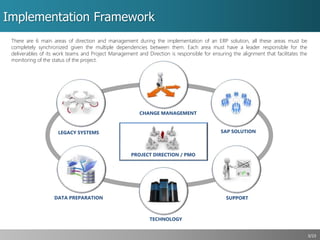
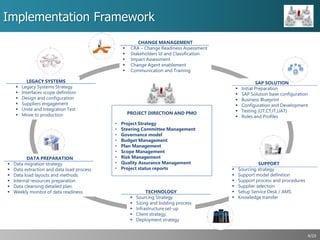
There are 6 main areas of direction and management during the implementation of an ERP solution, all these areas must be
completely synchronized given the multiple dependencies between them. Each area must have a leader responsible for the
deliverables of its work teams and Project Management and Direction is responsible for ensuring the alignment that facilitates the
monitoring of the status of the project.
3/23
LEGACY SYSTEMS
 Legacy Systems Strategy
 Interfaces scope definition
 Design and configuration
 Suppliers engagement
 Unite and Integration Test
 Move to production
DATA PREPARATION
 Data migration strategy
 Data extraction and data load process
 Data load layouts and methods
 Internal resources preparation
 Data cleansing detailed plan.
 Weekly monitor of data readiness
CHANGE MANAGEMENT
 CRA – Change Readiness Assessment
 Stakeholders Id and Classification
 Impact Assessment
 Change Agent enablement
 Communication and Training
TECHNOLOGY
 Sourcing Strategy
 Sizing and bidding process
 Infrastructure set-up
 Client strategy
 Deployment strategy
SUPPORT
 Sourcing strategy
 Support model definition
 Support process and procedures
 Supplier selection
 Setup Service Desk / AMS
 Knowledge transfer
PROJECT DIRECTION AND PMO
• Project Strategy
• Steering Committee Management
• Governance model
• Budget Management
• Plan Management
• Scope Management
• Risk Management
• Quality Assurance Management
• Project status reports
SAP SOLUTION
 Initial Preparation
 SAP Solution base configuration
 Business Blueprint
 Configuration and Development
 Testing (UT,CT,IT,UAT)
 Roles and Profiles
Implementation Framework
4/23
Project Direction and PMO
Project
Direction
Project
Methodology
Work plans
Management
Scope
Management
Budget
Management
Risk
Management
Quality
Management
- Project Methodology alignment
- Understanding Sessions
- Governance Model
- Standard formats and documentation
- Status Reports agreements
- Meeting frequency definition
- Roles and responsibilities description
- Project Roadmap development
- Integrated Work plans
- Metrics definition
- Key milestones identification
- Deliverables list
- Final scope agreement
- Agreement list
- Change Control process definition
- Escalation process
- Change Control Formats
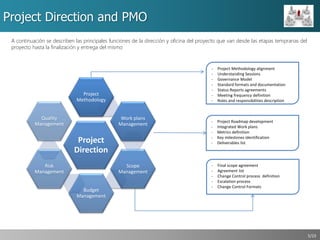
A continuación se describen las principales funciones de la dirección y oficina del proyecto que van desde las etapas tempranas del
proyecto hasta la finalización y entrega del mismo
5/23
Project Direction and PMO
- Business case revision
- Financial analysis revision
- Budget process understanding.
- Supplier quotations and invoicing
- Budget control definition
- Risk List
- Impact probability analysis
- Responsibilities
- Mitigation actions
- Risk evaluation method definition
- Risk List update process
- Quality plan development
- Exist criteria definition
- Acceptance criteria definition
- Quality metrics definition
- Deliverables quality evaluation
Project
Direction
Project
Methodology
Work plans
Management
Scope
Management
Budget
Management
Risk
Management
Quality
Management
6/23
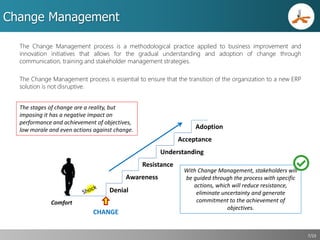
Change Management
The Change Management process is a methodological practice applied to business improvement and
innovation initiatives that allows for the gradual understanding and adoption of change through
communication, training and stakeholder management strategies.
The Change Management process is essential to ensure that the transition of the organization to a new ERP
solution is not disruptive.
Denial
Awareness
Resistance
Understanding
Acceptance
Adoption
Comfort
CHANGE
The stages of change are a reality, but
imposing it has a negative impact on
performance and achievement of objectives,
low morale and even actions against change.
With Change Management, stakeholders will
be guided through the process with specific
actions, which will reduce resistance,
eliminate uncertainty and generate
commitment to the achievement of
objectives.
7/23
Change Management
Change Management contemplates 3 management dimensions that must be considered for a proper
adoption of the new ERP solution that should be completely aligned to the integral project plan.
 Stakeholder identification
 Change Agents Identification
and Enablement
 Stakeholder action plan
definition
 Follow-up Risks and Issues
 Implement mitigation actions
 CRA Surveys preparation.
 Communication assessment
 Communication strategy
 Key message identification per
phase
 Communication campaign
implementation
 Media definition
 Execute plan
 Roles and profiles definition
based on user list
 Segregation of Duties
 Identification of training
audience
 Training logistics definition
 Train the trainers
 Training agenda and attendance
management
 Training Manuals
Communication
Stakeholder
Management
Training
8/23
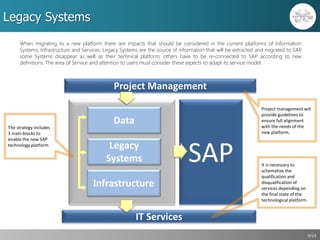
Legacy Systems
Legacy
Systems
Data
Infrastructure
Project Management
IT Services
SAP
The strategy includes
3 main blocks to
enable the new SAP
technology platform
It is necessary to
schematize the
qualification and
disqualification of
services depending on
the final state of the
technological platform.
Project management will
provide guidelines to
ensure full alignment
with the needs of the
new platform.
When migrating to a new platform there are impacts that should be considered in the current platforms of Information
Systems, Infrastructure and Services. Legacy Systems are the source of information that will be extracted and migrated to SAP,
some Systems disappear as well as their technical platform, others have to be re-connected to SAP according to new
definitions. The area of Service and attention to users must consider these aspects to adapt its service model.
9/23
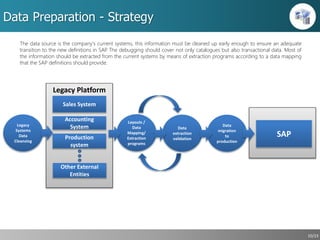
Data Preparation - Strategy
Layouts /
Data
Mapping/
Extraction
programs
Legacy Platform
Sales System
Accounting
SystemLegacy
Systems
Data
Cleansing
Data
extraction
validation
Data
migration
to
production
SAPProduction
system
The data source is the company's current systems, this information must be cleaned up early enough to ensure an adequate
transition to the new definitions in SAP. The debugging should cover not only catalogues but also transactional data. Most of
the information should be extracted from the current systems by means of extraction programs according to a data mapping
that the SAP definitions should provide.
Other External
Entities
10/23
Data Preparation - Approach
DEFINITION PLAN EXECUTION TESTS
Develop the data
preparation
strategy
• Cleanse
• Creation
• Quality Assurance
• Extraction Rules
• Conversion &
Transformation
rules
•Tests
• Migration
• Metrics and
Resources
Develop detail plan.
Detailed activities
within the plan
should be fully
aligned to the
Project Plan.
Dependencies
should be very well
identified with other
Teams activities and
across Project
stages.
Execute activities as
planned.
Follow-up and
report status in the
established
frequency..
• % of cleanse
• % of Conversion
and transformation
• Layouts definition
• Data Mapping
• Extraction
programs
• Data Load
Sequence definition
Execute data tests
(Extraction,
transformation and
Load)
Align data
preparation for
Integral Test
Evaluate results
and correct data,
programs, process.
Execute migration
to live environment,
data extraction,
transformation and
load)
Evaluate data
quality before and
after data load.
Update data on live
environment
according business
rules.
MIGRATION
It is necessary to establish a Data Preparation Plan that is fully aligned with the timelines established in the
overall project plan and to be able to determine the key dependencies.
11/23
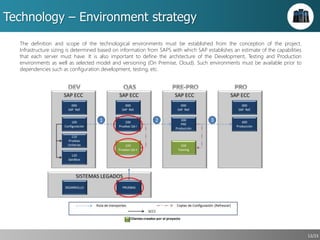
Technology – Environment strategy
The definition and scope of the technological environments must be established from the conception of the project.
Infrastructure sizing is determined based on information from SAPS with which SAP establishes an estimate of the capabilities
that each server must have. It is also important to define the architecture of the Development, Testing and Production
environments as well as selected model and versioning (On Premise, Cloud). Such environments must be available prior to
dependencies such as configuration development, testing, etc.
12/23
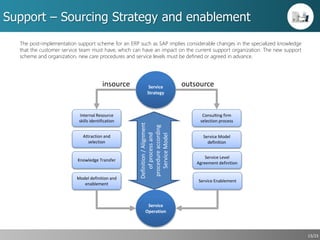
Support – Sourcing Strategy and enablement
The post-implementation support scheme for an ERP such as SAP implies considerable changes in the specialized knowledge
that the customer service team must have, which can have an impact on the current support organization. The new support
scheme and organization, new care procedures and service levels must be defined or agreed in advance.
Service
Strategy
Internal Resource
skills identification
Attraction and
selection
Knowledge Transfer
Model definition and
enablement
Consulting firm
selection process
Service Model
definition
Service Enablement
Service
Operation
Definition/Alignment
ofprocessand
procedureaccording
ServiceModel
Service Level
Agreement definition
insource outsource
13/23
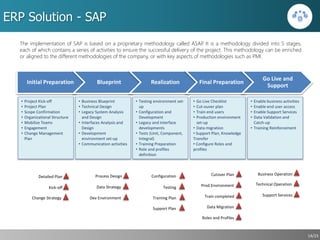
ERP Solution - SAP
The implementation of SAP is based on a proprietary methodology called ASAP. It is a methodology divided into 5 stages,
each of which contains a series of activities to ensure the successful delivery of the project. This methodology can be enriched
or aligned to the different methodologies of the company, or with key aspects of methodologies such as PMI.
• Project Kick-off
• Project Plan
• Scope Confirmation
• Organizational Structure
• Mobilize Teams
• Engagement
• Change Management
Plan
• Business Blueprint
• Technical Design
• Legacy System Analysis
and Design
• Interfaces Analysis and
Design
• Development
environment set-up
• Communication activities
• Testing environment set-
up
• Configuration and
Development
• Legacy and interface
developments
• Tests (Unit, Component,
Integral)
• Training Preparation
• Role and profiles
definition
• Go Live Checklist
• Cut-ouver plan
• Train end users
• Production environment
set-up
• Data migration
• Support Plan, Knowledge
Transfer
• Configure Roles and
profiles
• Enable business activities
• Enable end user access
• Enable Support Services
• Data Validation and
Catch-up
• Training Reinforcement
Initial Preparation Blueprint Realization Final Preparation
Go Live and
Support
Detailed Plan
Kick-off
Process Design
Data Strategy
Dev Environment
Configuration
Testing
Training Plan
Support Plan
Change Strategy
Cutover Plan
Prod Environment
Train completed
Data Migration
Roles and Profiles
Business Operation
Technical Operation
Support Services
14/23
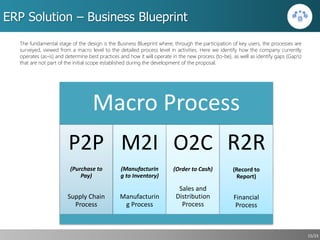
ERP Solution – Business Blueprint
Macro Process
P2P
(Purchase to
Pay)
Supply Chain
Process
M2I
(Manufacturin
g to Inventory)
Manufacturin
g Process
O2C
(Order to Cash)
Sales and
Distribution
Process
R2R
(Record to
Report)
Financial
Process
The fundamental stage of the design is the Business Blueprint where, through the participation of key users, the processes are
surveyed, viewed from a macro level to the detailed process level in activities. Here we identify how the company currently
operates (as-is) and determine best practices and how it will operate in the new process (to-be), as well as identify gaps (Gap's)
that are not part of the initial scope established during the development of the proposal.
15/23
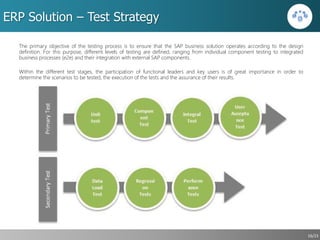
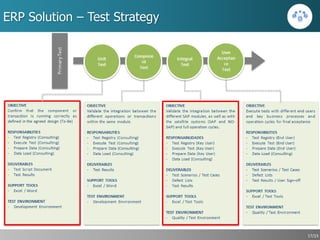
ERP Solution – Test Strategy
The primary objective of the testing process is to ensure that the SAP business solution operates according to the design
definition. For this purpose, different levels of testing are defined, ranging from individual component testing to integrated
business processes (e2e) and their integration with external SAP components.
Within the different test stages, the participation of functional leaders and key users is of great importance in order to
determine the scenarios to be tested, the execution of the tests and the assurance of their results.
16/23
ERP Solution – Test Strategy
17/23
ERP Solution – Cutover Strategy
ENABLE TECHNICAL ENVIROMENT
• Enable Infrastructure
• Enable SAP application and services
• Enable backup systems
• Transport Configuration to production
• SAP Components configuration (Integration components, etc.)
• Create Roles and profiles, create users
• Enable integration component SAP and NON-SAP (Jobs, etc.)
• Enable user access to SAP – Update Laptops/PCs
ENABLE BUSINESS ENVIRONMENT
• Enable data configuration
• Activate Freeze periods.
• Communicate to Internal and External stakeholders
• Train the users
• Enable new process, procedures and policies.
• Migrate Master data
• Migrate transactional data
• Data Quality validation and approval.
Infrastructure
Basis
Developers
Project Management
Consultants
Change Management
Track Leaders
Functional Leaders
Module Leaders
Key Users
Training Team
TEAMS
Process and IT Teams
The Cutover process or migration plan is the execution of the activities necessary for a successful transition of the business
operations from the current platforms to the new SAP platform.
The migration process includes 2 main and interdependent aspects that are the enabling of the technical components
(Technical Cutover) and the business components (Business Cutover).
18/23
M1 M2 M3 M4 M5 M6 M7 M8 M9 M10 M11 M12
Project
Initiation
Solution Design AS-IS / TO-BE
Business Blueprint
Build / Configuration
ERP
Unit Test Integral Test UAT
LEGAYSYS
Analysis Design Build
Unit Test
DATA
Data
Strategy
Data Cleaning
Data Preparation
TECHNOLOGYSUPPORTCHANGE
CRA
COMM Plan
Training
Strategy
TST DATA MIGRATION
Training
Plan
Communication Plan Execution
Roles & Profiles
DEV Environment QAS Environment PRD Environment
Legacy Dev environment Legacy Test Environment Legacy environment
Support
Strategy
Knowledge Transfer
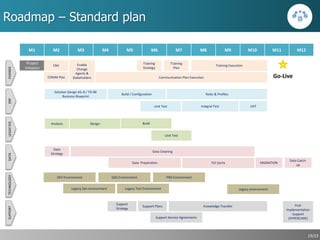
Roadmap – Standard plan
Support Plans
Support Service Agreements
Go-Live
Post
Implementation
Support
(HYPERCARE)
Data Catch-
up
Training ExecutionEnable
Change
Agents &
Stakeholders
19/23
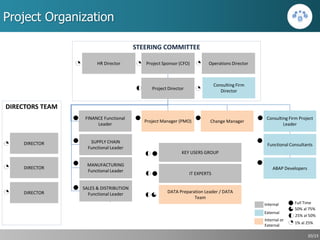
Project Organization
STEERING COMMITTEE
Project Sponsor (CFO)HR Director Operations Director
Project Director
FINANCE Functional
Leader
Project Manager (PMO)
Consulting Firm Project
Leader
Functional Consultants
Change Manager
ABAP Developers
SUPPLY CHAIN
Functional Leader
MANUFACTURING
Functional Leader
SALES & DISTRIBUTION
Functional Leader
DIRECTORS TEAM
DIRECTOR
DIRECTOR
DIRECTOR DATA Preparation Leader / DATA
Team
KEY USERS GROUP
IT EXPERTS
Full Time
50% al 75%
25% al 50%
1% al 25%
Internal
External
Internal or
External
Consulting Firm
Director
20/23
Key Constraints
Given the nature of the implementation of an ERP solution such as SAP it is important to highlight some of the main points of
complexity which are naturally identified during the initial risk analysis and can be addressed with different mitigation activities. The
main points of complexity are:
• Key Users participation
The participation of key users is not limited to the definition of the solution design, their participation highly increase during the
testing stages that occur in parallel with other 3 key stages, data preparation, training as well as the Cutover plan or final migration.
Having the ability to balance the users participation is fundamental for success.
• Data Preparation
Data preparation involves a major coordination effort as it involves both consultants and key users to assure a proper definition of
data cleansing, extraction and transformation rules. Likewise, the definition of the data load layouts and the understanding of how to
fill them by the consultants must be done with sufficient anticipation so that the users can have the adequate time to complete this
stage in time.
• Integration Test
The fundamental part of a successful comprehensive test lies in 2 main components, a correct definition of the Test Scenarios that are
the responsibility of the key users supported by consultants expertise and the preparation of test data. These 2 topics should be very
well explained by the consultant and well understood by the key users who will develop the scenarios and define their test set.
21/23
Key Constraints
• Roles and Profiles
The definition of roles and profiles is a task that requires the involvement of Managers of various functions as it establishes Who and
What is accessed from SAP in order to ensure segregation of duties. This task must be duly explained by the consultancy and
coordinated by the Change Management team.
• Cutover plan
For the final definition of the migration plan, many definition meetings must take place with the business areas where the migration
rules are established for both master data and transactional data, the latter being where the greatest complexity lies. It is important
to note that not all movements necessarily have to be migrated, history is not migrated and only balances are migrated normally.
Also here is defined the period of "freeze" where the business is left without operation under the system for a few days (depending
on the complexity).
• User Training
The training itself is not complex, the creation of manuals is where there is a real complication, since in order to elaborate the
manuals it is required that the solution is already in tests in order to take the screens for their development. This makes it especially
complex since it is not normally a deliverable of the consultancy and it is not possible to do it internally given the little knowledge of
the solution, a middle point has to be negotiated between the consultancy and the internal team looking for the internal team to be
supported by personnel dedicated to this issue.
22/23
Thank you
23/23
Get in touch for free advice.!
Mario Navarro
mnavarro.tsi@gmail.com
Linkedin : Mario Navarro

Effective management to implement ERP-SAP

  • 1.
    Implementing ERP Solution? EffectiveManagement for a successful implementation Mario Navarro mnavarro.tsi@gmail.com 1/23
  • 2.
    Esquema Estratégico de ImplementaciónERP 2017 Purpose The purpose of this document is to present an approach for the implementation of an ERP based in SAP System, presenting the main areas that compose it and the key aspects to assure a proper direction and management of a project of this nature. Despite this document is focused in the implementation of SAP as the ERP solution, this might be useful as a guide for project direction purposes for any other ERP solution as this probably has some small variance in terms of management, process and structure. 2/23
  • 3.
    DATA PREPARATION SAP SOLUTION CHANGEMANAGEMENT TECHNOLOGY SUPPORT PROJECT DIRECTION / PMO LEGACY SYSTEMS Implementation Framework There are 6 main areas of direction and management during the implementation of an ERP solution, all these areas must be completely synchronized given the multiple dependencies between them. Each area must have a leader responsible for the deliverables of its work teams and Project Management and Direction is responsible for ensuring the alignment that facilitates the monitoring of the status of the project. 3/23
  • 4.
    LEGACY SYSTEMS  LegacySystems Strategy  Interfaces scope definition  Design and configuration  Suppliers engagement  Unite and Integration Test  Move to production DATA PREPARATION  Data migration strategy  Data extraction and data load process  Data load layouts and methods  Internal resources preparation  Data cleansing detailed plan.  Weekly monitor of data readiness CHANGE MANAGEMENT  CRA – Change Readiness Assessment  Stakeholders Id and Classification  Impact Assessment  Change Agent enablement  Communication and Training TECHNOLOGY  Sourcing Strategy  Sizing and bidding process  Infrastructure set-up  Client strategy  Deployment strategy SUPPORT  Sourcing strategy  Support model definition  Support process and procedures  Supplier selection  Setup Service Desk / AMS  Knowledge transfer PROJECT DIRECTION AND PMO • Project Strategy • Steering Committee Management • Governance model • Budget Management • Plan Management • Scope Management • Risk Management • Quality Assurance Management • Project status reports SAP SOLUTION  Initial Preparation  SAP Solution base configuration  Business Blueprint  Configuration and Development  Testing (UT,CT,IT,UAT)  Roles and Profiles Implementation Framework 4/23
  • 5.
    Project Direction andPMO Project Direction Project Methodology Work plans Management Scope Management Budget Management Risk Management Quality Management - Project Methodology alignment - Understanding Sessions - Governance Model - Standard formats and documentation - Status Reports agreements - Meeting frequency definition - Roles and responsibilities description - Project Roadmap development - Integrated Work plans - Metrics definition - Key milestones identification - Deliverables list - Final scope agreement - Agreement list - Change Control process definition - Escalation process - Change Control Formats A continuación se describen las principales funciones de la dirección y oficina del proyecto que van desde las etapas tempranas del proyecto hasta la finalización y entrega del mismo 5/23
  • 6.
    Project Direction andPMO - Business case revision - Financial analysis revision - Budget process understanding. - Supplier quotations and invoicing - Budget control definition - Risk List - Impact probability analysis - Responsibilities - Mitigation actions - Risk evaluation method definition - Risk List update process - Quality plan development - Exist criteria definition - Acceptance criteria definition - Quality metrics definition - Deliverables quality evaluation Project Direction Project Methodology Work plans Management Scope Management Budget Management Risk Management Quality Management 6/23
  • 7.
    Change Management The ChangeManagement process is a methodological practice applied to business improvement and innovation initiatives that allows for the gradual understanding and adoption of change through communication, training and stakeholder management strategies. The Change Management process is essential to ensure that the transition of the organization to a new ERP solution is not disruptive. Denial Awareness Resistance Understanding Acceptance Adoption Comfort CHANGE The stages of change are a reality, but imposing it has a negative impact on performance and achievement of objectives, low morale and even actions against change. With Change Management, stakeholders will be guided through the process with specific actions, which will reduce resistance, eliminate uncertainty and generate commitment to the achievement of objectives. 7/23
  • 8.
    Change Management Change Managementcontemplates 3 management dimensions that must be considered for a proper adoption of the new ERP solution that should be completely aligned to the integral project plan.  Stakeholder identification  Change Agents Identification and Enablement  Stakeholder action plan definition  Follow-up Risks and Issues  Implement mitigation actions  CRA Surveys preparation.  Communication assessment  Communication strategy  Key message identification per phase  Communication campaign implementation  Media definition  Execute plan  Roles and profiles definition based on user list  Segregation of Duties  Identification of training audience  Training logistics definition  Train the trainers  Training agenda and attendance management  Training Manuals Communication Stakeholder Management Training 8/23
  • 9.
    Legacy Systems Legacy Systems Data Infrastructure Project Management ITServices SAP The strategy includes 3 main blocks to enable the new SAP technology platform It is necessary to schematize the qualification and disqualification of services depending on the final state of the technological platform. Project management will provide guidelines to ensure full alignment with the needs of the new platform. When migrating to a new platform there are impacts that should be considered in the current platforms of Information Systems, Infrastructure and Services. Legacy Systems are the source of information that will be extracted and migrated to SAP, some Systems disappear as well as their technical platform, others have to be re-connected to SAP according to new definitions. The area of Service and attention to users must consider these aspects to adapt its service model. 9/23
  • 10.
    Data Preparation -Strategy Layouts / Data Mapping/ Extraction programs Legacy Platform Sales System Accounting SystemLegacy Systems Data Cleansing Data extraction validation Data migration to production SAPProduction system The data source is the company's current systems, this information must be cleaned up early enough to ensure an adequate transition to the new definitions in SAP. The debugging should cover not only catalogues but also transactional data. Most of the information should be extracted from the current systems by means of extraction programs according to a data mapping that the SAP definitions should provide. Other External Entities 10/23
  • 11.
    Data Preparation -Approach DEFINITION PLAN EXECUTION TESTS Develop the data preparation strategy • Cleanse • Creation • Quality Assurance • Extraction Rules • Conversion & Transformation rules •Tests • Migration • Metrics and Resources Develop detail plan. Detailed activities within the plan should be fully aligned to the Project Plan. Dependencies should be very well identified with other Teams activities and across Project stages. Execute activities as planned. Follow-up and report status in the established frequency.. • % of cleanse • % of Conversion and transformation • Layouts definition • Data Mapping • Extraction programs • Data Load Sequence definition Execute data tests (Extraction, transformation and Load) Align data preparation for Integral Test Evaluate results and correct data, programs, process. Execute migration to live environment, data extraction, transformation and load) Evaluate data quality before and after data load. Update data on live environment according business rules. MIGRATION It is necessary to establish a Data Preparation Plan that is fully aligned with the timelines established in the overall project plan and to be able to determine the key dependencies. 11/23
  • 12.
    Technology – Environmentstrategy The definition and scope of the technological environments must be established from the conception of the project. Infrastructure sizing is determined based on information from SAPS with which SAP establishes an estimate of the capabilities that each server must have. It is also important to define the architecture of the Development, Testing and Production environments as well as selected model and versioning (On Premise, Cloud). Such environments must be available prior to dependencies such as configuration development, testing, etc. 12/23
  • 13.
    Support – SourcingStrategy and enablement The post-implementation support scheme for an ERP such as SAP implies considerable changes in the specialized knowledge that the customer service team must have, which can have an impact on the current support organization. The new support scheme and organization, new care procedures and service levels must be defined or agreed in advance. Service Strategy Internal Resource skills identification Attraction and selection Knowledge Transfer Model definition and enablement Consulting firm selection process Service Model definition Service Enablement Service Operation Definition/Alignment ofprocessand procedureaccording ServiceModel Service Level Agreement definition insource outsource 13/23
  • 14.
    ERP Solution -SAP The implementation of SAP is based on a proprietary methodology called ASAP. It is a methodology divided into 5 stages, each of which contains a series of activities to ensure the successful delivery of the project. This methodology can be enriched or aligned to the different methodologies of the company, or with key aspects of methodologies such as PMI. • Project Kick-off • Project Plan • Scope Confirmation • Organizational Structure • Mobilize Teams • Engagement • Change Management Plan • Business Blueprint • Technical Design • Legacy System Analysis and Design • Interfaces Analysis and Design • Development environment set-up • Communication activities • Testing environment set- up • Configuration and Development • Legacy and interface developments • Tests (Unit, Component, Integral) • Training Preparation • Role and profiles definition • Go Live Checklist • Cut-ouver plan • Train end users • Production environment set-up • Data migration • Support Plan, Knowledge Transfer • Configure Roles and profiles • Enable business activities • Enable end user access • Enable Support Services • Data Validation and Catch-up • Training Reinforcement Initial Preparation Blueprint Realization Final Preparation Go Live and Support Detailed Plan Kick-off Process Design Data Strategy Dev Environment Configuration Testing Training Plan Support Plan Change Strategy Cutover Plan Prod Environment Train completed Data Migration Roles and Profiles Business Operation Technical Operation Support Services 14/23
  • 15.
    ERP Solution –Business Blueprint Macro Process P2P (Purchase to Pay) Supply Chain Process M2I (Manufacturin g to Inventory) Manufacturin g Process O2C (Order to Cash) Sales and Distribution Process R2R (Record to Report) Financial Process The fundamental stage of the design is the Business Blueprint where, through the participation of key users, the processes are surveyed, viewed from a macro level to the detailed process level in activities. Here we identify how the company currently operates (as-is) and determine best practices and how it will operate in the new process (to-be), as well as identify gaps (Gap's) that are not part of the initial scope established during the development of the proposal. 15/23
  • 16.
    ERP Solution –Test Strategy The primary objective of the testing process is to ensure that the SAP business solution operates according to the design definition. For this purpose, different levels of testing are defined, ranging from individual component testing to integrated business processes (e2e) and their integration with external SAP components. Within the different test stages, the participation of functional leaders and key users is of great importance in order to determine the scenarios to be tested, the execution of the tests and the assurance of their results. 16/23
  • 17.
    ERP Solution –Test Strategy 17/23
  • 18.
    ERP Solution –Cutover Strategy ENABLE TECHNICAL ENVIROMENT • Enable Infrastructure • Enable SAP application and services • Enable backup systems • Transport Configuration to production • SAP Components configuration (Integration components, etc.) • Create Roles and profiles, create users • Enable integration component SAP and NON-SAP (Jobs, etc.) • Enable user access to SAP – Update Laptops/PCs ENABLE BUSINESS ENVIRONMENT • Enable data configuration • Activate Freeze periods. • Communicate to Internal and External stakeholders • Train the users • Enable new process, procedures and policies. • Migrate Master data • Migrate transactional data • Data Quality validation and approval. Infrastructure Basis Developers Project Management Consultants Change Management Track Leaders Functional Leaders Module Leaders Key Users Training Team TEAMS Process and IT Teams The Cutover process or migration plan is the execution of the activities necessary for a successful transition of the business operations from the current platforms to the new SAP platform. The migration process includes 2 main and interdependent aspects that are the enabling of the technical components (Technical Cutover) and the business components (Business Cutover). 18/23
  • 19.
    M1 M2 M3M4 M5 M6 M7 M8 M9 M10 M11 M12 Project Initiation Solution Design AS-IS / TO-BE Business Blueprint Build / Configuration ERP Unit Test Integral Test UAT LEGAYSYS Analysis Design Build Unit Test DATA Data Strategy Data Cleaning Data Preparation TECHNOLOGYSUPPORTCHANGE CRA COMM Plan Training Strategy TST DATA MIGRATION Training Plan Communication Plan Execution Roles & Profiles DEV Environment QAS Environment PRD Environment Legacy Dev environment Legacy Test Environment Legacy environment Support Strategy Knowledge Transfer Roadmap – Standard plan Support Plans Support Service Agreements Go-Live Post Implementation Support (HYPERCARE) Data Catch- up Training ExecutionEnable Change Agents & Stakeholders 19/23
  • 20.
    Project Organization STEERING COMMITTEE ProjectSponsor (CFO)HR Director Operations Director Project Director FINANCE Functional Leader Project Manager (PMO) Consulting Firm Project Leader Functional Consultants Change Manager ABAP Developers SUPPLY CHAIN Functional Leader MANUFACTURING Functional Leader SALES & DISTRIBUTION Functional Leader DIRECTORS TEAM DIRECTOR DIRECTOR DIRECTOR DATA Preparation Leader / DATA Team KEY USERS GROUP IT EXPERTS Full Time 50% al 75% 25% al 50% 1% al 25% Internal External Internal or External Consulting Firm Director 20/23
  • 21.
    Key Constraints Given thenature of the implementation of an ERP solution such as SAP it is important to highlight some of the main points of complexity which are naturally identified during the initial risk analysis and can be addressed with different mitigation activities. The main points of complexity are: • Key Users participation The participation of key users is not limited to the definition of the solution design, their participation highly increase during the testing stages that occur in parallel with other 3 key stages, data preparation, training as well as the Cutover plan or final migration. Having the ability to balance the users participation is fundamental for success. • Data Preparation Data preparation involves a major coordination effort as it involves both consultants and key users to assure a proper definition of data cleansing, extraction and transformation rules. Likewise, the definition of the data load layouts and the understanding of how to fill them by the consultants must be done with sufficient anticipation so that the users can have the adequate time to complete this stage in time. • Integration Test The fundamental part of a successful comprehensive test lies in 2 main components, a correct definition of the Test Scenarios that are the responsibility of the key users supported by consultants expertise and the preparation of test data. These 2 topics should be very well explained by the consultant and well understood by the key users who will develop the scenarios and define their test set. 21/23
  • 22.
    Key Constraints • Rolesand Profiles The definition of roles and profiles is a task that requires the involvement of Managers of various functions as it establishes Who and What is accessed from SAP in order to ensure segregation of duties. This task must be duly explained by the consultancy and coordinated by the Change Management team. • Cutover plan For the final definition of the migration plan, many definition meetings must take place with the business areas where the migration rules are established for both master data and transactional data, the latter being where the greatest complexity lies. It is important to note that not all movements necessarily have to be migrated, history is not migrated and only balances are migrated normally. Also here is defined the period of "freeze" where the business is left without operation under the system for a few days (depending on the complexity). • User Training The training itself is not complex, the creation of manuals is where there is a real complication, since in order to elaborate the manuals it is required that the solution is already in tests in order to take the screens for their development. This makes it especially complex since it is not normally a deliverable of the consultancy and it is not possible to do it internally given the little knowledge of the solution, a middle point has to be negotiated between the consultancy and the internal team looking for the internal team to be supported by personnel dedicated to this issue. 22/23
  • 23.
    Thank you 23/23 Get intouch for free advice.! Mario Navarro mnavarro.tsi@gmail.com Linkedin : Mario Navarro