skill-mine.com
Best Practices
and Implementation
Strategies
SAP Managed Services:
Skillmine: Your Trusted Partner
for Comprehensive End-to-End SAP
ERP Solutions.
INTRODUCTION
Introduction to SAP Managed Services.
SAP Best Practices
and Implementation Strategies.
2
Introduction to
SAP Managed
Services.
3
SAP?
Why
User
friendly
Liable
Easy to
Process
Accurate &
instant
Affordable
Improve
Effectiveness
Support
all Fields
Deployed
globally
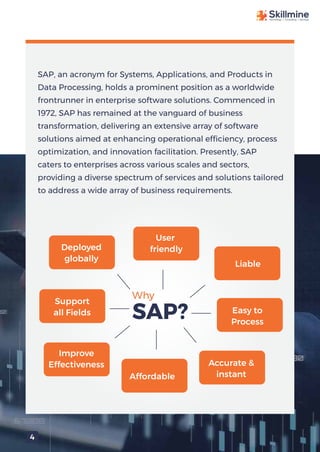
SAP, an acronym for Systems, Applications, and Products in
Data Processing, holds a prominent position as a worldwide
frontrunner in enterprise software solutions. Commenced in
1972, SAP has remained at the vanguard of business
transformation, delivering an extensive array of software
solutions aimed at enhancing operational efficiency, process
optimization, and innovation facilitation. Presently, SAP
caters to enterprises across various scales and sectors,
providing a diverse spectrum of services and solutions tailored
to address a wide array of business requirements.
4
SAP Managed Services refers to the outsourced management,
monitoring, and support of an organization's SAP environment
by a specialized service provider. As businesses increasingly
rely on SAP systems to drive their operations, manage data,
and facilitate critical processes, ensuring the seamless
operation, security, and optimization of these systems
becomes paramount.
SAP Managed Service providers offer a range of expertise,
from technical maintenance and troubleshooting to strategic
guidance, enabling companies to focus on their core activities
while entrusting the intricate management of their SAP
infrastructure to dedicated professionals. These services
encompass a broad spectrum of tasks, including system
monitoring, performance tuning, regular updates, patches,
and backups, as well as proactive issue resolution and security
management.
By leveraging the expertise of these external partners,
organizations can reduce the burden on their in-house IT
teams, access specialized knowledge, and stay current with
the rapidly evolving SAP ecosystem. This ebook will explore
the best practices and strategies for successful SAP
implementation.
5
Mastering SAP
Best Practices
through Strategic
Implementation.
6
SAP Best Practices
and Implementation Strategies
The implementation of SAP can be a challenging, costly, and
time-consuming endeavour.Many SAP implementations fail because
companies jump right in without doing the necessary planning and
research, or by putting a management team in charge who lacks
experience in SAP implementation.
To ensure success, it's crucial to get the preparation right and
assemble the right team to handle the SAP implementation.
Getting these aspects in place is vital for a successful outcome.
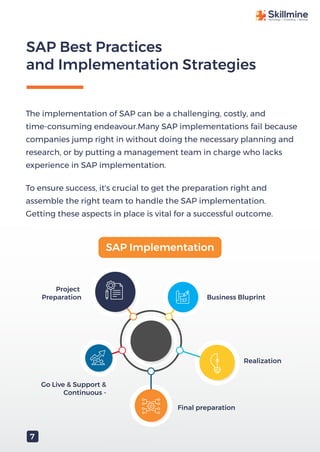
Project
Preparation Business Bluprint
Realization
Final preparation
Go Live & Support &
Continuous -
SAP Implementation
7
Here are a few best practices for successful SAP implementation.
The first step in any SAP implementation is to create a clear project
plan that outlines the project's scope, timeline, and budget. It's
crucial to involve key stakeholders in this planning process to ensure
alignment and set appropriate expectations.
Start with a well-defined project plan:
Planning Phase Recommendations:
Create a solid business case
that outlines the tangible benefits,
both in terms of business
outcomes, operational
improvements, and technology
advancements, that will result
from the transformation.
1. Develop a compelling
business case:
Each business function, such as
Sales, HR, Supply Chain,
Distribution, Finance, etc., should
produce a scope document that
identifies all the important
business scenarios for day-to-day
2. Define the program
scope clearly:
operations. It is crucial to not only
capture common scenarios but
also exceptions and how they are
currently handled. This upfront
identification of business
scenarios during the planning
phase ensures that your business
can continue running smoothly
after the transition.
Ensure that the scope and business
case include enhancements to
existing processes and the
deployment of new solutions to
address current pain points.
Consider investing in innovative
3. Incorporate enhancements
and new solutions:
8
solutions like cloud computing,
SAP HANA, etc., to enhance the
customer experience. Evaluate
your market competition and
include initiatives in the scope
that will help you stay ahead of
competitors.
The project charter should be
completed and include essential
elements such as program
governance, success criteria,
budget, timeline, and operating
structure. This document serves
as a guiding framework for the
entire program.
4. Finalize the project charter:
Select the appropriate implementation methodology:
There are various implementation methodologies available. It's
important to choose the methodology that best fits your project
goals and organizational structure.
Establish precise business requirements:
Before initiating the implementation process, it's vital to define clear
business requirements that will guide the project. This includes
identifying the necessary support for business processes within the
SAP system and any customization needs.
9
Prioritize data quality:
The success of an SAP implementation heavily relies on the quality
of data loaded into the system. Establishing a data governance
strategy is imperative to ensure data accuracy, completeness, and
consistency across the organization.
Develop a robust testing plan:
Testing plays a crucial role in any SAP implementation. It's essential to
create a comprehensive testing plan that covers unit testing, integration
testing, and User Acceptance Testing (UAT) to ensure the system's
thorough evaluation before going live.
Recommendations for Testing
During the testing kickoff, ensure
that all testers have a clear
understanding of the daily goals
that need to be achieved. Review
the tools used for logging testing
output and tracking issues with
all participants.
1. Communicate
expectations:
Log the step-by-step output of
each testing script and obtain
confirmation from subject matter
2. Thoroughly log testing
script outputs:
experts (SMEs) or business leads
that the script was completed.
All end-to-end (E2E) testing
scenarios should be signed off
by the respective process owners.
Any updates to the master data
source resulting from testing
issues should be carried out by
the data migration team and
signed off by the Data Migration
Lead. This ensures proper control
and validation of data changes.
3. Manage updates
to master data:
10
The business functional leads,
along with the Executive Sponsor,
should provide sign-off on testing
completion only when all testing
scenarios are completed and any
defects identified during testing
are resolved through re-tests
4. Obtain sign-off from
business stakeholders:
Before completing the testing,
the IT Project Manager should
ensure the establishment of a
new Quality Assurance (QA)
system. This system will be used
to perform a migration dry run,
ensuring that all aspects related
to data migration are thoroughly
tested before final implementation.
5. Set up a new QA system:
11
By following these recommendations, you can ensure a successful
testing phase and facilitate a smooth transition towards the final
implementation of the project.
To enable effective utilization of the SAP system, comprehensive
training should be provided to end-users. This training should cover
system usage as well as any introduced changes in business processes.
Provide comprehensive end-user training:
Once the SAP system is live, ongoing monitoring and maintenance
are essential to ensure its continued alignment with the organization's
needs. Regular system maintenance, performance monitoring, and
prompt issue resolution should be carried out.
Monitor and maintain the system:
12
Your Trusted Partner
for Comprehensive
End-to-End SAP ERP
Solutions.
Skillmine:
Skillmine stands as a prominent
authority in SAP consultancy and
implementation services. We
specialize in assisting
organizations of all sizes in
implementing tailored SAP
solutions to meet their unique
business needs. Our team of
seasoned consultants possesses
the expertise and knowledge
required to ensure that your SAP
implementation project is.
We offer comprehensive services
covering every aspect, from
strategy definition and design to
system installation, customization,
integration, and optimization.
Additionally, our team provides
ongoing support to ensure
seamless and efficient operation
of your SAP system.
delivered on schedule and within
budget.
13
Skillmine's SAP Integration
Impact on a Global Manufacturer.
A global manufacturing conglomerate, embarked on a transformative
journey to enhance its operational efficiency and decision-making
processes. Faced with disparate systems and data silos that hindered
agility, the company sought Skillmine’s help to implement SAP's
integrated suite of solutions.
The implementation began with a comprehensive analysis of the
company’s existing processes and requirements, followed by a
meticulous planning phase involving key stakeholders from various
departments. Customization and configuration of SAP modules were
executed to align with the company's specific needs, encompassing
finance, supply chain, human resources, and customer relationship
management.
Post-implementation, the company experienced significant
improvements. Real-time visibility into operations enabled swift
decision-making, reducing production bottlenecks and optimizing
inventory management. Employee productivity rose as manual tasks
were automated, and customer satisfaction improved due to
streamlined order processing and timely support.
In short, the SAP implementation empowered the company to unlock
operational synergies, improve resource allocation, and respond adeptly
to market dynamics.
14
CONTACT US
For more information
Contact: info@skill-mine.com
Visit us: skill-mine.com India | KSA | UK | USA
© 2023 Skillmine Technology Stay connected

SAP Managed Services Best Practices and Implementation Strategies

  • 1.
  • 2.
    Skillmine: Your TrustedPartner for Comprehensive End-to-End SAP ERP Solutions. INTRODUCTION Introduction to SAP Managed Services. SAP Best Practices and Implementation Strategies. 2
  • 3.
  • 4.
    SAP? Why User friendly Liable Easy to Process Accurate & instant Affordable Improve Effectiveness Support allFields Deployed globally SAP, an acronym for Systems, Applications, and Products in Data Processing, holds a prominent position as a worldwide frontrunner in enterprise software solutions. Commenced in 1972, SAP has remained at the vanguard of business transformation, delivering an extensive array of software solutions aimed at enhancing operational efficiency, process optimization, and innovation facilitation. Presently, SAP caters to enterprises across various scales and sectors, providing a diverse spectrum of services and solutions tailored to address a wide array of business requirements. 4
  • 5.
    SAP Managed Servicesrefers to the outsourced management, monitoring, and support of an organization's SAP environment by a specialized service provider. As businesses increasingly rely on SAP systems to drive their operations, manage data, and facilitate critical processes, ensuring the seamless operation, security, and optimization of these systems becomes paramount. SAP Managed Service providers offer a range of expertise, from technical maintenance and troubleshooting to strategic guidance, enabling companies to focus on their core activities while entrusting the intricate management of their SAP infrastructure to dedicated professionals. These services encompass a broad spectrum of tasks, including system monitoring, performance tuning, regular updates, patches, and backups, as well as proactive issue resolution and security management. By leveraging the expertise of these external partners, organizations can reduce the burden on their in-house IT teams, access specialized knowledge, and stay current with the rapidly evolving SAP ecosystem. This ebook will explore the best practices and strategies for successful SAP implementation. 5
  • 6.
    Mastering SAP Best Practices throughStrategic Implementation. 6
  • 7.
    SAP Best Practices andImplementation Strategies The implementation of SAP can be a challenging, costly, and time-consuming endeavour.Many SAP implementations fail because companies jump right in without doing the necessary planning and research, or by putting a management team in charge who lacks experience in SAP implementation. To ensure success, it's crucial to get the preparation right and assemble the right team to handle the SAP implementation. Getting these aspects in place is vital for a successful outcome. Project Preparation Business Bluprint Realization Final preparation Go Live & Support & Continuous - SAP Implementation 7
  • 8.
    Here are afew best practices for successful SAP implementation. The first step in any SAP implementation is to create a clear project plan that outlines the project's scope, timeline, and budget. It's crucial to involve key stakeholders in this planning process to ensure alignment and set appropriate expectations. Start with a well-defined project plan: Planning Phase Recommendations: Create a solid business case that outlines the tangible benefits, both in terms of business outcomes, operational improvements, and technology advancements, that will result from the transformation. 1. Develop a compelling business case: Each business function, such as Sales, HR, Supply Chain, Distribution, Finance, etc., should produce a scope document that identifies all the important business scenarios for day-to-day 2. Define the program scope clearly: operations. It is crucial to not only capture common scenarios but also exceptions and how they are currently handled. This upfront identification of business scenarios during the planning phase ensures that your business can continue running smoothly after the transition. Ensure that the scope and business case include enhancements to existing processes and the deployment of new solutions to address current pain points. Consider investing in innovative 3. Incorporate enhancements and new solutions: 8
  • 9.
    solutions like cloudcomputing, SAP HANA, etc., to enhance the customer experience. Evaluate your market competition and include initiatives in the scope that will help you stay ahead of competitors. The project charter should be completed and include essential elements such as program governance, success criteria, budget, timeline, and operating structure. This document serves as a guiding framework for the entire program. 4. Finalize the project charter: Select the appropriate implementation methodology: There are various implementation methodologies available. It's important to choose the methodology that best fits your project goals and organizational structure. Establish precise business requirements: Before initiating the implementation process, it's vital to define clear business requirements that will guide the project. This includes identifying the necessary support for business processes within the SAP system and any customization needs. 9
  • 10.
    Prioritize data quality: Thesuccess of an SAP implementation heavily relies on the quality of data loaded into the system. Establishing a data governance strategy is imperative to ensure data accuracy, completeness, and consistency across the organization. Develop a robust testing plan: Testing plays a crucial role in any SAP implementation. It's essential to create a comprehensive testing plan that covers unit testing, integration testing, and User Acceptance Testing (UAT) to ensure the system's thorough evaluation before going live. Recommendations for Testing During the testing kickoff, ensure that all testers have a clear understanding of the daily goals that need to be achieved. Review the tools used for logging testing output and tracking issues with all participants. 1. Communicate expectations: Log the step-by-step output of each testing script and obtain confirmation from subject matter 2. Thoroughly log testing script outputs: experts (SMEs) or business leads that the script was completed. All end-to-end (E2E) testing scenarios should be signed off by the respective process owners. Any updates to the master data source resulting from testing issues should be carried out by the data migration team and signed off by the Data Migration Lead. This ensures proper control and validation of data changes. 3. Manage updates to master data: 10
  • 11.
    The business functionalleads, along with the Executive Sponsor, should provide sign-off on testing completion only when all testing scenarios are completed and any defects identified during testing are resolved through re-tests 4. Obtain sign-off from business stakeholders: Before completing the testing, the IT Project Manager should ensure the establishment of a new Quality Assurance (QA) system. This system will be used to perform a migration dry run, ensuring that all aspects related to data migration are thoroughly tested before final implementation. 5. Set up a new QA system: 11
  • 12.
    By following theserecommendations, you can ensure a successful testing phase and facilitate a smooth transition towards the final implementation of the project. To enable effective utilization of the SAP system, comprehensive training should be provided to end-users. This training should cover system usage as well as any introduced changes in business processes. Provide comprehensive end-user training: Once the SAP system is live, ongoing monitoring and maintenance are essential to ensure its continued alignment with the organization's needs. Regular system maintenance, performance monitoring, and prompt issue resolution should be carried out. Monitor and maintain the system: 12
  • 13.
    Your Trusted Partner forComprehensive End-to-End SAP ERP Solutions. Skillmine: Skillmine stands as a prominent authority in SAP consultancy and implementation services. We specialize in assisting organizations of all sizes in implementing tailored SAP solutions to meet their unique business needs. Our team of seasoned consultants possesses the expertise and knowledge required to ensure that your SAP implementation project is. We offer comprehensive services covering every aspect, from strategy definition and design to system installation, customization, integration, and optimization. Additionally, our team provides ongoing support to ensure seamless and efficient operation of your SAP system. delivered on schedule and within budget. 13
  • 14.
    Skillmine's SAP Integration Impacton a Global Manufacturer. A global manufacturing conglomerate, embarked on a transformative journey to enhance its operational efficiency and decision-making processes. Faced with disparate systems and data silos that hindered agility, the company sought Skillmine’s help to implement SAP's integrated suite of solutions. The implementation began with a comprehensive analysis of the company’s existing processes and requirements, followed by a meticulous planning phase involving key stakeholders from various departments. Customization and configuration of SAP modules were executed to align with the company's specific needs, encompassing finance, supply chain, human resources, and customer relationship management. Post-implementation, the company experienced significant improvements. Real-time visibility into operations enabled swift decision-making, reducing production bottlenecks and optimizing inventory management. Employee productivity rose as manual tasks were automated, and customer satisfaction improved due to streamlined order processing and timely support. In short, the SAP implementation empowered the company to unlock operational synergies, improve resource allocation, and respond adeptly to market dynamics. 14
  • 15.
    CONTACT US For moreinformation Contact: info@skill-mine.com Visit us: skill-mine.com India | KSA | UK | USA © 2023 Skillmine Technology Stay connected