Valdo Berbert, A.Ag.Effective Leadership as a key factor for project success
Be FlexibleOil FlaskRusty Joints
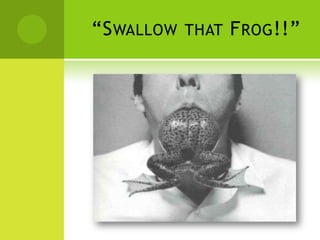
“Swallow that Frog!!”When you have to accept one situation or do something you don´t want to do......
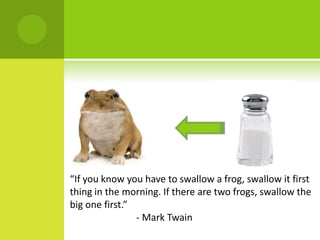
“If you know you have to swallow a frog, swallow it first thing in the morning. If there are two frogs, swallow the big one first.”		 - Mark Twain
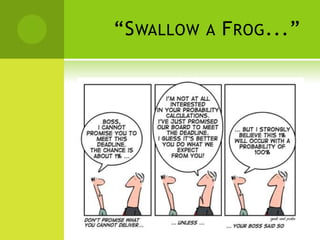
“Swallow a Frog...”
What is your opinion?Does the project manager’s leadership style influence project success?
AgendaLeadership definitionsSchools of leadership theoryProject Manager Leadership CompetencyWhat is project successLeadership StylesThe Top Leadership TraitsConclusionQuestions and Answers
Definitions “Leadership is the ability to influence a group toward the achievement of goals "                                                                                                             — S.  P. Robbins "My definition of a leader . . . is a man who can persuade people to do what they don't want to do, or do what they're too lazy to do, and like it.“                                                                                                                         — Harry S. Truman“Leadership is a process of influence. Anytime you seek to influence the thinking, behavior, or development of people in their personal or professional lives, you are taking on the role of a leader.”                                                                                                     — Ken Blanchard“Leadership is the discipline of deliberately exerting special influence within a group to move it toward goals of beneficial permanence that fulfill the group’s real needs.”                                                                                 — John Haggai
“The leader seeks to communicate his vision to his followers. He captures their attention with his optimistic intuition of possible solutions to their needs. He influences them by the dynamism of his faith. He demonstrates confidence that the challenge can be met, the need resolved, the crisis overcome.”									 John Haggai
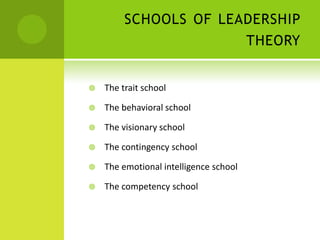
schools of leadership  theoryThe trait school The behavioral schoolThe visionary schoolThe contingency schoolThe emotional intelligence schoolThe competency school
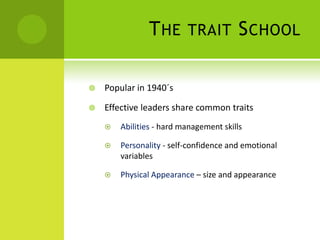
The trait SchoolPopular in 1940´sEffective leaders share common traitsAbilities - hard management skillsPersonality - self-confidence and emotional variablesPhysical Appearance – size and appearance
The behavioral schoolPopular in 1940´s and 1960´sEffective leaders display behavios or stylesProblem solvingResults orientationEnergy and initiativeSelf-confidencePerspectiveCommunicationNegotiating abilityLaissez-faire, democratic, autocratic and bureaucratic
The Contingency SchoolPopular from 1960´s to 1970´sEffective leaders depend on the situation
The Visionary SchoolPopular in 1980´s and 1990´sTwo types of leadersFocus on relationships (transformational leaders)Focus on process (transactional leaders)
The Emotional Intelligence SchoolAll managers have a reasonable level of intelligence. What distinguishes leaders is their emotional response to situationsGoleman el al. (2002) identify 19 leadership competencies grouped into 4 dimensions:Personal competenciesSelf-awarenessSelf-managementSocial competenciesSocial awarenessRelationship managementManagement styles: visionary, coaching, affinitive, democratic, pacesetting andcommanding
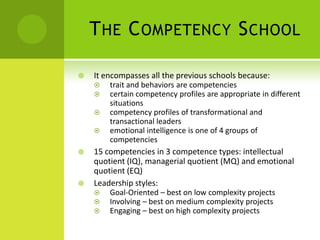
The Competency SchoolIt encompasses all the previous schools because:trait and behaviors are competenciescertain competency profiles are appropriate in different situationscompetency profiles of transformational and transactional leadersemotional intelligence is one of 4 groups of competencies15 competencies in 3 competence types: intellectual quotient (IQ), managerial quotient (MQ) and emotional quotient (EQ)Leadership styles: Goal-Oriented – best on low complexity projectsInvolving – best on medium complexity projectsEngaging – best on high complexity projects
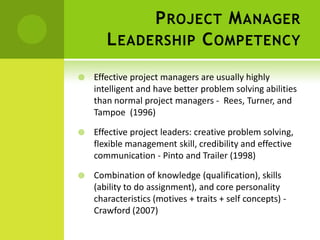
Project Manager Leadership Competency Effective project managers are usually highly intelligent and have better problem solving abilities than normal project managers -  Rees, Turner, and Tampoe  (1996)Effective project leaders: creative problem solving, flexible management skill, credibility and effective communication - Pinto and Trailer (1998) Combination of knowledge (qualification), skills (ability to do assignment), and core personality characteristics (motives + traits + self concepts) - Crawford (2007)
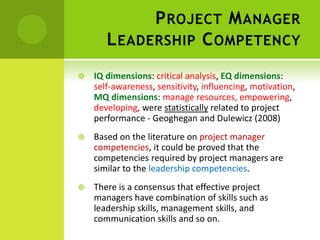
Project Manager Leadership Competency IQ dimensions: critical analysis, EQ dimensions: self-awareness, sensitivity, influencing, motivation, MQ dimensions: manage resources, empowering, developing, were statistically related to project performance - Geoghegan and Dulewicz (2008)Based on the literature onproject manager competencies, it could be proved that the competencies required by project managers are similar to the leadership competencies. There is a consensus that effective project managers have combination of skills such as leadership skills, management skills, and communication skills and so on.
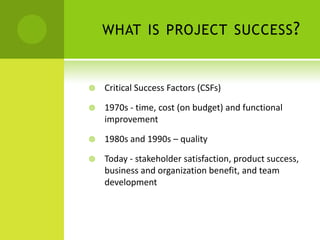
what is project success?Critical Success Factors (CSFs) 1970s - time, cost (on budget) and functional improvement1980s and 1990s – qualityToday - stakeholder satisfaction, product success, business and organization benefit, and team development
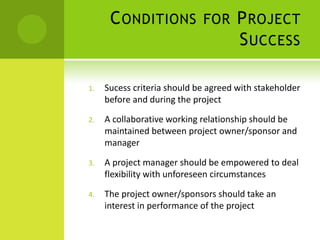
Conditions for Project SuccessSucess criteria should be agreed with stakeholder before and during the projectA collaborative working relationship should be maintained between project owner/sponsor and managerA project manager should be empowered to deal flexibility with unforeseen circumstancesThe project owner/sponsors should take an interest in performance of the project
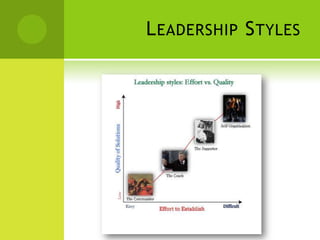
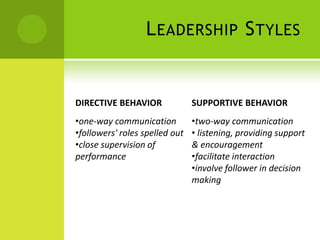
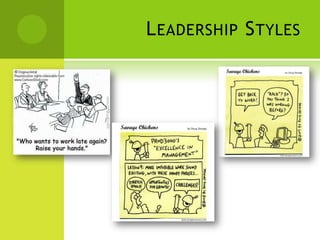
Leadership Styles
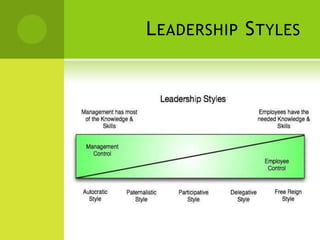
Leadership Styles
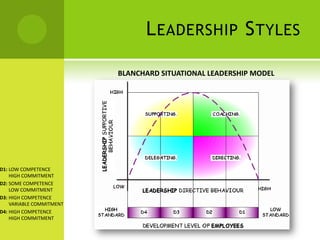
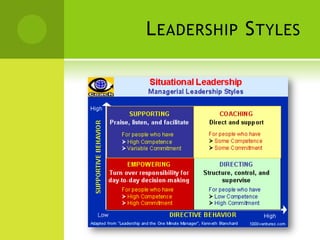
Leadership StylesBLANCHARD SITUATIONAL LEADERSHIP MODEL
Leadership Styles
Leadership Styles
Leadership Styles
Leadership Styles
Leadership Styles
The Top Leadership TraitsTrustworthiness Nobody will obey, follow, or be inspired by someone they distrust. A good reputation, likeability and respect will be absolutely impossible if you’re labeled as a liar. Regardless of their own mal-practices, people will never be able to associate with an untrustworthy character
The Top Leadership TraitsPassion and MotivationWhatever your role, people will respect the fact that you take pride in your work, you enjoy it, and that you will therefore try your hardest to succeed. 
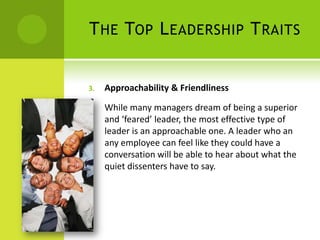
The Top Leadership TraitsApproachability & Friendliness While many managers dream of being a superior and ‘feared’ leader, the most effective type of leader is an approachable one. A leader who an any employee can feel like they could have a conversation will be able to hear about what the quiet dissenters have to say.
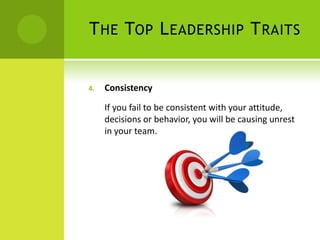
The Top Leadership TraitsConsistencyIf you fail to be consistent with your attitude, decisions or behavior, you will be causing unrest in your team.
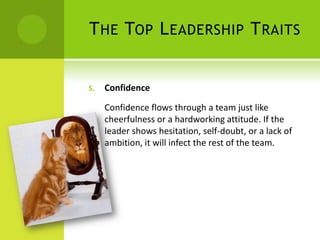
The Top Leadership TraitsConfidenceConfidence flows through a team just like cheerfulness or a hardworking attitude. If the leader shows hesitation, self-doubt, or a lack of ambition, it will infect the rest of the team.  
The Top Leadership TraitsAbility to ListenThe fantastic leaders thorough history were also good listeners. Drawing upon the expertise and ideas of all those around you will improve your decision making. It follows that leaders who listen well simply make better decisions. 
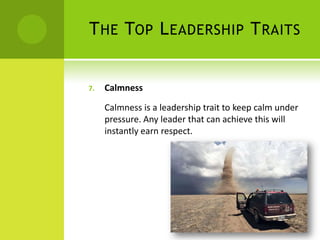
The Top Leadership TraitsCalmnessCalmness is a leadership trait to keep calm under pressure. Any leader that can achieve this will instantly earn respect.  
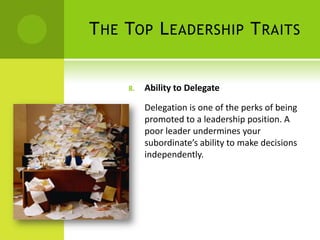
The Top Leadership TraitsAbility to Delegate Delegation is one of the perks of being promoted to a leadership position. A poor leader undermines your subordinate’s ability to make decisions independently.  
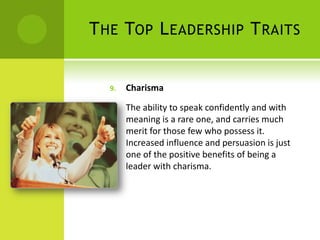
The Top Leadership TraitsCharismaThe ability to speak confidently and with meaning is a rare one, and carries much merit for those few who possess it. Increased influence and persuasion is just one of the positive benefits of being a leader with charisma.  
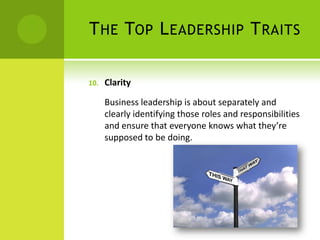
The Top Leadership TraitsClarityBusiness leadership is about separately and clearly identifying those roles and responsibilities and ensure that everyone knows what they’re supposed to be doing.
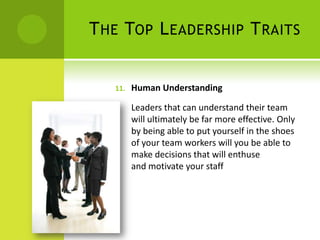
The Top Leadership TraitsHuman Understanding Leaders that can understand their team will ultimately be far more effective. Only by being able to put yourself in the shoes of your team workers will you be able to make decisions that will enthuse and motivate your staff
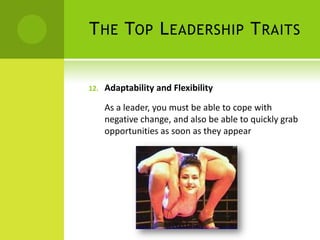
The Top Leadership TraitsAdaptability and FlexibilityAs a leader, you must be able to cope with negative change, and also be able to quickly grab opportunities as soon as they appear
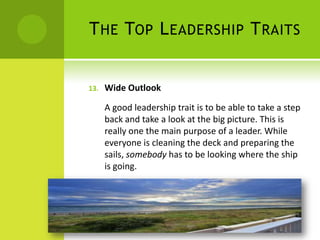
The Top Leadership TraitsWide Outlook A good leadership trait is to be able to take a step back and take a look at the big picture. This is really one the main purpose of a leader. While everyone is cleaning the deck and preparing the sails, somebody has to be looking where the ship is going.
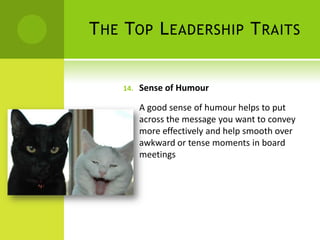
The Top Leadership TraitsSense of HumourA good sense of humour helps to put across the message you want to convey more effectively and help smooth over awkward or tense moments in board meetings 
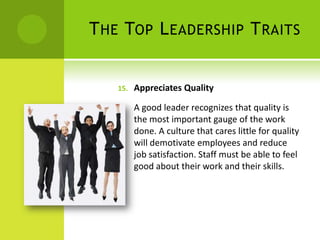
The Top Leadership TraitsAppreciates QualityA good leader recognizes that quality is the most important gauge of the work done. A culture that cares little for quality will demotivate employees and reduce job satisfaction. Staff must be able to feel good about their work and their skills. 
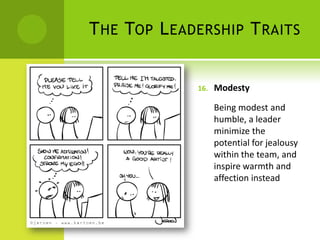
The Top Leadership TraitsModestyBeing modest and humble, a leader minimize the potential for jealousy within the team, and inspire warmth and affection instead
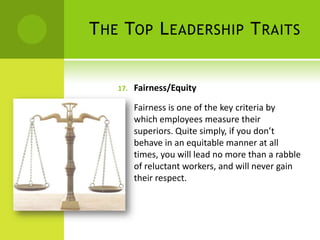
The Top Leadership TraitsFairness/EquityFairness is one of the key criteria by which employees measure their superiors. Quite simply, if you don’t behave in an equitable manner at all times, you will lead no more than a rabble of reluctant workers, and will never gain their respect.
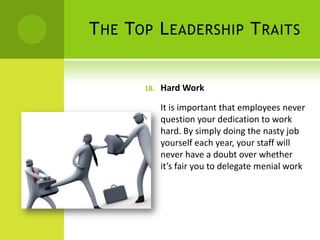
The Top Leadership TraitsHard WorkIt is important that employees never question your dedication to work hard. By simply doing the nasty job yourself each year, your staff will never have a doubt over whether it’s fair you to delegate menial work
The Top Leadership TraitsContinuous Development“There's always "one more thing" to learn! Learn from customers, competitors and partners. If you partner with someone whom you don't like, learn to like them – praise them and benefit from them. Learn to criticize your enemies openly, but honestly.”                                 — Steve Jobs
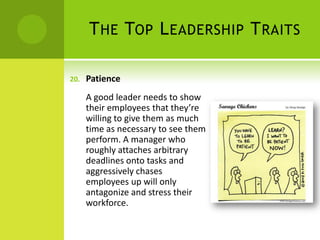
The Top Leadership TraitsPatienceA good leader needs to show their employees that they’re willing to give them as much time as necessary to see them perform. A manager who roughly attaches arbitrary deadlines onto tasks and aggressively chases employees up will only antagonize and stress their workforce. 
Conclusion
ReferencesD´Souza, A. (2003).  Developing the leader within you, 2nd edition.  Secunderabad, India: Haggai Center for Advanced Leadership Studies.  633 p.Lang, R. D. (2007). Project Leadership: Key Elements and Critical Success Factors for IT Project Managers. Journal of Healthcare Information Management, Vol. 21, No. 1. 4 p.Turner, J.R., & Müller, R. (2005). The project manager’s leadership style as a success factor on projects: a literature review. Project Management Journal, 2(36), 49-61.Zhang, W. (2009). The relationship between project manager leadership style and project success. 27 p. Retrieved January 30, 2010 from http://minds.wisconsin.edu/bitstream /handle/1793/34682/Zhang,%20Wei.pdf?sequence=1
Questions and Answers

Effective Leadership As A Key Factor For Project

  • 1.
    Valdo Berbert, A.Ag.EffectiveLeadership as a key factor for project success
  • 2.
  • 3.
    “Swallow that Frog!!”Whenyou have to accept one situation or do something you don´t want to do......
  • 4.
    “If you knowyou have to swallow a frog, swallow it first thing in the morning. If there are two frogs, swallow the big one first.” - Mark Twain
  • 5.
  • 6.
    What is youropinion?Does the project manager’s leadership style influence project success?
  • 7.
    AgendaLeadership definitionsSchools ofleadership theoryProject Manager Leadership CompetencyWhat is project successLeadership StylesThe Top Leadership TraitsConclusionQuestions and Answers
  • 8.
    Definitions “Leadership isthe ability to influence a group toward the achievement of goals " — S. P. Robbins "My definition of a leader . . . is a man who can persuade people to do what they don't want to do, or do what they're too lazy to do, and like it.“ — Harry S. Truman“Leadership is a process of influence. Anytime you seek to influence the thinking, behavior, or development of people in their personal or professional lives, you are taking on the role of a leader.” — Ken Blanchard“Leadership is the discipline of deliberately exerting special influence within a group to move it toward goals of beneficial permanence that fulfill the group’s real needs.” — John Haggai
  • 9.
    “The leader seeksto communicate his vision to his followers. He captures their attention with his optimistic intuition of possible solutions to their needs. He influences them by the dynamism of his faith. He demonstrates confidence that the challenge can be met, the need resolved, the crisis overcome.”  John Haggai
  • 12.
    schools of leadership theoryThe trait school The behavioral schoolThe visionary schoolThe contingency schoolThe emotional intelligence schoolThe competency school
  • 13.
    The trait SchoolPopularin 1940´sEffective leaders share common traitsAbilities - hard management skillsPersonality - self-confidence and emotional variablesPhysical Appearance – size and appearance
  • 14.
    The behavioral schoolPopularin 1940´s and 1960´sEffective leaders display behavios or stylesProblem solvingResults orientationEnergy and initiativeSelf-confidencePerspectiveCommunicationNegotiating abilityLaissez-faire, democratic, autocratic and bureaucratic
  • 15.
    The Contingency SchoolPopularfrom 1960´s to 1970´sEffective leaders depend on the situation
  • 16.
    The Visionary SchoolPopularin 1980´s and 1990´sTwo types of leadersFocus on relationships (transformational leaders)Focus on process (transactional leaders)
  • 17.
    The Emotional IntelligenceSchoolAll managers have a reasonable level of intelligence. What distinguishes leaders is their emotional response to situationsGoleman el al. (2002) identify 19 leadership competencies grouped into 4 dimensions:Personal competenciesSelf-awarenessSelf-managementSocial competenciesSocial awarenessRelationship managementManagement styles: visionary, coaching, affinitive, democratic, pacesetting andcommanding
  • 18.
    The Competency SchoolItencompasses all the previous schools because:trait and behaviors are competenciescertain competency profiles are appropriate in different situationscompetency profiles of transformational and transactional leadersemotional intelligence is one of 4 groups of competencies15 competencies in 3 competence types: intellectual quotient (IQ), managerial quotient (MQ) and emotional quotient (EQ)Leadership styles: Goal-Oriented – best on low complexity projectsInvolving – best on medium complexity projectsEngaging – best on high complexity projects
  • 19.
    Project Manager LeadershipCompetency Effective project managers are usually highly intelligent and have better problem solving abilities than normal project managers - Rees, Turner, and Tampoe (1996)Effective project leaders: creative problem solving, flexible management skill, credibility and effective communication - Pinto and Trailer (1998) Combination of knowledge (qualification), skills (ability to do assignment), and core personality characteristics (motives + traits + self concepts) - Crawford (2007)
  • 20.
    Project Manager LeadershipCompetency IQ dimensions: critical analysis, EQ dimensions: self-awareness, sensitivity, influencing, motivation, MQ dimensions: manage resources, empowering, developing, were statistically related to project performance - Geoghegan and Dulewicz (2008)Based on the literature onproject manager competencies, it could be proved that the competencies required by project managers are similar to the leadership competencies. There is a consensus that effective project managers have combination of skills such as leadership skills, management skills, and communication skills and so on.
  • 21.
    what is projectsuccess?Critical Success Factors (CSFs) 1970s - time, cost (on budget) and functional improvement1980s and 1990s – qualityToday - stakeholder satisfaction, product success, business and organization benefit, and team development
  • 22.
    Conditions for ProjectSuccessSucess criteria should be agreed with stakeholder before and during the projectA collaborative working relationship should be maintained between project owner/sponsor and managerA project manager should be empowered to deal flexibility with unforeseen circumstancesThe project owner/sponsors should take an interest in performance of the project
  • 23.
  • 24.
  • 25.
  • 26.
  • 27.
  • 28.
  • 29.
  • 30.
  • 32.
    The Top LeadershipTraitsTrustworthiness Nobody will obey, follow, or be inspired by someone they distrust. A good reputation, likeability and respect will be absolutely impossible if you’re labeled as a liar. Regardless of their own mal-practices, people will never be able to associate with an untrustworthy character
  • 33.
    The Top LeadershipTraitsPassion and MotivationWhatever your role, people will respect the fact that you take pride in your work, you enjoy it, and that you will therefore try your hardest to succeed. 
  • 34.
    The Top LeadershipTraitsApproachability & Friendliness While many managers dream of being a superior and ‘feared’ leader, the most effective type of leader is an approachable one. A leader who an any employee can feel like they could have a conversation will be able to hear about what the quiet dissenters have to say.
  • 35.
    The Top LeadershipTraitsConsistencyIf you fail to be consistent with your attitude, decisions or behavior, you will be causing unrest in your team.
  • 36.
    The Top LeadershipTraitsConfidenceConfidence flows through a team just like cheerfulness or a hardworking attitude. If the leader shows hesitation, self-doubt, or a lack of ambition, it will infect the rest of the team.  
  • 37.
    The Top LeadershipTraitsAbility to ListenThe fantastic leaders thorough history were also good listeners. Drawing upon the expertise and ideas of all those around you will improve your decision making. It follows that leaders who listen well simply make better decisions. 
  • 38.
    The Top LeadershipTraitsCalmnessCalmness is a leadership trait to keep calm under pressure. Any leader that can achieve this will instantly earn respect.  
  • 39.
    The Top LeadershipTraitsAbility to Delegate Delegation is one of the perks of being promoted to a leadership position. A poor leader undermines your subordinate’s ability to make decisions independently.  
  • 40.
    The Top LeadershipTraitsCharismaThe ability to speak confidently and with meaning is a rare one, and carries much merit for those few who possess it. Increased influence and persuasion is just one of the positive benefits of being a leader with charisma.  
  • 41.
    The Top LeadershipTraitsClarityBusiness leadership is about separately and clearly identifying those roles and responsibilities and ensure that everyone knows what they’re supposed to be doing.
  • 42.
    The Top LeadershipTraitsHuman Understanding Leaders that can understand their team will ultimately be far more effective. Only by being able to put yourself in the shoes of your team workers will you be able to make decisions that will enthuse and motivate your staff
  • 43.
    The Top LeadershipTraitsAdaptability and FlexibilityAs a leader, you must be able to cope with negative change, and also be able to quickly grab opportunities as soon as they appear
  • 44.
    The Top LeadershipTraitsWide Outlook A good leadership trait is to be able to take a step back and take a look at the big picture. This is really one the main purpose of a leader. While everyone is cleaning the deck and preparing the sails, somebody has to be looking where the ship is going.
  • 45.
    The Top LeadershipTraitsSense of HumourA good sense of humour helps to put across the message you want to convey more effectively and help smooth over awkward or tense moments in board meetings 
  • 46.
    The Top LeadershipTraitsAppreciates QualityA good leader recognizes that quality is the most important gauge of the work done. A culture that cares little for quality will demotivate employees and reduce job satisfaction. Staff must be able to feel good about their work and their skills. 
  • 47.
    The Top LeadershipTraitsModestyBeing modest and humble, a leader minimize the potential for jealousy within the team, and inspire warmth and affection instead
  • 48.
    The Top LeadershipTraitsFairness/EquityFairness is one of the key criteria by which employees measure their superiors. Quite simply, if you don’t behave in an equitable manner at all times, you will lead no more than a rabble of reluctant workers, and will never gain their respect.
  • 49.
    The Top LeadershipTraitsHard WorkIt is important that employees never question your dedication to work hard. By simply doing the nasty job yourself each year, your staff will never have a doubt over whether it’s fair you to delegate menial work
  • 50.
    The Top LeadershipTraitsContinuous Development“There's always "one more thing" to learn! Learn from customers, competitors and partners. If you partner with someone whom you don't like, learn to like them – praise them and benefit from them. Learn to criticize your enemies openly, but honestly.” — Steve Jobs
  • 51.
    The Top LeadershipTraitsPatienceA good leader needs to show their employees that they’re willing to give them as much time as necessary to see them perform. A manager who roughly attaches arbitrary deadlines onto tasks and aggressively chases employees up will only antagonize and stress their workforce. 
  • 52.
  • 53.
    ReferencesD´Souza, A. (2003).  Developingthe leader within you, 2nd edition.  Secunderabad, India: Haggai Center for Advanced Leadership Studies.  633 p.Lang, R. D. (2007). Project Leadership: Key Elements and Critical Success Factors for IT Project Managers. Journal of Healthcare Information Management, Vol. 21, No. 1. 4 p.Turner, J.R., & Müller, R. (2005). The project manager’s leadership style as a success factor on projects: a literature review. Project Management Journal, 2(36), 49-61.Zhang, W. (2009). The relationship between project manager leadership style and project success. 27 p. Retrieved January 30, 2010 from http://minds.wisconsin.edu/bitstream /handle/1793/34682/Zhang,%20Wei.pdf?sequence=1
  • 54.