EFFECTIVE
JAVA
Roshan Deniyage
Axiohelix Co. Ltd, Japan
21/12/2010
Design method signature carefully
Use overloading judiciously
Use varargs judiciously
Item 40: Design method signature carefully
This item describes API design hints that will help make your API easier to learn, use and
less prone to errors.
- Choose method names carefully
- Don’t go overboard in providing convenience methods
- Avoid long parameter lists
- For parameter types, favor interfaces over classes
- Prefer two-element enum types to boolean parameters
Design method signature carefully
Choose method names carefully
- Names should always obey the standard naming conventions (Item 56).
-Your primary goal should be to choose names that are understandable and
consistent with other
names in the same package.
- Your secondary goal should be to choose names consistent with the broader
consensus, where it exists.
Don’t go overboard in providing convenience methods
- Too many methods make a class difficult to learn, use, document, test, and
maintain.
- This is doubly true for interfaces, where too many methods complicate life for
implementers as well
as users
-For each action supported by your class or interface, provide a fully functional method
Avoid long parameter lists
- Aim for four parameters or fewer.
- Most programmers can’t remember longer parameter lists.
- If many of your methods exceed this limit, your API won’t be usable without constant
reference to its documentation.
- Long sequences of identically typed parameters are especially harmful.
- When they transpose parameters accidentally, their programs will still compile and run.
Method for shorting overly long parameter list
1. Break the method up into multiple methods, each of which requires only a
subset of the parameters.
(If done carelessly, this can lead to too many methods)
java.util.List Interface.
- It does not provide methods to find the first or last index of an element in a
sublist
(both of which would require three parameters)
- Instead it provides the subList method, which takes two parameters
(returns a view of a sublist)
- This method can be combined with the indexOf or lastIndexOf methods
(each of which has a single parameter)
- subList method can be combined with any method that operates on a List
instance to
perform arbitrary computations on sublists.
- The resulting API has a very high power-to-weight ratio.
Example
2. Create helper classes to hold groups of parameters
- Typically these helper classes are static member classes (Item 22).
- This technique is recommended if a frequently occurring sequence of parameters is
seen to represent some distinct entity.
3.Adapt the Builder pattern from object construction to method invocation
- If you have a method with many parameters, especially if some of them are optional.
- It can be beneficial to define an object that represents all of the parameters,
and to allow the client to make multiple “setter” calls on this object,
each of which sets a single parameter or a small, related group.
- Once the desired parameters have been set,
the client invokes the object’s “execute” method,
which does any final validity checks on the parameters and performs the actual
computation.
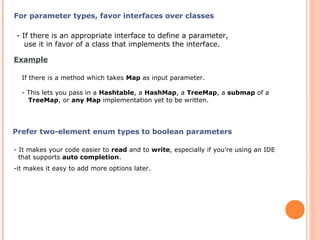
For parameter types, favor interfaces over classes
- If there is an appropriate interface to define a parameter,
use it in favor of a class that implements the interface.
Example
If there is a method which takes Map as input parameter.
- This lets you pass in a Hashtable, a HashMap, a TreeMap, a submap of a
TreeMap, or any Map implementation yet to be written.
Prefer two-element enum types to boolean parameters
- It makes your code easier to read and to write, especially if you’re using an IDE
that supports auto completion.
-it makes it easy to add more options later.
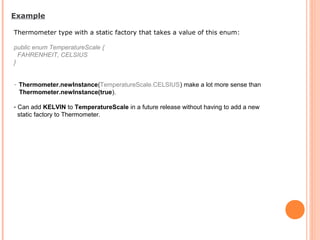
Thermometer type with a static factory that takes a value of this enum:
public enum TemperatureScale {
FAHRENHEIT, CELSIUS
}
- Thermometer.newInstance(TemperatureScale.CELSIUS) make a lot more sense than
Thermometer.newInstance(true).
- Can add KELVIN to TemperatureScale in a future release without having to add a new
static factory to Thermometer.
Example
Item 41: Use overloading judiciously
What does this program print?
public class CollectionClassifier {
public static String classify(Set<?> s) {
return "Set";
}
public static String classify(List<?> lst) {
return "List";
}
public static String classify(Collection<?> c) {
return "Unknown Collection";
}
public static void main(String[] args) {
Collection<?>[] collections = {new HashSet<String>(),
new ArrayList<BigInteger>(),
new HashMap<String, String>().values()};
for (Collection<?> c : collections)
System.out.println(classify(c));
}
}
Unknown Collection
Unknown Collection
Unknown Collection
Result output
Why does this happen?
- Because the classify method is overloaded, and the choice of which overloading to invoke is
made at compile time.
- For all three iterations of the loop, the compile-time type of the parameter is the same:
(Collection<?>)
NOTE
Selection among overloaded methods is static, while selection among overridden methods is
dynamic
- The correct version of an overridden method is chosen at runtime based on the
runtime type of the object on which the method is invoked
class Wine {
String name() { return "wine"; }
}
class SparklingWine extends Wine {
@Override String name() { return "sparkling wine"; }
}
class Champagne extends SparklingWine {
@Override String name() { return "champagne"; }
}
public class Overriding {
public static void main(String[] args) {
Wine[] wines = {new Wine(), new SparklingWine(), new Champagne()};
for (Wine wine : wines){
System.out.println(wine.name());
}
}
}
Example
wine
sparkling wine
champagne
Result output
- The best way to fix the program is to replace all three overloadings of
classify with a single method that does an explicit instanceof test
public static String classify(Collection<?> c) {
return c instanceof Set ? "Set" :
c instanceof List ? "List" : "Unknown Collection";
}
Solution
-Because overriding is the norm and overloading is the exception,
overriding sets people’s expectations for the behavior of method invocation.
-overloading can easily confound these expectations.
Therefore, you should avoid confusing uses of overloading
Conclusion
A safe, conservative policy is never to export two overloadings with
the same number of parameters
Note
- Instead you can always give methods different names instead of overloading them.
Constructors
- You don’t have the option of using different names.
- Have the option of exporting static factories instead of constructors.
- Constructors you don’t have to worry about interactions between overloading and overriding,
(because constructors can’t be overridden)
Exporting multiple overloadings with the same number of parameters is unlikely to
confuse programmers
- If it is always clear which overloading will apply to any given set of actual parameters.
But,…
When,…
- At least one corresponding formal parameter in each pair of overloadings has a “radically
different” type in the two overloadings.
What is radically different means…
Item 42: Use varargs judiciously
THE END
Thank You very much and Wish
you all the best!

Effective Java - Design Method Signature Overload Varargs

  • 1.
    EFFECTIVE JAVA Roshan Deniyage Axiohelix Co.Ltd, Japan 21/12/2010 Design method signature carefully Use overloading judiciously Use varargs judiciously
  • 2.
    Item 40: Designmethod signature carefully This item describes API design hints that will help make your API easier to learn, use and less prone to errors. - Choose method names carefully - Don’t go overboard in providing convenience methods - Avoid long parameter lists - For parameter types, favor interfaces over classes - Prefer two-element enum types to boolean parameters
  • 3.
    Design method signaturecarefully Choose method names carefully - Names should always obey the standard naming conventions (Item 56). -Your primary goal should be to choose names that are understandable and consistent with other names in the same package. - Your secondary goal should be to choose names consistent with the broader consensus, where it exists. Don’t go overboard in providing convenience methods - Too many methods make a class difficult to learn, use, document, test, and maintain. - This is doubly true for interfaces, where too many methods complicate life for implementers as well as users -For each action supported by your class or interface, provide a fully functional method
  • 4.
    Avoid long parameterlists - Aim for four parameters or fewer. - Most programmers can’t remember longer parameter lists. - If many of your methods exceed this limit, your API won’t be usable without constant reference to its documentation. - Long sequences of identically typed parameters are especially harmful. - When they transpose parameters accidentally, their programs will still compile and run. Method for shorting overly long parameter list 1. Break the method up into multiple methods, each of which requires only a subset of the parameters. (If done carelessly, this can lead to too many methods)
  • 5.
    java.util.List Interface. - Itdoes not provide methods to find the first or last index of an element in a sublist (both of which would require three parameters) - Instead it provides the subList method, which takes two parameters (returns a view of a sublist) - This method can be combined with the indexOf or lastIndexOf methods (each of which has a single parameter) - subList method can be combined with any method that operates on a List instance to perform arbitrary computations on sublists. - The resulting API has a very high power-to-weight ratio. Example
  • 6.
    2. Create helperclasses to hold groups of parameters - Typically these helper classes are static member classes (Item 22). - This technique is recommended if a frequently occurring sequence of parameters is seen to represent some distinct entity. 3.Adapt the Builder pattern from object construction to method invocation - If you have a method with many parameters, especially if some of them are optional. - It can be beneficial to define an object that represents all of the parameters, and to allow the client to make multiple “setter” calls on this object, each of which sets a single parameter or a small, related group. - Once the desired parameters have been set, the client invokes the object’s “execute” method, which does any final validity checks on the parameters and performs the actual computation.
  • 7.
    For parameter types,favor interfaces over classes - If there is an appropriate interface to define a parameter, use it in favor of a class that implements the interface. Example If there is a method which takes Map as input parameter. - This lets you pass in a Hashtable, a HashMap, a TreeMap, a submap of a TreeMap, or any Map implementation yet to be written. Prefer two-element enum types to boolean parameters - It makes your code easier to read and to write, especially if you’re using an IDE that supports auto completion. -it makes it easy to add more options later.
  • 8.
    Thermometer type witha static factory that takes a value of this enum: public enum TemperatureScale { FAHRENHEIT, CELSIUS } - Thermometer.newInstance(TemperatureScale.CELSIUS) make a lot more sense than Thermometer.newInstance(true). - Can add KELVIN to TemperatureScale in a future release without having to add a new static factory to Thermometer. Example
  • 9.
    Item 41: Useoverloading judiciously What does this program print? public class CollectionClassifier { public static String classify(Set<?> s) { return "Set"; } public static String classify(List<?> lst) { return "List"; } public static String classify(Collection<?> c) { return "Unknown Collection"; } public static void main(String[] args) { Collection<?>[] collections = {new HashSet<String>(), new ArrayList<BigInteger>(), new HashMap<String, String>().values()}; for (Collection<?> c : collections) System.out.println(classify(c)); } }
  • 10.
    Unknown Collection Unknown Collection UnknownCollection Result output Why does this happen? - Because the classify method is overloaded, and the choice of which overloading to invoke is made at compile time. - For all three iterations of the loop, the compile-time type of the parameter is the same: (Collection<?>) NOTE Selection among overloaded methods is static, while selection among overridden methods is dynamic - The correct version of an overridden method is chosen at runtime based on the runtime type of the object on which the method is invoked
  • 11.
    class Wine { Stringname() { return "wine"; } } class SparklingWine extends Wine { @Override String name() { return "sparkling wine"; } } class Champagne extends SparklingWine { @Override String name() { return "champagne"; } } public class Overriding { public static void main(String[] args) { Wine[] wines = {new Wine(), new SparklingWine(), new Champagne()}; for (Wine wine : wines){ System.out.println(wine.name()); } } } Example
  • 12.
    wine sparkling wine champagne Result output -The best way to fix the program is to replace all three overloadings of classify with a single method that does an explicit instanceof test public static String classify(Collection<?> c) { return c instanceof Set ? "Set" : c instanceof List ? "List" : "Unknown Collection"; } Solution -Because overriding is the norm and overloading is the exception, overriding sets people’s expectations for the behavior of method invocation. -overloading can easily confound these expectations. Therefore, you should avoid confusing uses of overloading Conclusion
  • 13.
    A safe, conservativepolicy is never to export two overloadings with the same number of parameters Note - Instead you can always give methods different names instead of overloading them. Constructors - You don’t have the option of using different names. - Have the option of exporting static factories instead of constructors. - Constructors you don’t have to worry about interactions between overloading and overriding, (because constructors can’t be overridden)
  • 14.
    Exporting multiple overloadingswith the same number of parameters is unlikely to confuse programmers - If it is always clear which overloading will apply to any given set of actual parameters. But,… When,… - At least one corresponding formal parameter in each pair of overloadings has a “radically different” type in the two overloadings. What is radically different means…
  • 15.
    Item 42: Usevarargs judiciously
  • 16.
    THE END Thank Youvery much and Wish you all the best!