Effective Java


Presentation of the Joshua Bloch's Book.


                                                             www.supinfo.com
                                           Copyright © SUPINFO. All   rights reserved
Effective Java

    The Speaker
                         Professional Experiences:
                         - Bug Out PC         - Groupe Open
                         - ADF                - Atos Worldline
                         - Adullact           - Xebia IT
                         - Webpulser
                         - Audaxis
                         Training:
                         - DUT Informatique / Montpellier
                         - Supinfo B3 / Montpellier
                         - Supinfo M1 / Lille
                         - STA Java Lille / Valenciennes
       Brice Argenson
-    59253@supinfo.com   Certifications:
     brice.argenson      - SCJP 6
     @bargenson          - SCWCD 5
Effective Java

Agenda

   Develop more effectively ?
        Creating and Destroying objects
        Classes and Interfaces
        Methods
        General Programming
   The Book
   About the Author
Effective Java


                 Develop more effectively ?

                 Good practices
Develop more effectively ?

Creating and Destroying objects
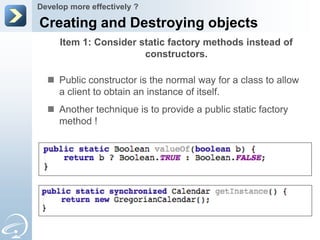
     Item 1: Consider static factory methods instead of
                       constructors.

   Public constructor is the normal way for a class to allow
    a client to obtain an instance of itself.
   Another technique is to provide a public static factory
    method !
Develop more effectively ?

Creating and Destroying objects
     Item 1: Consider static factory methods instead of
                       constructors.

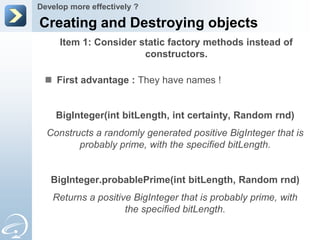
  First advantage : They have names !


    BigInteger(int bitLength, int certainty, Random rnd)
  Constructs a randomly generated positive BigInteger that is
         probably prime, with the specified bitLength.


   BigInteger.probablePrime(int bitLength, Random rnd)
   Returns a positive BigInteger that is probably prime, with
                    the specified bitLength.
Develop more effectively ?

Creating and Destroying objects
     Item 1: Consider static factory methods instead of
                       constructors.

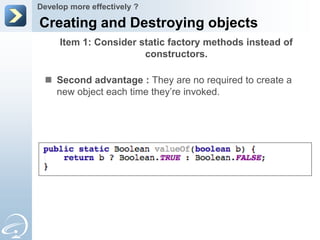
  Second advantage : They are no required to create a
   new object each time they’re invoked.
Develop more effectively ?

Creating and Destroying objects
     Item 1: Consider static factory methods instead of
                       constructors.

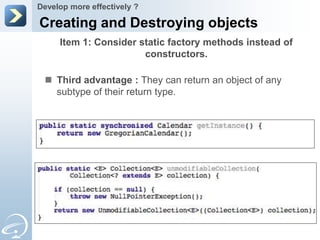
  Third advantage : They can return an object of any
   subtype of their return type.
Develop more effectively ?

Creating and Destroying objects
     Item 1: Consider static factory methods instead of
                       constructors.

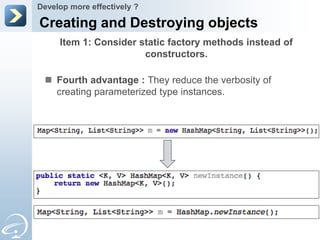
  Fourth advantage : They reduce the verbosity of
   creating parameterized type instances.
Develop more effectively ?

Creating and Destroying objects
     Item 1: Consider static factory methods instead of
                       constructors.


  First disadvantage : Classes without public or protected
   constructors cannot be sub-classed.


  Second disadvantage : They are not readily
   distinguishable from other static methods.
Develop more effectively ?

Creating and Destroying objects
      Item 2: Consider a builder when faced with many
                  constructor parameters.


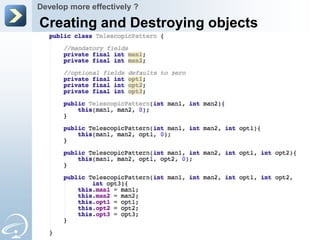
  Static factories and constructors share a limitation: they
   don’t scale well to large members of optional parameters.


  Traditionally, two patterns are used :
       Telescoping constructor pattern.
       JavaBeans pattern.
Develop more effectively ?

Creating and Destroying objects
Develop more effectively ?

Creating and Destroying objects
      Item 2: Consider a builder when faced with many
                  constructor parameters.


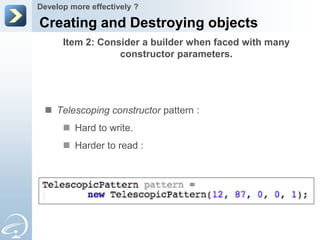
  Telescoping constructor pattern :
       Hard to write.
       Harder to read :
Develop more effectively ?

Creating and Destroying objects
Develop more effectively ?

Creating and Destroying objects
      Item 2: Consider a builder when faced with many
                  constructor parameters.


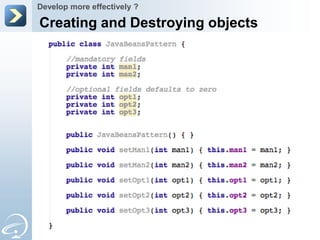
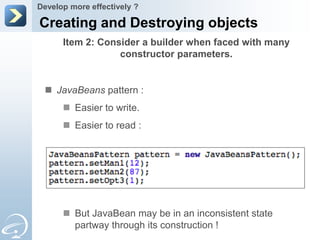
  JavaBeans pattern :
       Easier to write.
       Easier to read :


       But JavaBean may be in an inconsistent state
        partway through its construction !
Develop more effectively ?

Creating and Destroying objects
Develop more effectively ?

Creating and Destroying objects
      Item 2: Consider a builder when faced with many
                  constructor parameters.


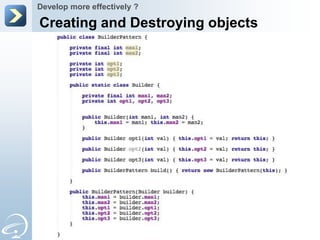
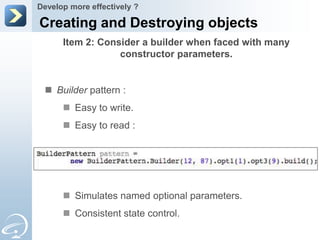
  Builder pattern :
       Easy to write.
       Easy to read :


       Simulates named optional parameters.
       Consistent state control.
Develop more effectively ?

Creating and Destroying objects
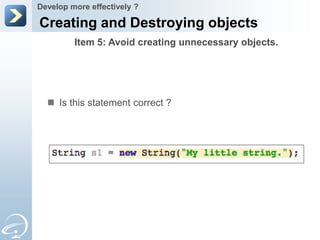
         Item 5: Avoid creating unnecessary objects.


   Is this statement correct ?
Develop more effectively ?

Creating and Destroying objects
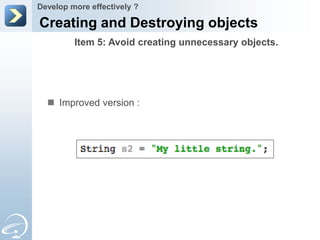
         Item 5: Avoid creating unnecessary objects.


   Improved version :
Develop more effectively ?

Creating and Destroying objects
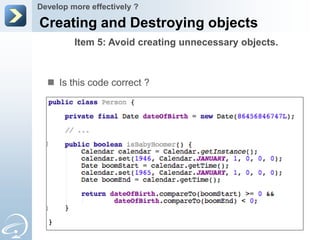
         Item 5: Avoid creating unnecessary objects.


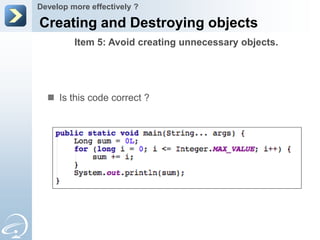
   Is this code correct ?
Develop more effectively ?

Creating and Destroying objects
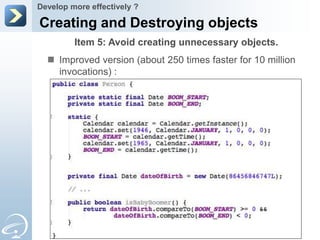
         Item 5: Avoid creating unnecessary objects.
   Improved version (about 250 times faster for 10 million
    invocations) :
Develop more effectively ?

Creating and Destroying objects
         Item 5: Avoid creating unnecessary objects.


   Is this code correct ?
Develop more effectively ?

Creating and Destroying objects
         Item 5: Avoid creating unnecessary objects.


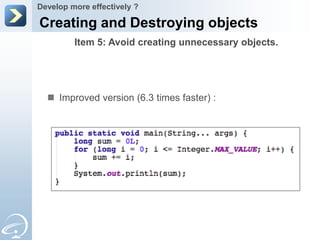
   Improved version (6.3 times faster) :
Develop more effectively ?

Classes and Interfaces
        Item 16: Favor composition over inheritance.


   Inheritance is a powerful way to achieve code reuse
        But not always the best !
   Inheritance from ordinary concrete classes across
    package boundaries is dangerous !


       Unlike method invocation, inheritance violates
                      encapsulation.
Develop more effectively ?

Classes and Interfaces
        Item 16: Favor composition over inheritance.
Develop more effectively ?

Classes and Interfaces
        Item 16: Favor composition over inheritance.


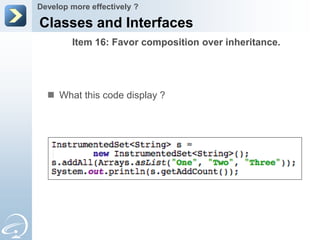
   What this code display ?
Develop more effectively ?

Classes and Interfaces
        Item 16: Favor composition over inheritance.
Develop more effectively ?

Classes and Interfaces
        Item 16: Favor composition over inheritance.
Develop more effectively ?

Classes and Interfaces
        Item 16: Favor composition over inheritance.

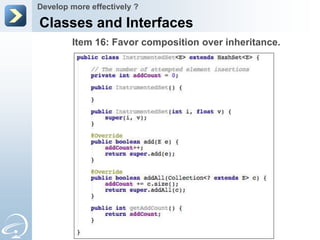
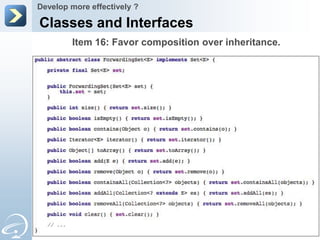
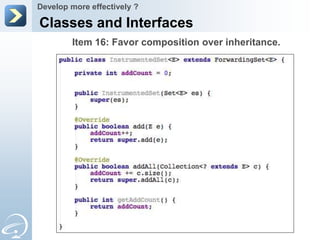
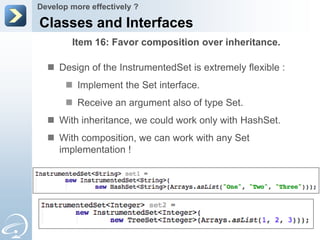
   Design of the InstrumentedSet is extremely flexible :
        Implement the Set interface.
        Receive an argument also of type Set.
   With inheritance, we could work only with HashSet.
   With composition, we can work with any Set
    implementation !
Develop more effectively ?

Classes and Interfaces
Develop more effectively ?

Classes and Interfaces
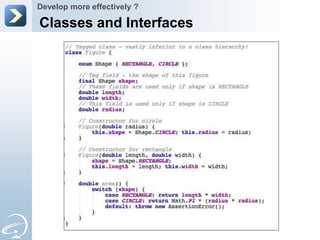
     Item 20: Prefer class hierarchies to tagged classes.

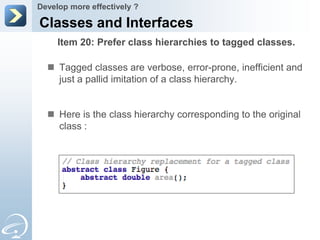
   Tagged classes are verbose, error-prone, inefficient and
    just a pallid imitation of a class hierarchy.


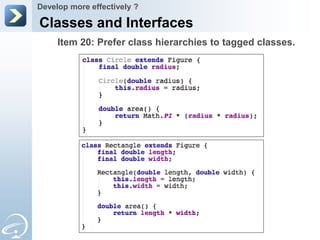
   Here is the class hierarchy corresponding to the original
    class :
Develop more effectively ?

Classes and Interfaces
     Item 20: Prefer class hierarchies to tagged classes.
Develop more effectively ?

Classes and Interfaces
     Item 20: Prefer class hierarchies to tagged classes.


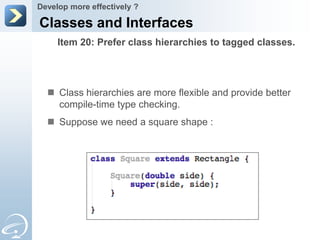
   Class hierarchies are more flexible and provide better
    compile-time type checking.
   Suppose we need a square shape :
Develop more effectively ?

Methods

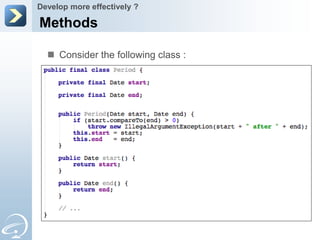
   Consider the following class :
Develop more effectively ?

Methods

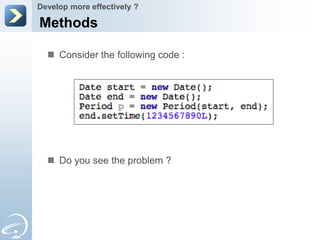
   Consider the following code :


   Do you see the problem ?
Develop more effectively ?

Methods
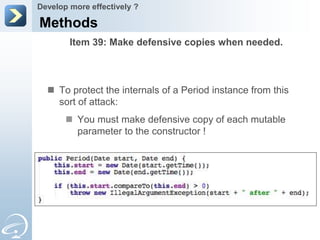
        Item 39: Make defensive copies when needed.


   To protect the internals of a Period instance from this
    sort of attack:
        You must make defensive copy of each mutable
         parameter to the constructor !
Develop more effectively ?

Methods
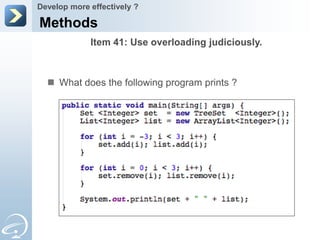
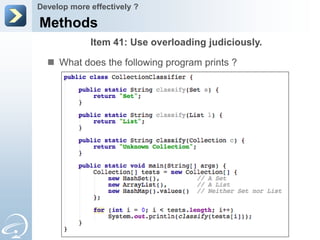
             Item 41: Use overloading judiciously.

   What does the following program prints ?
Develop more effectively ?

Methods
             Item 41: Use overloading judiciously.


   The program print : “Unknown Collection” three times.


   The choice of which overloading to invoke is made at
    compile time !
        Not like overridden methods…
Develop more effectively ?

Methods
             Item 41: Use overloading judiciously.


   What does the following program prints ?
Develop more effectively ?

Methods
             Item 41: Use overloading judiciously.


   The program print : [-3, -2, -1] [-2, 0, 2].
   The remove method is overloaded inside List class :
        remove(E) : delete the E element inside the list.
        remove(int) : delete the element at the specified
         position.
Develop more effectively ?

Methods
             Item 41: Use overloading judiciously.


   Refrain from overloading methods with multiple
    signatures that have the same number of parameters.


   If you can’t, at least avoid situations where the same set
    of parameters can be passed to different overloadings
    by the addition of casts.
Develop more effectively ?

General Programming
    Item 48: Avoid float and double if exact answers are
                          required.


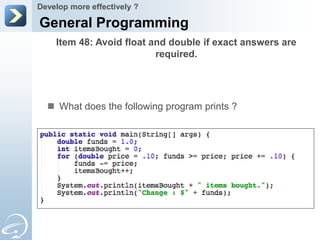
   What does the following program prints ?
Develop more effectively ?

General Programming
    Item 48: Avoid float and double if exact answers are
                          required.


   It prints you can afford 3 items and you have
    $0.3999999999999999 left…


   The float and double types are designed primarily for
    scientific and engineering calculations.
        They perform binary floating-point arithmetic with
         approximations !
   They should not be used where exact results are
    required.
Develop more effectively ?

General Programming
    Item 48: Avoid float and double if exact answers are
                          required.


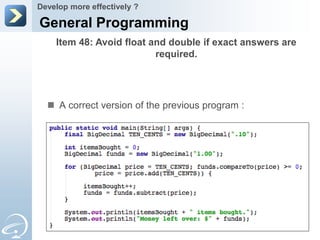
   A correct version of the previous program :
Develop more effectively ?

General Programming
                  Item 55: Optimize judiciously.
      "More computing sins are committed in the name of
    efficiency (without necessarily achieving it) than for any
          other single reason - including blind stupidity."
                                                    - W.A. Wulf

   “We should forget about small efficiencies, say about 97%
    of the time: premature optimization is the root of all evil.”
                                             - Donald E. Knuth

   “The First Rule of Program Optimization: Don't do it. The
   Second Rule of Program Optimization (for experts only!):
                        Don't do it yet.”
                                         - Michael A. Jackson
Develop more effectively ?

General Programming
                  Item 55: Optimize judiciously.


   Strive to write good programs rather than fast ones.
   Strive to avoid design decisions that limit performance.
   Consider the performance consequence of your API
    design decisions.
   Measure performance before and after each attempted
    optimization.
Effective Java


                 The Book

                 For all the other tips !
The Book

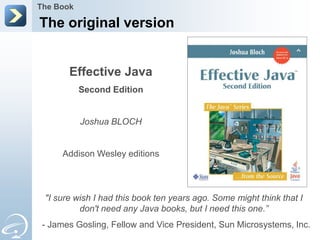
The original version


       Effective Java
           Second Edition


           Joshua BLOCH


      Addison Wesley editions


 "I sure wish I had this book ten years ago. Some might think that I
          don't need any Java books, but I need this one.”
 - James Gosling, Fellow and Vice President, Sun Microsystems, Inc.
The Book

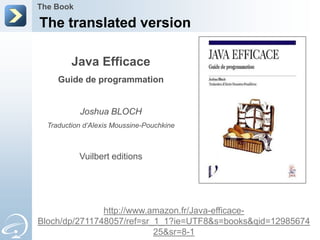
The translated version

         Java Efficace
     Guide de programmation


           Joshua BLOCH
  Traduction d’Alexis Moussine-Pouchkine


           Vuilbert editions


               http://www.amazon.fr/Java-efficace-
Bloch/dp/2711748057/ref=sr_1_1?ie=UTF8&s=books&qid=12985674
                           25&sr=8-1
Effective Java


                 About the Author

                 For all the other tips !
About the Author

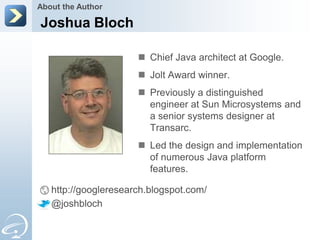
Joshua Bloch

                       Chief Java architect at Google.
                       Jolt Award winner.
                       Previously a distinguished
                        engineer at Sun Microsystems and
                        a senior systems designer at
                        Transarc.
                       Led the design and implementation
                        of numerous Java platform
                        features.

   http://googleresearch.blogspot.com/
   @joshbloch
About the Author

Bibliographie
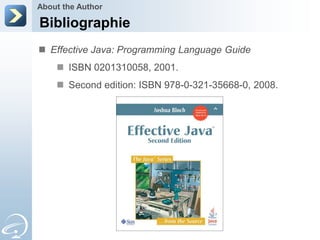
 Effective Java: Programming Language Guide
     ISBN 0201310058, 2001.
     Second edition: ISBN 978-0-321-35668-0, 2008.
About the Author

Bibliographie
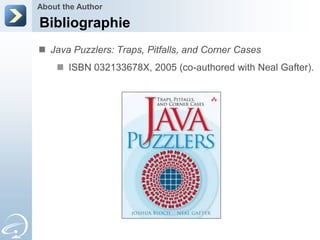
 Java Puzzlers: Traps, Pitfalls, and Corner Cases
     ISBN 032133678X, 2005 (co-authored with Neal Gafter).
About the Author

Bibliographie
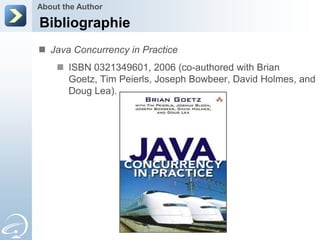
 Java Concurrency in Practice
     ISBN 0321349601, 2006 (co-authored with Brian
      Goetz, Tim Peierls, Joseph Bowbeer, David Holmes, and
      Doug Lea).
Effective Java

The end

Effective Java

  • 1.
    Effective Java Presentation ofthe Joshua Bloch's Book. www.supinfo.com Copyright © SUPINFO. All rights reserved
  • 2.
    Effective Java The Speaker Professional Experiences: - Bug Out PC - Groupe Open - ADF - Atos Worldline - Adullact - Xebia IT - Webpulser - Audaxis Training: - DUT Informatique / Montpellier - Supinfo B3 / Montpellier - Supinfo M1 / Lille - STA Java Lille / Valenciennes Brice Argenson - 59253@supinfo.com Certifications: brice.argenson - SCJP 6 @bargenson - SCWCD 5
  • 3.
    Effective Java Agenda  Develop more effectively ?  Creating and Destroying objects  Classes and Interfaces  Methods  General Programming  The Book  About the Author
  • 4.
    Effective Java Develop more effectively ? Good practices
  • 5.
    Develop more effectively? Creating and Destroying objects Item 1: Consider static factory methods instead of constructors.  Public constructor is the normal way for a class to allow a client to obtain an instance of itself.  Another technique is to provide a public static factory method !
  • 6.
    Develop more effectively? Creating and Destroying objects Item 1: Consider static factory methods instead of constructors.  First advantage : They have names ! BigInteger(int bitLength, int certainty, Random rnd) Constructs a randomly generated positive BigInteger that is probably prime, with the specified bitLength. BigInteger.probablePrime(int bitLength, Random rnd) Returns a positive BigInteger that is probably prime, with the specified bitLength.
  • 7.
    Develop more effectively? Creating and Destroying objects Item 1: Consider static factory methods instead of constructors.  Second advantage : They are no required to create a new object each time they’re invoked.
  • 8.
    Develop more effectively? Creating and Destroying objects Item 1: Consider static factory methods instead of constructors.  Third advantage : They can return an object of any subtype of their return type.
  • 9.
    Develop more effectively? Creating and Destroying objects Item 1: Consider static factory methods instead of constructors.  Fourth advantage : They reduce the verbosity of creating parameterized type instances.
  • 10.
    Develop more effectively? Creating and Destroying objects Item 1: Consider static factory methods instead of constructors.  First disadvantage : Classes without public or protected constructors cannot be sub-classed.  Second disadvantage : They are not readily distinguishable from other static methods.
  • 11.
    Develop more effectively? Creating and Destroying objects Item 2: Consider a builder when faced with many constructor parameters.  Static factories and constructors share a limitation: they don’t scale well to large members of optional parameters.  Traditionally, two patterns are used :  Telescoping constructor pattern.  JavaBeans pattern.
  • 12.
    Develop more effectively? Creating and Destroying objects
  • 13.
    Develop more effectively? Creating and Destroying objects Item 2: Consider a builder when faced with many constructor parameters.  Telescoping constructor pattern :  Hard to write.  Harder to read :
  • 14.
    Develop more effectively? Creating and Destroying objects
  • 15.
    Develop more effectively? Creating and Destroying objects Item 2: Consider a builder when faced with many constructor parameters.  JavaBeans pattern :  Easier to write.  Easier to read :  But JavaBean may be in an inconsistent state partway through its construction !
  • 16.
    Develop more effectively? Creating and Destroying objects
  • 17.
    Develop more effectively? Creating and Destroying objects Item 2: Consider a builder when faced with many constructor parameters.  Builder pattern :  Easy to write.  Easy to read :  Simulates named optional parameters.  Consistent state control.
  • 18.
    Develop more effectively? Creating and Destroying objects Item 5: Avoid creating unnecessary objects.  Is this statement correct ?
  • 19.
    Develop more effectively? Creating and Destroying objects Item 5: Avoid creating unnecessary objects.  Improved version :
  • 20.
    Develop more effectively? Creating and Destroying objects Item 5: Avoid creating unnecessary objects.  Is this code correct ?
  • 21.
    Develop more effectively? Creating and Destroying objects Item 5: Avoid creating unnecessary objects.  Improved version (about 250 times faster for 10 million invocations) :
  • 22.
    Develop more effectively? Creating and Destroying objects Item 5: Avoid creating unnecessary objects.  Is this code correct ?
  • 23.
    Develop more effectively? Creating and Destroying objects Item 5: Avoid creating unnecessary objects.  Improved version (6.3 times faster) :
  • 24.
    Develop more effectively? Classes and Interfaces Item 16: Favor composition over inheritance.  Inheritance is a powerful way to achieve code reuse  But not always the best !  Inheritance from ordinary concrete classes across package boundaries is dangerous ! Unlike method invocation, inheritance violates encapsulation.
  • 25.
    Develop more effectively? Classes and Interfaces Item 16: Favor composition over inheritance.
  • 26.
    Develop more effectively? Classes and Interfaces Item 16: Favor composition over inheritance.  What this code display ?
  • 27.
    Develop more effectively? Classes and Interfaces Item 16: Favor composition over inheritance.
  • 28.
    Develop more effectively? Classes and Interfaces Item 16: Favor composition over inheritance.
  • 29.
    Develop more effectively? Classes and Interfaces Item 16: Favor composition over inheritance.  Design of the InstrumentedSet is extremely flexible :  Implement the Set interface.  Receive an argument also of type Set.  With inheritance, we could work only with HashSet.  With composition, we can work with any Set implementation !
  • 30.
    Develop more effectively? Classes and Interfaces
  • 31.
    Develop more effectively? Classes and Interfaces Item 20: Prefer class hierarchies to tagged classes.  Tagged classes are verbose, error-prone, inefficient and just a pallid imitation of a class hierarchy.  Here is the class hierarchy corresponding to the original class :
  • 32.
    Develop more effectively? Classes and Interfaces Item 20: Prefer class hierarchies to tagged classes.
  • 33.
    Develop more effectively? Classes and Interfaces Item 20: Prefer class hierarchies to tagged classes.  Class hierarchies are more flexible and provide better compile-time type checking.  Suppose we need a square shape :
  • 34.
    Develop more effectively? Methods  Consider the following class :
  • 35.
    Develop more effectively? Methods  Consider the following code :  Do you see the problem ?
  • 36.
    Develop more effectively? Methods Item 39: Make defensive copies when needed.  To protect the internals of a Period instance from this sort of attack:  You must make defensive copy of each mutable parameter to the constructor !
  • 37.
    Develop more effectively? Methods Item 41: Use overloading judiciously.  What does the following program prints ?
  • 38.
    Develop more effectively? Methods Item 41: Use overloading judiciously.  The program print : “Unknown Collection” three times.  The choice of which overloading to invoke is made at compile time !  Not like overridden methods…
  • 39.
    Develop more effectively? Methods Item 41: Use overloading judiciously.  What does the following program prints ?
  • 40.
    Develop more effectively? Methods Item 41: Use overloading judiciously.  The program print : [-3, -2, -1] [-2, 0, 2].  The remove method is overloaded inside List class :  remove(E) : delete the E element inside the list.  remove(int) : delete the element at the specified position.
  • 41.
    Develop more effectively? Methods Item 41: Use overloading judiciously.  Refrain from overloading methods with multiple signatures that have the same number of parameters.  If you can’t, at least avoid situations where the same set of parameters can be passed to different overloadings by the addition of casts.
  • 42.
    Develop more effectively? General Programming Item 48: Avoid float and double if exact answers are required.  What does the following program prints ?
  • 43.
    Develop more effectively? General Programming Item 48: Avoid float and double if exact answers are required.  It prints you can afford 3 items and you have $0.3999999999999999 left…  The float and double types are designed primarily for scientific and engineering calculations.  They perform binary floating-point arithmetic with approximations !  They should not be used where exact results are required.
  • 44.
    Develop more effectively? General Programming Item 48: Avoid float and double if exact answers are required.  A correct version of the previous program :
  • 45.
    Develop more effectively? General Programming Item 55: Optimize judiciously. "More computing sins are committed in the name of efficiency (without necessarily achieving it) than for any other single reason - including blind stupidity." - W.A. Wulf “We should forget about small efficiencies, say about 97% of the time: premature optimization is the root of all evil.” - Donald E. Knuth “The First Rule of Program Optimization: Don't do it. The Second Rule of Program Optimization (for experts only!): Don't do it yet.” - Michael A. Jackson
  • 46.
    Develop more effectively? General Programming Item 55: Optimize judiciously.  Strive to write good programs rather than fast ones.  Strive to avoid design decisions that limit performance.  Consider the performance consequence of your API design decisions.  Measure performance before and after each attempted optimization.
  • 47.
    Effective Java The Book For all the other tips !
  • 48.
    The Book The originalversion Effective Java Second Edition Joshua BLOCH Addison Wesley editions "I sure wish I had this book ten years ago. Some might think that I don't need any Java books, but I need this one.” - James Gosling, Fellow and Vice President, Sun Microsystems, Inc.
  • 49.
    The Book The translatedversion Java Efficace Guide de programmation Joshua BLOCH Traduction d’Alexis Moussine-Pouchkine Vuilbert editions http://www.amazon.fr/Java-efficace- Bloch/dp/2711748057/ref=sr_1_1?ie=UTF8&s=books&qid=12985674 25&sr=8-1
  • 50.
    Effective Java About the Author For all the other tips !
  • 51.
    About the Author JoshuaBloch  Chief Java architect at Google.  Jolt Award winner.  Previously a distinguished engineer at Sun Microsystems and a senior systems designer at Transarc.  Led the design and implementation of numerous Java platform features. http://googleresearch.blogspot.com/ @joshbloch
  • 52.
    About the Author Bibliographie Effective Java: Programming Language Guide  ISBN 0201310058, 2001.  Second edition: ISBN 978-0-321-35668-0, 2008.
  • 53.
    About the Author Bibliographie Java Puzzlers: Traps, Pitfalls, and Corner Cases  ISBN 032133678X, 2005 (co-authored with Neal Gafter).
  • 54.
    About the Author Bibliographie Java Concurrency in Practice  ISBN 0321349601, 2006 (co-authored with Brian Goetz, Tim Peierls, Joseph Bowbeer, David Holmes, and Doug Lea).
  • 55.