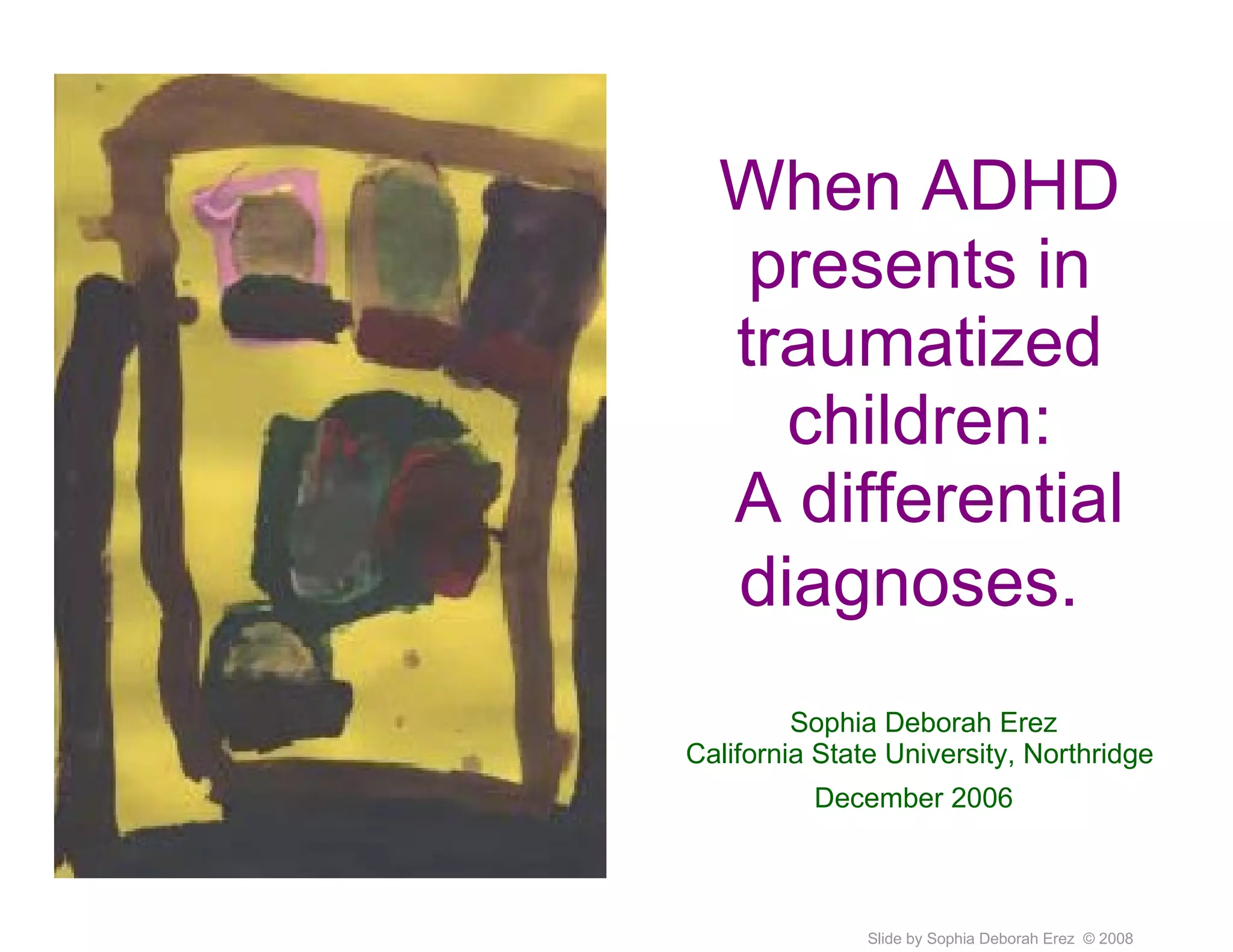
When ADHD presents in traumatized children:  A differential diagnoses.    Sophia  Deborah Erez California State University, Northridge December 2006
ADHD Fidgety Phil Volitional inhibition Restlessness syndrome Organic drive ness Post encephalitic behavior disorder Brain injured child syndrome Minimal brain damage Minimal brain dysfunction Hyperactive child syndrome Hyper kinetic reaction of childhood Attention deficit disorder (ADD) with or without hyperactivity Attention-deficit hyperactivity disorder Attention deficit/hyperactivity disorder Combined Predominantly inattentive  Predominantly hyperactive-impulsive
Trauma Susto Ataque de nervios Railway Spine Soldiers heart Battle fatigue War combat syndrome Shell shock War neuroses Posttraumatic stress disorder (PTSD) Complex PTSD Rape trauma syndrome Battered women’s syndrome Chronic interpersonal trauma Chronic developmental trauma Complex trauma Disorders of extreme stress not otherwise specified (DESNOS).
DESNOS “ The DSM IV Field Trial supported the notion that trauma, particularly trauma that is prolonged, that first occurs at an early age and that is of an interpersonal nature, can have significant effects on psychological functioning above and beyond PTSD symptomatology.  These effects include: problems with affect dysregulation aggression against self and others dissociative symptoms somatization character pathology These various symptoms tend to cluster into distinct patterns and to be highly interrelated” (van der Kolk, Roth, Pelcovitz, Sunday and Spinnazzola, 2005).
 
What presents as ADHD might be unresolved trauma or PTSD. Glod and Teicher (1996), studied the relationship between early abuse, posttraumatic stress disorder and activity levels in prepubertal children and found that  PTSD is “an important differential diagnosis in children presenting with ADHD”  (p. 1392). In the study “Child maltreatment, other trauma exposure, and posttraumatic symptomatology among children with oppositional defiant and attention deficit hyperactivity disorders,” Ford et al. (2000) found “ that many of the tens of thousands of children with disruptive behavior disorders may have been exposed to traumatic maltreatment and may experience undetected PTSD symptoms”  (p. 214).
Note.  From “Attention deficit hyperactivity disorder and posttraumatic stress disorder: Differential diagnosis in childhood sexual abuse ” by D. Weinstein, D. Staffelbach, and M. Biaggio, 2000,  Clinical Psychology Review, 20 , p. 368.
Overlapping Comorbidity ADHD is frequently comorbid with:   Anxiety disorders Bipolar disorders  Conduct disorders Hoarding Mood disorder Oppositional Defiance Disorder Posttraumatic Stress Disorder (Adler, Kunz, Chua, Rotrosen, and Resnick, 2004; Cuffe, McCullough, & Pumariega, 1994; Hartl, Duffany, Allen, Steketee, & Frost, 2005; Wozniak et al., 1999)
Overlapping Comorbidity Pediatric PTSD is frequently comorbid with:   Attention Deficit Hyperactivity Disorder (ADHD) Bipolar Disorder Brief Psychotic Disorder or psychotic Disorder NOS Hoarding Major Depression  Oppositional Defiant Disorder Other anxiety disorders The presence of suicidal ideation   (Ackerman, Newton, McPherson, Jones & Dykman, 1998; Adler, Junz,Chua, Rotrosen, and Resnick, 2004; Famularo, Fenton, Kinscherff, & Augustyn, 1996; Hartl, Duffany, Allen, Steketee, & Frost, 2005).    
Overlapping Comorbidity   Note.  From “ Findings from the NIMH multimodal treatment study of ADHD (MTA): Implications and applications for primary care providers” by Jensen et al., 2001,  Developmental and Behavioral Pediatrics, 22 , 64. The symptoms resulting in the diagnoses of ADHD and ODD may have been caused by maltreatment and may actually be part of the anxiety associated with PTSD” (Famularo, Kinscherff & Fenton, 1992, p.866).    “ A primary clinical implication is that children in treatment for disruptive behavior disorders may benefit from screening for maltreatment, accidental trauma, and PTSD symptoms” (Ford et al, 2000, p. 214).
Overlapping Comorbidity In an issue of the  The Journal of Traumatic Stress  dedicated to the developmental impact of chronic interpersonal trauma  ,  the editors, van der Kolk and Courtois, (2005) wrote: “ this special issue examines the likelihood that these other problems do not constitute comorbid diagnoses, but rather are somatic, affective, behavioral and characterological manifestations of chronic interpersonal trauma and thus are part of the primary disorder” (p.386).
Neurobiological Findings - ADHD ADHD is no longer seen as a disorder of attention, but increasingly as a  disorder in key aspects of self-regulation  (Nigg, 2005). Recent neuroscience points to problems with response inhibition, self-regulation, and the related domain of executive functioning (Barkely, 2003). Executive Functions play an important role in the complex neuropsychology of ADHD (Willcutt et al., 2005). Executive Function weaknesses are neither necessary nor sufficient to cause all cases of ADHD (Willcutt et al., 2005, p.1343). “ The HPA axis may be dysfunctional in some subjects with ADHD ” (Barkley, 1998).
Neurobiological Findings - ADHD ADHD has been found to be comorbid with Central Auditory Processing Disorder (CAPD)  (Chermak, Hall, & Musiek, 1999). The primarily inattentive subtype of ADHD remains relatively under-investigated (Nigg, 2005). Barkley suggests that the predominantly inattentive subtype might be an entirely distinct disorder and require a different treatment (Barkley, 2003). ADHD cannot be explained with just one neuropsychological deficit (Nigg, 2005). No single theory can account for the range of phenomena to be explained in children diagnosed with ADHD  (Nigg, 2005).
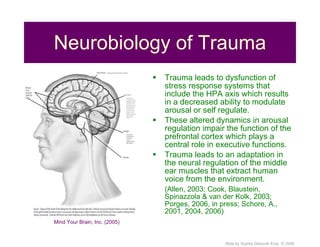
Neurobiology of Trauma Trauma leads to dysfunction of stress response systems that include the HPA axis which results in a decreased ability to modulate arousal or self regulate. These altered dynamics in arousal regulation impair the function of the prefrontal cortex which plays a central role in executive functions. Trauma leads to an adaptation in the neural regulation of the middle ear muscles that extract human voice from the environment. (Allen, 2003; Cook, Blaustein, Spinazzola & van der Kolk, 2003; Porges, 2006, in press; Schore, A., 2001, 2004, 2006) Mind Your Brain, Inc. (2005)
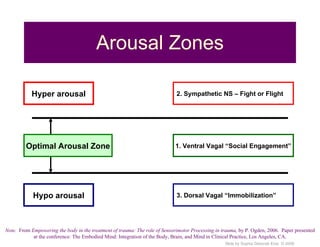
Arousal Zones Hyper arousal Hypo arousal Optimal Arousal Zone 1. Ventral Vagal “Social Engagement” 2. Sympathetic NS – Fight or Flight  3. Dorsal Vagal “Immobilization” Note.   From  Empowering the body in the treatment of trauma: The role of Sensorimotor Processing in trauma,  by P. Ogden, 2006.  Paper presented at  the conference: The Embodied Mind: Integration of the Body, Brain, and Mind in Clinical Practice, Los Angeles, CA.
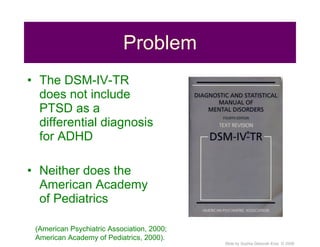
Problem The DSM-IV-TR does not include PTSD as a differential diagnosis for ADHD Neither does the American Academy of Pediatrics  (American Psychiatric Association, 2000; American Academy of Pediatrics, 2000).
Some populations at risk for  misdiagnosis Children who are adopted, both those adopted as infants and those placed as children  (Henderson, 2002; Howe & Fearnely, 2003; Schore, 2001, 2004; Verrier, 1991). Children suffering from chronic neglect/maltreatment  (Bennett, 2000; Famularo, Kinscherff & Fenton, 1992; Glod & Teicher, 1996; Howe & Fearnely,  2003; Schore,  2001, 2004). Children with attachment disorders  (Howe & Fearnely, 2003; Schore, 2001; Verrier, 1991). Children who have had surgery under anesthesia  (Osterman, Hopper, Heran, Keane & van der Kolk, 2001).
Some populations at risk for  misdiagnosis Children who have been hospitalized for long periods  (Bennett,  2000). Children who are or have been in the foster system  (Bennett, 2000; Famularo, Kinscherff & Fenton, 1992, Glod & Teicher, 1996; Howe & Fearnely,  2003; Schore,  2001, 2004). Children who have been sexually abused  (Bennett, 2000; Glod  & Teicher, 1996; Weinstein, Staffelbach,  & Biaggio,  2000). Children who have been physically abused  (Bennett, 2000; Famularo, Kinscherff,  & Fenton, 1992; Glod  & Teicher, 1996; Schore, 2001, 2004).
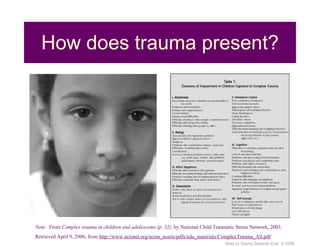
How does trauma present? Note.   From  Complex trauma in children and adolescents (p. 32),  by National Child Traumatic Stress Network, 2003.  Retrieved April 9, 2006, from  http://www.nctsnet.org/nctsn_assets/pdfs/edu_materials/ComplexTrauma_All.pdf
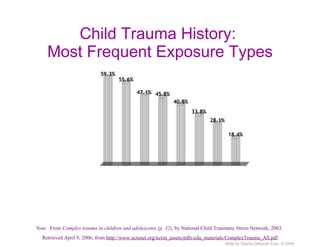
Child Trauma History:  Most Frequent Exposure Types Note.   From  Complex trauma in children and adolescents (p. 32),  by National Child Traumatic Stress Network, 2003.  Retrieved April 9, 2006, from  http://www.nctsnet.org/nctsn_assets/pdfs/edu_materials/ComplexTrauma_All.pdf
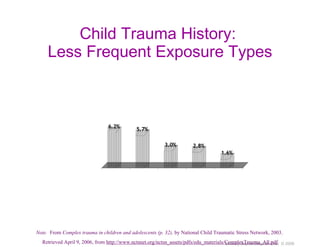
Child Trauma History:  Less Frequent Exposure Types Note.   From  Complex trauma in children and adolescents (p. 32),  by National Child Traumatic Stress Network, 2003.  Retrieved April 9, 2006, from  http://www.nctsnet.org/nctsn_assets/pdfs/edu_materials/ComplexTrauma_All.pdf
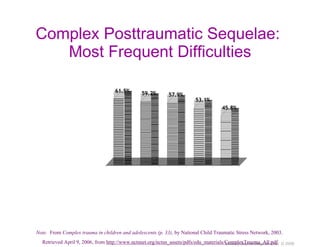
Complex Posttraumatic Sequelae:  Most Frequent Difficulties Note.   From  Complex trauma in children and adolescents (p. 33),  by National Child Traumatic Stress Network, 2003.  Retrieved April 9, 2006, from  http://www.nctsnet.org/nctsn_assets/pdfs/edu_materials/ComplexTrauma_All.pdf
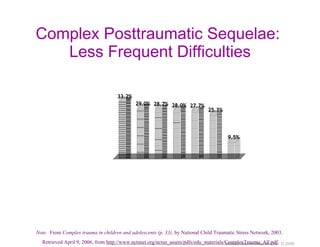
Complex Posttraumatic Sequelae:  Less Frequent Difficulties Note.   From  Complex trauma in children and adolescents (p. 33),  by National Child Traumatic Stress Network, 2003.  Retrieved April 9, 2006, from  http://www.nctsnet.org/nctsn_assets/pdfs/edu_materials/ComplexTrauma_All.pdf
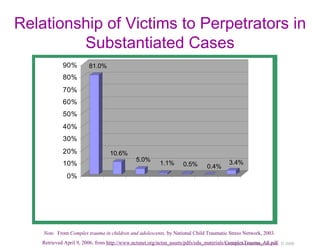
Relationship of Victims to Perpetrators in Substantiated Cases Note.   From  Complex trauma in children and adolescents,  by National Child Traumatic Stress Network, 2003.  Retrieved April 9, 2006, from  http://www.nctsnet.org/nctsn_assets/pdfs/edu_materials/ComplexTrauma_All.pdf
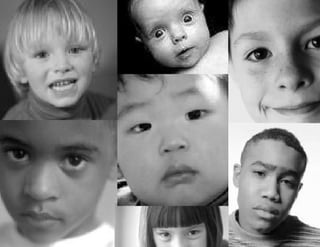
A Silent Epidemic If 20 million people were infected  by a virus that caused  anxiety, impulsivity, aggression, sleep problems,  depression, respiratory and heart problems, vulnerability to  substance abuse, antisocial and criminal behavior,  retardation and school failure, we would consider it an  urgent public health crisis.  Yet, in the United States alone,  there are more than 20 million abused, neglected  and traumatized children vulnerable to  these problems. Our society has yet to recognize this  epidemic, let alone develop an immunization strategy.   Bruce D. Perry, M.D., Ph.D., Senior Fellow, ChildTrauma Academy Note:  Retreived April 10, 2006,  from   http://www.childtrauma.org/ourImpact/our_impact.asp
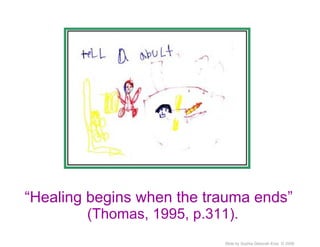
“ Healing begins when the trauma ends”  (Thomas, 1995, p.311).
Consequences of “missed” diagnosis of trauma Failure to stop the trauma. Trauma may be ongoing.  When it doesn’t end, the trauma and its implications for the child are compounded. Failure to treat the trauma. Treatments for ADHD are very distinct from efficacious PTSD treatments. Possibly unnecessary medication. In addition to varied side effects, “stimulants may precipitate or exacerbate psychosis” (Thomas, 1995, p. 315; Barkley, 2000).
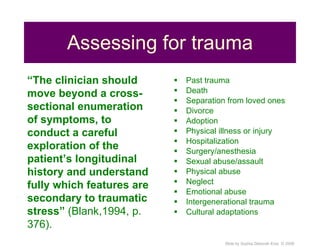
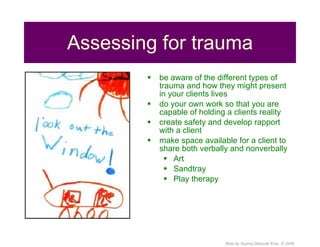
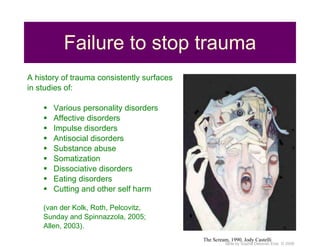
Failure to stop trauma A history of trauma consistently surfaces in studies of:  Various personality disorders Affective disorders Impulse disorders Antisocial disorders Substance abuse Somatization Dissociative disorders Eating disorders Cutting and other self harm (van der Kolk, Roth, Pelcovitz, Sunday and Spinnazzola, 2005; Allen, 2003). The Scream, 1990. Jody Castelli
Failure to treat the trauma Putting off treatment for trauma is about the worst thing one can do. Trauma does not ordinarily get “better” by itself.  It burrows down further and further under the child’s defenses and coping strategies.  Suppression, displacement, overgeneralization, identification with the aggressor, splitting, passive-into-active, undoing, and self-anesthesia take over.  The trauma may actually come to “look” better after all these coping and defense mechanisms go into operation.  But the trauma will continue to affect the child’s character, dreams, feelings about sex, trust, and attitudes about the future. (Terr, 1990, p. 293)
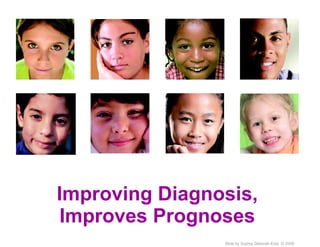
Improving Diagnosis, Improves Prognoses
Assessing for trauma Past trauma Death Separation from loved ones Divorce Adoption Physical illness or injury Hospitalization Surgery/anesthesia Sexual abuse/assault Physical abuse Neglect Emotional abuse Intergenerational trauma Cultural adaptations “ The clinician should move beyond a cross-sectional enumeration of symptoms, to conduct a careful exploration of the patient’s longitudinal history and understand fully which features are secondary to traumatic stress”  (Blank,1994, p. 376).
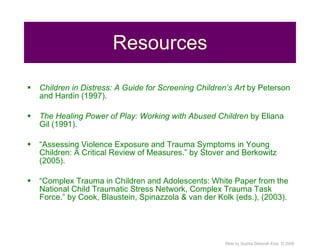
Assessing for trauma be aware of the different types of trauma and how they might present in your clients lives do your own work so that you are capable of holding a clients reality create safety and develop rapport with a client make space available for a client to share both verbally and nonverbally Art  Sandtray Play therapy
Resources Children in Distress: A Guide for Screening Children’s Art  by Peterson and Hardin (1997). The Healing Power of Play: Working with Abused Children  by Eliana Gil (1991).  “ Assessing Violence Exposure and Trauma Symptoms in Young Children: A Critical Review of Measures.” by Stover and Berkowitz (2005). “ Complex Trauma in Children and Adolescents: White Paper from the National Child Traumatic Stress Network, Complex Trauma Task Force.” by Cook, Blaustein, Spinazzola & van der Kolk (eds.), (2003).
 

When ADHD presents in traumatized children: A differential diagnoses.

  • 1.
    When ADHD presentsin traumatized children: A differential diagnoses. Sophia Deborah Erez California State University, Northridge December 2006
  • 2.
    ADHD Fidgety PhilVolitional inhibition Restlessness syndrome Organic drive ness Post encephalitic behavior disorder Brain injured child syndrome Minimal brain damage Minimal brain dysfunction Hyperactive child syndrome Hyper kinetic reaction of childhood Attention deficit disorder (ADD) with or without hyperactivity Attention-deficit hyperactivity disorder Attention deficit/hyperactivity disorder Combined Predominantly inattentive Predominantly hyperactive-impulsive
  • 3.
    Trauma Susto Ataquede nervios Railway Spine Soldiers heart Battle fatigue War combat syndrome Shell shock War neuroses Posttraumatic stress disorder (PTSD) Complex PTSD Rape trauma syndrome Battered women’s syndrome Chronic interpersonal trauma Chronic developmental trauma Complex trauma Disorders of extreme stress not otherwise specified (DESNOS).
  • 4.
    DESNOS “ TheDSM IV Field Trial supported the notion that trauma, particularly trauma that is prolonged, that first occurs at an early age and that is of an interpersonal nature, can have significant effects on psychological functioning above and beyond PTSD symptomatology. These effects include: problems with affect dysregulation aggression against self and others dissociative symptoms somatization character pathology These various symptoms tend to cluster into distinct patterns and to be highly interrelated” (van der Kolk, Roth, Pelcovitz, Sunday and Spinnazzola, 2005).
  • 5.
  • 6.
    What presents asADHD might be unresolved trauma or PTSD. Glod and Teicher (1996), studied the relationship between early abuse, posttraumatic stress disorder and activity levels in prepubertal children and found that PTSD is “an important differential diagnosis in children presenting with ADHD” (p. 1392). In the study “Child maltreatment, other trauma exposure, and posttraumatic symptomatology among children with oppositional defiant and attention deficit hyperactivity disorders,” Ford et al. (2000) found “ that many of the tens of thousands of children with disruptive behavior disorders may have been exposed to traumatic maltreatment and may experience undetected PTSD symptoms” (p. 214).
  • 7.
    Note. From“Attention deficit hyperactivity disorder and posttraumatic stress disorder: Differential diagnosis in childhood sexual abuse ” by D. Weinstein, D. Staffelbach, and M. Biaggio, 2000, Clinical Psychology Review, 20 , p. 368.
  • 8.
    Overlapping Comorbidity ADHDis frequently comorbid with:   Anxiety disorders Bipolar disorders Conduct disorders Hoarding Mood disorder Oppositional Defiance Disorder Posttraumatic Stress Disorder (Adler, Kunz, Chua, Rotrosen, and Resnick, 2004; Cuffe, McCullough, & Pumariega, 1994; Hartl, Duffany, Allen, Steketee, & Frost, 2005; Wozniak et al., 1999)
  • 9.
    Overlapping Comorbidity PediatricPTSD is frequently comorbid with:   Attention Deficit Hyperactivity Disorder (ADHD) Bipolar Disorder Brief Psychotic Disorder or psychotic Disorder NOS Hoarding Major Depression Oppositional Defiant Disorder Other anxiety disorders The presence of suicidal ideation   (Ackerman, Newton, McPherson, Jones & Dykman, 1998; Adler, Junz,Chua, Rotrosen, and Resnick, 2004; Famularo, Fenton, Kinscherff, & Augustyn, 1996; Hartl, Duffany, Allen, Steketee, & Frost, 2005).    
  • 10.
    Overlapping Comorbidity Note. From “ Findings from the NIMH multimodal treatment study of ADHD (MTA): Implications and applications for primary care providers” by Jensen et al., 2001, Developmental and Behavioral Pediatrics, 22 , 64. The symptoms resulting in the diagnoses of ADHD and ODD may have been caused by maltreatment and may actually be part of the anxiety associated with PTSD” (Famularo, Kinscherff & Fenton, 1992, p.866).   “ A primary clinical implication is that children in treatment for disruptive behavior disorders may benefit from screening for maltreatment, accidental trauma, and PTSD symptoms” (Ford et al, 2000, p. 214).
  • 11.
    Overlapping Comorbidity Inan issue of the The Journal of Traumatic Stress dedicated to the developmental impact of chronic interpersonal trauma , the editors, van der Kolk and Courtois, (2005) wrote: “ this special issue examines the likelihood that these other problems do not constitute comorbid diagnoses, but rather are somatic, affective, behavioral and characterological manifestations of chronic interpersonal trauma and thus are part of the primary disorder” (p.386).
  • 12.
    Neurobiological Findings -ADHD ADHD is no longer seen as a disorder of attention, but increasingly as a disorder in key aspects of self-regulation (Nigg, 2005). Recent neuroscience points to problems with response inhibition, self-regulation, and the related domain of executive functioning (Barkely, 2003). Executive Functions play an important role in the complex neuropsychology of ADHD (Willcutt et al., 2005). Executive Function weaknesses are neither necessary nor sufficient to cause all cases of ADHD (Willcutt et al., 2005, p.1343). “ The HPA axis may be dysfunctional in some subjects with ADHD ” (Barkley, 1998).
  • 13.
    Neurobiological Findings -ADHD ADHD has been found to be comorbid with Central Auditory Processing Disorder (CAPD) (Chermak, Hall, & Musiek, 1999). The primarily inattentive subtype of ADHD remains relatively under-investigated (Nigg, 2005). Barkley suggests that the predominantly inattentive subtype might be an entirely distinct disorder and require a different treatment (Barkley, 2003). ADHD cannot be explained with just one neuropsychological deficit (Nigg, 2005). No single theory can account for the range of phenomena to be explained in children diagnosed with ADHD (Nigg, 2005).
  • 14.
    Neurobiology of TraumaTrauma leads to dysfunction of stress response systems that include the HPA axis which results in a decreased ability to modulate arousal or self regulate. These altered dynamics in arousal regulation impair the function of the prefrontal cortex which plays a central role in executive functions. Trauma leads to an adaptation in the neural regulation of the middle ear muscles that extract human voice from the environment. (Allen, 2003; Cook, Blaustein, Spinazzola & van der Kolk, 2003; Porges, 2006, in press; Schore, A., 2001, 2004, 2006) Mind Your Brain, Inc. (2005)
  • 15.
    Arousal Zones Hyperarousal Hypo arousal Optimal Arousal Zone 1. Ventral Vagal “Social Engagement” 2. Sympathetic NS – Fight or Flight 3. Dorsal Vagal “Immobilization” Note. From Empowering the body in the treatment of trauma: The role of Sensorimotor Processing in trauma, by P. Ogden, 2006. Paper presented at the conference: The Embodied Mind: Integration of the Body, Brain, and Mind in Clinical Practice, Los Angeles, CA.
  • 16.
    Problem The DSM-IV-TRdoes not include PTSD as a differential diagnosis for ADHD Neither does the American Academy of Pediatrics (American Psychiatric Association, 2000; American Academy of Pediatrics, 2000).
  • 17.
    Some populations atrisk for misdiagnosis Children who are adopted, both those adopted as infants and those placed as children (Henderson, 2002; Howe & Fearnely, 2003; Schore, 2001, 2004; Verrier, 1991). Children suffering from chronic neglect/maltreatment (Bennett, 2000; Famularo, Kinscherff & Fenton, 1992; Glod & Teicher, 1996; Howe & Fearnely, 2003; Schore, 2001, 2004). Children with attachment disorders (Howe & Fearnely, 2003; Schore, 2001; Verrier, 1991). Children who have had surgery under anesthesia (Osterman, Hopper, Heran, Keane & van der Kolk, 2001).
  • 18.
    Some populations atrisk for misdiagnosis Children who have been hospitalized for long periods (Bennett, 2000). Children who are or have been in the foster system (Bennett, 2000; Famularo, Kinscherff & Fenton, 1992, Glod & Teicher, 1996; Howe & Fearnely, 2003; Schore, 2001, 2004). Children who have been sexually abused (Bennett, 2000; Glod & Teicher, 1996; Weinstein, Staffelbach, & Biaggio, 2000). Children who have been physically abused (Bennett, 2000; Famularo, Kinscherff, & Fenton, 1992; Glod & Teicher, 1996; Schore, 2001, 2004).
  • 19.
    How does traumapresent? Note. From Complex trauma in children and adolescents (p. 32), by National Child Traumatic Stress Network, 2003. Retrieved April 9, 2006, from http://www.nctsnet.org/nctsn_assets/pdfs/edu_materials/ComplexTrauma_All.pdf
  • 20.
    Child Trauma History: Most Frequent Exposure Types Note. From Complex trauma in children and adolescents (p. 32), by National Child Traumatic Stress Network, 2003. Retrieved April 9, 2006, from http://www.nctsnet.org/nctsn_assets/pdfs/edu_materials/ComplexTrauma_All.pdf
  • 21.
    Child Trauma History: Less Frequent Exposure Types Note. From Complex trauma in children and adolescents (p. 32), by National Child Traumatic Stress Network, 2003. Retrieved April 9, 2006, from http://www.nctsnet.org/nctsn_assets/pdfs/edu_materials/ComplexTrauma_All.pdf
  • 22.
    Complex Posttraumatic Sequelae: Most Frequent Difficulties Note. From Complex trauma in children and adolescents (p. 33), by National Child Traumatic Stress Network, 2003. Retrieved April 9, 2006, from http://www.nctsnet.org/nctsn_assets/pdfs/edu_materials/ComplexTrauma_All.pdf
  • 23.
    Complex Posttraumatic Sequelae: Less Frequent Difficulties Note. From Complex trauma in children and adolescents (p. 33), by National Child Traumatic Stress Network, 2003. Retrieved April 9, 2006, from http://www.nctsnet.org/nctsn_assets/pdfs/edu_materials/ComplexTrauma_All.pdf
  • 24.
    Relationship of Victimsto Perpetrators in Substantiated Cases Note. From Complex trauma in children and adolescents, by National Child Traumatic Stress Network, 2003. Retrieved April 9, 2006, from http://www.nctsnet.org/nctsn_assets/pdfs/edu_materials/ComplexTrauma_All.pdf
  • 25.
    A Silent EpidemicIf 20 million people were infected by a virus that caused anxiety, impulsivity, aggression, sleep problems, depression, respiratory and heart problems, vulnerability to substance abuse, antisocial and criminal behavior, retardation and school failure, we would consider it an urgent public health crisis. Yet, in the United States alone, there are more than 20 million abused, neglected  and traumatized children vulnerable to these problems. Our society has yet to recognize this epidemic, let alone develop an immunization strategy.   Bruce D. Perry, M.D., Ph.D., Senior Fellow, ChildTrauma Academy Note: Retreived April 10, 2006, from http://www.childtrauma.org/ourImpact/our_impact.asp
  • 26.
    “ Healing beginswhen the trauma ends” (Thomas, 1995, p.311).
  • 27.
    Consequences of “missed”diagnosis of trauma Failure to stop the trauma. Trauma may be ongoing. When it doesn’t end, the trauma and its implications for the child are compounded. Failure to treat the trauma. Treatments for ADHD are very distinct from efficacious PTSD treatments. Possibly unnecessary medication. In addition to varied side effects, “stimulants may precipitate or exacerbate psychosis” (Thomas, 1995, p. 315; Barkley, 2000).
  • 28.
    Failure to stoptrauma A history of trauma consistently surfaces in studies of: Various personality disorders Affective disorders Impulse disorders Antisocial disorders Substance abuse Somatization Dissociative disorders Eating disorders Cutting and other self harm (van der Kolk, Roth, Pelcovitz, Sunday and Spinnazzola, 2005; Allen, 2003). The Scream, 1990. Jody Castelli
  • 29.
    Failure to treatthe trauma Putting off treatment for trauma is about the worst thing one can do. Trauma does not ordinarily get “better” by itself. It burrows down further and further under the child’s defenses and coping strategies. Suppression, displacement, overgeneralization, identification with the aggressor, splitting, passive-into-active, undoing, and self-anesthesia take over. The trauma may actually come to “look” better after all these coping and defense mechanisms go into operation. But the trauma will continue to affect the child’s character, dreams, feelings about sex, trust, and attitudes about the future. (Terr, 1990, p. 293)
  • 30.
  • 31.
    Assessing for traumaPast trauma Death Separation from loved ones Divorce Adoption Physical illness or injury Hospitalization Surgery/anesthesia Sexual abuse/assault Physical abuse Neglect Emotional abuse Intergenerational trauma Cultural adaptations “ The clinician should move beyond a cross-sectional enumeration of symptoms, to conduct a careful exploration of the patient’s longitudinal history and understand fully which features are secondary to traumatic stress” (Blank,1994, p. 376).
  • 32.
    Assessing for traumabe aware of the different types of trauma and how they might present in your clients lives do your own work so that you are capable of holding a clients reality create safety and develop rapport with a client make space available for a client to share both verbally and nonverbally Art Sandtray Play therapy
  • 33.
    Resources Children inDistress: A Guide for Screening Children’s Art by Peterson and Hardin (1997). The Healing Power of Play: Working with Abused Children by Eliana Gil (1991). “ Assessing Violence Exposure and Trauma Symptoms in Young Children: A Critical Review of Measures.” by Stover and Berkowitz (2005). “ Complex Trauma in Children and Adolescents: White Paper from the National Child Traumatic Stress Network, Complex Trauma Task Force.” by Cook, Blaustein, Spinazzola & van der Kolk (eds.), (2003).
  • 34.

Editor's Notes

  • #3 Other descriptions: ill mannered, immoral, excessively passionate, emotional, idiot or imbecile despite normal intellectual development (Barkley, 1999, p.28).
  • #4 The diagnoses we assign a cluster of symptoms often change over time. our understanding changes Societal context changes Technology changes, etc
  • #17 They both mention anxiety disorders, but do not specifically list PTSD or trauma. In 2000 published “Clinical Practice Guideline: Diagnosis and Evaluation of the Child With Attention-Deficit/Hyperactivity Disorder. Makes six recommendations for the diagnosis of ADHD in addition to the DSM IV TR criteria including assessing for associated or coexisting conditions but fails to identify trauma.
  • #26 Put some statistics on child abuse
  • #27 Healing cannot begin unless the trauma ends!
  • #29 Trauma may be ongoing. When it doesn’t end, the trauma and its implications for the child are compounded. The artist of this oil painting is Jody Castelli, a women who has been diagnosed with DID since doing this painting. She is a survivor of horrific child abuse which went undetected for her whole childhood. She had been institutionalized and misdiagnosed numerous times before learning she was DID and identifying 44 alter personalities.
  • #30 In the book “Too scared to cry.” Terr wrote
  • #33 “ Rapport is crucial for diagnosis” - (Blank, 1994, p. 353).
  • #34 The authors review and evaluate the assessment measures currently available for the evaluation of potentially traumatic events and posttraumatic stress disorder symptoms in children less than 6 years old.