Good Listeners don't interrupt, especially to correct mistakes or make points;  don't judge; think before answering; face the speaker;  are close enough to hear; watch nonverbal behavior;  are aware of biases or values that distort what they hear;  look for the feelings and basic assumptions underlying remarks;  concentrate on what is being said;  avoid rehearsing answers while the other person is talking; and  don't insist on having the last word (Richard Gemmet 1977).
SKILLS OF EFFECTIVE COMMUNICATORS "Asking questions" "Giving Feedback" "Paraphrasing" "Perception Checking" "Describing Behavior"
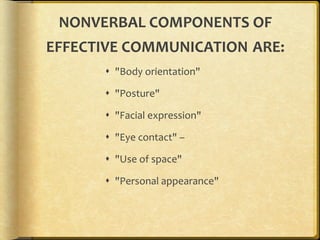
NONVERBAL COMPONENTS OF EFFECTIVE COMMUNICATION   ARE: "Body orientation"  "Posture"  "Facial expression"  "Eye contact" –  "Use of space" "Personal appearance"
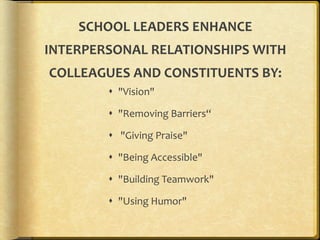
SCHOOL LEADERS ENHANCE INTERPERSONAL RELATIONSHIPS WITH COLLEAGUES AND CONSTITUENTS BY: "Vision" "Removing Barriers“ "Giving Praise"  "Being Accessible"  "Building Teamwork"  "Using Humor"

Effective communication

  • 1.
  • 2.
  • 3.
    Good Listeners don'tinterrupt, especially to correct mistakes or make points; don't judge; think before answering; face the speaker; are close enough to hear; watch nonverbal behavior; are aware of biases or values that distort what they hear; look for the feelings and basic assumptions underlying remarks; concentrate on what is being said; avoid rehearsing answers while the other person is talking; and don't insist on having the last word (Richard Gemmet 1977).
  • 4.
    SKILLS OF EFFECTIVECOMMUNICATORS "Asking questions" "Giving Feedback" "Paraphrasing" "Perception Checking" "Describing Behavior"
  • 5.
    NONVERBAL COMPONENTS OFEFFECTIVE COMMUNICATION ARE: "Body orientation" "Posture" "Facial expression" "Eye contact" – "Use of space" "Personal appearance"
  • 6.
    SCHOOL LEADERS ENHANCEINTERPERSONAL RELATIONSHIPS WITH COLLEAGUES AND CONSTITUENTS BY: "Vision" "Removing Barriers“ "Giving Praise" "Being Accessible" "Building Teamwork" "Using Humor"