Initiating Legal action against health
            care provider
       PATIENTS SAFETY… THE FIRST CONCERN


           DOCTORS ARE NOT INFALLIBLE


        EVERY MISTAKE IS NOT NEGLIGENCE


COURTS AND LEGAL RECOURSE IS NOT THE ONLY OPTION
TAKING LEGAL RECOURSE


 Accidents do happen. All mishaps are unfortunate but only
 some are because of medical negligence
 If possible, take an independent opinion before coming to
  conclusion of medical negligence.
 Give an opportunity to the doctor/hospital to explain their side.
 Think rationally, not emotionally– one false case can demoralize
  a good doctor for life.
 If still, you feel that the doctor/hospital is guilty, be prepared to
  take your case to its logical conclusion.
Don’t allow emotional outbreak take over..


 Ransacking hospitals or attacking doctors CAN put some on
  else’s life in danger.
 There is a law which empowers police to arrest the relatives and
  put them behind bars for this offence.
 It can reflect badly on your case later.
What are the options?


1. Criminal court or police: Gross negligence is extremely rare and
   difficult to prove

2. Consumer Court for compensation/ damages: Correct forum to
   approach

3. Maharashtra Medical Council ( disciplinary action): Only if they
   ethical issues are involved
Preparation for legal recourse


 Collect the certified copies of all the papers from the healthcare
  provider and mark them chronologically.
 You do not need the originals for this.
 Read , understand what has gone wrong.
 Find out whether these are known complications or no.
 Take help of independent professionals if need be.
Choosing a Lawyer


 Referral of friends, relatives, organisations.
 Practicing in this field requires aptitude, inclination and
 motivation to go the extra mile
 The conference- remember you have to tell all relevant facts,
 written brief helps, carry all papers and let him decide the
 relevance.
 Understand the limitations, achievable targets and timeline.
 In consumer courts you do not necessarily need a lawyer to
  represent you.
 You can your self do it. You can appoint an authorized
  representative.
 Be aware of lawyers who try to strike a deal of taking
  percentage of award from you. That is not legal in India.
 Be aware of doctors who may instigate for their internal
  professional rivalry
Understanding stages of proceedings


     Complaint
     Written statement
     Rejoinder
     Evidence
     Judgement
Heirarchy of consumer courts


District forum
State forum
National forum

Quantum of compensation decides the forum.
Lawyers fees may rise when you are going to
 higher forum
Myths: “Ask for more; you will get something!”
Truth: It may send derogatory signal.
Expert for evidence: difficulty in finding one


 It is hard to find an expert to depose as witness in
  the court.
 Experts may easily find faults, mistakes, errors in
  hind sight but it may be difficult to call it as
  “negligence.”
Is opinion of government doctor required?


 Jacob Mathew case: In criminal prosecution :yes.
 Martin F. D'Souza vs Mohd. Ishfaq: Rule extended to all
 V. Kishan Rao Versus Nikhil Super Speciality Hospital:
  Role restricted to criminal cases only.
BEFORE YOU GO TO THE POLICE/COURT


 Criminal prosecutions are normally for punishment and not
 compensation. The standard of proof to establish your case is
 that of gross negligence, which is rarely the case, hence high
 rate of acquittal.
 Advisable to pursue consumer disputes since compensation
 is awarded. Several instances of hospitals and doctors having
 to cough up hefty amounts of compensation.
 Need for a non-adversarial alternate dispute resolution
 mechanism which is where Patient Safety Alliance can play a
 role.
YOUR RIGHTS IN COURT


 RIGHT TO BE HEARD


 RIGHT TO BE ALLOWED
 REPRESENTATION

 RIGHT TO CERTIFIED COPIES
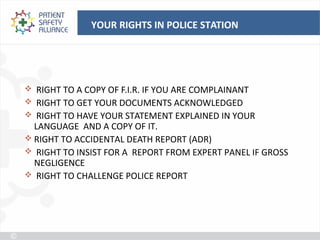
YOUR RIGHTS IN POLICE STATION


 RIGHT TO A COPY OF F.I.R. IF YOU ARE COMPLAINANT
 RIGHT TO GET YOUR DOCUMENTS ACKNOWLEDGED
 RIGHT TO HAVE YOUR STATEMENT EXPLAINED IN YOUR
  LANGUAGE AND A COPY OF IT.
 RIGHT TO ACCIDENTAL DEATH REPORT (ADR)
 RIGHT TO INSIST FOR A REPORT FROM EXPERT PANEL IF GROSS
  NEGLIGENCE
 RIGHT TO CHALLENGE POLICE REPORT
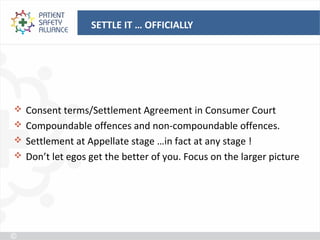
SETTLE IT … OFFICIALLY


 Consent terms/Settlement Agreement in Consumer Court
 Compoundable offences and non-compoundable offences.
 Settlement at Appellate stage …in fact at any stage !
 Don’t let egos get the better of you. Focus on the larger picture
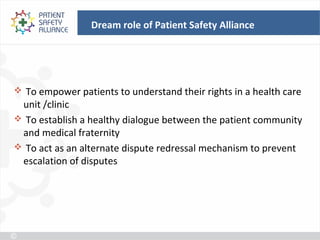
Dream role of Patient Safety Alliance


 To empower patients to understand their rights in a health care
 unit /clinic
 To establish a healthy dialogue between the patient community
 and medical fraternity
 To act as an alternate dispute redressal mechanism to prevent
 escalation of disputes
THANK YOU !
 ASHISH S. CHAVAN, ADVOCATE

Legal recourse

  • 1.
    Initiating Legal actionagainst health care provider PATIENTS SAFETY… THE FIRST CONCERN DOCTORS ARE NOT INFALLIBLE EVERY MISTAKE IS NOT NEGLIGENCE COURTS AND LEGAL RECOURSE IS NOT THE ONLY OPTION
  • 2.
    TAKING LEGAL RECOURSE Accidents do happen. All mishaps are unfortunate but only some are because of medical negligence  If possible, take an independent opinion before coming to conclusion of medical negligence.  Give an opportunity to the doctor/hospital to explain their side.  Think rationally, not emotionally– one false case can demoralize a good doctor for life.  If still, you feel that the doctor/hospital is guilty, be prepared to take your case to its logical conclusion.
  • 3.
    Don’t allow emotionaloutbreak take over..  Ransacking hospitals or attacking doctors CAN put some on else’s life in danger.  There is a law which empowers police to arrest the relatives and put them behind bars for this offence.  It can reflect badly on your case later.
  • 4.
    What are theoptions? 1. Criminal court or police: Gross negligence is extremely rare and difficult to prove 2. Consumer Court for compensation/ damages: Correct forum to approach 3. Maharashtra Medical Council ( disciplinary action): Only if they ethical issues are involved
  • 5.
    Preparation for legalrecourse  Collect the certified copies of all the papers from the healthcare provider and mark them chronologically.  You do not need the originals for this.  Read , understand what has gone wrong.  Find out whether these are known complications or no.  Take help of independent professionals if need be.
  • 6.
    Choosing a Lawyer Referral of friends, relatives, organisations.  Practicing in this field requires aptitude, inclination and motivation to go the extra mile  The conference- remember you have to tell all relevant facts, written brief helps, carry all papers and let him decide the relevance.  Understand the limitations, achievable targets and timeline.
  • 7.
     In consumercourts you do not necessarily need a lawyer to represent you.  You can your self do it. You can appoint an authorized representative.  Be aware of lawyers who try to strike a deal of taking percentage of award from you. That is not legal in India.  Be aware of doctors who may instigate for their internal professional rivalry
  • 8.
    Understanding stages ofproceedings  Complaint  Written statement  Rejoinder  Evidence  Judgement
  • 9.
    Heirarchy of consumercourts District forum State forum National forum Quantum of compensation decides the forum. Lawyers fees may rise when you are going to higher forum Myths: “Ask for more; you will get something!” Truth: It may send derogatory signal.
  • 10.
    Expert for evidence:difficulty in finding one  It is hard to find an expert to depose as witness in the court.  Experts may easily find faults, mistakes, errors in hind sight but it may be difficult to call it as “negligence.”
  • 11.
    Is opinion ofgovernment doctor required?  Jacob Mathew case: In criminal prosecution :yes.  Martin F. D'Souza vs Mohd. Ishfaq: Rule extended to all  V. Kishan Rao Versus Nikhil Super Speciality Hospital: Role restricted to criminal cases only.
  • 12.
    BEFORE YOU GOTO THE POLICE/COURT  Criminal prosecutions are normally for punishment and not compensation. The standard of proof to establish your case is that of gross negligence, which is rarely the case, hence high rate of acquittal.  Advisable to pursue consumer disputes since compensation is awarded. Several instances of hospitals and doctors having to cough up hefty amounts of compensation.  Need for a non-adversarial alternate dispute resolution mechanism which is where Patient Safety Alliance can play a role.
  • 13.
    YOUR RIGHTS INCOURT  RIGHT TO BE HEARD  RIGHT TO BE ALLOWED REPRESENTATION  RIGHT TO CERTIFIED COPIES
  • 14.
    YOUR RIGHTS INPOLICE STATION  RIGHT TO A COPY OF F.I.R. IF YOU ARE COMPLAINANT  RIGHT TO GET YOUR DOCUMENTS ACKNOWLEDGED  RIGHT TO HAVE YOUR STATEMENT EXPLAINED IN YOUR LANGUAGE AND A COPY OF IT.  RIGHT TO ACCIDENTAL DEATH REPORT (ADR)  RIGHT TO INSIST FOR A REPORT FROM EXPERT PANEL IF GROSS NEGLIGENCE  RIGHT TO CHALLENGE POLICE REPORT
  • 15.
    SETTLE IT …OFFICIALLY  Consent terms/Settlement Agreement in Consumer Court  Compoundable offences and non-compoundable offences.  Settlement at Appellate stage …in fact at any stage !  Don’t let egos get the better of you. Focus on the larger picture
  • 16.
    Dream role ofPatient Safety Alliance  To empower patients to understand their rights in a health care unit /clinic  To establish a healthy dialogue between the patient community and medical fraternity  To act as an alternate dispute redressal mechanism to prevent escalation of disputes
  • 17.
    THANK YOU ! ASHISH S. CHAVAN, ADVOCATE