Broken Promises: Helping
Employees Cope With Income
Losses and Benefit Reductions
            Barbara O’Neill
     Rutgers Cooperative Extension
       oneill@aesop.rutgers.edu
What’s Happening?
Workers can’t even count on income and
benefits promised in their CURRENT labor
contract, not to mention promises made
years ago when they were first hired.
Era of Broken Promises
• Terminated pensions

• “Church plan” pension exemptions from ERISA

• Suspended 401(k) matches

• Salary cuts and freezes

• Furloughs

• Benefit cuts

• Pension COLA cuts

• Others
Key Themes During Past Few Years
      Peggy Noonan reply to question from Maria
      Bartiromo about “game-changing events
      during 2011” on Wall Street Journal Report,
      1/1/12
      “The fall of structures that we’ve come to
      rely on” and “Lots of insecurity”


4
More Evidence of Broken Promises
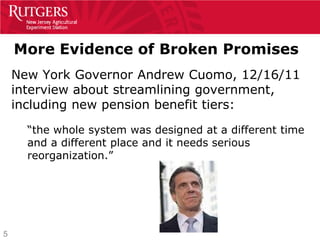
    New York Governor Andrew Cuomo, 12/16/11
    interview about streamlining government,
    including new pension benefit tiers:
      “the whole system was designed at a different time
      and a different place and it needs serious
      reorganization.”


5
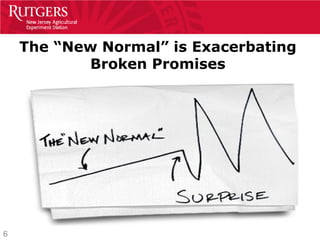
The “New Normal” is Exacerbating
           Broken Promises


6
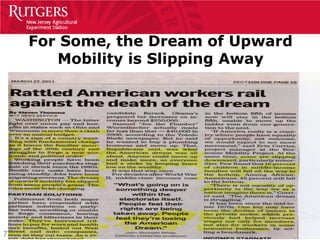
For Some, the Dream of Upward
       Mobility is Slipping Away


7
The Real Cause of All the Anger
             While recent media reports have
             covered angry protests directed at
             public employees whose pension and
             health benefit packages lasted longer
             than most in the private sector…

     …the REAL ISSUE is that workers in
     both the public and private sector
     have lost critical pillars of financial
     planning support that they once
     thought they could count on!
8
More Background
• Increasing numbers of public (and private) sector job
  benefits have been overhauled
    – Employers realizing previously-promised benefits are
      unsustainable and/or unaffordable

    – Politically popular to slash public employee benefits

• More than half of public pensions are <80% funded

    – < 80% level deemed “substantially underfunded”

• Defined benefit (DB) pension formulas and COLAs
  especially under attack

9
Why the Concern About DB
             Public Worker Pensions?
     • Employers bear the risk of providing formula-based
       benefits calculated from:
         – Highest salary levels (e.g., 3- or 5-year average)

         – Years of service

     • Greater life expectancy, medical advances

     • Pension contribution under-funding

     •   Unrealistic growth assumptions


10
Frequent Pension Plan Changes
     • Lower benefit tiers for new hires
     • Retirement ages raised (e.g., 55 to 60, 62 to 65)
     • Automatic COLAs eliminated or scaled back
     • COLAs tied to pension plan performance
     • Changes in pension benefit formulas
       – Elimination of “sick day” bonuses

       – Change from “High 3” average salary formula to
         “High 5”
11
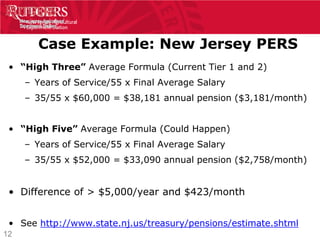
Case Example: New Jersey PERS
 • “High Three” Average Formula (Current Tier 1 and 2)
     – Years of Service/55 x Final Average Salary
     – 35/55 x $60,000 = $38,181 annual pension ($3,181/month)


 • “High Five” Average Formula (Could Happen)
     – Years of Service/55 x Final Average Salary
     – 35/55 x $52,000 = $33,090 annual pension ($2,758/month)


 • Difference of > $5,000/year and $423/month


 • See http://www.state.nj.us/treasury/pensions/estimate.shtml
12
Health Benefit Challenges
 • Workers’ coverage is decreasing and/or they
   are increasingly paying more for:
     – Premiums
     – Deductibles
     – Co-payments
 • From 2000 to 2010, average premiums for
   family coverage through an employer
   increased 114%
 • More employees’ ONLY option is high-
   deductible health insurance
13
More About High-Deductible Plans
 • Moderately lower premiums than traditional plans

 • Twice the deductible of conventional health insurance
     – $1,908 average deductible (2011 Kaiser survey) vs. < $1,000

 • Now the ONLY benefit option at Wells Fargo, General
   Electric, American Express
     – Public sector employees will be next!!!


 • Often tied to Health Savings Accounts (HSAs)
     – Tax-free employee savings accounts to cover deductible and
       other medical costs

14
More About High-Deductible Plans
 • Percentage of workers enrolled in high-deductible
   health plans quadrupled from 2006 to 2011.
 • Often called “consumer-driven health plans”
 • Encourages consumers to be more conscious of
   medical-care costs; comparison shopping is difficult
 • 2011 quote from health insurance company CEO:
   “It’s safe to say we expect enrollment in consumer-
   driven health plans to continue to grow.”


15
So What Do All These Changes Mean?
 • Any income or benefit promise can be broken…even
   in union contracts

 • NO employee benefit is “guaranteed”

 • New economic realities require adjustment to avoid
     – Accumulating debt due to negative cash flow

     – Setting aside inadequate retirement savings

     – Outliving retirement assets

 • Proactive planning can mitigate benefit losses
16
The Consequences of Inaction are
                Serious
 Example: 30 year suspension of COLAs on NJ state
 pensions (legislated in 2011)

 • Inflation effects will be corrosive (e.g., 4%)

     –   $10,000 annual pension payment at age 55

     –   Purchasing power of $4,563 in 20 years

     –   Purchasing power of $3,083 in 30 years


17
Beware of “Stampedes”
 • Employees heading for the door in droves fearing
   that an employer will cut benefits
 • Employers could cut benefits anyway (no guarantees
   that you’ll be “grandfathered”)
 • Examples:
     – NJ state workers, teachers, uniformed personnel
     – Federal government workers?
 • In many cases, longer service will mitigate benefit
   reductions (e.g., loss of COLAs)
     – Increases “Years of Service” part of DB pension formula

18
How Do People Adjust to Broken
                  Promises?
     • Increase income

     • Reduce expenses

     • Save more money

     • Reduce retirement lifestyle expectations
         – Lower-cost housing and/or geographic area

         – Less travel, gifting, entertainment

     •   Work longer than originally planned

     •   Ask family members for help
19
What to Do When Your
               Income/Benefits are Cut
     • Work longer
     • “Retire” while working
     • Accelerate debt repayment
     • Save the shortfall
     • Consider career changes and/or freelancing
     • Consider investing more aggressively
     • Control investment expenses
     • Spend less and shop savvy
     • Investigate new benefit alternatives
     • Define “success” differently
20
Work Longer
 • Time is an enemy (twice) for early retirees
     – Fewer working years to accumulate personal
       savings, pension benefits, and SS
     – More non-working years to finance
 • The years just prior to normal retirement age
   are usually a period of peak earnings
 • May have more control over “service” part of
   DB pension formula than “average earnings”
     – Example: tenured professor with a pay freeze
21
“Retire” While Working
• Standard Strategy #1- Retire at a planned age with less
  money than anticipated due to NN events and risk running out
  of money due to benefit cutbacks, increased health care costs,
  longevity, etc.
• Standard Strategy #2- Retire later and risk “waiting too long”
  (e.g., after age 65-70) so that death, health “issues,”
  widowhood, etc. hinder planned retirement lifestyle and/or
  quality of life.
• New Strategy #3- Keep working BUT use money that had
  been going into savings (i.e., suspend or reduce 401(k) or
  403(b) contributions) to begin enjoying “retirement activities”
  NOW without actually retiring.
     https://www2.troweprice.com/iws/wps/wcm/connect/d2edab0046d7abf0a87eb899d3
     5c25cc/04779-
     23_P1.pdf?MOD=AJPERES&CACHEID=d2edab0046d7abf0a87eb899d35c25cc
     (Fahlund, C. Delaying Retirement, But Not Your Retirement Dreams)
22
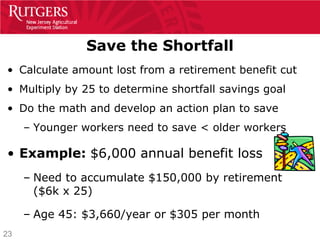
Save the Shortfall
• Calculate amount lost from a retirement benefit cut
• Multiply by 25 to determine shortfall savings goal
• Do the math and develop an action plan to save
     – Younger workers need to save < older workers

• Example: $6,000 annual benefit loss
     – Need to accumulate $150,000 by retirement
       ($6k x 25)

     – Age 45: $3,660/year or $305 per month
23
Consider Career Changes and/or
               Freelancing
 • Public sector employment benefits are generally not
   as attractive as they once were
     – Newer tier hires often have lower benefit tiers
 • Option #1: Changing jobs could lead to better
   benefits; less stress
 • Option #2: Aggressively demonstrate value to
   current employer (to earn a promotion)
 • Option #3: Freelance for additional income or to
   replace lost income due to benefit plan changes
     – Increased health insurance cost-sharing
     – Increased pension plan contributions
24
Consider Investing More Aggressively
 • Even with elimination of COLAs, people with DB
   pensions have income for life (acts like an annuity)

     – Ditto for Social Security

 • Most retirees with DC plans have risk of an ever-
   changing sum of money that needs to last a lifetime

 • May be able to invest more aggressively if you have
   streams of lifetime income

 • Know your risk tolerance:
   http://njaes.rutgers.edu/money/riskquiz/

25
Spend Less and Shop Savvy
• Unpleasant as it is, you may need to spend less to
  adjust to the effects of broken promises
• Adjusting to less support from an employer or
  government may be a necessity, not an option

     – “Stepping down” spending
     – Moving to a smaller/cheaper home
     – Phone apps to compare prices
     – Coupons and groupons
     – Asking for discounts
     – Fewer trips and gifts (e.g., retirees)
     – Other ideas?
26
Investigate New Benefit Alternatives
• Explore benefit options that you might not
  have considered previously
     – High-deductible health insurance and an HSA or
       HRA
• Do a cost-benefit analysis of alternatives
     – Premium savings from high-deductible plan vs.
       amount of out-of-pocket payment
 • Attend benefit fairs/seminars and ask
   questions
27
Keep an Eye on Government Benefits
 • Changes to Social Security

     – More needs-based? Older age? Lower benefits?

 • Changes to Medicare

     – More needs-based? Older age? Lower benefits?

 • New health care law and aftermath

 • Consider using very conservative benefit estimates
   for financial planning purposes

 • Assume that you can’t count on promised benefits?
28
Major Take-Away:
      Focus on What You CAN Control
CAN’T Control                  CAN Control
• Speed of economic recovery   • Healthy lifestyle
• Financial markets            • Spending habits
• Labor market/unemployment    • Saving habits
  rate
                               • Investment expenses
• Housing market
                               • Human capital investments
• Employee benefit cutbacks
                               • How you spend your time
• Political environment

• Actions of lawmakers
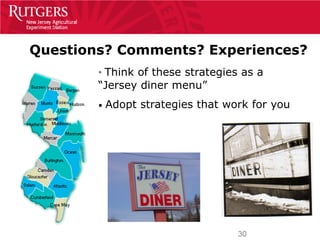
Questions? Comments? Experiences?
        • Think of these strategies as a
        “Jersey diner menu”
        •   Adopt strategies that work for you


                                    30

EFERMA 2012 Workshop #1-Broken Promises-02-12

  • 1.
    Broken Promises: Helping EmployeesCope With Income Losses and Benefit Reductions Barbara O’Neill Rutgers Cooperative Extension oneill@aesop.rutgers.edu
  • 2.
    What’s Happening? Workers can’teven count on income and benefits promised in their CURRENT labor contract, not to mention promises made years ago when they were first hired.
  • 3.
    Era of BrokenPromises • Terminated pensions • “Church plan” pension exemptions from ERISA • Suspended 401(k) matches • Salary cuts and freezes • Furloughs • Benefit cuts • Pension COLA cuts • Others
  • 4.
    Key Themes DuringPast Few Years Peggy Noonan reply to question from Maria Bartiromo about “game-changing events during 2011” on Wall Street Journal Report, 1/1/12 “The fall of structures that we’ve come to rely on” and “Lots of insecurity” 4
  • 5.
    More Evidence ofBroken Promises New York Governor Andrew Cuomo, 12/16/11 interview about streamlining government, including new pension benefit tiers: “the whole system was designed at a different time and a different place and it needs serious reorganization.” 5
  • 6.
    The “New Normal”is Exacerbating Broken Promises 6
  • 7.
    For Some, theDream of Upward Mobility is Slipping Away 7
  • 8.
    The Real Causeof All the Anger While recent media reports have covered angry protests directed at public employees whose pension and health benefit packages lasted longer than most in the private sector… …the REAL ISSUE is that workers in both the public and private sector have lost critical pillars of financial planning support that they once thought they could count on! 8
  • 9.
    More Background • Increasingnumbers of public (and private) sector job benefits have been overhauled – Employers realizing previously-promised benefits are unsustainable and/or unaffordable – Politically popular to slash public employee benefits • More than half of public pensions are <80% funded – < 80% level deemed “substantially underfunded” • Defined benefit (DB) pension formulas and COLAs especially under attack 9
  • 10.
    Why the ConcernAbout DB Public Worker Pensions? • Employers bear the risk of providing formula-based benefits calculated from: – Highest salary levels (e.g., 3- or 5-year average) – Years of service • Greater life expectancy, medical advances • Pension contribution under-funding • Unrealistic growth assumptions 10
  • 11.
    Frequent Pension PlanChanges • Lower benefit tiers for new hires • Retirement ages raised (e.g., 55 to 60, 62 to 65) • Automatic COLAs eliminated or scaled back • COLAs tied to pension plan performance • Changes in pension benefit formulas – Elimination of “sick day” bonuses – Change from “High 3” average salary formula to “High 5” 11
  • 12.
    Case Example: NewJersey PERS • “High Three” Average Formula (Current Tier 1 and 2) – Years of Service/55 x Final Average Salary – 35/55 x $60,000 = $38,181 annual pension ($3,181/month) • “High Five” Average Formula (Could Happen) – Years of Service/55 x Final Average Salary – 35/55 x $52,000 = $33,090 annual pension ($2,758/month) • Difference of > $5,000/year and $423/month • See http://www.state.nj.us/treasury/pensions/estimate.shtml 12
  • 13.
    Health Benefit Challenges • Workers’ coverage is decreasing and/or they are increasingly paying more for: – Premiums – Deductibles – Co-payments • From 2000 to 2010, average premiums for family coverage through an employer increased 114% • More employees’ ONLY option is high- deductible health insurance 13
  • 14.
    More About High-DeductiblePlans • Moderately lower premiums than traditional plans • Twice the deductible of conventional health insurance – $1,908 average deductible (2011 Kaiser survey) vs. < $1,000 • Now the ONLY benefit option at Wells Fargo, General Electric, American Express – Public sector employees will be next!!! • Often tied to Health Savings Accounts (HSAs) – Tax-free employee savings accounts to cover deductible and other medical costs 14
  • 15.
    More About High-DeductiblePlans • Percentage of workers enrolled in high-deductible health plans quadrupled from 2006 to 2011. • Often called “consumer-driven health plans” • Encourages consumers to be more conscious of medical-care costs; comparison shopping is difficult • 2011 quote from health insurance company CEO: “It’s safe to say we expect enrollment in consumer- driven health plans to continue to grow.” 15
  • 16.
    So What DoAll These Changes Mean? • Any income or benefit promise can be broken…even in union contracts • NO employee benefit is “guaranteed” • New economic realities require adjustment to avoid – Accumulating debt due to negative cash flow – Setting aside inadequate retirement savings – Outliving retirement assets • Proactive planning can mitigate benefit losses 16
  • 17.
    The Consequences ofInaction are Serious Example: 30 year suspension of COLAs on NJ state pensions (legislated in 2011) • Inflation effects will be corrosive (e.g., 4%) – $10,000 annual pension payment at age 55 – Purchasing power of $4,563 in 20 years – Purchasing power of $3,083 in 30 years 17
  • 18.
    Beware of “Stampedes” • Employees heading for the door in droves fearing that an employer will cut benefits • Employers could cut benefits anyway (no guarantees that you’ll be “grandfathered”) • Examples: – NJ state workers, teachers, uniformed personnel – Federal government workers? • In many cases, longer service will mitigate benefit reductions (e.g., loss of COLAs) – Increases “Years of Service” part of DB pension formula 18
  • 19.
    How Do PeopleAdjust to Broken Promises? • Increase income • Reduce expenses • Save more money • Reduce retirement lifestyle expectations – Lower-cost housing and/or geographic area – Less travel, gifting, entertainment • Work longer than originally planned • Ask family members for help 19
  • 20.
    What to DoWhen Your Income/Benefits are Cut • Work longer • “Retire” while working • Accelerate debt repayment • Save the shortfall • Consider career changes and/or freelancing • Consider investing more aggressively • Control investment expenses • Spend less and shop savvy • Investigate new benefit alternatives • Define “success” differently 20
  • 21.
    Work Longer •Time is an enemy (twice) for early retirees – Fewer working years to accumulate personal savings, pension benefits, and SS – More non-working years to finance • The years just prior to normal retirement age are usually a period of peak earnings • May have more control over “service” part of DB pension formula than “average earnings” – Example: tenured professor with a pay freeze 21
  • 22.
    “Retire” While Working •Standard Strategy #1- Retire at a planned age with less money than anticipated due to NN events and risk running out of money due to benefit cutbacks, increased health care costs, longevity, etc. • Standard Strategy #2- Retire later and risk “waiting too long” (e.g., after age 65-70) so that death, health “issues,” widowhood, etc. hinder planned retirement lifestyle and/or quality of life. • New Strategy #3- Keep working BUT use money that had been going into savings (i.e., suspend or reduce 401(k) or 403(b) contributions) to begin enjoying “retirement activities” NOW without actually retiring. https://www2.troweprice.com/iws/wps/wcm/connect/d2edab0046d7abf0a87eb899d3 5c25cc/04779- 23_P1.pdf?MOD=AJPERES&CACHEID=d2edab0046d7abf0a87eb899d35c25cc (Fahlund, C. Delaying Retirement, But Not Your Retirement Dreams) 22
  • 23.
    Save the Shortfall •Calculate amount lost from a retirement benefit cut • Multiply by 25 to determine shortfall savings goal • Do the math and develop an action plan to save – Younger workers need to save < older workers • Example: $6,000 annual benefit loss – Need to accumulate $150,000 by retirement ($6k x 25) – Age 45: $3,660/year or $305 per month 23
  • 24.
    Consider Career Changesand/or Freelancing • Public sector employment benefits are generally not as attractive as they once were – Newer tier hires often have lower benefit tiers • Option #1: Changing jobs could lead to better benefits; less stress • Option #2: Aggressively demonstrate value to current employer (to earn a promotion) • Option #3: Freelance for additional income or to replace lost income due to benefit plan changes – Increased health insurance cost-sharing – Increased pension plan contributions 24
  • 25.
    Consider Investing MoreAggressively • Even with elimination of COLAs, people with DB pensions have income for life (acts like an annuity) – Ditto for Social Security • Most retirees with DC plans have risk of an ever- changing sum of money that needs to last a lifetime • May be able to invest more aggressively if you have streams of lifetime income • Know your risk tolerance: http://njaes.rutgers.edu/money/riskquiz/ 25
  • 26.
    Spend Less andShop Savvy • Unpleasant as it is, you may need to spend less to adjust to the effects of broken promises • Adjusting to less support from an employer or government may be a necessity, not an option – “Stepping down” spending – Moving to a smaller/cheaper home – Phone apps to compare prices – Coupons and groupons – Asking for discounts – Fewer trips and gifts (e.g., retirees) – Other ideas? 26
  • 27.
    Investigate New BenefitAlternatives • Explore benefit options that you might not have considered previously – High-deductible health insurance and an HSA or HRA • Do a cost-benefit analysis of alternatives – Premium savings from high-deductible plan vs. amount of out-of-pocket payment • Attend benefit fairs/seminars and ask questions 27
  • 28.
    Keep an Eyeon Government Benefits • Changes to Social Security – More needs-based? Older age? Lower benefits? • Changes to Medicare – More needs-based? Older age? Lower benefits? • New health care law and aftermath • Consider using very conservative benefit estimates for financial planning purposes • Assume that you can’t count on promised benefits? 28
  • 29.
    Major Take-Away: Focus on What You CAN Control CAN’T Control CAN Control • Speed of economic recovery • Healthy lifestyle • Financial markets • Spending habits • Labor market/unemployment • Saving habits rate • Investment expenses • Housing market • Human capital investments • Employee benefit cutbacks • How you spend your time • Political environment • Actions of lawmakers
  • 30.
    Questions? Comments? Experiences? • Think of these strategies as a “Jersey diner menu” • Adopt strategies that work for you 30