English file Upper-
Intermediate
Unit 3A – Narrative tenses
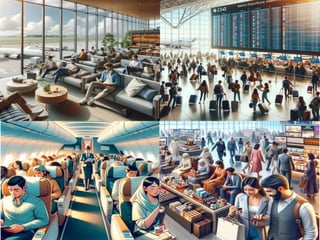
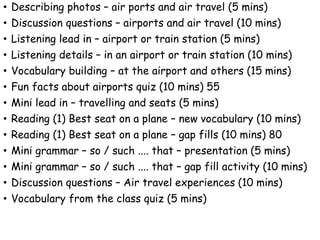
• Describing photos – air ports and air travel (5 mins)
• Discussion questions – airports and air travel (10 mins)
• Listening lead in – airport or train station (5 mins)
• Listening details – in an airport or train station (10 mins)
• Vocabulary building – at the airport and others (15 mins)
• Fun facts about airports quiz (10 mins) 55
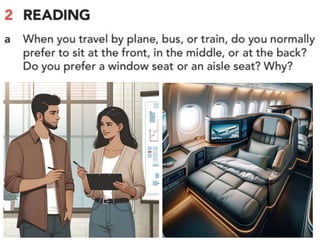
• Mini lead in – travelling and seats (5 mins)
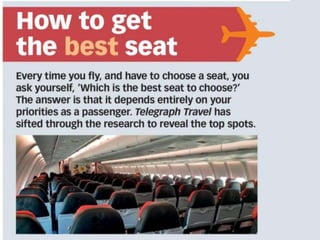
• Reading (1) Best seat on a plane – new vocabulary (10 mins)
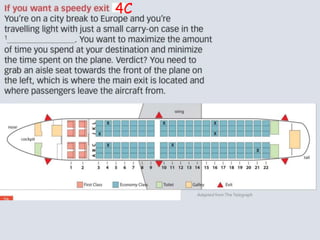
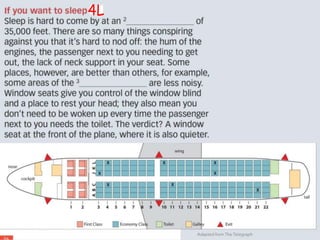
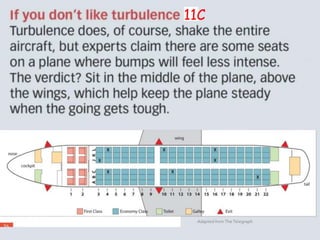
• Reading (1) Best seat on a plane – gap fills (10 mins) 80
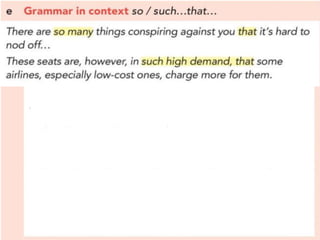
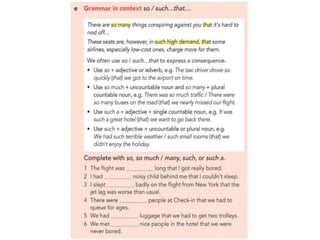
• Mini grammar – so / such .... that – presentation (5 mins)
• Mini grammar – so / such .... that – gap fill activity (10 mins)
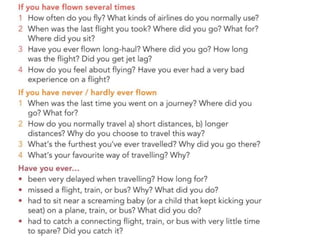
• Discussion questions – Air travel experiences (10 mins)
• Vocabulary from the class quiz (5 mins)
• If you could fly anywhere right now, where would you go
and why?
• How do you pass the time when you are at the airport?
• What's your packing strategy: are you a light packer or do
you prefer to take lots of items "just in case"?
• Do you enjoy duty-free shopping? What's the best thing
you've ever bought at an airport?
• Share a funny or unusual experience you had during a
flight.
• How do you feel about airplane food? Do you have a
memorable meal you've had on a flight?
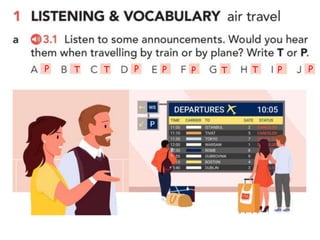
P T T P P P T T P P
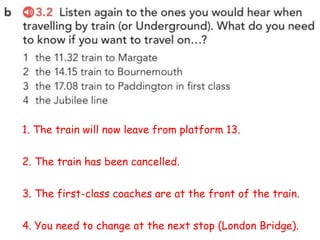
1. The train will now leave from platform 13.
2. The train has been cancelled.
3. The first-class coaches are at the front of the train.
4. You need to change at the next stop (London Bridge).
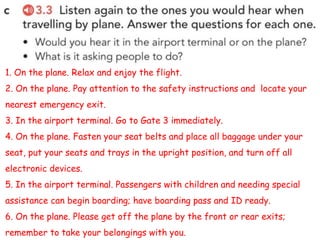
1. On the plane. Relax and enjoy the flight.
2. On the plane. Pay attention to the safety instructions and locate your
nearest emergency exit.
3. In the airport terminal. Go to Gate 3 immediately.
4. On the plane. Fasten your seat belts and place all baggage under your
seat, put your seats and trays in the upright position, and turn off all
electronic devices.
5. In the airport terminal. Passengers with children and needing special
assistance can begin boarding; have boarding pass and ID ready.
6. On the plane. Please get off the plane by the front or rear exits;
remember to take your belongings with you.
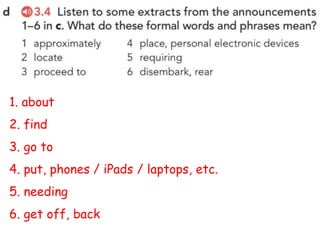
1. about
2. find
3. go to
4. put, phones / iPads / laptops, etc.
5. needing
6. get off, back
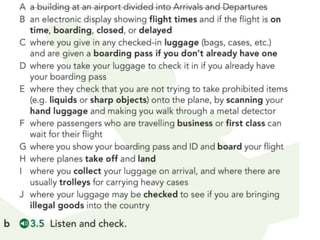
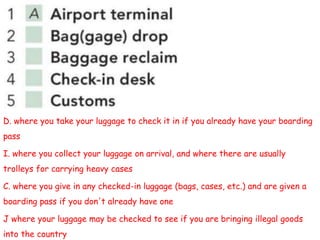
D. where you take your luggage to check it in if you already have your boarding
pass
I. where you collect your luggage on arrival, and where there are usually
trolleys for carrying heavy cases
C. where you give in any checked-in luggage (bags, cases, etc.) and are given a
boarding pass if you don't already have one
J where your luggage may be checked to see if you are bringing illegal goods
into the country
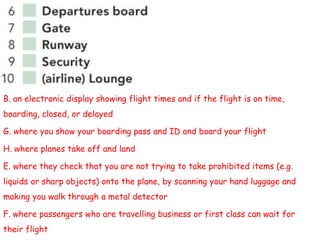
B. an electronic display showing flight times and if the flight is on time,
boarding, closed, or delayed
G. where you show your boarding pass and ID and board your flight
H. where planes take off and land
E. where they check that you are not trying to take prohibited items (e.g.
liquids or sharp objects) onto the plane, by scanning your hand luggage and
making you walk through a metal detector
F. where passengers who are travelling business or first class can wait for
their flight
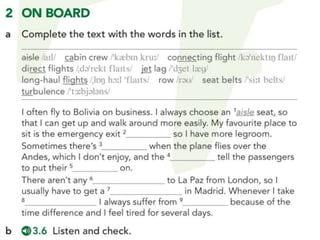
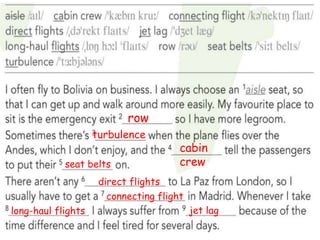
row
turbulence
cabin
crew
seat belts
direct flights
connecting flight
long-haul flights jet lag
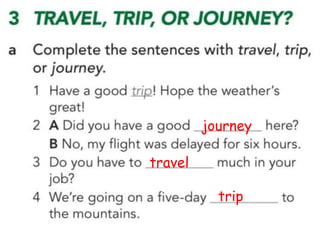
journey
travel
trip
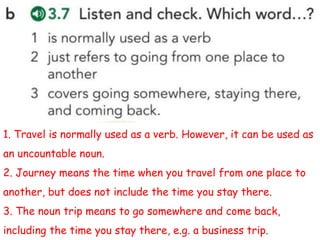
1. Travel is normally used as a verb. However, it can be used as
an uncountable noun.
2. Journey means the time when you travel from one place to
another, but does not include the time you stay there.
3. The noun trip means to go somewhere and come back,
including the time you stay there, e.g. a business trip.
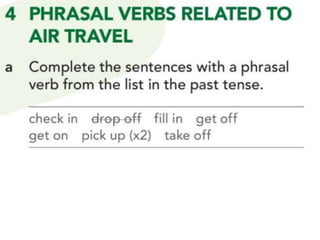
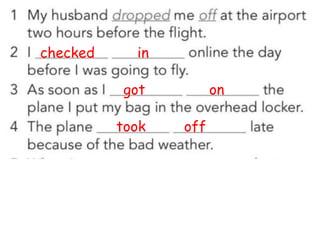
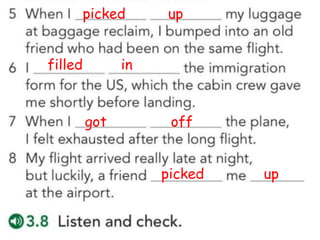
checked in
got on
took off
picked up
filled in
got off
picked up
What unusual feature can you find at Singapore Changi
Airport?
a. A butterfly garden
b. An indoor rainforest
c. A rooftop swimming pool
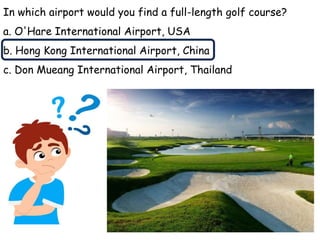
In which airport would you find a full-length golf course?
a. O'Hare International Airport, USA
b. Hong Kong International Airport, China
c. Don Mueang International Airport, Thailand
What can you do while waiting for your flight at Munich
Airport, Germany?
a. Take a surfing lesson
b. Brew your own beer
c. Enjoy a movie at a cinema
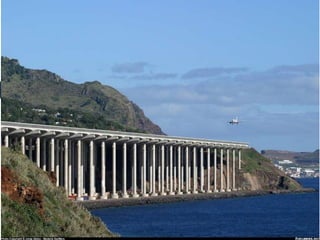
What distinctive feature does the Madeira Airport in Portugal
have?
a. It is on an artificial island
b. It has a beach beneath the landing approach
c. Its runway is supported by columns
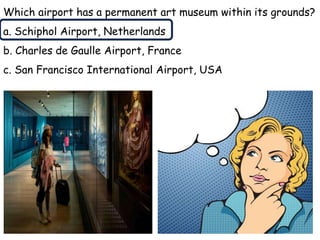
Which airport has a permanent art museum within its grounds?
a. Schiphol Airport, Netherlands
b. Charles de Gaulle Airport, France
c. San Francisco International Airport, USA
What did Gatwick Airport in the UK introduce to help
passengers with the boarding process?
a. Personalized holographic boarding assistants
b. An app that guides you through the airport with AR
c. Automated boarding by facial recognition
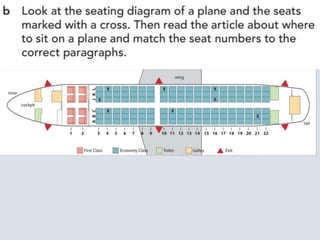
4C
4L
11C
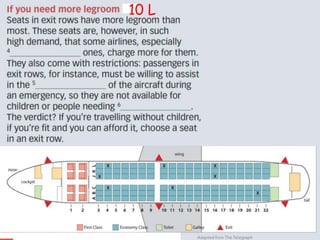
10 L
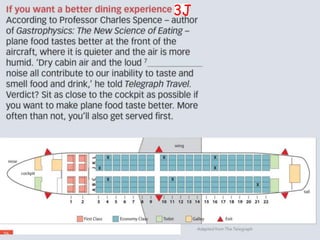
3J
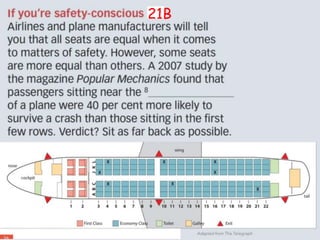
21B
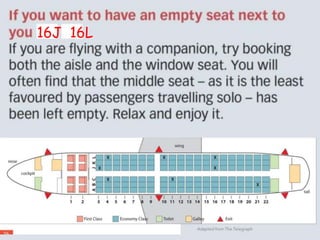
16J 16L
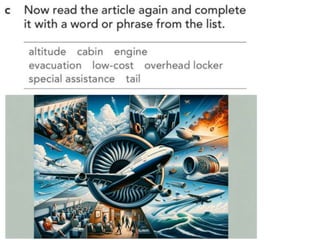
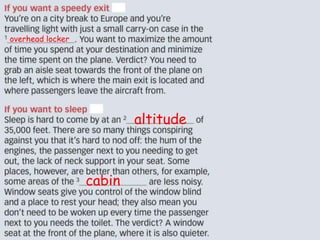
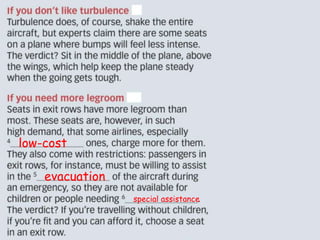
overhead locker
altitude
cabin
low-cost
evacuation
special assistance
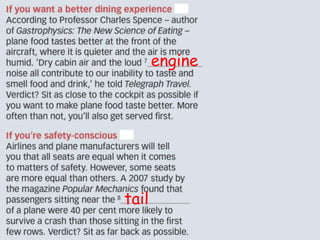
engine
tail
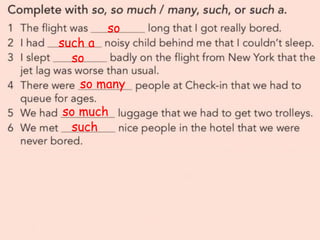
so
such a
so
so many
so much
such
Speaking
Activity
Long turn practice
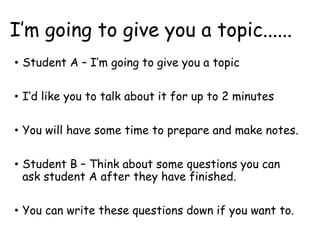
I’m going to give you a topic......
• Student A – I’m going to give you a topic
• I’d like you to talk about it for up to 2 minutes
• You will have some time to prepare and make notes.
• Student B – Think about some questions you can
ask student A after they have finished.
• You can write these questions down if you want to.
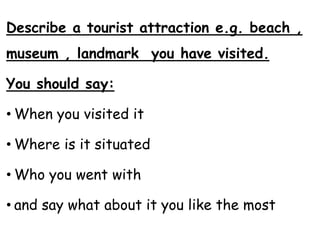
Describe a tourist attraction e.g. beach ,
museum , landmark you have visited.
You should say:
• When you visited it
• Where is it situated
• Who you went with
• and say what about it you like the most
Now change roles
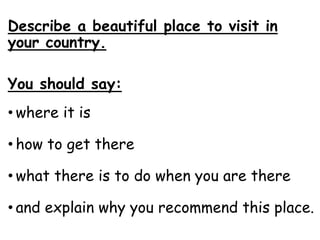
Describe a beautiful place to visit in
your country.
You should say:
• where it is
• how to get there
• what there is to do when you are there
• and explain why you recommend this place.
Class 2
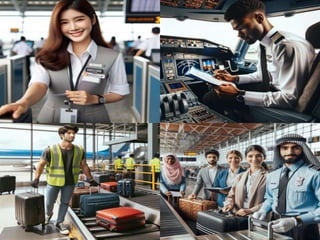
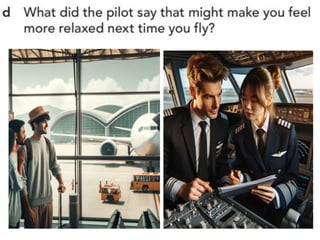
• Describing photos – jobs in air travel (5 mins)
• Discussion questions – jobs in air ports (10 mins)
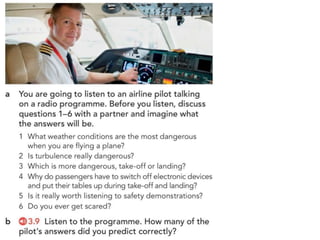
• Listening (1) Interview with a pilot – general (5 mins)
• Listening (1) Interview with a pilot – details (5 mins)
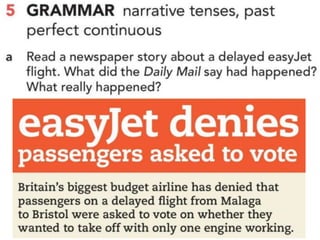
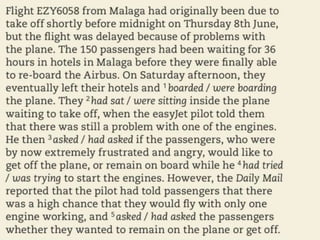
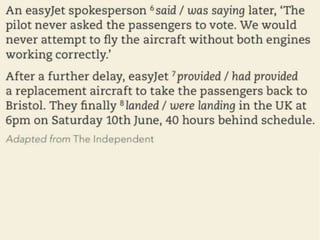
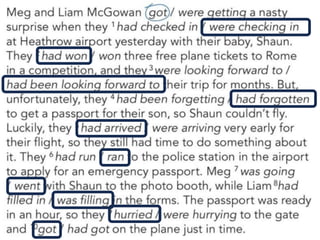
• Grammar – narrative tenses – highlighting (5 mins)
• Grammar – narrative tenses – exercise (5 mins)
• Grammar – narrative tenses – presentation (5 mins)
• Grammar – narrative tenses – exercises (15 mins) 55
• Game / filler (10 mins)
• Pronunciation focus – irregular past forms (10 mins)
• Listening practice – anecdote verbs (5 mins)
• Speaking practice – split anecdotes (10 mins)
• Speaking practice – personal anecdotes (10 mins) 100
• Speaking practice – Personalised speaking -travel (10 mins)
• Vocabulary from the class quiz (5 mins)
• If you could choose any job at the airport, which
one would you pick and why?
• What do you think are the most challenging aspects
of being a pilot?
• How important are language skills for a flight
attendant who travels internationally?
• How has technology changed the way people work in
air travel jobs?
• Discuss the role of customer service in the airport.
Why is it so crucial?
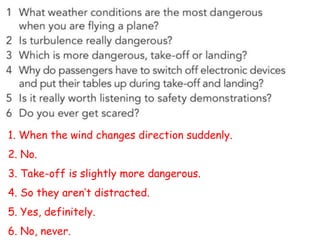
1. When the wind changes direction suddenly.
2. No.
3. Take-off is slightly more dangerous.
4. So they aren’t distracted.
5. Yes, definitely.
6. No, never.
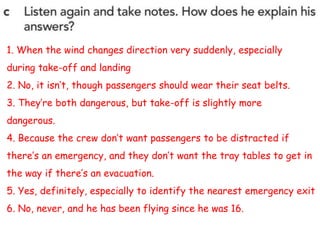
1. When the wind changes direction very suddenly, especially
during take-off and landing
2. No, it isn’t, though passengers should wear their seat belts.
3. They’re both dangerous, but take-off is slightly more
dangerous.
4. Because the crew don’t want passengers to be distracted if
there’s an emergency, and they don’t want the tray tables to get in
the way if there’s an evacuation.
5. Yes, definitely, especially to identify the nearest emergency exit
6. No, never, and he has been flying since he was 16.
1. When the wind changes direction very suddenly, especially
during take-off and landing
2. No, it isn’t, though passengers should wear their seat belts.
3. They’re both dangerous, but take-off is slightly more
dangerous.
4. Because the crew don’t want passengers to be distracted if
there’s an emergency, and they don’t want the tray tables to get in
the way if there’s an evacuation.
5. Yes, definitely, especially to identify the nearest emergency exit
6. No, never, and he has been flying since he was 16.
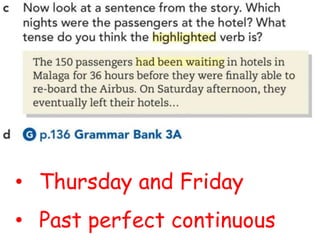
• Thursday and Friday
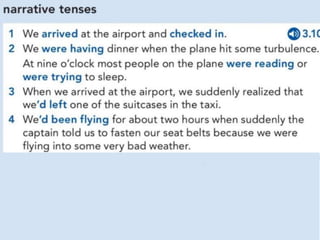
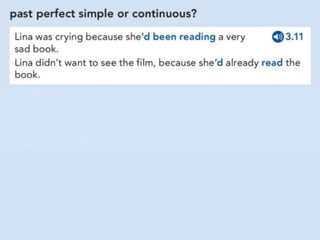
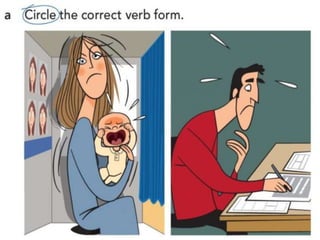
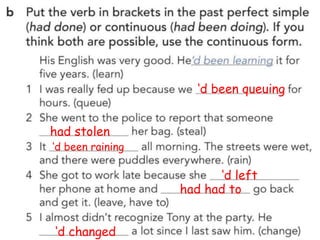
• Past perfect continuous
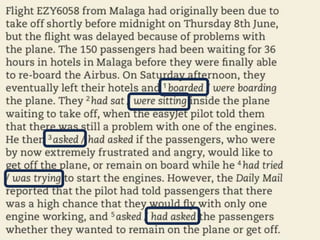
‘d been queuing
had stolen
‘d been raining
‘d left
had had to
‘d changed
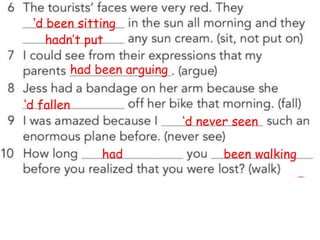
‘d been sitting
hadn’t put
had been arguing
‘d fallen
‘d never seen
had been walking
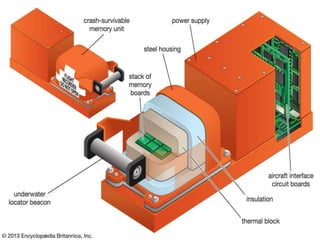
What colour are the black boxes in aircraft for ease of
locating after an accident?
a. Red
b. Black
c. Bright orange
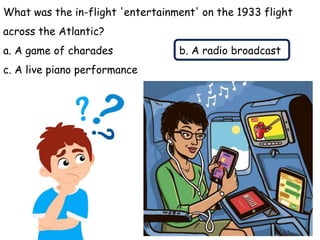
What was the in-flight 'entertainment' on the 1933 flight
across the Atlantic?
a. A game of charades b. A radio broadcast
c. A live piano performance
Answer: b. A radio broadcast
How did early pilots navigate before modern instruments?
a. They followed the stars
b. They guessed based on the wind
c. They used landmarks and road maps
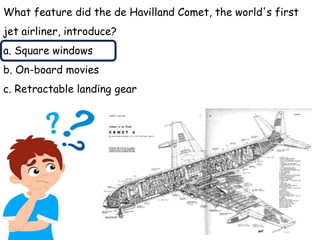
What feature did the de Havilland Comet, the world's first
jet airliner, introduce?
a. Square windows
b. On-board movies
c. Retractable landing gear
What was the initial purpose of the now universally recognized
aircraft call sign "Mayday"?
a. It’s an anglicization of the French 'm’aidez', meaning 'help me'.
b. It was the name of the inventor of the radio distress call.
c. It indicated the first day of May, historically a day for
celebration in aviation.
How were cats involved in early aircraft history?
a. They were kept as mascots for good luck.
b. They were used in weightlessness experiments.
c. They were believed to sense upcoming turbulence.
Talking about you
• You are going to answer some questions
about your experiences with travel.
• You will take it in turns to answer a
question.
• The other person should ask TWO follow
up questions about what they have said.
• You will do this twice each.
Think about a time when....
•(A) you visited a new place for the first
time.
-(B)Ask 2 follow up questions about what
they said
•(A) you discovered a new tourist
destination.
- (B) Ask 2 follow up questions about
what they said
Think about a time when....
• (A) You had a negative experience while
travelling.
- (B) Ask 2 follow up questions about what they
said
• (A) You travelled in an unusual way.
- (B) Ask 2 follow up questions about what they
said
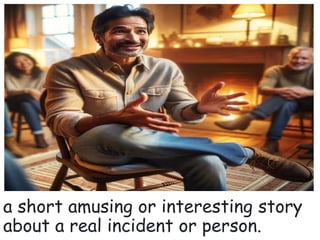
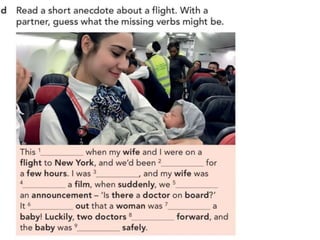
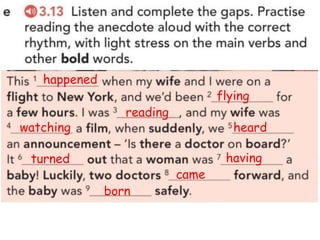
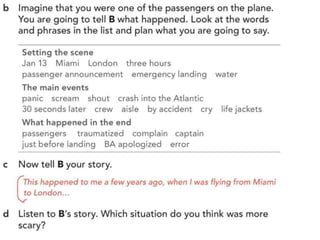
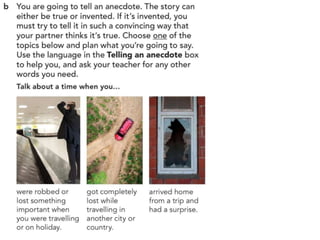
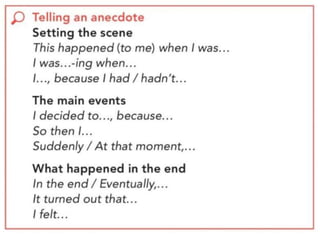
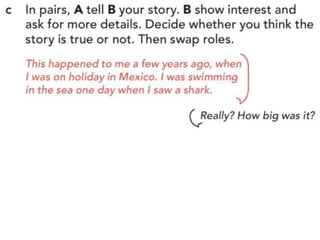
a short amusing or interesting story
about a real incident or person.

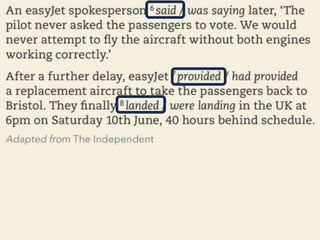
happened
flying
reading
watching heard
turned having
came
born
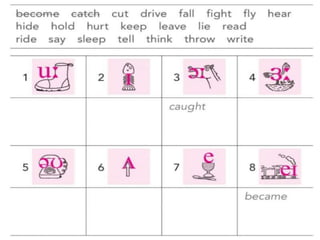
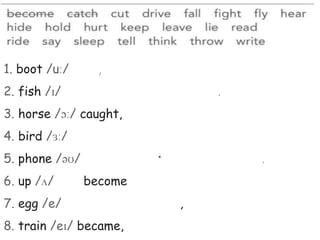
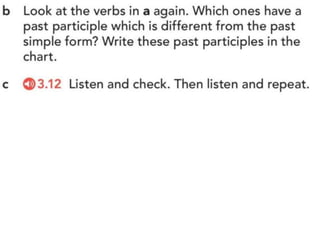
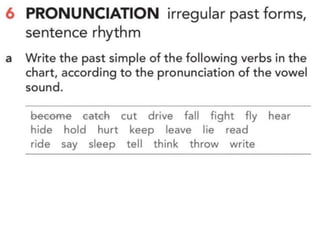
1. boot /uː/ flew, threw
2. fish /ɪ/ hid, driven, hidden, ridden, written
3. horse /ɔː/ caught, fought, thought, fallen
4. bird /ɜː/ heard, hurt
5. phone /əʊ/ drove, rode, told, wrote, flown, thrown
6. up /ʌ/ cut, become
7. egg /e/ fell, held, kept, left, read, said, slept
8. train /eɪ/ became, lay, lain
EF4UI Unit 3A Narrative tenses.pptx

EF4UI Unit 3A Narrative tenses.pptx

  • 1.
  • 2.
    • Describing photos– air ports and air travel (5 mins) • Discussion questions – airports and air travel (10 mins) • Listening lead in – airport or train station (5 mins) • Listening details – in an airport or train station (10 mins) • Vocabulary building – at the airport and others (15 mins) • Fun facts about airports quiz (10 mins) 55 • Mini lead in – travelling and seats (5 mins) • Reading (1) Best seat on a plane – new vocabulary (10 mins) • Reading (1) Best seat on a plane – gap fills (10 mins) 80 • Mini grammar – so / such .... that – presentation (5 mins) • Mini grammar – so / such .... that – gap fill activity (10 mins) • Discussion questions – Air travel experiences (10 mins) • Vocabulary from the class quiz (5 mins)
  • 4.
    • If youcould fly anywhere right now, where would you go and why? • How do you pass the time when you are at the airport? • What's your packing strategy: are you a light packer or do you prefer to take lots of items "just in case"? • Do you enjoy duty-free shopping? What's the best thing you've ever bought at an airport? • Share a funny or unusual experience you had during a flight. • How do you feel about airplane food? Do you have a memorable meal you've had on a flight?
  • 5.
    P T TP P P T T P P
  • 6.
    1. The trainwill now leave from platform 13. 2. The train has been cancelled. 3. The first-class coaches are at the front of the train. 4. You need to change at the next stop (London Bridge).
  • 7.
    1. On theplane. Relax and enjoy the flight. 2. On the plane. Pay attention to the safety instructions and locate your nearest emergency exit. 3. In the airport terminal. Go to Gate 3 immediately. 4. On the plane. Fasten your seat belts and place all baggage under your seat, put your seats and trays in the upright position, and turn off all electronic devices. 5. In the airport terminal. Passengers with children and needing special assistance can begin boarding; have boarding pass and ID ready. 6. On the plane. Please get off the plane by the front or rear exits; remember to take your belongings with you.
  • 8.
    1. about 2. find 3.go to 4. put, phones / iPads / laptops, etc. 5. needing 6. get off, back
  • 11.
    D. where youtake your luggage to check it in if you already have your boarding pass I. where you collect your luggage on arrival, and where there are usually trolleys for carrying heavy cases C. where you give in any checked-in luggage (bags, cases, etc.) and are given a boarding pass if you don't already have one J where your luggage may be checked to see if you are bringing illegal goods into the country
  • 12.
    B. an electronicdisplay showing flight times and if the flight is on time, boarding, closed, or delayed G. where you show your boarding pass and ID and board your flight H. where planes take off and land E. where they check that you are not trying to take prohibited items (e.g. liquids or sharp objects) onto the plane, by scanning your hand luggage and making you walk through a metal detector F. where passengers who are travelling business or first class can wait for their flight
  • 14.
  • 15.
  • 16.
    1. Travel isnormally used as a verb. However, it can be used as an uncountable noun. 2. Journey means the time when you travel from one place to another, but does not include the time you stay there. 3. The noun trip means to go somewhere and come back, including the time you stay there, e.g. a business trip.
  • 18.
  • 19.
  • 21.
    What unusual featurecan you find at Singapore Changi Airport? a. A butterfly garden b. An indoor rainforest c. A rooftop swimming pool
  • 22.
    In which airportwould you find a full-length golf course? a. O'Hare International Airport, USA b. Hong Kong International Airport, China c. Don Mueang International Airport, Thailand
  • 23.
    What can youdo while waiting for your flight at Munich Airport, Germany? a. Take a surfing lesson b. Brew your own beer c. Enjoy a movie at a cinema
  • 24.
    What distinctive featuredoes the Madeira Airport in Portugal have? a. It is on an artificial island b. It has a beach beneath the landing approach c. Its runway is supported by columns
  • 25.
    Which airport hasa permanent art museum within its grounds? a. Schiphol Airport, Netherlands b. Charles de Gaulle Airport, France c. San Francisco International Airport, USA
  • 26.
    What did GatwickAirport in the UK introduce to help passengers with the boarding process? a. Personalized holographic boarding assistants b. An app that guides you through the airport with AR c. Automated boarding by facial recognition
  • 30.
  • 31.
  • 32.
  • 33.
  • 34.
  • 35.
  • 36.
  • 38.
  • 39.
  • 40.
  • 43.
  • 45.
  • 46.
    I’m going togive you a topic...... • Student A – I’m going to give you a topic • I’d like you to talk about it for up to 2 minutes • You will have some time to prepare and make notes. • Student B – Think about some questions you can ask student A after they have finished. • You can write these questions down if you want to.
  • 47.
    Describe a touristattraction e.g. beach , museum , landmark you have visited. You should say: • When you visited it • Where is it situated • Who you went with • and say what about it you like the most
  • 48.
  • 49.
    Describe a beautifulplace to visit in your country. You should say: • where it is • how to get there • what there is to do when you are there • and explain why you recommend this place.
  • 52.
  • 53.
    • Describing photos– jobs in air travel (5 mins) • Discussion questions – jobs in air ports (10 mins) • Listening (1) Interview with a pilot – general (5 mins) • Listening (1) Interview with a pilot – details (5 mins) • Grammar – narrative tenses – highlighting (5 mins) • Grammar – narrative tenses – exercise (5 mins) • Grammar – narrative tenses – presentation (5 mins) • Grammar – narrative tenses – exercises (15 mins) 55 • Game / filler (10 mins) • Pronunciation focus – irregular past forms (10 mins) • Listening practice – anecdote verbs (5 mins) • Speaking practice – split anecdotes (10 mins) • Speaking practice – personal anecdotes (10 mins) 100 • Speaking practice – Personalised speaking -travel (10 mins) • Vocabulary from the class quiz (5 mins)
  • 55.
    • If youcould choose any job at the airport, which one would you pick and why? • What do you think are the most challenging aspects of being a pilot? • How important are language skills for a flight attendant who travels internationally? • How has technology changed the way people work in air travel jobs? • Discuss the role of customer service in the airport. Why is it so crucial?
  • 57.
    1. When thewind changes direction suddenly. 2. No. 3. Take-off is slightly more dangerous. 4. So they aren’t distracted. 5. Yes, definitely. 6. No, never.
  • 58.
    1. When thewind changes direction very suddenly, especially during take-off and landing 2. No, it isn’t, though passengers should wear their seat belts. 3. They’re both dangerous, but take-off is slightly more dangerous. 4. Because the crew don’t want passengers to be distracted if there’s an emergency, and they don’t want the tray tables to get in the way if there’s an evacuation. 5. Yes, definitely, especially to identify the nearest emergency exit 6. No, never, and he has been flying since he was 16.
  • 59.
    1. When thewind changes direction very suddenly, especially during take-off and landing 2. No, it isn’t, though passengers should wear their seat belts. 3. They’re both dangerous, but take-off is slightly more dangerous. 4. Because the crew don’t want passengers to be distracted if there’s an emergency, and they don’t want the tray tables to get in the way if there’s an evacuation. 5. Yes, definitely, especially to identify the nearest emergency exit 6. No, never, and he has been flying since he was 16.
  • 67.
    • Thursday andFriday • Past perfect continuous
  • 74.
    ‘d been queuing hadstolen ‘d been raining ‘d left had had to ‘d changed
  • 75.
    ‘d been sitting hadn’tput had been arguing ‘d fallen ‘d never seen had been walking
  • 78.
    What colour arethe black boxes in aircraft for ease of locating after an accident? a. Red b. Black c. Bright orange
  • 79.
    What was thein-flight 'entertainment' on the 1933 flight across the Atlantic? a. A game of charades b. A radio broadcast c. A live piano performance Answer: b. A radio broadcast
  • 80.
    How did earlypilots navigate before modern instruments? a. They followed the stars b. They guessed based on the wind c. They used landmarks and road maps
  • 81.
    What feature didthe de Havilland Comet, the world's first jet airliner, introduce? a. Square windows b. On-board movies c. Retractable landing gear
  • 82.
    What was theinitial purpose of the now universally recognized aircraft call sign "Mayday"? a. It’s an anglicization of the French 'm’aidez', meaning 'help me'. b. It was the name of the inventor of the radio distress call. c. It indicated the first day of May, historically a day for celebration in aviation.
  • 83.
    How were catsinvolved in early aircraft history? a. They were kept as mascots for good luck. b. They were used in weightlessness experiments. c. They were believed to sense upcoming turbulence.
  • 85.
    Talking about you •You are going to answer some questions about your experiences with travel. • You will take it in turns to answer a question. • The other person should ask TWO follow up questions about what they have said. • You will do this twice each.
  • 86.
    Think about atime when.... •(A) you visited a new place for the first time. -(B)Ask 2 follow up questions about what they said •(A) you discovered a new tourist destination. - (B) Ask 2 follow up questions about what they said
  • 87.
    Think about atime when.... • (A) You had a negative experience while travelling. - (B) Ask 2 follow up questions about what they said • (A) You travelled in an unusual way. - (B) Ask 2 follow up questions about what they said
  • 88.
    a short amusingor interesting story about a real incident or person.
  • 90.
  • 101.
    1. boot /uː/flew, threw 2. fish /ɪ/ hid, driven, hidden, ridden, written 3. horse /ɔː/ caught, fought, thought, fallen 4. bird /ɜː/ heard, hurt 5. phone /əʊ/ drove, rode, told, wrote, flown, thrown 6. up /ʌ/ cut, become 7. egg /e/ fell, held, kept, left, read, said, slept 8. train /eɪ/ became, lay, lain

Editor's Notes

  • #48 https://ielts-up.com/speaking/ielts-speaking-sample-1.html
  • #50 https://www.ielts-exam.net/ielts-speaking/ielts-speaking-part-two-and-three.html