1. About the ‘Guide to PHARMACOLOGY’
3. Large scale kinase inhibitor profiling data
2. Curated information on enzymes
Elena Faccenda1, Christopher Southan1, Helen E. Benson1, Joanna L. Sharman1, Adam J. Pawson1,
Doriano Fabbro2, Jamie A Davies1, Michael Spedding3, and NC-IUPHAR*
1The University of Edinburgh/Centre for Integrated Physiology, Edinburgh, EH8 9XD, UK; 2 Piqur Therapeutics, Hohe Winde Strasse 21, CH-4039 Riehen, Switzerland; 3 Spedding Research Solutions SARL, 6
Rue Ampere, Le Vésinet 78110, France.* The International Union of Basic and Clinical Pharmacology Committee on Receptor Nomenclature and Drug Classification.
What is the Guide to PHARMACOLOGY?
The Guide to PHARMACOLOGY (GtoPdb) web portal is an open
access resource providing general overviews of the key properties
of a wide range of biological targets, including selective ligand
information and access to relevant publications. Our detailed
target information is uniquely expert- and wholly manually-
curated. One aim of GtoPdb is to include all targets of approved
drugs and drugs in development, mapping interaction data for
the drugs to their primary molecular target(s). Recent GtoPdb
expansions have seen the introduction of target families for
clinically important enzymes and associated biological and chemical
modulators.
Which enzyme drug targets are
included?
• All proteins of the human kinome (>500)
• Proteinases (>180)
• Chromatin modifying enzymes (>90)
• ‘Other’ enzymes such as DNA
topoisomerases and small monomeric
GTPases
www.guidetopharmacology.org
Enzymes as drug targets:
curated pharmacological information
in the ‘Guide to PHARMACOLOGY’
enquiries@guidetopharmacology.org
Supported by:
We especially thank all contributors, collaborators and NC-IUPHAR members
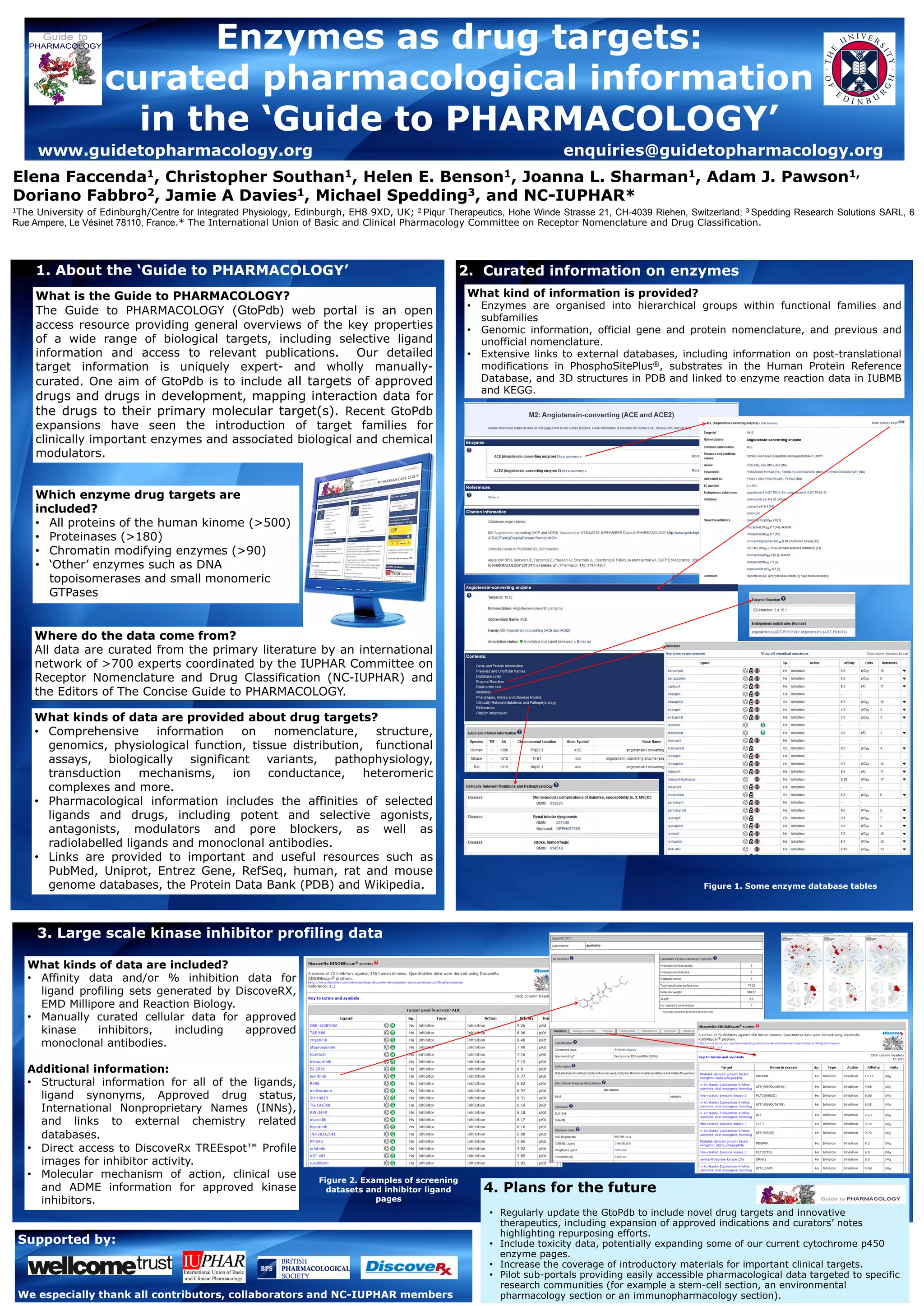
Figure 1. Some enzyme database tables
What kinds of data are provided about drug targets?
• Comprehensive information on nomenclature, structure,
genomics, physiological function, tissue distribution, functional
assays, biologically significant variants, pathophysiology,
transduction mechanisms, ion conductance, heteromeric
complexes and more.
• Pharmacological information includes the affinities of selected
ligands and drugs, including potent and selective agonists,
antagonists, modulators and pore blockers, as well as
radiolabelled ligands and monoclonal antibodies.
• Links are provided to important and useful resources such as
PubMed, Uniprot, Entrez Gene, RefSeq, human, rat and mouse
genome databases, the Protein Data Bank (PDB) and Wikipedia.
Where do the data come from?
All data are curated from the primary literature by an international
network of >700 experts coordinated by the IUPHAR Committee on
Receptor Nomenclature and Drug Classification (NC-IUPHAR) and
the Editors of The Concise Guide to PHARMACOLOGY.
What kind of information is provided?
• Enzymes are organised into hierarchical groups within functional families and
subfamilies
• Genomic information, official gene and protein nomenclature, and previous and
unofficial nomenclature.
• Extensive links to external databases, including information on post-translational
modifications in PhosphoSitePlus®, substrates in the Human Protein Reference
Database, and 3D structures in PDB and linked to enzyme reaction data in IUBMB
and KEGG.
What kinds of data are included?
• Affinity data and/or % inhibition data for
ligand profiling sets generated by DiscoveRX,
EMD Millipore and Reaction Biology.
• Manually curated cellular data for approved
kinase inhibitors, including approved
monoclonal antibodies.
Additional information:
• Structural information for all of the ligands,
ligand synonyms, Approved drug status,
International Nonproprietary Names (INNs),
and links to external chemistry related
databases.
• Direct access to DiscoveRx TREEspot™ Profile
images for inhibitor activity.
• Molecular mechanism of action, clinical use
and ADME information for approved kinase
inhibitors.
Figure 2. Examples of screening
datasets and inhibitor ligand
pages
4. Plans for the future
• Regularly update the GtoPdb to include novel drug targets and innovative
therapeutics, including expansion of approved indications and curators’ notes
highlighting repurposing efforts.
• Include toxicity data, potentially expanding some of our current cytochrome p450
enzyme pages.
• Increase the coverage of introductory materials for important clinical targets.
• Pilot sub-portals providing easily accessible pharmacological data targeted to specific
research communities (for example a stem-cell section, an environmental
pharmacology section or an immunopharmacology section).

Enzymes as drug targets: curated pharmacological information in the 'Guide to PHARMACOLOGY'

  • 1.
    1. About the‘Guide to PHARMACOLOGY’ 3. Large scale kinase inhibitor profiling data 2. Curated information on enzymes Elena Faccenda1, Christopher Southan1, Helen E. Benson1, Joanna L. Sharman1, Adam J. Pawson1, Doriano Fabbro2, Jamie A Davies1, Michael Spedding3, and NC-IUPHAR* 1The University of Edinburgh/Centre for Integrated Physiology, Edinburgh, EH8 9XD, UK; 2 Piqur Therapeutics, Hohe Winde Strasse 21, CH-4039 Riehen, Switzerland; 3 Spedding Research Solutions SARL, 6 Rue Ampere, Le Vésinet 78110, France.* The International Union of Basic and Clinical Pharmacology Committee on Receptor Nomenclature and Drug Classification. What is the Guide to PHARMACOLOGY? The Guide to PHARMACOLOGY (GtoPdb) web portal is an open access resource providing general overviews of the key properties of a wide range of biological targets, including selective ligand information and access to relevant publications. Our detailed target information is uniquely expert- and wholly manually- curated. One aim of GtoPdb is to include all targets of approved drugs and drugs in development, mapping interaction data for the drugs to their primary molecular target(s). Recent GtoPdb expansions have seen the introduction of target families for clinically important enzymes and associated biological and chemical modulators. Which enzyme drug targets are included? • All proteins of the human kinome (>500) • Proteinases (>180) • Chromatin modifying enzymes (>90) • ‘Other’ enzymes such as DNA topoisomerases and small monomeric GTPases www.guidetopharmacology.org Enzymes as drug targets: curated pharmacological information in the ‘Guide to PHARMACOLOGY’ enquiries@guidetopharmacology.org Supported by: We especially thank all contributors, collaborators and NC-IUPHAR members Figure 1. Some enzyme database tables What kinds of data are provided about drug targets? • Comprehensive information on nomenclature, structure, genomics, physiological function, tissue distribution, functional assays, biologically significant variants, pathophysiology, transduction mechanisms, ion conductance, heteromeric complexes and more. • Pharmacological information includes the affinities of selected ligands and drugs, including potent and selective agonists, antagonists, modulators and pore blockers, as well as radiolabelled ligands and monoclonal antibodies. • Links are provided to important and useful resources such as PubMed, Uniprot, Entrez Gene, RefSeq, human, rat and mouse genome databases, the Protein Data Bank (PDB) and Wikipedia. Where do the data come from? All data are curated from the primary literature by an international network of >700 experts coordinated by the IUPHAR Committee on Receptor Nomenclature and Drug Classification (NC-IUPHAR) and the Editors of The Concise Guide to PHARMACOLOGY. What kind of information is provided? • Enzymes are organised into hierarchical groups within functional families and subfamilies • Genomic information, official gene and protein nomenclature, and previous and unofficial nomenclature. • Extensive links to external databases, including information on post-translational modifications in PhosphoSitePlus®, substrates in the Human Protein Reference Database, and 3D structures in PDB and linked to enzyme reaction data in IUBMB and KEGG. What kinds of data are included? • Affinity data and/or % inhibition data for ligand profiling sets generated by DiscoveRX, EMD Millipore and Reaction Biology. • Manually curated cellular data for approved kinase inhibitors, including approved monoclonal antibodies. Additional information: • Structural information for all of the ligands, ligand synonyms, Approved drug status, International Nonproprietary Names (INNs), and links to external chemistry related databases. • Direct access to DiscoveRx TREEspot™ Profile images for inhibitor activity. • Molecular mechanism of action, clinical use and ADME information for approved kinase inhibitors. Figure 2. Examples of screening datasets and inhibitor ligand pages 4. Plans for the future • Regularly update the GtoPdb to include novel drug targets and innovative therapeutics, including expansion of approved indications and curators’ notes highlighting repurposing efforts. • Include toxicity data, potentially expanding some of our current cytochrome p450 enzyme pages. • Increase the coverage of introductory materials for important clinical targets. • Pilot sub-portals providing easily accessible pharmacological data targeted to specific research communities (for example a stem-cell section, an environmental pharmacology section or an immunopharmacology section).