Special Considerations for teaching Listening & SpeakingEESL-542D Module 2January 28, 2011Group #5Brian  Natarte Donna Parrish Tzuyun Shih
Cognate AwarenessBy: Brian NatarteCognates are words that are very similar in meaning, spelling and/or form. These types of words have most likely been inherited from the same base language and have been altered slightly over the years. Cognates are most often an issue between Spanish and English since there are so many similar words among these two languages.Reference: http://spanish.about.com/cs/vocabulary/g/cognategloss.htm
Examples of CognatesBanana
Idea
Simple
Construction
ProductionKey PointsTeachers need to be aware of the issue with cognates.The similarities and differences need to be taught.Many students find cognates difficult.
Long-term habits are hard to break.Practice is essential.Improve Teaching CognatesBasic Awareness -	Spend a little extra time pointing out the difference between the cognates, addressing similarities, etc. That way the students can practice and gain a better understanding.
Improve Teaching Cognates Cont.Cognate Awareness Test (CAT) – 	A test that shows exactly how aware students are of cognates and how high the difficulty level could be for them when learning cognates.Reference: http://www.cal.org/acquiringliteracy/assessments/cognate.html
Improve Teaching Cognates Cont.Practice	As with anything in life, practice is the only way to improve upon something. Allow the students the time and space to practice as much as possible.
OverviewCognate Awareness is something that not every teacher may take into consideration. When a student is learning to speak and listen in a new language there are many things that propose challenges for the student. Teachers need to be aware of all special considerations when teaching listening and speaking; cognate awareness is just one of those special considerations.
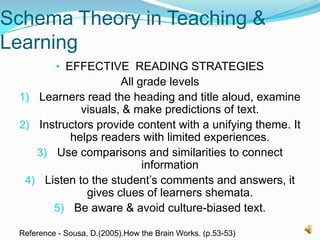
SchemataIs a unit of understanding to store knowledge. Students use existing knowledge or     schemata (plural) to recognize & connect  with learning.Reference – Diaz-Rico, L. (2008). Strategies for Teaching English Learners. (p. 117).Donna Parrish
Schemata & LearningA reader’s ability to comprehend is dependent on their past experiences.
Schemata are created through repeated experiences with
 EVENTS, PEOPLE, & OBJECTS
Encountering new  information - shemata can be modified THREE ways:Reference - Sousa, D. (2005). How the Brain works. (p.52).
Modifying SchemataACCREATION – Learners incorporate new information into an existing schema.
TUNING – Learners realize existing schema is inadequate and alters their schema to become consistent with the experience.
RESTRUCTURING – Learners create a new schema to understand the material.Reference - Sousa, D.(2005).How the Brain Works. (p.52-53).

EESL 542 Group #5 PPT

  • 1.
    Special Considerations forteaching Listening & SpeakingEESL-542D Module 2January 28, 2011Group #5Brian Natarte Donna Parrish Tzuyun Shih
  • 2.
    Cognate AwarenessBy: BrianNatarteCognates are words that are very similar in meaning, spelling and/or form. These types of words have most likely been inherited from the same base language and have been altered slightly over the years. Cognates are most often an issue between Spanish and English since there are so many similar words among these two languages.Reference: http://spanish.about.com/cs/vocabulary/g/cognategloss.htm
  • 3.
  • 4.
  • 5.
  • 6.
  • 7.
    ProductionKey PointsTeachers needto be aware of the issue with cognates.The similarities and differences need to be taught.Many students find cognates difficult.
  • 8.
    Long-term habits arehard to break.Practice is essential.Improve Teaching CognatesBasic Awareness - Spend a little extra time pointing out the difference between the cognates, addressing similarities, etc. That way the students can practice and gain a better understanding.
  • 9.
    Improve Teaching CognatesCont.Cognate Awareness Test (CAT) – A test that shows exactly how aware students are of cognates and how high the difficulty level could be for them when learning cognates.Reference: http://www.cal.org/acquiringliteracy/assessments/cognate.html
  • 10.
    Improve Teaching CognatesCont.Practice As with anything in life, practice is the only way to improve upon something. Allow the students the time and space to practice as much as possible.
  • 11.
    OverviewCognate Awareness issomething that not every teacher may take into consideration. When a student is learning to speak and listen in a new language there are many things that propose challenges for the student. Teachers need to be aware of all special considerations when teaching listening and speaking; cognate awareness is just one of those special considerations.
  • 12.
    SchemataIs a unitof understanding to store knowledge. Students use existing knowledge or schemata (plural) to recognize & connect with learning.Reference – Diaz-Rico, L. (2008). Strategies for Teaching English Learners. (p. 117).Donna Parrish
  • 13.
    Schemata & LearningAreader’s ability to comprehend is dependent on their past experiences.
  • 14.
    Schemata are createdthrough repeated experiences with
  • 15.
  • 16.
    Encountering new information - shemata can be modified THREE ways:Reference - Sousa, D. (2005). How the Brain works. (p.52).
  • 17.
    Modifying SchemataACCREATION –Learners incorporate new information into an existing schema.
  • 18.
    TUNING – Learnersrealize existing schema is inadequate and alters their schema to become consistent with the experience.
  • 19.
    RESTRUCTURING – Learnerscreate a new schema to understand the material.Reference - Sousa, D.(2005).How the Brain Works. (p.52-53).