

All About Entrepreneurship
Sunil Shukla
Entrepreneurship
Entrepreneurship is a purposeful activity
of an individual or a group of associated
individuals, undertaken to initiate,
maintain or aggrandise profit by
production or distribution of economic
goods.
Entrepreneurial Individual
 Has concept, vision, dream
 Adapts concept to reflect realities in environment,
scans environment
 Assesses risks versus rewards
 Mobilizes resources
 Able to convert dream into products and people within
an organizational context
 Able to champion the concept to a wide range of
publics and partners
 Persevere in overcoming obstacles
 Optimizes profits
An Integrative Model of Entrepreneurial Inputs and Outcomes
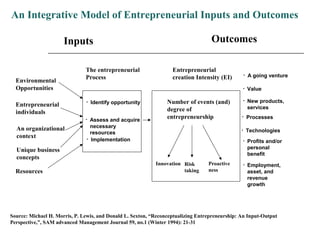
Inputs Outcomes
Environmental
Opportunities
Entrepreneurial
individuals
An organizational
context
Unique business
concepts
Resources
The entrepreneurial
Process
• Identify opportunity
• Assess and acquire
necessary
resources
• Implementation
• A going venture
• Value
• New products,
services
• Processes
• Profits and/or
personal
benefit
• Technologies
• Employment,
asset, and
revenue
growth
Entrepreneurial
creation Intensity (EI)
Number of events (and)
degree of
entrepreneurship
Innovation Risk
taking
Proactive
ness
Source: Michael H. Morris, P. Lewis, and Donald L. Sexton, “Reconceptualizing Entrepreneurship: An Input-Output
Perspective,”, SAM advanced Management Journal 59, no.1 (Winter 1994): 21-31
Entrepreneurial Personality-
Psychological
 1. Motivation – driven by range of factors
 Necessity (survival)
 Opportunity (proactivity)
 Dissatisfaction (can’t stand job)
 Curiosity (What if…?)
 Material gain (We could make a killing…)
 Achievement oriented more than anything else
 Driven by the task, challenge, opportunity
 Money as a by-product, but scorecard
 2. Strong belief in themselves- believe they can change their
environments
…Personality
 3. Calculated risk-takers (financial, career, family &
social, psychic)
 Attempt to estimate likelihood and magnitude of key risk
factors and manage or mitigate them through good planning
or decisions
 4. High tolerance of ambiguity
 Process can be loose, messy, shift directions
 Prize their independence – self-motivated, self-reliant,
prefer autonomy, have perseverance
Situation-based Characteristics
 Willingness and ability to assume and manage
risks
 More critical with new-to-the-world products
 Political skills important in large corporate
settings
 Adaptability and tenacity are bigger factors in
turbulent environments
Dark Side Traits
 Excessive need for control
 Tendency to micromanage
 Suspicion – others will steal my idea
 Impatience
 Need for applause
 Defensive attitude
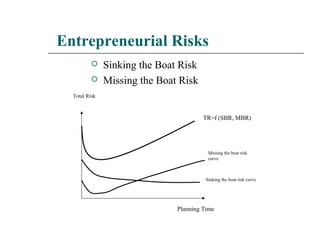
Entrepreneurial Risks
 Sinking the Boat Risk
 Missing the Boat Risk
TR=f (SBR, MBR)
Missing the boat risk
curve
Total Risk
Planning Time
Sinking the boat risk curve
Risks at Startup
 Risk in Opportunity Identification
 Risk in Commercial Viability
 Risk in Investment
 Risk in Financing
Rewards of Entrepreneurship
 Financial
 A successful business has the potential to make good profits
and provide substantial wealth for the entrepreneur.
 Social and Emotional
 There is seldom a higher reward than making a positive
difference to another person's life.
 The successful business provides jobs, pride and financial
security for its employees.
 Independence
 Financial success increases the independence and potential of
Growth Rewards.
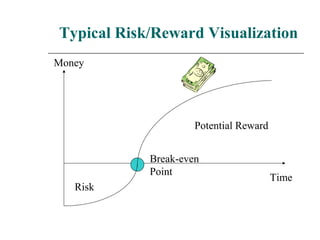
Typical Risk/Reward Visualization
Money
Time
Break-even
Point
Potential Reward
Risk
Entrepreneurship Development :
Process, Stages and Interventions
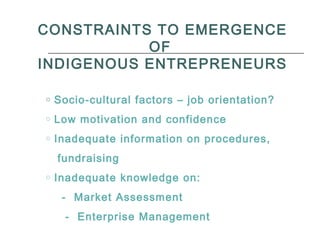
CONSTRAINTS TO EMERGENCE
OF
INDIGENOUS ENTREPRENEURS
o Socio-cultural factors – job orientation?
o Low motivation and confidence
o Inadequate information on procedures,
fundraising
o Inadequate knowledge on:
- Market Assessment
- Enterprise Management
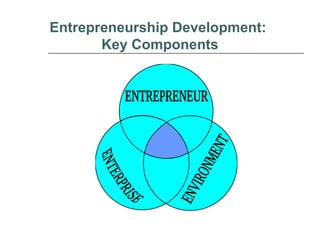
Entrepreneurship Development:
Key Components
ENTREPRENEURSHIP
DEVELOPMENT PROCESS
• Identify, select, train, counsel and support potential
entrepreneurs for creating new enterprises
• Facilitate growth of existing entrepreneurs and groom
successors
• Contribute towards developing entrepreneurial culture
• Facilitate creation of a conducive environment for
emergence and growth of enterprises
• Intervene for developing enterprises- technology and
management (market, quality, finance, human resources)
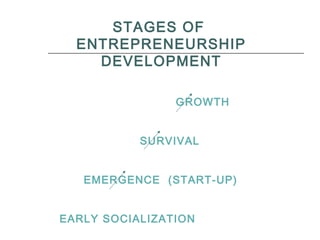
STAGES OF
ENTREPRENEURSHIP
DEVELOPMENT
GROWTH
SURVIVAL
EMERGENCE (START-UP)
EARLY SOCIALIZATION
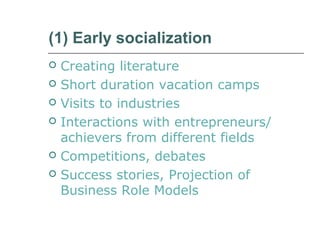
(1) Early socialization
 Creating literature
 Short duration vacation camps
 Visits to industries
 Interactions with entrepreneurs/
achievers from different fields
 Competitions, debates
 Success stories, Projection of
Business Role Models
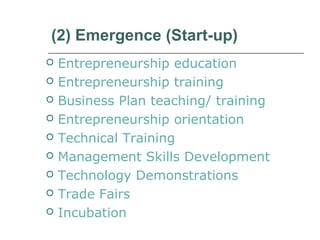
(2) Emergence (Start-up)
 Entrepreneurship education
 Entrepreneurship training
 Business Plan teaching/ training
 Entrepreneurship orientation
 Technical Training
 Management Skills Development
 Technology Demonstrations
 Trade Fairs
 Incubation
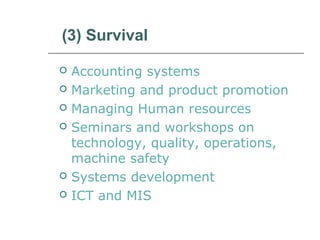
(3) Survival
 Accounting systems
 Marketing and product promotion
 Managing Human resources
 Seminars and workshops on
technology, quality, operations,
machine safety
 Systems development
 ICT and MIS
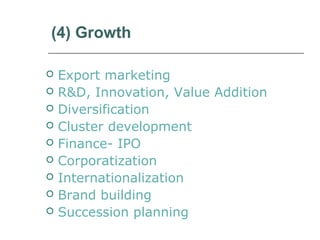
(4) Growth
 Export marketing
 R&D, Innovation, Value Addition
 Diversification
 Cluster development
 Finance- IPO
 Corporatization
 Internationalization
 Brand building
 Succession planning
Thankssunilshukla@ediindia.org

Entrepreneurship concept & process

  • 1.
  • 2.
    Entrepreneurship Entrepreneurship is apurposeful activity of an individual or a group of associated individuals, undertaken to initiate, maintain or aggrandise profit by production or distribution of economic goods.
  • 3.
    Entrepreneurial Individual  Hasconcept, vision, dream  Adapts concept to reflect realities in environment, scans environment  Assesses risks versus rewards  Mobilizes resources  Able to convert dream into products and people within an organizational context  Able to champion the concept to a wide range of publics and partners  Persevere in overcoming obstacles  Optimizes profits
  • 4.
    An Integrative Modelof Entrepreneurial Inputs and Outcomes Inputs Outcomes Environmental Opportunities Entrepreneurial individuals An organizational context Unique business concepts Resources The entrepreneurial Process • Identify opportunity • Assess and acquire necessary resources • Implementation • A going venture • Value • New products, services • Processes • Profits and/or personal benefit • Technologies • Employment, asset, and revenue growth Entrepreneurial creation Intensity (EI) Number of events (and) degree of entrepreneurship Innovation Risk taking Proactive ness Source: Michael H. Morris, P. Lewis, and Donald L. Sexton, “Reconceptualizing Entrepreneurship: An Input-Output Perspective,”, SAM advanced Management Journal 59, no.1 (Winter 1994): 21-31
  • 5.
    Entrepreneurial Personality- Psychological  1.Motivation – driven by range of factors  Necessity (survival)  Opportunity (proactivity)  Dissatisfaction (can’t stand job)  Curiosity (What if…?)  Material gain (We could make a killing…)  Achievement oriented more than anything else  Driven by the task, challenge, opportunity  Money as a by-product, but scorecard  2. Strong belief in themselves- believe they can change their environments
  • 6.
    …Personality  3. Calculatedrisk-takers (financial, career, family & social, psychic)  Attempt to estimate likelihood and magnitude of key risk factors and manage or mitigate them through good planning or decisions  4. High tolerance of ambiguity  Process can be loose, messy, shift directions  Prize their independence – self-motivated, self-reliant, prefer autonomy, have perseverance
  • 7.
    Situation-based Characteristics  Willingnessand ability to assume and manage risks  More critical with new-to-the-world products  Political skills important in large corporate settings  Adaptability and tenacity are bigger factors in turbulent environments
  • 8.
    Dark Side Traits Excessive need for control  Tendency to micromanage  Suspicion – others will steal my idea  Impatience  Need for applause  Defensive attitude
  • 9.
    Entrepreneurial Risks  Sinkingthe Boat Risk  Missing the Boat Risk TR=f (SBR, MBR) Missing the boat risk curve Total Risk Planning Time Sinking the boat risk curve
  • 10.
    Risks at Startup Risk in Opportunity Identification  Risk in Commercial Viability  Risk in Investment  Risk in Financing
  • 11.
    Rewards of Entrepreneurship Financial  A successful business has the potential to make good profits and provide substantial wealth for the entrepreneur.  Social and Emotional  There is seldom a higher reward than making a positive difference to another person's life.  The successful business provides jobs, pride and financial security for its employees.  Independence  Financial success increases the independence and potential of Growth Rewards.
  • 12.
  • 14.
  • 15.
    CONSTRAINTS TO EMERGENCE OF INDIGENOUSENTREPRENEURS o Socio-cultural factors – job orientation? o Low motivation and confidence o Inadequate information on procedures, fundraising o Inadequate knowledge on: - Market Assessment - Enterprise Management
  • 16.
  • 17.
    ENTREPRENEURSHIP DEVELOPMENT PROCESS • Identify,select, train, counsel and support potential entrepreneurs for creating new enterprises • Facilitate growth of existing entrepreneurs and groom successors • Contribute towards developing entrepreneurial culture • Facilitate creation of a conducive environment for emergence and growth of enterprises • Intervene for developing enterprises- technology and management (market, quality, finance, human resources)
  • 18.
  • 19.
    (1) Early socialization Creating literature  Short duration vacation camps  Visits to industries  Interactions with entrepreneurs/ achievers from different fields  Competitions, debates  Success stories, Projection of Business Role Models
  • 20.
    (2) Emergence (Start-up) Entrepreneurship education  Entrepreneurship training  Business Plan teaching/ training  Entrepreneurship orientation  Technical Training  Management Skills Development  Technology Demonstrations  Trade Fairs  Incubation
  • 21.
    (3) Survival  Accountingsystems  Marketing and product promotion  Managing Human resources  Seminars and workshops on technology, quality, operations, machine safety  Systems development  ICT and MIS
  • 22.
    (4) Growth  Exportmarketing  R&D, Innovation, Value Addition  Diversification  Cluster development  Finance- IPO  Corporatization  Internationalization  Brand building  Succession planning
  • 23.