EEDC
                          34330
Execution
Environments for                             REST
Distributed
                                              vs
Computing
Master in Computer Architecture,
                                             SOAP
Networks and Systems - CANS


                                        Homework number: 2
                                   Roger Rafanell   rogerrafanell@gmail.com
Content

Distributed Systems

  – Part 1: Definitions

  – Part 2: REST

  – Part 3: SOAP

  – Part 4: Conclusions


                          2
Part 1 - Definitions


  Representational State Transfer (REST)

  “Is a web service architectural style
   based on the existing HTTP protocol
  and markup languages, designed for
          operations on data.”


                       3
Part 1 - Definitions


  Simple Object Access Protocol (SOAP)

“Is a web service protocol specification
 for exchanging structured information
   designed to offer application logic
             as a service.”


                       4
Part 2 - REST Overview
 Data oriented
   – Expose a API over the internet to handle CRUD operations on DATA.
 Simplicity
   – Based on HTTP and URIs standards.
   – Creating clients (consume).
 Flexibility
   – Allows many data formats such JSON (better browser support).
   – JSON fits better for parsing data.
 Lightweight
   – Requests can be short and can take 10 times less than SOAP ones.
 Performance
   – Better performance and scalability.
   – Reads can be cached on client browsers, not like SOAP.
 Complex to build
   – More complex to develop services than SOAP.
                                    5
Part 3 - SOAP Overview

 Logic oriented
   – Expose OPERATIONS over the internet as a service.
 Simplicity
   – More easy to develop services than REST (toolkits).
 Security
   – SOAP supports SSL (just like REST) it also supports WS-Security
     adding some enterprise security features. 
 Reliability
   – SOAP, not like REST, has successful/retry logic built in and provides
     end-to-end reliability. 
 Atomicity
   – SOAP offers ACID transactions over a service while REST it
     isn’t ACID compliant. 


                                      6
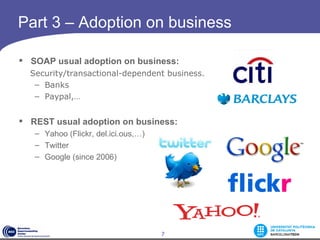
Part 3 – Adoption on business

 SOAP usual adoption on business:
    Security/transactional-dependent business. 
     – Banks 
     – Paypal,…


 REST usual adoption on business:
   – Yahoo (Flickr, del.ici.ous,…)
   – Twitter
   – Google (since 2006)


                                     7
Part 4 - Conclusions


Unless you have a special reason to use SOAP use
 REST but, choose according your services needs!


                        8
Q&A


      9
Fields of application


             Thank You!


                    10

EEDC SOAP vs REST

  • 1.
    EEDC 34330 Execution Environments for REST Distributed vs Computing Master in Computer Architecture, SOAP Networks and Systems - CANS Homework number: 2 Roger Rafanell rogerrafanell@gmail.com
  • 2.
    Content Distributed Systems – Part 1: Definitions – Part 2: REST – Part 3: SOAP – Part 4: Conclusions 2
  • 3.
    Part 1 -Definitions Representational State Transfer (REST) “Is a web service architectural style based on the existing HTTP protocol and markup languages, designed for operations on data.”   3
  • 4.
    Part 1 -Definitions Simple Object Access Protocol (SOAP) “Is a web service protocol specification for exchanging structured information designed to offer application logic as a service.”   4
  • 5.
    Part 2 -REST Overview  Data oriented – Expose a API over the internet to handle CRUD operations on DATA.  Simplicity – Based on HTTP and URIs standards. – Creating clients (consume).  Flexibility – Allows many data formats such JSON (better browser support). – JSON fits better for parsing data.  Lightweight – Requests can be short and can take 10 times less than SOAP ones.  Performance – Better performance and scalability. – Reads can be cached on client browsers, not like SOAP.  Complex to build – More complex to develop services than SOAP. 5
  • 6.
    Part 3 -SOAP Overview  Logic oriented – Expose OPERATIONS over the internet as a service.  Simplicity – More easy to develop services than REST (toolkits).  Security – SOAP supports SSL (just like REST) it also supports WS-Security adding some enterprise security features.   Reliability – SOAP, not like REST, has successful/retry logic built in and provides end-to-end reliability.   Atomicity – SOAP offers ACID transactions over a service while REST it isn’t ACID compliant.  6
  • 7.
    Part 3 –Adoption on business  SOAP usual adoption on business:     Security/transactional-dependent business.  – Banks  – Paypal,…  REST usual adoption on business: – Yahoo (Flickr, del.ici.ous,…) – Twitter – Google (since 2006) 7
  • 8.
    Part 4 -Conclusions Unless you have a special reason to use SOAP use REST but, choose according your services needs! 8
  • 9.
  • 10.