The Web:  Distributed Objects Realized! Mark Baker, Coactus Consulting Stuart Charlton, BEA Systems
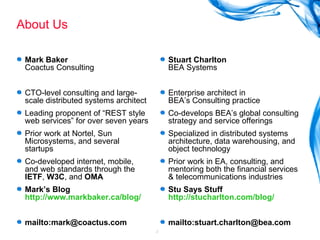
About Us Mark Baker Coactus Consulting CTO-level consulting and large-scale distributed systems architect Leading proponent of “REST style web services” for over seven years Prior work at Nortel, Sun Microsystems, and several startups  Co-developed internet, mobile, and web standards through the  IETF ,  W3C , and  OMA Mark’s Blog http://www.markbaker.ca/blog/ mailto:mark@coactus.com Stuart Charlton BEA Systems Enterprise architect in  BEA’s Consulting practice Co-develops BEA’s global consulting strategy and service offerings Specialized in distributed systems architecture, data warehousing, and object technology Prior work in EA, consulting, and mentoring both the financial services & telecommunications industries Stu Says Stuff http://stucharlton.com/blog/ mailto:stuart.charlton@bea.com
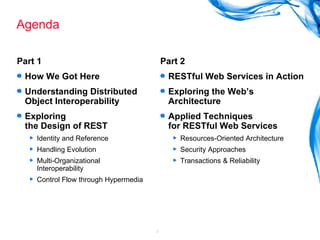
Agenda Part 1 How We Got Here Understanding Distributed Object Interoperability Exploring  the Design of REST Identity and Reference Handling Evolution Multi-Organizational Interoperability Control Flow through Hypermedia Part 2 RESTful Web Services in Action Exploring the Web’s Architecture Applied Techniques  for RESTful Web Services Resources-Oriented Architecture Security Approaches Transactions & Reliability
How We Got Here The Rise of the Object Web
Where we’ve come from… “ The next shift catalyzed by the Web will be the adoption of enterprise systems based on distributed objects and IIOP (Internet Inter-ORB Protocol).  IIOP will manage the communication between the object components that power the system.  Users will be pointing and clicking at objects available on IIOP-enabled servers.” - Marc Andressen, Netscape Cofounder (October, 1996)
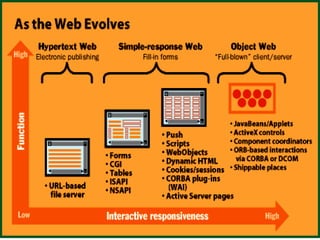
The Object Web Shall Arise! “To move to the next step, the Web needs distributed objects. We call this next wave of Internet innovation the "Object Web.“ The HTTP form you submit is still the basic unit of client/server interaction. This clumsy work-around is not suitable for full-blown client/server applications that require highly interactive conversations between components. It also does not scale well.” -  CORBA, Java, and the Object Web    BYTE Magazine    (October 1997)
 
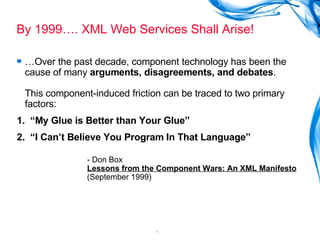
By 1999…. XML Web Services Shall Arise! …Over the past decade, component technology has been the cause of many  arguments, disagreements, and debates .  This component-induced friction can be traced to two primary factors:  1.  “My Glue is Better than Your Glue” 2.  “I Can’t Believe You Program In That Language” - Don Box Lessons from the Component Wars: An XML Manifesto (September 1999)
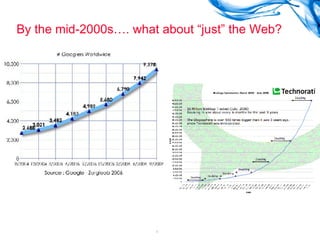
By the mid-2000s…. what about “just” the Web?
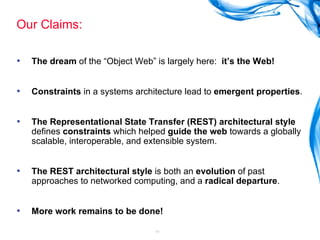
Our Claims: The dream  of the “Object Web” is largely here:  it’s the Web! Constraints  in a systems architecture lead to  emergent properties . The   Representational State Transfer (REST)   architectural style  defines  constraints  which helped  guide the web  towards a globally scalable, interoperable, and extensible system. The REST architectural style  is both an  evolution  of past approaches to networked computing, and a  radical departure . More work remains to be done!
Understanding Distributed Object Interoperability
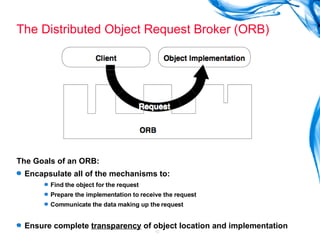
The Distributed Object Request Broker (ORB) The Goals of an ORB: Encapsulate all of the mechanisms to: Find the object for the request Prepare the implementation to receive the request Communicate the data making up the request Ensure complete  transparency  of object location and implementation
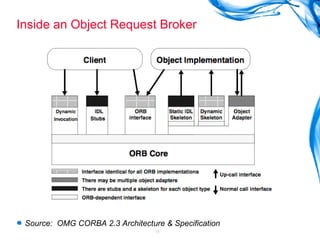
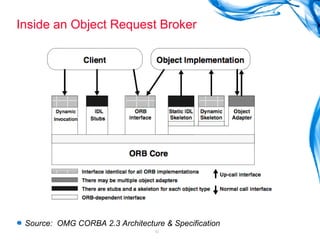
Inside an Object Request Broker Source:  OMG CORBA 2.3 Architecture & Specification
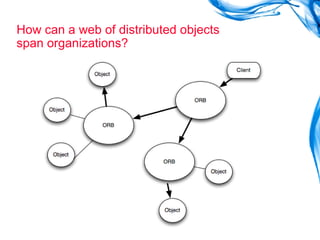
How can a web of distributed objects  span organizations?
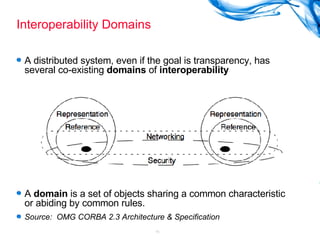
Interoperability Domains A distributed system, even if the goal is transparency, has several co-existing  domains  of  interoperability A  domain  is a set of objects sharing a common characteristic or abiding by common rules. Source:  OMG CORBA 2.3 Architecture & Specification
Types of Interoperability Domains Referencing The scope of a distributed object reference Representation The scope of a message transfer syntax & protocol Network Connectivity Potential scope of a network message Network Addressing Potential scope of a network address Security The extent of a particular security policy Others… Source:  OMG CORBA 2.3 Architecture & Specification
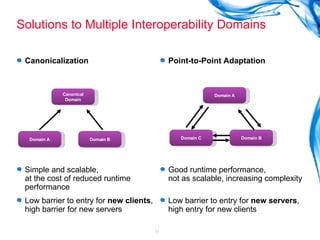
Solutions to Multiple Interoperability Domains Canonicalization Simple and scalable,  at the cost of reduced runtime performance Low barrier to entry for  new clients , high barrier for new servers Point-to-Point Adaptation Good runtime performance, not as scalable, increasing complexity Low barrier to entry for  new servers , high entry for new clients Canonical Domain Domain A Domain B Domain A Domain C Domain B
Solutions for a “Global Object Web”? Goal seems to be primarily about  use  and  reuse:  more consumption Thus, lower the barriers to new clients!  Scope of Object References:  Global Scope of Representation:  Global (but extensible) Scope of Network Connectivity:  Global Scope of Security:  Shared Agreement Requires at least some level of  Global Canonicalization
Solutions for a “Global Object Web”? Further Concerns: Unpredictable type, usage, and volume of information Thus, shaped around extensible, streamable, cacheable, identifiable information Both Human and Automated actors Thus, simple, reusable, and extensible interfaces, appropriate for either …  How would you architect such a system? This is  atypical  of most  distributed object   systems architectures  in practice
Two Very Different Types of Architectural Domains Client or Builder-focused Identifiable Client or Customer(s) Clearly identifiable builders Clearly identifiable users Control governance & control Overall architectural control System is a result of deliberate value judgement by the client Examples Most IT projects, software products, civil structures, etc. Collaborative Systems No identifiable client Many builders Many (unpredictable) users No central control in terms of development, or operation System is a result of the voluntary choices of the participants Examples Internet and WWW, electrical power systems, joint military operations, etc. Source:  Eberherdt Rechtin,  The Art of Systems Architecting
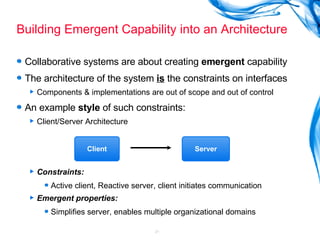
Building Emergent Capability into an Architecture Collaborative systems are about creating  emergent  capability The architecture of the system  is  the constraints on interfaces Components & implementations are out of scope and out of control An example  style  of such constraints: Client/Server Architecture Constraints:   Active client, Reactive server, client initiates communication Emergent properties:  Simplifies server, enables multiple organizational domains Client Server
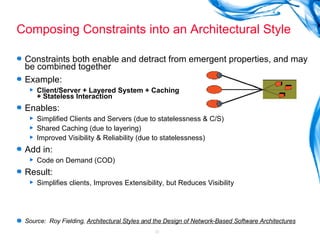
Composing Constraints into an Architectural Style Constraints both enable and detract from emergent properties, and may be combined together Example: Client/Server + Layered System + Caching + Stateless Interaction Enables: Simplified Clients and Servers (due to statelessness & C/S) Shared Caching (due to layering) Improved Visibility & Reliability (due to statelessness) Add in: Code on Demand (COD) Result:  Simplifies clients, Improves Extensibility, but Reduces Visibility Source:  Roy Fielding,  Architectural Styles and the Design of Network-Based Software Architectures
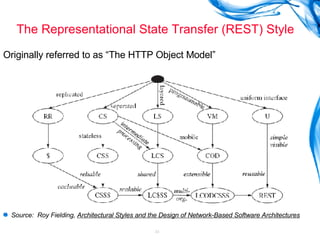
The Representational State Transfer (REST) Style Originally referred to as “The HTTP Object Model” Source:  Roy Fielding,  Architectural Styles and the Design of Network-Based Software Architectures
Some Major Differences between  REST and Distributed Objects  1.  Most distributed architectures do not assume application requirements Yet, the Web is an application with goals & requirements! The overall goal: sharing information and capabilities at a global scale REST assumes the requirement is to provide an  architecture of participation  for a globally networked information space 2. Most distributed architectures do not require globally scoped interoperability domains REST insists on a  uniform interface  to ensure global scope interoperability The  uniform interface  is what we explore next! These differences apply elsewhere: SOAP Web Services, RPC, etc. are also just general toolkits
RESTful Distributed Objects  in contrast to SOAP Web Services Perceived advantages: Communication occurs through XML document exchange Agreement occurs in the network protocol The XML InfoSet is the basis of interoperability No worrying about object-oriented purity / language-oriented bindings Disadvantages: Prefers interface descriptions for  specific  (non-uniform) interfaces All data must flow through the XML InfoSet, other types are secondary Nearly eliminates the notions of: Object lifecycle (creation, removal, activation) Object identification & references (i.e. linking) Assumes  transfer protocol independence  is possible and desirable In practice, transfer protocol semantics  leak  into message exchanges
A Word on REST vs. The World Wide Web Consider three levels of abstraction: Architectural Styles :  Representation State Transfer (REST) Architecture : The World Wide Web Implementation : “User Agents, Web Servers, Proxies, etc.” REST is a  model  of constraints and emergent properties The Web is the most  widely used  and understood implementation
Exploring  the Design of REST
A Global, Networked, Shared Information Space
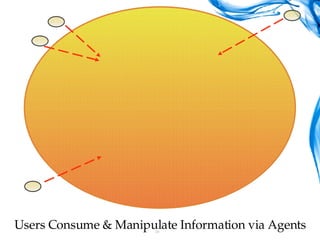
Users Consume & Manipulate Information via Agents
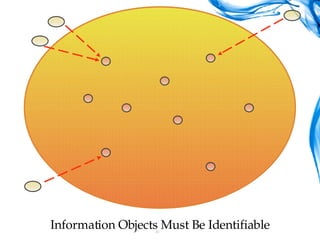
Information Objects Must Be Identifiable
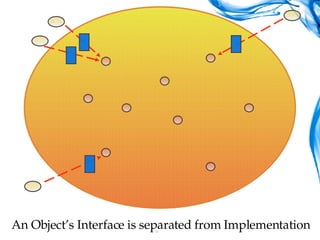
An Object’s Interface is separated from Implementation
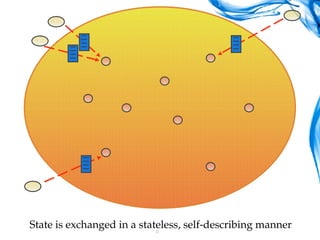
State is exchanged in a stateless, self-describing manner
Handling Evolution
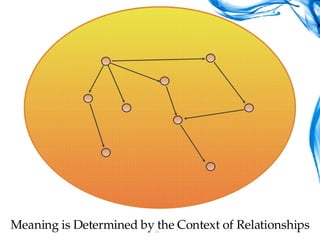
Meaning is Determined by the Context of Relationships
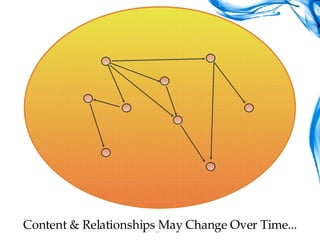
Content & Relationships May Change Over Time...
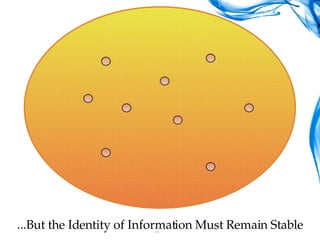
...But the Identity of Information Must Remain Stable
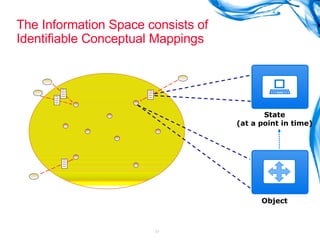
The Information Space consists of  Identifiable Conceptual Mappings State (at a point in time) Object
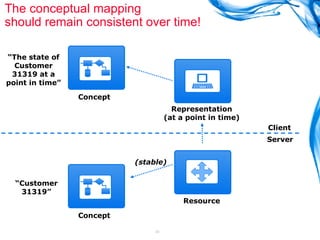
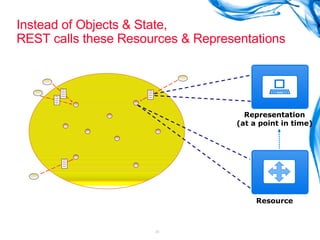
Instead of Objects & State,  REST calls these Resources & Representations Representation (at a point in time) Resource
The conceptual mapping  should remain consistent over time! Concept Representation (at a point in time) Resource “ Customer 31319” Concept “ The state of Customer 31319 at a point in time” Server Client (stable)
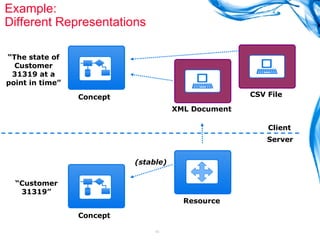
Example: Different Representations Concept XML Document Resource “ Customer 31319” Concept “ The state of Customer 31319 at a point in time” Server Client (stable) CSV File
Multi-Organization Interoperability
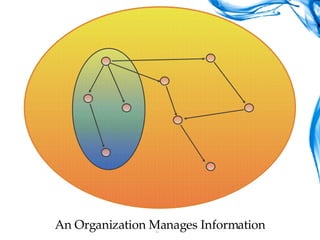
An Organization Manages Information
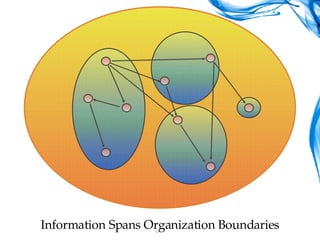
Information Spans Organization Boundaries
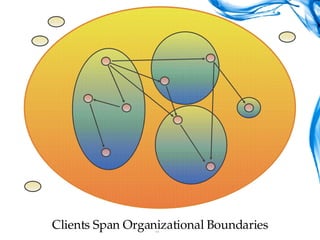
Clients Span Organizational Boundaries
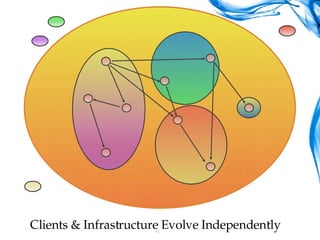
Clients & Infrastructure Evolve Independently
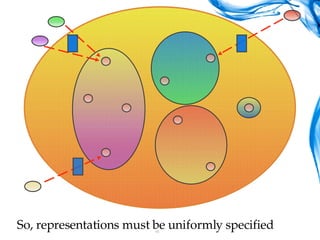
So, representations must be uniformly specified
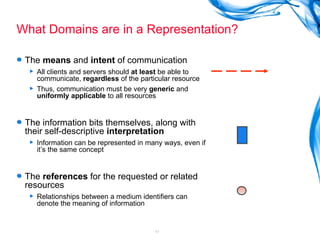
What Domains are in a Representation? The  means  and  intent  of communication All clients and servers should  at least  be able to communicate,  regardless  of the particular resource Thus, communication must be very  generic  and  uniformly applicable  to all resources The information bits themselves, along with their self-descriptive  interpretation Information can be represented in many ways, even if it’s the same concept The  references  for the requested or related resources Relationships between a medium identifiers can denote the meaning of information
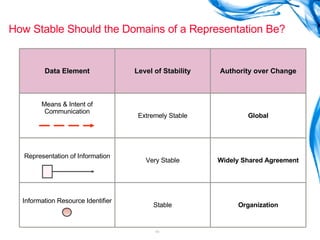
How Stable Should the Domains of a Representation Be? Data Element Level of Stability Authority over Change Means & Intent of Communication Extremely Stable Global Representation of Information Very Stable Widely Shared Agreement Information Resource Identifier Stable Organization
Control Flow
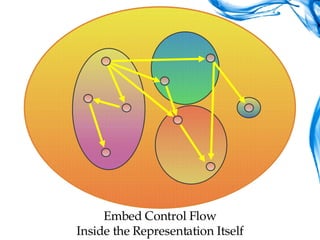
Embed Control Flow Inside the Representation Itself
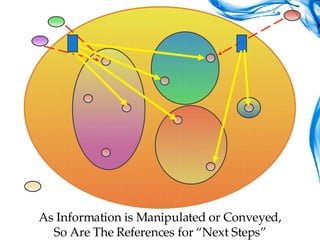
As Information is Manipulated or Conveyed, So Are The References for “Next Steps”
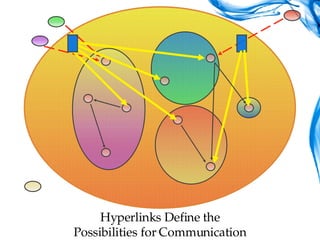
Hyperlinks Define the Possibilities for Communication
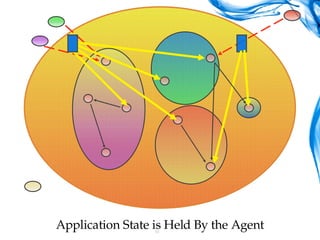
Application State is Held By the Agent
Summary of the REST Uniform Interface All valuable  resources  are identified by a globally scoped, uniform,  resource identifier Simple, consistent ability to (de)reference both information & services Resources  are manipulated through the exchange of  representations Stateless, visible communication to encapsulated resources All exchanges are  self-descriptive Enables visibility and extensibility All access  methods  mean the same for all resources Communication semantics are universal Hypermedia is the  engine  of application state Information and controls are intertwingled
Agenda Part 1 How We Got Here Understanding Distributed Object Interoperability Exploring  the Design of REST Identity and Reference Handling Evolution Multi-Organizational Interoperability Control Flow through Hypermedia Part 2 RESTful Web Services in Action Exploring the Web’s Architecture Applied Techniques  for RESTful Web Services Resources-Oriented Architecture Security Approaches Transactions & Reliability
RESTful Web Services in Action
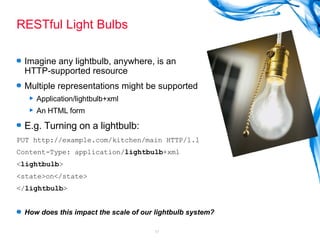
RESTful Light Bulbs Imagine any lightbulb, anywhere, is an  HTTP-supported resource Multiple representations might be supported Application/lightbulb+xml An HTML form E.g. Turning on a lightbulb: PUT http://example.com/kitchen/main HTTP/1.1 Content-Type: application/ lightbulb +xml < lightbulb > <state>on</state> </ lightbulb > How does this impact the scale of our lightbulb system?
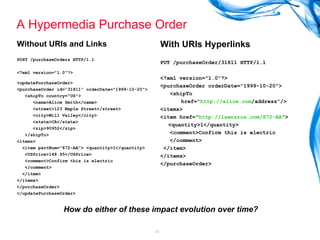
A Hypermedia Purchase Order Without URIs and Links POST /purchaseOrders HTTP/1.1 <?xml version=&quot;1.0&quot;?> <updatePurchaseOrder> <purchaseOrder id=“31811” orderDate=&quot;1999-10-20&quot;> <shipTo country=&quot;US&quot;> <name>Alice Smith</name> <street>123 Maple Street</street> <city>Mill Valley</city> <state>CA</state> <zip>90952</zip> </shipTo> <items> <item partNum=&quot;872-AA&quot;> <quantity>1</quantity> <USPrice>148.95</USPrice> <comment>Confirm this is electric </comment> </item> </items> </purchaseOrder> </updatePurchaseOrder> With URIs Hyperlinks PUT /purchaseOrder/31811 HTTP/1.1 <?xml version=&quot;1.0&quot;?> <purchaseOrder orderDate=&quot;1999-10-20&quot;> <shipTo    href=“ http:// alice.com /address ”/> <items> <item href=“ http://lawnsrus.com/872-AA ”> <quantity>1</quantity> <comment>Confirm this is electric </comment> </item> </items> </purchaseOrder> How do either of these impact evolution over time?
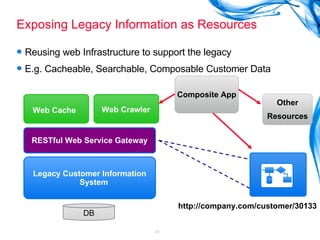
Exposing Legacy Information as Resources Reusing web Infrastructure to support the legacy E.g. Cacheable, Searchable, Composable Customer Data RESTful Web Service Gateway Legacy Customer Information  System Composite App DB Web Cache Web Crawler http://company.com/customer/30133 Other Resources
Exploring the  Web Architecture Highlights
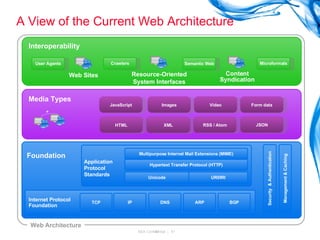
A View of the Current Web Architecture BEA Confidential  |  Web Architecture Foundation Internet Protocol Foundation Hypertext Transfer Protocol (HTTP) Security  & Authentication Management & Caching BGP Application Protocol Standards ARP DNS IP TCP Multipurpose Internet Mail Extensions (MIME) Media Types HTML XML RSS / Atom URI/IRI Unicode JavaScript Images Video JSON Form data Interoperability Crawlers User Agents Semantic Web Microformats Web Sites Resource-Oriented System Interfaces Content Syndication
Inside an Object Request Broker Source:  OMG CORBA 2.3 Architecture & Specification
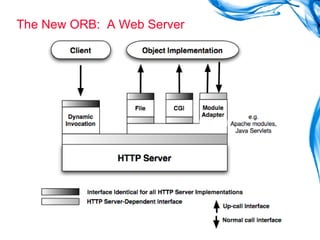
The New ORB:  A Web Server
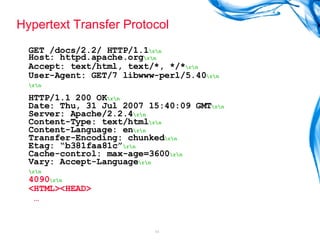
Hypertext Transfer Protocol GET /docs/2.2/ HTTP/1.1 \r\n Host: httpd.apache.org \r\n Accept: text/html, text/*, */* \r\n User-Agent: GET/7 libwww-perl/5.40 \r\n \r\n HTTP/1.1 200 OK \r\n Date: Thu, 31 Jul 2007 15:40:09 GMT \r\n Server: Apache/2.2.4 \r\n Content-Type: text/html \r\n Content-Language: en \r\n Transfer-Encoding: chunked \r\n Etag: “b381faa81c” \r\n Cache-control: max-age=3600 \r\n Vary: Accept-Language \r\n \r\n   4090 \r\n <HTML><HEAD> …
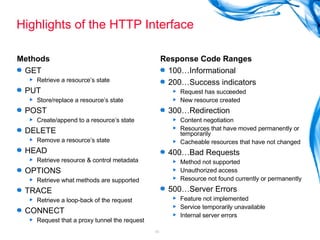
Highlights of the HTTP Interface Methods GET Retrieve a resource’s state PUT  Store/replace a resource’s state POST Create/append to a resource’s state DELETE Remove a resource’s state HEAD Retrieve resource & control metadata OPTIONS Retrieve what methods are supported TRACE Retrieve a loop-back of the request CONNECT Request that a proxy tunnel the request Response Code Ranges 100…Informational 200…Success indicators Request has succeeded New resource created 300…Redirection Content negotiation Resources that have moved permanently or temporarily Cacheable resources that have not changed 400…Bad Requests Method not supported Unauthorized access Resource not found currently or permanently 500…Server Errors Feature not implemented Service temporarily unavailable Internal server errors
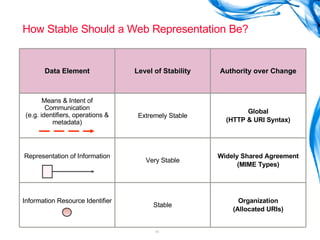
How Stable Should a Web Representation Be? Data Element Level of Stability Authority over Change Means & Intent of Communication (e.g. identifiers, operations & metadata) Extremely Stable Global (HTTP & URI Syntax) Representation of Information Very Stable Widely Shared Agreement (MIME Types) Information Resource Identifier Stable Organization (Allocated URIs)
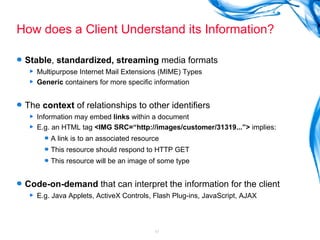
How does a Client Understand its Information? Stable ,  standardized, streaming  media formats Multipurpose Internet Mail Extensions (MIME) Types Generic  containers for more specific information The  context  of relationships to other identifiers Information may embed  links  within a document E.g. an HTML tag  <IMG SRC=“http://images/customer/31319...”>  implies: A link is to an associated resource This resource should respond to HTTP GET This resource will be an image of some type  Code-on-demand  that can interpret the information for the client E.g. Java Applets, ActiveX Controls, Flash Plug-ins, JavaScript, AJAX
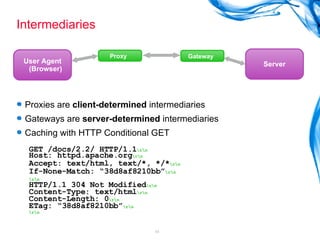
Intermediaries Proxies are  client-determined  intermediaries Gateways are  server-determined  intermediaries Caching with HTTP Conditional GET GET /docs/2.2/ HTTP/1.1 \r\n Host: httpd.apache.org \r\n Accept: text/html, text/*, */* \r\n If-None-Match: “38d8af8210bb” \r\n \r\n HTTP/1.1 304 Not Modified \r\n Content-Type: text/html \r\n Content-Length: 0 \r\n ETag: “38d8af8210bb” \r\n \r\n Proxy User Agent (Browser) Gateway Server
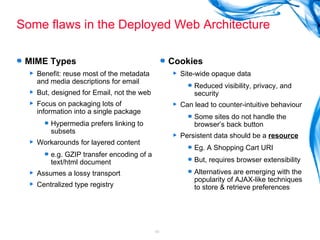
Some flaws in the Deployed Web Architecture MIME Types Benefit: reuse most of the metadata and media descriptions for email But, designed for Email, not the web Focus on packaging lots of information into a single package Hypermedia prefers linking to subsets Workarounds for layered content e.g. GZIP transfer encoding of a text/html document Assumes a lossy transport Centralized type registry Cookies Site-wide opaque data Reduced visibility, privacy, and security Can lead to counter-intuitive behaviour Some sites do not handle the browser’s back button Persistent data should be a  resource Eg. A Shopping Cart URI But, requires browser extensibility Alternatives are emerging with the popularity of AJAX-like techniques to store & retrieve preferences
Applied Techniques for RESTful Web Services
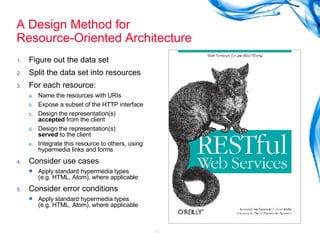
A Design Method for Resource-Oriented Architecture Figure out the data set Split the data set into resources For each resource: Name the resources with URIs Expose a subset of the HTTP interface Design the representation(s)  accepted  from the client Design the representation(s)  served  to the client Integrate this resource to others, using hypermedia links and forms Consider use cases Apply standard hypermedia types  (e.g. HTML, Atom), where applicable Consider error conditions Apply standard hypermedia types  (e.g. HTML, Atom), where applicable
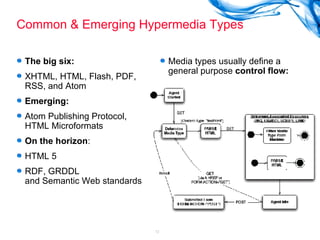
Common & Emerging Hypermedia Types The big six:   XHTML, HTML, Flash, PDF, RSS, and Atom Emerging:   Atom Publishing Protocol, HTML Microformats On the horizon :  HTML 5 RDF, GRDDL  and Semantic Web standards Media types usually define a general purpose  control flow:
RESTful Security Approaches Identity Assertion OpenID URI-based digital identity Open ID 2.0 is adding attributes, secure messages Kerberos / SPNEGO Popular on intranets, requires a server Not likely internet scalable Current implementations require excessive round-trips
RESTful Message Confidentiality & Integrity Mutual SSL Robust, widely supported Does not enable intermediary visibility or persistent signatures XML Signature & Encryption But XML Canonicalization is extremely complicated S/MIME or PGP Key negotiation is usually out of band OpenID 2.0 may help Widely deployed within the email system (perhaps not as widely  used ) Fits within existing HTTP infrastructure Not widely deployed within HTTP Limitations:  http://blog.jclark.com/2007/10/why-not-smime.html Image: Mark Wahl, ldap.com
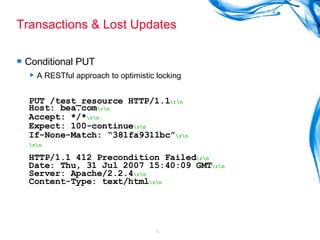
Transactions & Lost Updates Conditional PUT A RESTful approach to optimistic locking PUT /test_resource HTTP/1.1 \r\n Host: bea.com \r\n Accept: */* \r\n Expect: 100-continue \r\n If-None-Match: “381fa9311bc” \r\n \r\n HTTP/1.1 412 Precondition Failed \r\n Date: Thu, 31 Jul 2007 15:40:09 GMT \r\n Server: Apache/2.2.4 \r\n Content-Type: text/html \r\n
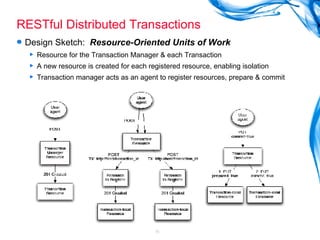
RESTful Distributed Transactions Design Sketch:  Resource-Oriented Units of Work Resource for the Transaction Manager & each Transaction A new resource is created for each registered resource, enabling isolation Transaction manager acts as an agent to register resources, prepare & commit
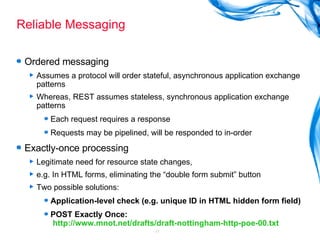
Reliable Messaging Ordered messaging Assumes a protocol will order stateful, asynchronous application exchange patterns Whereas, REST assumes stateless, synchronous application exchange patterns Each request requires a response Requests may be pipelined, will be responded to in-order Exactly-once processing Legitimate need for resource state changes,  e.g. In HTML forms, eliminating the “double form submit” button Two possible solutions: Application-level check (e.g. unique ID in HTML hidden form field) POST Exactly Once:   http://www.mnot.net/drafts/draft-nottingham-http-poe-00.txt
Summary
Summary The “Global Object Web” is largely here:  it’s the Web! The Web is similar to a Distributed Object System Objects ~= Resources Resources may be referenced, created, updated and/or deleted Global-scale interoperability requires constraints on communication Unpredictable evolution & configurations are the norm Serendipitous reuse is more common than planned reuse Must depend on a stable, but extensible, uniform interface to communicate Many traditional distributed systems challenges can be solved in a RESTful manner Reliability, optimistic locking, security, transactions More work remains to be done – “Learn to love the Web”!
Thank you!
Alternative Architectures When is REST not appropriate?
Alternative Architectures Transparent Remote Access Developer transparency is paramount Information sharing is unimportant Evolution is federally controlled (e.g. producers & consumers are under the same control ) Distributed Objects or XML Web Services can be appropriate Globally Consistent Transaction System Tightly Coupled Single-System Image (e.g. a cluster) Consistency trumps High Availability Accomplished through language-level bindings (e.g. Java XA, MSDTC) or distributed object network protocols (e.g. TIP or IIOP)
Alternative Architectures Stateful, In-Order, Reliable Messaging When you don’t have the time or inclination to share data Most interactions are  not  safe or idempotent The application does not lend itself well to statelessness The physical scale (number of servers) is relatively small at each layer Clients are trusted & controlled in the same federation as the servers The network is controlled & predictable Structured Data Analysis, Manipulation and Reporting Remote Data Access (SQL, SPARQL) interfaces use general-purpose connectors Requires extensive knowledge of the schema Often requires per-client state maintenance
Alternative Architectures Stateful, real-time two-way communication E.g. voice or video communication / conferencing, P2P file transfer Requires a synchronous two-way streaming architecture  However,  stream signaling  and  negotiation  arguably can be RESTful E.g. BitTorrent registries & trackers require the Web to function
Alternative Architectures High-speed Publish/Subscribe Event Notification HTTP is limited to request/response semantics May be significant protocol overhead Arguably a limitation of HTTP 1.1, not REST Examples of fitting publish/subscribe into HTTP: Simulating an Event Stream as a long HTTP GET Request Installing an HTTP Server on the Agent side No obvious message correlation, hindering visibility
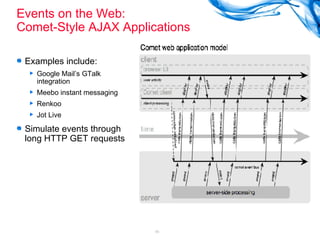
Events on the Web:  Comet-Style AJAX Applications Examples include: Google Mail’s GTalk integration Meebo instant messaging Renkoo Jot Live Simulate events through long HTTP GET requests
References
Further Reading Andreessen, Mark.  IIOP and the Distributed Objects Model http://web.archive.org/web/19961026035558/http://www3.netscape.com/comprod/columns/techvision/iiop.html Box, Don.  Lessons from the Component Wars:  An XML Manifesto http://msdn2.microsoft.com/en-us/library/aa468562.aspx Fielding, Roy.  Architectural Styles and the Design of Network-Based Software Architectures http:// www.ics.uci.edu/~fielding/pubs/dissertation/top.htm Fielding, Roy.  ApacheCon 2007 Presentation:  The Rest of REST http://roy.gbiv.com/talks/200709_fielding_rest.pdf The Object Management Group, The Common Object Request Broker:  Architecture and Specification http://www.omg.org/docs/formal/99-10-07.pdf The OpenID Foundation http:// openid.net Orfali, Harkey, and Edwards. BYTE Magazine (October 1997), CORBA, Java, and the Object Web http://www.byte.com/art/9710/sec6/art3.htm Maier & Rechtin. The Art of Systems Architecting. CRC Press, ISBN 0849304407  Nieslen & LaLiberte. Editing the Web: Detecting the Lost Update Problem Using Unreserved Checkout http://www.w3.org/1999/04/Editing/ Nottingham, Mark.  Post Once Exactly (POE) Internet Draft http://www.mnot.net/drafts/draft-nottingham-http-poe-00.txt Richardson & Ruby.  RESTful Web Services.  O’Reilly Media, ISBN 0596529260 Russell, Alex.  Comet:  Low Latency Data for the Browser http:// alex.dojotoolkit.org/?p =545 World Wide Web Consortium, Architecture of the World Wide Web, Volume One http://www.w3.org/TR/webarch/

Oopsla 2007 - The Web: Distributed Objects Realized!

  • 1.
    The Web: Distributed Objects Realized! Mark Baker, Coactus Consulting Stuart Charlton, BEA Systems
  • 2.
    About Us MarkBaker Coactus Consulting CTO-level consulting and large-scale distributed systems architect Leading proponent of “REST style web services” for over seven years Prior work at Nortel, Sun Microsystems, and several startups Co-developed internet, mobile, and web standards through the IETF , W3C , and OMA Mark’s Blog http://www.markbaker.ca/blog/ mailto:mark@coactus.com Stuart Charlton BEA Systems Enterprise architect in BEA’s Consulting practice Co-develops BEA’s global consulting strategy and service offerings Specialized in distributed systems architecture, data warehousing, and object technology Prior work in EA, consulting, and mentoring both the financial services & telecommunications industries Stu Says Stuff http://stucharlton.com/blog/ mailto:stuart.charlton@bea.com
  • 3.
    Agenda Part 1How We Got Here Understanding Distributed Object Interoperability Exploring the Design of REST Identity and Reference Handling Evolution Multi-Organizational Interoperability Control Flow through Hypermedia Part 2 RESTful Web Services in Action Exploring the Web’s Architecture Applied Techniques for RESTful Web Services Resources-Oriented Architecture Security Approaches Transactions & Reliability
  • 4.
    How We GotHere The Rise of the Object Web
  • 5.
    Where we’ve comefrom… “ The next shift catalyzed by the Web will be the adoption of enterprise systems based on distributed objects and IIOP (Internet Inter-ORB Protocol). IIOP will manage the communication between the object components that power the system. Users will be pointing and clicking at objects available on IIOP-enabled servers.” - Marc Andressen, Netscape Cofounder (October, 1996)
  • 6.
    The Object WebShall Arise! “To move to the next step, the Web needs distributed objects. We call this next wave of Internet innovation the &quot;Object Web.“ The HTTP form you submit is still the basic unit of client/server interaction. This clumsy work-around is not suitable for full-blown client/server applications that require highly interactive conversations between components. It also does not scale well.” - CORBA, Java, and the Object Web BYTE Magazine (October 1997)
  • 7.
  • 8.
    By 1999…. XMLWeb Services Shall Arise! …Over the past decade, component technology has been the cause of many arguments, disagreements, and debates . This component-induced friction can be traced to two primary factors: 1. “My Glue is Better than Your Glue” 2. “I Can’t Believe You Program In That Language” - Don Box Lessons from the Component Wars: An XML Manifesto (September 1999)
  • 9.
    By the mid-2000s….what about “just” the Web?
  • 10.
    Our Claims: Thedream of the “Object Web” is largely here: it’s the Web! Constraints in a systems architecture lead to emergent properties . The Representational State Transfer (REST) architectural style defines constraints which helped guide the web towards a globally scalable, interoperable, and extensible system. The REST architectural style is both an evolution of past approaches to networked computing, and a radical departure . More work remains to be done!
  • 11.
  • 12.
    The Distributed ObjectRequest Broker (ORB) The Goals of an ORB: Encapsulate all of the mechanisms to: Find the object for the request Prepare the implementation to receive the request Communicate the data making up the request Ensure complete transparency of object location and implementation
  • 13.
    Inside an ObjectRequest Broker Source: OMG CORBA 2.3 Architecture & Specification
  • 14.
    How can aweb of distributed objects span organizations?
  • 15.
    Interoperability Domains Adistributed system, even if the goal is transparency, has several co-existing domains of interoperability A domain is a set of objects sharing a common characteristic or abiding by common rules. Source: OMG CORBA 2.3 Architecture & Specification
  • 16.
    Types of InteroperabilityDomains Referencing The scope of a distributed object reference Representation The scope of a message transfer syntax & protocol Network Connectivity Potential scope of a network message Network Addressing Potential scope of a network address Security The extent of a particular security policy Others… Source: OMG CORBA 2.3 Architecture & Specification
  • 17.
    Solutions to MultipleInteroperability Domains Canonicalization Simple and scalable, at the cost of reduced runtime performance Low barrier to entry for new clients , high barrier for new servers Point-to-Point Adaptation Good runtime performance, not as scalable, increasing complexity Low barrier to entry for new servers , high entry for new clients Canonical Domain Domain A Domain B Domain A Domain C Domain B
  • 18.
    Solutions for a“Global Object Web”? Goal seems to be primarily about use and reuse: more consumption Thus, lower the barriers to new clients! Scope of Object References: Global Scope of Representation: Global (but extensible) Scope of Network Connectivity: Global Scope of Security: Shared Agreement Requires at least some level of Global Canonicalization
  • 19.
    Solutions for a“Global Object Web”? Further Concerns: Unpredictable type, usage, and volume of information Thus, shaped around extensible, streamable, cacheable, identifiable information Both Human and Automated actors Thus, simple, reusable, and extensible interfaces, appropriate for either … How would you architect such a system? This is atypical of most distributed object systems architectures in practice
  • 20.
    Two Very DifferentTypes of Architectural Domains Client or Builder-focused Identifiable Client or Customer(s) Clearly identifiable builders Clearly identifiable users Control governance & control Overall architectural control System is a result of deliberate value judgement by the client Examples Most IT projects, software products, civil structures, etc. Collaborative Systems No identifiable client Many builders Many (unpredictable) users No central control in terms of development, or operation System is a result of the voluntary choices of the participants Examples Internet and WWW, electrical power systems, joint military operations, etc. Source: Eberherdt Rechtin, The Art of Systems Architecting
  • 21.
    Building Emergent Capabilityinto an Architecture Collaborative systems are about creating emergent capability The architecture of the system is the constraints on interfaces Components & implementations are out of scope and out of control An example style of such constraints: Client/Server Architecture Constraints: Active client, Reactive server, client initiates communication Emergent properties: Simplifies server, enables multiple organizational domains Client Server
  • 22.
    Composing Constraints intoan Architectural Style Constraints both enable and detract from emergent properties, and may be combined together Example: Client/Server + Layered System + Caching + Stateless Interaction Enables: Simplified Clients and Servers (due to statelessness & C/S) Shared Caching (due to layering) Improved Visibility & Reliability (due to statelessness) Add in: Code on Demand (COD) Result: Simplifies clients, Improves Extensibility, but Reduces Visibility Source: Roy Fielding, Architectural Styles and the Design of Network-Based Software Architectures
  • 23.
    The Representational StateTransfer (REST) Style Originally referred to as “The HTTP Object Model” Source: Roy Fielding, Architectural Styles and the Design of Network-Based Software Architectures
  • 24.
    Some Major Differencesbetween REST and Distributed Objects 1. Most distributed architectures do not assume application requirements Yet, the Web is an application with goals & requirements! The overall goal: sharing information and capabilities at a global scale REST assumes the requirement is to provide an architecture of participation for a globally networked information space 2. Most distributed architectures do not require globally scoped interoperability domains REST insists on a uniform interface to ensure global scope interoperability The uniform interface is what we explore next! These differences apply elsewhere: SOAP Web Services, RPC, etc. are also just general toolkits
  • 25.
    RESTful Distributed Objects in contrast to SOAP Web Services Perceived advantages: Communication occurs through XML document exchange Agreement occurs in the network protocol The XML InfoSet is the basis of interoperability No worrying about object-oriented purity / language-oriented bindings Disadvantages: Prefers interface descriptions for specific (non-uniform) interfaces All data must flow through the XML InfoSet, other types are secondary Nearly eliminates the notions of: Object lifecycle (creation, removal, activation) Object identification & references (i.e. linking) Assumes transfer protocol independence is possible and desirable In practice, transfer protocol semantics leak into message exchanges
  • 26.
    A Word onREST vs. The World Wide Web Consider three levels of abstraction: Architectural Styles : Representation State Transfer (REST) Architecture : The World Wide Web Implementation : “User Agents, Web Servers, Proxies, etc.” REST is a model of constraints and emergent properties The Web is the most widely used and understood implementation
  • 27.
    Exploring theDesign of REST
  • 28.
    A Global, Networked,Shared Information Space
  • 29.
    Users Consume &Manipulate Information via Agents
  • 30.
    Information Objects MustBe Identifiable
  • 31.
    An Object’s Interfaceis separated from Implementation
  • 32.
    State is exchangedin a stateless, self-describing manner
  • 33.
  • 34.
    Meaning is Determinedby the Context of Relationships
  • 35.
    Content & RelationshipsMay Change Over Time...
  • 36.
    ...But the Identityof Information Must Remain Stable
  • 37.
    The Information Spaceconsists of Identifiable Conceptual Mappings State (at a point in time) Object
  • 38.
    Instead of Objects& State, REST calls these Resources & Representations Representation (at a point in time) Resource
  • 39.
    The conceptual mapping should remain consistent over time! Concept Representation (at a point in time) Resource “ Customer 31319” Concept “ The state of Customer 31319 at a point in time” Server Client (stable)
  • 40.
    Example: Different RepresentationsConcept XML Document Resource “ Customer 31319” Concept “ The state of Customer 31319 at a point in time” Server Client (stable) CSV File
  • 41.
  • 42.
  • 43.
  • 44.
  • 45.
    Clients & InfrastructureEvolve Independently
  • 46.
    So, representations mustbe uniformly specified
  • 47.
    What Domains arein a Representation? The means and intent of communication All clients and servers should at least be able to communicate, regardless of the particular resource Thus, communication must be very generic and uniformly applicable to all resources The information bits themselves, along with their self-descriptive interpretation Information can be represented in many ways, even if it’s the same concept The references for the requested or related resources Relationships between a medium identifiers can denote the meaning of information
  • 48.
    How Stable Shouldthe Domains of a Representation Be? Data Element Level of Stability Authority over Change Means & Intent of Communication Extremely Stable Global Representation of Information Very Stable Widely Shared Agreement Information Resource Identifier Stable Organization
  • 49.
  • 50.
    Embed Control FlowInside the Representation Itself
  • 51.
    As Information isManipulated or Conveyed, So Are The References for “Next Steps”
  • 52.
    Hyperlinks Define thePossibilities for Communication
  • 53.
    Application State isHeld By the Agent
  • 54.
    Summary of theREST Uniform Interface All valuable resources are identified by a globally scoped, uniform, resource identifier Simple, consistent ability to (de)reference both information & services Resources are manipulated through the exchange of representations Stateless, visible communication to encapsulated resources All exchanges are self-descriptive Enables visibility and extensibility All access methods mean the same for all resources Communication semantics are universal Hypermedia is the engine of application state Information and controls are intertwingled
  • 55.
    Agenda Part 1How We Got Here Understanding Distributed Object Interoperability Exploring the Design of REST Identity and Reference Handling Evolution Multi-Organizational Interoperability Control Flow through Hypermedia Part 2 RESTful Web Services in Action Exploring the Web’s Architecture Applied Techniques for RESTful Web Services Resources-Oriented Architecture Security Approaches Transactions & Reliability
  • 56.
  • 57.
    RESTful Light BulbsImagine any lightbulb, anywhere, is an HTTP-supported resource Multiple representations might be supported Application/lightbulb+xml An HTML form E.g. Turning on a lightbulb: PUT http://example.com/kitchen/main HTTP/1.1 Content-Type: application/ lightbulb +xml < lightbulb > <state>on</state> </ lightbulb > How does this impact the scale of our lightbulb system?
  • 58.
    A Hypermedia PurchaseOrder Without URIs and Links POST /purchaseOrders HTTP/1.1 <?xml version=&quot;1.0&quot;?> <updatePurchaseOrder> <purchaseOrder id=“31811” orderDate=&quot;1999-10-20&quot;> <shipTo country=&quot;US&quot;> <name>Alice Smith</name> <street>123 Maple Street</street> <city>Mill Valley</city> <state>CA</state> <zip>90952</zip> </shipTo> <items> <item partNum=&quot;872-AA&quot;> <quantity>1</quantity> <USPrice>148.95</USPrice> <comment>Confirm this is electric </comment> </item> </items> </purchaseOrder> </updatePurchaseOrder> With URIs Hyperlinks PUT /purchaseOrder/31811 HTTP/1.1 <?xml version=&quot;1.0&quot;?> <purchaseOrder orderDate=&quot;1999-10-20&quot;> <shipTo href=“ http:// alice.com /address ”/> <items> <item href=“ http://lawnsrus.com/872-AA ”> <quantity>1</quantity> <comment>Confirm this is electric </comment> </item> </items> </purchaseOrder> How do either of these impact evolution over time?
  • 59.
    Exposing Legacy Informationas Resources Reusing web Infrastructure to support the legacy E.g. Cacheable, Searchable, Composable Customer Data RESTful Web Service Gateway Legacy Customer Information System Composite App DB Web Cache Web Crawler http://company.com/customer/30133 Other Resources
  • 60.
    Exploring the Web Architecture Highlights
  • 61.
    A View ofthe Current Web Architecture BEA Confidential | Web Architecture Foundation Internet Protocol Foundation Hypertext Transfer Protocol (HTTP) Security & Authentication Management & Caching BGP Application Protocol Standards ARP DNS IP TCP Multipurpose Internet Mail Extensions (MIME) Media Types HTML XML RSS / Atom URI/IRI Unicode JavaScript Images Video JSON Form data Interoperability Crawlers User Agents Semantic Web Microformats Web Sites Resource-Oriented System Interfaces Content Syndication
  • 62.
    Inside an ObjectRequest Broker Source: OMG CORBA 2.3 Architecture & Specification
  • 63.
    The New ORB: A Web Server
  • 64.
    Hypertext Transfer ProtocolGET /docs/2.2/ HTTP/1.1 \r\n Host: httpd.apache.org \r\n Accept: text/html, text/*, */* \r\n User-Agent: GET/7 libwww-perl/5.40 \r\n \r\n HTTP/1.1 200 OK \r\n Date: Thu, 31 Jul 2007 15:40:09 GMT \r\n Server: Apache/2.2.4 \r\n Content-Type: text/html \r\n Content-Language: en \r\n Transfer-Encoding: chunked \r\n Etag: “b381faa81c” \r\n Cache-control: max-age=3600 \r\n Vary: Accept-Language \r\n \r\n 4090 \r\n <HTML><HEAD> …
  • 65.
    Highlights of theHTTP Interface Methods GET Retrieve a resource’s state PUT Store/replace a resource’s state POST Create/append to a resource’s state DELETE Remove a resource’s state HEAD Retrieve resource & control metadata OPTIONS Retrieve what methods are supported TRACE Retrieve a loop-back of the request CONNECT Request that a proxy tunnel the request Response Code Ranges 100…Informational 200…Success indicators Request has succeeded New resource created 300…Redirection Content negotiation Resources that have moved permanently or temporarily Cacheable resources that have not changed 400…Bad Requests Method not supported Unauthorized access Resource not found currently or permanently 500…Server Errors Feature not implemented Service temporarily unavailable Internal server errors
  • 66.
    How Stable Shoulda Web Representation Be? Data Element Level of Stability Authority over Change Means & Intent of Communication (e.g. identifiers, operations & metadata) Extremely Stable Global (HTTP & URI Syntax) Representation of Information Very Stable Widely Shared Agreement (MIME Types) Information Resource Identifier Stable Organization (Allocated URIs)
  • 67.
    How does aClient Understand its Information? Stable , standardized, streaming media formats Multipurpose Internet Mail Extensions (MIME) Types Generic containers for more specific information The context of relationships to other identifiers Information may embed links within a document E.g. an HTML tag <IMG SRC=“http://images/customer/31319...”> implies: A link is to an associated resource This resource should respond to HTTP GET This resource will be an image of some type Code-on-demand that can interpret the information for the client E.g. Java Applets, ActiveX Controls, Flash Plug-ins, JavaScript, AJAX
  • 68.
    Intermediaries Proxies are client-determined intermediaries Gateways are server-determined intermediaries Caching with HTTP Conditional GET GET /docs/2.2/ HTTP/1.1 \r\n Host: httpd.apache.org \r\n Accept: text/html, text/*, */* \r\n If-None-Match: “38d8af8210bb” \r\n \r\n HTTP/1.1 304 Not Modified \r\n Content-Type: text/html \r\n Content-Length: 0 \r\n ETag: “38d8af8210bb” \r\n \r\n Proxy User Agent (Browser) Gateway Server
  • 69.
    Some flaws inthe Deployed Web Architecture MIME Types Benefit: reuse most of the metadata and media descriptions for email But, designed for Email, not the web Focus on packaging lots of information into a single package Hypermedia prefers linking to subsets Workarounds for layered content e.g. GZIP transfer encoding of a text/html document Assumes a lossy transport Centralized type registry Cookies Site-wide opaque data Reduced visibility, privacy, and security Can lead to counter-intuitive behaviour Some sites do not handle the browser’s back button Persistent data should be a resource Eg. A Shopping Cart URI But, requires browser extensibility Alternatives are emerging with the popularity of AJAX-like techniques to store & retrieve preferences
  • 70.
    Applied Techniques forRESTful Web Services
  • 71.
    A Design Methodfor Resource-Oriented Architecture Figure out the data set Split the data set into resources For each resource: Name the resources with URIs Expose a subset of the HTTP interface Design the representation(s) accepted from the client Design the representation(s) served to the client Integrate this resource to others, using hypermedia links and forms Consider use cases Apply standard hypermedia types (e.g. HTML, Atom), where applicable Consider error conditions Apply standard hypermedia types (e.g. HTML, Atom), where applicable
  • 72.
    Common & EmergingHypermedia Types The big six: XHTML, HTML, Flash, PDF, RSS, and Atom Emerging: Atom Publishing Protocol, HTML Microformats On the horizon : HTML 5 RDF, GRDDL and Semantic Web standards Media types usually define a general purpose control flow:
  • 73.
    RESTful Security ApproachesIdentity Assertion OpenID URI-based digital identity Open ID 2.0 is adding attributes, secure messages Kerberos / SPNEGO Popular on intranets, requires a server Not likely internet scalable Current implementations require excessive round-trips
  • 74.
    RESTful Message Confidentiality& Integrity Mutual SSL Robust, widely supported Does not enable intermediary visibility or persistent signatures XML Signature & Encryption But XML Canonicalization is extremely complicated S/MIME or PGP Key negotiation is usually out of band OpenID 2.0 may help Widely deployed within the email system (perhaps not as widely used ) Fits within existing HTTP infrastructure Not widely deployed within HTTP Limitations: http://blog.jclark.com/2007/10/why-not-smime.html Image: Mark Wahl, ldap.com
  • 75.
    Transactions & LostUpdates Conditional PUT A RESTful approach to optimistic locking PUT /test_resource HTTP/1.1 \r\n Host: bea.com \r\n Accept: */* \r\n Expect: 100-continue \r\n If-None-Match: “381fa9311bc” \r\n \r\n HTTP/1.1 412 Precondition Failed \r\n Date: Thu, 31 Jul 2007 15:40:09 GMT \r\n Server: Apache/2.2.4 \r\n Content-Type: text/html \r\n
  • 76.
    RESTful Distributed TransactionsDesign Sketch: Resource-Oriented Units of Work Resource for the Transaction Manager & each Transaction A new resource is created for each registered resource, enabling isolation Transaction manager acts as an agent to register resources, prepare & commit
  • 77.
    Reliable Messaging Orderedmessaging Assumes a protocol will order stateful, asynchronous application exchange patterns Whereas, REST assumes stateless, synchronous application exchange patterns Each request requires a response Requests may be pipelined, will be responded to in-order Exactly-once processing Legitimate need for resource state changes, e.g. In HTML forms, eliminating the “double form submit” button Two possible solutions: Application-level check (e.g. unique ID in HTML hidden form field) POST Exactly Once: http://www.mnot.net/drafts/draft-nottingham-http-poe-00.txt
  • 78.
  • 79.
    Summary The “GlobalObject Web” is largely here: it’s the Web! The Web is similar to a Distributed Object System Objects ~= Resources Resources may be referenced, created, updated and/or deleted Global-scale interoperability requires constraints on communication Unpredictable evolution & configurations are the norm Serendipitous reuse is more common than planned reuse Must depend on a stable, but extensible, uniform interface to communicate Many traditional distributed systems challenges can be solved in a RESTful manner Reliability, optimistic locking, security, transactions More work remains to be done – “Learn to love the Web”!
  • 80.
  • 81.
    Alternative Architectures Whenis REST not appropriate?
  • 82.
    Alternative Architectures TransparentRemote Access Developer transparency is paramount Information sharing is unimportant Evolution is federally controlled (e.g. producers & consumers are under the same control ) Distributed Objects or XML Web Services can be appropriate Globally Consistent Transaction System Tightly Coupled Single-System Image (e.g. a cluster) Consistency trumps High Availability Accomplished through language-level bindings (e.g. Java XA, MSDTC) or distributed object network protocols (e.g. TIP or IIOP)
  • 83.
    Alternative Architectures Stateful,In-Order, Reliable Messaging When you don’t have the time or inclination to share data Most interactions are not safe or idempotent The application does not lend itself well to statelessness The physical scale (number of servers) is relatively small at each layer Clients are trusted & controlled in the same federation as the servers The network is controlled & predictable Structured Data Analysis, Manipulation and Reporting Remote Data Access (SQL, SPARQL) interfaces use general-purpose connectors Requires extensive knowledge of the schema Often requires per-client state maintenance
  • 84.
    Alternative Architectures Stateful,real-time two-way communication E.g. voice or video communication / conferencing, P2P file transfer Requires a synchronous two-way streaming architecture However, stream signaling and negotiation arguably can be RESTful E.g. BitTorrent registries & trackers require the Web to function
  • 85.
    Alternative Architectures High-speedPublish/Subscribe Event Notification HTTP is limited to request/response semantics May be significant protocol overhead Arguably a limitation of HTTP 1.1, not REST Examples of fitting publish/subscribe into HTTP: Simulating an Event Stream as a long HTTP GET Request Installing an HTTP Server on the Agent side No obvious message correlation, hindering visibility
  • 86.
    Events on theWeb: Comet-Style AJAX Applications Examples include: Google Mail’s GTalk integration Meebo instant messaging Renkoo Jot Live Simulate events through long HTTP GET requests
  • 87.
  • 88.
    Further Reading Andreessen,Mark. IIOP and the Distributed Objects Model http://web.archive.org/web/19961026035558/http://www3.netscape.com/comprod/columns/techvision/iiop.html Box, Don. Lessons from the Component Wars: An XML Manifesto http://msdn2.microsoft.com/en-us/library/aa468562.aspx Fielding, Roy. Architectural Styles and the Design of Network-Based Software Architectures http:// www.ics.uci.edu/~fielding/pubs/dissertation/top.htm Fielding, Roy. ApacheCon 2007 Presentation: The Rest of REST http://roy.gbiv.com/talks/200709_fielding_rest.pdf The Object Management Group, The Common Object Request Broker: Architecture and Specification http://www.omg.org/docs/formal/99-10-07.pdf The OpenID Foundation http:// openid.net Orfali, Harkey, and Edwards. BYTE Magazine (October 1997), CORBA, Java, and the Object Web http://www.byte.com/art/9710/sec6/art3.htm Maier & Rechtin. The Art of Systems Architecting. CRC Press, ISBN 0849304407 Nieslen & LaLiberte. Editing the Web: Detecting the Lost Update Problem Using Unreserved Checkout http://www.w3.org/1999/04/Editing/ Nottingham, Mark. Post Once Exactly (POE) Internet Draft http://www.mnot.net/drafts/draft-nottingham-http-poe-00.txt Richardson & Ruby. RESTful Web Services. O’Reilly Media, ISBN 0596529260 Russell, Alex. Comet: Low Latency Data for the Browser http:// alex.dojotoolkit.org/?p =545 World Wide Web Consortium, Architecture of the World Wide Web, Volume One http://www.w3.org/TR/webarch/