Variable Refrigerant Flow (VRF) Systems
An alternative HVAC system which provides
significant energy savings & individual comfort control
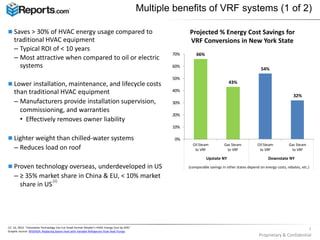
 Saves > 30% of HVAC energy usage compared to
traditional HVAC equipment
– Typical ROI of < 10 years
– Most attractive when compared to oil or electric
systems
 Lower installation, maintenance, and lifecycle costs
than traditional HVAC equipment
– Manufacturers provide installation supervision,
commissioning, and warranties
• Effectively removes owner liability
 Lighter weight than chilled-water systems
– Reduces load on roof
 Proven technology overseas, underdeveloped in US
– ≥ 35% market share in China & EU, < 10% market
share in US
1
Proprietary & Confidential
Multiple benefits of VRF systems (1 of 2)
(1) LG, 2012. “Innovative Technology Can Cut Small-format Retailer’s HVAC Energy Cost by 45%”
Graphic source: NYSERDA: Replacing Steam Heat with Variable Refrigerant Flow Heat Pumps
(1)
Projected % Energy Cost Savings for
VRF Conversions in New York State
66%
43%
54%
32%
0%
10%
20%
30%
40%
50%
60%
70%
Oil Steam
to VRF
Gas Steam
to VRF
Oil Steam
to VRF
Gas Steam
to VRF
Upstate NY Downstate NY
(comparable savings in other states depend on energy costs, rebates, etc.)
 Little to no duct space needed – only 2-3 pipes
– Improved aesthetics of building exterior
– Can repurpose otherwise unusable attic / basement space
– Removes need for window AC units
– New buildings need less above-ceiling space
– Increased design flexibility for contractors / installers
 Helps obtain LEED and ENERGY STAR® certification, Green
Globes requirements
– Occupant satisfaction & health increases
• Quieter systems
• Less chance for mold growth with no ducts
– Can deliver accurate reports on individual room /
occupant energy usages
• Allows for more accurate charging of tenants,
opportunity to increase marketability, rent price, M&V
 Financing for VRF systems is available for $0 upfront to the
building owner
– PACE or other financing options should be considered
2
Proprietary & Confidential
Multiple benefits of VRF systems (2 of 2)
Picture source: Fujitsu General
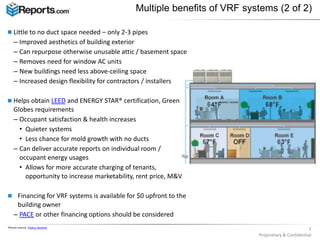
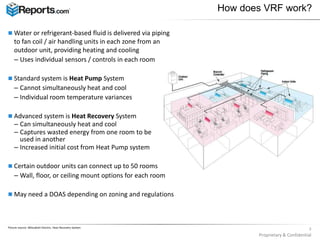
 Water or refrigerant-based fluid is delivered via piping
to fan coil / air handling units in each zone from an
outdoor unit, providing heating and cooling
– Uses individual sensors / controls in each room
 Standard system is Heat Pump System
– Cannot simultaneously heat and cool
– Individual room temperature variances
 Advanced system is Heat Recovery System
– Can simultaneously heat and cool
– Captures wasted energy from one room to be
used in another
– Increased initial cost from Heat Pump system
 Certain outdoor units can connect up to 50 rooms
– Wall, floor, or ceiling mount options for each room
 May need a DOAS depending on zoning and regulations
How does VRF work?
Picture source: Mitsubishi Electric, Heat Recovery System
3
Proprietary & Confidential
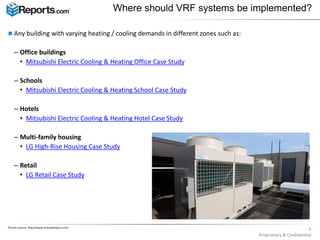
 Any building with varying heating / cooling demands in different zones such as:
– Office buildings
• Mitsubishi Electric Cooling & Heating Office Case Study
– Schools
• Mitsubishi Electric Cooling & Heating School Case Study
– Hotels
• Mitsubishi Electric Cooling & Heating Hotel Case Study
– Multi-family housing
• LG High-Rise Housing Case Study
– Retail
• LG Retail Case Study
4
Proprietary & Confidential
Where should VRF systems be implemented?
Picture source: http://www.mitsubishipro.com/
 High upfront cost
– Can be ~5-20% more expensive than
traditional systems
– Estimated initial cost of VRF system ~$15-20 /
ft2 (as of June, 2014) in New York
– Limited amount of manufacturers
• Less competition = more expensive units
 Many contractors are unfamiliar with systems
 Not as effective in large one-room buildings,
such as gymnasiums and churches
5
Proprietary & Confidential
Potential drawbacks to VRF systems
(1) NYSERDA . Subject to change. Please only use as a base-case, rule of thumb scenario. Every install cost will vary.
DrawbackDrawback Rebuttal
 May have comparable cost to other systems
when looking at total cost including all
infrastructure and construction / installation
– Financing options and state / federal rebates
keep VRF systems fairly competitive
• New York has rebates for up to $0.16/kWh
for energy efficiency upgrades
 Slowly improving & educating the market
 Can still be applicable and has been successfully
installed in these building types
(1)
 Start recruiting VRF professionals
(Example: Mitsubishi Electric Cooling & Heating
certified contractor list)
 Obtain multiple quotes from contractors /
manufacturers to realize your best options
– Helps to …
• Determine best system size, placement, etc.
• Find financing options
• Capture appropriate rebates and financial
incentives
• Receive assistance installing and submitting
all legal paperwork
• Procure M&V which can be guaranteed after
installation
 Most of the largest manufacturers require
contractor / installer training:
 Daikin – Daikin training details
 Danfoss – Danfoss training details
 Fujitsu – Fujitsu training details
 Johnson Controls – JCI training details
 Lennox – Lennox training details
 LG – LG training details
 Mitsubishi – Mitsubishi training details
 Samsung – Samsung training details
 Trane – Trane training details
6
Proprietary & Confidential
How to get involved
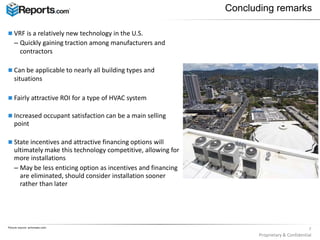
 VRF is a relatively new technology in the U.S.
– Quickly gaining traction among manufacturers and
contractors
 Can be applicable to nearly all building types and
situations
 Fairly attractive ROI for a type of HVAC system
 Increased occupant satisfaction can be a main selling
point
 State incentives and attractive financing options will
ultimately make this technology competitive, allowing for
more installations
– May be less enticing option as incentives and financing
are eliminated, should consider installation sooner
rather than later
7
Proprietary & Confidential
Concluding remarks
Picture source: achrnews.com
For more information, email us at info@eereports.com
And visit our site eereports.com
Appendices
 Dedicated Outdoor Air Systems (DOAS)
– Systems which brings in fresh air to improve air quality without sacrificing energy efficiency
 Heating, Venting, Air Conditioning, Refrigeration (HVACR) Systems
– Basic systems to help regulate temperature and comfort of a building
 Leadership in Energy & Environmental Design (LEED)
– Standardized certification for energy efficient and sustainable buildings,
developed and issued by the US Green Building Council (USGBC)
 Measurement & Verification (M&V)
– Procedures to ensure that the energy conservation measure implemented works as was projected
and to quantify actual energy and cost savings
• Energy efficient products, renewables, BMS reformatted etc.
 Return on Investment (ROI), Payback
– ROI is a snapshot of the profitability of a project, adjusted for the size of investment in the project
• Often a rate of return on money invested in project
– Payback is a quantifiable number (typically years) for how long a project takes to become profitable
Terminology and quick references
Picture source: Shutterstock
10
Proprietary & Confidential

EE Reports VRF Guide

  • 1.
    Variable Refrigerant Flow(VRF) Systems An alternative HVAC system which provides significant energy savings & individual comfort control
  • 2.
     Saves >30% of HVAC energy usage compared to traditional HVAC equipment – Typical ROI of < 10 years – Most attractive when compared to oil or electric systems  Lower installation, maintenance, and lifecycle costs than traditional HVAC equipment – Manufacturers provide installation supervision, commissioning, and warranties • Effectively removes owner liability  Lighter weight than chilled-water systems – Reduces load on roof  Proven technology overseas, underdeveloped in US – ≥ 35% market share in China & EU, < 10% market share in US 1 Proprietary & Confidential Multiple benefits of VRF systems (1 of 2) (1) LG, 2012. “Innovative Technology Can Cut Small-format Retailer’s HVAC Energy Cost by 45%” Graphic source: NYSERDA: Replacing Steam Heat with Variable Refrigerant Flow Heat Pumps (1) Projected % Energy Cost Savings for VRF Conversions in New York State 66% 43% 54% 32% 0% 10% 20% 30% 40% 50% 60% 70% Oil Steam to VRF Gas Steam to VRF Oil Steam to VRF Gas Steam to VRF Upstate NY Downstate NY (comparable savings in other states depend on energy costs, rebates, etc.)
  • 3.
     Little tono duct space needed – only 2-3 pipes – Improved aesthetics of building exterior – Can repurpose otherwise unusable attic / basement space – Removes need for window AC units – New buildings need less above-ceiling space – Increased design flexibility for contractors / installers  Helps obtain LEED and ENERGY STAR® certification, Green Globes requirements – Occupant satisfaction & health increases • Quieter systems • Less chance for mold growth with no ducts – Can deliver accurate reports on individual room / occupant energy usages • Allows for more accurate charging of tenants, opportunity to increase marketability, rent price, M&V  Financing for VRF systems is available for $0 upfront to the building owner – PACE or other financing options should be considered 2 Proprietary & Confidential Multiple benefits of VRF systems (2 of 2) Picture source: Fujitsu General
  • 4.
     Water orrefrigerant-based fluid is delivered via piping to fan coil / air handling units in each zone from an outdoor unit, providing heating and cooling – Uses individual sensors / controls in each room  Standard system is Heat Pump System – Cannot simultaneously heat and cool – Individual room temperature variances  Advanced system is Heat Recovery System – Can simultaneously heat and cool – Captures wasted energy from one room to be used in another – Increased initial cost from Heat Pump system  Certain outdoor units can connect up to 50 rooms – Wall, floor, or ceiling mount options for each room  May need a DOAS depending on zoning and regulations How does VRF work? Picture source: Mitsubishi Electric, Heat Recovery System 3 Proprietary & Confidential
  • 5.
     Any buildingwith varying heating / cooling demands in different zones such as: – Office buildings • Mitsubishi Electric Cooling & Heating Office Case Study – Schools • Mitsubishi Electric Cooling & Heating School Case Study – Hotels • Mitsubishi Electric Cooling & Heating Hotel Case Study – Multi-family housing • LG High-Rise Housing Case Study – Retail • LG Retail Case Study 4 Proprietary & Confidential Where should VRF systems be implemented? Picture source: http://www.mitsubishipro.com/
  • 6.
     High upfrontcost – Can be ~5-20% more expensive than traditional systems – Estimated initial cost of VRF system ~$15-20 / ft2 (as of June, 2014) in New York – Limited amount of manufacturers • Less competition = more expensive units  Many contractors are unfamiliar with systems  Not as effective in large one-room buildings, such as gymnasiums and churches 5 Proprietary & Confidential Potential drawbacks to VRF systems (1) NYSERDA . Subject to change. Please only use as a base-case, rule of thumb scenario. Every install cost will vary. DrawbackDrawback Rebuttal  May have comparable cost to other systems when looking at total cost including all infrastructure and construction / installation – Financing options and state / federal rebates keep VRF systems fairly competitive • New York has rebates for up to $0.16/kWh for energy efficiency upgrades  Slowly improving & educating the market  Can still be applicable and has been successfully installed in these building types (1)
  • 7.
     Start recruitingVRF professionals (Example: Mitsubishi Electric Cooling & Heating certified contractor list)  Obtain multiple quotes from contractors / manufacturers to realize your best options – Helps to … • Determine best system size, placement, etc. • Find financing options • Capture appropriate rebates and financial incentives • Receive assistance installing and submitting all legal paperwork • Procure M&V which can be guaranteed after installation  Most of the largest manufacturers require contractor / installer training:  Daikin – Daikin training details  Danfoss – Danfoss training details  Fujitsu – Fujitsu training details  Johnson Controls – JCI training details  Lennox – Lennox training details  LG – LG training details  Mitsubishi – Mitsubishi training details  Samsung – Samsung training details  Trane – Trane training details 6 Proprietary & Confidential How to get involved
  • 8.
     VRF isa relatively new technology in the U.S. – Quickly gaining traction among manufacturers and contractors  Can be applicable to nearly all building types and situations  Fairly attractive ROI for a type of HVAC system  Increased occupant satisfaction can be a main selling point  State incentives and attractive financing options will ultimately make this technology competitive, allowing for more installations – May be less enticing option as incentives and financing are eliminated, should consider installation sooner rather than later 7 Proprietary & Confidential Concluding remarks Picture source: achrnews.com
  • 9.
    For more information,email us at info@eereports.com And visit our site eereports.com
  • 10.
  • 11.
     Dedicated OutdoorAir Systems (DOAS) – Systems which brings in fresh air to improve air quality without sacrificing energy efficiency  Heating, Venting, Air Conditioning, Refrigeration (HVACR) Systems – Basic systems to help regulate temperature and comfort of a building  Leadership in Energy & Environmental Design (LEED) – Standardized certification for energy efficient and sustainable buildings, developed and issued by the US Green Building Council (USGBC)  Measurement & Verification (M&V) – Procedures to ensure that the energy conservation measure implemented works as was projected and to quantify actual energy and cost savings • Energy efficient products, renewables, BMS reformatted etc.  Return on Investment (ROI), Payback – ROI is a snapshot of the profitability of a project, adjusted for the size of investment in the project • Often a rate of return on money invested in project – Payback is a quantifiable number (typically years) for how long a project takes to become profitable Terminology and quick references Picture source: Shutterstock 10 Proprietary & Confidential