Theoretical Evaluation of Production
1B) GENRE
WHAT IS GENRE?
• ‘Genre’ is a term used to describe the categorisation of different types of music, film and
literature based upon common elements. It is a critical tool which allows us to study texts and
audiences responses to texts.
• Examples of genre include:
• We can recognise genre through certain codes which become conventions. Signs and signifiers
play a crucial role in this recognition.
• Daniel Chandler (2001) argues that the word ‘genre’ comes from the French word for ‘kind’ or
‘class’ – This being a term widely used in rhetoric, literacy theory, and media theory to refer to a
distinctive type of text.
Jazz
Classical
EDM/ Dance
Electro
Western
Documentary
Sci-fi
Thriller
Horror
Comedy
Rock
Metal
Pop
Indie
Grunge
R&B
Grime
Punk
Rhythm & Blues
Folk
SUB-GENRES
• All genres have sub-genres (a genre within a genre). This means that they are divided up
into more specific categories that allow audiences to identify them specifically by their
familiar and what become recognisable characteristics. (Barry Keith Grant, 1995)
• However, Steve Neale (1995) stresses that ‘genres’ are not systems, they are processes
of systematisation, i.e. they are dynamic and evolve over time.
DEFINITION OF GENRE
• Genre can be composed of the following aspects:
 1 – Costume
 2 – Props
 3 – Location
 4 – Transport
 5 – Sound
 6 – Narrative
 7 – Characters
• This is known as a Paradigm model, summarising the ‘typical example or pattern of
something’ in this case, being the components of genre.
USING THE MODEL – WESTERN IDEOLOGIES
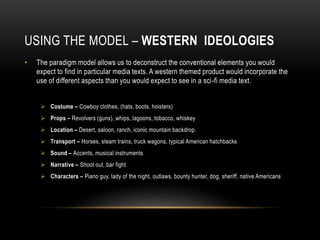
• The paradigm model allows us to deconstruct the conventional elements you would
expect to find in particular media texts. A western themed product would incorporate the
use of different aspects than you would expect to see in a sci-fi media text.
 Costume – Cowboy clothes, (hats, boots, hoisters)
 Props – Revolvers (guns), whips, lagoons, tobacco, whiskey
 Location – Desert, saloon, ranch, iconic mountain backdrop.
 Transport – Horses, steam trains, truck wagons, typical American hatchbacks
 Sound – Accents, musical instruments
 Narrative – Shoot out, bar fight
 Characters – Piano guy, lady of the night, outlaws, bounty hunter, dog, sheriff, native Americans
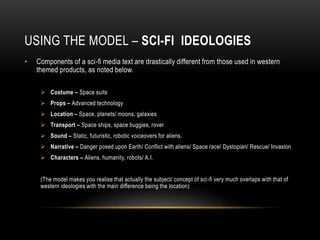
USING THE MODEL – SCI-FI IDEOLOGIES
• Components of a sci-fi media text are drastically different from those used in western
themed products, as noted below.
 Costume – Space suits
 Props – Advanced technology
 Location – Space, planets/ moons, galaxies
 Transport – Space ships, space buggies, rover
 Sound – Static, futuristic, robotic voiceovers for aliens.
 Narrative – Danger posed upon Earth/ Conflict with aliens/ Space race/ Dystopian/ Rescue/ Invasion
 Characters – Aliens, humanity, robots/ A.I.
(The model makes you realise that actually the subject/ concept of sci-fi very much overlaps with that of
western ideologies with the main difference being the location)
IDEOLOGY
• Describes the way that genres are constructed and the choices that are made about
costume, props, location, etc., in order to construct meaning for the viewer and form
‘Myth’ as Ronald Barthes referred to it. He also suggests that we can tell the ideology of
the media text through codes and conventions.
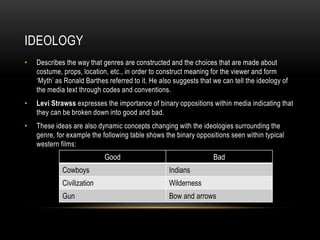
• Levi Strawss expresses the importance of binary oppositions within media indicating that
they can be broken down into good and bad.
• These ideas are also dynamic concepts changing with the ideologies surrounding the
genre, for example the following table shows the binary oppositions seen within typical
western films:
Good Bad
Cowboys Indians
Civilization Wilderness
Gun Bow and arrows

1b) A2 Media - Genre Analysis

  • 1.
    Theoretical Evaluation ofProduction 1B) GENRE
  • 2.
    WHAT IS GENRE? •‘Genre’ is a term used to describe the categorisation of different types of music, film and literature based upon common elements. It is a critical tool which allows us to study texts and audiences responses to texts. • Examples of genre include: • We can recognise genre through certain codes which become conventions. Signs and signifiers play a crucial role in this recognition. • Daniel Chandler (2001) argues that the word ‘genre’ comes from the French word for ‘kind’ or ‘class’ – This being a term widely used in rhetoric, literacy theory, and media theory to refer to a distinctive type of text. Jazz Classical EDM/ Dance Electro Western Documentary Sci-fi Thriller Horror Comedy Rock Metal Pop Indie Grunge R&B Grime Punk Rhythm & Blues Folk
  • 3.
    SUB-GENRES • All genreshave sub-genres (a genre within a genre). This means that they are divided up into more specific categories that allow audiences to identify them specifically by their familiar and what become recognisable characteristics. (Barry Keith Grant, 1995) • However, Steve Neale (1995) stresses that ‘genres’ are not systems, they are processes of systematisation, i.e. they are dynamic and evolve over time.
  • 4.
    DEFINITION OF GENRE •Genre can be composed of the following aspects:  1 – Costume  2 – Props  3 – Location  4 – Transport  5 – Sound  6 – Narrative  7 – Characters • This is known as a Paradigm model, summarising the ‘typical example or pattern of something’ in this case, being the components of genre.
  • 5.
    USING THE MODEL– WESTERN IDEOLOGIES • The paradigm model allows us to deconstruct the conventional elements you would expect to find in particular media texts. A western themed product would incorporate the use of different aspects than you would expect to see in a sci-fi media text.  Costume – Cowboy clothes, (hats, boots, hoisters)  Props – Revolvers (guns), whips, lagoons, tobacco, whiskey  Location – Desert, saloon, ranch, iconic mountain backdrop.  Transport – Horses, steam trains, truck wagons, typical American hatchbacks  Sound – Accents, musical instruments  Narrative – Shoot out, bar fight  Characters – Piano guy, lady of the night, outlaws, bounty hunter, dog, sheriff, native Americans
  • 6.
    USING THE MODEL– SCI-FI IDEOLOGIES • Components of a sci-fi media text are drastically different from those used in western themed products, as noted below.  Costume – Space suits  Props – Advanced technology  Location – Space, planets/ moons, galaxies  Transport – Space ships, space buggies, rover  Sound – Static, futuristic, robotic voiceovers for aliens.  Narrative – Danger posed upon Earth/ Conflict with aliens/ Space race/ Dystopian/ Rescue/ Invasion  Characters – Aliens, humanity, robots/ A.I. (The model makes you realise that actually the subject/ concept of sci-fi very much overlaps with that of western ideologies with the main difference being the location)
  • 7.
    IDEOLOGY • Describes theway that genres are constructed and the choices that are made about costume, props, location, etc., in order to construct meaning for the viewer and form ‘Myth’ as Ronald Barthes referred to it. He also suggests that we can tell the ideology of the media text through codes and conventions. • Levi Strawss expresses the importance of binary oppositions within media indicating that they can be broken down into good and bad. • These ideas are also dynamic concepts changing with the ideologies surrounding the genre, for example the following table shows the binary oppositions seen within typical western films: Good Bad Cowboys Indians Civilization Wilderness Gun Bow and arrows