EDUP WIFI for Raspberry Zero
spring 2019
Preparing for wifi installation
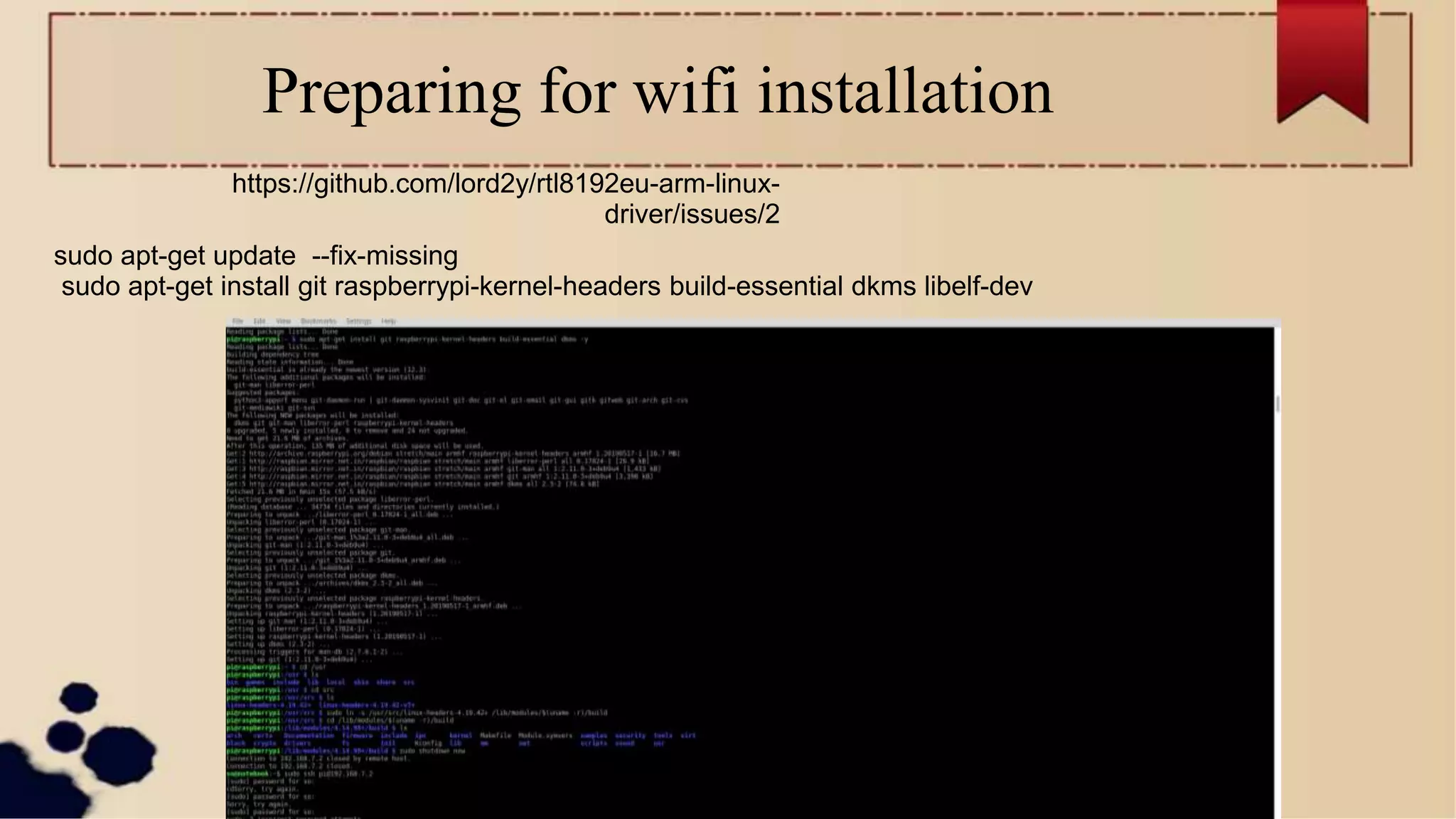
sudo apt-get update --fix-missing
sudo apt-get install git raspberrypi-kernel-headers build-essential dkms libelf-dev
https://github.com/lord2y/rtl8192eu-arm-linux-
driver/issues/2
Github project files
#https://github.com/lwfinger/rtlwifi_new
cd
#For all distros:
git clone https://github.com/lwfinger/rtlwifi_new.git
cd rtlwifi_new
Make clean
make
sudo make install
sudo modprobe -r <<YOUR WIRELESS DRIVER CODE>>
sudo modprobe <<YOUR WIRELESS DRIVER CODE>>
Setting up WiFi using an RTL8188eu
dongle on Raspberry Pi Zero
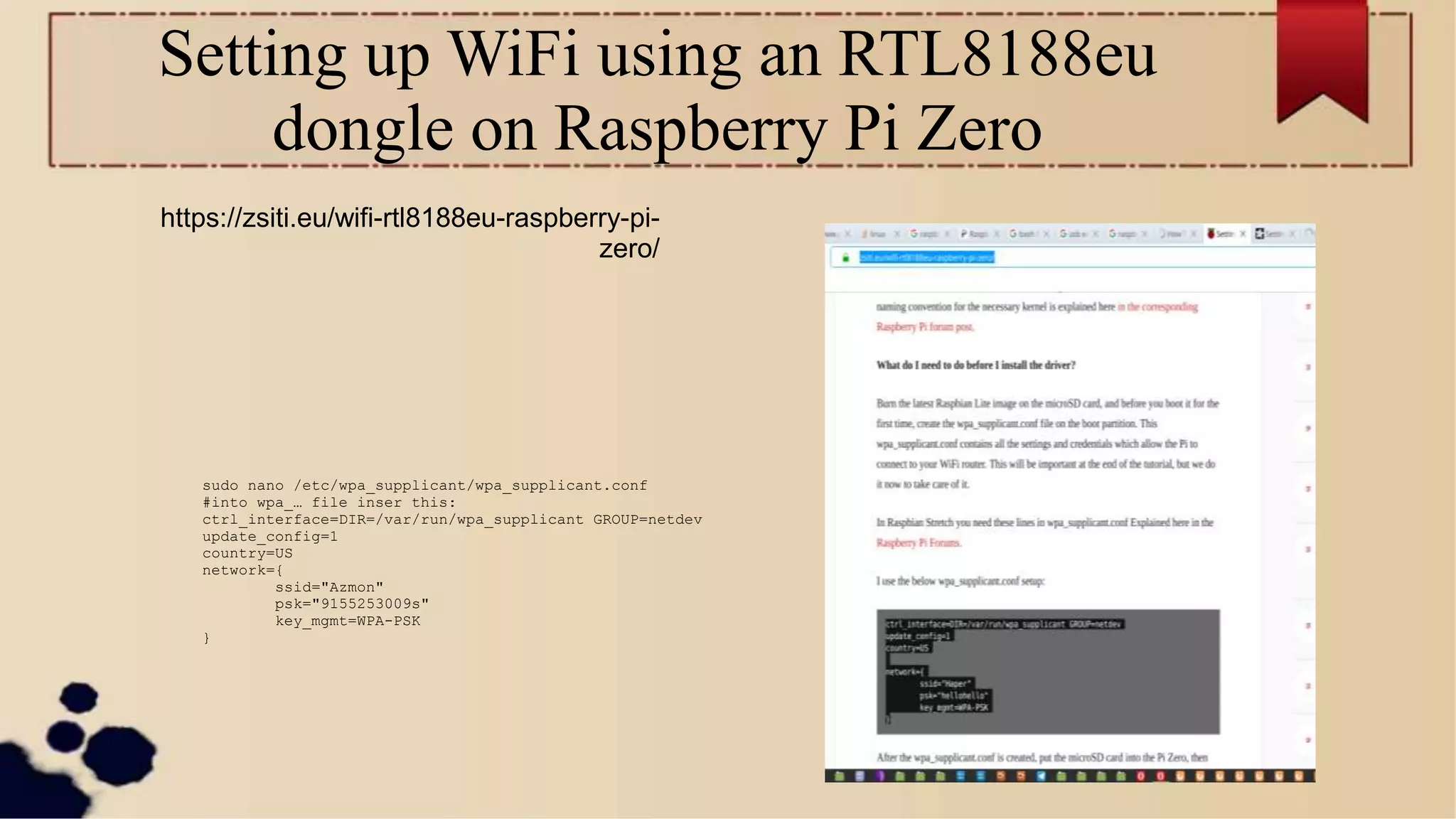
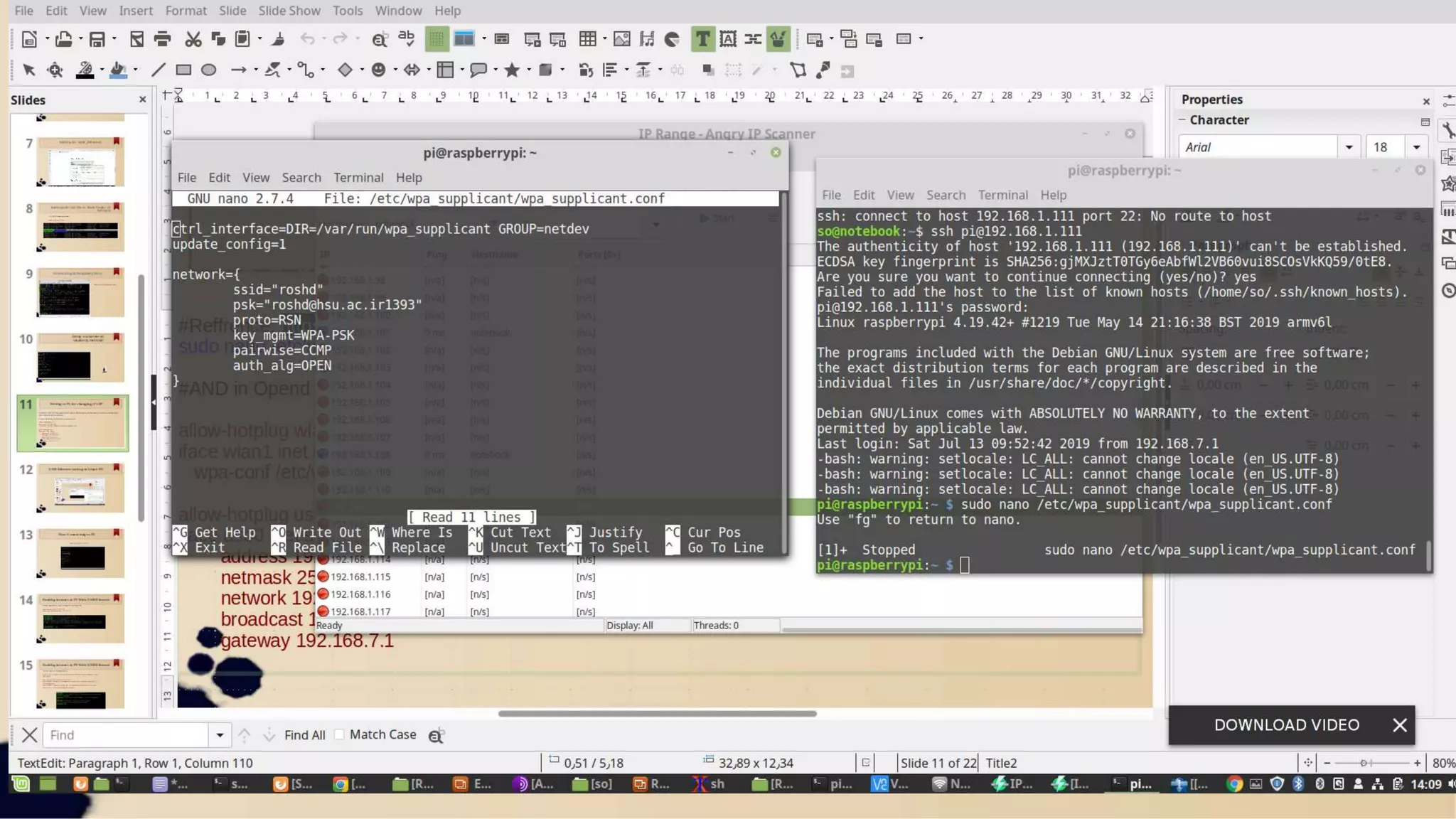
sudo nano /etc/wpa_supplicant/wpa_supplicant.conf
#into wpa_… file inser this:
ctrl_interface=DIR=/var/run/wpa_supplicant GROUP=netdev
update_config=1
country=US
network={
ssid="Azmon"
psk="9155253009s"
key_mgmt=WPA-PSK
}
https://zsiti.eu/wifi-rtl8188eu-raspberry-pi-
zero/
Raspberry Pi - Wifi Setup with WPA2-PSK
[aes]
https://coderwall.com/p/v290ta/raspberry-pi-wifi-setup-with-wpa2-psk-
aes
ctrl_interface=DIR=/var/run/wpa_supplicant GROUP=netdev
update_config=1
network={
ssid="Azmon"
psk="9155253009s"
proto=RSN
key_mgmt=WPA-PSK
pairwise=CCMP
group=CCMP
auth_alg=OPEN
}
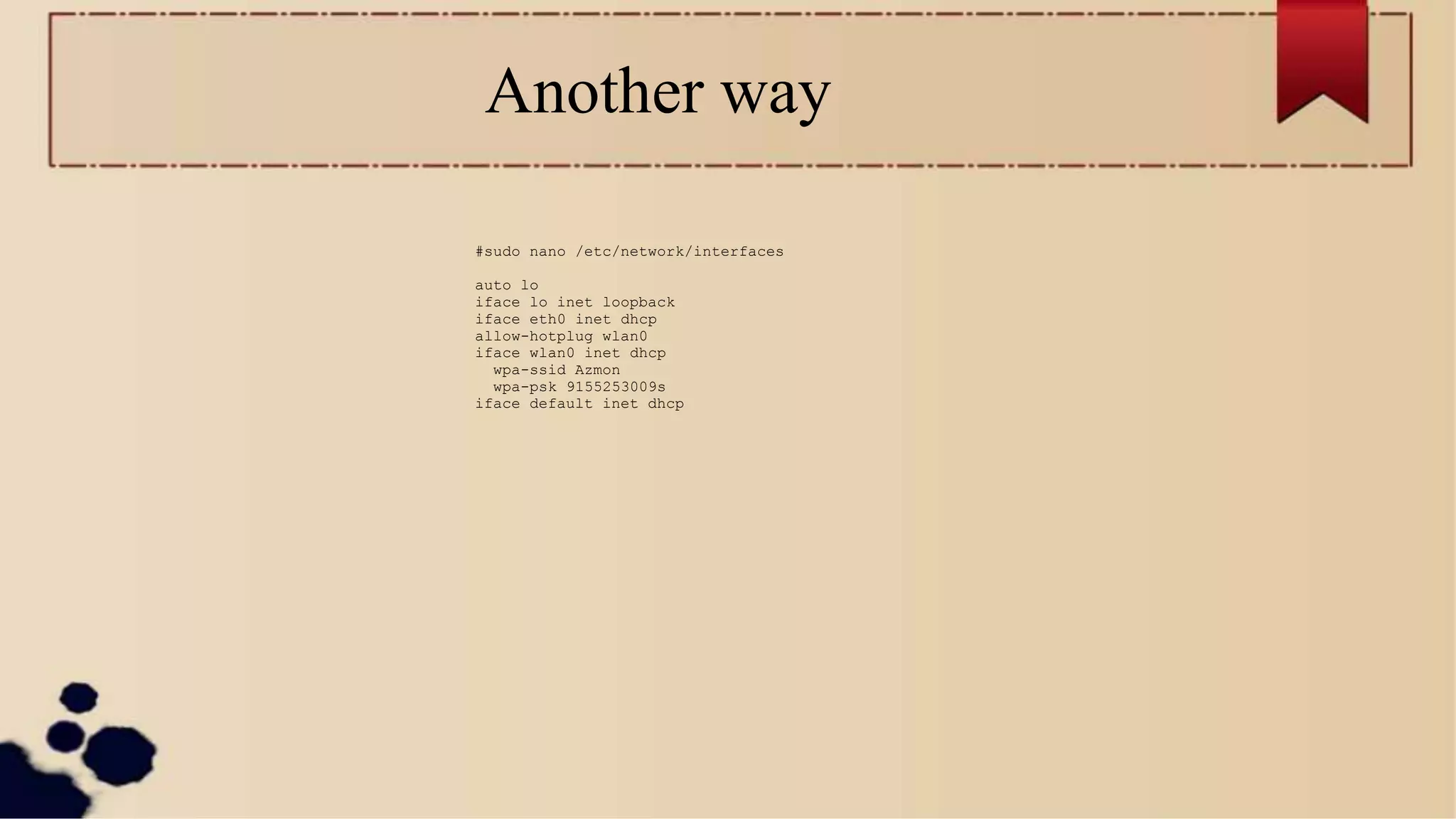
Another way
#sudo nano /etc/network/interfaces
auto lo
iface lo inet loopback
iface eth0 inet dhcp
allow-hotplug wlan0
iface wlan0 inet dhcp
wpa-ssid Azmon
wpa-psk 9155253009s
iface default inet dhcp
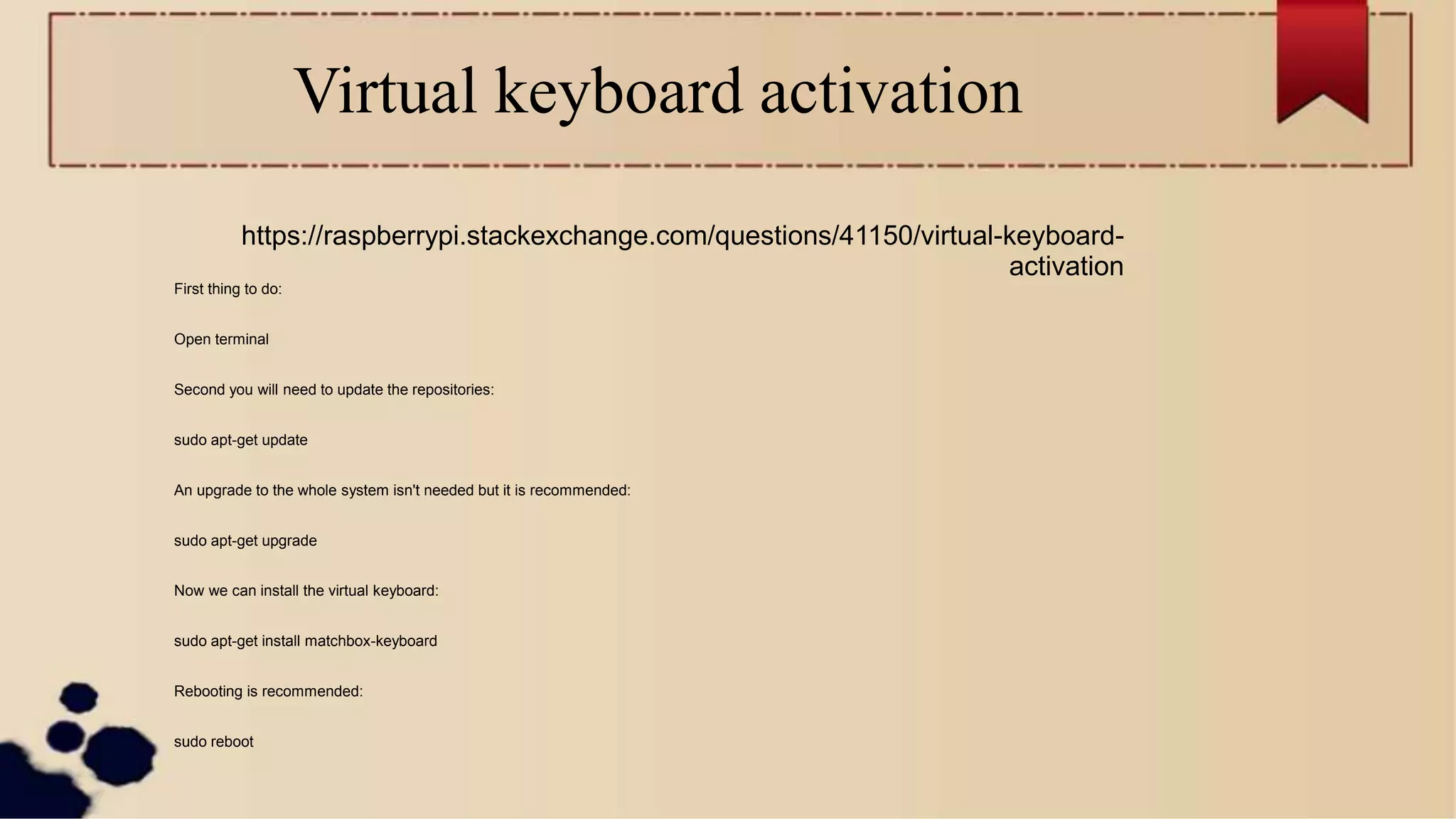
Virtual keyboard activation
First thing to do:
Open terminal
Second you will need to update the repositories:
sudo apt-get update
An upgrade to the whole system isn't needed but it is recommended:
sudo apt-get upgrade
Now we can install the virtual keyboard:
sudo apt-get install matchbox-keyboard
Rebooting is recommended:
sudo reboot
https://raspberrypi.stackexchange.com/questions/41150/virtual-keyboard-
activation
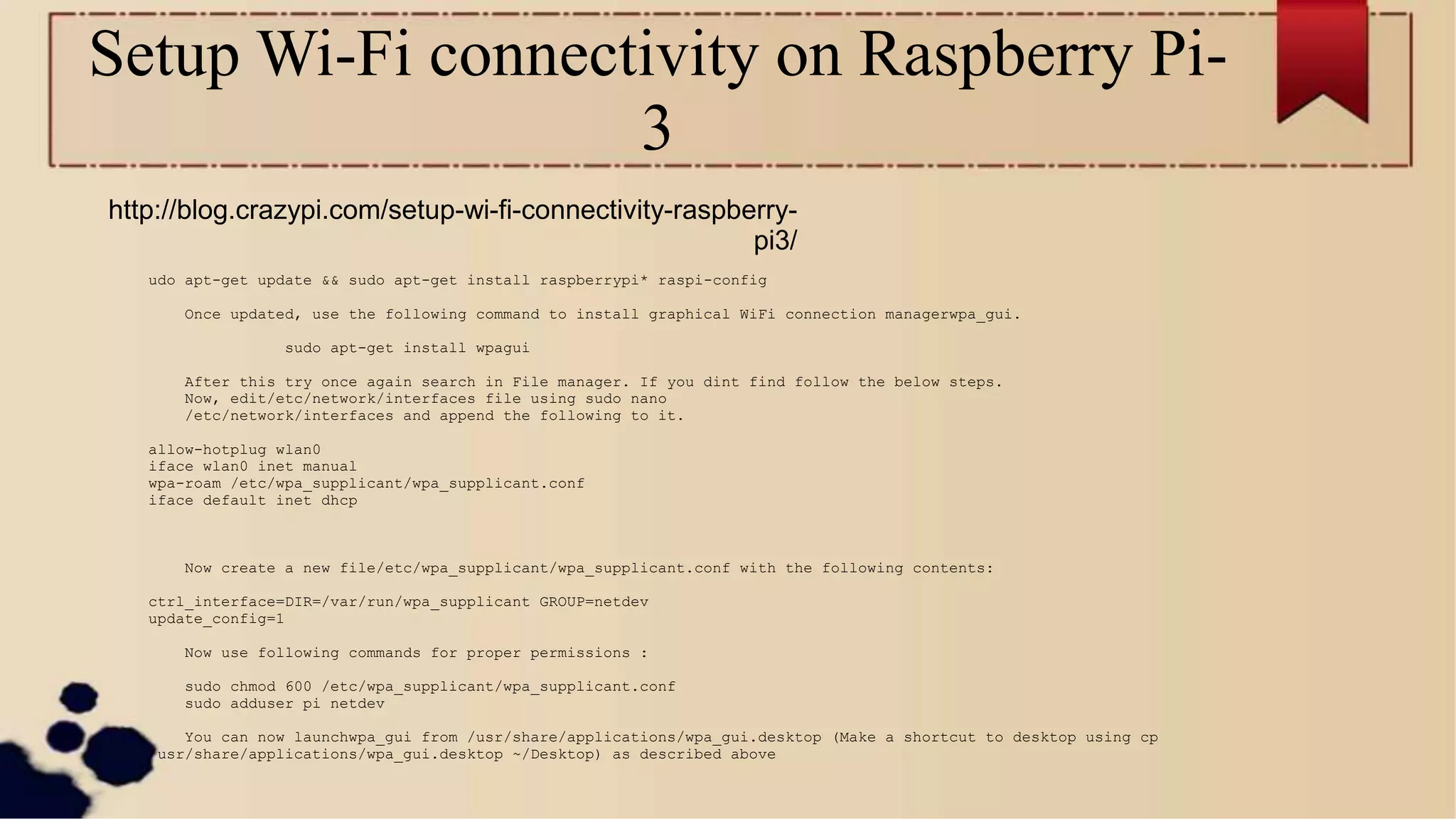
Setup Wi-Fi connectivity on Raspberry Pi-
3
http://blog.crazypi.com/setup-wi-fi-connectivity-raspberry-
pi3/
udo apt-get update && sudo apt-get install raspberrypi* raspi-config
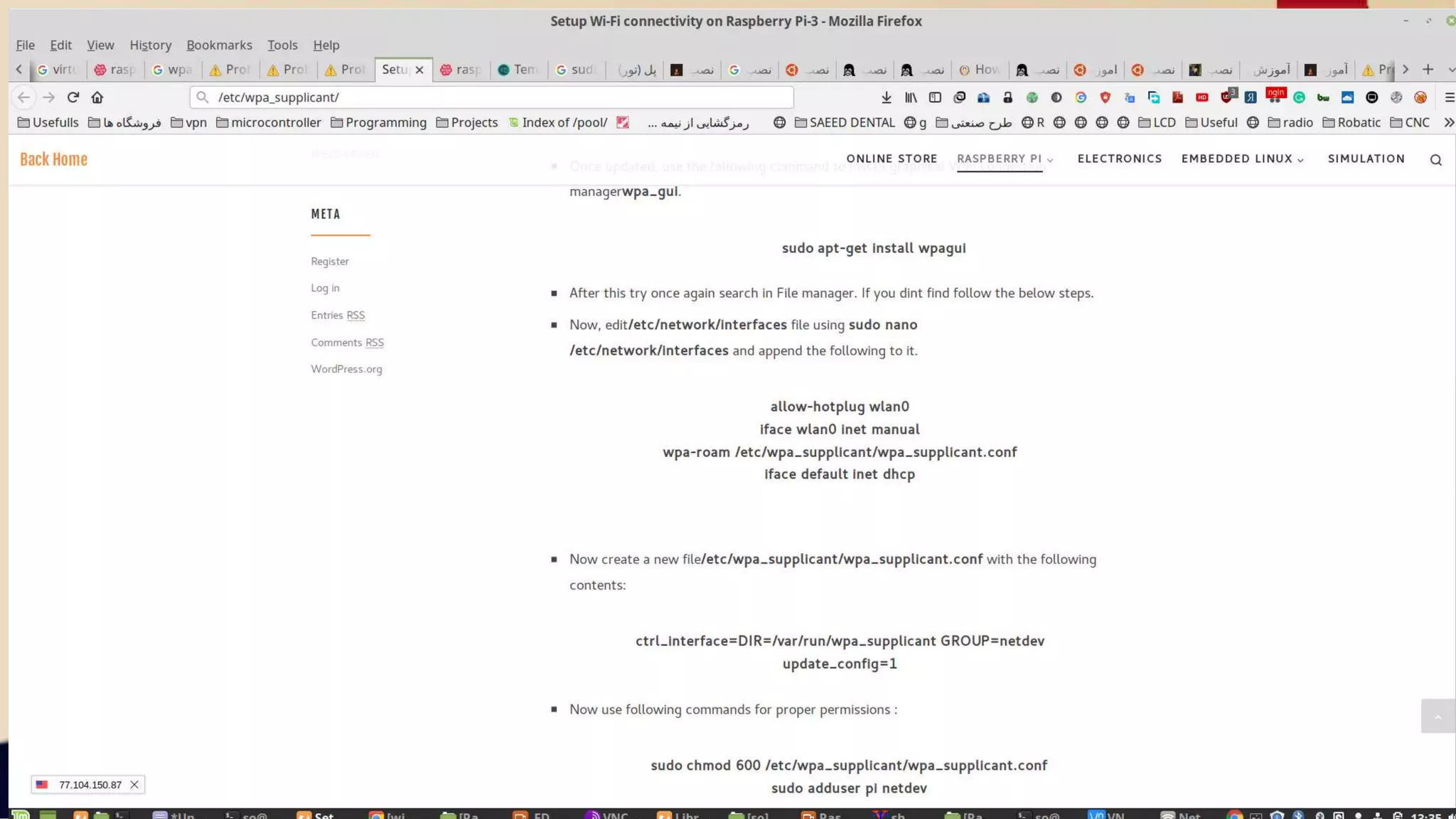
Once updated, use the following command to install graphical WiFi connection managerwpa_gui.
sudo apt-get install wpagui
After this try once again search in File manager. If you dint find follow the below steps.
Now, edit/etc/network/interfaces file using sudo nano
/etc/network/interfaces and append the following to it.
allow-hotplug wlan0
iface wlan0 inet manual
wpa-roam /etc/wpa_supplicant/wpa_supplicant.conf
iface default inet dhcp
Now create a new file/etc/wpa_supplicant/wpa_supplicant.conf with the following contents:
ctrl_interface=DIR=/var/run/wpa_supplicant GROUP=netdev
update_config=1
Now use following commands for proper permissions :
sudo chmod 600 /etc/wpa_supplicant/wpa_supplicant.conf
sudo adduser pi netdev
You can now launchwpa_gui from /usr/share/applications/wpa_gui.desktop (Make a shortcut to desktop using cp
/usr/share/applications/wpa_gui.desktop ~/Desktop) as described above
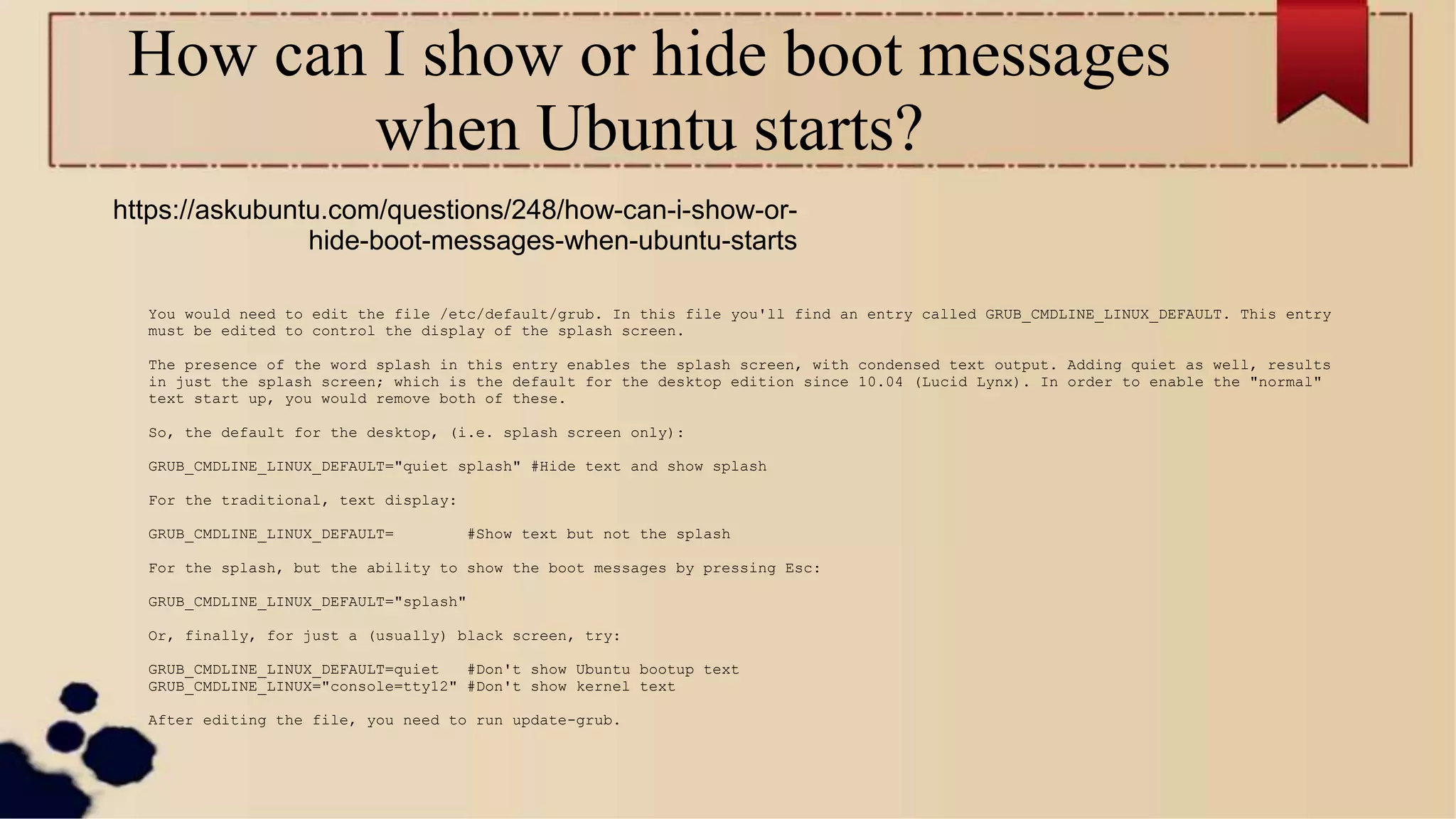
How can I show or hide boot messages
when Ubuntu starts?
https://askubuntu.com/questions/248/how-can-i-show-or-
hide-boot-messages-when-ubuntu-starts
You would need to edit the file /etc/default/grub. In this file you'll find an entry called GRUB_CMDLINE_LINUX_DEFAULT. This entry
must be edited to control the display of the splash screen.
The presence of the word splash in this entry enables the splash screen, with condensed text output. Adding quiet as well, results
in just the splash screen; which is the default for the desktop edition since 10.04 (Lucid Lynx). In order to enable the "normal"
text start up, you would remove both of these.
So, the default for the desktop, (i.e. splash screen only):
GRUB_CMDLINE_LINUX_DEFAULT="quiet splash" #Hide text and show splash
For the traditional, text display:
GRUB_CMDLINE_LINUX_DEFAULT= #Show text but not the splash
For the splash, but the ability to show the boot messages by pressing Esc:
GRUB_CMDLINE_LINUX_DEFAULT="splash"
Or, finally, for just a (usually) black screen, try:
GRUB_CMDLINE_LINUX_DEFAULT=quiet #Don't show Ubuntu bootup text
GRUB_CMDLINE_LINUX="console=tty12" #Don't show kernel text
After editing the file, you need to run update-grub.
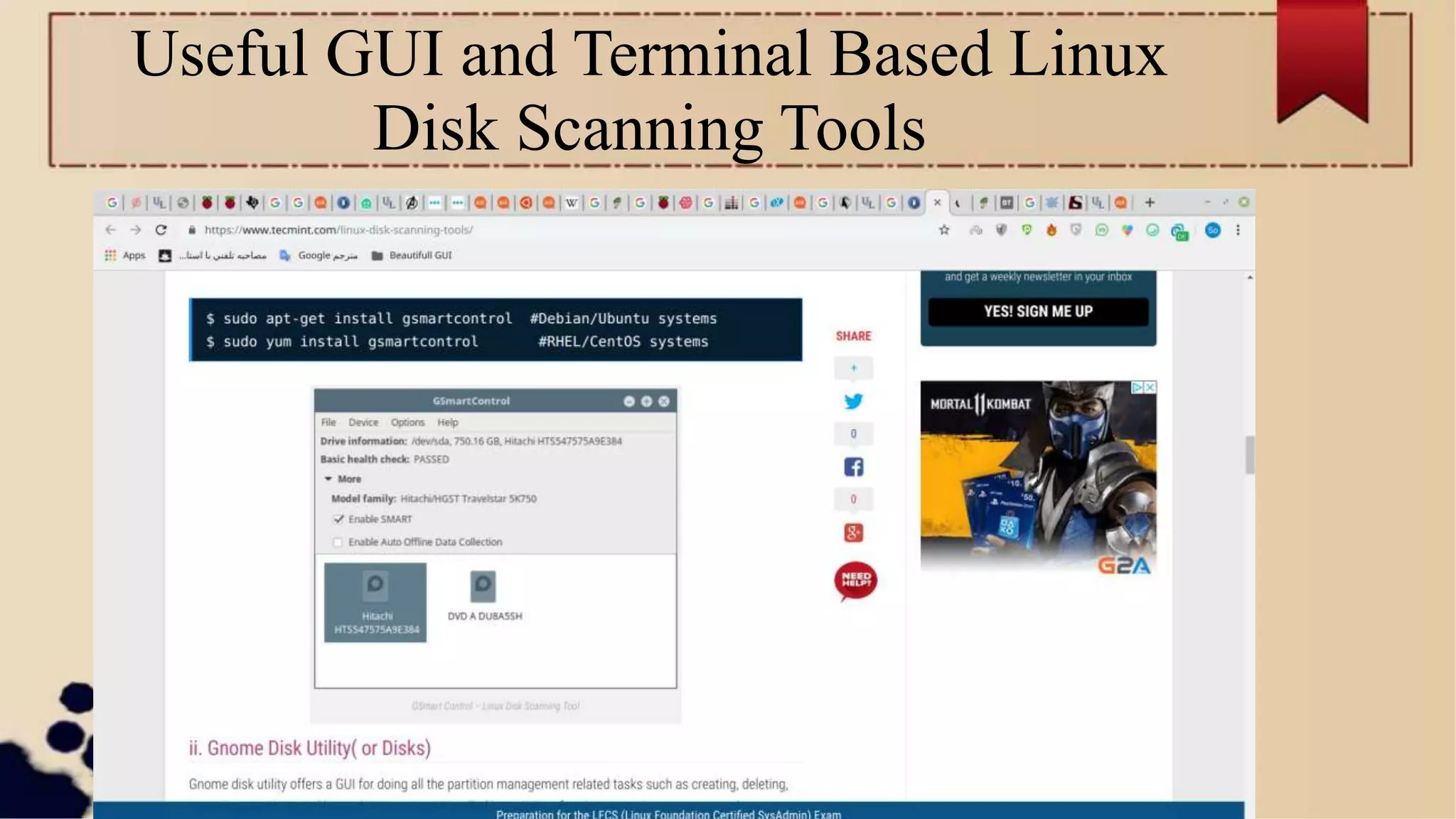
Useful GUI and Terminal Based Linux
Disk Scanning Tools

Edup wifi for raspberry zero

  • 1.
    EDUP WIFI forRaspberry Zero spring 2019
  • 2.
    Preparing for wifiinstallation sudo apt-get update --fix-missing sudo apt-get install git raspberrypi-kernel-headers build-essential dkms libelf-dev https://github.com/lord2y/rtl8192eu-arm-linux- driver/issues/2
  • 3.
    Github project files #https://github.com/lwfinger/rtlwifi_new cd #Forall distros: git clone https://github.com/lwfinger/rtlwifi_new.git cd rtlwifi_new Make clean make sudo make install sudo modprobe -r <<YOUR WIRELESS DRIVER CODE>> sudo modprobe <<YOUR WIRELESS DRIVER CODE>>
  • 4.
    Setting up WiFiusing an RTL8188eu dongle on Raspberry Pi Zero sudo nano /etc/wpa_supplicant/wpa_supplicant.conf #into wpa_… file inser this: ctrl_interface=DIR=/var/run/wpa_supplicant GROUP=netdev update_config=1 country=US network={ ssid="Azmon" psk="9155253009s" key_mgmt=WPA-PSK } https://zsiti.eu/wifi-rtl8188eu-raspberry-pi- zero/
  • 5.
    Raspberry Pi -Wifi Setup with WPA2-PSK [aes] https://coderwall.com/p/v290ta/raspberry-pi-wifi-setup-with-wpa2-psk- aes
  • 6.
  • 7.
    Another way #sudo nano/etc/network/interfaces auto lo iface lo inet loopback iface eth0 inet dhcp allow-hotplug wlan0 iface wlan0 inet dhcp wpa-ssid Azmon wpa-psk 9155253009s iface default inet dhcp
  • 8.
    Virtual keyboard activation Firstthing to do: Open terminal Second you will need to update the repositories: sudo apt-get update An upgrade to the whole system isn't needed but it is recommended: sudo apt-get upgrade Now we can install the virtual keyboard: sudo apt-get install matchbox-keyboard Rebooting is recommended: sudo reboot https://raspberrypi.stackexchange.com/questions/41150/virtual-keyboard- activation
  • 9.
    Setup Wi-Fi connectivityon Raspberry Pi- 3 http://blog.crazypi.com/setup-wi-fi-connectivity-raspberry- pi3/ udo apt-get update && sudo apt-get install raspberrypi* raspi-config Once updated, use the following command to install graphical WiFi connection managerwpa_gui. sudo apt-get install wpagui After this try once again search in File manager. If you dint find follow the below steps. Now, edit/etc/network/interfaces file using sudo nano /etc/network/interfaces and append the following to it. allow-hotplug wlan0 iface wlan0 inet manual wpa-roam /etc/wpa_supplicant/wpa_supplicant.conf iface default inet dhcp Now create a new file/etc/wpa_supplicant/wpa_supplicant.conf with the following contents: ctrl_interface=DIR=/var/run/wpa_supplicant GROUP=netdev update_config=1 Now use following commands for proper permissions : sudo chmod 600 /etc/wpa_supplicant/wpa_supplicant.conf sudo adduser pi netdev You can now launchwpa_gui from /usr/share/applications/wpa_gui.desktop (Make a shortcut to desktop using cp /usr/share/applications/wpa_gui.desktop ~/Desktop) as described above
  • 12.
    How can Ishow or hide boot messages when Ubuntu starts? https://askubuntu.com/questions/248/how-can-i-show-or- hide-boot-messages-when-ubuntu-starts You would need to edit the file /etc/default/grub. In this file you'll find an entry called GRUB_CMDLINE_LINUX_DEFAULT. This entry must be edited to control the display of the splash screen. The presence of the word splash in this entry enables the splash screen, with condensed text output. Adding quiet as well, results in just the splash screen; which is the default for the desktop edition since 10.04 (Lucid Lynx). In order to enable the "normal" text start up, you would remove both of these. So, the default for the desktop, (i.e. splash screen only): GRUB_CMDLINE_LINUX_DEFAULT="quiet splash" #Hide text and show splash For the traditional, text display: GRUB_CMDLINE_LINUX_DEFAULT= #Show text but not the splash For the splash, but the ability to show the boot messages by pressing Esc: GRUB_CMDLINE_LINUX_DEFAULT="splash" Or, finally, for just a (usually) black screen, try: GRUB_CMDLINE_LINUX_DEFAULT=quiet #Don't show Ubuntu bootup text GRUB_CMDLINE_LINUX="console=tty12" #Don't show kernel text After editing the file, you need to run update-grub.
  • 13.
    Useful GUI andTerminal Based Linux Disk Scanning Tools