COMPARISON OF EDUCATION SYSTEM BETWEEN INDONESIA AND TURKEYJuniati P081104183
The General Aims Of Education In TurkeyThe aim of the Turkish educational system is to nurture productive, happy individuals with broad views on world affairs who will unite in national consciousness and thinking to form an inseparable state, and will contribute to the prosperity of society through their skills. This is thought to be instrumental in making the Turkish nation a creative and distinguished member of the modern world.
EDUCATION SYSTEM IN TURKEYThe Turkish National Educational System is composed of two main sections: Formal EducationNon-formal Education.
Formal EducationFormal education is the regular education of individuals in a certain age group and given in schools. This includes :Pre-Primary education, Primary education, Secondary education, and Higher education institutions.
Pre-Primary EducationPre-school education is not compulsory. Institutions offering pre-school education programmes includes:Crèches (age group 0-3 years), Kindergartens (age group 3-5 years) and Primary schools with pre-school classes (age group 5-6 years).
Early Education ( Indonesia)From the age of 2, children in Indonesia in general attend pre-school playgroup, known as PAUD (PendidikanAnakUsiaDini). From the age of 4, they attend kindergarten(Taman Kanak-Kanak). This education is not compulsory for Indonesian citizens, as the aim of this is to prepare them for primary school
Primary EducationPrimary education is compulsory, co-educational and provided free in state schools to children in the age group 6-14. The transition from five-year primary schools and three-year junior high schools into eight-year primary (basic) schools has been effective . The last three years of primary education (Grades VI-VIII) were not compulsory or considered as part of secondary education. Upon successful completion of primary education, pupils receive a diploma(IlköğretimDiplomasi (Basic Education Diploma)).
Elementary School (Indonesia)Children ages 6–11 attend SekolahDasar (SD) (literally Elementary School). This level of education is compulsory for all Indonesian citizens, based on the national constitution. In contrast to the majority of privately run kindergartens, most elementary schools are government operated public schools, accounting for 93% of all elementary schools in Indonesia
Junior High School (Indonesia)Junior High school, generally known by the abbreviation "SMP" (SekolahMenengahPertama) is part of primary education in Indonesia. Length of program in years: 3 with age level from: 13 to: 15. After graduating from elementary school, students attend Middle School for three years from the age of 12-14. After three years of schooling and graduation, students may move on to Senior High School.
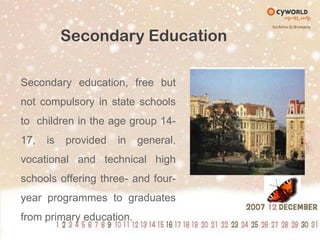
Secondary EducationSecondary education, free but not compulsory in state schools to  children in the age group 14-17, is provided in general, vocational and technical high schools offering three- and four-year programmes to graduates from primary education.
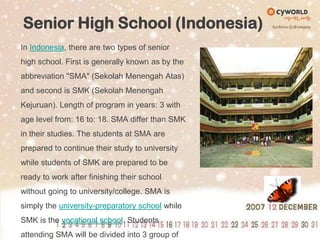
Senior High School (Indonesia)In Indonesia, there are two types of senior high school. First is generally known as by the abbreviation "SMA" (SekolahMenengahAtas) and second is SMK (SekolahMenengahKejuruan). Length of program in years: 3 with age level from: 16 to: 18. SMA differ than SMK in their studies. The students at SMA are prepared to continue their study to university while students of SMK are prepared to be ready to work after finishing their school without going to university/college. SMA is simply the university-preparatory school while SMK is the vocational school. Students attending SMA will be divided into 3 group of studies in their 11th grade, i.e. Science, Social studies, and Linguistic.
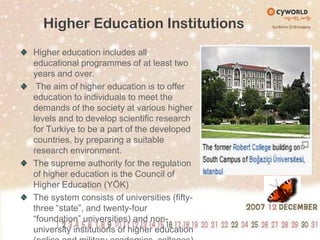
Higher Education InstitutionsHigher education includes all educational programmes of at least two years and over. The aim of higher education is to offer education to individuals to meet the demands of the society at various higher levels and to develop scientific research for Turkiye to be a part of the developed countries, by preparing a suitable research environment. The supreme authority for the regulation of higher education is the Council of Higher Education (YÖK)The system consists of universities (fifty-three “state”, and twenty-four “foundation” universities) and non-university institutions of higher education (police and military academies, colleges)
Higher education (Indonesia)After graduation from High school or college, students may attend a university (higher education). The higher education institution is categorized in two types: public and private which supervised by Ministry of National Education. There are four types of higher education institution: Universities, Institutes, Academies, and Polytechnics. There are different degrees in higher education, namely Diploma 3 (D3), Diploma 4 (D4), Strata 1 (S1), Strata 2 (S2) and Strata 3 (S3).
Non-formal EducationNon-formal education covers education, training, guidance and application activities arranged outside the formal education system for those individuals who have never been within the formal system, who are currently at a certain stage of their education or have left their studies at any stage.
Thank You
Education system in turkey

Education system in turkey

  • 1.
    COMPARISON OF EDUCATIONSYSTEM BETWEEN INDONESIA AND TURKEYJuniati P081104183
  • 2.
    The General AimsOf Education In TurkeyThe aim of the Turkish educational system is to nurture productive, happy individuals with broad views on world affairs who will unite in national consciousness and thinking to form an inseparable state, and will contribute to the prosperity of society through their skills. This is thought to be instrumental in making the Turkish nation a creative and distinguished member of the modern world.
  • 3.
    EDUCATION SYSTEM INTURKEYThe Turkish National Educational System is composed of two main sections: Formal EducationNon-formal Education.
  • 4.
    Formal EducationFormal educationis the regular education of individuals in a certain age group and given in schools. This includes :Pre-Primary education, Primary education, Secondary education, and Higher education institutions.
  • 5.
    Pre-Primary EducationPre-school educationis not compulsory. Institutions offering pre-school education programmes includes:Crèches (age group 0-3 years), Kindergartens (age group 3-5 years) and Primary schools with pre-school classes (age group 5-6 years).
  • 6.
    Early Education (Indonesia)From the age of 2, children in Indonesia in general attend pre-school playgroup, known as PAUD (PendidikanAnakUsiaDini). From the age of 4, they attend kindergarten(Taman Kanak-Kanak). This education is not compulsory for Indonesian citizens, as the aim of this is to prepare them for primary school
  • 7.
    Primary EducationPrimary educationis compulsory, co-educational and provided free in state schools to children in the age group 6-14. The transition from five-year primary schools and three-year junior high schools into eight-year primary (basic) schools has been effective . The last three years of primary education (Grades VI-VIII) were not compulsory or considered as part of secondary education. Upon successful completion of primary education, pupils receive a diploma(IlköğretimDiplomasi (Basic Education Diploma)).
  • 8.
    Elementary School (Indonesia)Childrenages 6–11 attend SekolahDasar (SD) (literally Elementary School). This level of education is compulsory for all Indonesian citizens, based on the national constitution. In contrast to the majority of privately run kindergartens, most elementary schools are government operated public schools, accounting for 93% of all elementary schools in Indonesia
  • 9.
    Junior High School(Indonesia)Junior High school, generally known by the abbreviation "SMP" (SekolahMenengahPertama) is part of primary education in Indonesia. Length of program in years: 3 with age level from: 13 to: 15. After graduating from elementary school, students attend Middle School for three years from the age of 12-14. After three years of schooling and graduation, students may move on to Senior High School.
  • 10.
    Secondary EducationSecondary education,free but not compulsory in state schools to children in the age group 14-17, is provided in general, vocational and technical high schools offering three- and four-year programmes to graduates from primary education.
  • 11.
    Senior High School(Indonesia)In Indonesia, there are two types of senior high school. First is generally known as by the abbreviation "SMA" (SekolahMenengahAtas) and second is SMK (SekolahMenengahKejuruan). Length of program in years: 3 with age level from: 16 to: 18. SMA differ than SMK in their studies. The students at SMA are prepared to continue their study to university while students of SMK are prepared to be ready to work after finishing their school without going to university/college. SMA is simply the university-preparatory school while SMK is the vocational school. Students attending SMA will be divided into 3 group of studies in their 11th grade, i.e. Science, Social studies, and Linguistic.
  • 12.
    Higher Education InstitutionsHighereducation includes all educational programmes of at least two years and over. The aim of higher education is to offer education to individuals to meet the demands of the society at various higher levels and to develop scientific research for Turkiye to be a part of the developed countries, by preparing a suitable research environment. The supreme authority for the regulation of higher education is the Council of Higher Education (YÖK)The system consists of universities (fifty-three “state”, and twenty-four “foundation” universities) and non-university institutions of higher education (police and military academies, colleges)
  • 13.
    Higher education (Indonesia)Aftergraduation from High school or college, students may attend a university (higher education). The higher education institution is categorized in two types: public and private which supervised by Ministry of National Education. There are four types of higher education institution: Universities, Institutes, Academies, and Polytechnics. There are different degrees in higher education, namely Diploma 3 (D3), Diploma 4 (D4), Strata 1 (S1), Strata 2 (S2) and Strata 3 (S3).
  • 14.
    Non-formal EducationNon-formal educationcovers education, training, guidance and application activities arranged outside the formal education system for those individuals who have never been within the formal system, who are currently at a certain stage of their education or have left their studies at any stage.
  • 15.