TURKISH EDUCATION SYSTEM
GENERAL INFORMATION
• According to the Constitution of the Republic of Turkey, every citizen has the right to education.
• Since 2012, twelve years of education has been compulsory for boys and girls, which can be divided into 4+4+4 years of schooling.
• Schools are in session for five days a week (Monday to Friday) in a total of 35-40 hours.
• There is a two-week winter break between January-February.
• The academic calendar generally begins in mid-September and extends through to mid-June
• The central government is responsible for all educational expenses of the public, about 10% of the general budget is allocated for
national education
• MEB runs educational administration of the country
• MEB is responsible for drawing up curricula, coordinating the work of official, private and
voluntary organizations, designing and building schools, developing educational
materials and so on.
• Educational affairs are regulated only by the Directorates of Education appointed by the
Minister on the governor's order.
THE TURKISH NATIONAL EDUCATIONAL SYSTEM IS
COMPOSED OF TWO MAIN SECTIONS:
• Formal Education and Non-formal Education.
• This includes Pre-Primary education, Primary education, Elementary
education, Secondary education and Higher education institutions.
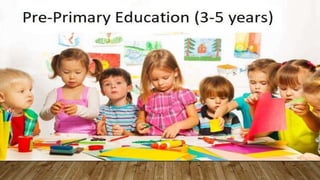
• Pre-school education is given in kindergartens, daycare homes, nursery
classes in primary schools, and in private nurseries, all under the
supervision of the Ministry. They are usually concentrated in larger towns
and cities.
Primary Education (6-10 years)
• There are also private (and paid) schools under State control.
• In all of the primary schools, foreign language education start from 2nd
class and it is two hours a week.
• Most elementary school students dress similarly in a type of uniform to
avoid any social class differences between rich and poor students.
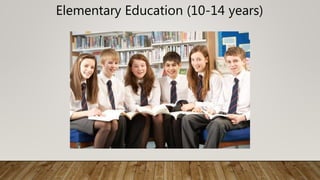
Elementary Education (10-14 years)
• At the end of 4 years, students will attend secondary school according to
the result of national high school entrance exam.
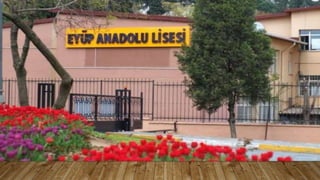
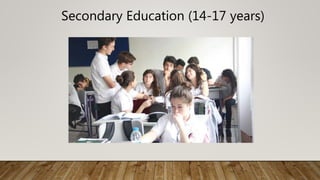
Secondary Education (14-17 years)
• Secondary education is compulsory for four years and covers general,
vocational and technical high schools.
• General high schools prepare students for higher learning institutions.
Some of the secondary schools and the private secondary schools have
foreign language preparatory classes. This kind of private high schools
have double language education (such as Italian High School, German
High School, Austrian High School, French High School, and so on).
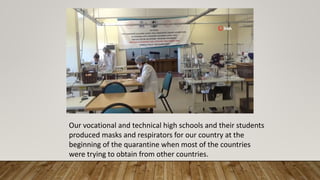
Our vocational and technical high schools and their students
produced masks and respirators for our country at the
beginning of the quarantine when most of the countries
were trying to obtain from other countries.
• After the highschool, the graduates enter a two-stage examination system
known as YGS and LYS (formerly known as ÖSS - Student Selection
Examination) in order to be admitted to Higher Education institutions. This
nation-wide centralized examinations are administrated by the Student
Selection and Placement Center (ÖSYM) every year, which determines
candidates for the enrollment of each university and faculty after
evaluating the grades of related subjects, their high school average results
and their preferences according to the student capacity of each faculty.
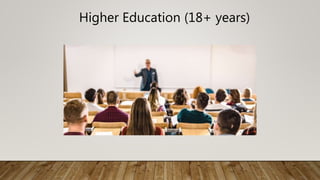
Higher Education (18+ years)
• Universities, faculties and institutes of four-year higher education schools
are founded by Law, while the two-year vocational schools, departments
and divisions are established by the Council of Higher Education (YÖK).
FOREIGN STUDENTS ADMISSION
• Foreign students who would like to enroll in the post-graduate programs
of the Turkish institutions of higher education can apply directly
to universities and must have completed their secondary education in a
high school in which the education is equivalent to that of a Turkish lycee;
they need to have it confirmed from a Turkish Embassy in their country
and apply for a student visa.
 THANKS 

Turkish educational system

  • 1.
  • 2.
    GENERAL INFORMATION • Accordingto the Constitution of the Republic of Turkey, every citizen has the right to education. • Since 2012, twelve years of education has been compulsory for boys and girls, which can be divided into 4+4+4 years of schooling. • Schools are in session for five days a week (Monday to Friday) in a total of 35-40 hours. • There is a two-week winter break between January-February. • The academic calendar generally begins in mid-September and extends through to mid-June • The central government is responsible for all educational expenses of the public, about 10% of the general budget is allocated for national education
  • 4.
    • MEB runseducational administration of the country • MEB is responsible for drawing up curricula, coordinating the work of official, private and voluntary organizations, designing and building schools, developing educational materials and so on. • Educational affairs are regulated only by the Directorates of Education appointed by the Minister on the governor's order.
  • 5.
    THE TURKISH NATIONALEDUCATIONAL SYSTEM IS COMPOSED OF TWO MAIN SECTIONS: • Formal Education and Non-formal Education. • This includes Pre-Primary education, Primary education, Elementary education, Secondary education and Higher education institutions.
  • 8.
    • Pre-school educationis given in kindergartens, daycare homes, nursery classes in primary schools, and in private nurseries, all under the supervision of the Ministry. They are usually concentrated in larger towns and cities.
  • 9.
  • 10.
    • There arealso private (and paid) schools under State control. • In all of the primary schools, foreign language education start from 2nd class and it is two hours a week. • Most elementary school students dress similarly in a type of uniform to avoid any social class differences between rich and poor students.
  • 11.
  • 12.
    • At theend of 4 years, students will attend secondary school according to the result of national high school entrance exam.
  • 14.
  • 15.
    • Secondary educationis compulsory for four years and covers general, vocational and technical high schools. • General high schools prepare students for higher learning institutions. Some of the secondary schools and the private secondary schools have foreign language preparatory classes. This kind of private high schools have double language education (such as Italian High School, German High School, Austrian High School, French High School, and so on).
  • 16.
    Our vocational andtechnical high schools and their students produced masks and respirators for our country at the beginning of the quarantine when most of the countries were trying to obtain from other countries.
  • 17.
    • After thehighschool, the graduates enter a two-stage examination system known as YGS and LYS (formerly known as ÖSS - Student Selection Examination) in order to be admitted to Higher Education institutions. This nation-wide centralized examinations are administrated by the Student Selection and Placement Center (ÖSYM) every year, which determines candidates for the enrollment of each university and faculty after evaluating the grades of related subjects, their high school average results and their preferences according to the student capacity of each faculty.
  • 18.
  • 19.
    • Universities, facultiesand institutes of four-year higher education schools are founded by Law, while the two-year vocational schools, departments and divisions are established by the Council of Higher Education (YÖK).
  • 20.
    FOREIGN STUDENTS ADMISSION •Foreign students who would like to enroll in the post-graduate programs of the Turkish institutions of higher education can apply directly to universities and must have completed their secondary education in a high school in which the education is equivalent to that of a Turkish lycee; they need to have it confirmed from a Turkish Embassy in their country and apply for a student visa.
  • 22.