Good morning
Leaders !!
Let’s have
a game!!
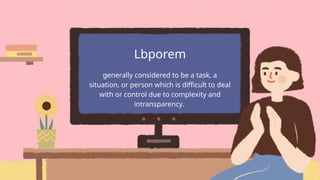
generally considered to be a task, a
situation, or person which is difficult to deal
with or control due to complexity and
intransparency.
Lbporem
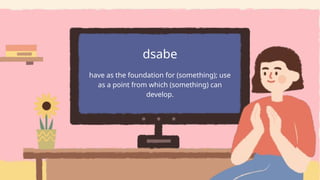
have as the foundation for (something); use
as a point from which (something) can
develop.
dsabe
the acquisition of knowledge or skills
through experience, study, or by being
taught.
elrngian
an individual or collaborative enterprise
that is carefully planned to achieve a
particular aim.
ceopjrt
the application of scientific knowledge for
practical purposes, especially in industry.
ogtcehyonl
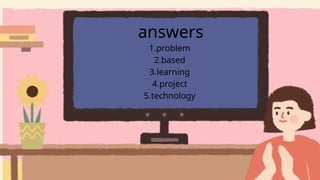
1.problem
2.based
3.learning
4.project
5.technology
answers
Problem-Based Learning
and
Project-Based Learning
Group 4
Garcia, Gesille
Zonio, Rea Jean
Lacsao, Aiprel
Anne
Omo, Mary Grace
Ordinario, Jhon
Fried
At the end of the lesson, the students should be
able to:
⚫ determine correctly the salient features of
problem-based learning and project-based
learning and their application to the attainment of
learning competencies and learning outcomes;
⚫ analyze appropriately how technologies for
teaching and learning can be maximized in
problem-based learning and project-based
learning; and
⚫share some performance standards from the
Curriculum Guide that can employ problem-based
learning and project-based learning.
Learning
Goals
• Involves inquiry and problem-solving through open-ended
questions.
• Focuses on specific content standards and their
application to real-life issues.
• Requires multiple solutions or answers.
• Engages learners in collaborative tasks towards problem
resolution.
• Typically conducted in small groups with assigned tasks.
• Enhances skills like problem-solving, communication, and
research, crucial in the workplace.
Nature of
Problem-Based Learning
Ali (2019)
described PBL as a process that is used to
identify problems with a scenario to increase
knowledge and understanding. In her article, she
proposed the following five principles of PBL that
may be considered by teachers in planning or
using the approach
1. It is a power of independent and self-directed
learning.
2. Learning happens in a group and teacher is a
facilitator.
3. All groups have to participate equally.
4. Students' learn about motivation, teamwork,
problem-solving and engagement with the task.
5. Materials such as data, photographs, articles, can
be used to solve the problem. (p. 73)
Ali (2019)
5 PRINCIPLES OF PROBLEM-BASED
LEARNING
1. Identifying the problem current issues that do
not have just one answer or one definite
solution;
2. Brainstorming generate ideas; tackle the
problem through self- directed questioning;
arouse students' intrinsic motivation;
Lo (2009, p. 208)
six-stage process used in the adoption
of the online PROBLEM-BASED
LEARNING
3. Collecting and analyzing the information-
assigning group members to collect information;
posting what they found and what they learned;
collaborative collection of useful information;
4. Synthesizing information-solving the problem
through synthesized relevant data; knowledge
building;
Lo (2009, p. 208)
six-stage process used in the adoption
of the online PROBLEM-BASED
LEARNING
5. Co-building knowledge-presentation of the
solution to the learning problem/ issue; and
6. Refining the outcomes-giving of feedback and
suggestions by the instructor to help students
improve; learning from other group's
presentation.
Lo (2009, p. 208)
six-stage process used in the adoption
of the online PROBLEM-BASED
LEARNING
1. Promotes self-confidence and motivation
2. Reduces students' nervousness during the
learning process
3. Increases students' responsibility in learning
4. Makes students easily learn the material through
sharing of ideas
Benefits of Problem-Based
Learning
(Ghufron & Ermawati, 2018, p. 666-in n EFL
writing class)
5. Promotes problem-solving skills
6. Promotes self-directed learning
7. Promotes active learning
8. Makes students explore many learning resources
9. Makes students develop positive attitude towards
learning
Benefits of Problem-Based
Learning
(Ghufron & Ermawati, 2018, p. 666-in n
EFL writing class)
• Enhances fluency in communication
• Improves grammar
• Increases comprehension
• Enhances good pronunciations and intonations
• Enhances self-confidence
• Increases range of vocabulary
Benefits of Problem-Based
Learning
For Baresh, Ali, & Darmi, 2019-EFL students:
• Enhances fluency in communication
• Improves grammar
• Increases comprehension
• Enhances good pronunciations and intonations
• Enhances self-confidence
• Increases range of vocabulary
Benefits of Problem-Based
Learning
For English as a Foreign Language (EFL) students, PBL:
• Lin's study (2017) found PBL participants improved
their reading comprehension more than non-PBL
participants.
• PBL participants showed higher motivation intensity,
desire to learn English, and communication.
• Active English learning attitudes significantly related to
reading comprehension.
The study of Lin
(2017)
• Markušic and Sabljic's (2019) study found PBL an
“acceptable methodological system” because they
saw greater interest and activity of students
• PBL fosters student interest, critical thinking,
communication skills, curiosity, love of reading
• PBL helps in developing the skills of connecting
teaching topics
The study of Markušic
and Sabljic's (2019)
Role of Technology
How is technology
integrated in the PBL
activity?
Bower, Hedberg and Kuswara
(2010) stress that technology is
simply the mediator for
collaboration and representation
and that it is the type of task and
thinking processes in which
students engage that determine
the quality of learning (p. 181)
• Utilizes free online tools for collaborative
group tasks, especially during non-class
hours.
• Facilitates active engagement and
monitoring of learners' contributions.
• Allows teachers to provide feedback at
any stage of the PBL activity.
Technology Integration in PBL
Activities
• Technology serves as a mediator for
collaboration and representation,
determining the quality of learning.
• Web 2.0 technologies facilitate and
enhance PBL activities through
collaboration, sharing, and networking.
Technology Integration in PBL
Activities
• Productivity tools like writing,
presentations, spreadsheets, calendars,
organizers, and citations assist learners
and teachers in completing tasks.
• • Free tools available for download for
mobile phones, laptops, or desktops.
Technology Integration in PBL
Activities
Nature of Project-Based Learning
/ Project-Based Approach
• Evolved as a teaching method involving
planned tasks to generate solutions to
real-world problems.
• Student-centered approach considering
students' experiences and interests.
Nature of Project-Based Learning
/ Project-Based Approach
• Based on John Dewey's principle of learning by
doing and Vygotsky's constructivist theory of
learning.
• Collaborative learning activity with open-ended
question.
• Each member contributes to problem-solving,
Researches Proves PrBL to
be Beneficial in the
Development of Various
Skills
Researches Proves PrBL to be Beneficial in the
Development of Various Skills
1. Research methodology skills (Tiwari, Arya, & Bansal,
2017).
• Student feedback from 99 students revealed
improved topic knowledge, search review,
communication, data collections kills, and
analytical/presentation skills.
• Teachers believe PrBL could cause 100% enhance
knowledge on research methodology components,
topic updates, and student interaction.
Researches Proves PrBL to be Beneficial in the
Development of Various Skills
2. Oral communicative competence (Bakar, Noordin, &
Rali, 2019)
• 44 Malaysian English language learners improved
oral communicative competence after 12-week PrBL
intervention.
• concluded that PrBL is effective teaching strategy,
recommended for learners with low English
proficiency.
Researches Proves PrBL to be Beneficial in the
Development of Various Skills
3. Development of life skills (Wurdinger & Qureshi, 2015)
• they used Mixed-method in the study
FINDINGS
-Significant difference in mean scores for
responsibility, problem-solving, self-direction,
communication, and creativity skills.
• Concluded that PrBL promotes further life skill
development.
ANSWER ME!!!
1-5. WHAT ARE THE 5 PRINCIPLES OF PROBLEM-BASED LEARNING
ACCORDING TO ALI (2019) ?
6-8. GIVE THE 3 RESEARCHERS PROVES PrBL TO BE BENEFECIAL IN
THE DEVELOPMENT OF VARIOUS SKILLS.
9. IN THEIR STUDY, THEY FOUND PBL AS AN “ACCEPTABLE
METHODOLOGICAL SYSTEM” BECAUSE THEY SAW “GREATER
INTEREST AND ACTIVITY OF STUDENTS. WHO THEY ARE?
10. HOW MANY STAGE PROCESS USED IN THE ADOPTION OF THE
ONLINE PROBLEM-BASED LEARNING ACCORDING TO
LO (2009)?

THAT’S ALL ,
THANK YOU LEADERS!!

EDTECH-2-GROUP-4-PBL-AND-PrBL-LEARNING.pptx

  • 1.
  • 2.
  • 3.
    generally considered tobe a task, a situation, or person which is difficult to deal with or control due to complexity and intransparency. Lbporem
  • 4.
    have as thefoundation for (something); use as a point from which (something) can develop. dsabe
  • 5.
    the acquisition ofknowledge or skills through experience, study, or by being taught. elrngian
  • 6.
    an individual orcollaborative enterprise that is carefully planned to achieve a particular aim. ceopjrt
  • 7.
    the application ofscientific knowledge for practical purposes, especially in industry. ogtcehyonl
  • 8.
  • 9.
    Problem-Based Learning and Project-Based Learning Group4 Garcia, Gesille Zonio, Rea Jean Lacsao, Aiprel Anne Omo, Mary Grace Ordinario, Jhon Fried
  • 10.
    At the endof the lesson, the students should be able to: ⚫ determine correctly the salient features of problem-based learning and project-based learning and their application to the attainment of learning competencies and learning outcomes; ⚫ analyze appropriately how technologies for teaching and learning can be maximized in problem-based learning and project-based learning; and ⚫share some performance standards from the Curriculum Guide that can employ problem-based learning and project-based learning. Learning Goals
  • 11.
    • Involves inquiryand problem-solving through open-ended questions. • Focuses on specific content standards and their application to real-life issues. • Requires multiple solutions or answers. • Engages learners in collaborative tasks towards problem resolution. • Typically conducted in small groups with assigned tasks. • Enhances skills like problem-solving, communication, and research, crucial in the workplace. Nature of Problem-Based Learning
  • 12.
    Ali (2019) described PBLas a process that is used to identify problems with a scenario to increase knowledge and understanding. In her article, she proposed the following five principles of PBL that may be considered by teachers in planning or using the approach
  • 13.
    1. It isa power of independent and self-directed learning. 2. Learning happens in a group and teacher is a facilitator. 3. All groups have to participate equally. 4. Students' learn about motivation, teamwork, problem-solving and engagement with the task. 5. Materials such as data, photographs, articles, can be used to solve the problem. (p. 73) Ali (2019) 5 PRINCIPLES OF PROBLEM-BASED LEARNING
  • 14.
    1. Identifying theproblem current issues that do not have just one answer or one definite solution; 2. Brainstorming generate ideas; tackle the problem through self- directed questioning; arouse students' intrinsic motivation; Lo (2009, p. 208) six-stage process used in the adoption of the online PROBLEM-BASED LEARNING
  • 15.
    3. Collecting andanalyzing the information- assigning group members to collect information; posting what they found and what they learned; collaborative collection of useful information; 4. Synthesizing information-solving the problem through synthesized relevant data; knowledge building; Lo (2009, p. 208) six-stage process used in the adoption of the online PROBLEM-BASED LEARNING
  • 16.
    5. Co-building knowledge-presentationof the solution to the learning problem/ issue; and 6. Refining the outcomes-giving of feedback and suggestions by the instructor to help students improve; learning from other group's presentation. Lo (2009, p. 208) six-stage process used in the adoption of the online PROBLEM-BASED LEARNING
  • 17.
    1. Promotes self-confidenceand motivation 2. Reduces students' nervousness during the learning process 3. Increases students' responsibility in learning 4. Makes students easily learn the material through sharing of ideas Benefits of Problem-Based Learning (Ghufron & Ermawati, 2018, p. 666-in n EFL writing class)
  • 18.
    5. Promotes problem-solvingskills 6. Promotes self-directed learning 7. Promotes active learning 8. Makes students explore many learning resources 9. Makes students develop positive attitude towards learning Benefits of Problem-Based Learning (Ghufron & Ermawati, 2018, p. 666-in n EFL writing class)
  • 19.
    • Enhances fluencyin communication • Improves grammar • Increases comprehension • Enhances good pronunciations and intonations • Enhances self-confidence • Increases range of vocabulary Benefits of Problem-Based Learning For Baresh, Ali, & Darmi, 2019-EFL students:
  • 20.
    • Enhances fluencyin communication • Improves grammar • Increases comprehension • Enhances good pronunciations and intonations • Enhances self-confidence • Increases range of vocabulary Benefits of Problem-Based Learning For English as a Foreign Language (EFL) students, PBL:
  • 21.
    • Lin's study(2017) found PBL participants improved their reading comprehension more than non-PBL participants. • PBL participants showed higher motivation intensity, desire to learn English, and communication. • Active English learning attitudes significantly related to reading comprehension. The study of Lin (2017)
  • 22.
    • Markušic andSabljic's (2019) study found PBL an “acceptable methodological system” because they saw greater interest and activity of students • PBL fosters student interest, critical thinking, communication skills, curiosity, love of reading • PBL helps in developing the skills of connecting teaching topics The study of Markušic and Sabljic's (2019)
  • 23.
  • 24.
    How is technology integratedin the PBL activity?
  • 25.
    Bower, Hedberg andKuswara (2010) stress that technology is simply the mediator for collaboration and representation and that it is the type of task and thinking processes in which students engage that determine the quality of learning (p. 181)
  • 26.
    • Utilizes freeonline tools for collaborative group tasks, especially during non-class hours. • Facilitates active engagement and monitoring of learners' contributions. • Allows teachers to provide feedback at any stage of the PBL activity. Technology Integration in PBL Activities
  • 27.
    • Technology servesas a mediator for collaboration and representation, determining the quality of learning. • Web 2.0 technologies facilitate and enhance PBL activities through collaboration, sharing, and networking. Technology Integration in PBL Activities
  • 28.
    • Productivity toolslike writing, presentations, spreadsheets, calendars, organizers, and citations assist learners and teachers in completing tasks. • • Free tools available for download for mobile phones, laptops, or desktops. Technology Integration in PBL Activities
  • 29.
    Nature of Project-BasedLearning / Project-Based Approach • Evolved as a teaching method involving planned tasks to generate solutions to real-world problems. • Student-centered approach considering students' experiences and interests.
  • 30.
    Nature of Project-BasedLearning / Project-Based Approach • Based on John Dewey's principle of learning by doing and Vygotsky's constructivist theory of learning. • Collaborative learning activity with open-ended question. • Each member contributes to problem-solving,
  • 31.
    Researches Proves PrBLto be Beneficial in the Development of Various Skills
  • 32.
    Researches Proves PrBLto be Beneficial in the Development of Various Skills 1. Research methodology skills (Tiwari, Arya, & Bansal, 2017). • Student feedback from 99 students revealed improved topic knowledge, search review, communication, data collections kills, and analytical/presentation skills. • Teachers believe PrBL could cause 100% enhance knowledge on research methodology components, topic updates, and student interaction.
  • 33.
    Researches Proves PrBLto be Beneficial in the Development of Various Skills 2. Oral communicative competence (Bakar, Noordin, & Rali, 2019) • 44 Malaysian English language learners improved oral communicative competence after 12-week PrBL intervention. • concluded that PrBL is effective teaching strategy, recommended for learners with low English proficiency.
  • 34.
    Researches Proves PrBLto be Beneficial in the Development of Various Skills 3. Development of life skills (Wurdinger & Qureshi, 2015) • they used Mixed-method in the study FINDINGS -Significant difference in mean scores for responsibility, problem-solving, self-direction, communication, and creativity skills. • Concluded that PrBL promotes further life skill development.
  • 35.
    ANSWER ME!!! 1-5. WHATARE THE 5 PRINCIPLES OF PROBLEM-BASED LEARNING ACCORDING TO ALI (2019) ? 6-8. GIVE THE 3 RESEARCHERS PROVES PrBL TO BE BENEFECIAL IN THE DEVELOPMENT OF VARIOUS SKILLS. 9. IN THEIR STUDY, THEY FOUND PBL AS AN “ACCEPTABLE METHODOLOGICAL SYSTEM” BECAUSE THEY SAW “GREATER INTEREST AND ACTIVITY OF STUDENTS. WHO THEY ARE? 10. HOW MANY STAGE PROCESS USED IN THE ADOPTION OF THE ONLINE PROBLEM-BASED LEARNING ACCORDING TO LO (2009)?

  • 36.
    THAT’S ALL , THANKYOU LEADERS!!