Entrepreneurship Management
Training and Entrepreneurship
Development Programme in India
Importance of training
Methods of training
EDP- Need and importance
Phases of EDP
Selection of entrepreneurs for EDP
Training programme - Course contents
Pre requisites of EDP
Organisations providing EDP
Entrepreneurship Management
Importance of Training
• Ensures availability of skilled manpower at all management
levels
• Enhancing abilities, potential among entrepreneurs
• Increase efficiency
• Maintain and enhance product quality
• Minimise wastages in production process
• Minimise accidents on the job
• Reduce fatigue and increase speed of work
• Standardisation in industry and internal processes
Entrepreneurship Management
Methods of Training
• Individual instruction
• Group instruction
• Lecture method
• Demonstration method
• Written instruction method
• Conference
• Meetings
Entrepreneurship Management
EDP
• Designed with an aim of encouraging self employment
• Imparts training and motivates potential and existing
entrepreneurs to start new business or diversify and
expand the existing one
• Helps employment and wealth creation among educated
unemployed youth
• Well equipped to face risks and challenges as an
entrepreneur
• Government needs considerable human and material
resource, importance to detailed planning & implementation
Entrepreneurship Management
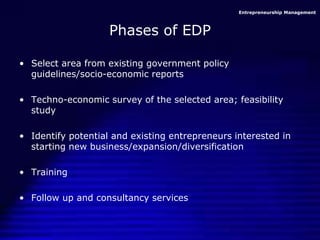
Phases of EDP
• Select area from existing government policy
guidelines/socio-economic reports
• Techno-economic survey of the selected area; feasibility
study
• Identify potential and existing entrepreneurs interested in
starting new business/expansion/diversification
• Training
• Follow up and consultancy services
Entrepreneurship Management
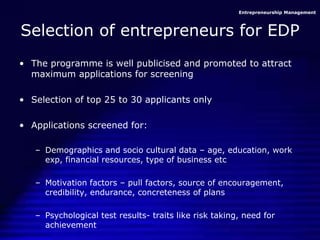
Selection of entrepreneurs for EDP
• The programme is well publicised and promoted to attract
maximum applications for screening
• Selection of top 25 to 30 applicants only
• Applications screened for:
– Demographics and socio cultural data – age, education, work
exp, financial resources, type of business etc
– Motivation factors – pull factors, source of encouragement,
credibility, endurance, concreteness of plans
– Psychological test results- traits like risk taking, need for
achievement
Entrepreneurship Management
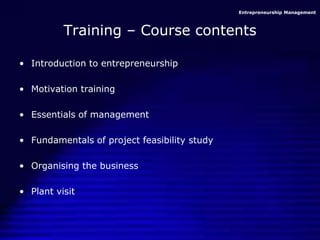
Training – Course contents
• Introduction to entrepreneurship
• Motivation training
• Essentials of management
• Fundamentals of project feasibility study
• Organising the business
• Plant visit
Entrepreneurship Management
Pre requisites of EDP
• Selection of entrepreneurs
• Inputs for EDP
• Support system
• Follow up
Entrepreneurship Management
Organisations providing EDP
Entrepreneurship Management
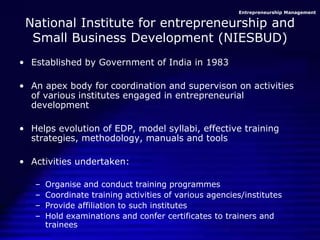
National Institute for entrepreneurship and
Small Business Development (NIESBUD)
• Established by Government of India in 1983
• An apex body for coordination and supervison on activities
of various institutes engaged in entrepreneurial
development
• Helps evolution of EDP, model syllabi, effective training
strategies, methodology, manuals and tools
• Activities undertaken:
– Organise and conduct training programmes
– Coordinate training activities of various agencies/institutes
– Provide affiliation to such institutes
– Hold examinations and confer certificates to trainers and
trainees
Entrepreneurship Management
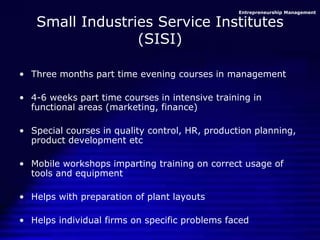
Small Industries Service Institutes
(SISI)
• Three months part time evening courses in management
• 4-6 weeks part time courses in intensive training in
functional areas (marketing, finance)
• Special courses in quality control, HR, production planning,
product development etc
• Mobile workshops imparting training on correct usage of
tools and equipment
• Helps with preparation of plant layouts
• Helps individual firms on specific problems faced
Entrepreneurship Management
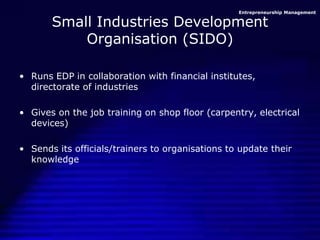
Small Industries Development
Organisation (SIDO)
• Runs EDP in collaboration with financial institutes,
directorate of industries
• Gives on the job training on shop floor (carpentry, electrical
devices)
• Sends its officials/trainers to organisations to update their
knowledge
Entrepreneurship Management
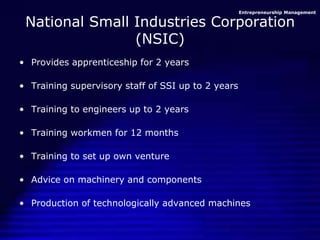
National Small Industries Corporation
(NSIC)
• Provides apprenticeship for 2 years
• Training supervisory staff of SSI up to 2 years
• Training to engineers up to 2 years
• Training workmen for 12 months
• Training to set up own venture
• Advice on machinery and components
• Production of technologically advanced machines
Entrepreneurship Management
Entrepreneurship Development
Institute of India (EDII)
• Develops programmes for entrepreneurial training and
development
• Develops innovative training techniques for trainers
• Focused attention on women entrepreneurs with first such
EDP in 1988
• EDP for rural entrepreneurship development in U.P and
Orissa
• Famous for organising camps on entrepreneurship
• Condusted EDP in Sri Lanka, Nepal, Ghana, Kenya etc
Entrepreneurship Management
National Alliance of Young
Entrepreneurs (NAYE)
• Contribution in encouraging women entrepreneurship
• Set up women’s wing in 1975
• This wing assists women in:
– Getting better access to resources, infrastructure, markets
– Identify investment opportunities
– Attending to problems of individual industries
– Sponsor participation in trade fairs, exhibitions, conferences
– Organise seminars, training programmes, workshops

Edp

  • 1.
    Entrepreneurship Management Training andEntrepreneurship Development Programme in India Importance of training Methods of training EDP- Need and importance Phases of EDP Selection of entrepreneurs for EDP Training programme - Course contents Pre requisites of EDP Organisations providing EDP
  • 2.
    Entrepreneurship Management Importance ofTraining • Ensures availability of skilled manpower at all management levels • Enhancing abilities, potential among entrepreneurs • Increase efficiency • Maintain and enhance product quality • Minimise wastages in production process • Minimise accidents on the job • Reduce fatigue and increase speed of work • Standardisation in industry and internal processes
  • 3.
    Entrepreneurship Management Methods ofTraining • Individual instruction • Group instruction • Lecture method • Demonstration method • Written instruction method • Conference • Meetings
  • 4.
    Entrepreneurship Management EDP • Designedwith an aim of encouraging self employment • Imparts training and motivates potential and existing entrepreneurs to start new business or diversify and expand the existing one • Helps employment and wealth creation among educated unemployed youth • Well equipped to face risks and challenges as an entrepreneur • Government needs considerable human and material resource, importance to detailed planning & implementation
  • 5.
    Entrepreneurship Management Phases ofEDP • Select area from existing government policy guidelines/socio-economic reports • Techno-economic survey of the selected area; feasibility study • Identify potential and existing entrepreneurs interested in starting new business/expansion/diversification • Training • Follow up and consultancy services
  • 6.
    Entrepreneurship Management Selection ofentrepreneurs for EDP • The programme is well publicised and promoted to attract maximum applications for screening • Selection of top 25 to 30 applicants only • Applications screened for: – Demographics and socio cultural data – age, education, work exp, financial resources, type of business etc – Motivation factors – pull factors, source of encouragement, credibility, endurance, concreteness of plans – Psychological test results- traits like risk taking, need for achievement
  • 7.
    Entrepreneurship Management Training –Course contents • Introduction to entrepreneurship • Motivation training • Essentials of management • Fundamentals of project feasibility study • Organising the business • Plant visit
  • 8.
    Entrepreneurship Management Pre requisitesof EDP • Selection of entrepreneurs • Inputs for EDP • Support system • Follow up
  • 9.
  • 10.
    Entrepreneurship Management National Institutefor entrepreneurship and Small Business Development (NIESBUD) • Established by Government of India in 1983 • An apex body for coordination and supervison on activities of various institutes engaged in entrepreneurial development • Helps evolution of EDP, model syllabi, effective training strategies, methodology, manuals and tools • Activities undertaken: – Organise and conduct training programmes – Coordinate training activities of various agencies/institutes – Provide affiliation to such institutes – Hold examinations and confer certificates to trainers and trainees
  • 11.
    Entrepreneurship Management Small IndustriesService Institutes (SISI) • Three months part time evening courses in management • 4-6 weeks part time courses in intensive training in functional areas (marketing, finance) • Special courses in quality control, HR, production planning, product development etc • Mobile workshops imparting training on correct usage of tools and equipment • Helps with preparation of plant layouts • Helps individual firms on specific problems faced
  • 12.
    Entrepreneurship Management Small IndustriesDevelopment Organisation (SIDO) • Runs EDP in collaboration with financial institutes, directorate of industries • Gives on the job training on shop floor (carpentry, electrical devices) • Sends its officials/trainers to organisations to update their knowledge
  • 13.
    Entrepreneurship Management National SmallIndustries Corporation (NSIC) • Provides apprenticeship for 2 years • Training supervisory staff of SSI up to 2 years • Training to engineers up to 2 years • Training workmen for 12 months • Training to set up own venture • Advice on machinery and components • Production of technologically advanced machines
  • 14.
    Entrepreneurship Management Entrepreneurship Development Instituteof India (EDII) • Develops programmes for entrepreneurial training and development • Develops innovative training techniques for trainers • Focused attention on women entrepreneurs with first such EDP in 1988 • EDP for rural entrepreneurship development in U.P and Orissa • Famous for organising camps on entrepreneurship • Condusted EDP in Sri Lanka, Nepal, Ghana, Kenya etc
  • 15.
    Entrepreneurship Management National Allianceof Young Entrepreneurs (NAYE) • Contribution in encouraging women entrepreneurship • Set up women’s wing in 1975 • This wing assists women in: – Getting better access to resources, infrastructure, markets – Identify investment opportunities – Attending to problems of individual industries – Sponsor participation in trade fairs, exhibitions, conferences – Organise seminars, training programmes, workshops