What is Universal Design?
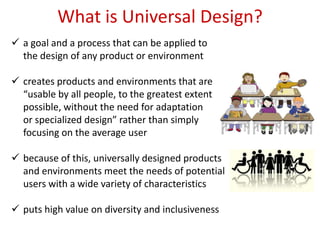
 a goal and a process that can be applied to
the design of any product or environment

 creates products and environments that are
“usable by all people, to the greatest extent
possible, without the need for adaptation
or specialized design” rather than simply
focusing on the average user
 because of this, universally designed products
and environments meet the needs of potential
users with a wide variety of characteristics
 puts high value on diversity and inclusiveness
What is the Process of Universal Design?

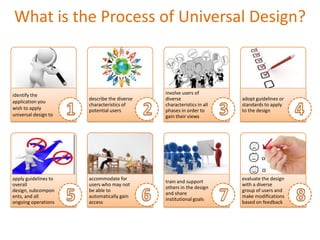
identify the
application you
wish to apply
universal design to

describe the diverse
characteristics of
potential users

involve users of
diverse
characteristics in all
phases in order to
gain their views

adopt guidelines or
standards to apply
to the design

apply guidelines to
overall
design, subcompon
ents, and all
ongoing operations

accommodate for
users who may not
be able to
automatically gain
access

train and support
others in the design
and share
institutional goals

evaluate the design
with a diverse
group of users and
make modifications
based on feedback
What are its Principles?
they are based on how the learner:
picks up information

MULTIPLE MEANS OF
REPRESENTATION
so everyone can learn the
information
accomplished by providing
options for perception, language
and symbols, for comprehension

expresses/acts on information

MULTIPLE MEANS OF
ACTION &EXPRESSION
so everyone can display their
knowledge of the information

accomplished by providing
options for physical action, for
expressive skills and fluency, and
for executive functions

is engaged by the learning situation

MULTIPLE MEANS OF
ENGAGEMENT
so students are motivated to
learn
accomplished by providing
options for gaining
interest, sustaining effort and
persistence, and for selfregulation
Important Points

There isn't an “average student” anywhere;
universal design makes sure to reach
students who have been marginalized at
either end of the spectrum

The main components of curriculum
that need to be universally designed
are:
goals/standards, materials, methods, an
d assessment

Universal design can be applied to:
curriculum, instruction, career, museums, app
liances, technology, and many more products
or environments

The main purpose is to make sure that
everyone is a successful learner, and even
further, that everyone is an expert learner

Universal design gives the power to be
flexible in allowing choices and different
paths for different students
Works Consulted
Burgstahler, S. Universal design: Process, Principles, and Applications. University of Washington.
Retrieved from http://www.washington.edu/doit/Brochures/Programs/ud.html
UDL Center. (2010, March 17). Implementing UDL. National Center on Universal Design and
Learning. [Video file]. Retrieved from http://www.youtube.com/watch?v=
vr3ardmq0a0&feature=relmfu
UDL Center. (2010, March 17). The UDL guidelines. National Center on Universal Design and
Learning. [Video file]. Retrieved from http://www.youtube.com/watch?v=rfsx3DGpv5o
&feature=relmfu
UDL Center. (2010, March 17). UDL: Principles and practice. National Center on Universal Design and
Learning. [Video file]. Retrieved from http://www.youtube.com/watch?v=pGLTJw0GSxk
&noredirect=1
Universal design: Universal design in action. CEC Today. Retrieved from http://oldsite.cec.sped.org/
AM/Template.cfm?Section=CEC_Today1&TEMPLATE=/CM/ContentDisplay.cfm&CONTEN
TID=2657

Universal Design

  • 2.
    What is UniversalDesign?  a goal and a process that can be applied to the design of any product or environment  creates products and environments that are “usable by all people, to the greatest extent possible, without the need for adaptation or specialized design” rather than simply focusing on the average user  because of this, universally designed products and environments meet the needs of potential users with a wide variety of characteristics  puts high value on diversity and inclusiveness
  • 3.
    What is theProcess of Universal Design? identify the application you wish to apply universal design to describe the diverse characteristics of potential users involve users of diverse characteristics in all phases in order to gain their views adopt guidelines or standards to apply to the design apply guidelines to overall design, subcompon ents, and all ongoing operations accommodate for users who may not be able to automatically gain access train and support others in the design and share institutional goals evaluate the design with a diverse group of users and make modifications based on feedback
  • 4.
    What are itsPrinciples? they are based on how the learner: picks up information MULTIPLE MEANS OF REPRESENTATION so everyone can learn the information accomplished by providing options for perception, language and symbols, for comprehension expresses/acts on information MULTIPLE MEANS OF ACTION &EXPRESSION so everyone can display their knowledge of the information accomplished by providing options for physical action, for expressive skills and fluency, and for executive functions is engaged by the learning situation MULTIPLE MEANS OF ENGAGEMENT so students are motivated to learn accomplished by providing options for gaining interest, sustaining effort and persistence, and for selfregulation
  • 5.
    Important Points There isn'tan “average student” anywhere; universal design makes sure to reach students who have been marginalized at either end of the spectrum The main components of curriculum that need to be universally designed are: goals/standards, materials, methods, an d assessment Universal design can be applied to: curriculum, instruction, career, museums, app liances, technology, and many more products or environments The main purpose is to make sure that everyone is a successful learner, and even further, that everyone is an expert learner Universal design gives the power to be flexible in allowing choices and different paths for different students
  • 6.
    Works Consulted Burgstahler, S.Universal design: Process, Principles, and Applications. University of Washington. Retrieved from http://www.washington.edu/doit/Brochures/Programs/ud.html UDL Center. (2010, March 17). Implementing UDL. National Center on Universal Design and Learning. [Video file]. Retrieved from http://www.youtube.com/watch?v= vr3ardmq0a0&feature=relmfu UDL Center. (2010, March 17). The UDL guidelines. National Center on Universal Design and Learning. [Video file]. Retrieved from http://www.youtube.com/watch?v=rfsx3DGpv5o &feature=relmfu UDL Center. (2010, March 17). UDL: Principles and practice. National Center on Universal Design and Learning. [Video file]. Retrieved from http://www.youtube.com/watch?v=pGLTJw0GSxk &noredirect=1 Universal design: Universal design in action. CEC Today. Retrieved from http://oldsite.cec.sped.org/ AM/Template.cfm?Section=CEC_Today1&TEMPLATE=/CM/ContentDisplay.cfm&CONTEN TID=2657