Introduction to the Europeana Data
Model (EDM)
22nd September 2013, TPDL2013, Malta
Valentine Charles
A Collaborative Effort
Original principle: make Europeana ready to ingest metadata that is
closer to specific community concerns
Europeana & partners can develop EDM “profiles” upon which
everyone could build specific functionality
 Based on best practices from sector or domain level
EDM is consolidated with partners who re-use it
 Europeana providers, DPLA, CARARE…
Metadata interoperability challenges
 Needs:
• Accommodate different data models
• Accommodate domain specific requirements
• Avoid losing data and keep the best granularity
• Co-exist with the original data
EDM rationale: requirements
 Richer metadata - finer granularity
1. Distinguish “provided objects” (painting, book, movie, etc.)
from their digital representations
2. Distinguish object from its metadata record
3. Allow multiple records for a same object, containing
potentially contradictory statements about it
4. Support for objects that are composed of other objects
5. Support for contextual resources, including concepts from
controlled vocabularies
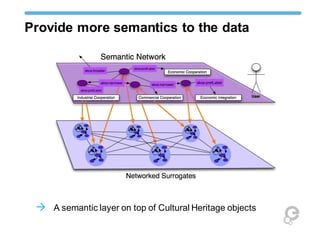
Provide more semantics to the data
 A semantic layer on top of Cultural Heritage objects
Provide more semantics to the data
 Semantic layer provides more context to the metadata
 Allow the representation of specific relationships
• Aboutness
• Similarity between objects
• Part-whole relation, representation, derivation…
 Promote the re-use of external resources (available as
Linked Data)
EDM rationale: principles
 Compatibility with different levels of description
1. Allow different levels of granularity
2. Allow the specificationof domain-specific application profiles
3. Enable the re-use of existing standards
EDM basis
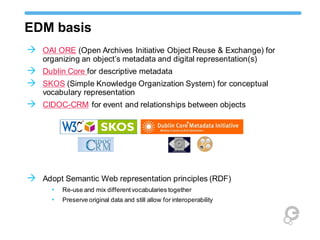
 OAI ORE (Open Archives Initiative Object Reuse & Exchange) for
organizing an object’s metadata and digital representation(s)
 Dublin Core for descriptive metadata
 SKOS (Simple Knowledge Organization System) for conceptual
vocabulary representation
 CIDOC-CRM for event and relationships between objects
 Adopt Semantic Web representation principles (RDF)
• Re-use and mix differentvocabularies together
• Preserve original data and still allow for interoperability
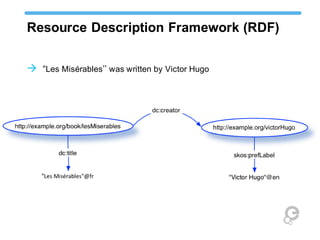
Resource Description Framework (RDF)
 “Les Misérables’’ was written by Victor Hugo
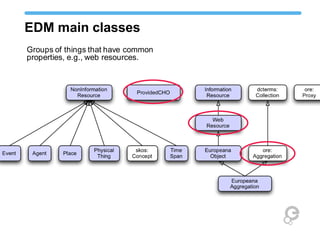
EDM main classes
Groups of things that have common
properties, e.g., web resources.
EDM main properties Attributes or characteristics of
resources e.g., a member of the
class Agent will have a name.
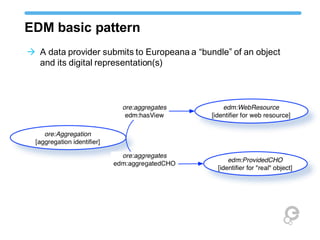
EDM basic pattern
 A data provider submits to Europeana a “bundle” of an object
and its digital representation(s)
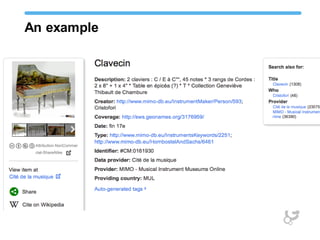
An example
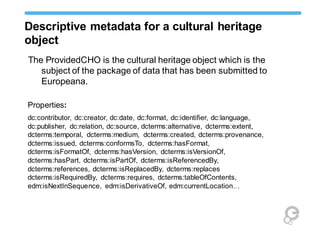
Descriptive metadata for a cultural heritage
object
The ProvidedCHO is the cultural heritage object which is the
subject of the package of data that has been submitted to
Europeana.
Properties:
dc:contributor, dc:creator, dc:date, dc:format, dc:identifier, dc:language,
dc:publisher, dc:relation, dc:source, dcterms:alternative, dcterms:extent,
dcterms:temporal, dcterms:medium, dcterms:created, dcterms:provenance,
dcterms:issued, dcterms:conformsTo, dcterms:hasFormat,
dcterms:isFormatOf, dcterms:hasVersion, dcterms:isVersionOf,
dcterms:hasPart, dcterms:isPartOf, dcterms:isReferencedBy,
dcterms:references, dcterms:isReplacedBy, dcterms:replaces
dcterms:isRequiredBy, dcterms:requires, dcterms:tableOfContents,
edm:isNextInSequence, edm:isDerivativeOf, edm:currentLocation…
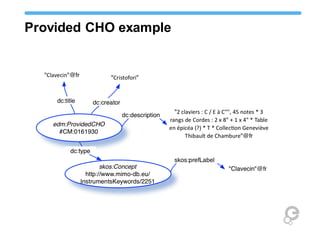
Provided CHO example
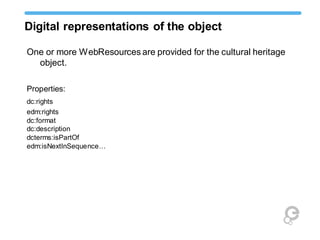
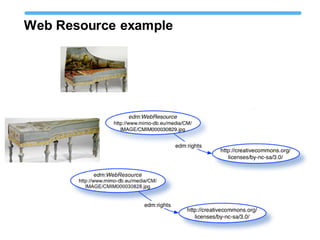
Digital representations of the object
One or more WebResources are provided for the cultural heritage
object.
Properties:
dc:rights
edm:rights
dc:format
dc:description
dcterms:isPartOf
edm:isNextInSequence…
Web Resource example
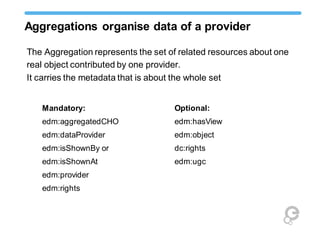
Aggregations organise data of a provider
The Aggregation represents the set of related resources about one
real object contributed by one provider.
It carries the metadata that is about the whole set
Mandatory:
edm:aggregatedCHO
edm:dataProvider
edm:isShownBy or
edm:isShownAt
edm:provider
edm:rights
Optional:
edm:hasView
edm:object
dc:rights
edm:ugc
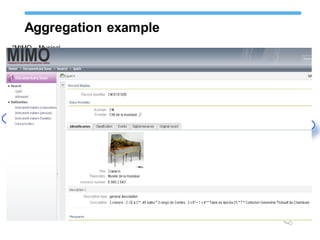
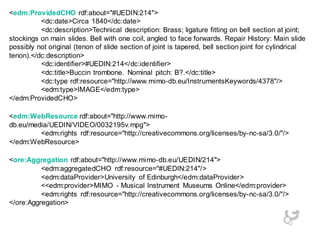
Aggregation example
<edm:ProvidedCHO rdf:about="#UEDIN:214">
<dc:date>Circa 1840</dc:date>
<dc:description>Technical description: Brass; ligature fitting on bell section at joint;
stockings on main slides. Bell with one coil, angled to face forwards. Repair History: Main slide
possibly not original (tenon of slide section of joint is tapered, bell section joint for cylindrical
tenon).</dc:description>
<dc:identifier>#UEDIN:214</dc:identifier>
<dc:title>Buccin trombone. Nominal pitch: B?.</dc:title>
<dc:type rdf:resource="http://www.mimo-db.eu/InstrumentsKeywords/4378"/>
<edm:type>IMAGE</edm:type>
</edm:ProvidedCHO>
<edm:WebResource rdf:about="http://www.mimo-
db.eu/media/UEDIN/VIDEO/0032195v.mpg">
<edm:rights rdf:resource="http://creativecommons.org/licenses/by-nc-sa/3.0/"/>
</edm:WebResource>
<ore:Aggregation rdf:about="http://www.mimo-db.eu/UEDIN/214">
<edm:aggregatedCHO rdf:resource="#UEDIN:214"/>
<edm:dataProvider>University of Edinburgh</edm:dataProvider>
<<edm:provider>MIMO - Musical Instrument Museums Online</edm:provider>
<edm:rights rdf:resource="http://creativecommons.org/licenses/by-nc-sa/3.0/"/>
</ore:Aggregation>
Questions so far?
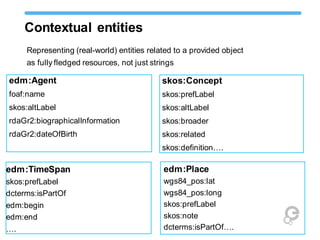
Contextual entities
Representing (real-world) entities related to a provided object
as fully fledged resources, not just strings
edm:Agent
foaf:name
skos:altLabel
rdaGr2:biographicalInformation
rdaGr2:dateOfBirth
skos:Concept
skos:prefLabel
skos:altLabel
skos:broader
skos:related
skos:definition….
edm:TimeSpan
skos:prefLabel
dcterms:isPartOf
edm:begin
edm:end
….
edm:Place
wgs84_pos:lat
wgs84_pos:long
skos:prefLabel
skos:note
dcterms:isPartOf….
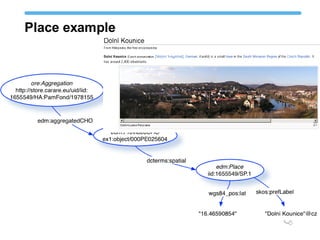
Place example
Applications of EDM
 Europeana Portal
 Europeana Linked Data pilot (data.europeana.eu)
 EuropeanaAPI
 Provision of EDM data: MIMO, CARARE, HOPE projects
 EDM re-use at the Digital Public Library of America,
Smithsonian Institute
 EDM extensions at projects: German Digital Library,
Europeana Fashion, Digital Manuscripts to Europeana
 EDM mapping to Schema.org
Documentation
Main documentation:
EDM Definition
EDM Primer
EDM Mapping guidelines for data providers
http://pro.europeana.eu/edm-documentation
 Other resources:
EDM case studies
http://pro.europeana.eu/case-studies-edm
EDM object templates & XML schema
http://europeanalabs.eu/wiki/EDMXMLSchema
Cases studies
EDM and data providers’ duties & benefits
 Mapping the data to EDM has benefits
• Closer to original metadata
• Data can be contextualized, semantically linked to other data
• Allows for richer semantic query expansion & cross-collection
browsing
A mapping to EDM: the CARARE example
 A three-year project making digital content from the
archaeology and architecture heritage domain available to
Europeana.
 Domain-specific metadata schema based on existing
standards from the archaeology and architecture domain
( MIDAS Heritage, LIDO & CIDOC CRM)
• Heritage Assets
• Digital resources
• Collections
• Activities
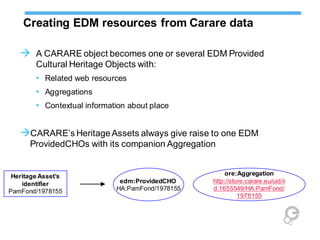
Creating EDM resources from Carare data
 A CARARE object becomes one or several EDM Provided
Cultural Heritage Objects with:
• Related web resources
• Aggregations
• Contextual information about place
CARARE’s HeritageAssets always give raise to one EDM
ProvidedCHOs with its companion Aggregation
edm:ProvidedCHO
HA:PamFond/1978155
ore:Aggregation
http://store.carare.eu/uid/ii
d:1655549/HA:PamFond/
1978155
Heritage Asset’s
identifier
PamFond/1978155
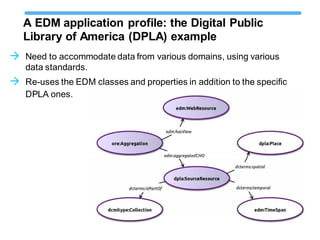
A EDM application profile: the Digital Public
Library of America (DPLA) example
 Need to accommodate data from various domains, using various
data standards.
 Re-uses the EDM classes and properties in addition to the specific
DPLA ones.
An extension for EDM: The DM2E example

Mapping cross-­domain metadata to the Europeana Data Model (EDM) - EDM introduction

  • 1.
    Introduction to theEuropeana Data Model (EDM) 22nd September 2013, TPDL2013, Malta Valentine Charles
  • 2.
    A Collaborative Effort Originalprinciple: make Europeana ready to ingest metadata that is closer to specific community concerns Europeana & partners can develop EDM “profiles” upon which everyone could build specific functionality  Based on best practices from sector or domain level EDM is consolidated with partners who re-use it  Europeana providers, DPLA, CARARE…
  • 3.
    Metadata interoperability challenges Needs: • Accommodate different data models • Accommodate domain specific requirements • Avoid losing data and keep the best granularity • Co-exist with the original data
  • 4.
    EDM rationale: requirements Richer metadata - finer granularity 1. Distinguish “provided objects” (painting, book, movie, etc.) from their digital representations 2. Distinguish object from its metadata record 3. Allow multiple records for a same object, containing potentially contradictory statements about it 4. Support for objects that are composed of other objects 5. Support for contextual resources, including concepts from controlled vocabularies
  • 5.
    Provide more semanticsto the data  A semantic layer on top of Cultural Heritage objects
  • 6.
    Provide more semanticsto the data  Semantic layer provides more context to the metadata  Allow the representation of specific relationships • Aboutness • Similarity between objects • Part-whole relation, representation, derivation…  Promote the re-use of external resources (available as Linked Data)
  • 7.
    EDM rationale: principles Compatibility with different levels of description 1. Allow different levels of granularity 2. Allow the specificationof domain-specific application profiles 3. Enable the re-use of existing standards
  • 8.
    EDM basis  OAIORE (Open Archives Initiative Object Reuse & Exchange) for organizing an object’s metadata and digital representation(s)  Dublin Core for descriptive metadata  SKOS (Simple Knowledge Organization System) for conceptual vocabulary representation  CIDOC-CRM for event and relationships between objects  Adopt Semantic Web representation principles (RDF) • Re-use and mix differentvocabularies together • Preserve original data and still allow for interoperability
  • 9.
    Resource Description Framework(RDF)  “Les Misérables’’ was written by Victor Hugo
  • 10.
    EDM main classes Groupsof things that have common properties, e.g., web resources.
  • 11.
    EDM main propertiesAttributes or characteristics of resources e.g., a member of the class Agent will have a name.
  • 12.
    EDM basic pattern A data provider submits to Europeana a “bundle” of an object and its digital representation(s)
  • 13.
  • 14.
    Descriptive metadata fora cultural heritage object The ProvidedCHO is the cultural heritage object which is the subject of the package of data that has been submitted to Europeana. Properties: dc:contributor, dc:creator, dc:date, dc:format, dc:identifier, dc:language, dc:publisher, dc:relation, dc:source, dcterms:alternative, dcterms:extent, dcterms:temporal, dcterms:medium, dcterms:created, dcterms:provenance, dcterms:issued, dcterms:conformsTo, dcterms:hasFormat, dcterms:isFormatOf, dcterms:hasVersion, dcterms:isVersionOf, dcterms:hasPart, dcterms:isPartOf, dcterms:isReferencedBy, dcterms:references, dcterms:isReplacedBy, dcterms:replaces dcterms:isRequiredBy, dcterms:requires, dcterms:tableOfContents, edm:isNextInSequence, edm:isDerivativeOf, edm:currentLocation…
  • 15.
  • 16.
    Digital representations ofthe object One or more WebResources are provided for the cultural heritage object. Properties: dc:rights edm:rights dc:format dc:description dcterms:isPartOf edm:isNextInSequence…
  • 17.
  • 18.
    Aggregations organise dataof a provider The Aggregation represents the set of related resources about one real object contributed by one provider. It carries the metadata that is about the whole set Mandatory: edm:aggregatedCHO edm:dataProvider edm:isShownBy or edm:isShownAt edm:provider edm:rights Optional: edm:hasView edm:object dc:rights edm:ugc
  • 19.
  • 20.
    <edm:ProvidedCHO rdf:about="#UEDIN:214"> <dc:date>Circa 1840</dc:date> <dc:description>Technicaldescription: Brass; ligature fitting on bell section at joint; stockings on main slides. Bell with one coil, angled to face forwards. Repair History: Main slide possibly not original (tenon of slide section of joint is tapered, bell section joint for cylindrical tenon).</dc:description> <dc:identifier>#UEDIN:214</dc:identifier> <dc:title>Buccin trombone. Nominal pitch: B?.</dc:title> <dc:type rdf:resource="http://www.mimo-db.eu/InstrumentsKeywords/4378"/> <edm:type>IMAGE</edm:type> </edm:ProvidedCHO> <edm:WebResource rdf:about="http://www.mimo- db.eu/media/UEDIN/VIDEO/0032195v.mpg"> <edm:rights rdf:resource="http://creativecommons.org/licenses/by-nc-sa/3.0/"/> </edm:WebResource> <ore:Aggregation rdf:about="http://www.mimo-db.eu/UEDIN/214"> <edm:aggregatedCHO rdf:resource="#UEDIN:214"/> <edm:dataProvider>University of Edinburgh</edm:dataProvider> <<edm:provider>MIMO - Musical Instrument Museums Online</edm:provider> <edm:rights rdf:resource="http://creativecommons.org/licenses/by-nc-sa/3.0/"/> </ore:Aggregation>
  • 21.
  • 22.
    Contextual entities Representing (real-world)entities related to a provided object as fully fledged resources, not just strings edm:Agent foaf:name skos:altLabel rdaGr2:biographicalInformation rdaGr2:dateOfBirth skos:Concept skos:prefLabel skos:altLabel skos:broader skos:related skos:definition…. edm:TimeSpan skos:prefLabel dcterms:isPartOf edm:begin edm:end …. edm:Place wgs84_pos:lat wgs84_pos:long skos:prefLabel skos:note dcterms:isPartOf….
  • 23.
  • 24.
    Applications of EDM Europeana Portal  Europeana Linked Data pilot (data.europeana.eu)  EuropeanaAPI  Provision of EDM data: MIMO, CARARE, HOPE projects  EDM re-use at the Digital Public Library of America, Smithsonian Institute  EDM extensions at projects: German Digital Library, Europeana Fashion, Digital Manuscripts to Europeana  EDM mapping to Schema.org
  • 25.
    Documentation Main documentation: EDM Definition EDMPrimer EDM Mapping guidelines for data providers http://pro.europeana.eu/edm-documentation  Other resources: EDM case studies http://pro.europeana.eu/case-studies-edm EDM object templates & XML schema http://europeanalabs.eu/wiki/EDMXMLSchema
  • 26.
  • 27.
    EDM and dataproviders’ duties & benefits  Mapping the data to EDM has benefits • Closer to original metadata • Data can be contextualized, semantically linked to other data • Allows for richer semantic query expansion & cross-collection browsing
  • 28.
    A mapping toEDM: the CARARE example  A three-year project making digital content from the archaeology and architecture heritage domain available to Europeana.  Domain-specific metadata schema based on existing standards from the archaeology and architecture domain ( MIDAS Heritage, LIDO & CIDOC CRM) • Heritage Assets • Digital resources • Collections • Activities
  • 29.
    Creating EDM resourcesfrom Carare data  A CARARE object becomes one or several EDM Provided Cultural Heritage Objects with: • Related web resources • Aggregations • Contextual information about place CARARE’s HeritageAssets always give raise to one EDM ProvidedCHOs with its companion Aggregation edm:ProvidedCHO HA:PamFond/1978155 ore:Aggregation http://store.carare.eu/uid/ii d:1655549/HA:PamFond/ 1978155 Heritage Asset’s identifier PamFond/1978155
  • 30.
    A EDM applicationprofile: the Digital Public Library of America (DPLA) example  Need to accommodate data from various domains, using various data standards.  Re-uses the EDM classes and properties in addition to the specific DPLA ones.
  • 31.
    An extension forEDM: The DM2E example