Europeana Data Model
                                                            Berlin, HU-Berlin
                                                                    1.03.2012


Steffen Hennicke
Humboldt-Universität zu Berlin / School of Library and Information Science
Steffen.hennicke@ibi.hu-berlin.de


                                                                             1
ESE
“Europeana Semantic Elements” (ESE)

Created for 2008 version of Europeana
enforces interoperability by converting datasets to a
  Dublin-Core like “flat” representation
“simple and robust” but:
   original metadata is not visible anymore
   no specializations to finer-grained models
   no connections to external (open data) resources
Probably shouldn't have been called “semantic” :-)


                              Europeana Data Model
               Steffen Hennicke. HU-Berlin, DM2E-Kick-Off, 1./2. March 2012.   2
ESE ...

<...xmlns:europeana="http://www.europeana.eu/schemas/ese/“
...
<!--National Library of Poland-->
<record>
  <dc:identifier>urn:repox.bn.org.pl:polona:oai:www.polona.pl:4445</dc:identifier>
  <europeana:uri>http://www.europeana.eu/resolve/record/01406/18A8F5DFCAE75694A
  8AAD18E2791861FBE92589A</europeana:uri>
    <dc:title>[Ośmiu powstańców uzbrojonych w kosy]</dc:title>
    <dc:subject>Powstanie 1863 r. styczniowe - ikonografia</dc:subject>
    <dc:date>[1863-1864]</dc:date>
    <dc:rights>Biblioteka Narodowa</dc:rights>
    <europeana:object>http://193.59.172.16/szzz/IsShownBy.do?
  id=6481</europeana:object>
    <europeana:isShownAt>http://193.59.172.16/szzz/ShowStart.do?
  id=6481</europeana:isShownAt>
  </record>


                                   Europeana Data Model
                    Steffen Hennicke. HU-Berlin, DM2E-Kick-Off, 1./2. March 2012.   3
EDM
“Europeana Data Model” (EDM)

preserves original data while still allowing for
  interoperability
uses Semantic Web representation principles: RDF(S)

ESE “application profile” of EDM (backwards
   compatibility)
is about to replace ESE (LoD prototype in parallel to ESE
   based portal)


                             Europeana Data Model
              Steffen Hennicke. HU-Berlin, DM2E-Kick-Off, 1./2. March 2012.   4
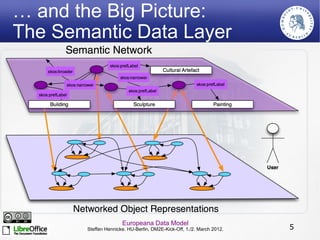
… and the Big Picture:
The Semantic Data Layer


                      Europeana Data Model
       Steffen Hennicke. HU-Berlin, DM2E-Kick-Off, 1./2. March 2012.   5
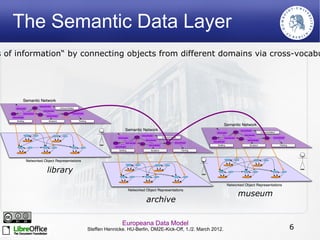
The Semantic Data Layer
s of information“ by connecting objects from different domains via cross-vocabu


            library

                                                                                      museum
                                                archive

                                     Europeana Data Model
                      Steffen Hennicke. HU-Berlin, DM2E-Kick-Off, 1./2. March 2012.            6
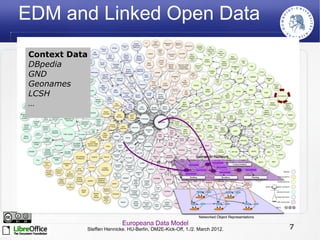
EDM and Linked Open Data
Context Data
DBpedia
GND
Geonames
LCSH
…


                          Europeana Data Model
           Steffen Hennicke. HU-Berlin, DM2E-Kick-Off, 1./2. March 2012.   7
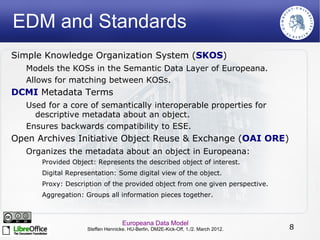
EDM and Standards
Simple Knowledge Organization System (SKOS)
   Models the KOSs in the Semantic Data Layer of Europeana.
   Allows for matching between KOSs.
DCMI Metadata Terms
   Used for a core of semantically interoperable properties for
     descriptive metadata about an object.
   Ensures backwards compatibility to ESE.
Open Archives Initiative Object Reuse & Exchange (OAI ORE)
   Organizes the metadata about an object in Europeana:
      Provided Object: Represents the described object of interest.
      Digital Representation: Some digital view of the object.
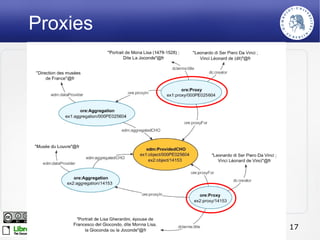
      Proxy: Description of the provided object from one given perspective.
      Aggregation: Groups all information pieces together.


                                   Europeana Data Model
                    Steffen Hennicke. HU-Berlin, DM2E-Kick-Off, 1./2. March 2012.   8
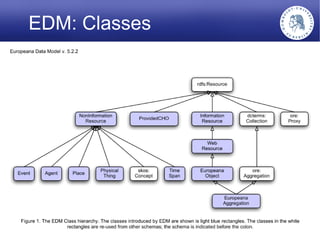
EDM: Classes


                    Europeana Data Model
     Steffen Hennicke. HU-Berlin, DM2E-Kick-Off, 1./2. March 2012.   9
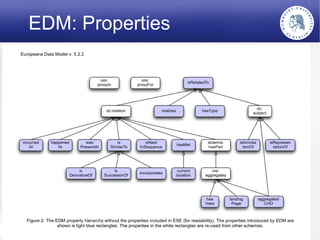
EDM: Properties


                     Europeana Data Model
      Steffen Hennicke. HU-Berlin, DM2E-Kick-Off, 1./2. March 2012.   10
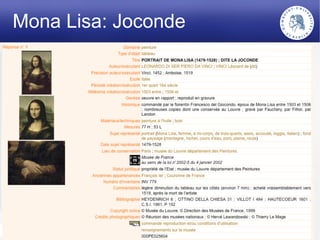
Mona Lisa: Joconde


                      Europeana Data Model
       Steffen Hennicke. HU-Berlin, DM2E-Kick-Off, 1./2. March 2012.   11
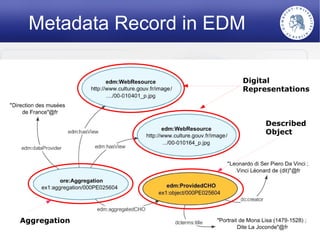
Metadata Record in EDM

                                                                              Digital
                                                                              Representations


                                                                                   Described
                                                                                   Object


Aggregation                  Europeana Data Model
              Steffen Hennicke. HU-Berlin, DM2E-Kick-Off, 1./2. March 2012.             12
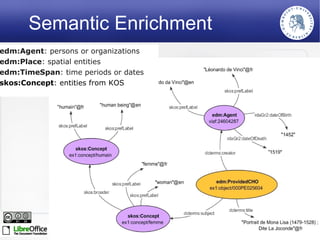
Semantic Enrichment
edm:Agent: persons or organizations
edm:Place: spatial entities
edm:TimeSpan: time periods or dates
skos:Concept: entities from KOS


                                    Europeana Data Model
                     Steffen Hennicke. HU-Berlin, DM2E-Kick-Off, 1./2. March 2012.   13
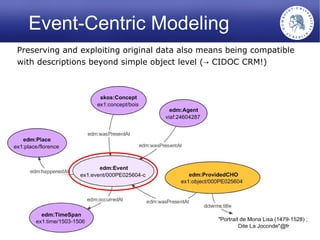
Event-Centric Modeling
Preserving and exploiting original data also means being compatible
with descriptions beyond simple object level (→ CIDOC CRM!)


                               Europeana Data Model
                Steffen Hennicke. HU-Berlin, DM2E-Kick-Off, 1./2. March 2012.   14
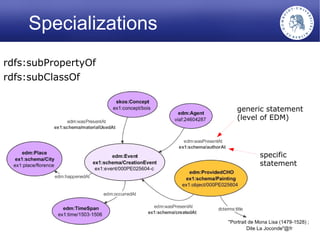
Specializations
rdfs:subPropertyOf
rdfs:subClassOf


                                                                                generic statement
                                                                                (level of EDM)


                                                                                     specific
                                                                                     statement


                               Europeana Data Model
                Steffen Hennicke. HU-Berlin, DM2E-Kick-Off, 1./2. March 2012.                15
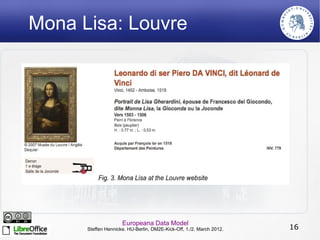
Mona Lisa: Louvre


                     Europeana Data Model
      Steffen Hennicke. HU-Berlin, DM2E-Kick-Off, 1./2. March 2012.   16
Proxies


                     Europeana Data Model
      Steffen Hennicke. HU-Berlin, DM2E-Kick-Off, 1./2. March 2012.   17
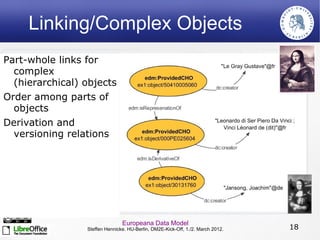
Linking/Complex Objects
Part-whole links for
  complex
  (hierarchical) objects
Order among parts of
  objects
Derivation and
  versioning relations


                                Europeana Data Model
                 Steffen Hennicke. HU-Berlin, DM2E-Kick-Off, 1./2. March 2012.   18
Current State of EDM
Confirmed feasibility in community workshops (archives,
  libraries, audiovisual archives, museums)
LOD-Prototype
    http://data.europeana.eu
    At launchtime had 3,5 millions of the 19 million
      objects represented in Europeana – a coalition of the
      willing :)
    Integration of additional contextualisation links
      ongoing (GeoNames, VIAF, DBPedia)
    Available as RDF dump
    Credits to Bernhard Haslhofer (U Wien), Antoine Isaac
      (Europeana Foundation), Cesare Concordia (CNR
      IST) and many more ...
                              Europeana Data Model
               Steffen Hennicke. HU-Berlin, DM2E-Kick-Off, 1./2. March 2012.   19
Pointers
EDM Specifications and Primer
   http://version1.europeana.eu/web/europeana-
     project/technicaldocuments/


Martin Doerr, Stefan Gradmann, Steffen Hennicke, Antoine Isaac,
 Carlo Meghini, Herbert van de Sompel: The Europeana Data
 Model. IFLA 2010 (Gothenburg).
   http://www.ifla.org/files/hq/papers/ifla76/149-doerr-en.pdf


                               Europeana Data Model
                Steffen Hennicke. HU-Berlin, DM2E-Kick-Off, 1./2. March 2012.   20

Steffen Hennicke Presentation DM2E Kick-Off

  • 1.
    Europeana Data Model Berlin, HU-Berlin 1.03.2012 Steffen Hennicke Humboldt-Universität zu Berlin / School of Library and Information Science Steffen.hennicke@ibi.hu-berlin.de 1
  • 2.
    ESE “Europeana Semantic Elements”(ESE) Created for 2008 version of Europeana enforces interoperability by converting datasets to a Dublin-Core like “flat” representation “simple and robust” but: original metadata is not visible anymore no specializations to finer-grained models no connections to external (open data) resources Probably shouldn't have been called “semantic” :-) Europeana Data Model Steffen Hennicke. HU-Berlin, DM2E-Kick-Off, 1./2. March 2012. 2
  • 3.
    ESE ... <...xmlns:europeana="http://www.europeana.eu/schemas/ese/“ ... <!--National Libraryof Poland--> <record> <dc:identifier>urn:repox.bn.org.pl:polona:oai:www.polona.pl:4445</dc:identifier> <europeana:uri>http://www.europeana.eu/resolve/record/01406/18A8F5DFCAE75694A 8AAD18E2791861FBE92589A</europeana:uri> <dc:title>[Ośmiu powstańców uzbrojonych w kosy]</dc:title> <dc:subject>Powstanie 1863 r. styczniowe - ikonografia</dc:subject> <dc:date>[1863-1864]</dc:date> <dc:rights>Biblioteka Narodowa</dc:rights> <europeana:object>http://193.59.172.16/szzz/IsShownBy.do? id=6481</europeana:object> <europeana:isShownAt>http://193.59.172.16/szzz/ShowStart.do? id=6481</europeana:isShownAt> </record> Europeana Data Model Steffen Hennicke. HU-Berlin, DM2E-Kick-Off, 1./2. March 2012. 3
  • 4.
    EDM “Europeana Data Model”(EDM) preserves original data while still allowing for interoperability uses Semantic Web representation principles: RDF(S) ESE “application profile” of EDM (backwards compatibility) is about to replace ESE (LoD prototype in parallel to ESE based portal) Europeana Data Model Steffen Hennicke. HU-Berlin, DM2E-Kick-Off, 1./2. March 2012. 4
  • 5.
    … and theBig Picture: The Semantic Data Layer Europeana Data Model Steffen Hennicke. HU-Berlin, DM2E-Kick-Off, 1./2. March 2012. 5
  • 6.
    The Semantic DataLayer s of information“ by connecting objects from different domains via cross-vocabu library museum archive Europeana Data Model Steffen Hennicke. HU-Berlin, DM2E-Kick-Off, 1./2. March 2012. 6
  • 7.
    EDM and LinkedOpen Data Context Data DBpedia GND Geonames LCSH … Europeana Data Model Steffen Hennicke. HU-Berlin, DM2E-Kick-Off, 1./2. March 2012. 7
  • 8.
    EDM and Standards SimpleKnowledge Organization System (SKOS) Models the KOSs in the Semantic Data Layer of Europeana. Allows for matching between KOSs. DCMI Metadata Terms Used for a core of semantically interoperable properties for descriptive metadata about an object. Ensures backwards compatibility to ESE. Open Archives Initiative Object Reuse & Exchange (OAI ORE) Organizes the metadata about an object in Europeana: Provided Object: Represents the described object of interest. Digital Representation: Some digital view of the object. Proxy: Description of the provided object from one given perspective. Aggregation: Groups all information pieces together. Europeana Data Model Steffen Hennicke. HU-Berlin, DM2E-Kick-Off, 1./2. March 2012. 8
  • 9.
    EDM: Classes Europeana Data Model Steffen Hennicke. HU-Berlin, DM2E-Kick-Off, 1./2. March 2012. 9
  • 10.
    EDM: Properties Europeana Data Model Steffen Hennicke. HU-Berlin, DM2E-Kick-Off, 1./2. March 2012. 10
  • 11.
    Mona Lisa: Joconde Europeana Data Model Steffen Hennicke. HU-Berlin, DM2E-Kick-Off, 1./2. March 2012. 11
  • 12.
    Metadata Record inEDM Digital Representations Described Object Aggregation Europeana Data Model Steffen Hennicke. HU-Berlin, DM2E-Kick-Off, 1./2. March 2012. 12
  • 13.
    Semantic Enrichment edm:Agent: personsor organizations edm:Place: spatial entities edm:TimeSpan: time periods or dates skos:Concept: entities from KOS Europeana Data Model Steffen Hennicke. HU-Berlin, DM2E-Kick-Off, 1./2. March 2012. 13
  • 14.
    Event-Centric Modeling Preserving andexploiting original data also means being compatible with descriptions beyond simple object level (→ CIDOC CRM!) Europeana Data Model Steffen Hennicke. HU-Berlin, DM2E-Kick-Off, 1./2. March 2012. 14
  • 15.
    Specializations rdfs:subPropertyOf rdfs:subClassOf generic statement (level of EDM) specific statement Europeana Data Model Steffen Hennicke. HU-Berlin, DM2E-Kick-Off, 1./2. March 2012. 15
  • 16.
    Mona Lisa: Louvre Europeana Data Model Steffen Hennicke. HU-Berlin, DM2E-Kick-Off, 1./2. March 2012. 16
  • 17.
    Proxies Europeana Data Model Steffen Hennicke. HU-Berlin, DM2E-Kick-Off, 1./2. March 2012. 17
  • 18.
    Linking/Complex Objects Part-whole linksfor complex (hierarchical) objects Order among parts of objects Derivation and versioning relations Europeana Data Model Steffen Hennicke. HU-Berlin, DM2E-Kick-Off, 1./2. March 2012. 18
  • 19.
    Current State ofEDM Confirmed feasibility in community workshops (archives, libraries, audiovisual archives, museums) LOD-Prototype http://data.europeana.eu At launchtime had 3,5 millions of the 19 million objects represented in Europeana – a coalition of the willing :) Integration of additional contextualisation links ongoing (GeoNames, VIAF, DBPedia) Available as RDF dump Credits to Bernhard Haslhofer (U Wien), Antoine Isaac (Europeana Foundation), Cesare Concordia (CNR IST) and many more ... Europeana Data Model Steffen Hennicke. HU-Berlin, DM2E-Kick-Off, 1./2. March 2012. 19
  • 20.
    Pointers EDM Specifications andPrimer http://version1.europeana.eu/web/europeana- project/technicaldocuments/ Martin Doerr, Stefan Gradmann, Steffen Hennicke, Antoine Isaac, Carlo Meghini, Herbert van de Sompel: The Europeana Data Model. IFLA 2010 (Gothenburg). http://www.ifla.org/files/hq/papers/ifla76/149-doerr-en.pdf Europeana Data Model Steffen Hennicke. HU-Berlin, DM2E-Kick-Off, 1./2. March 2012. 20

Editor's Notes

  • #6 First a few words about the envisioned information architecture of Europeana: This is how the information space of Europeana will be restructured : At the “bottom” we have the objects which are provided to Europeana. Above we have the “Semantic Data Layer” which is new. It contains various kinds of KOSs with knowledge about people, places, concepts, and so on. These concepts are linked to the objects below and thereby contextualize and enrich them.
  • #7 The data provided to Europeana will come from many different kinds of domains like libraries, archives, or museums. They all will provide their specific collections and KOSs . That will naturally result in „isles of information“ . In order to make the data interoperable the concepts of the various KOSs in the Semantic Data Layer will be aligned , that means they will be connected via cross-vocabulary links . This technically enables applications to navigate through a semantic layer of concepts from different sources and to use it to access objects which are originally described by different but semantically related concepts.
  • #8 Europeana intends to connect to the Linked Open Data community. In the Linked Open Data cloud we find many more knowledge sources like Dbpedia, Geonames, or Library of Congress Subject Headings. Europeana wants to use them to further contextualize and enrich the objects in its information space. At the same time Europeana wants to make its own data available to other communities. The EDM is crucial for realizing this vision. [ LOD cloud July 2009 ]
  • #9 EDM re-uses three ontologies all of which are defined as a RDFS model. SKOS SKOS is an ontology to model KOS (vocabularies) in the Semantic Data Layer of Europeana. It specifically enables cross-vocabulary matching between concepts. Dublin Core Dublin Core is used to describe the core features of culture objects. ESE uses “old” Dublin Core Element Set. EDM uses “new” Dublin Core Metadata Terms which are specializations of the 15 “old” Dublin Core Elements. The use of DC Terms ensures backward compatibility to ESE. OAI ORE The typical record about an object provided to Europeana will included several information pieces: e.g. with descriptive metadata, views (thumbnails, video files, audio files, text documents etc.), links to landing pages etc. OAI ORE allows us to group and organize these information pieces: the abstract “provided object” (Object), the descriptive metadata (Proxy), any “view” of the provided object (Digital Representation).
  • #12 Mona Lisa as described and depicted by the French ministry of culture (Directions des musees de France)
  • #13 This is the metadata record of the French ministry of culture modeled in EDM. Each bubble represent a resource. In the bubble you have the class of the resource (its type) in italics and beneath the URI of the resource which identifies it. The arrows are the semantic links (the properties) between the resources. If there are two properties then the one below is the sub-property of the other one with a more specific meaning. First we have the Aggregation node which groups together all information pieces delivered by the Ministry. It aggregates the node representing the physical object “Mona Lisa”, the digital representations of the Mona Lisa, and the proxy node which is specific to a given provider, and is used to represent the description of the provided object, as seen from the perspective of that specific provider. This is how every metadata record provided to Europeana will look like in its basic form. Why manage central nodes for provided objects? The ORE model says so: an ORE proxy has to be proxy for some &amp;quot;view- independent&amp;quot; resource. Users are looking for (real world) objects (the painting Mona Lisa) and not for the specific view on it of Louvre, or Jaconde (of which they normally do not know anyway). So the approach is: Find the object first (PhysicalThing) and then proceed to the specific views on it. This is also the LOD approach.