Wikidata, a target for Europeana’s semantic strategy
Valentine Charles, Hugo Manguinhas, Antoine Isaac: Europeana
Vladimir Alexiev: Ontotext Corp
GLAM Wiki 2015, Den Haag
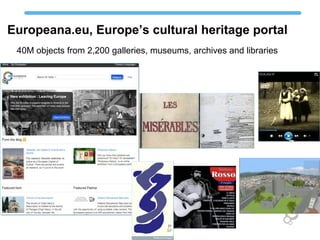
Europeana.eu, Europe’s cultural heritage portal
40M objects from 2,200 galleries, museums, archives and libraries
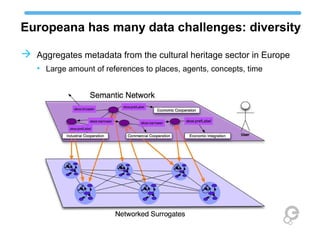
Europeana has many data challenges: diversity
 Aggregates metadata from the cultural heritage sector in Europe
• Large amount of references to places, agents, concepts, time
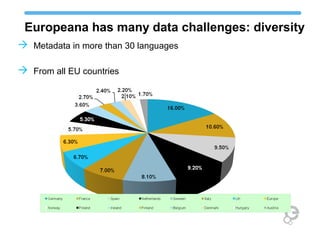
Europeana has many data challenges: diversity
 Metadata in more than 30 languages
 From all EU countries
Europeana’s priority 1: Improve data quality
 Europeana Data Model (EDM), a framework for richer data
• Re-uses several existing Semantic Web-based models
Dublin Core, OAI-ORE, SKOS, CIDOC-CRM…
• EDM gives support for contextual resources (semantic layer)
 Rely on vocabularies to solve a problem of data interlinking
• Encourage data providers to contribute their own vocabularies
and benefit from data links made at data providers’ level
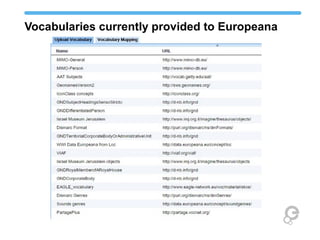
Vocabularies currently provided to Europeana
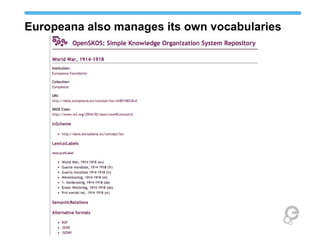
Europeana also manages its own vocabularies
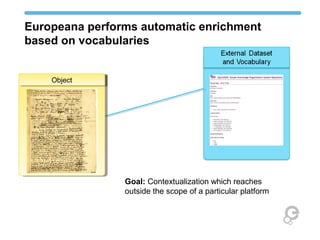
Europeana performs automatic enrichment
based on vocabularies
Goal: Contextualization which reaches
outside the scope of a particular platform
ObjectObject
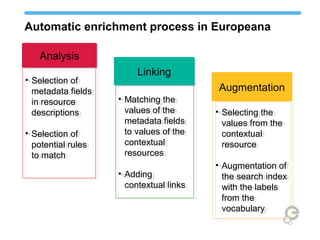
Automatic enrichment process in Europeana
• Selection of
metadata fields
in resource
descriptions
• Selection of
potential rules
to match
• Selection of
metadata fields
in resource
descriptions
• Selection of
potential rules
to match
AnalysisAnalysis
• Matching the
values of the
metadata fields
to values of the
contextual
resources
• Adding
contextual links
• Matching the
values of the
metadata fields
to values of the
contextual
resources
• Adding
contextual links
LinkingLinking
• Selecting the
values from the
contextual
resource
• Augmentation of
the search index
with the labels
from the
vocabulary
• Selecting the
values from the
contextual
resource
• Augmentation of
the search index
with the labels
from the
vocabulary
Augmentation
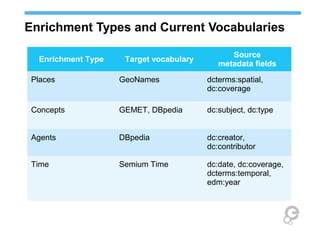
Enrichment Types and Current Vocabularies
Enrichment Type Target vocabulary
Source
metadata fields
Places GeoNames dcterms:spatial,
dc:coverage
Concepts GEMET, DBpedia dc:subject, dc:type
Agents DBpedia dc:creator,
dc:contributor
Time Semium Time dc:date, dc:coverage,
dcterms:temporal,
edm:year
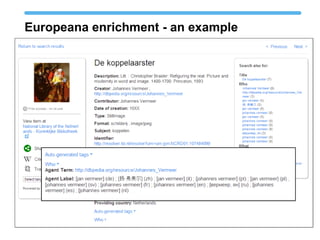
Europeana enrichment - an example
How Wikidata fits in Europeana’s
semantic strategy?
Wikipedia's Relevance for Cultural Heritage
 Authority Lists and Thesauri have central importance in CH
 Wikipedia being "the sum of all knowledge" has broader reach than
any institutional authority list
 Only large-scale aggregations like VIAF (35 institutions) and LCSH
(about 10 libraries around LoC) are comparable
 While some facts are inaccurate and disputable, Wikipedia has a
great role as a source of stable URLs on all kinds of topics
How Big is Wikidata?
 Name data sources for semantic enrichment (Europeana Creative
D2.4) gives DBpedia and Wikidata stats
 Wikidata: 3y old, 14M items, 209M edits
 2.7M humans, 5k families, 22k literary characters
 215k organizations
 66k creative orgs (bands, radio/TV stations, newspapers…)
 30k educational institutions
 20k non-profit orgs
 13k GLAM orgs: 0.5k galleries,1k libraries, 0.2k archives, 9k
museums
 500k creative works
 110k heritages sites and monuments
 40k family names, 20k first names
Is this big enough?
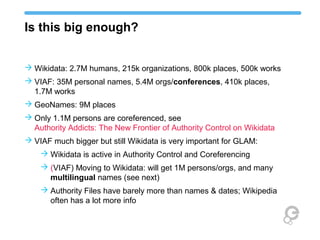
 Wikidata: 2.7M humans, 215k organizations, 800k places, 500k works
 VIAF: 35M personal names, 5.4M orgs/conferences, 410k places,
1.7M works
 GeoNames: 9M places
 Only 1.1M persons are coreferenced, see
Authority Addicts: The New Frontier of Authority Control on Wikidata
 VIAF much bigger but still Wikidata is very important for GLAM:
 Wikidata is active in Authority Control and Coreferencing
 (VIAF) Moving to Wikidata: will get 1M persons/orgs, and many
multilingual names (see next)
 Authority Files have barely more than names & dates; Wikipedia
often has a lot more info
Wikidata Multilingual Coverage
 Wikidata/DBpedia has huge multilingual coverage
 Each entity is represented in 2.11 Wikipedias on average (see
Europeana food and drink classification scheme, EFD D2.2)
 But popular entities are present in many more (up to 180); and
even in one Wikipedia there are many languages
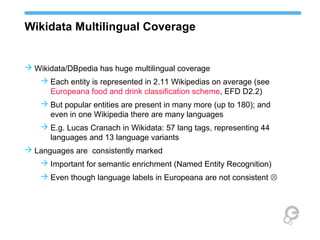
 E.g. Lucas Cranach in Wikidata: 57 lang tags, representing 44
languages and 13 language variants
 Languages are consistently marked
 Important for semantic enrichment (Named Entity Recognition)
 Even though language labels in Europeana are not consistent 
Name Variants for Lucas Cranach
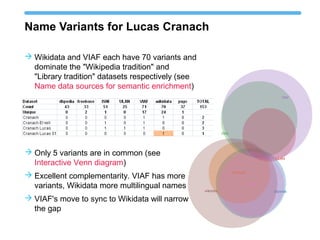
 Wikidata and VIAF each have 70 variants and
dominate the "Wikipedia tradition" and
"Library tradition" datasets respectively (see
Name data sources for semantic enrichment)
 Only 5 variants are in common (see
Interactive Venn diagram)
 Excellent complementarity. VIAF has more
variants, Wikidata more multilingual names
 VIAF's move to sync to Wikidata will narrow
the gap
Wikidata is connected to other vocabularies
 Europeana prefers using pivot vocabularies
• that are connected to many other vocabularies
• It is key to avoid duplication and redundancy
 Wikidata has lot of coreferences to other vocabularies that
can be used to create extra links, and extract missing data
• https://www.wikidata.org/wiki/Wikidata:WikiProject_Authority_control
• https://twitter.com/hashtag/coreferencing: shots and news
• Please tweet!
VIAF-Wikidata Coreferences for Lucas Cranach
 Can be leveraged to fill the gaps, e.g. bring RKDartists into VIAF
VIAF id in VIAF Wikidata id in Wikidata
viafID 49268177 VIAF 49268177
BAV ADV10197613
BNC .a10853637
BNE XX907273
BNF cb12176451h BNF 12176451h
DNB 118522582 GND 118522582
ISNI 0000000121319721 ISNI 0000 0001 2131 9721
JPG 500115364 ULAN 500115364
LC n50020861 LCCN n50020861
LNB LNC10-000002573
NDL 00436834
NKC jn20000700335
NLA 000035031951
NLI 000035532,001445575,001448179
NLP a16828161
NTA 068435312 NTA PPN 068435312
NUKAT vtls000190728
SELIBR 182422
SUDOC 028710010
WKP Lucas_Cranach_the_Elder Many Wikipedias
IMAGINE T7238,T267474 Cantic a10853637
Commons Creator Lucas Cranach (I)
Commons category Lucas Cranach d. Ä.
Freebase /m/0kqp0
RKDartists 18978
SIMBAD CRANACH, Lucas the Elder
Your Paintings lucas-the-elder-cranach​ ​ ​
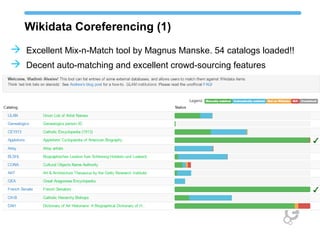
Wikidata Coreferencing (1)
 Excellent Mix-n-Match tool by Magnus Manske. 54 catalogs loaded!!
 Decent auto-matching and excellent crowd-sourcing features
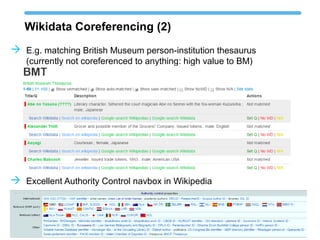
Wikidata Coreferencing (2)
 Excellent Authority Control navbox in Wikipedia
 E.g. matching British Museum person-institution thesaurus
(currently not coreferenced to anything: high value to BM)
Europeana Food and Drink
 How do you define such wide area as Food and Drink,
which is so pervasive in every day life and culture?
 Europeana food and drink classification scheme (EFD D2.2,
or presentation) studies ~20 datasets for relevance to FD
 Concludes that Wikipedia is our playing ground, and we
should try to use Wikipedia Categories to delineate the topic
• AGROVOC has 32k concepts but on production/science
• Wikipedia/DBpedia has 6.6k proper Foods (with infoboxes and
ingredients)
• But I estimate 0.6-1.2M things relevant to FD in all Wikipedias
 Background image: 2 levels of Food_and_drink cat hierarchy
Wikidata is Easily Accessible
 It is important for Europeana to have the data
• Technically available:
• Data dump preferably as Linked Data (RDF)
• SPARQL end-point or other query mechanism (e.g. WDQ)
• Properly documented and structured
• Wikidata has an excellent Property Proposal process
• Wikidata integrity constraints are excellent
• In contrast, no Class creation process, so the classes are quite a
mess (16k of which 2/3 have less than 5 instances)
• Data templates should be made more visible and be used as
references
• Open access
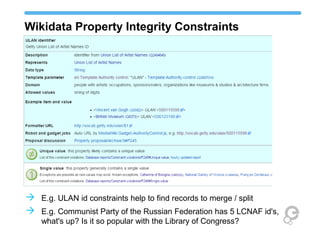
Wikidata Property Integrity Constraints
 E.g. ULAN id constraints help to find records to merge / split
 E.g. Communist Party of the Russian Federation has 5 LCNAF id's,
what's up? Is it so popular with the Library of Congress?
How Wikidata will be used by Europeana
 Semantic Enrichment of Europeana data with additional
information
• With a specific focus on entities such as persons and concepts
 Linking Europeana objects with Wikidata
• Approach similar to
https://www.wikidata.org/wiki/Wikidata:WikiProject_sum_of_all_pa
intings
• But would be extended to the whole Europeana dataset
• Links would be added in the Europeana data
 Structure (data template) for CH objects (e.g. paintings) still
not very rich on Wikidata, e.g. Measurements not there
• Improvements are made all the time, but see next
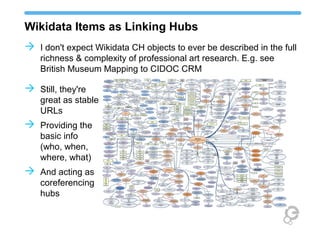
Wikidata Items as Linking Hubs
 Still, they're
great as stable
URLs
 Providing the
basic info
(who, when,
where, what)
 And acting as
coreferencing
hubs
 I don't expect Wikidata CH objects to ever be described in the full
richness & complexity of professional art research. E.g. see
British Museum Mapping to CIDOC CRM
Wikidata and DBpedia
 Wikidata and DBpedia are the two structured representations of
Wikipedia
 Wikidata: initially populated from Wikipedia, manually curated, will
master structured data for Wikipedia. Synchronized through an
assortment of bots
 Data is fairly accurate but data depth is still small
 DBpedia: automatically extracted from Wikipedia, live update, one-
way extraction only.
 Data reach is deep, but there are many problems in ontology and
individual mappings, especially for non-English. E.g. United
Nations is extracted as "Country". See DBpedia Ontology and
Mapping Problems.
Should they be together?
GLAMs should add to Wikipedia or Wikidata!
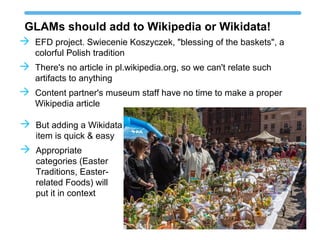
 EFD project. Swiecenie Koszyczek, "blessing of the baskets", a
colorful Polish tradition
 There's no article in pl.wikipedia.org, so we can't relate such
artifacts to anything
 Content partner's museum staff have no time to make a proper
Wikipedia article
 But adding a Wikidata
item is quick & easy
 Appropriate
categories (Easter
Traditions, Easter-
related Foods) will
put it in context
Thank you
Valentine Charles, valentine.charles@europeana.eu
Vladimir Alexiev, vladimir.alexiev@ontotext.com
Hugo Manguinhas, hugo.manguinhas@europeana.eu

Wikidata, a target for Europeana's semantic strategy - GLAM-WIKI 2015

  • 1.
    Wikidata, a targetfor Europeana’s semantic strategy Valentine Charles, Hugo Manguinhas, Antoine Isaac: Europeana Vladimir Alexiev: Ontotext Corp GLAM Wiki 2015, Den Haag
  • 2.
    Europeana.eu, Europe’s culturalheritage portal 40M objects from 2,200 galleries, museums, archives and libraries
  • 3.
    Europeana has manydata challenges: diversity  Aggregates metadata from the cultural heritage sector in Europe • Large amount of references to places, agents, concepts, time
  • 4.
    Europeana has manydata challenges: diversity  Metadata in more than 30 languages  From all EU countries
  • 5.
    Europeana’s priority 1:Improve data quality  Europeana Data Model (EDM), a framework for richer data • Re-uses several existing Semantic Web-based models Dublin Core, OAI-ORE, SKOS, CIDOC-CRM… • EDM gives support for contextual resources (semantic layer)  Rely on vocabularies to solve a problem of data interlinking • Encourage data providers to contribute their own vocabularies and benefit from data links made at data providers’ level
  • 6.
  • 7.
    Europeana also managesits own vocabularies
  • 8.
    Europeana performs automaticenrichment based on vocabularies Goal: Contextualization which reaches outside the scope of a particular platform ObjectObject
  • 9.
    Automatic enrichment processin Europeana • Selection of metadata fields in resource descriptions • Selection of potential rules to match • Selection of metadata fields in resource descriptions • Selection of potential rules to match AnalysisAnalysis • Matching the values of the metadata fields to values of the contextual resources • Adding contextual links • Matching the values of the metadata fields to values of the contextual resources • Adding contextual links LinkingLinking • Selecting the values from the contextual resource • Augmentation of the search index with the labels from the vocabulary • Selecting the values from the contextual resource • Augmentation of the search index with the labels from the vocabulary Augmentation
  • 10.
    Enrichment Types andCurrent Vocabularies Enrichment Type Target vocabulary Source metadata fields Places GeoNames dcterms:spatial, dc:coverage Concepts GEMET, DBpedia dc:subject, dc:type Agents DBpedia dc:creator, dc:contributor Time Semium Time dc:date, dc:coverage, dcterms:temporal, edm:year
  • 11.
  • 12.
    How Wikidata fitsin Europeana’s semantic strategy?
  • 13.
    Wikipedia's Relevance forCultural Heritage  Authority Lists and Thesauri have central importance in CH  Wikipedia being "the sum of all knowledge" has broader reach than any institutional authority list  Only large-scale aggregations like VIAF (35 institutions) and LCSH (about 10 libraries around LoC) are comparable  While some facts are inaccurate and disputable, Wikipedia has a great role as a source of stable URLs on all kinds of topics
  • 14.
    How Big isWikidata?  Name data sources for semantic enrichment (Europeana Creative D2.4) gives DBpedia and Wikidata stats  Wikidata: 3y old, 14M items, 209M edits  2.7M humans, 5k families, 22k literary characters  215k organizations  66k creative orgs (bands, radio/TV stations, newspapers…)  30k educational institutions  20k non-profit orgs  13k GLAM orgs: 0.5k galleries,1k libraries, 0.2k archives, 9k museums  500k creative works  110k heritages sites and monuments  40k family names, 20k first names
  • 15.
    Is this bigenough?  Wikidata: 2.7M humans, 215k organizations, 800k places, 500k works  VIAF: 35M personal names, 5.4M orgs/conferences, 410k places, 1.7M works  GeoNames: 9M places  Only 1.1M persons are coreferenced, see Authority Addicts: The New Frontier of Authority Control on Wikidata  VIAF much bigger but still Wikidata is very important for GLAM:  Wikidata is active in Authority Control and Coreferencing  (VIAF) Moving to Wikidata: will get 1M persons/orgs, and many multilingual names (see next)  Authority Files have barely more than names & dates; Wikipedia often has a lot more info
  • 16.
    Wikidata Multilingual Coverage Wikidata/DBpedia has huge multilingual coverage  Each entity is represented in 2.11 Wikipedias on average (see Europeana food and drink classification scheme, EFD D2.2)  But popular entities are present in many more (up to 180); and even in one Wikipedia there are many languages  E.g. Lucas Cranach in Wikidata: 57 lang tags, representing 44 languages and 13 language variants  Languages are consistently marked  Important for semantic enrichment (Named Entity Recognition)  Even though language labels in Europeana are not consistent 
  • 17.
    Name Variants forLucas Cranach  Wikidata and VIAF each have 70 variants and dominate the "Wikipedia tradition" and "Library tradition" datasets respectively (see Name data sources for semantic enrichment)  Only 5 variants are in common (see Interactive Venn diagram)  Excellent complementarity. VIAF has more variants, Wikidata more multilingual names  VIAF's move to sync to Wikidata will narrow the gap
  • 18.
    Wikidata is connectedto other vocabularies  Europeana prefers using pivot vocabularies • that are connected to many other vocabularies • It is key to avoid duplication and redundancy  Wikidata has lot of coreferences to other vocabularies that can be used to create extra links, and extract missing data • https://www.wikidata.org/wiki/Wikidata:WikiProject_Authority_control • https://twitter.com/hashtag/coreferencing: shots and news • Please tweet!
  • 19.
    VIAF-Wikidata Coreferences forLucas Cranach  Can be leveraged to fill the gaps, e.g. bring RKDartists into VIAF VIAF id in VIAF Wikidata id in Wikidata viafID 49268177 VIAF 49268177 BAV ADV10197613 BNC .a10853637 BNE XX907273 BNF cb12176451h BNF 12176451h DNB 118522582 GND 118522582 ISNI 0000000121319721 ISNI 0000 0001 2131 9721 JPG 500115364 ULAN 500115364 LC n50020861 LCCN n50020861 LNB LNC10-000002573 NDL 00436834 NKC jn20000700335 NLA 000035031951 NLI 000035532,001445575,001448179 NLP a16828161 NTA 068435312 NTA PPN 068435312 NUKAT vtls000190728 SELIBR 182422 SUDOC 028710010 WKP Lucas_Cranach_the_Elder Many Wikipedias IMAGINE T7238,T267474 Cantic a10853637 Commons Creator Lucas Cranach (I) Commons category Lucas Cranach d. Ä. Freebase /m/0kqp0 RKDartists 18978 SIMBAD CRANACH, Lucas the Elder Your Paintings lucas-the-elder-cranach​ ​ ​
  • 20.
    Wikidata Coreferencing (1) Excellent Mix-n-Match tool by Magnus Manske. 54 catalogs loaded!!  Decent auto-matching and excellent crowd-sourcing features
  • 21.
    Wikidata Coreferencing (2) Excellent Authority Control navbox in Wikipedia  E.g. matching British Museum person-institution thesaurus (currently not coreferenced to anything: high value to BM)
  • 22.
    Europeana Food andDrink  How do you define such wide area as Food and Drink, which is so pervasive in every day life and culture?  Europeana food and drink classification scheme (EFD D2.2, or presentation) studies ~20 datasets for relevance to FD  Concludes that Wikipedia is our playing ground, and we should try to use Wikipedia Categories to delineate the topic • AGROVOC has 32k concepts but on production/science • Wikipedia/DBpedia has 6.6k proper Foods (with infoboxes and ingredients) • But I estimate 0.6-1.2M things relevant to FD in all Wikipedias  Background image: 2 levels of Food_and_drink cat hierarchy
  • 23.
    Wikidata is EasilyAccessible  It is important for Europeana to have the data • Technically available: • Data dump preferably as Linked Data (RDF) • SPARQL end-point or other query mechanism (e.g. WDQ) • Properly documented and structured • Wikidata has an excellent Property Proposal process • Wikidata integrity constraints are excellent • In contrast, no Class creation process, so the classes are quite a mess (16k of which 2/3 have less than 5 instances) • Data templates should be made more visible and be used as references • Open access
  • 24.
    Wikidata Property IntegrityConstraints  E.g. ULAN id constraints help to find records to merge / split  E.g. Communist Party of the Russian Federation has 5 LCNAF id's, what's up? Is it so popular with the Library of Congress?
  • 25.
    How Wikidata willbe used by Europeana  Semantic Enrichment of Europeana data with additional information • With a specific focus on entities such as persons and concepts  Linking Europeana objects with Wikidata • Approach similar to https://www.wikidata.org/wiki/Wikidata:WikiProject_sum_of_all_pa intings • But would be extended to the whole Europeana dataset • Links would be added in the Europeana data  Structure (data template) for CH objects (e.g. paintings) still not very rich on Wikidata, e.g. Measurements not there • Improvements are made all the time, but see next
  • 26.
    Wikidata Items asLinking Hubs  Still, they're great as stable URLs  Providing the basic info (who, when, where, what)  And acting as coreferencing hubs  I don't expect Wikidata CH objects to ever be described in the full richness & complexity of professional art research. E.g. see British Museum Mapping to CIDOC CRM
  • 27.
    Wikidata and DBpedia Wikidata and DBpedia are the two structured representations of Wikipedia  Wikidata: initially populated from Wikipedia, manually curated, will master structured data for Wikipedia. Synchronized through an assortment of bots  Data is fairly accurate but data depth is still small  DBpedia: automatically extracted from Wikipedia, live update, one- way extraction only.  Data reach is deep, but there are many problems in ontology and individual mappings, especially for non-English. E.g. United Nations is extracted as "Country". See DBpedia Ontology and Mapping Problems. Should they be together?
  • 28.
    GLAMs should addto Wikipedia or Wikidata!  EFD project. Swiecenie Koszyczek, "blessing of the baskets", a colorful Polish tradition  There's no article in pl.wikipedia.org, so we can't relate such artifacts to anything  Content partner's museum staff have no time to make a proper Wikipedia article  But adding a Wikidata item is quick & easy  Appropriate categories (Easter Traditions, Easter- related Foods) will put it in context
  • 29.
    Thank you Valentine Charles,valentine.charles@europeana.eu Vladimir Alexiev, vladimir.alexiev@ontotext.com Hugo Manguinhas, hugo.manguinhas@europeana.eu

Editor's Notes

  • #7 Take advantages of these rich data to improve other types of services such as auto-completion Two categories: Global Produced by projects See list on the wiki
  • #9 In the linked environment, enrichment often refers to adding new information at the semantic level to the data about certain resources. It is the creation of new links between the enriched resources and another data resource, such as controlled vocabularies and authority files. The goal is contextualization of metadata and embedding the resources in context outside the scope of the platform