Defining collections and 
creating their descriptions 
Valentine Charles 
A bridge across Europe: linking collections at international 
level, Birmingham, October 2014
What does The European Library 
consider as a collection? 
• The collection has items that have been 
gathered together in the past or will be 
gathered together in the future. 
• Membership in a collection is determined by 
some criteria of the collector. 
• The collection may be treated as an individual 
object in itself
Digitisation still in progress… 
 According to the 
ENUMERATE survey 10- 
12% of content is digitised 
 Only 10% of the 132 million 
objects held at the Library of 
Congress digitised 
 http://www.nytimes.com/200 
7/03/10/business/yourmoney 
/11archive.html? 
pagewanted=all&_r=1&
Information access in new 
digital services 
 Rich information and interesting items are 
digitally available but 
• are located in different services 
• have been developed by many projects and 
for different purposes 
 Lack of contextual information: poor titles, 
lack of other metadata. 
 The information is still not connected
Challenges for users 
 Researchers want to search in large 
corpora and find special items. 
 But 
• Collections relevant for researchers are not 
always available in a digital form 
• Many collections are not known to research 
communities
Collection descriptions for 
resource access and discovery 
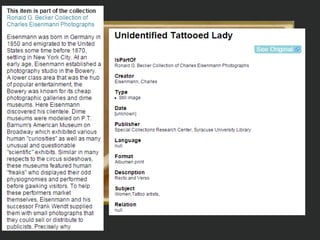
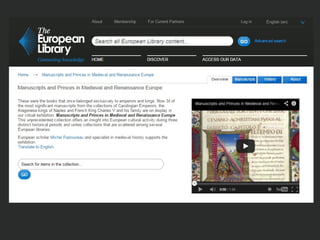
 Visibility for non-digitised or even un-catalogued 
collections 
• Special collections
 Provide context for item-level 
resources
 Create curated corpora based on 
specific topics
 Use logical and curated information 
for improving search (relevance)
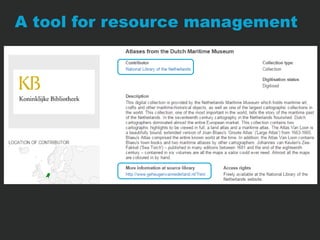
A tool for resource management 
 Representation of provenance 
information
 Better expression of relations 
between item-level and collection 
resources
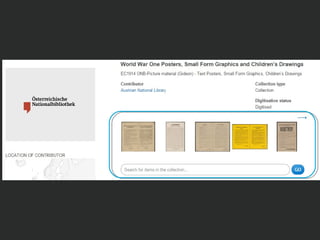
 Management of new type of 
resources in digital environment: 
datasets, virtual exhibitions, users 
generated collections… 
• Creation of metadata records for collections of 
items uncatalogued so far.
 Management of the collections 
themselves: 
• acquisition periodicity 
• growth 
• subjects gaps 
• access Rights
Do you have such collections? 
Do you have structured descriptions for 
them? 
Would you like to share them?
Thank you 
 www.theeuropeanlibrary.org/ 
 www.theeuropeanlibrary.org/tel4/access 
Valentine Charles 
valentine.charles@kb.nl

Defining collections and creating their descriptions

  • 1.
    Defining collections and creating their descriptions Valentine Charles A bridge across Europe: linking collections at international level, Birmingham, October 2014
  • 2.
    What does TheEuropean Library consider as a collection? • The collection has items that have been gathered together in the past or will be gathered together in the future. • Membership in a collection is determined by some criteria of the collector. • The collection may be treated as an individual object in itself
  • 4.
    Digitisation still inprogress…  According to the ENUMERATE survey 10- 12% of content is digitised  Only 10% of the 132 million objects held at the Library of Congress digitised  http://www.nytimes.com/200 7/03/10/business/yourmoney /11archive.html? pagewanted=all&_r=1&
  • 5.
    Information access innew digital services  Rich information and interesting items are digitally available but • are located in different services • have been developed by many projects and for different purposes  Lack of contextual information: poor titles, lack of other metadata.  The information is still not connected
  • 6.
    Challenges for users  Researchers want to search in large corpora and find special items.  But • Collections relevant for researchers are not always available in a digital form • Many collections are not known to research communities
  • 7.
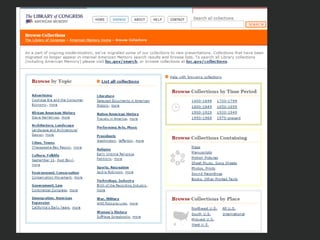
    Collection descriptions for resource access and discovery  Visibility for non-digitised or even un-catalogued collections • Special collections
  • 8.
     Provide contextfor item-level resources
  • 9.
     Create curatedcorpora based on specific topics
  • 10.
     Use logicaland curated information for improving search (relevance)
  • 11.
    A tool forresource management  Representation of provenance information
  • 12.
     Better expressionof relations between item-level and collection resources
  • 13.
     Management ofnew type of resources in digital environment: datasets, virtual exhibitions, users generated collections… • Creation of metadata records for collections of items uncatalogued so far.
  • 14.
     Management ofthe collections themselves: • acquisition periodicity • growth • subjects gaps • access Rights
  • 15.
    Do you havesuch collections? Do you have structured descriptions for them? Would you like to share them?
  • 16.
    Thank you www.theeuropeanlibrary.org/  www.theeuropeanlibrary.org/tel4/access Valentine Charles valentine.charles@kb.nl

Editor's Notes

  • #5 Move examples earlier in the presentation
  • #7 Link exists between materials but are not represented doing this through collection descriptions/
  • #13 Add management of the collections themselves: acquisition periodicity, growth, types of subjects to measures gaps, Rights
  • #15 Add examples for each bullets )CRM..) Add management of the collections themselves: acquisition periodicity, growth, types of subjects to measures gaps, Rights