Regional policy implementation practice  and perspectives  Riga, 2 nd  December 2011  Piotr Żuber Director of the Department of Structural Policy Coordination Ministry of Regional Development
Period from 1989 to 1999:   – Lack of policy or very soft activities limited to coordination and monitoring of sectoral instruments,  – A few  pilot  programmes financed by the EU-Phare and national sources,  – Territorially different instrument s  of sectoral polic i es [labour policy, transport policy, restructuring of traditional industries] Period from 1999 to 2004:   –   Legislative basics of regional policy [Law on Regional Development, Self government Act], –   First programming documents on national and regional level , –   More pilot programmes financed by the national sources and the Wor l d Bank [for example for  Silesia, rural areas], –   More EU funds for regional development, entrepreneurship, rural areas [SAPARD] and infrastructure  [ISPA] development Current period from the accession to the EU in 2004:   –   Increase d  role of regional Policy  =  EU cohesion policy –   More complex  approach [ regulations on development policy] , –   Development of a set of strategic programming documents [National Development Plan, N SRF , National Development Strategy, new model strategies in different fields], –   Multi-level and inter-sectoral mechanisms of coordination, –   Decentralization of the EU fund management [since 2007] . Phases of regional policy in Poland
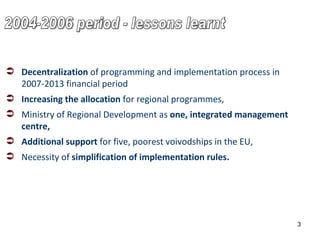
D ecentralization  of programming and implementation process in 2007-2013 financial period Increasing the allocation  for regional programmes,  Ministry of Regional Development as  one, integrated management centre, Additional support  for five, poorest voivodships in the EU, Necessity of  simplification of implement a tion rules . 2004-2006 period - lessons learnt
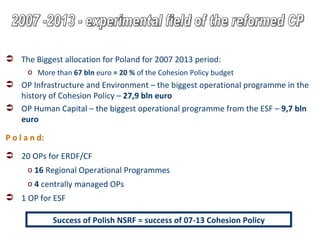
The Biggest allocation for Poland for 2007 2013 period: More than  67 bln  euro  =   20 %  of the Cohesion Policy budget OP Infrastructure and Environment – the biggest operational programme in the history of Cohesion Policy –  27,9 bln euro OP Human Capital – the biggest operational programme from the ESF –  9,7 bln euro P o l a n d: 20 OPs for ERDF/CF 16  Regional Operational Programmes 4  centrally managed OPs 1 OP for ESF Success of Polish NSRF = success of 07-13 Cohesion Policy 2007 -2013 - experimental field of the reformed CP
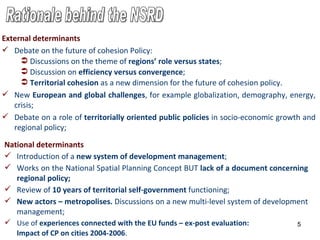
National determinants Introduction of a  new system of development management ;   Works  on the National Spatial Planning Concept  BUT  l ack of a document concerning regional policy ;   Review of  10 years   of territorial self-government  functioning ; New actors – metropolises .  D iscu s sions on a new multi-level system of development management ;   U se of  experiences connected with the EU funds  – ex-post evaluation:  Impact of CP on cities 2004-2006 . Rationale behind the NSRD External determinants Debate on the future of cohesion Policy: Discussions on the theme of  regions’ role versus states ; Discussion on  efficiency versus convergence ; Territorial cohesion  as a new dimension for the future of cohesion  p olicy . New  European and global challenges , for example globalization, demography, energy, crisis ; Debate on a role of  territorially  oriented  public polic i es  in socio-economic growth and regional policy ;
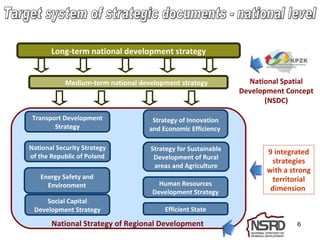
National Spatial Development Concept (NSDC) 9 integrated strategies with a strong territorial dimension   Target system of strategic documents - national level National Strategy of Regional Development  Strategy for Sustainable Development of Rural areas and Agriculture National Security Strategy of the Republic of Poland Efficient State Energy Safety and Environment Transport Development Strategy Human Resources Development Strategy Strategy of Innovation and Economic Efficiency  Social Capital Development Strategy Medium-term national development strategy Long-term national development strategy
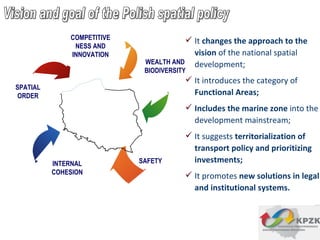
COMPETITIVENESS AND INNOVATI ON SAFETY   SPATIAL ORDER WEALTH AND BIODIVERSITY INTERNAL COHESION It  changes the approach to the vision  of the national spatial development ; It introduces the category of  Functional Areas ; Includes the marine zone  into the development mainstream ;   It suggests   territorialization of  transport  policy   and  prioritizing investments ; It promotes  new solutions in legal and institutional systems .  Vision and goal of the Polish spatial policy
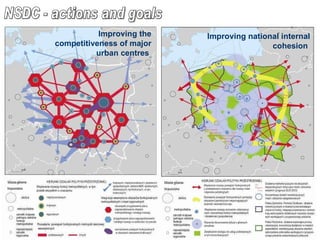
Improving the competitiveness of major  u rban centres  Improving national internal cohesion  NSDC - actions and goals
National Strategy of Regional Development Regional policy perceived broader than before  – as a public intervention  aimed to achieve development goals, through territorialy oriented measures, where regional level is a main level of planning and implementation ;   Regional policy is an  integrated element of development policy  contributing to achieving national objectives through involving territorial resources . As a consequence: Defines  objectives and strategy of activities  of public entities  in reference to  territories , to achieve strategic development objectives on national level ; Reforms the way of planning and implementing the regional policy , including public policies with territorial influence [managing these policies, cooperation, coordination, monitoring and evaluation] ; Includes the proposals of a  new role of voivodship self-government and other public entities  in the implementation of regional policy ; NEW QUALITY
Each region is different, but each has endogenous development potential, therefore… Regional policy is  not only policy for poor areas  – it does not forget about them but  first of all it is policy for all Polish regions and territories  supporting in the best possible way in using their development potential and where is a necessity providing external resources ; Regional policy is  effective  –  in order to deliver,  it supports necessary institutional, legal and financial changes . Regional policy has  integrated character : allows  regional  integration of different public policies on national and regional level   [national meets regional] forces the coordination of national policies, makes them territory conscious and territory oriented  [national meets national in territorial context]; PARADIGM SHIFT National Strategy of Regional Development
Objectives of NSRD reflect the main areas of intervention of the strategy until 2020 They create the „ triad”: competitiveness – cohesion – efficiency NSRD 2010-2020 Regional policy objectives Objective 1 Objective  2 Objective  3 Competitiveness Cohesion Efficiency Strategic Objective
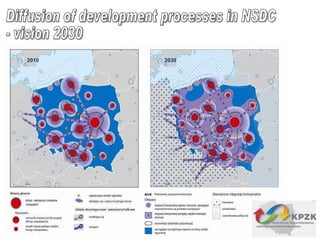
Supporting growth of competitiveness of regions The objective covers the whole area of Poland. Focus on: making use of development  potentials of growth poles  [ voivodships centers ]; creating conditions for supporting the diffusion and  absorption  mechanisms on European, national and regional level. NSRD 2010-2020 -  Objective 1 Fostering the metropolitan functions   of the voivodship capitals and integration of their functional areas; Creating conditions for diffusion of development processes from voivodship capitals and their absorption in non-voivodship cities    [ transport accessibility, creating conditions for investments in sub-regional cities and rural areas and stimulating the urbanization process ]; Creating basis for competitiveness of voivodships   – thematic measures [horizontal]. Directions of measures
diffusion Concentration and diffusion – the way we see it NSRD 2010-2020 -  Objective 1
Diffusion of development processes in NSDC  - vision 2030 2010 2030
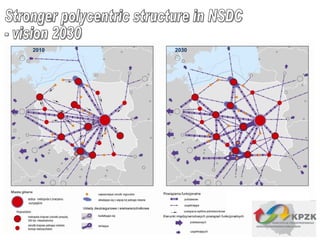
Stronger polycentric structure in NSDC - vision 2030 2010 2030
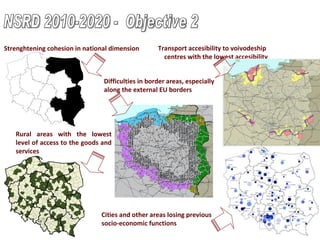
Objective  only   covers  selected areas,  which are  endangered with   exclusion ; Areas too distant from main urban centres  or  the scale of problem is too big  for diffusion; These areas are so called  problematic areas ; Five directions of measures: Strengthening cohesion in  national  dimension ;   Support to  rural areas with the lowest level of inhabitants access to the goods and services   following from the development possibilities ; Restructurisation and revitalisation of  cities and other areas losing their previously fulfilled socio-economic functions ; Overcoming the difficulties related to the situation of the  border areas, especially along the external EU borders ; Increasing transport accessibility to  voivodship centers situated within  the areas with the lowest accessibility . Establishment of territorial cohesion and preventing marginalization  of problem areas NSRD 2010-2020 -  Objective 2
Average GDP  per capita  in NUTS II and NUTS III in 2004-2007  towards national average NSRD 2010-2020 -  Objective 2
NSRD 2010-2020 -  Objective 2 Rural areas with the lowest level of access to the goods and services Cities and other areas losing previous  socio-economic functions Difficulties in border areas, especially along the external EU borders Transport accesibility to voivodeship  centres with the lowest accesibility Strenghtening cohesion in national dimension
Functional Urban Areas  Integrated Costal Zone Management   Functional Rural Areas  Functional Maritime Area   Functional Catchments  Areas  Functional Mountains Area  Functional areas in NSDC
Reconstruction and reinforcement of coordination in the multi-level governance system New type of contractual instrument  [ territorial contract ]. Directions of measures Strengthening the strategic dimension of regional policy National Territorial Forum  [ instrument of strategic discussion ] + 16 regional forums; Horizontal  - c overs all institutions in the implementation of spatially oriented, public policies; Increasing the role of voivodships –   main decision and coordination centres on regional level; More EFFECT oriented approach. Establishment of conditions for efficient, effective and partnership implementation of development measures targeted at territories Improving the quality of managing public policies, including proper territorial  orientation Including regional policy in the national system of strategic development; Connection of planning  and implementation  system s   within various sectoral policies; Support to the construction of social capital for the regional development on the basis of network of cooperation between various actors of regional policy Strenghtening and creating new partnership mechanisms, strenghtening the visibility and accountability of public enitities’ work NSRD 2010-2020 -  Objective 3
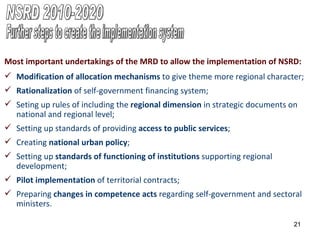
Most important undertakings of the MRD to allow the implementation of NSRD: Modification of allocation mechanisms  to give theme more regional character;  Rationalization  of self-government financing system; Seting up rules of including the  regional dimension  in strategic documents on national and regional level; Setting up standards of providing  access to public services ; Creating  national urban policy ; Setting up  standards of functioning of institutions  supporting regional development; Pilot implementation  of territorial contracts; Preparing  changes in competence acts  regarding self-government and sectoral ministers. Further steps to create the implementation system NSRD 2010-2020
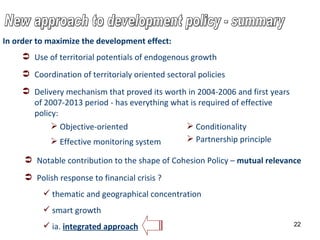
Use of territorial potentials of endogenous growth Coordination of territorialy oriented sectoral policies Delivery mechanism that proved its worth in 2004-2006 and first years of 2007-2013 period - has everything what is required of effective policy: Effective monitoring system Conditionality Partnership principle Notable contribution to the shape of Cohesion Policy –  mutual relevance Polish response to financial crisis ? thematic and geographical concentration smart growth  ia.  integrated approach Objective-oriented In order to maximize the development effect: New approach to development policy - summary
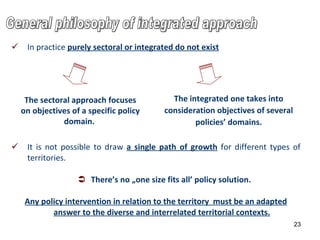
In p ractice   purely sectoral or integrated do not exist   It is not possible to draw  a single path of growth  for different types of territories.   There ’s  no „one size fits all’ policy solution.  Any policy intervention in relation to the territory  must be an adapted answer to the diverse and interrelated territorial contexts.   05/12/11 The sectoral approach focuses on objectives of a specific policy domain.  The integrated one takes into consideration objectives of several policies’ domains. General philosophy of integrated approach
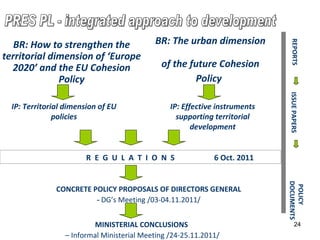
R  E  G  U  L  A  T  I  O  N  S  6 Oct. 2011   REPORTS ISSUE PAPERS POLICY DOCUMENTS MINISTERIAL  CONCLUSIONS   –   Informal Ministerial Meeting  /24- 25 .11.2011/ IP:  Territorial dimension of EU  policies IP:  Effective  i nstruments supporting territorial development CONCRETE POLICY PROPOSALS OF DIRECTORS GENERAL -  DG’s Meeting   /03-0 4 .11.2011/ BR:  How to strengthen   the territorial dimension   of ‘Europe 2020’ and  the  EU Cohesion Policy BR:  The urban dimension   of the   future Cohesion Policy   PRES PL - integrated approach to development
Ministry of Regional Development [email_address] Thank you for your attention

5 zuber mb_120ex_3_slaidi_uz_lapas

  • 1.
    Regional policy implementationpractice and perspectives Riga, 2 nd December 2011 Piotr Żuber Director of the Department of Structural Policy Coordination Ministry of Regional Development
  • 2.
    Period from 1989to 1999: – Lack of policy or very soft activities limited to coordination and monitoring of sectoral instruments, – A few pilot programmes financed by the EU-Phare and national sources, – Territorially different instrument s of sectoral polic i es [labour policy, transport policy, restructuring of traditional industries] Period from 1999 to 2004: – Legislative basics of regional policy [Law on Regional Development, Self government Act], – First programming documents on national and regional level , – More pilot programmes financed by the national sources and the Wor l d Bank [for example for Silesia, rural areas], – More EU funds for regional development, entrepreneurship, rural areas [SAPARD] and infrastructure [ISPA] development Current period from the accession to the EU in 2004: – Increase d role of regional Policy = EU cohesion policy – More complex approach [ regulations on development policy] , – Development of a set of strategic programming documents [National Development Plan, N SRF , National Development Strategy, new model strategies in different fields], – Multi-level and inter-sectoral mechanisms of coordination, – Decentralization of the EU fund management [since 2007] . Phases of regional policy in Poland
  • 3.
    D ecentralization of programming and implementation process in 2007-2013 financial period Increasing the allocation for regional programmes, Ministry of Regional Development as one, integrated management centre, Additional support for five, poorest voivodships in the EU, Necessity of simplification of implement a tion rules . 2004-2006 period - lessons learnt
  • 4.
    The Biggest allocationfor Poland for 2007 2013 period: More than 67 bln euro = 20 % of the Cohesion Policy budget OP Infrastructure and Environment – the biggest operational programme in the history of Cohesion Policy – 27,9 bln euro OP Human Capital – the biggest operational programme from the ESF – 9,7 bln euro P o l a n d: 20 OPs for ERDF/CF 16 Regional Operational Programmes 4 centrally managed OPs 1 OP for ESF Success of Polish NSRF = success of 07-13 Cohesion Policy 2007 -2013 - experimental field of the reformed CP
  • 5.
    National determinants Introductionof a new system of development management ; Works on the National Spatial Planning Concept BUT l ack of a document concerning regional policy ; Review of 10 years of territorial self-government functioning ; New actors – metropolises . D iscu s sions on a new multi-level system of development management ; U se of experiences connected with the EU funds – ex-post evaluation: Impact of CP on cities 2004-2006 . Rationale behind the NSRD External determinants Debate on the future of cohesion Policy: Discussions on the theme of regions’ role versus states ; Discussion on efficiency versus convergence ; Territorial cohesion as a new dimension for the future of cohesion p olicy . New European and global challenges , for example globalization, demography, energy, crisis ; Debate on a role of territorially oriented public polic i es in socio-economic growth and regional policy ;
  • 6.
    National Spatial DevelopmentConcept (NSDC) 9 integrated strategies with a strong territorial dimension Target system of strategic documents - national level National Strategy of Regional Development Strategy for Sustainable Development of Rural areas and Agriculture National Security Strategy of the Republic of Poland Efficient State Energy Safety and Environment Transport Development Strategy Human Resources Development Strategy Strategy of Innovation and Economic Efficiency Social Capital Development Strategy Medium-term national development strategy Long-term national development strategy
  • 7.
    COMPETITIVENESS AND INNOVATION SAFETY SPATIAL ORDER WEALTH AND BIODIVERSITY INTERNAL COHESION It changes the approach to the vision of the national spatial development ; It introduces the category of Functional Areas ; Includes the marine zone into the development mainstream ; It suggests territorialization of transport policy and prioritizing investments ; It promotes new solutions in legal and institutional systems . Vision and goal of the Polish spatial policy
  • 8.
    Improving the competitivenessof major u rban centres Improving national internal cohesion NSDC - actions and goals
  • 9.
    National Strategy ofRegional Development Regional policy perceived broader than before – as a public intervention aimed to achieve development goals, through territorialy oriented measures, where regional level is a main level of planning and implementation ; Regional policy is an integrated element of development policy contributing to achieving national objectives through involving territorial resources . As a consequence: Defines objectives and strategy of activities of public entities in reference to territories , to achieve strategic development objectives on national level ; Reforms the way of planning and implementing the regional policy , including public policies with territorial influence [managing these policies, cooperation, coordination, monitoring and evaluation] ; Includes the proposals of a new role of voivodship self-government and other public entities in the implementation of regional policy ; NEW QUALITY
  • 10.
    Each region isdifferent, but each has endogenous development potential, therefore… Regional policy is not only policy for poor areas – it does not forget about them but first of all it is policy for all Polish regions and territories supporting in the best possible way in using their development potential and where is a necessity providing external resources ; Regional policy is effective – in order to deliver, it supports necessary institutional, legal and financial changes . Regional policy has integrated character : allows regional integration of different public policies on national and regional level [national meets regional] forces the coordination of national policies, makes them territory conscious and territory oriented [national meets national in territorial context]; PARADIGM SHIFT National Strategy of Regional Development
  • 11.
    Objectives of NSRDreflect the main areas of intervention of the strategy until 2020 They create the „ triad”: competitiveness – cohesion – efficiency NSRD 2010-2020 Regional policy objectives Objective 1 Objective 2 Objective 3 Competitiveness Cohesion Efficiency Strategic Objective
  • 12.
    Supporting growth ofcompetitiveness of regions The objective covers the whole area of Poland. Focus on: making use of development potentials of growth poles [ voivodships centers ]; creating conditions for supporting the diffusion and absorption mechanisms on European, national and regional level. NSRD 2010-2020 - Objective 1 Fostering the metropolitan functions of the voivodship capitals and integration of their functional areas; Creating conditions for diffusion of development processes from voivodship capitals and their absorption in non-voivodship cities [ transport accessibility, creating conditions for investments in sub-regional cities and rural areas and stimulating the urbanization process ]; Creating basis for competitiveness of voivodships – thematic measures [horizontal]. Directions of measures
  • 13.
    diffusion Concentration anddiffusion – the way we see it NSRD 2010-2020 - Objective 1
  • 14.
    Diffusion of developmentprocesses in NSDC - vision 2030 2010 2030
  • 15.
    Stronger polycentric structurein NSDC - vision 2030 2010 2030
  • 16.
    Objective only covers selected areas, which are endangered with exclusion ; Areas too distant from main urban centres or the scale of problem is too big for diffusion; These areas are so called problematic areas ; Five directions of measures: Strengthening cohesion in national dimension ; Support to rural areas with the lowest level of inhabitants access to the goods and services following from the development possibilities ; Restructurisation and revitalisation of cities and other areas losing their previously fulfilled socio-economic functions ; Overcoming the difficulties related to the situation of the border areas, especially along the external EU borders ; Increasing transport accessibility to voivodship centers situated within the areas with the lowest accessibility . Establishment of territorial cohesion and preventing marginalization of problem areas NSRD 2010-2020 - Objective 2
  • 17.
    Average GDP per capita in NUTS II and NUTS III in 2004-2007 towards national average NSRD 2010-2020 - Objective 2
  • 18.
    NSRD 2010-2020 - Objective 2 Rural areas with the lowest level of access to the goods and services Cities and other areas losing previous socio-economic functions Difficulties in border areas, especially along the external EU borders Transport accesibility to voivodeship centres with the lowest accesibility Strenghtening cohesion in national dimension
  • 19.
    Functional Urban Areas Integrated Costal Zone Management Functional Rural Areas Functional Maritime Area Functional Catchments Areas Functional Mountains Area Functional areas in NSDC
  • 20.
    Reconstruction and reinforcementof coordination in the multi-level governance system New type of contractual instrument [ territorial contract ]. Directions of measures Strengthening the strategic dimension of regional policy National Territorial Forum [ instrument of strategic discussion ] + 16 regional forums; Horizontal - c overs all institutions in the implementation of spatially oriented, public policies; Increasing the role of voivodships – main decision and coordination centres on regional level; More EFFECT oriented approach. Establishment of conditions for efficient, effective and partnership implementation of development measures targeted at territories Improving the quality of managing public policies, including proper territorial orientation Including regional policy in the national system of strategic development; Connection of planning and implementation system s within various sectoral policies; Support to the construction of social capital for the regional development on the basis of network of cooperation between various actors of regional policy Strenghtening and creating new partnership mechanisms, strenghtening the visibility and accountability of public enitities’ work NSRD 2010-2020 - Objective 3
  • 21.
    Most important undertakingsof the MRD to allow the implementation of NSRD: Modification of allocation mechanisms to give theme more regional character; Rationalization of self-government financing system; Seting up rules of including the regional dimension in strategic documents on national and regional level; Setting up standards of providing access to public services ; Creating national urban policy ; Setting up standards of functioning of institutions supporting regional development; Pilot implementation of territorial contracts; Preparing changes in competence acts regarding self-government and sectoral ministers. Further steps to create the implementation system NSRD 2010-2020
  • 22.
    Use of territorialpotentials of endogenous growth Coordination of territorialy oriented sectoral policies Delivery mechanism that proved its worth in 2004-2006 and first years of 2007-2013 period - has everything what is required of effective policy: Effective monitoring system Conditionality Partnership principle Notable contribution to the shape of Cohesion Policy – mutual relevance Polish response to financial crisis ? thematic and geographical concentration smart growth ia. integrated approach Objective-oriented In order to maximize the development effect: New approach to development policy - summary
  • 23.
    In p ractice purely sectoral or integrated do not exist It is not possible to draw a single path of growth for different types of territories. There ’s no „one size fits all’ policy solution. Any policy intervention in relation to the territory must be an adapted answer to the diverse and interrelated territorial contexts. 05/12/11 The sectoral approach focuses on objectives of a specific policy domain. The integrated one takes into consideration objectives of several policies’ domains. General philosophy of integrated approach
  • 24.
    R E G U L A T I O N S 6 Oct. 2011 REPORTS ISSUE PAPERS POLICY DOCUMENTS MINISTERIAL CONCLUSIONS – Informal Ministerial Meeting /24- 25 .11.2011/ IP: Territorial dimension of EU policies IP: Effective i nstruments supporting territorial development CONCRETE POLICY PROPOSALS OF DIRECTORS GENERAL - DG’s Meeting /03-0 4 .11.2011/ BR: How to strengthen the territorial dimension of ‘Europe 2020’ and the EU Cohesion Policy BR: The urban dimension of the future Cohesion Policy PRES PL - integrated approach to development
  • 25.
    Ministry of RegionalDevelopment [email_address] Thank you for your attention

Editor's Notes

  • #25 BRs serve as a basis for the Issue Paper and than the formulation of the ministerial conclusions to be disscussed by Directors General There might not be any final conclusion on many of them, but they should provide the basis for all relevant players to choose an option most appropriate for the territory and the issue at stake. T he regulations for the next programming period are conductive , some of the discussed policy options require specific legislative provisions , for remov e of the barriers for flexible and truly integrated programming. The results of these discussion will be translated into concrete proposals that will be raised for discussion among EU policy-makers responsible for regional policy, territorial cohesion and urban development (the Directors General meeting – 3-4 November 2011 and the informal meeting of Ministers – 24-25 November 2011). The final outputs of these discussions will be included .