Territorial Co-operation in the European Union  Future of the Cohesion Policy 1 March 2011, Bellevue Programme Seminar, Brussels
What do we need territorial co-operation in the EU for? What do we spend the money on? ETC – 3 strands ENPI Macro regions EGTC Beyond 2013... What kind of future? Presentation plan
Territorial co-operation is part of the regional policy  Among the 271 EU regions exist huge disparities– this weakens the EU’s dynamism  Hence the political goal of  reducing the gaps in development  It is in the Treaty on European Union: “ to promote economic and social cohesion by reducing disparities between the regions”
Why do we bother? that   would wreck two of the policies on which Europe’s growth has been based: the single market and the European Monetary Union (EMU)
For this reason the cohesion policy:  supports activities which decrease the negative impacts of borders  enhances cooperation and integration among partners who share a “common space”. encourages regions and cities from different EU Member  States to work together and learn from each other through joint programmes, projects and networks.  Cohesion Policy and this is what we call territorial co-operation
The territorial co-operation is the best  travel agency  in the EU In the opinion of some experts: European Territorial Co-operation
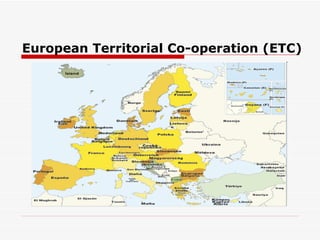
European Territorial Co-operation (ETC)
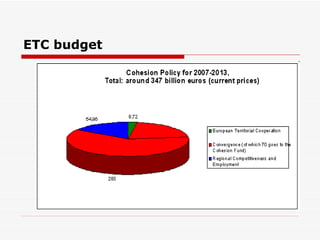
In the period 2007-2013,  cohesion policy  benefits from  35.7% of the total EU budget  i.e.  347.41 billion euros   It is the biggest slice of the EU budget.  It is supposed to unlock up to €700bn
ETC budget
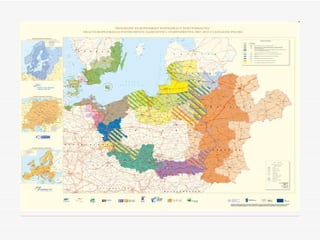
How is it organised ? For the European Territorial Cooperation objective, the ERDF focuses its aid on three  main areas: Cross-border Transnational Interregional
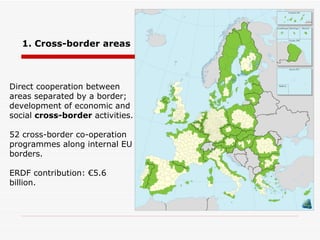
Direct cooperation between areas separated by a border; development of economic and social  cross-border  activities. 52 cross-border co-operation programmes along internal EU borders. ERDF contribution: €5.6 billion. 1. Cross-border areas
 
What do cross-border programmes do? Cross-border co-operation  works on erasing the negative effects of borders.  Essentially local in nature: Entrepreneurship and SMEs, cross-border trade, tourism and culture Protection and joint management of the environment  Better access to transport Information and communication networks Water, waste management and energy management systems Joint use of health, culture and education infrastructure People to people projects
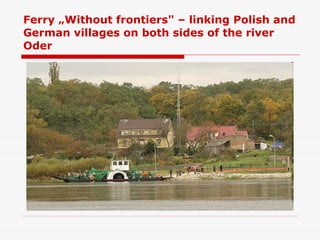
Ferry „Without frontiers"  – linking Polish and German villages on both sides of the river Oder
Regional development co-operation programmes outside the EU  There are also a number of new instruments  available to support regional development along  the EU’s external borders with countries which  are either candidates for EU membership or  potential candidates (the  Instrument for  Pre-Accession Assistance,  IPA), and also with so- called third countries (i.e. non-EU members).
The European Neighbourhood and Partnership Instrument (ENPI) ENPI promotes co-operation and economic integration between the EU and partner countries – Algeria, Armenia, Azerbaijan, Belarus, Egypt, Georgia, Israel, Jordan, Lebanon, Libya, Moldova, Morocco, the Palestinian Authority, the Russian Federation, Syria, Tunisia, and Ukraine.  It supports partnerships encouraging good governance and social and economic development.  Included are 14 cross-border co-operation programmes which operate along EU external borders.  EU allocation: €11.18 billion, of which ENPI-CBC programmes account for €1.18 billion.
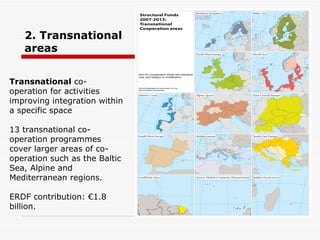
2. Transnational areas Transnational  co-operation for activities improving integration within a specific space  13 transnational co-operation programmes cover larger areas of co-operation such as the Baltic Sea, Alpine and Mediterranean regions.  ERDF contribution: €1.8 billion.
Transnational Programmes Focus of transnational programmes on: innovation, R&D, enterprises environment : water management, environmental protection and risk prevention (including maritime safety) improved accessibility, transport, information and communication networks sustainable urban development
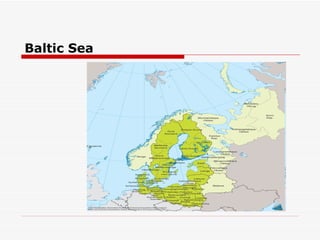
Baltic Sea
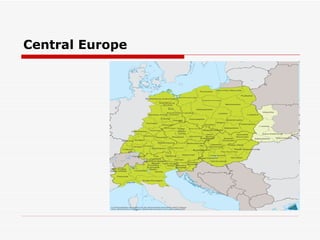
Central Europe
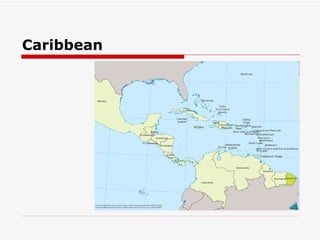
Caribbean
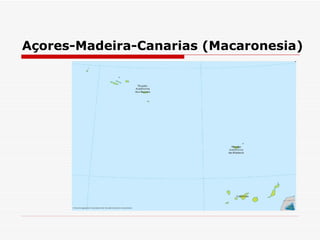
Açores-Madeira-Canarias (Macaronesia)
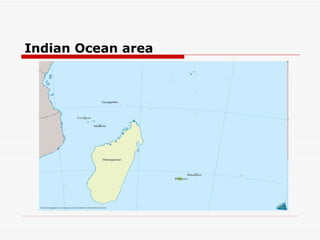
Indian Ocean area
Sonora Smooth journey between Baltic and Adriatic waters Austria, Czech Republic, Germany, Italy, Poland and Slovenia   The SoNorA project focuses on the development of  multimodal transport  infrastructure and services in Central Europe, providing  better connections between the Baltic and Adriatic seas . The approach is unique in that it brings together several South-North network connections under one project.   The benefits to be gained by the six countries involved include improved inland waterways, guidelines on strategic planning, impact assessments on development, and use of state-of-the-art systems.
Baltic fashion Promoting the innovative Baltic Fashion industry throughout the Baltic Sea Region Partners from:  Germany, Lithuania, Latvia, Poland, Estonia, Sweden, Finland The Baltic fashion sector is mainly composed of SMEs, with large share of females not only in services & administration but also production (80% in new member states). Despite dramatic changes within the last decade resulting in a loss of a third of its volume and jobs textile, clothing and leather industries still highly contribute to employment esp in the E-BSR, where the sector counts for approx. 6% of the workforce. Fashion project is intended to  strengthen SMEs, especially in the creative sector, and to promote female entrepreneurship . In addition to its contribution to (female & non-metropole) employment, the project will also contribute to bridging the East-West divide.
3. Interregional co-operation The INTERREG IV C  programme enables EU regions to work together. Countries: EU-27, Norway and Switzerland. Interregional cooperation builds networks to develop good practice and facilitate the exchange and transfer of experience by successful regions. It showcases what regions do well, to the benefit of those still investing.  Networks between regional actors across Europe and across different objectives of Structural Policy to identify and transfer good practice in the field of: innovation and the knowledge economy, regional development policies and environment and risk prevention.  ERDF contribution: €321 million.
CREATIVE REGIONS / CREA.RE  CREA.RE was originated to combine, on the one hand, Regions having faced such problems of rural regions and regional urban centres when starting to integrate the creative sector into the EU Regional programmes with, on the other hand, several very advanced partners who agree to share their experience – but each partner providing specific added value for CREA.RE.  Within CREA.RE the know-how, good practice and policy experience in the field of creative economy will be exchanged aiming to enhance the effectiveness of each partner’s EU Regional programmes.  Partnership: Austria, Finland, Germany, Italia, Poland, Rumania, Belgium, Slovenia, Spain,
Macro regions EU Strategy for the Baltic Sea Region EU Strategy for the Danube Region
Why are strategies needed? Challenges facing the EU have increased. Escalating environmental threats, gaps in economic development and poor transport accessibility are  Issues which need to be tackled urgently. Many of these problems can only be addressed through better coordination and joint action. The EU is well-placed to facilitate this.
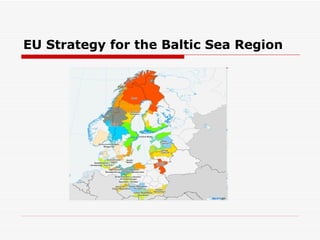
EU Strategy for the Baltic Sea Region The countries around the Baltic Sea, Europe's largest inland sea, are joining forces to save their shared inland sea and to strengthen the competitiveness of the region. The Baltic countries together have major environmental problems to address. However, it is not just problems that unite them. The countries also have a similar history, common features and already cooperate in a number of areas. To overcome environmental problems, but also to increase the region's competitiveness and prosperity, the Baltic countries have united on a common Baltic Sea Region Strategy.
EU Strategy for the Baltic Sea Region The Strategy aims at  coordinating action  by Member States, regions, the EU, pan-Baltic organisations, financing institutions and non-governmental bodies to  promote a more balanced development of the Region .  The  four cornerstones of the Strategy  are to make this part of Europe more:   Environmentally sustainable (e.g. reducing pollution in the sea);  Prosperous and dynamic (e.g. promoting innovation in small and medium enterprises);  Accessible and attractive (e.g. better transport links);  Safe and secure (e.g. improving accident response).
EU Strategy for the Baltic Sea Region
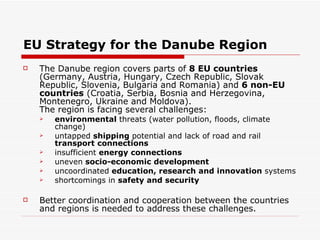
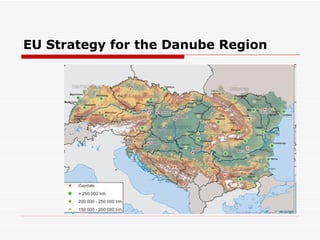
EU Strategy for the Danube Region The Danube region covers parts of  8 EU countries  (Germany, Austria, Hungary, Czech Republic, Slovak Republic, Slovenia, Bulgaria and Romania) and  6 non-EU countries  (Croatia, Serbia, Bosnia and Herzegovina, Montenegro, Ukraine and Moldova). The region is facing several challenges: environmental  threats (water pollution, floods, climate change)  untapped  shipping  potential and lack of road and rail  transport   connections   insufficient  energy connections   uneven  socio-economic development   uncoordinated  education, research and innovation  systems  shortcomings in  safety and security   Better coordination and cooperation between the countries and regions is needed to address these challenges.
EU Strategy for the Danube Region The 115 million people living in the Danube Region will benefit from: faster transport  by road and rail  cleaner transport  by improving the navigability of rivers  cheaper and more secure energy  thanks to better connections and alternative sources  a  better environment  with cleaner water, protected biodiversity, and cross-border  flood prevention  a  prosperous region , through working together on the economy, education, social inclusion, and research and innovation  attractive tourist and cultural destinations ,   developed and marketed jointly  a  safer, well-governed region,  thanks to better cooperation and coordination of government and non-governmental organisations  What exactly would change? The EU has identified 11 priority areas, which will focus on improving: transport  connections  energy  connections  the  environment   socio-economic  development  security
EU Strategy for the Danube Region
European Grouping for Territorial Cooperation (EGTC) A new European legal instrument designed to facilitate and promote cross-border, transnational and interregional cooperation. Unlike the structures which governed this kind of cooperation before 2007, the EGTC is a legal entity and as such, will enable regional and local authorities and other public bodies from different member states, to set up cooperation groupings with a legal personality.
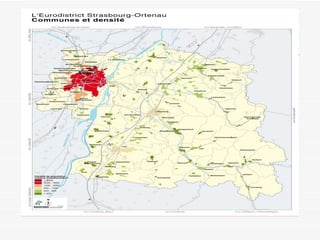
Eurodistrikt Strasbourg – Ortenau  Strasbourg-Ortenau is a Franco-German eurodistrict, a cross border administrative entity sharing common institutions, established on 17 October 2005 and definitely functional since 4 February 2010.  The district is formed by the Urban Community of Strasbourg (centred on the city of Strasbourg) on the French side of the Rhine and the Ortenau district (including Achern, Kehl, Lahr, Oberkirch and Offenburg) on the German side. The combined population of the district is 884,988. It covers an area of 2,176 km².
Eurodistrikt Strasbourg – Ortenau  The main objectives: to add value to all residents of the area, regardless of whether they live a transnational life or not,  to lay the foundations for an innovative district, to strengthen the European dimension of Strasbourg as the seat of European institutions,  to continue and intensify the existing cross-border cooperation.
 
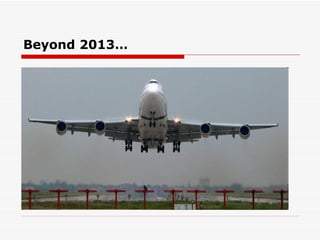
Future of the Cohesion Policy Beyond 2013…
Beyond 2013… Reform rather then revolution
A policy for all European regions Social and economic  cohesion remains central  to the European integration process in the 21st century. The European economic integration can only work if  all regions can contribute and reap the benefits . There is  potential for growth across all types of regions , dependent on how well regions mobilize their assets and potentials.  Full geographical coverage  Cohesion policy should play a stronger role in  strengthening inter-connections between lagging and leading regions  (maximising spill-over effects of leading areas).
Main issues of the debate Reinforcing  strategic programming.  Focus resources on limited number of key priorities  Modernising the economy Enhancing environmental sustainability Promoting employment and socia l  cohesion Improving the way regional and local  resources  from all territories  are used , so that they all contribute to the competitiveness of all Europe More  focus on results  so that its impact can be measured. Improving evaluation, performance and results Continue  simplifying the process  used to implement the policy, at the same time ensuring it remains  effective Focussing the policy towards the  future  and helping regions deal with  challenges Stronger emphasis on new financial instruments
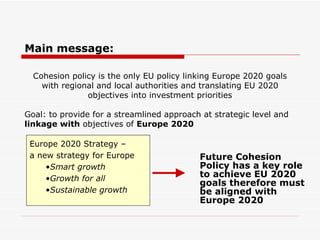
Main message:   Future Cohesion Policy has a key role to achieve EU 2020 goals  therefore  must be aligned with Europe 2020 Europe 2020 Strategy –  a new strategy for Europe   Smart growth Growth for all Sustainable growth Cohesion policy is the only  EU  policy linking Europe  2020  goals with regional and local authorities and  translating EU 2020 objectives into investment priorities Goal: to provide for a streamlined approach at strategic level and  linkage with  objectives of  Europe 2020
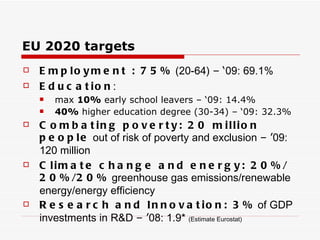
EU 2020 targets  Employment : 75%  (20-64)  –   ‘ 09: 69.1% Education :  max  10%  early school leavers – ‘09: 14.4% 40%  higher education degree (30-34) – ‘09: 32.3% Combating poverty: 20 million people  out of risk of poverty and exclusion  –   ’ 09: 120 million Climate change and energy: 20%/20%/20%  greenhouse gas emissions/renewable energy/energy efficiency Research and Innovation: 3%  of GDP investments in R&D  –   ’ 08: 1.9*  (Estimate Eurostat)
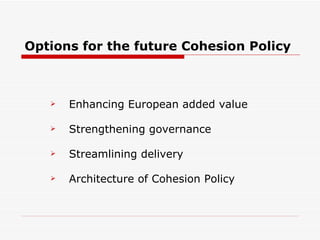
Options for the future Cohesion Policy Enhancing European added value Strengthening governance Streamlining delivery Architecture of Cohesion Policy
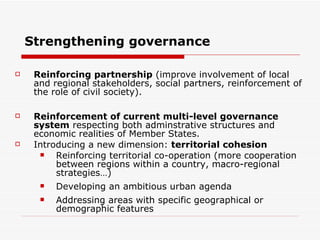
Strengthening governance Reinforcing partnership  (improve involvement of local and regional stakeholders, social partners, r einforcement of the role of civil society ).   Reinforcement of current multi-level governance system  respecting both adminstrative structures and economic realities of Member States . Introducing a new dimension:  territorial cohesion Reinforcing territorial co-operation (more cooperation between regions within a country, macro-regional strategies…) Developing an ambitious urban agenda Addressing areas with specific geographical or demographic features
Improving financial management Reducing the administrative burden Simplifying financial discipline Reviewing financial control Streamlining Delivery
Development and Investment Partnership Contract Partnership contracts to be signed  between Member States, regions and the Commission. Member States and regions will  concentrate EU and national resources on a small number of priorities  responding to the specific challenges they face.  A greater concentration of resources will build up a  critical mass  so that a  greater impact  can be attained.  For each priority selected Member States and regions will have to set themselves – at the beginning of the programming cycle –  clear and measurable targets  to better evaluate progress.
How to render it operational? One of the options is to  link the disbursement  of EU funding to specific  reforms  closely related to the areas of intervention of Cohesion Policy. These would be negotiated and fixed in the contract at the beginning of the programming cycle.  These may concern, for example, the functioning of the  public procurement  system, the transposition of relevant EU  environmental legislation  into national law, the existence of comprehensive sectoral strategies (for  transport, or waste management ), or the criteria for selecting projects  The performance of the policy to be strengthened through the introduction of stronger  conditions and incentives
Budget review  - content Budget review  kicks off the debate  on Post 2013 Multiannual Financial Framework TFUE art. 312: MFF Approval  by Council unanimity after Parliament consent. Duration period of at least 5 years : Commission preferred option, 10 year period with a mid-term review (5 + 5) MMF  size, % for each policy : no indication. Discussion on principles, ideas & options. However from President Barroso’s speeches etc size of proposal would be + or – as current MFF ie  around 1,05% of estimated GNI (around 120 billion/year). Wide-ranging review should affect:  Agricultural policy (3 options) ands Own resources' system  (UK rebate and reductions/rebates for  DE, NL, SE and AT). Own resources’ regulation is also approved by unanimity at the Council.
European Territorial Co-operation beyond 2013 ETC will be continued Two main challenges for territorial co-operation: Ensuring strategic approach Optimising architecture and implementation
Beyond 2013…
Thank you for your attention! Any questions? Source of information:  DG Regional Policy  European Commission   http:// ec.europa.eu/regional_policy

ETC Future 1 march

  • 1.
    Territorial Co-operation inthe European Union Future of the Cohesion Policy 1 March 2011, Bellevue Programme Seminar, Brussels
  • 2.
    What do weneed territorial co-operation in the EU for? What do we spend the money on? ETC – 3 strands ENPI Macro regions EGTC Beyond 2013... What kind of future? Presentation plan
  • 3.
    Territorial co-operation ispart of the regional policy Among the 271 EU regions exist huge disparities– this weakens the EU’s dynamism Hence the political goal of reducing the gaps in development It is in the Treaty on European Union: “ to promote economic and social cohesion by reducing disparities between the regions”
  • 4.
    Why do webother? that would wreck two of the policies on which Europe’s growth has been based: the single market and the European Monetary Union (EMU)
  • 5.
    For this reasonthe cohesion policy: supports activities which decrease the negative impacts of borders enhances cooperation and integration among partners who share a “common space”. encourages regions and cities from different EU Member States to work together and learn from each other through joint programmes, projects and networks. Cohesion Policy and this is what we call territorial co-operation
  • 6.
    The territorial co-operationis the best travel agency in the EU In the opinion of some experts: European Territorial Co-operation
  • 7.
  • 8.
    In the period2007-2013, cohesion policy benefits from 35.7% of the total EU budget i.e. 347.41 billion euros It is the biggest slice of the EU budget. It is supposed to unlock up to €700bn
  • 9.
  • 10.
    How is itorganised ? For the European Territorial Cooperation objective, the ERDF focuses its aid on three main areas: Cross-border Transnational Interregional
  • 11.
    Direct cooperation betweenareas separated by a border; development of economic and social cross-border activities. 52 cross-border co-operation programmes along internal EU borders. ERDF contribution: €5.6 billion. 1. Cross-border areas
  • 12.
  • 13.
    What do cross-borderprogrammes do? Cross-border co-operation works on erasing the negative effects of borders. Essentially local in nature: Entrepreneurship and SMEs, cross-border trade, tourism and culture Protection and joint management of the environment Better access to transport Information and communication networks Water, waste management and energy management systems Joint use of health, culture and education infrastructure People to people projects
  • 14.
    Ferry „Without frontiers" – linking Polish and German villages on both sides of the river Oder
  • 15.
    Regional development co-operationprogrammes outside the EU There are also a number of new instruments available to support regional development along the EU’s external borders with countries which are either candidates for EU membership or potential candidates (the Instrument for Pre-Accession Assistance, IPA), and also with so- called third countries (i.e. non-EU members).
  • 16.
    The European Neighbourhoodand Partnership Instrument (ENPI) ENPI promotes co-operation and economic integration between the EU and partner countries – Algeria, Armenia, Azerbaijan, Belarus, Egypt, Georgia, Israel, Jordan, Lebanon, Libya, Moldova, Morocco, the Palestinian Authority, the Russian Federation, Syria, Tunisia, and Ukraine. It supports partnerships encouraging good governance and social and economic development. Included are 14 cross-border co-operation programmes which operate along EU external borders. EU allocation: €11.18 billion, of which ENPI-CBC programmes account for €1.18 billion.
  • 17.
    2. Transnational areasTransnational co-operation for activities improving integration within a specific space 13 transnational co-operation programmes cover larger areas of co-operation such as the Baltic Sea, Alpine and Mediterranean regions. ERDF contribution: €1.8 billion.
  • 18.
    Transnational Programmes Focusof transnational programmes on: innovation, R&D, enterprises environment : water management, environmental protection and risk prevention (including maritime safety) improved accessibility, transport, information and communication networks sustainable urban development
  • 19.
  • 20.
  • 21.
  • 22.
  • 23.
  • 24.
    Sonora Smooth journeybetween Baltic and Adriatic waters Austria, Czech Republic, Germany, Italy, Poland and Slovenia The SoNorA project focuses on the development of multimodal transport infrastructure and services in Central Europe, providing better connections between the Baltic and Adriatic seas . The approach is unique in that it brings together several South-North network connections under one project.  The benefits to be gained by the six countries involved include improved inland waterways, guidelines on strategic planning, impact assessments on development, and use of state-of-the-art systems.
  • 25.
    Baltic fashion Promotingthe innovative Baltic Fashion industry throughout the Baltic Sea Region Partners from: Germany, Lithuania, Latvia, Poland, Estonia, Sweden, Finland The Baltic fashion sector is mainly composed of SMEs, with large share of females not only in services & administration but also production (80% in new member states). Despite dramatic changes within the last decade resulting in a loss of a third of its volume and jobs textile, clothing and leather industries still highly contribute to employment esp in the E-BSR, where the sector counts for approx. 6% of the workforce. Fashion project is intended to strengthen SMEs, especially in the creative sector, and to promote female entrepreneurship . In addition to its contribution to (female & non-metropole) employment, the project will also contribute to bridging the East-West divide.
  • 26.
    3. Interregional co-operationThe INTERREG IV C programme enables EU regions to work together. Countries: EU-27, Norway and Switzerland. Interregional cooperation builds networks to develop good practice and facilitate the exchange and transfer of experience by successful regions. It showcases what regions do well, to the benefit of those still investing. Networks between regional actors across Europe and across different objectives of Structural Policy to identify and transfer good practice in the field of: innovation and the knowledge economy, regional development policies and environment and risk prevention. ERDF contribution: €321 million.
  • 27.
    CREATIVE REGIONS /CREA.RE CREA.RE was originated to combine, on the one hand, Regions having faced such problems of rural regions and regional urban centres when starting to integrate the creative sector into the EU Regional programmes with, on the other hand, several very advanced partners who agree to share their experience – but each partner providing specific added value for CREA.RE. Within CREA.RE the know-how, good practice and policy experience in the field of creative economy will be exchanged aiming to enhance the effectiveness of each partner’s EU Regional programmes. Partnership: Austria, Finland, Germany, Italia, Poland, Rumania, Belgium, Slovenia, Spain,
  • 28.
    Macro regions EUStrategy for the Baltic Sea Region EU Strategy for the Danube Region
  • 29.
    Why are strategiesneeded? Challenges facing the EU have increased. Escalating environmental threats, gaps in economic development and poor transport accessibility are Issues which need to be tackled urgently. Many of these problems can only be addressed through better coordination and joint action. The EU is well-placed to facilitate this.
  • 30.
    EU Strategy forthe Baltic Sea Region The countries around the Baltic Sea, Europe's largest inland sea, are joining forces to save their shared inland sea and to strengthen the competitiveness of the region. The Baltic countries together have major environmental problems to address. However, it is not just problems that unite them. The countries also have a similar history, common features and already cooperate in a number of areas. To overcome environmental problems, but also to increase the region's competitiveness and prosperity, the Baltic countries have united on a common Baltic Sea Region Strategy.
  • 31.
    EU Strategy forthe Baltic Sea Region The Strategy aims at coordinating action by Member States, regions, the EU, pan-Baltic organisations, financing institutions and non-governmental bodies to promote a more balanced development of the Region . The four cornerstones of the Strategy are to make this part of Europe more:  Environmentally sustainable (e.g. reducing pollution in the sea); Prosperous and dynamic (e.g. promoting innovation in small and medium enterprises); Accessible and attractive (e.g. better transport links); Safe and secure (e.g. improving accident response).
  • 32.
    EU Strategy forthe Baltic Sea Region
  • 33.
    EU Strategy forthe Danube Region The Danube region covers parts of 8 EU countries (Germany, Austria, Hungary, Czech Republic, Slovak Republic, Slovenia, Bulgaria and Romania) and 6 non-EU countries (Croatia, Serbia, Bosnia and Herzegovina, Montenegro, Ukraine and Moldova). The region is facing several challenges: environmental threats (water pollution, floods, climate change) untapped shipping potential and lack of road and rail transport connections insufficient energy connections uneven socio-economic development uncoordinated education, research and innovation systems shortcomings in safety and security Better coordination and cooperation between the countries and regions is needed to address these challenges.
  • 34.
    EU Strategy forthe Danube Region The 115 million people living in the Danube Region will benefit from: faster transport by road and rail cleaner transport by improving the navigability of rivers cheaper and more secure energy thanks to better connections and alternative sources a better environment with cleaner water, protected biodiversity, and cross-border  flood prevention a prosperous region , through working together on the economy, education, social inclusion, and research and innovation attractive tourist and cultural destinations , developed and marketed jointly a safer, well-governed region, thanks to better cooperation and coordination of government and non-governmental organisations What exactly would change? The EU has identified 11 priority areas, which will focus on improving: transport connections energy connections the environment socio-economic development security
  • 35.
    EU Strategy forthe Danube Region
  • 36.
    European Grouping forTerritorial Cooperation (EGTC) A new European legal instrument designed to facilitate and promote cross-border, transnational and interregional cooperation. Unlike the structures which governed this kind of cooperation before 2007, the EGTC is a legal entity and as such, will enable regional and local authorities and other public bodies from different member states, to set up cooperation groupings with a legal personality.
  • 37.
    Eurodistrikt Strasbourg –Ortenau Strasbourg-Ortenau is a Franco-German eurodistrict, a cross border administrative entity sharing common institutions, established on 17 October 2005 and definitely functional since 4 February 2010. The district is formed by the Urban Community of Strasbourg (centred on the city of Strasbourg) on the French side of the Rhine and the Ortenau district (including Achern, Kehl, Lahr, Oberkirch and Offenburg) on the German side. The combined population of the district is 884,988. It covers an area of 2,176 km².
  • 38.
    Eurodistrikt Strasbourg –Ortenau The main objectives: to add value to all residents of the area, regardless of whether they live a transnational life or not, to lay the foundations for an innovative district, to strengthen the European dimension of Strasbourg as the seat of European institutions, to continue and intensify the existing cross-border cooperation.
  • 39.
  • 40.
    Future of theCohesion Policy Beyond 2013…
  • 41.
    Beyond 2013… Reformrather then revolution
  • 42.
    A policy forall European regions Social and economic cohesion remains central to the European integration process in the 21st century. The European economic integration can only work if all regions can contribute and reap the benefits . There is potential for growth across all types of regions , dependent on how well regions mobilize their assets and potentials. Full geographical coverage Cohesion policy should play a stronger role in strengthening inter-connections between lagging and leading regions (maximising spill-over effects of leading areas).
  • 43.
    Main issues ofthe debate Reinforcing strategic programming. Focus resources on limited number of key priorities Modernising the economy Enhancing environmental sustainability Promoting employment and socia l cohesion Improving the way regional and local resources from all territories are used , so that they all contribute to the competitiveness of all Europe More focus on results so that its impact can be measured. Improving evaluation, performance and results Continue simplifying the process used to implement the policy, at the same time ensuring it remains effective Focussing the policy towards the future and helping regions deal with challenges Stronger emphasis on new financial instruments
  • 44.
    Main message: Future Cohesion Policy has a key role to achieve EU 2020 goals therefore must be aligned with Europe 2020 Europe 2020 Strategy – a new strategy for Europe Smart growth Growth for all Sustainable growth Cohesion policy is the only EU policy linking Europe 2020 goals with regional and local authorities and translating EU 2020 objectives into investment priorities Goal: to provide for a streamlined approach at strategic level and linkage with objectives of Europe 2020
  • 45.
    EU 2020 targets Employment : 75% (20-64) – ‘ 09: 69.1% Education : max 10% early school leavers – ‘09: 14.4% 40% higher education degree (30-34) – ‘09: 32.3% Combating poverty: 20 million people out of risk of poverty and exclusion – ’ 09: 120 million Climate change and energy: 20%/20%/20% greenhouse gas emissions/renewable energy/energy efficiency Research and Innovation: 3% of GDP investments in R&D – ’ 08: 1.9* (Estimate Eurostat)
  • 46.
    Options for thefuture Cohesion Policy Enhancing European added value Strengthening governance Streamlining delivery Architecture of Cohesion Policy
  • 47.
    Strengthening governance Reinforcingpartnership (improve involvement of local and regional stakeholders, social partners, r einforcement of the role of civil society ). Reinforcement of current multi-level governance system respecting both adminstrative structures and economic realities of Member States . Introducing a new dimension: territorial cohesion Reinforcing territorial co-operation (more cooperation between regions within a country, macro-regional strategies…) Developing an ambitious urban agenda Addressing areas with specific geographical or demographic features
  • 48.
    Improving financial managementReducing the administrative burden Simplifying financial discipline Reviewing financial control Streamlining Delivery
  • 49.
    Development and InvestmentPartnership Contract Partnership contracts to be signed between Member States, regions and the Commission. Member States and regions will concentrate EU and national resources on a small number of priorities responding to the specific challenges they face. A greater concentration of resources will build up a critical mass so that a greater impact can be attained. For each priority selected Member States and regions will have to set themselves – at the beginning of the programming cycle – clear and measurable targets to better evaluate progress.
  • 50.
    How to renderit operational? One of the options is to link the disbursement of EU funding to specific reforms closely related to the areas of intervention of Cohesion Policy. These would be negotiated and fixed in the contract at the beginning of the programming cycle. These may concern, for example, the functioning of the public procurement system, the transposition of relevant EU environmental legislation into national law, the existence of comprehensive sectoral strategies (for transport, or waste management ), or the criteria for selecting projects The performance of the policy to be strengthened through the introduction of stronger conditions and incentives
  • 51.
    Budget review - content Budget review kicks off the debate on Post 2013 Multiannual Financial Framework TFUE art. 312: MFF Approval by Council unanimity after Parliament consent. Duration period of at least 5 years : Commission preferred option, 10 year period with a mid-term review (5 + 5) MMF size, % for each policy : no indication. Discussion on principles, ideas & options. However from President Barroso’s speeches etc size of proposal would be + or – as current MFF ie around 1,05% of estimated GNI (around 120 billion/year). Wide-ranging review should affect: Agricultural policy (3 options) ands Own resources' system (UK rebate and reductions/rebates for DE, NL, SE and AT). Own resources’ regulation is also approved by unanimity at the Council.
  • 52.
    European Territorial Co-operationbeyond 2013 ETC will be continued Two main challenges for territorial co-operation: Ensuring strategic approach Optimising architecture and implementation
  • 53.
  • 54.
    Thank you foryour attention! Any questions? Source of information: DG Regional Policy European Commission http:// ec.europa.eu/regional_policy

Editor's Notes

  • #47 Evaluations reports published in April 2010 give a clear indication of the achievements of the policy. Capturing the impact and results of cohesion policy is critical to its ongoing success. Letting the public know what is achieved with the investment from the policy is key to its transparency and accountability. It also offers the opportunity to learn from good practice elsewhere, and to continuously improve projects and programmes. The task of safeguarding and developing competitiveness as a constant necessity in successful economies - no region in Europe can assume prosperity forever. It is important for regions to diversify their economic activities in order to sustain their success – regional policy strategic programming support this.
  • #48 Evaluations reports published in April 2010 give a clear indication of the achievements of the policy. Capturing the impact and results of cohesion policy is critical to its ongoing success. Letting the public know what is achieved with the investment from the policy is key to its transparency and accountability. It also offers the opportunity to learn from good practice elsewhere, and to continuously improve projects and programmes. The task of safeguarding and developing competitiveness as a constant necessity in successful economies - no region in Europe can assume prosperity forever. It is important for regions to diversify their economic activities in order to sustain their success – regional policy strategic programming support this.
  • #51 Evaluations reports published in April 2010 give a clear indication of the achievements of the policy. Capturing the impact and results of cohesion policy is critical to its ongoing success. Letting the public know what is achieved with the investment from the policy is key to its transparency and accountability. It also offers the opportunity to learn from good practice elsewhere, and to continuously improve projects and programmes. The task of safeguarding and developing competitiveness as a constant necessity in successful economies - no region in Europe can assume prosperity forever. It is important for regions to diversify their economic activities in order to sustain their success – regional policy strategic programming support this.