CENTRAL EUROPEAN INITIATIVE
Marina Juricev
Towards the integration of the physics community in CEI countries into the ERA
Trieste, 11-12 December 2014
 A regional intergovernmental forum committed to supporting European integration
 25th Anniversary in 2014 (since 1989)
 18 Member States with a total population of over 250 million:
• 10 EU Member States
• 4 candidates (Albania, Macedonia, Montenegro, Serbia)
• 1 potential candidate (Bosnia and Herzegovina)
• 3 countries involved in European Neighbourhood Policy (Belarus, Moldova,
Ukraine)
 25th CEI Rotating Presidency (Austria 2014, Macedonia 2015)
 CEI Secretariat (Headquarters in Trieste, Italy)
Membership and Geopolitical context
1
 Main EU Policies within CEI Area:
• Enlargement Policy (Western Balkans)
• European Neighbourhood Policy (Eastern Europe)
• Regional/Cohesion Policy
 Keen interest in EU Macro-regional strategies (overlapping membership and matching sectoral
priorities):
• EU Strategy for the Danube Region - EUSDR: 13 countries in common (out of 14)
• EU Strategy for the Adriatic and Ionian Region - EUSAIR: 7 countries in common (out of 8)
• EU Strategy for the Baltic Sea Region - EUSBSR: 1 country in common, Poland (out of 8)
 Opportunity: CEI acting as a «bridge between macro-regions»
Membership and Geopolitical context
2
 Main institutional mission: regional cooperation for European integration
 Not only a platform for political dialogue: specific methodology combining
multilateral diplomacy and project management (both as donor and
beneficiary)
 Support to multilateral dialogue enhanced by a strong project-oriented
approach (elaboration and project management)
Mission and
methodology
3
CEI Plan of Action 2014-2016 negotiated and adopted by all 18 CEI MS at HoGs’ level
Strategic Objectives
 Support CEI Member States on their path towards European integration
 Promote the alignment of CEI Member States to EU standards
 Implement small and medium-sized projects
Measures
 Structural strengthening
 Reinforce institutional links with the EU and other international and
regional organisations
 Enhance CEI visibility and capitalisation on achievements
CEI Plan of Action 2014 – 2016 – Part I
4
Areas of cooperation
 10 areas of cooperation, grouped into 3 main thematic pillars in line with the
Europe 2020 Strategy:
1. Towards a Knowledge-based society (Research and Innovation; Life-long
Education and Training; Information Society).
2. Towards a Sustainable Economy and Development (Transport, Logistics and
Accessibility; Energy Efficiency and Renewable Energy; Climate, Environment
and Rural Development; SMEs and Business Development)
3. Towards an Inclusive Society (Intercultural Cooperation; Media; Civil Society).
 For each area: 2/3 priorities and 4/6 concrete actions agreed upon by the 18 CEI
Member States (to avoid dispersion of resources and enhance impact of activities).
CEI Plan of Action 2014 – 2016 – Part II
5
 The CEI avails itself of:
1. Expertise in EU Project development and implementation both as Lead Partner
and Partner;
2. Financial instruments:
a) Cooperation Fund,
b) CEI Fund at the EBRD,
c) Know-how Exchange Programme.
Needed in order to reach the objectives outlined in the CEI Plan of Action 2014-2016
within the framework of the CEI Dimensions:
Governmental, Parliamentary, Business
CEI Expertise and Instruments
6
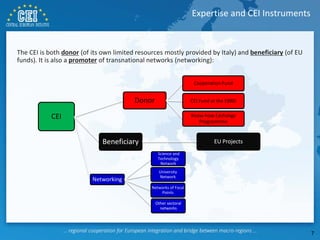
The CEI is both donor (of its own limited resources mostly provided by Italy) and beneficiary (of EU
funds). It is also a promoter of transnational networks (networking):
Expertise and CEI Instruments
7
CEI
Donor
Cooperation Fund
CEI Fund at the EBRD
Know-how Exchange
Progranmme
Beneficiary EU Projects
Networking
Science and
Technology
Network
University
Network
Networks of Focal
Points
Other sectoral
networks
CEI Cooperation Fund
 With all Member States contribution, it supports seminars, workshops, conferences,
training courses and activities fostering, inter alia, the development of project
proposals to be submitted at EU level.
 Main objective: transnational mobility of participants
 Since its inception in 2002:
• about 857 activities co-financed
• with around €8 million and an overall value of about €52 million
• an estimated 5000 participants take part in the events every year
CEI Cooperation Fund
8
CEI Fund at the EBRD
 Main objective: supports projects targeting the whole CEI Region.
 Managed by the Office for the CEI Fund at the EBRD and financed by Italy with
€38.5 million.
 The Fund provides grant-type technical assistance (prefeasibility and feasibility
studies, project implementation, management training, capacity building, and pre-
loan audits) in support of investments and operations of the European Bank for
Reconstruction and Development (EBRD).
 Since 1992:
• more than €23 million committed for 122 technical cooperation projects.
• mobilisation of €4.8 billion of international investments in the countries of
operations. For each euro provided by the CEI Fund, the EBRD and other financiers
have invested €215.
CEI Fund at the EBRD
9
Know-how Exchange Programme
Main objective: provides grants for projects related to capacity building and transfer of
good practices from EU to non-EU CEI Member States.
Donors:
 Italy, through the CEI Fund at the EBRD, has since 2004 committed more than 2.1
million EUR for 75 projects;
 Austria, through the Austrian Development Agency (ADA) has, since
2007, contributed around 730.000 EUR for 26 projects with funds from the Austrian
Development Cooperation;
 Poland has contributed with 50.000 EUR to projects co-financed together with Italy.
Priority sectors: European integration, capacity building, agriculture, energy and
environment, SME development, infrastructure.
Know-how Exchange Programme
10
EU Projects
 Main objective: enhance the involvement of CEI countries in EU projects focusing
on transnational and regional cooperation for European integration, based on the
priorities set by the CEI Plan of Action.
 14 projects implemented between 2004 and 2013
‒ Administered by CEI: €3.8 million
‒ Total fund mobilisation: €17 million
‒
 11 projects under implementation (out of which 2 as Lead Partner)
‒ Administered by CEI: €7.9 million
‒ Total fund mobilisation: €31.5 million

Main areas of intervention: transport, ICT, environment, energy, intercultural
cooperation, corporate social responsibility, regional cooperation, SMEs, research
and innovation.
EU Projects
11
 Networking through science and education
• The CEI Science and Technology Network (S&TN) and the CEI University Network (UniNet)
are proven effective tools for promoting regional cooperation in the scientific and academic
fields.
• Contacts established over the years with renowned Centres of Excellence and universities
contribute to fostering mobility of scientists, professors and graduate/ postgraduate
students and to developing tangible programmes and projects.
 Network of Focal Points (institutional / sectoral)
 Other sectoral networks
 Results: since 2004, more than 180 activities, 60 fellowships and more than 1000
scholarships and grants for around 1800 participants, scientists and professors.
Networking
12
 Fullfill objectives outlined in the CEI Plan of Action 2014 – 2016
 Strengthening of Organisation within its 3 main operational Dimensions:
1. Facilitate diplomatic relations (CEI as a multilateral platform and promotor of
transnational networking)
2. Finance bi- and multilateral projects through its own funds and instruments
3. Implement projects financed by other «donors», in particular by the European
Commission
Future prospects
13
Thank you for your kind attention!

"Central European Initiative" - Marina Juricev

  • 1.
    CENTRAL EUROPEAN INITIATIVE MarinaJuricev Towards the integration of the physics community in CEI countries into the ERA Trieste, 11-12 December 2014
  • 2.
     A regionalintergovernmental forum committed to supporting European integration  25th Anniversary in 2014 (since 1989)  18 Member States with a total population of over 250 million: • 10 EU Member States • 4 candidates (Albania, Macedonia, Montenegro, Serbia) • 1 potential candidate (Bosnia and Herzegovina) • 3 countries involved in European Neighbourhood Policy (Belarus, Moldova, Ukraine)  25th CEI Rotating Presidency (Austria 2014, Macedonia 2015)  CEI Secretariat (Headquarters in Trieste, Italy) Membership and Geopolitical context 1
  • 3.
     Main EUPolicies within CEI Area: • Enlargement Policy (Western Balkans) • European Neighbourhood Policy (Eastern Europe) • Regional/Cohesion Policy  Keen interest in EU Macro-regional strategies (overlapping membership and matching sectoral priorities): • EU Strategy for the Danube Region - EUSDR: 13 countries in common (out of 14) • EU Strategy for the Adriatic and Ionian Region - EUSAIR: 7 countries in common (out of 8) • EU Strategy for the Baltic Sea Region - EUSBSR: 1 country in common, Poland (out of 8)  Opportunity: CEI acting as a «bridge between macro-regions» Membership and Geopolitical context 2
  • 4.
     Main institutionalmission: regional cooperation for European integration  Not only a platform for political dialogue: specific methodology combining multilateral diplomacy and project management (both as donor and beneficiary)  Support to multilateral dialogue enhanced by a strong project-oriented approach (elaboration and project management) Mission and methodology 3
  • 5.
    CEI Plan ofAction 2014-2016 negotiated and adopted by all 18 CEI MS at HoGs’ level Strategic Objectives  Support CEI Member States on their path towards European integration  Promote the alignment of CEI Member States to EU standards  Implement small and medium-sized projects Measures  Structural strengthening  Reinforce institutional links with the EU and other international and regional organisations  Enhance CEI visibility and capitalisation on achievements CEI Plan of Action 2014 – 2016 – Part I 4
  • 6.
    Areas of cooperation 10 areas of cooperation, grouped into 3 main thematic pillars in line with the Europe 2020 Strategy: 1. Towards a Knowledge-based society (Research and Innovation; Life-long Education and Training; Information Society). 2. Towards a Sustainable Economy and Development (Transport, Logistics and Accessibility; Energy Efficiency and Renewable Energy; Climate, Environment and Rural Development; SMEs and Business Development) 3. Towards an Inclusive Society (Intercultural Cooperation; Media; Civil Society).  For each area: 2/3 priorities and 4/6 concrete actions agreed upon by the 18 CEI Member States (to avoid dispersion of resources and enhance impact of activities). CEI Plan of Action 2014 – 2016 – Part II 5
  • 7.
     The CEIavails itself of: 1. Expertise in EU Project development and implementation both as Lead Partner and Partner; 2. Financial instruments: a) Cooperation Fund, b) CEI Fund at the EBRD, c) Know-how Exchange Programme. Needed in order to reach the objectives outlined in the CEI Plan of Action 2014-2016 within the framework of the CEI Dimensions: Governmental, Parliamentary, Business CEI Expertise and Instruments 6
  • 8.
    The CEI isboth donor (of its own limited resources mostly provided by Italy) and beneficiary (of EU funds). It is also a promoter of transnational networks (networking): Expertise and CEI Instruments 7 CEI Donor Cooperation Fund CEI Fund at the EBRD Know-how Exchange Progranmme Beneficiary EU Projects Networking Science and Technology Network University Network Networks of Focal Points Other sectoral networks
  • 9.
    CEI Cooperation Fund With all Member States contribution, it supports seminars, workshops, conferences, training courses and activities fostering, inter alia, the development of project proposals to be submitted at EU level.  Main objective: transnational mobility of participants  Since its inception in 2002: • about 857 activities co-financed • with around €8 million and an overall value of about €52 million • an estimated 5000 participants take part in the events every year CEI Cooperation Fund 8
  • 10.
    CEI Fund atthe EBRD  Main objective: supports projects targeting the whole CEI Region.  Managed by the Office for the CEI Fund at the EBRD and financed by Italy with €38.5 million.  The Fund provides grant-type technical assistance (prefeasibility and feasibility studies, project implementation, management training, capacity building, and pre- loan audits) in support of investments and operations of the European Bank for Reconstruction and Development (EBRD).  Since 1992: • more than €23 million committed for 122 technical cooperation projects. • mobilisation of €4.8 billion of international investments in the countries of operations. For each euro provided by the CEI Fund, the EBRD and other financiers have invested €215. CEI Fund at the EBRD 9
  • 11.
    Know-how Exchange Programme Mainobjective: provides grants for projects related to capacity building and transfer of good practices from EU to non-EU CEI Member States. Donors:  Italy, through the CEI Fund at the EBRD, has since 2004 committed more than 2.1 million EUR for 75 projects;  Austria, through the Austrian Development Agency (ADA) has, since 2007, contributed around 730.000 EUR for 26 projects with funds from the Austrian Development Cooperation;  Poland has contributed with 50.000 EUR to projects co-financed together with Italy. Priority sectors: European integration, capacity building, agriculture, energy and environment, SME development, infrastructure. Know-how Exchange Programme 10
  • 12.
    EU Projects  Mainobjective: enhance the involvement of CEI countries in EU projects focusing on transnational and regional cooperation for European integration, based on the priorities set by the CEI Plan of Action.  14 projects implemented between 2004 and 2013 ‒ Administered by CEI: €3.8 million ‒ Total fund mobilisation: €17 million ‒  11 projects under implementation (out of which 2 as Lead Partner) ‒ Administered by CEI: €7.9 million ‒ Total fund mobilisation: €31.5 million  Main areas of intervention: transport, ICT, environment, energy, intercultural cooperation, corporate social responsibility, regional cooperation, SMEs, research and innovation. EU Projects 11
  • 13.
     Networking throughscience and education • The CEI Science and Technology Network (S&TN) and the CEI University Network (UniNet) are proven effective tools for promoting regional cooperation in the scientific and academic fields. • Contacts established over the years with renowned Centres of Excellence and universities contribute to fostering mobility of scientists, professors and graduate/ postgraduate students and to developing tangible programmes and projects.  Network of Focal Points (institutional / sectoral)  Other sectoral networks  Results: since 2004, more than 180 activities, 60 fellowships and more than 1000 scholarships and grants for around 1800 participants, scientists and professors. Networking 12
  • 14.
     Fullfill objectivesoutlined in the CEI Plan of Action 2014 – 2016  Strengthening of Organisation within its 3 main operational Dimensions: 1. Facilitate diplomatic relations (CEI as a multilateral platform and promotor of transnational networking) 2. Finance bi- and multilateral projects through its own funds and instruments 3. Implement projects financed by other «donors», in particular by the European Commission Future prospects 13
  • 15.
    Thank you foryour kind attention!