EDDY DE AZEVEDO
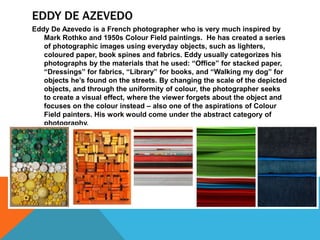
Eddy De Azevedo is a French photographer who is very much inspired by
Mark Rothko and 1950s Colour Field paintings. He has created a series
of photographic images using everyday objects, such as lighters,
coloured paper, book spines and fabrics. Eddy usually categorizes his
photographs by the materials that he used: “Office” for stacked paper,
“Dressings” for fabrics, “Library” for books, and “Walking my dog” for
objects he’s found on the streets. By changing the scale of the depicted
objects, and through the uniformity of colour, the photographer seeks
to create a visual effect, where the viewer forgets about the object and
focuses on the colour instead – also one of the aspirations of Colour
Field painters. His work would come under the abstract category of
photography.
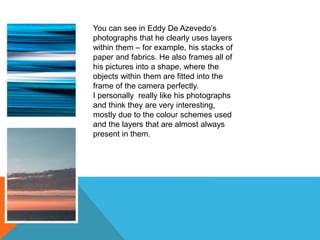
You can see in Eddy De Azevedo’s
photographs that he clearly uses layers
within them – for example, his stacks of
paper and fabrics. He also frames all of
his pictures into a shape, where the
objects within them are fitted into the
frame of the camera perfectly.
I personally really like his photographs
and think they are very interesting,
mostly due to the colour schemes used
and the layers that are almost always
present in them.
ABSTRACT PHOTOGRAPHY
There is no standard definition of abstract photography. Actually, it
is not easy to create a clear-cut definition of an abstract
concept. Abstract photography can produce very dramatic
images - it relies on our more primal sense of form, colour, and
curves than it does on detail. The problem is that most
photographers tend to think in terms of detail when evaluating
photographic opportunities. However, it takes a different way of
looking at our world to perceive the abstract photography
opportunities that surround us.
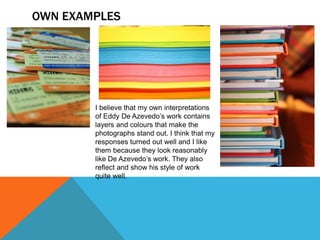
OWN EXAMPLES
I believe that my own interpretations
of Eddy De Azevedo’s work contains
layers and colours that make the
photographs stand out. I think that my
responses turned out well and I like
them because they look reasonably
like De Azevedo’s work. They also
reflect and show his style of work
quite well.

Eddy De Azevedo

  • 2.
    EDDY DE AZEVEDO EddyDe Azevedo is a French photographer who is very much inspired by Mark Rothko and 1950s Colour Field paintings. He has created a series of photographic images using everyday objects, such as lighters, coloured paper, book spines and fabrics. Eddy usually categorizes his photographs by the materials that he used: “Office” for stacked paper, “Dressings” for fabrics, “Library” for books, and “Walking my dog” for objects he’s found on the streets. By changing the scale of the depicted objects, and through the uniformity of colour, the photographer seeks to create a visual effect, where the viewer forgets about the object and focuses on the colour instead – also one of the aspirations of Colour Field painters. His work would come under the abstract category of photography.
  • 3.
    You can seein Eddy De Azevedo’s photographs that he clearly uses layers within them – for example, his stacks of paper and fabrics. He also frames all of his pictures into a shape, where the objects within them are fitted into the frame of the camera perfectly. I personally really like his photographs and think they are very interesting, mostly due to the colour schemes used and the layers that are almost always present in them.
  • 4.
    ABSTRACT PHOTOGRAPHY There isno standard definition of abstract photography. Actually, it is not easy to create a clear-cut definition of an abstract concept. Abstract photography can produce very dramatic images - it relies on our more primal sense of form, colour, and curves than it does on detail. The problem is that most photographers tend to think in terms of detail when evaluating photographic opportunities. However, it takes a different way of looking at our world to perceive the abstract photography opportunities that surround us.
  • 5.
    OWN EXAMPLES I believethat my own interpretations of Eddy De Azevedo’s work contains layers and colours that make the photographs stand out. I think that my responses turned out well and I like them because they look reasonably like De Azevedo’s work. They also reflect and show his style of work quite well.