Social Media and the Public Spherein the Dutch
Parliamentary Twitter Network: A Spacefor
Political Deliberation?
Marc EsteveDel Valle Rimmert Sijtsma Hanne Stegeman
Department of Media Studies and Journalism, University of Groningen, The
Netherlands
ECPR GeneralConference,Hamburg,Germany,22-25 August
2018
Outline
1 Objectives
2 Theoretical Background
3 Data & Methods
4 Political & Network Characteristics
5 Results
6 Discussion
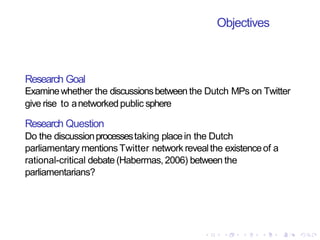
Objectives
Research Goal
Examinewhether the discussionsbetween the Dutch MPs on Twitter
give rise to anetworkedpublic sphere
Research Question
Do the discussionprocessestaking placein the Dutch
parliamentary mentions Twitter network revealthe existenceof a
rational-critical debate (Habermas,2006) between the
parliamentarians?
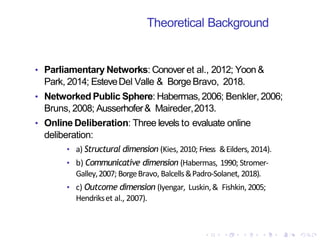
Theoretical Background
• Parliamentary Networks: Conover et al., 2012; Yoon &
Park, 2014; EsteveDel Valle & BorgeBravo, 2018.
• Networked Public Sphere: Habermas,2006; Benkler, 2006;
Bruns, 2008; Ausserhofer& Maireder,2013.
• Online Deliberation: Three levels to evaluate online
deliberation:
• a) Structural dimension (Kies, 2010; Friess &Eilders, 2014).
• b) Communicative dimension (Habermas, 1990; Stromer-
Galley,2007; BorgeBravo, Balcells&Padro-Solanet, 2018).
• c) Outcome dimension (Iyengar, Luskin,& Fishkin,2005;
Hendrikset al., 2007).
Hypotheses
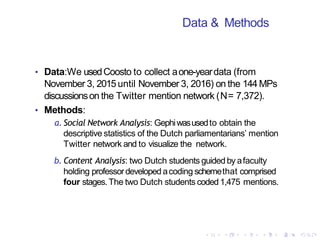
• H0: Assumesno relation between the criteria of deliberative
quality andthe Dutch MPs interactions in the Twitter
mention network.
• H1: Assumesthe institutional factors of Twitter to enable
online deliberation in the Dutch MPs’ Twitter mention
network.
• H2: Assumesthe existenceof arational-critical debate in the
the Dutch MPs' Twitter mention network.
Data & Methods
• Data:We usedCoosto to collect aone-yeardata (from
November 3, 2015 until November 3, 2016) on the 144 MPs
discussionson the Twitter mention network (N= 7,372).
• Methods:
a. Social Network Analysis: Gephiwasusedto obtain the
descriptive statistics of the Dutch parliamentarians’ mention
Twitter network and to visualize the network.
b. Content Analysis: two Dutch students guided by afaculty
holding professordeveloped acoding schemethat comprised
four stages.The two Dutch students coded1,475 mentions.
Data & Methods
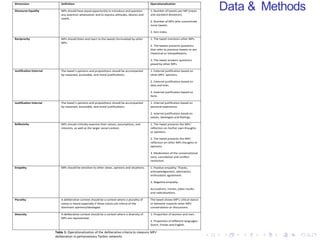
Table 1: Operationalization of the deliberative criteria to measure MPs’
deliberation in parliamentary Twitter networks
Dimension Definition Operationalization
Discourse Equality MPs should have equal opportunity to introduce and question
any assertion whatsoever and to express attitudes, desires and
needs.
1. Number of tweets per MP (mean
and standard deviation).
2. Number of MPs who concentrate
more tweets.
3. Gini index.
Reciprocity MPs should listen and react to the tweets formulated by other
MPs.
1. The tweet mentions other MPs.
2. The tweets presents questions
that refer to previous tweets or are
rhetorical or interpellations.
3. The tweet answers questions
posed by other MPs.
Justification External The tweet’s opinions and propositions should be accompanied
by reasoned, accessible, and moral justifications.
1. External justification based on
other MPs’ opinions.
2. External justification based on
data and links.
3. External justification based on
facts.
Justification Internal The tweet’s opinions and propositions should be accompanied
by reasoned, accessible, and moral justifications.
1. Internal justification based on
personal experience.
2. Internal justification based on
values, ideologies and feelings.
Reflexivity MPs should critically examine their values, assumptions, and
interests, as well as the larger social context.
1. The tweet presents the MPs’
reflection on his/her own thoughts
or opinions.
2. The tweet presents the MPs’
reflection on other MPs thoughts or
opinions.
3. Moderation of the conversational
tone, conciliation and conflict
resolution.
Empathy MPs should be sensitive to other views, opinions and situations. 1. Positive empathy: Thanks,
acknowledgement, admiration,
enthusiastic agreement.
2. Negative empathy:
Accusations, ironies, jokes insults,
and radicalizations.
Plurality A deliberative context should be a context where a plurality of
voices is heard especially if these voices are critical of the
dominant opinions/ideologies
The tweet shows MP’s critical stance
or behavior towards other MPs’
conversations or discussions.
Diversity A deliberative context should be a context where a diversity of
MPs are represented.
1. Proportion of women and men.
2. Proportion of different languages:
Dutch, Frisian and English.
Political & Network Characteristics
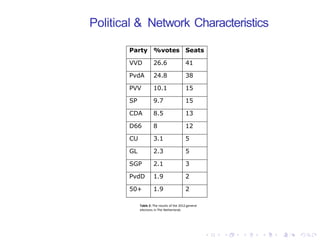
Party %votes Seats
VVD 26.6 41
PvdA 24.8 38
PVV 10.1 15
SP 9.7 15
CDA 8.5 13
D66 8 12
CU 3.1 5
GL 2.3 5
SGP 2.1 3
PvdD 1.9 2
50+ 1.9 2
Table 2: The results of the 2012 general
elections in The Netherlands
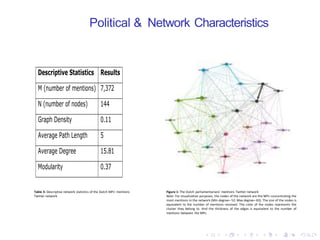
Political & Network Characteristics
Descriptive Statistics Results
M (number of mentions) 7,372
N (number of nodes) 144
Graph Density 0.11
Average Path Length 5
Average Degree 15.81
Modularity 0.37
Table 3: Descriptive network statistics of the Dutch MPs’ mentions
Twitter network
Figure 1: The Dutch parliamentarians’ mentions Twitter network
Note: For visualization purposes, the nodes of the network are the MPs concentrating the
most mentions in the network (Min degree= 52; Max degree= 83). The size of the nodes is
equivalent to the number of mentions received. The color of the nodes represents the
cluster they belong to. And the thickness of the edges is equivalent to the number of
mentions between the MPs.
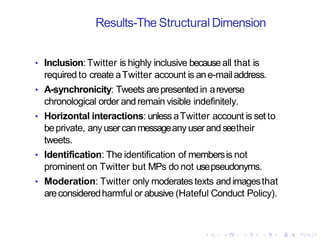
Results-The Structural Dimension
• Inclusion:Twitter is highly inclusive becauseall that is
required to create aTwitter account is ane-mailaddress.
• A-synchronicity: Tweets arepresentedin areverse
chronological order and remain visible indefinitely.
• Horizontal interactions: unless aTwitter account is set to
beprivate, anyusercanmessageany userand seetheir
tweets.
• Identification: The identification of membersis not
prominent on Twitter but MPs do not usepseudonyms.
• Moderation: Twitter only moderatestexts andimagesthat
areconsideredharmful or abusive (Hateful Conduct Policy).
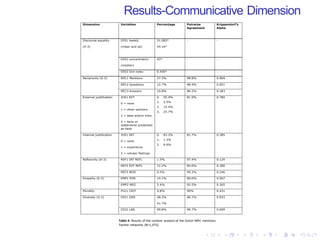
Results-Communicative Dimension
Table 4: Results of the content analysis of the Dutch MPs’ mentions
Twitter networks (N=1,475).
Dimension Variables Percentage Pairwise
Agreement
Krippendorf’s
Alpha
Discourse equality
(0-3)
DIS1 tweets
(mean and sd)
51.083*
44.16*
- -
DIS2 concentration
(median)
42* - -
DIS3 Gini index 0.456* - -
Reciprocity (0-3) REC1 Mentions 27.3% 98.8% 0.969
REC2 Questions 12.7% 98.9% 0.951
REC3 Answers 10.8% 86.2% 0.283
External justification JUS1 EXT
0 = none
1 = other opinions
2 = data and/or links
3 = facts or
statements presented
as facts
0. 55.4%
1. 3.5%
2. 15.4%
3. 25.7%
81.9% 0.784
Internal justification JUS1 INT
0 = none
1 = experience
2 = values/ feelings
0. 83.3%
1. 1.3%
2. 9.9%
81.7% 0.385
Reflexivity (0-3) REF1 INT REFL 1.5% 97.4% 0.124
REF2 EXT REFL 12.2% 84.6% 0.280
REF3 MOD 0.5% 99.2% 0.246
Empathy (0-2) EMP1 POS 14.1% 89.6% 0.567
EMP2 NEG 5.4% 92.5% 0.265
Plurality PLU1 CRIT 9.8% 90% 0.431
Diversity (0-2) DIV1 GEN 58.3%
41.7%
96.7% 0.933
DIV2 LAN 99.8% 99.7% 0.699
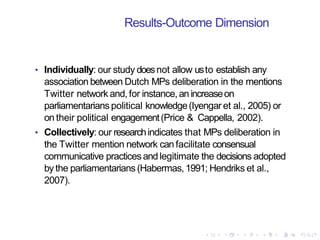
Results-Outcome Dimension
• Individually: our study doesnot allow usto establish any
association between Dutch MPs deliberation in the mentions
Twitter network and, for instance, an increaseon
parliamentarians political knowledge(Iyengaret al., 2005) or
on their political engagement(Price & Cappella, 2002).
• Collectively: our researchindicates that MPs deliberation in
the Twitter mention network can facilitate consensual
communicative practices andlegitimate the decisions adopted
by the parliamentarians (Habermas,1991; Hendriks et al.,
2007).
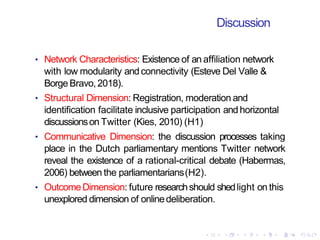
Discussion
• Network Characteristics: Existence of an affiliation network
with low modularity andconnectivity (Esteve Del Valle &
Borge Bravo,2018).
• Structural Dimension: Registration, moderation and
identification facilitate inclusive participation andhorizontal
discussionson Twitter (Kies, 2010) (H1)
• Communicative Dimension: the discussion processes taking
place in the Dutch parliamentary mentions Twitter network
reveal the existence of a rational-critical debate (Habermas,
2006) between the parliamentarians(H2).
• OutcomeDimension: future researchshould shedlight on this
unexplored dimension of onlinedeliberation.
ReferencesI
Benkler, Y.
The Wealth of Networks: How Social Production Transforms Markets and
Freedom
Yale University Press, 2006.
Habermas, J.
The Structural Transformation of the Public Sphere: An Inquiry into a
Category of Bourgeois Society
MIT Press, 1991.
Kies, R.
Promises and Limits ofWeb-deliberation
Palgrave Macmillan, 2010.
Borge Bravo, R., Balcells, J., & Padr-Solanet, A.
Online Citizen Deliberation through New Local Participatory Platforms
and Twitter: Barcelona CaseStudy.
ECPR Joint Sessionsof Workshops, University of Nicosia,Cyprus.
ReferencesII
Bruns, A.
Life Beyond the Public Sphere: Towards a Networked Model for Political
Deliberation
Information Polity: The International Journal of Government Democracy in
the Information Age 13(1/2): 65-79, 2008.
Ausserhofer, J., & Maireder, A.
National Politics on Twitter
Information, Communication & Society 16(3): 291314.
Conover, M., Ratkiewicz, J., Francisco, M. R., Gonalves, B., Menczer, F.,
& Flammini, A.
Political Polarization on Twitter.
Icwsm 133: 89-96,2018.
EsteveDel Valle, M., & Borge Bravo, R.
Leadersor Brokers? Potential Influencers in Online Parliamentary
Networks.
Policy & Internet, 10(1): 61-86, 2018.
ReferencesIII
Friess, D., & Eilders, C.
Towards a More Complex Approach to Measure and Explain
Deliberativeness Online.
The Internet, Policy & Politics Conference1-19, 2014.
Hendriks, C. M., Dryzek, J. S., Hunold, C.
Turning Up the Heat: Partisanship in Deliberative Innovation
Political Studies, 55(2): 362383,2007.
Habermas, J.
Political Communication in Media Society: Does Democracy Still Enjoy an
Epistemic Dimension? The Impact of Normative Theory on Empirical
Research.
Communication Theory, 16(4):411-426, 2006.
Iyengar, S., Luskin, R. C., & Fishkin, J. S.
Deliberative Preferences in the Presidential Nomination Campaign:
Evidence from an Online Deliberative Poll
Communication Theory, 16(4):411-426, 2006.
ReferencesIV
Price, V & Cappella, N. J.
Online Deliberation and its Influence: The Electronic Dialogue Project in
Campaign 2000
IT & Society 1: 303-329.
Stromer-Galley, J.
Measuring deliberations content: A coding scheme.
Journal of Public Deliberation, 3(1): 1-12, 2007.
Yoon, H. Y., & Park, H. W.
Strategies Affecting Twitter-based Networking Pattern of South Korean
Politicians: Social Network Analysis and Exponential Random Graph
Model.
Quality & Quantity 48(1): 409-423.
Thanks
Marc EsteveDel Valle
m.esteve.del.valle[at]rug.nl

Ecpr general conference_presentation

  • 1.
    Social Media andthe Public Spherein the Dutch Parliamentary Twitter Network: A Spacefor Political Deliberation? Marc EsteveDel Valle Rimmert Sijtsma Hanne Stegeman Department of Media Studies and Journalism, University of Groningen, The Netherlands ECPR GeneralConference,Hamburg,Germany,22-25 August 2018
  • 2.
    Outline 1 Objectives 2 TheoreticalBackground 3 Data & Methods 4 Political & Network Characteristics 5 Results 6 Discussion
  • 3.
    Objectives Research Goal Examinewhether thediscussionsbetween the Dutch MPs on Twitter give rise to anetworkedpublic sphere Research Question Do the discussionprocessestaking placein the Dutch parliamentary mentions Twitter network revealthe existenceof a rational-critical debate (Habermas,2006) between the parliamentarians?
  • 4.
    Theoretical Background • ParliamentaryNetworks: Conover et al., 2012; Yoon & Park, 2014; EsteveDel Valle & BorgeBravo, 2018. • Networked Public Sphere: Habermas,2006; Benkler, 2006; Bruns, 2008; Ausserhofer& Maireder,2013. • Online Deliberation: Three levels to evaluate online deliberation: • a) Structural dimension (Kies, 2010; Friess &Eilders, 2014). • b) Communicative dimension (Habermas, 1990; Stromer- Galley,2007; BorgeBravo, Balcells&Padro-Solanet, 2018). • c) Outcome dimension (Iyengar, Luskin,& Fishkin,2005; Hendrikset al., 2007).
  • 5.
    Hypotheses • H0: Assumesnorelation between the criteria of deliberative quality andthe Dutch MPs interactions in the Twitter mention network. • H1: Assumesthe institutional factors of Twitter to enable online deliberation in the Dutch MPs’ Twitter mention network. • H2: Assumesthe existenceof arational-critical debate in the the Dutch MPs' Twitter mention network.
  • 6.
    Data & Methods •Data:We usedCoosto to collect aone-yeardata (from November 3, 2015 until November 3, 2016) on the 144 MPs discussionson the Twitter mention network (N= 7,372). • Methods: a. Social Network Analysis: Gephiwasusedto obtain the descriptive statistics of the Dutch parliamentarians’ mention Twitter network and to visualize the network. b. Content Analysis: two Dutch students guided by afaculty holding professordeveloped acoding schemethat comprised four stages.The two Dutch students coded1,475 mentions.
  • 7.
    Data & Methods Table1: Operationalization of the deliberative criteria to measure MPs’ deliberation in parliamentary Twitter networks Dimension Definition Operationalization Discourse Equality MPs should have equal opportunity to introduce and question any assertion whatsoever and to express attitudes, desires and needs. 1. Number of tweets per MP (mean and standard deviation). 2. Number of MPs who concentrate more tweets. 3. Gini index. Reciprocity MPs should listen and react to the tweets formulated by other MPs. 1. The tweet mentions other MPs. 2. The tweets presents questions that refer to previous tweets or are rhetorical or interpellations. 3. The tweet answers questions posed by other MPs. Justification External The tweet’s opinions and propositions should be accompanied by reasoned, accessible, and moral justifications. 1. External justification based on other MPs’ opinions. 2. External justification based on data and links. 3. External justification based on facts. Justification Internal The tweet’s opinions and propositions should be accompanied by reasoned, accessible, and moral justifications. 1. Internal justification based on personal experience. 2. Internal justification based on values, ideologies and feelings. Reflexivity MPs should critically examine their values, assumptions, and interests, as well as the larger social context. 1. The tweet presents the MPs’ reflection on his/her own thoughts or opinions. 2. The tweet presents the MPs’ reflection on other MPs thoughts or opinions. 3. Moderation of the conversational tone, conciliation and conflict resolution. Empathy MPs should be sensitive to other views, opinions and situations. 1. Positive empathy: Thanks, acknowledgement, admiration, enthusiastic agreement. 2. Negative empathy: Accusations, ironies, jokes insults, and radicalizations. Plurality A deliberative context should be a context where a plurality of voices is heard especially if these voices are critical of the dominant opinions/ideologies The tweet shows MP’s critical stance or behavior towards other MPs’ conversations or discussions. Diversity A deliberative context should be a context where a diversity of MPs are represented. 1. Proportion of women and men. 2. Proportion of different languages: Dutch, Frisian and English.
  • 8.
    Political & NetworkCharacteristics Party %votes Seats VVD 26.6 41 PvdA 24.8 38 PVV 10.1 15 SP 9.7 15 CDA 8.5 13 D66 8 12 CU 3.1 5 GL 2.3 5 SGP 2.1 3 PvdD 1.9 2 50+ 1.9 2 Table 2: The results of the 2012 general elections in The Netherlands
  • 9.
    Political & NetworkCharacteristics Descriptive Statistics Results M (number of mentions) 7,372 N (number of nodes) 144 Graph Density 0.11 Average Path Length 5 Average Degree 15.81 Modularity 0.37 Table 3: Descriptive network statistics of the Dutch MPs’ mentions Twitter network Figure 1: The Dutch parliamentarians’ mentions Twitter network Note: For visualization purposes, the nodes of the network are the MPs concentrating the most mentions in the network (Min degree= 52; Max degree= 83). The size of the nodes is equivalent to the number of mentions received. The color of the nodes represents the cluster they belong to. And the thickness of the edges is equivalent to the number of mentions between the MPs.
  • 10.
    Results-The Structural Dimension •Inclusion:Twitter is highly inclusive becauseall that is required to create aTwitter account is ane-mailaddress. • A-synchronicity: Tweets arepresentedin areverse chronological order and remain visible indefinitely. • Horizontal interactions: unless aTwitter account is set to beprivate, anyusercanmessageany userand seetheir tweets. • Identification: The identification of membersis not prominent on Twitter but MPs do not usepseudonyms. • Moderation: Twitter only moderatestexts andimagesthat areconsideredharmful or abusive (Hateful Conduct Policy).
  • 11.
    Results-Communicative Dimension Table 4:Results of the content analysis of the Dutch MPs’ mentions Twitter networks (N=1,475). Dimension Variables Percentage Pairwise Agreement Krippendorf’s Alpha Discourse equality (0-3) DIS1 tweets (mean and sd) 51.083* 44.16* - - DIS2 concentration (median) 42* - - DIS3 Gini index 0.456* - - Reciprocity (0-3) REC1 Mentions 27.3% 98.8% 0.969 REC2 Questions 12.7% 98.9% 0.951 REC3 Answers 10.8% 86.2% 0.283 External justification JUS1 EXT 0 = none 1 = other opinions 2 = data and/or links 3 = facts or statements presented as facts 0. 55.4% 1. 3.5% 2. 15.4% 3. 25.7% 81.9% 0.784 Internal justification JUS1 INT 0 = none 1 = experience 2 = values/ feelings 0. 83.3% 1. 1.3% 2. 9.9% 81.7% 0.385 Reflexivity (0-3) REF1 INT REFL 1.5% 97.4% 0.124 REF2 EXT REFL 12.2% 84.6% 0.280 REF3 MOD 0.5% 99.2% 0.246 Empathy (0-2) EMP1 POS 14.1% 89.6% 0.567 EMP2 NEG 5.4% 92.5% 0.265 Plurality PLU1 CRIT 9.8% 90% 0.431 Diversity (0-2) DIV1 GEN 58.3% 41.7% 96.7% 0.933 DIV2 LAN 99.8% 99.7% 0.699
  • 12.
    Results-Outcome Dimension • Individually:our study doesnot allow usto establish any association between Dutch MPs deliberation in the mentions Twitter network and, for instance, an increaseon parliamentarians political knowledge(Iyengaret al., 2005) or on their political engagement(Price & Cappella, 2002). • Collectively: our researchindicates that MPs deliberation in the Twitter mention network can facilitate consensual communicative practices andlegitimate the decisions adopted by the parliamentarians (Habermas,1991; Hendriks et al., 2007).
  • 13.
    Discussion • Network Characteristics:Existence of an affiliation network with low modularity andconnectivity (Esteve Del Valle & Borge Bravo,2018). • Structural Dimension: Registration, moderation and identification facilitate inclusive participation andhorizontal discussionson Twitter (Kies, 2010) (H1) • Communicative Dimension: the discussion processes taking place in the Dutch parliamentary mentions Twitter network reveal the existence of a rational-critical debate (Habermas, 2006) between the parliamentarians(H2). • OutcomeDimension: future researchshould shedlight on this unexplored dimension of onlinedeliberation.
  • 14.
    ReferencesI Benkler, Y. The Wealthof Networks: How Social Production Transforms Markets and Freedom Yale University Press, 2006. Habermas, J. The Structural Transformation of the Public Sphere: An Inquiry into a Category of Bourgeois Society MIT Press, 1991. Kies, R. Promises and Limits ofWeb-deliberation Palgrave Macmillan, 2010. Borge Bravo, R., Balcells, J., & Padr-Solanet, A. Online Citizen Deliberation through New Local Participatory Platforms and Twitter: Barcelona CaseStudy. ECPR Joint Sessionsof Workshops, University of Nicosia,Cyprus.
  • 15.
    ReferencesII Bruns, A. Life Beyondthe Public Sphere: Towards a Networked Model for Political Deliberation Information Polity: The International Journal of Government Democracy in the Information Age 13(1/2): 65-79, 2008. Ausserhofer, J., & Maireder, A. National Politics on Twitter Information, Communication & Society 16(3): 291314. Conover, M., Ratkiewicz, J., Francisco, M. R., Gonalves, B., Menczer, F., & Flammini, A. Political Polarization on Twitter. Icwsm 133: 89-96,2018. EsteveDel Valle, M., & Borge Bravo, R. Leadersor Brokers? Potential Influencers in Online Parliamentary Networks. Policy & Internet, 10(1): 61-86, 2018.
  • 16.
    ReferencesIII Friess, D., &Eilders, C. Towards a More Complex Approach to Measure and Explain Deliberativeness Online. The Internet, Policy & Politics Conference1-19, 2014. Hendriks, C. M., Dryzek, J. S., Hunold, C. Turning Up the Heat: Partisanship in Deliberative Innovation Political Studies, 55(2): 362383,2007. Habermas, J. Political Communication in Media Society: Does Democracy Still Enjoy an Epistemic Dimension? The Impact of Normative Theory on Empirical Research. Communication Theory, 16(4):411-426, 2006. Iyengar, S., Luskin, R. C., & Fishkin, J. S. Deliberative Preferences in the Presidential Nomination Campaign: Evidence from an Online Deliberative Poll Communication Theory, 16(4):411-426, 2006.
  • 17.
    ReferencesIV Price, V &Cappella, N. J. Online Deliberation and its Influence: The Electronic Dialogue Project in Campaign 2000 IT & Society 1: 303-329. Stromer-Galley, J. Measuring deliberations content: A coding scheme. Journal of Public Deliberation, 3(1): 1-12, 2007. Yoon, H. Y., & Park, H. W. Strategies Affecting Twitter-based Networking Pattern of South Korean Politicians: Social Network Analysis and Exponential Random Graph Model. Quality & Quantity 48(1): 409-423.
  • 18.

Editor's Notes

  • #9 144 MPs (96%). 11 parties divided in 2 axes (Left-Right; Christian-Liberal).