Is Social Media Challenging
Traditional Politics?
Social Media Lab Speaker Series, November 26, 2015
Marc Esteve Del Valle
mesteved@ryerson.ca
@NetMev
Outline
1. Social Media and Traditional Politics
2. Research Questions and Hypotheses
3. Case Study: The Catalan Parliament
4. Approach and Methods
5. Results
@NETMEV 2
Social Media and Politics
Opportunities:
 To listen the electorate
 To engage with the electorate
Challenges:
 Parties’ hierarchical organization
 Politicians’ behavior towards social media
@NETMEV 3
Desireit.wordpress.com
Social Media and Political Research
 Streams of Research:
Electoral studies: parties and candidates use of Twitter and Facebook during the political
campaigns (Tumasjan et al, 2010; Aragon et al, 2012)
Personalization of Politics: Twitter used by political leaders to reinforce their intraparty
position and contact directly with the electorate (Klinger, 2014; Esteve Del Valle, 2015)
@NETMEV 4
 My Research:
Twitter and Polarization: exposure to cross-ideological opinions (Arendt, 1968; Calhoun,
1988; Habermas, 1989) is an inherent factor of the democratic health of representative
institutions
Twitter and Opinion Leaders: Party Leadership should be threatened by the emergence
of new leaders (Duverger, 1954)
Twitter and Politics: Polarization?
@NETMEV 5
Conover et al, 2011
Retweet Network Mention Network
• Red: Left
Wing
• Blue: Right
Wing
Twitter and Politics: Opinion Leaders
@NETMEV 6
Katz, 1957
Leadership in Twitter NetworksLeadership in Mass Media
• Black Node=
Politician
• Grey Nodes=
other
politicians
• Lines=
relations
(followers,
retweets or
mentions)
Is Social Media Challenging Traditional
Politics?
@NETMEV 7
o.canada.com Forbes.com
Twitter Networks
Following- Follower Network: network of parliamentarians following other parliamentarians
Retweet Network: network of parliamentarians retweeting other parliamentarians
Mention Network: network parliamentarians mentioning other parliamentarians
@NETMEV 8
Outline
1. Social Media and Traditional Politics
2. Research Questions and Hypotheses
3. Case Study: The Catalan Parliament
4. Approach and Methods
5. Results
@NETMEV 9
Research Questions
 Research Question 1: Is Twitter facilitating parliamentarians' exposure to cross-
ideological opinion or is it confining them to like-minded clusters?
Research Question 2: Who are the opinion leaders of the following-follower,
retweet and mention networks of parliamentarians and what are their
characteristics?
@NETMEV 10
Hypotheses
 Hypothesis 1: Communication flows of Catalan parliamentarians' following-
follower and retweet Twitter networks are party and ideological polarized while
those of the mention network revel some cross-ideological and cross-party
connections
 Hypothesis 2: Communication flows of the Catalan parliamentarians'
following-follower, retweet and mention Twitter networks are empowering
highly visible political leaders
@NETMEV 11
Outline
1. Social Media and Traditional Politics
2. Research Questions and Hypotheses
3. Case Study: The Catalan Parliament
4. Approach and Methods
5. Results
@NETMEV 12
The Catalan Parliament: 2013-2014
Early adoption of social media by Catalan
parliament: “Parliament 2.0” (2009)
Parliamentarians’ use of Twitter: In 2014
85% of Catalan parliamentarians used
Twitter
Number of Political Parties: 7
Ideological Axis : 2
@NETMEV 13
Parlament.cat
The Catalan Parliament: Parties and
Ideological Axis
@NETMEV 14
Outline
1. Social Media and Traditional Politics
2. Research Questions and Hypotheses
3. Case Study: The Catalan Parliament
4. Approach and Methods
5. Results
@NETMEV 15
Approach and Methods
@NETMEV 16
 Network Approach: understand how the relations between Catalan MPs explain polarization
and leadership in the Catalan parliamentarian Twitter network.
 Statistical Analysis: to find the parliamentarians exposure to cross-ideological opinions and
build statistical models to discover the factors behind Catalan parliamentarians leadership in
the following-follower, retweet and mention networks.
Creation of a Data Base
Catalan Parliamentarians socio-demographic and political characteristics:
Socio-demographic characteristics: Age, gender and education level.
Electoral characteristics: Incumbency and Political party.
Parliament activity: Number of interventions in the Plenary, Number of interventions in
commissions and Number of commissions in which the MPs participate.
Political position: Political position in the Parliament and in the parliamentarian group,
Political position in Parliament commissions, Political Position in the political party, Position
on the Left-Right axis and Position on the Catalan Nationalist- Non Nationalist axis
@NETMEV 17
Creation of a Data Base
Catalan Parliamentarians behavior on Twitter:
Period of Time: 1 January 2013 and 31 March 2014
Data: All relations (4,516), retweets (6,045) and mentions (19,507) of Catalan MPs
Internet behavior: blog, Facebook.
Twitter activity: Number of followers (MPs), Number of parliamentarians followed, Tweets
x day, Favorites per day, Retweets (received and sent), Mentions (received and sent).
@NETMEV 18
Outline
1. Social Media and Traditional Politics
2. Research Questions and Hypotheses
3. Case Study: The Catalan Parliament
4. Approach and Methods
5. Results
@NETMEV 19
Political Polarization: Catalan MPs’
Following-Follower Network
@NETMEV 20
Political Polarization: Catalan MPs’
Following-Follower Network
@NETMEV 21
*The nodes of the network are the
115 deputies with Twitter account
**The size of the nodes is
equivalent to the number of
followers of the MPs
***The color of the nodes indicates
the political party they belong to:
orange (CIU), yellow (ERC), red
(PSC), blue (PP), green (ICV), brown
(C’S) and violet (CUP)
The following-follower network of the Catalan parliamentarians’ Twitter Network
(January 1st 2013- March 31 2014)
Catalan Nationalist- Non
Nationalist Axis
Left-Right Axis
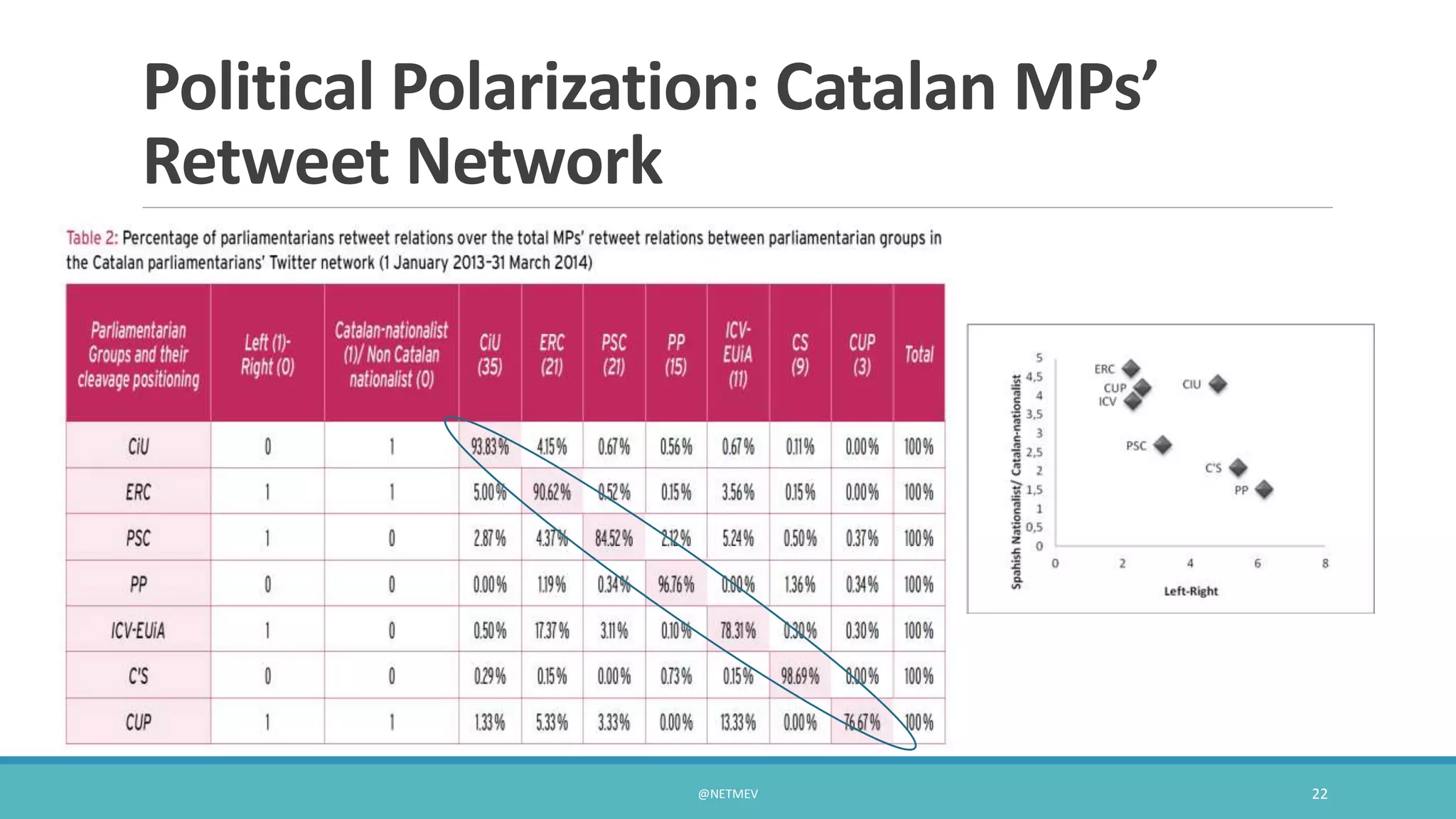
Political Polarization: Catalan MPs’
Retweet Network
@NETMEV 22
Political Polarization: Catalan MPs
Mention Network
@NETMEV 23
Political Polarization: Catalan MPs
Mention Network
@NETMEV 24
*The nodes of the network are the
115 deputies with Twitter account
**The size of the nodes is equivalent
to the number of mentions of the
MPs
***The color of the nodes indicates
the political party they belong to:
orange (CIU), yellow (ERC), red (PSC),
blue (PP), green (ICV), brown (C’S)
and violet (CUP)
The Mention network of the Catalan parliamentarians’ Twitter Network
(January 1st 2013- March 31 2014)
Political Polarization: Following-
Follower and Mention Network
@NETMEV 25
The following-follower network of the Catalan parliamentarians’ Twitter Network
(January 1st 2013- March 31 2014)
The Mention network of the Catalan parliamentarians’ Twitter Network
(January 1st 2013- March 31 2014)
@NETMEV 26
Opinion leaders
• Following-Follower: MPs position in the
Parliament is significant
• Retweet Network: Neither the MPs
position in the Parliamentarian nor their
Political Position are significant
• Mention Network: The Political position is
significant (and the in-degree highly
significant)
Political Leadership
CATALAN MPS’ FOLLOWING-
FOLLOWER NETWORK
CATALAN MPS’ MENTION NETWORK
Rocio Martinez Pere Navarro
Oriol Junqueras Oriol Junqueras
Joana Ortega Joana Ortega
Josep Rull Marta Rovira
Jaume Collboni Marina Geli
Dolors Camats Albert Rivera
Marina Geli Oriol Amoros
Marta Rovira Alicia Camacho
Joan herrera Joan Herrera
Perea Aragonès Josep Rull
@NETMEV 27
Table 5: Top 10 most followed and mentioned MPs
• In Red: Party
Leaders
• In Blue: Ordinary
MPs
Political Leadership
@NETMEV 28
Table 5: Top 10 most retweeted MPs
CATALAN MPS’ RETWEET NETWORK
Rocio Martinez
Marc Sanglas
Marina Geli
Oriol Amoros
David Companyon
Josep Rull
Joan Igansi Elelena
Marta Rovira
Meritxell Rotge
Merce Senserich
Conclusions
Yes, Twitter is Challenging Traditional Politics because:
 Facilitates communication between MPs who think differently (the polarization degree of
Catalan parliamentarians Twitter network is higher in the following-follower and mention
network than in the retweet network)
 Ordinary MPs (different from party leaders) are emerging as the opinion leaders of the
retweet network
@NETMEV 29
Limitations
The research studies the direction of the communication flows but not the content
The research is focus in one party system
The regression models could be refined
@NETMEV 30
Is social Media Challenging
Traditional Politics?
Social Media Lab Speaker Series, November 26, 2015
Marc Esteve Del Valle
mesteved@ryerson.ca
@NetMev

Is social media challenging traditional politics ?

  • 1.
    Is Social MediaChallenging Traditional Politics? Social Media Lab Speaker Series, November 26, 2015 Marc Esteve Del Valle mesteved@ryerson.ca @NetMev
  • 2.
    Outline 1. Social Mediaand Traditional Politics 2. Research Questions and Hypotheses 3. Case Study: The Catalan Parliament 4. Approach and Methods 5. Results @NETMEV 2
  • 3.
    Social Media andPolitics Opportunities:  To listen the electorate  To engage with the electorate Challenges:  Parties’ hierarchical organization  Politicians’ behavior towards social media @NETMEV 3 Desireit.wordpress.com
  • 4.
    Social Media andPolitical Research  Streams of Research: Electoral studies: parties and candidates use of Twitter and Facebook during the political campaigns (Tumasjan et al, 2010; Aragon et al, 2012) Personalization of Politics: Twitter used by political leaders to reinforce their intraparty position and contact directly with the electorate (Klinger, 2014; Esteve Del Valle, 2015) @NETMEV 4  My Research: Twitter and Polarization: exposure to cross-ideological opinions (Arendt, 1968; Calhoun, 1988; Habermas, 1989) is an inherent factor of the democratic health of representative institutions Twitter and Opinion Leaders: Party Leadership should be threatened by the emergence of new leaders (Duverger, 1954)
  • 5.
    Twitter and Politics:Polarization? @NETMEV 5 Conover et al, 2011 Retweet Network Mention Network • Red: Left Wing • Blue: Right Wing
  • 6.
    Twitter and Politics:Opinion Leaders @NETMEV 6 Katz, 1957 Leadership in Twitter NetworksLeadership in Mass Media • Black Node= Politician • Grey Nodes= other politicians • Lines= relations (followers, retweets or mentions)
  • 7.
    Is Social MediaChallenging Traditional Politics? @NETMEV 7 o.canada.com Forbes.com
  • 8.
    Twitter Networks Following- FollowerNetwork: network of parliamentarians following other parliamentarians Retweet Network: network of parliamentarians retweeting other parliamentarians Mention Network: network parliamentarians mentioning other parliamentarians @NETMEV 8
  • 9.
    Outline 1. Social Mediaand Traditional Politics 2. Research Questions and Hypotheses 3. Case Study: The Catalan Parliament 4. Approach and Methods 5. Results @NETMEV 9
  • 10.
    Research Questions  ResearchQuestion 1: Is Twitter facilitating parliamentarians' exposure to cross- ideological opinion or is it confining them to like-minded clusters? Research Question 2: Who are the opinion leaders of the following-follower, retweet and mention networks of parliamentarians and what are their characteristics? @NETMEV 10
  • 11.
    Hypotheses  Hypothesis 1:Communication flows of Catalan parliamentarians' following- follower and retweet Twitter networks are party and ideological polarized while those of the mention network revel some cross-ideological and cross-party connections  Hypothesis 2: Communication flows of the Catalan parliamentarians' following-follower, retweet and mention Twitter networks are empowering highly visible political leaders @NETMEV 11
  • 12.
    Outline 1. Social Mediaand Traditional Politics 2. Research Questions and Hypotheses 3. Case Study: The Catalan Parliament 4. Approach and Methods 5. Results @NETMEV 12
  • 13.
    The Catalan Parliament:2013-2014 Early adoption of social media by Catalan parliament: “Parliament 2.0” (2009) Parliamentarians’ use of Twitter: In 2014 85% of Catalan parliamentarians used Twitter Number of Political Parties: 7 Ideological Axis : 2 @NETMEV 13 Parlament.cat
  • 14.
    The Catalan Parliament:Parties and Ideological Axis @NETMEV 14
  • 15.
    Outline 1. Social Mediaand Traditional Politics 2. Research Questions and Hypotheses 3. Case Study: The Catalan Parliament 4. Approach and Methods 5. Results @NETMEV 15
  • 16.
    Approach and Methods @NETMEV16  Network Approach: understand how the relations between Catalan MPs explain polarization and leadership in the Catalan parliamentarian Twitter network.  Statistical Analysis: to find the parliamentarians exposure to cross-ideological opinions and build statistical models to discover the factors behind Catalan parliamentarians leadership in the following-follower, retweet and mention networks.
  • 17.
    Creation of aData Base Catalan Parliamentarians socio-demographic and political characteristics: Socio-demographic characteristics: Age, gender and education level. Electoral characteristics: Incumbency and Political party. Parliament activity: Number of interventions in the Plenary, Number of interventions in commissions and Number of commissions in which the MPs participate. Political position: Political position in the Parliament and in the parliamentarian group, Political position in Parliament commissions, Political Position in the political party, Position on the Left-Right axis and Position on the Catalan Nationalist- Non Nationalist axis @NETMEV 17
  • 18.
    Creation of aData Base Catalan Parliamentarians behavior on Twitter: Period of Time: 1 January 2013 and 31 March 2014 Data: All relations (4,516), retweets (6,045) and mentions (19,507) of Catalan MPs Internet behavior: blog, Facebook. Twitter activity: Number of followers (MPs), Number of parliamentarians followed, Tweets x day, Favorites per day, Retweets (received and sent), Mentions (received and sent). @NETMEV 18
  • 19.
    Outline 1. Social Mediaand Traditional Politics 2. Research Questions and Hypotheses 3. Case Study: The Catalan Parliament 4. Approach and Methods 5. Results @NETMEV 19
  • 20.
    Political Polarization: CatalanMPs’ Following-Follower Network @NETMEV 20
  • 21.
    Political Polarization: CatalanMPs’ Following-Follower Network @NETMEV 21 *The nodes of the network are the 115 deputies with Twitter account **The size of the nodes is equivalent to the number of followers of the MPs ***The color of the nodes indicates the political party they belong to: orange (CIU), yellow (ERC), red (PSC), blue (PP), green (ICV), brown (C’S) and violet (CUP) The following-follower network of the Catalan parliamentarians’ Twitter Network (January 1st 2013- March 31 2014) Catalan Nationalist- Non Nationalist Axis Left-Right Axis
  • 22.
    Political Polarization: CatalanMPs’ Retweet Network @NETMEV 22
  • 23.
    Political Polarization: CatalanMPs Mention Network @NETMEV 23
  • 24.
    Political Polarization: CatalanMPs Mention Network @NETMEV 24 *The nodes of the network are the 115 deputies with Twitter account **The size of the nodes is equivalent to the number of mentions of the MPs ***The color of the nodes indicates the political party they belong to: orange (CIU), yellow (ERC), red (PSC), blue (PP), green (ICV), brown (C’S) and violet (CUP) The Mention network of the Catalan parliamentarians’ Twitter Network (January 1st 2013- March 31 2014)
  • 25.
    Political Polarization: Following- Followerand Mention Network @NETMEV 25 The following-follower network of the Catalan parliamentarians’ Twitter Network (January 1st 2013- March 31 2014) The Mention network of the Catalan parliamentarians’ Twitter Network (January 1st 2013- March 31 2014)
  • 26.
    @NETMEV 26 Opinion leaders •Following-Follower: MPs position in the Parliament is significant • Retweet Network: Neither the MPs position in the Parliamentarian nor their Political Position are significant • Mention Network: The Political position is significant (and the in-degree highly significant)
  • 27.
    Political Leadership CATALAN MPS’FOLLOWING- FOLLOWER NETWORK CATALAN MPS’ MENTION NETWORK Rocio Martinez Pere Navarro Oriol Junqueras Oriol Junqueras Joana Ortega Joana Ortega Josep Rull Marta Rovira Jaume Collboni Marina Geli Dolors Camats Albert Rivera Marina Geli Oriol Amoros Marta Rovira Alicia Camacho Joan herrera Joan Herrera Perea Aragonès Josep Rull @NETMEV 27 Table 5: Top 10 most followed and mentioned MPs • In Red: Party Leaders • In Blue: Ordinary MPs
  • 28.
    Political Leadership @NETMEV 28 Table5: Top 10 most retweeted MPs CATALAN MPS’ RETWEET NETWORK Rocio Martinez Marc Sanglas Marina Geli Oriol Amoros David Companyon Josep Rull Joan Igansi Elelena Marta Rovira Meritxell Rotge Merce Senserich
  • 29.
    Conclusions Yes, Twitter isChallenging Traditional Politics because:  Facilitates communication between MPs who think differently (the polarization degree of Catalan parliamentarians Twitter network is higher in the following-follower and mention network than in the retweet network)  Ordinary MPs (different from party leaders) are emerging as the opinion leaders of the retweet network @NETMEV 29
  • 30.
    Limitations The research studiesthe direction of the communication flows but not the content The research is focus in one party system The regression models could be refined @NETMEV 30
  • 31.
    Is social MediaChallenging Traditional Politics? Social Media Lab Speaker Series, November 26, 2015 Marc Esteve Del Valle mesteved@ryerson.ca @NetMev

Editor's Notes

  • #7 Is Twitter giving room for the appearance of new leaders? Can be found in: what I want to see if the pattern of information diffusion could be corroborated in Twitter.
  • #27 List of bullet points; Name the tittle