COMMUNITY STRUCTURE IN
CONGRESSIONAL
CONVERSATION NETWORKS
Or, the paper formerly known as
Relationships Among Twitter Conversation
Networks, Language Use, and Congressional
Voting

Libby Hemphill, Jahna Otterbacher, and
Matthew Shapiro
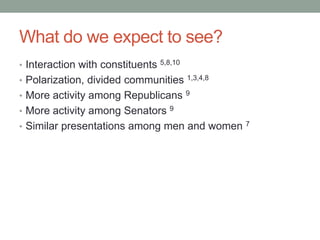
What do we expect to see?
• Interaction with constituents   5,8,10

• Polarization, divided communities        1,3,4,8

• More activity among Republicans          9

• More activity among Senators      9

• Similar presentations among men and women          7
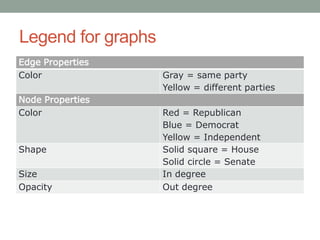
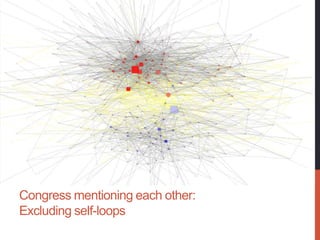
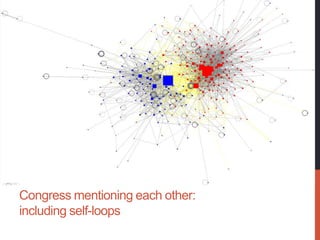
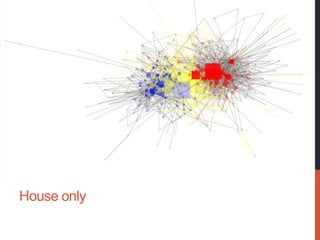
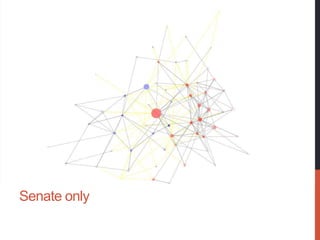
Legend for graphs
Edge Properties
Color               Gray = same party
                    Yellow = different parties
Node Properties
Color               Red = Republican
                    Blue = Democrat
                    Yellow = Independent
Shape               Solid square = House
                    Solid circle = Senate
Size                In degree
Opacity             Out degree
April 12, 2012         Shapiro, Hemphill, and Otterbacher


Congress mentioning each other:
Excluding self-loops
April 12, 2012         Shapiro, Hemphill, and Otterbacher


Congress mentioning each other:
including self-loops
April 12, 2012   Shapiro, Hemphill, and Otterbacher


House only
April 12, 2012   Shapiro, Hemphill, and Otterbacher


Senate only
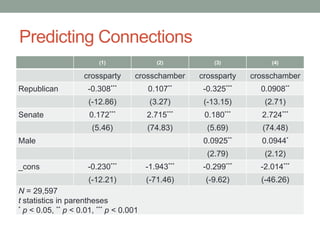
Predicting Connections
                         (1)                (2)          (3)           (4)

                    crossparty       crosschamber    crossparty   crosschamber
Republican            -0.308***          0.107**      -0.325***     0.0908**
                      (-12.86)            (3.27)      (-13.15)       (2.71)
Senate                0.172***           2.715***     0.180***      2.724***
                       (5.46)            (74.83)       (5.69)       (74.48)
Male                                                  0.0925**      0.0944*
                                                       (2.79)        (2.12)
_cons                 -0.230***          -1.943***    -0.299***     -2.014***
                      (-12.21)           (-71.46)     (-9.62)       (-46.26)
N = 29,597
t statistics in parentheses
* p < 0.05, ** p < 0.01, *** p < 0.001
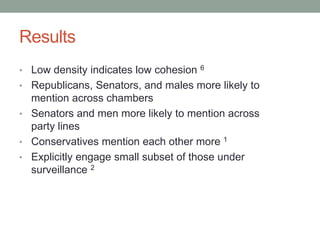
Results
• Low density indicates low cohesion   6

• Republicans, Senators, and males more likely to
  mention across chambers
• Senators and men more likely to mention across
  party lines
• Conservatives mention each other more 1
• Explicitly engage small subset of those under
  surveillance 2
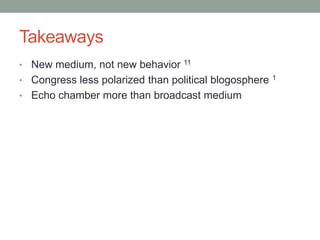
Takeaways
• New medium, not new behavior    11

• Congress less polarized than political blogosphere   1

• Echo chamber more than broadcast medium
Contact us
• Libby Hemphill (libby.hemphill@iit.edu)
• Jahna Otterbacher (jotterba@iit.edu)
• Matt Shapiro (mshapir2@iit.edu)


• Illinois Institute of Technology
• info@casmlab.org
• http://www.casmlab.org/projects/publicofficials/
References
1.    Adamic, L. A., & Glance, N. (2005). The political blogosphere and the 2004 U.S. election: Divided they blog. Proceedings
      of the 3rd International Workshop on Link Discovery (LinkKDD ’05) (pp. 36–43). New York, NY, USA: ACM. Retrieved
      from http://portal.acm.org/citation.cfm?id=1134277
2.    Bakshy, E., Hofman, J. M., Watts, D. J., & Mason, W. A. (2011). Everyone’s an influencer: Quantifying influence on Twitter.
      Proceedings of the fourth ACM International Conference on Web Search and Data Mining (WSDM ’11) (pp. 65-74). New
      York: ACM.
3.    Conover, M. D., Ratkiewicz, J., Francisco, M., Goncalves, B., Flammini, A., & Menczer, F. (2011). Political polarization on
      Twitter. Proceedings of the Fifth International AAAI Conference on Weblogs and Social Media (pp. 89-96). Palo Alto: AAAI
      Press.
4.    Iyengar, S., & Hahn, K. S. (2009). Red Media, Blue Media: Evidence of Ideological Selectivity in Media Use. Journal of
      Communication, 59(1), 19-39. Retrieved from http://doi.wiley.com/10.1111/j.1460-2466.2008.01402.x
5.    Johnson, D. W. (2004). Congress Online: Bridging the Gap Between Citizens and Their Representatives (Google eBook)
      (p. 242). Psychology Press. Retrieved from http://books.google.com/books?hl=en&lr=&id=0vgVHQTpygkC&pgis=1
6.    Livne, A., Simmons, M. P., Adar, E., & Adamic, L. A. (2011). The party is over here: Structure and content in the 2010
      election. 5th International AAAI Conference on Weblogs and Social Media (ICWSM). Palto Alto: AAAI Press.
7.    Niven, D., & Zilber, J. (2001). Do Women and Men in Congress Cultivate Different Images? Evidence from Congressional
      Web Sites. Political Communication, 18(4), 395-405. Routledge. Retrieved from
      http://www.tandfonline.com/doi/abs/10.1080/10584600152647100
8.    Parmelee, J. H., & Bichard, S. L. (2011). Politics and the Twitter Revolution: How Tweets Influence the Relationship
      Between Political Leaders and the Public (Google eBook) (Vol. 2011, p. 247). Lexington Books. Retrieved from
      http://books.google.com/books?id=KPn5Pnkhx7sC&pgis=1
9.    Wang, (Bryan) M., Hanna, A., Sayre, B., Yang, J., Mirer, M., Kim, M., & Shah, D. (2011). Who is following me? An analysis
      of candidate egocentric networks on Twitter in the 2010 midterm elections. 2011 Midwest Political Science Association
      Annual National Conference. Chicago: MPSA.
10.   Williams, C. B., & Gulati, G. J. (2010). Communicating with constituents in 140 characters or less: Twitter and the diffusion
      of technology innovation in the United States Congress . SSRN eLibrary. Chicago: SSRN. Retrieved from
      http://ssrn.com/paper=1817053
11.   Xenos, M. A., & Foot, K. A. (2005). Politics as usual, or politics unusual? Position taking and dialogue on campaign
      websites in the 2002 U.S. Elections. Journal of Communication, 55(1), 169-185. Retrieved from
      http://doi.wiley.com/10.1111/j.1460-2466.2005.tb02665.x

Community Structure in Congressional Conversation Networks

  • 1.
    COMMUNITY STRUCTURE IN CONGRESSIONAL CONVERSATIONNETWORKS Or, the paper formerly known as Relationships Among Twitter Conversation Networks, Language Use, and Congressional Voting Libby Hemphill, Jahna Otterbacher, and Matthew Shapiro
  • 2.
    What do weexpect to see? • Interaction with constituents 5,8,10 • Polarization, divided communities 1,3,4,8 • More activity among Republicans 9 • More activity among Senators 9 • Similar presentations among men and women 7
  • 3.
    Legend for graphs EdgeProperties Color Gray = same party Yellow = different parties Node Properties Color Red = Republican Blue = Democrat Yellow = Independent Shape Solid square = House Solid circle = Senate Size In degree Opacity Out degree
  • 4.
    April 12, 2012 Shapiro, Hemphill, and Otterbacher Congress mentioning each other: Excluding self-loops
  • 5.
    April 12, 2012 Shapiro, Hemphill, and Otterbacher Congress mentioning each other: including self-loops
  • 6.
    April 12, 2012 Shapiro, Hemphill, and Otterbacher House only
  • 7.
    April 12, 2012 Shapiro, Hemphill, and Otterbacher Senate only
  • 8.
    Predicting Connections (1) (2) (3) (4) crossparty crosschamber crossparty crosschamber Republican -0.308*** 0.107** -0.325*** 0.0908** (-12.86) (3.27) (-13.15) (2.71) Senate 0.172*** 2.715*** 0.180*** 2.724*** (5.46) (74.83) (5.69) (74.48) Male 0.0925** 0.0944* (2.79) (2.12) _cons -0.230*** -1.943*** -0.299*** -2.014*** (-12.21) (-71.46) (-9.62) (-46.26) N = 29,597 t statistics in parentheses * p < 0.05, ** p < 0.01, *** p < 0.001
  • 9.
    Results • Low densityindicates low cohesion 6 • Republicans, Senators, and males more likely to mention across chambers • Senators and men more likely to mention across party lines • Conservatives mention each other more 1 • Explicitly engage small subset of those under surveillance 2
  • 10.
    Takeaways • New medium,not new behavior 11 • Congress less polarized than political blogosphere 1 • Echo chamber more than broadcast medium
  • 11.
    Contact us • LibbyHemphill (libby.hemphill@iit.edu) • Jahna Otterbacher (jotterba@iit.edu) • Matt Shapiro (mshapir2@iit.edu) • Illinois Institute of Technology • info@casmlab.org • http://www.casmlab.org/projects/publicofficials/
  • 12.
    References 1. Adamic, L. A., & Glance, N. (2005). The political blogosphere and the 2004 U.S. election: Divided they blog. Proceedings of the 3rd International Workshop on Link Discovery (LinkKDD ’05) (pp. 36–43). New York, NY, USA: ACM. Retrieved from http://portal.acm.org/citation.cfm?id=1134277 2. Bakshy, E., Hofman, J. M., Watts, D. J., & Mason, W. A. (2011). Everyone’s an influencer: Quantifying influence on Twitter. Proceedings of the fourth ACM International Conference on Web Search and Data Mining (WSDM ’11) (pp. 65-74). New York: ACM. 3. Conover, M. D., Ratkiewicz, J., Francisco, M., Goncalves, B., Flammini, A., & Menczer, F. (2011). Political polarization on Twitter. Proceedings of the Fifth International AAAI Conference on Weblogs and Social Media (pp. 89-96). Palo Alto: AAAI Press. 4. Iyengar, S., & Hahn, K. S. (2009). Red Media, Blue Media: Evidence of Ideological Selectivity in Media Use. Journal of Communication, 59(1), 19-39. Retrieved from http://doi.wiley.com/10.1111/j.1460-2466.2008.01402.x 5. Johnson, D. W. (2004). Congress Online: Bridging the Gap Between Citizens and Their Representatives (Google eBook) (p. 242). Psychology Press. Retrieved from http://books.google.com/books?hl=en&lr=&id=0vgVHQTpygkC&pgis=1 6. Livne, A., Simmons, M. P., Adar, E., & Adamic, L. A. (2011). The party is over here: Structure and content in the 2010 election. 5th International AAAI Conference on Weblogs and Social Media (ICWSM). Palto Alto: AAAI Press. 7. Niven, D., & Zilber, J. (2001). Do Women and Men in Congress Cultivate Different Images? Evidence from Congressional Web Sites. Political Communication, 18(4), 395-405. Routledge. Retrieved from http://www.tandfonline.com/doi/abs/10.1080/10584600152647100 8. Parmelee, J. H., & Bichard, S. L. (2011). Politics and the Twitter Revolution: How Tweets Influence the Relationship Between Political Leaders and the Public (Google eBook) (Vol. 2011, p. 247). Lexington Books. Retrieved from http://books.google.com/books?id=KPn5Pnkhx7sC&pgis=1 9. Wang, (Bryan) M., Hanna, A., Sayre, B., Yang, J., Mirer, M., Kim, M., & Shah, D. (2011). Who is following me? An analysis of candidate egocentric networks on Twitter in the 2010 midterm elections. 2011 Midwest Political Science Association Annual National Conference. Chicago: MPSA. 10. Williams, C. B., & Gulati, G. J. (2010). Communicating with constituents in 140 characters or less: Twitter and the diffusion of technology innovation in the United States Congress . SSRN eLibrary. Chicago: SSRN. Retrieved from http://ssrn.com/paper=1817053 11. Xenos, M. A., & Foot, K. A. (2005). Politics as usual, or politics unusual? Position taking and dialogue on campaign websites in the 2002 U.S. Elections. Journal of Communication, 55(1), 169-185. Retrieved from http://doi.wiley.com/10.1111/j.1460-2466.2005.tb02665.x