www.SustainabilityAllianceAZ.org • www.SustainabilityCertifications.org
Do well by doing good
In the last 15 years, there has been a huge shift toward sustainable
business practices (which help the community and the environment
and also increase profitability). This is happening in part because
striving for sustainability:
 Reduces operating costs.
 Drives innovation.
 Attracts and retains talented employees (especially Millennials).
 Creates efficiencies and reduces expenses.
 Improves the company’s image.
 Brings into compliance vendors to large corporations. (Did you know
the majority of the largest businesses are pursuing sustainability?)
 Helps the business foresee future regulations and get ahead of them.
Why certify your business?
Do you strive to be a responsible business, helping
the community, being a preferred employer, and
reducing your environmental footprint?
 Get recognition for your ‘good business’ deeds and methods
 Attract the growing cadre of customers want to do business with those
who share their values
 Energize your employees with a powerful mission
 Differentiate yourself from your competitors
 Discover what the sustainable ‘end game’ is for your business
 Identify practical actions you can make now to reduce costs and
improve your impact on the community and the environment
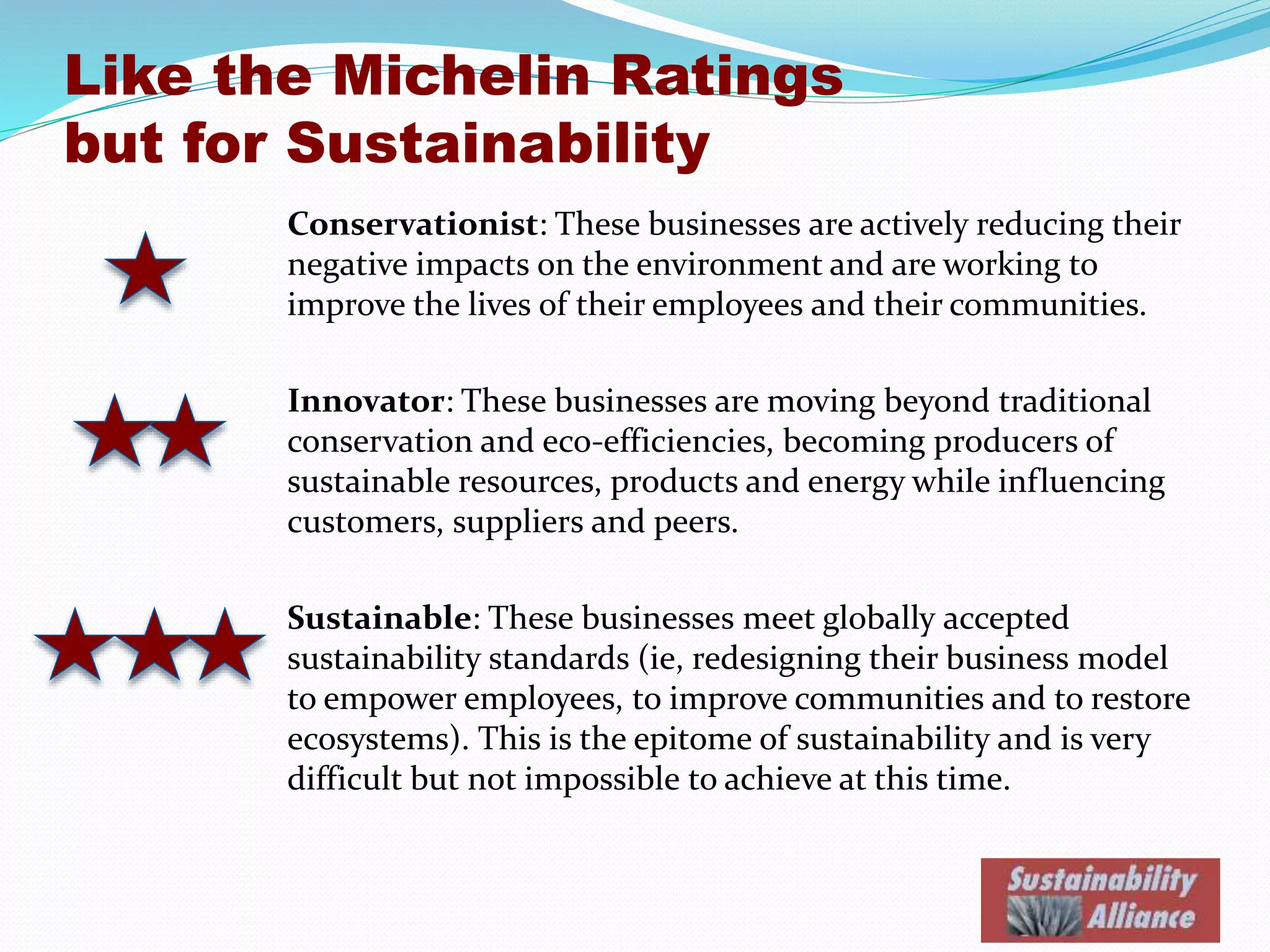
How sustainable is your business?
Conservationist (BRONZE): These businesses
are actively reducing their negative impacts on the
environment and are working to improve the lives
of their employees and their communities.
Innovator (SILVER): These businesses are
moving beyond traditional conservation and eco-
efficiencies, becoming producers of sustainable
resources, products and energy while influencing
customers, suppliers and peers.
Sustainable (GOLD): These businesses meet
globally accepted sustainability standards (ie,
redesigning their business model to empower
employees, to improve communities and to
restore ecosystems). This is the epitome of
sustainability and is very difficult but not
impossible to achieve at this time.
How to get started
If you’re unsure your business would qualify:
 Take the Sustainable Business Certification as a guest to assess your
organization, learn about sustainable business practices and see if you
might qualify for one of our levels of certification. [NOTE: You can review
the questions but if you want to save your results, JOIN first.]
If you’ve been working on sustainability for a while:
 Complete your profile and certification questions so see what level of
certification you qualify for. See your stars build as you work.
 If you write in things you are doing which you think might qualify as an
alternative to the practices in the certification, a Sustainability Alliance
member will contact you with your final certification level.
There are only 12 questions; it takes about 15 minutes. Go to
www.SustainabilityCertifications.org
How to get help
 Want help filling out the survey?
 Want to schedule a meeting to explore how to improve
your sustainability performance?
Contact Darcy Hitchcock
Darcy@SustainabilityAllianceAZ.org
928-554-5171
How you get recognized
What we do for you
 Prepare a Press Release
 Include you in our list of certified business linked to your website
 Get certified businesses or our link referenced by others (eg, Chamber
of Commerce, Sedona Monthly, Kudos)
What you can do
 Post our Certified Sustainable Business decal on your facility door
 Use the Certification Badge on website and other marketing materials
 Include reference to certification on Trip Advisor, Facebook, Yelp and
other social media
FAQ’s
 What does it cost? Becoming certified is currently free. After 2017, there may be a nominal fee to
cover administrative costs (currently estimated to be under $50). Anyone can take the survey as a
guest for free.
 How long is the certification good for? You should recertify every year to get credit for your
improvements and continue to use the badges.
 What if I made significant changes before the year is up and think I could earn another star?
Take the certification again—no charge.
 How do customers know the certifications are accurate? The claims certified businesses make
will be available to the public. If customers or competitors notify us of an inaccurate claim, the
business will be given 60 days to correct the problem or have its certification stripped.
 What if I have more than one location or facility? Certify each location separately unless their
management and facility are similar.
 What if my business is certified in another program—We want to know about it. However, no
other certification is based on a scientific framework and goes to full sustainability. So you will learn a
lot by going through ours.
 Why did the Sustainability Alliance create its own certification—Most certifications are, in our
view, weak. “You recycle, great, you’re a certified green business!” We could find no other existing
certification was easy and fast, based on hard science, provided levels of performance, included social
as well as environmental issues and went to full sustainability.
FAQ’s
 What is this certification based on? The Natural Step’s 4 principles or
system conditions are derived from hard science and describe a fully
sustainable society. Paraphrased, they call on businesses to:
 Move away from or close the loop on non-renewable resources and
energy
 Move away from or close the loop on toxic materials (especially
persistent bioaccumulative toxins).
 Preserve and restore critical ecosystems and their functions (eg,
cleaning air and water, creating renewable resources like fish and
lumber)
 Address human needs (for employees, customers, the local
communities and suppliers)
For more info on The Natural Step principles, go to Sustainability Illustrated and The Natural Step
For more insight into the structure of the questions in the
certification, please see the following slides.
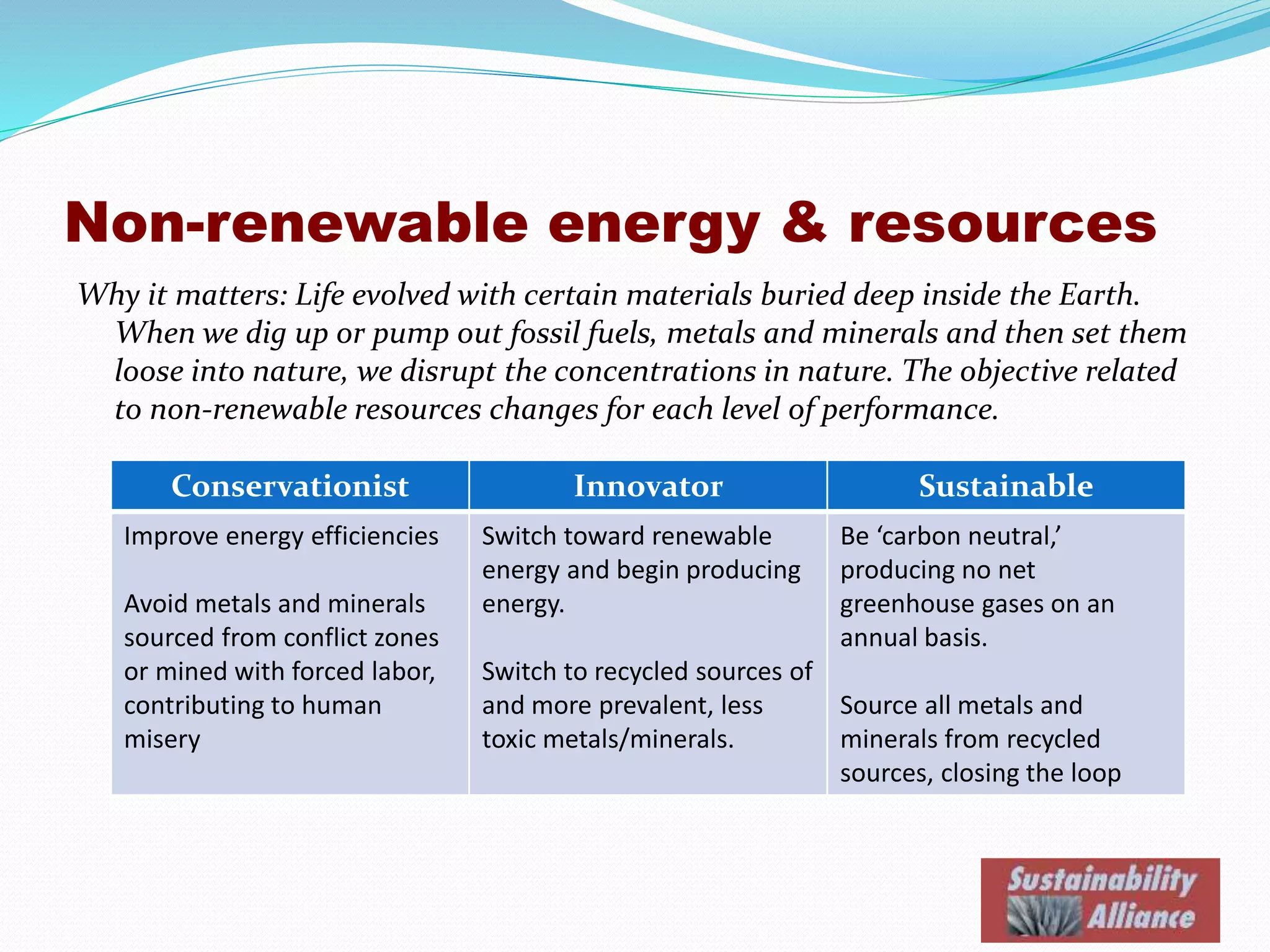
Non-renewable energy & resources
Why it matters: Life evolved with certain materials buried deep inside the Earth.
When we dig up or pump out fossil fuels, metals and minerals and then set them
loose into nature, we disrupt the concentrations in nature. The objective related
to non-renewable resources changes for each level of performance.
Conservationist Innovator Sustainable
Improve energy efficiencies
Avoid metals and minerals
sourced from conflict zones
or mined with forced labor,
contributing to human
misery
Switch toward renewable
energy and begin producing
energy.
Switch to recycled sources of
and more prevalent, less
toxic metals/minerals.
Be ‘carbon neutral,’
producing no net
greenhouse gases on an
annual basis.
Source all metals and
minerals from recycled
sources, closing the loop
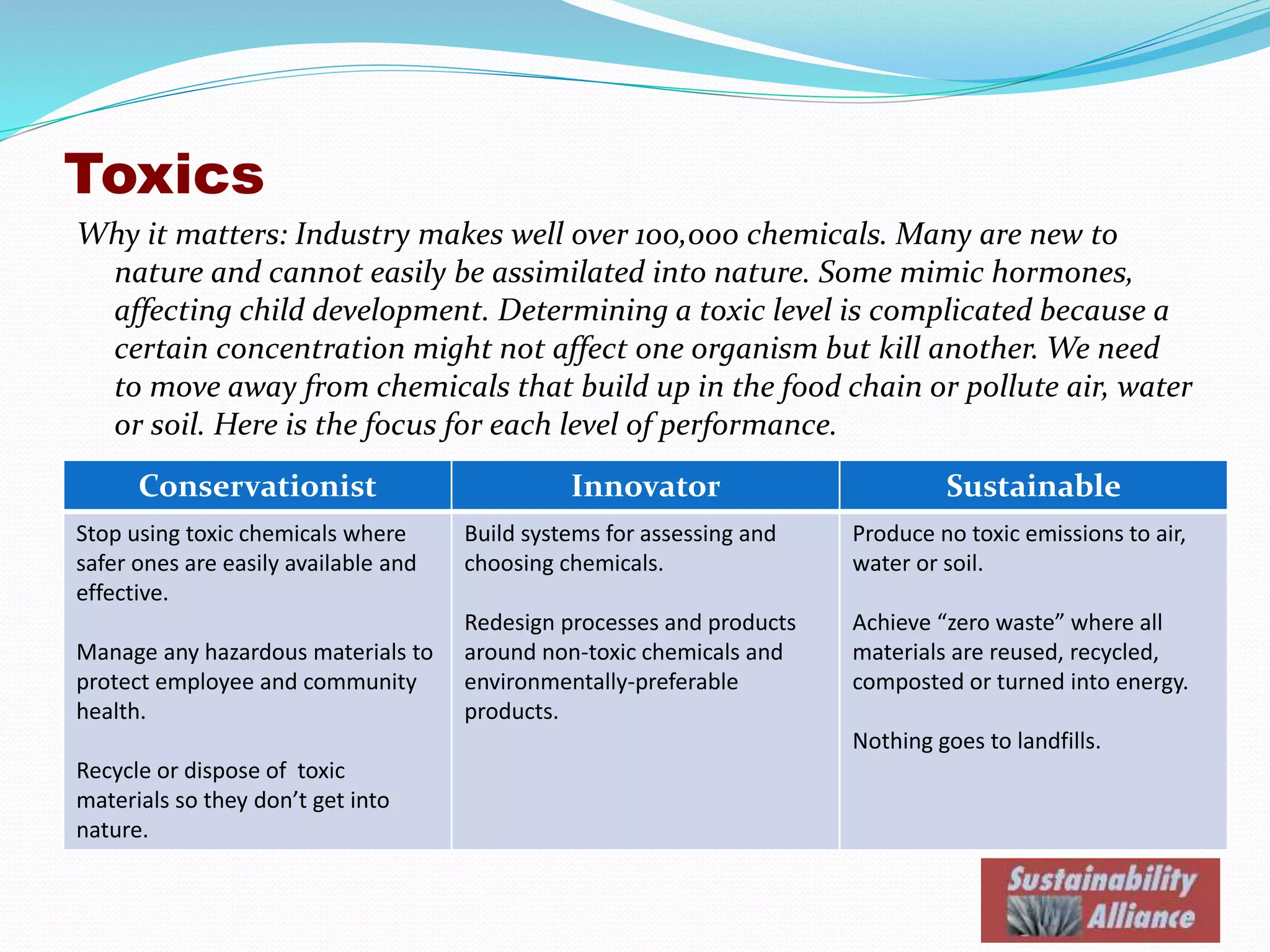
Toxics
Why it matters: Industry makes well over 100,000 chemicals. Many are new to
nature and cannot easily be assimilated into nature. Some mimic hormones,
affecting child development. Determining a toxic level is complicated because a
certain concentration might not affect one organism but kill another. We need
to move away from chemicals that build up in the food chain or pollute air, water
or soil. Here is the focus for each level of performance.
.
Conservationist Innovator Sustainable
Stop using toxic chemicals where
safer ones are easily available and
effective.
Manage any hazardous materials to
protect employee and community
health.
Recycle or dispose of toxic
materials so they don’t get into
nature.
Build systems for assessing and
choosing chemicals.
Redesign processes and products
around non-toxic chemicals and
environmentally-preferable
products.
Produce no toxic emissions to air,
water or soil.
Achieve “zero waste” where all
materials are reused, recycled,
composted or turned into energy.
Nothing goes to landfills.
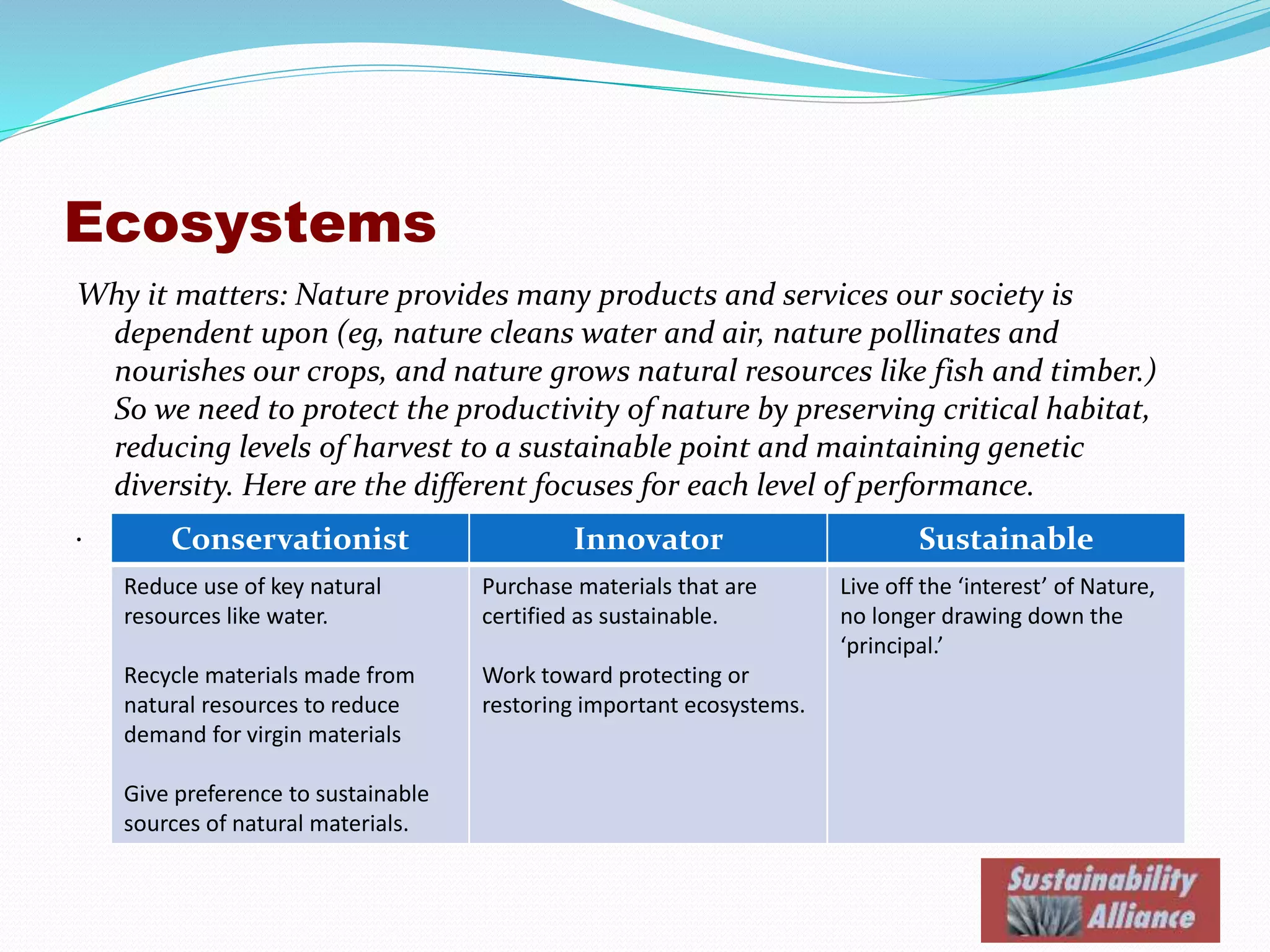
Ecosystems
Why it matters: Nature provides many products and services our society is
dependent upon (eg, nature cleans water and air, nature pollinates and
nourishes our crops, and nature grows natural resources like fish and timber.)
So we need to protect the productivity of nature by preserving critical habitat,
reducing levels of harvest to a sustainable point and maintaining genetic
diversity. Here are the different focuses for each level of performance.
. Conservationist Innovator Sustainable
Reduce use of key natural
resources like water.
Recycle materials made from
natural resources to reduce
demand for virgin materials
Give preference to sustainable
sources of natural materials.
Purchase materials that are
certified as sustainable.
Work toward protecting or
restoring important ecosystems.
Live off the ‘interest’ of Nature,
no longer drawing down the
‘principal.’
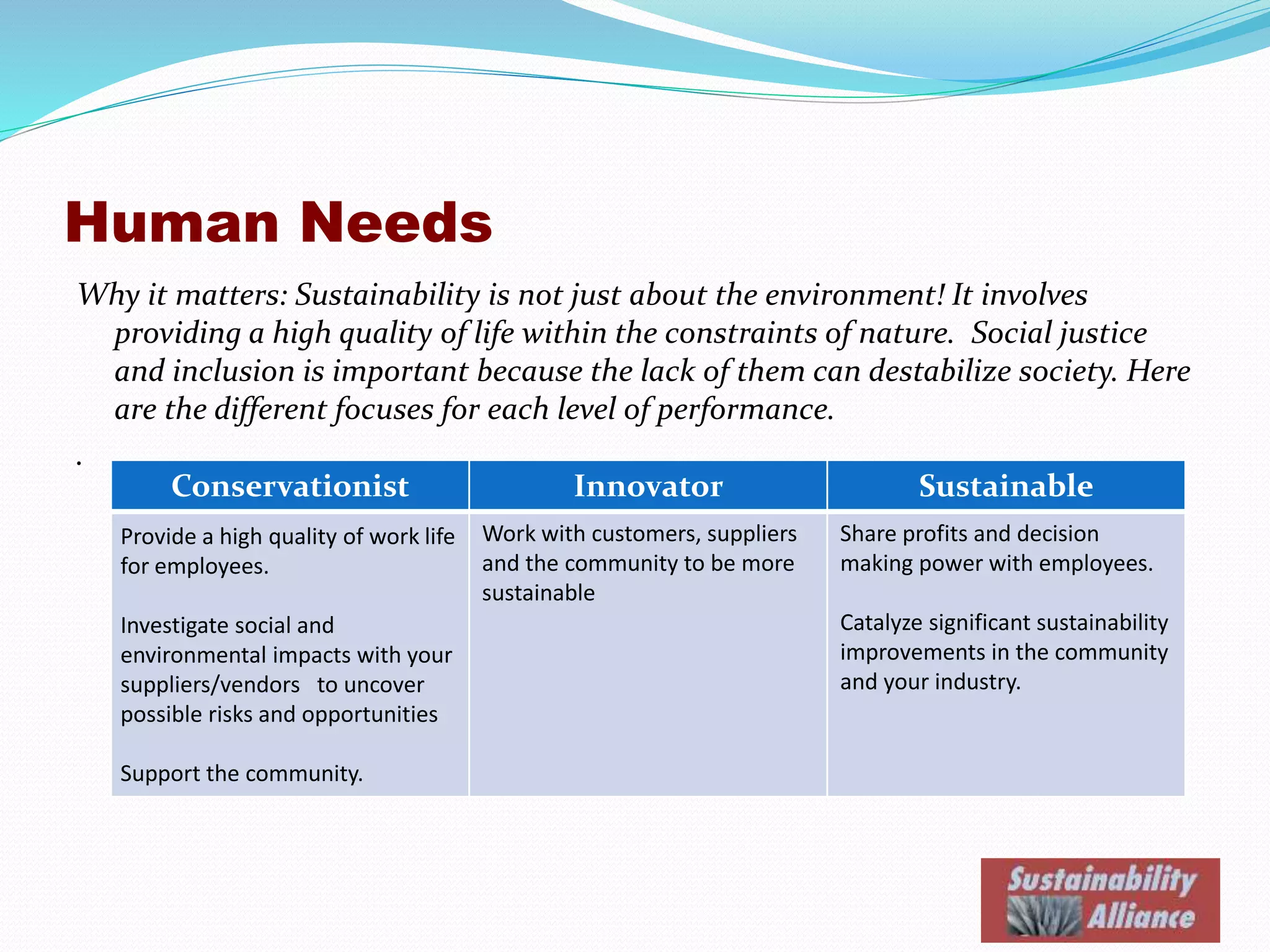
Human Needs
Why it matters: Sustainability is not just about the environment! It involves
providing a high quality of life within the constraints of nature. Social justice
and inclusion is important because the lack of them can destabilize society. Here
are the different focuses for each level of performance.
.
Conservationist Innovator Sustainable
Provide a high quality of work life
for employees.
Investigate social and
environmental impacts with your
suppliers/vendors to uncover
possible risks and opportunities
Support the community.
Work with customers, suppliers
and the community to be more
sustainable
Share profits and decision
making power with employees.
Catalyze significant sustainability
improvements in the community
and your industry.

Sustainable Business Certification: overview

  • 1.
  • 2.
    Do well bydoing good In the last 15 years, there has been a huge shift toward sustainable business practices (which help the community and the environment and also increase profitability). This is happening in part because striving for sustainability:  Reduces operating costs.  Drives innovation.  Attracts and retains talented employees (especially Millennials).  Creates efficiencies and reduces expenses.  Improves the company’s image.  Brings into compliance vendors to large corporations. (Did you know the majority of the largest businesses are pursuing sustainability?)  Helps the business foresee future regulations and get ahead of them.
  • 3.
    Why certify yourbusiness? Do you strive to be a responsible business, helping the community, being a preferred employer, and reducing your environmental footprint?  Get recognition for your ‘good business’ deeds and methods  Attract the growing cadre of customers want to do business with those who share their values  Energize your employees with a powerful mission  Differentiate yourself from your competitors  Discover what the sustainable ‘end game’ is for your business  Identify practical actions you can make now to reduce costs and improve your impact on the community and the environment
  • 4.
    How sustainable isyour business? Conservationist (BRONZE): These businesses are actively reducing their negative impacts on the environment and are working to improve the lives of their employees and their communities. Innovator (SILVER): These businesses are moving beyond traditional conservation and eco- efficiencies, becoming producers of sustainable resources, products and energy while influencing customers, suppliers and peers. Sustainable (GOLD): These businesses meet globally accepted sustainability standards (ie, redesigning their business model to empower employees, to improve communities and to restore ecosystems). This is the epitome of sustainability and is very difficult but not impossible to achieve at this time.
  • 5.
    How to getstarted If you’re unsure your business would qualify:  Take the Sustainable Business Certification as a guest to assess your organization, learn about sustainable business practices and see if you might qualify for one of our levels of certification. [NOTE: You can review the questions but if you want to save your results, JOIN first.] If you’ve been working on sustainability for a while:  Complete your profile and certification questions so see what level of certification you qualify for. See your stars build as you work.  If you write in things you are doing which you think might qualify as an alternative to the practices in the certification, a Sustainability Alliance member will contact you with your final certification level. There are only 12 questions; it takes about 15 minutes. Go to www.SustainabilityCertifications.org
  • 6.
    How to gethelp  Want help filling out the survey?  Want to schedule a meeting to explore how to improve your sustainability performance? Contact Darcy Hitchcock Darcy@SustainabilityAllianceAZ.org 928-554-5171
  • 7.
    How you getrecognized What we do for you  Prepare a Press Release  Include you in our list of certified business linked to your website  Get certified businesses or our link referenced by others (eg, Chamber of Commerce, Sedona Monthly, Kudos) What you can do  Post our Certified Sustainable Business decal on your facility door  Use the Certification Badge on website and other marketing materials  Include reference to certification on Trip Advisor, Facebook, Yelp and other social media
  • 8.
    FAQ’s  What doesit cost? Becoming certified is currently free. After 2017, there may be a nominal fee to cover administrative costs (currently estimated to be under $50). Anyone can take the survey as a guest for free.  How long is the certification good for? You should recertify every year to get credit for your improvements and continue to use the badges.  What if I made significant changes before the year is up and think I could earn another star? Take the certification again—no charge.  How do customers know the certifications are accurate? The claims certified businesses make will be available to the public. If customers or competitors notify us of an inaccurate claim, the business will be given 60 days to correct the problem or have its certification stripped.  What if I have more than one location or facility? Certify each location separately unless their management and facility are similar.  What if my business is certified in another program—We want to know about it. However, no other certification is based on a scientific framework and goes to full sustainability. So you will learn a lot by going through ours.  Why did the Sustainability Alliance create its own certification—Most certifications are, in our view, weak. “You recycle, great, you’re a certified green business!” We could find no other existing certification was easy and fast, based on hard science, provided levels of performance, included social as well as environmental issues and went to full sustainability.
  • 9.
    FAQ’s  What isthis certification based on? The Natural Step’s 4 principles or system conditions are derived from hard science and describe a fully sustainable society. Paraphrased, they call on businesses to:  Move away from or close the loop on non-renewable resources and energy  Move away from or close the loop on toxic materials (especially persistent bioaccumulative toxins).  Preserve and restore critical ecosystems and their functions (eg, cleaning air and water, creating renewable resources like fish and lumber)  Address human needs (for employees, customers, the local communities and suppliers) For more info on The Natural Step principles, go to Sustainability Illustrated and The Natural Step
  • 10.
    For more insightinto the structure of the questions in the certification, please see the following slides.
  • 11.
    Non-renewable energy &resources Why it matters: Life evolved with certain materials buried deep inside the Earth. When we dig up or pump out fossil fuels, metals and minerals and then set them loose into nature, we disrupt the concentrations in nature. The objective related to non-renewable resources changes for each level of performance. Conservationist Innovator Sustainable Improve energy efficiencies Avoid metals and minerals sourced from conflict zones or mined with forced labor, contributing to human misery Switch toward renewable energy and begin producing energy. Switch to recycled sources of and more prevalent, less toxic metals/minerals. Be ‘carbon neutral,’ producing no net greenhouse gases on an annual basis. Source all metals and minerals from recycled sources, closing the loop
  • 12.
    Toxics Why it matters:Industry makes well over 100,000 chemicals. Many are new to nature and cannot easily be assimilated into nature. Some mimic hormones, affecting child development. Determining a toxic level is complicated because a certain concentration might not affect one organism but kill another. We need to move away from chemicals that build up in the food chain or pollute air, water or soil. Here is the focus for each level of performance. . Conservationist Innovator Sustainable Stop using toxic chemicals where safer ones are easily available and effective. Manage any hazardous materials to protect employee and community health. Recycle or dispose of toxic materials so they don’t get into nature. Build systems for assessing and choosing chemicals. Redesign processes and products around non-toxic chemicals and environmentally-preferable products. Produce no toxic emissions to air, water or soil. Achieve “zero waste” where all materials are reused, recycled, composted or turned into energy. Nothing goes to landfills.
  • 13.
    Ecosystems Why it matters:Nature provides many products and services our society is dependent upon (eg, nature cleans water and air, nature pollinates and nourishes our crops, and nature grows natural resources like fish and timber.) So we need to protect the productivity of nature by preserving critical habitat, reducing levels of harvest to a sustainable point and maintaining genetic diversity. Here are the different focuses for each level of performance. . Conservationist Innovator Sustainable Reduce use of key natural resources like water. Recycle materials made from natural resources to reduce demand for virgin materials Give preference to sustainable sources of natural materials. Purchase materials that are certified as sustainable. Work toward protecting or restoring important ecosystems. Live off the ‘interest’ of Nature, no longer drawing down the ‘principal.’
  • 14.
    Human Needs Why itmatters: Sustainability is not just about the environment! It involves providing a high quality of life within the constraints of nature. Social justice and inclusion is important because the lack of them can destabilize society. Here are the different focuses for each level of performance. . Conservationist Innovator Sustainable Provide a high quality of work life for employees. Investigate social and environmental impacts with your suppliers/vendors to uncover possible risks and opportunities Support the community. Work with customers, suppliers and the community to be more sustainable Share profits and decision making power with employees. Catalyze significant sustainability improvements in the community and your industry.