Industry Roundtable on Zero and Low GWP HCFC Alternatives Leena Wokeck [email_address] www.csr-asia.com Male, 8-9 May 2011
Outline Introduction to CSR Climate Change – the number one CSR issue in Asia  Maldives Commitment to be carbon neutral by 2010 – key industries need to step up to the challenge: CSR in the Tourism and Fisheries industries Conclusion: Business solutions to global challenges
Defining Corporate Social Responsibility “ the commitment of businesses  to contribute to sustainable economic development ”  (IFC World Bank)  “ a company’s commitment to operating  in an economically, socially and environmentally sustainable manner  whilst balancing the interests of diverse stakeholders.”  (CSR Asia)
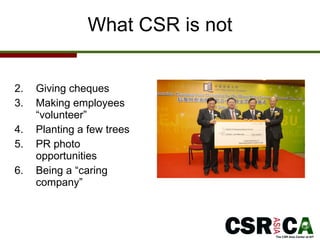
What CSR is not Giving cheques Making employees “volunteer” Planting a few trees PR photo opportunities Being a “caring company”
Strategic CSR - beyond philanthropy Understanding the broad interests and expectations of society  Understanding the reciprocal relationship  between b usiness’ everyday activities and the world around it Willingness of an organization to take responsibility and to be accountable for its impacts on society and the environment Respect for the rule of law and going beyond it The need to integrate social responsibility throughout the whole organization
“ We believe that  business cannot succeed in societies that fail .  We believe that […] the leading global companies of the future will be those that do business in ways that address, openly and transparently, the  world ’ s major challenges,  including poverty and inequity,  climate change , pollution, resource depletion, globalization and demographic shifts. ” (WBCSD)  “ Not only can  corporate and social needs be integrated , but the success of the developing world in improving prosperity is of  fundamental strategic importance  to almost every company”   Professor Michael Porter, Harvard Business School “ An organization’s performance in relation to the society in which it operates and its impacts on the environment has become a  critical part of measuring its overall performance and its ability to continue operating effectively .  ”  ISO 26000
The Business Case for Social Responsibility Increasing stakeholder demand for good CSR performance  Enhancing reputation and trust Improving risk management Improving relationships with stakeholders Improving employee morale, loyalty and productivity Improving resource efficiency and lowering negative environmental impacts as well as costs Promoting sustainability of natural resources and environmental services Driving innovation and access to new markets Enhancing competitiveness through improved products and processes
CSR is about… responsible business practices and sustainable development Climate change Corporate governance Water Supply chain concerns  Community development, base of the pyramid initiatives Environmental pollution Increased regulation and leadership from governments Bribery and corruption Product responsibility and sustainable consumption Employee health and wellbeing The Future of CSR: CSR Asia’s  CSR in 10  project  Emerging trends and issues for corporate social responsibility over the next decade
CSR in the Tourism Sector Key issues Climate change Resource use, environment, and biodiversity Employment practices, community impacts, supply chains Key drivers and opportunities Increased climate and eco conscious customers in a client facing industry Differentiation and competitive advantages Reducing conflicts with communities over resources Brand protection and building Energy efficiency and cost savings Reducing carbon footprint
CSR in the Fisheries Sector Key issues Climate change Sustainable fisheries and environmental protection  Food safety Employment practices Key drivers and opportunities  Cold chain key for the industry - saving cost by saving energy  Consumer focus on sustainable food production and supply chain traceability  Labeling initiatives like the Marine Stewardship Council Market opportunities as consumer facing industries like retailers seek sustainability along their supply chains
Business solutions to global challenges  Corporate responsibility to protect the climate – accountability for impacts and commitments to proactive protection Developing and implementing effective environmental management and climate change strategies and policies Putting in place ambitious energy efficiency and GHG targets – for own operations as well as products Investing in climate friendly technology Engaging in a constructive dialogue with policy makers on creating a level playing field and policy instruments that incentivize a race to the top Staying one step ahead of regulation and implementing international norms of best practice beyond legal compliance Contributing to national carbon neutrality targets through energy efficient and low GWP equipment use
THANK YOU! [email_address] www.csr-asia.com

Zero and Low GWP HCFC Alternatives

  • 1.
    Industry Roundtable onZero and Low GWP HCFC Alternatives Leena Wokeck [email_address] www.csr-asia.com Male, 8-9 May 2011
  • 2.
    Outline Introduction toCSR Climate Change – the number one CSR issue in Asia Maldives Commitment to be carbon neutral by 2010 – key industries need to step up to the challenge: CSR in the Tourism and Fisheries industries Conclusion: Business solutions to global challenges
  • 3.
    Defining Corporate SocialResponsibility “ the commitment of businesses to contribute to sustainable economic development ” (IFC World Bank) “ a company’s commitment to operating in an economically, socially and environmentally sustainable manner whilst balancing the interests of diverse stakeholders.” (CSR Asia)
  • 4.
    What CSR isnot Giving cheques Making employees “volunteer” Planting a few trees PR photo opportunities Being a “caring company”
  • 5.
    Strategic CSR -beyond philanthropy Understanding the broad interests and expectations of society Understanding the reciprocal relationship between b usiness’ everyday activities and the world around it Willingness of an organization to take responsibility and to be accountable for its impacts on society and the environment Respect for the rule of law and going beyond it The need to integrate social responsibility throughout the whole organization
  • 6.
    “ We believethat business cannot succeed in societies that fail . We believe that […] the leading global companies of the future will be those that do business in ways that address, openly and transparently, the world ’ s major challenges, including poverty and inequity, climate change , pollution, resource depletion, globalization and demographic shifts. ” (WBCSD) “ Not only can corporate and social needs be integrated , but the success of the developing world in improving prosperity is of fundamental strategic importance to almost every company” Professor Michael Porter, Harvard Business School “ An organization’s performance in relation to the society in which it operates and its impacts on the environment has become a critical part of measuring its overall performance and its ability to continue operating effectively . ” ISO 26000
  • 7.
    The Business Casefor Social Responsibility Increasing stakeholder demand for good CSR performance Enhancing reputation and trust Improving risk management Improving relationships with stakeholders Improving employee morale, loyalty and productivity Improving resource efficiency and lowering negative environmental impacts as well as costs Promoting sustainability of natural resources and environmental services Driving innovation and access to new markets Enhancing competitiveness through improved products and processes
  • 8.
    CSR is about…responsible business practices and sustainable development Climate change Corporate governance Water Supply chain concerns Community development, base of the pyramid initiatives Environmental pollution Increased regulation and leadership from governments Bribery and corruption Product responsibility and sustainable consumption Employee health and wellbeing The Future of CSR: CSR Asia’s CSR in 10 project Emerging trends and issues for corporate social responsibility over the next decade
  • 9.
    CSR in theTourism Sector Key issues Climate change Resource use, environment, and biodiversity Employment practices, community impacts, supply chains Key drivers and opportunities Increased climate and eco conscious customers in a client facing industry Differentiation and competitive advantages Reducing conflicts with communities over resources Brand protection and building Energy efficiency and cost savings Reducing carbon footprint
  • 10.
    CSR in theFisheries Sector Key issues Climate change Sustainable fisheries and environmental protection Food safety Employment practices Key drivers and opportunities Cold chain key for the industry - saving cost by saving energy Consumer focus on sustainable food production and supply chain traceability Labeling initiatives like the Marine Stewardship Council Market opportunities as consumer facing industries like retailers seek sustainability along their supply chains
  • 11.
    Business solutions toglobal challenges Corporate responsibility to protect the climate – accountability for impacts and commitments to proactive protection Developing and implementing effective environmental management and climate change strategies and policies Putting in place ambitious energy efficiency and GHG targets – for own operations as well as products Investing in climate friendly technology Engaging in a constructive dialogue with policy makers on creating a level playing field and policy instruments that incentivize a race to the top Staying one step ahead of regulation and implementing international norms of best practice beyond legal compliance Contributing to national carbon neutrality targets through energy efficient and low GWP equipment use
  • 12.

Editor's Notes

  • #5 Not how you spend your money but how you make it