Building the
DECENTRALISED UTILITY
ON THE ETHEREUM BLOCKCHAIN
Ecosummit Berlin 2016
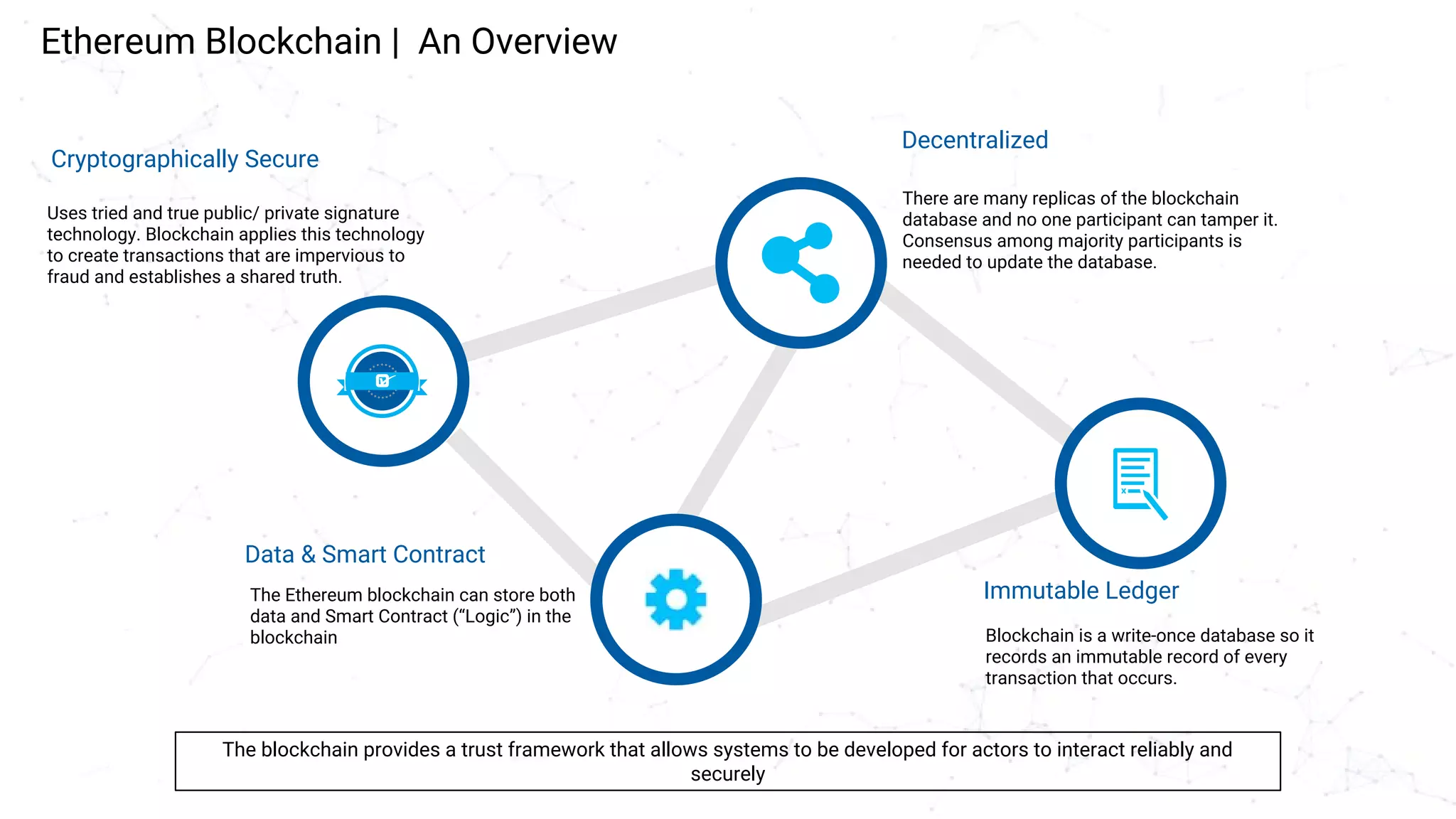
Ethereum Blockchain | An Overview
Cryptographically Secure
Uses tried and true public/ private signature
technology. Blockchain applies this technology
to create transactions that are impervious to
fraud and establishes a shared truth.
Decentralized
There are many replicas of the blockchain
database and no one participant can tamper it.
Consensus among majority participants is
needed to update the database.
Data & Smart Contract
The Ethereum blockchain can store both
data and Smart Contract (“Logic”) in the
blockchain
Immutable Ledger
Blockchain is a write-once database so it
records an immutable record of every
transaction that occurs.
The blockchain provides a trust framework that allows systems to be developed for actors to interact reliably and
securely
© 2016 consensys.net/enterprise
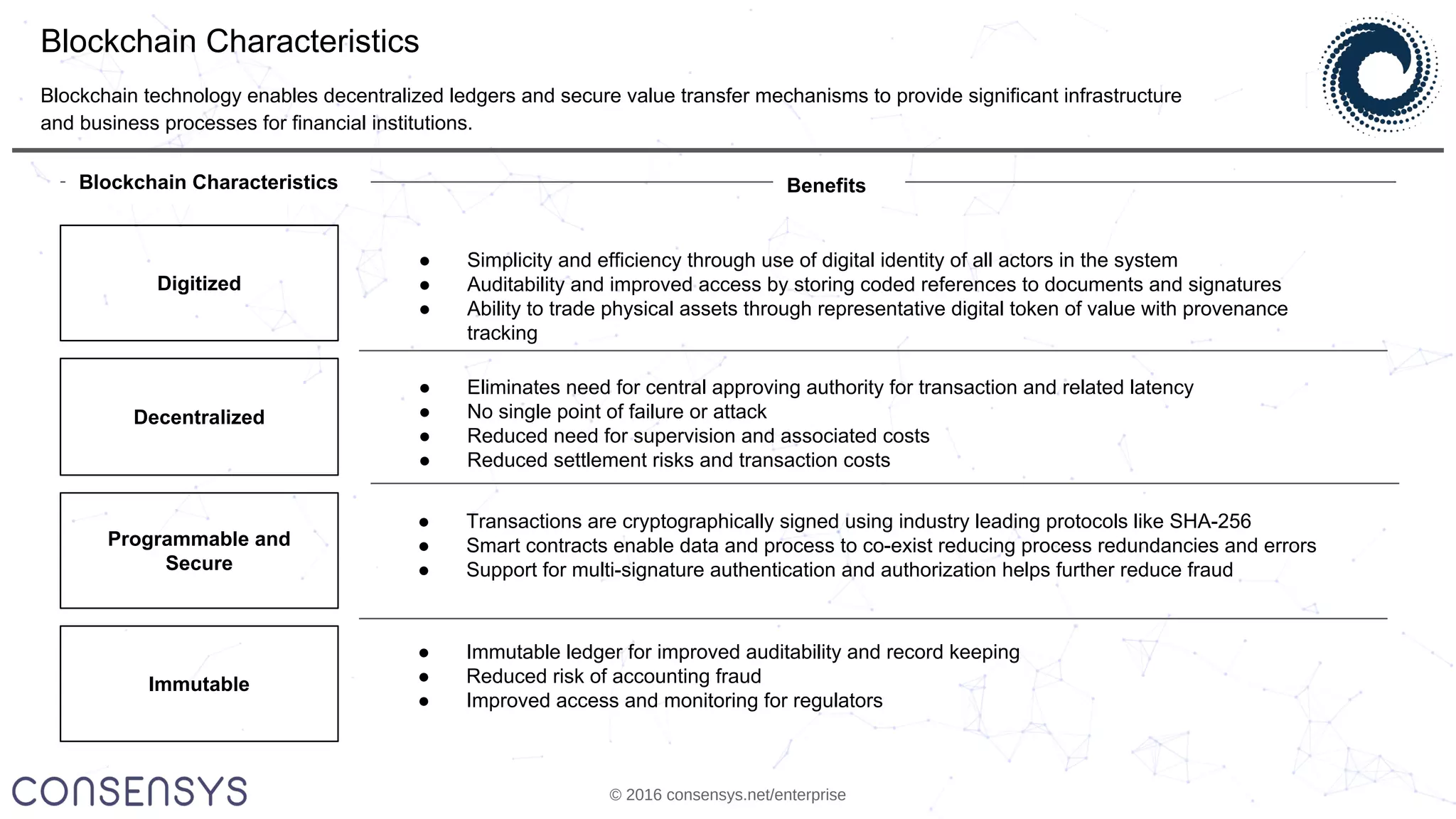
Blockchain Characteristics
Blockchain technology enables decentralized ledgers and secure value transfer mechanisms to provide significant infrastructure
and business processes for financial institutions.
Blockchain Characteristics
Decentralized
Programmable and
Secure
Immutable
Digitized
Benefits
● Simplicity and efficiency through use of digital identity of all actors in the system
● Auditability and improved access by storing coded references to documents and signatures
● Ability to trade physical assets through representative digital token of value with provenance
tracking
● Eliminates need for central approving authority for transaction and related latency
● No single point of failure or attack
● Reduced need for supervision and associated costs
● Reduced settlement risks and transaction costs
● Transactions are cryptographically signed using industry leading protocols like SHA-256
● Smart contracts enable data and process to co-exist reducing process redundancies and errors
● Support for multi-signature authentication and authorization helps further reduce fraud
● Immutable ledger for improved auditability and record keeping
● Reduced risk of accounting fraud
● Improved access and monitoring for regulators
© 2016 consensys.net/enterprise
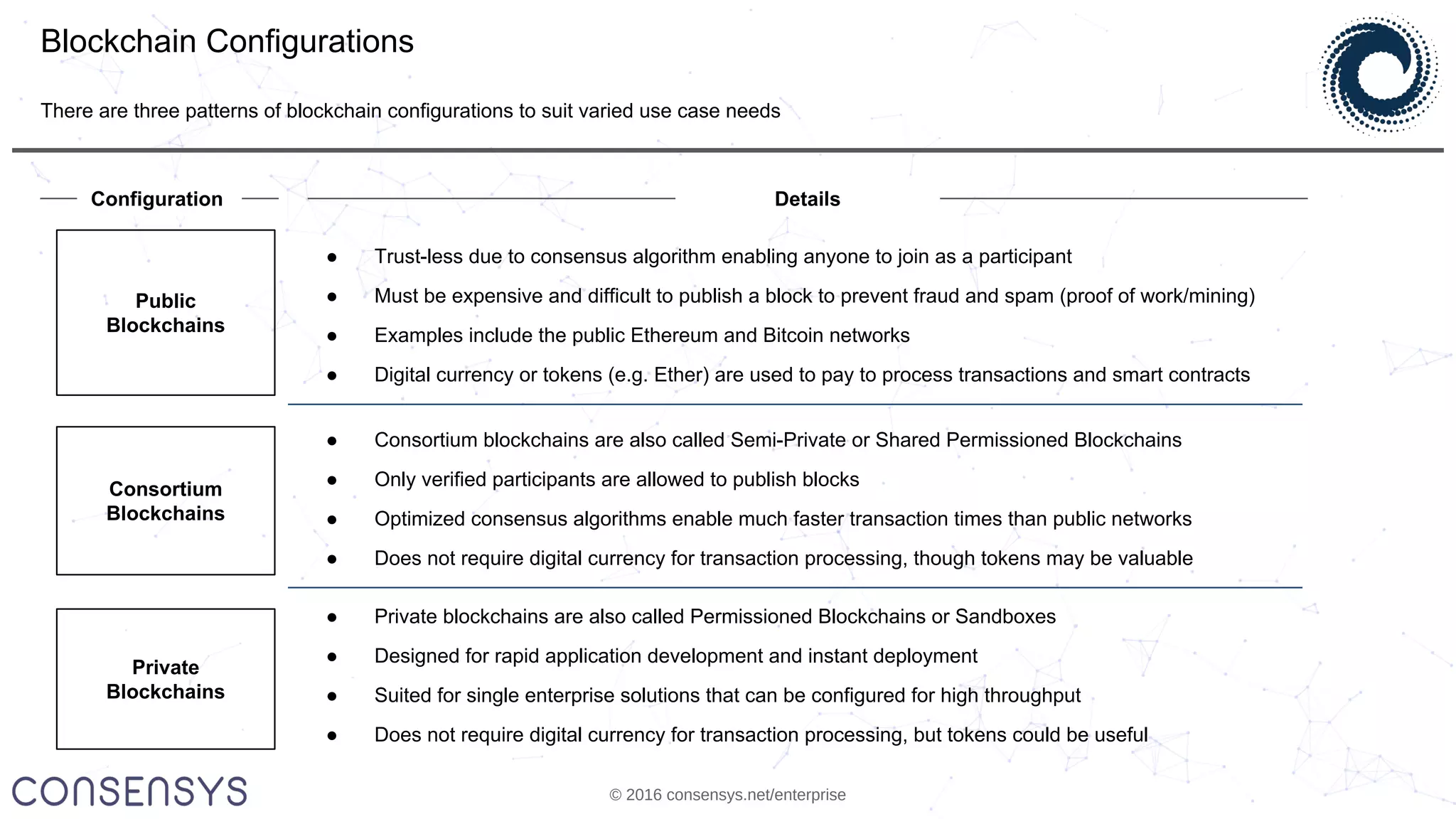
Blockchain Configurations
There are three patterns of blockchain configurations to suit varied use case needs
● Trust-less due to consensus algorithm enabling anyone to join as a participant
● Must be expensive and difficult to publish a block to prevent fraud and spam (proof of work/mining)
● Examples include the public Ethereum and Bitcoin networks
● Digital currency or tokens (e.g. Ether) are used to pay to process transactions and smart contracts
Private
Blockchains
Consortium
Blockchains
Public
Blockchains
● Consortium blockchains are also called Semi-Private or Shared Permissioned Blockchains
● Only verified participants are allowed to publish blocks
● Optimized consensus algorithms enable much faster transaction times than public networks
● Does not require digital currency for transaction processing, though tokens may be valuable
● Private blockchains are also called Permissioned Blockchains or Sandboxes
● Designed for rapid application development and instant deployment
● Suited for single enterprise solutions that can be configured for high throughput
● Does not require digital currency for transaction processing, but tokens could be useful
DetailsConfiguration
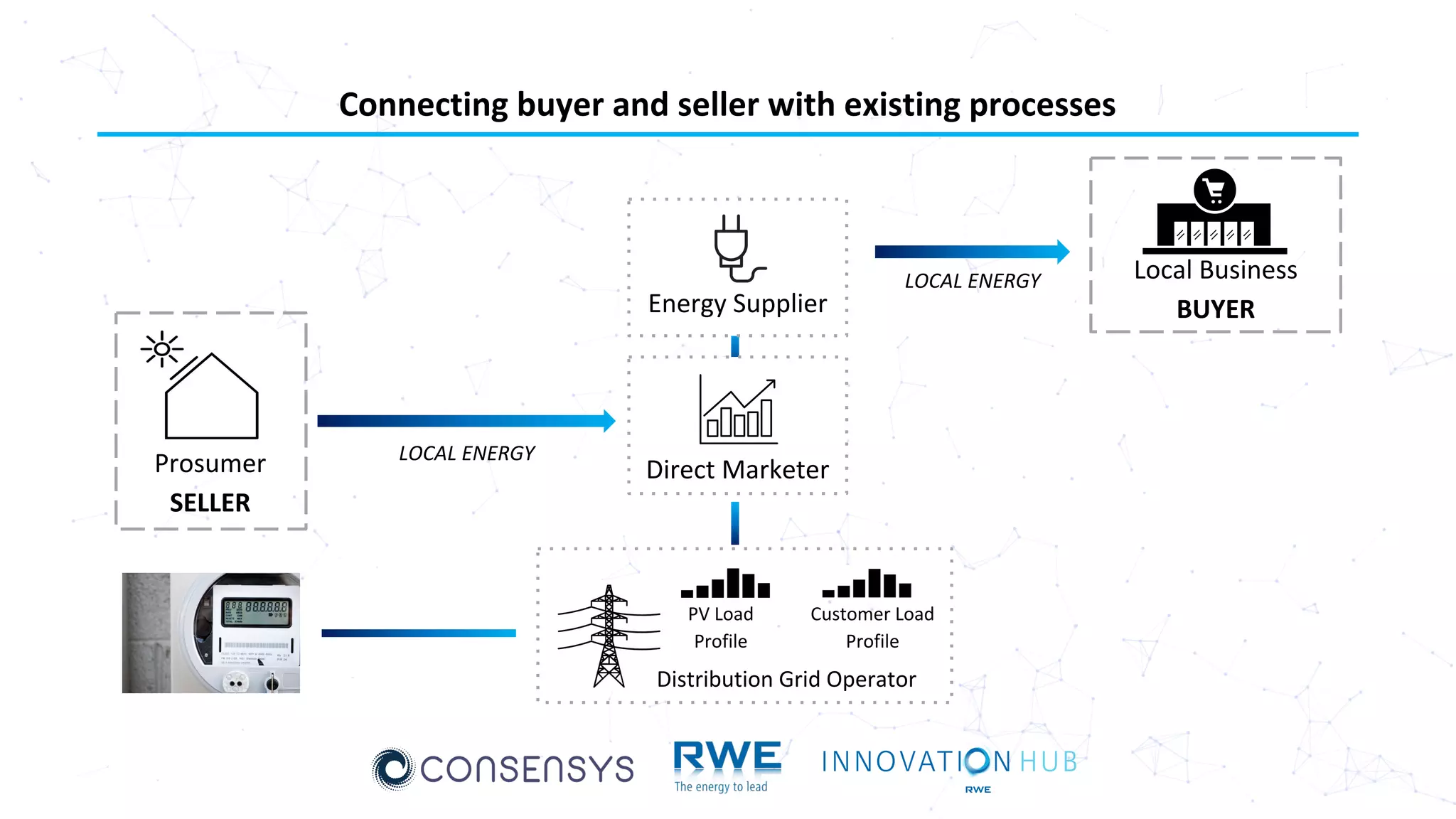
Connecting buyer and seller with existing processes
Distribution Grid Operator
PV Load
Profile
Customer Load
Profile
LOCAL ENERGY
Direct Marketer
LOCAL ENERGY
Energy Supplier
Prosumer
SELLER
Local Business
BUYER
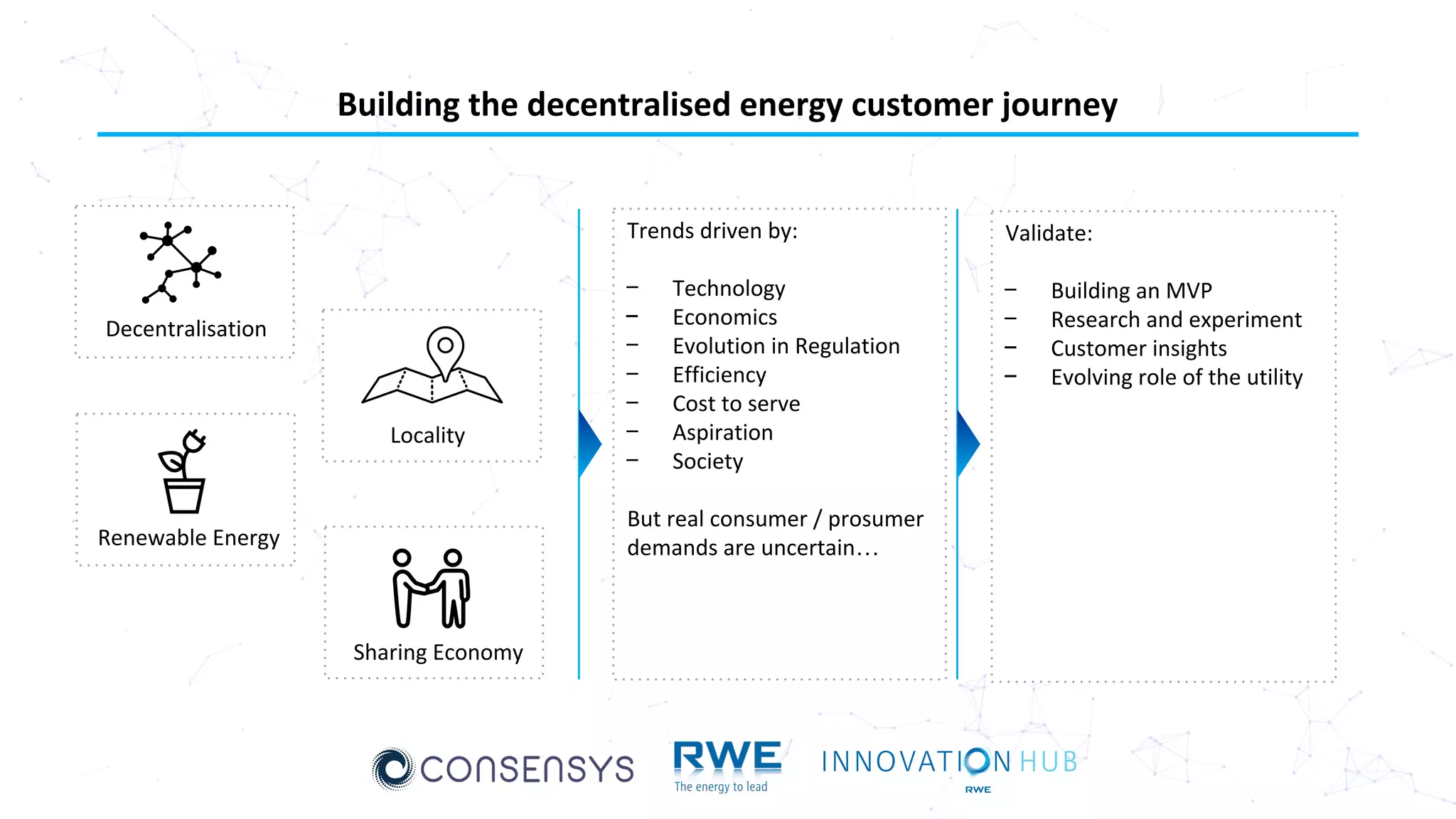
Trends driven by:
− Technology
− Economics
− Evolution in Regulation
− Efficiency
− Cost to serve
− Aspiration
− Society
But real consumer / prosumer
demands are uncertain…
Building the decentralised energy customer journey
Validate:
− Building an MVP
− Research and experiment
− Customer insights
− Evolving role of the utility
Locality
Renewable Energy
Sharing Economy
Decentralisation
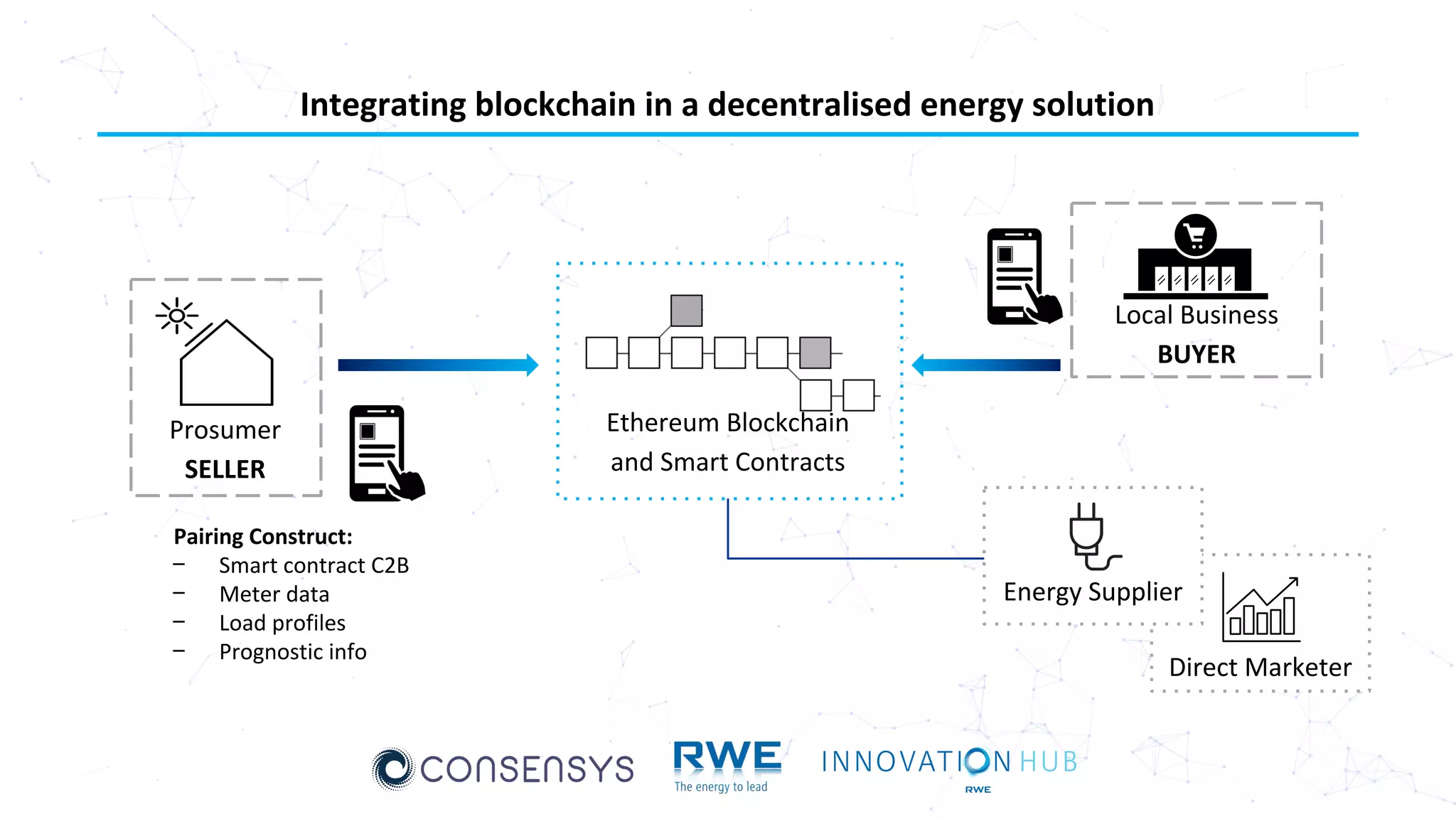
Pairing Construct:
− Smart contract C2B
− Meter data
− Load profiles
− Prognostic info
Integrating blockchain in a decentralised energy solution
Prosumer
SELLER
Local Business
BUYER
Direct Marketer
Energy Supplier
Ethereum Blockchain
and Smart Contracts
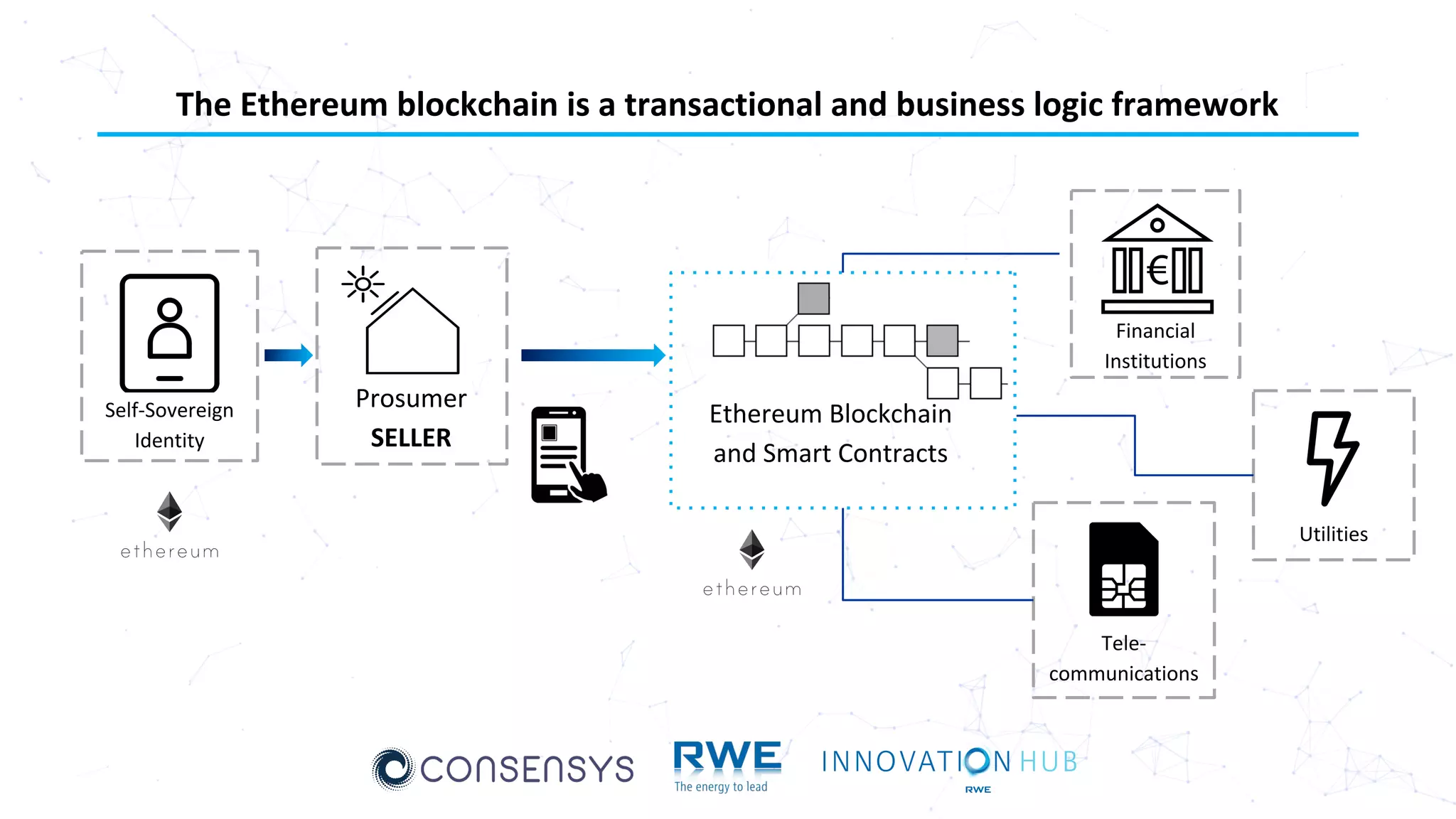
The Ethereum blockchain is a transactional and business logic framework
Prosumer
SELLER
Ethereum Blockchain
and Smart Contracts
Financial
Institutions
Utilities
Tele-
communications
Self-Sovereign
Identity
Contacts
John Lilic
ConsenSys
john.lilic@consensys.net
Sam Warburton
RWE
sam.warburton@rwe.com

EcoSummit 2016 in Berlin Presentation - ConsenSys / RWE

  • 1.
    Building the DECENTRALISED UTILITY ONTHE ETHEREUM BLOCKCHAIN Ecosummit Berlin 2016
  • 2.
    Ethereum Blockchain |An Overview Cryptographically Secure Uses tried and true public/ private signature technology. Blockchain applies this technology to create transactions that are impervious to fraud and establishes a shared truth. Decentralized There are many replicas of the blockchain database and no one participant can tamper it. Consensus among majority participants is needed to update the database. Data & Smart Contract The Ethereum blockchain can store both data and Smart Contract (“Logic”) in the blockchain Immutable Ledger Blockchain is a write-once database so it records an immutable record of every transaction that occurs. The blockchain provides a trust framework that allows systems to be developed for actors to interact reliably and securely
  • 3.
    © 2016 consensys.net/enterprise BlockchainCharacteristics Blockchain technology enables decentralized ledgers and secure value transfer mechanisms to provide significant infrastructure and business processes for financial institutions. Blockchain Characteristics Decentralized Programmable and Secure Immutable Digitized Benefits ● Simplicity and efficiency through use of digital identity of all actors in the system ● Auditability and improved access by storing coded references to documents and signatures ● Ability to trade physical assets through representative digital token of value with provenance tracking ● Eliminates need for central approving authority for transaction and related latency ● No single point of failure or attack ● Reduced need for supervision and associated costs ● Reduced settlement risks and transaction costs ● Transactions are cryptographically signed using industry leading protocols like SHA-256 ● Smart contracts enable data and process to co-exist reducing process redundancies and errors ● Support for multi-signature authentication and authorization helps further reduce fraud ● Immutable ledger for improved auditability and record keeping ● Reduced risk of accounting fraud ● Improved access and monitoring for regulators
  • 4.
    © 2016 consensys.net/enterprise BlockchainConfigurations There are three patterns of blockchain configurations to suit varied use case needs ● Trust-less due to consensus algorithm enabling anyone to join as a participant ● Must be expensive and difficult to publish a block to prevent fraud and spam (proof of work/mining) ● Examples include the public Ethereum and Bitcoin networks ● Digital currency or tokens (e.g. Ether) are used to pay to process transactions and smart contracts Private Blockchains Consortium Blockchains Public Blockchains ● Consortium blockchains are also called Semi-Private or Shared Permissioned Blockchains ● Only verified participants are allowed to publish blocks ● Optimized consensus algorithms enable much faster transaction times than public networks ● Does not require digital currency for transaction processing, though tokens may be valuable ● Private blockchains are also called Permissioned Blockchains or Sandboxes ● Designed for rapid application development and instant deployment ● Suited for single enterprise solutions that can be configured for high throughput ● Does not require digital currency for transaction processing, but tokens could be useful DetailsConfiguration
  • 5.
    Connecting buyer andseller with existing processes Distribution Grid Operator PV Load Profile Customer Load Profile LOCAL ENERGY Direct Marketer LOCAL ENERGY Energy Supplier Prosumer SELLER Local Business BUYER
  • 6.
    Trends driven by: −Technology − Economics − Evolution in Regulation − Efficiency − Cost to serve − Aspiration − Society But real consumer / prosumer demands are uncertain… Building the decentralised energy customer journey Validate: − Building an MVP − Research and experiment − Customer insights − Evolving role of the utility Locality Renewable Energy Sharing Economy Decentralisation
  • 7.
    Pairing Construct: − Smartcontract C2B − Meter data − Load profiles − Prognostic info Integrating blockchain in a decentralised energy solution Prosumer SELLER Local Business BUYER Direct Marketer Energy Supplier Ethereum Blockchain and Smart Contracts
  • 8.
    The Ethereum blockchainis a transactional and business logic framework Prosumer SELLER Ethereum Blockchain and Smart Contracts Financial Institutions Utilities Tele- communications Self-Sovereign Identity
  • 9.