Blockchain
Outline:
 Introduction to Blockchain
 Blockchain Fundamentals
 Distributed Ledger Technology
 Cryptography in Blockchain
 Consensus Mechanisms
 Smart Contracts
 Blockchain Applications
 Blockchain challenges and Limitations
 Blockchain Trends and Future
 Conclusion and key Takeaways
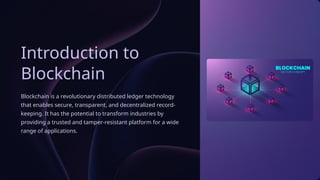
Introduction to
Blockchain
Blockchain is a revolutionary distributed ledger technology
that enables secure, transparent, and decentralized record-
keeping. It has the potential to transform industries by
providing a trusted and tamper-resistant platform for a wide
range of applications.
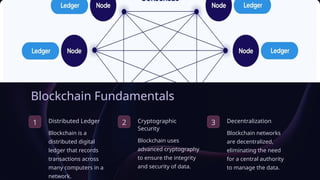
Blockchain Fundamentals
1 Distributed Ledger
Blockchain is a
distributed digital
ledger that records
transactions across
many computers in a
network.
2 Cryptographic
Security
Blockchain uses
advanced cryptography
to ensure the integrity
and security of data.
3 Decentralization
Blockchain networks
are decentralized,
eliminating the need
for a central authority
to manage the data.
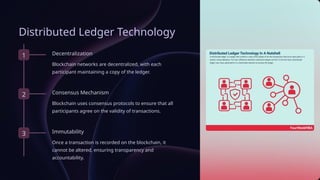
Distributed Ledger Technology
1 Decentralization
Blockchain networks are decentralized, with each
participant maintaining a copy of the ledger.
2 Consensus Mechanism
Blockchain uses consensus protocols to ensure that all
participants agree on the validity of transactions.
3 Immutability
Once a transaction is recorded on the blockchain, it
cannot be altered, ensuring transparency and
accountability.
Cryptography in Blockchain
Public-Key Cryptography
Blockchain uses public-key
cryptography to ensure
secure communication and
data ownership.
Hash Functions
Blockchain employs hash
functions to create unique
digital signatures for each
transaction.
Digital Signatures
Blockchain leverages digital
signatures to authenticate
transactions and verify
ownership.
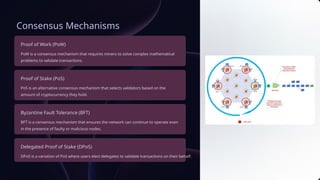
Consensus Mechanisms
Proof of Work (PoW)
PoW is a consensus mechanism that requires miners to solve complex mathematical
problems to validate transactions.
Proof of Stake (PoS)
PoS is an alternative consensus mechanism that selects validators based on the
amount of cryptocurrency they hold.
Byzantine Fault Tolerance (BFT)
BFT is a consensus mechanism that ensures the network can continue to operate even
in the presence of faulty or malicious nodes.
Delegated Proof of Stake (DPoS)
DPoS is a variation of PoS where users elect delegates to validate transactions on their behalf.
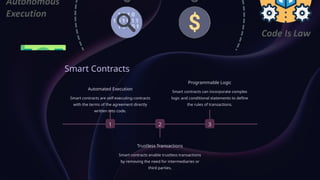
Smart Contracts
1
Automated Execution
Smart contracts are self-executing contracts
with the terms of the agreement directly
written into code.
2
Trustless Transactions
Smart contracts enable trustless transactions
by removing the need for intermediaries or
third parties.
3
Programmable Logic
Smart contracts can incorporate complex
logic and conditional statements to define
the rules of transactions.
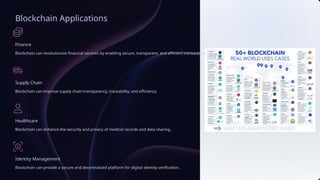
Blockchain Applications
Finance
Blockchain can revolutionize financial services by enabling secure, transparent, and efficient transactions.
Supply Chain
Blockchain can improve supply chain transparency, traceability, and efficiency.
Healthcare
Blockchain can enhance the security and privacy of medical records and data sharing.
Identity Management
Blockchain can provide a secure and decentralized platform for digital identity verification.
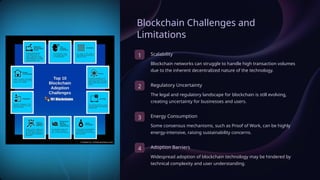
Blockchain Challenges and
Limitations
1 Scalability
Blockchain networks can struggle to handle high transaction volumes
due to the inherent decentralized nature of the technology.
2 Regulatory Uncertainty
The legal and regulatory landscape for blockchain is still evolving,
creating uncertainty for businesses and users.
3 Energy Consumption
Some consensus mechanisms, such as Proof of Work, can be highly
energy-intensive, raising sustainability concerns.
4 Adoption Barriers
Widespread adoption of blockchain technology may be hindered by
technical complexity and user understanding.
Blockchain Trends and Future
Interoperability
Blockchain networks are working towards greater
interoperability to enable seamless cross-chain
communication and data exchange.
Decentralized Finance (DeFi)
The rise of DeFi applications is transforming the financial
landscape by providing decentralized, transparent, and
accessible financial services.
Tokenization
Blockchain-based tokenization is enabling the digitization
and fractionalization of a wide range of assets, increasing
their accessibility and liquidity.
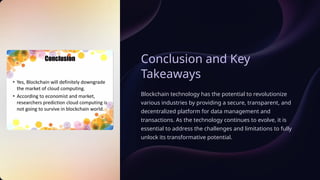
Conclusion and Key
Takeaways
Blockchain technology has the potential to revolutionize
various industries by providing a secure, transparent, and
decentralized platform for data management and
transactions. As the technology continues to evolve, it is
essential to address the challenges and limitations to fully
unlock its transformative potential.

blockchain technology seminar presentation.pptx

  • 1.
  • 2.
    Outline:  Introduction toBlockchain  Blockchain Fundamentals  Distributed Ledger Technology  Cryptography in Blockchain  Consensus Mechanisms  Smart Contracts  Blockchain Applications  Blockchain challenges and Limitations  Blockchain Trends and Future  Conclusion and key Takeaways
  • 3.
    Introduction to Blockchain Blockchain isa revolutionary distributed ledger technology that enables secure, transparent, and decentralized record- keeping. It has the potential to transform industries by providing a trusted and tamper-resistant platform for a wide range of applications.
  • 4.
    Blockchain Fundamentals 1 DistributedLedger Blockchain is a distributed digital ledger that records transactions across many computers in a network. 2 Cryptographic Security Blockchain uses advanced cryptography to ensure the integrity and security of data. 3 Decentralization Blockchain networks are decentralized, eliminating the need for a central authority to manage the data.
  • 5.
    Distributed Ledger Technology 1Decentralization Blockchain networks are decentralized, with each participant maintaining a copy of the ledger. 2 Consensus Mechanism Blockchain uses consensus protocols to ensure that all participants agree on the validity of transactions. 3 Immutability Once a transaction is recorded on the blockchain, it cannot be altered, ensuring transparency and accountability.
  • 6.
    Cryptography in Blockchain Public-KeyCryptography Blockchain uses public-key cryptography to ensure secure communication and data ownership. Hash Functions Blockchain employs hash functions to create unique digital signatures for each transaction. Digital Signatures Blockchain leverages digital signatures to authenticate transactions and verify ownership.
  • 7.
    Consensus Mechanisms Proof ofWork (PoW) PoW is a consensus mechanism that requires miners to solve complex mathematical problems to validate transactions. Proof of Stake (PoS) PoS is an alternative consensus mechanism that selects validators based on the amount of cryptocurrency they hold. Byzantine Fault Tolerance (BFT) BFT is a consensus mechanism that ensures the network can continue to operate even in the presence of faulty or malicious nodes. Delegated Proof of Stake (DPoS) DPoS is a variation of PoS where users elect delegates to validate transactions on their behalf.
  • 8.
    Smart Contracts 1 Automated Execution Smartcontracts are self-executing contracts with the terms of the agreement directly written into code. 2 Trustless Transactions Smart contracts enable trustless transactions by removing the need for intermediaries or third parties. 3 Programmable Logic Smart contracts can incorporate complex logic and conditional statements to define the rules of transactions.
  • 9.
    Blockchain Applications Finance Blockchain canrevolutionize financial services by enabling secure, transparent, and efficient transactions. Supply Chain Blockchain can improve supply chain transparency, traceability, and efficiency. Healthcare Blockchain can enhance the security and privacy of medical records and data sharing. Identity Management Blockchain can provide a secure and decentralized platform for digital identity verification.
  • 10.
    Blockchain Challenges and Limitations 1Scalability Blockchain networks can struggle to handle high transaction volumes due to the inherent decentralized nature of the technology. 2 Regulatory Uncertainty The legal and regulatory landscape for blockchain is still evolving, creating uncertainty for businesses and users. 3 Energy Consumption Some consensus mechanisms, such as Proof of Work, can be highly energy-intensive, raising sustainability concerns. 4 Adoption Barriers Widespread adoption of blockchain technology may be hindered by technical complexity and user understanding.
  • 11.
    Blockchain Trends andFuture Interoperability Blockchain networks are working towards greater interoperability to enable seamless cross-chain communication and data exchange. Decentralized Finance (DeFi) The rise of DeFi applications is transforming the financial landscape by providing decentralized, transparent, and accessible financial services. Tokenization Blockchain-based tokenization is enabling the digitization and fractionalization of a wide range of assets, increasing their accessibility and liquidity.
  • 12.
    Conclusion and Key Takeaways Blockchaintechnology has the potential to revolutionize various industries by providing a secure, transparent, and decentralized platform for data management and transactions. As the technology continues to evolve, it is essential to address the challenges and limitations to fully unlock its transformative potential.