Blockchain Technology:
a Sustainable Concept for the Future?
“Die Blockchain-Technologie: Ein nachhaltiges Konzept für die Zukunft?“
Kryptorechtstag, October 2023
Prof. Dr. Ingo Weber
ingo.weber@tum.de
http://imweber.de/
Full professor at TUM and
Director IT infrastructure & digital transformation
at Fraunhofer
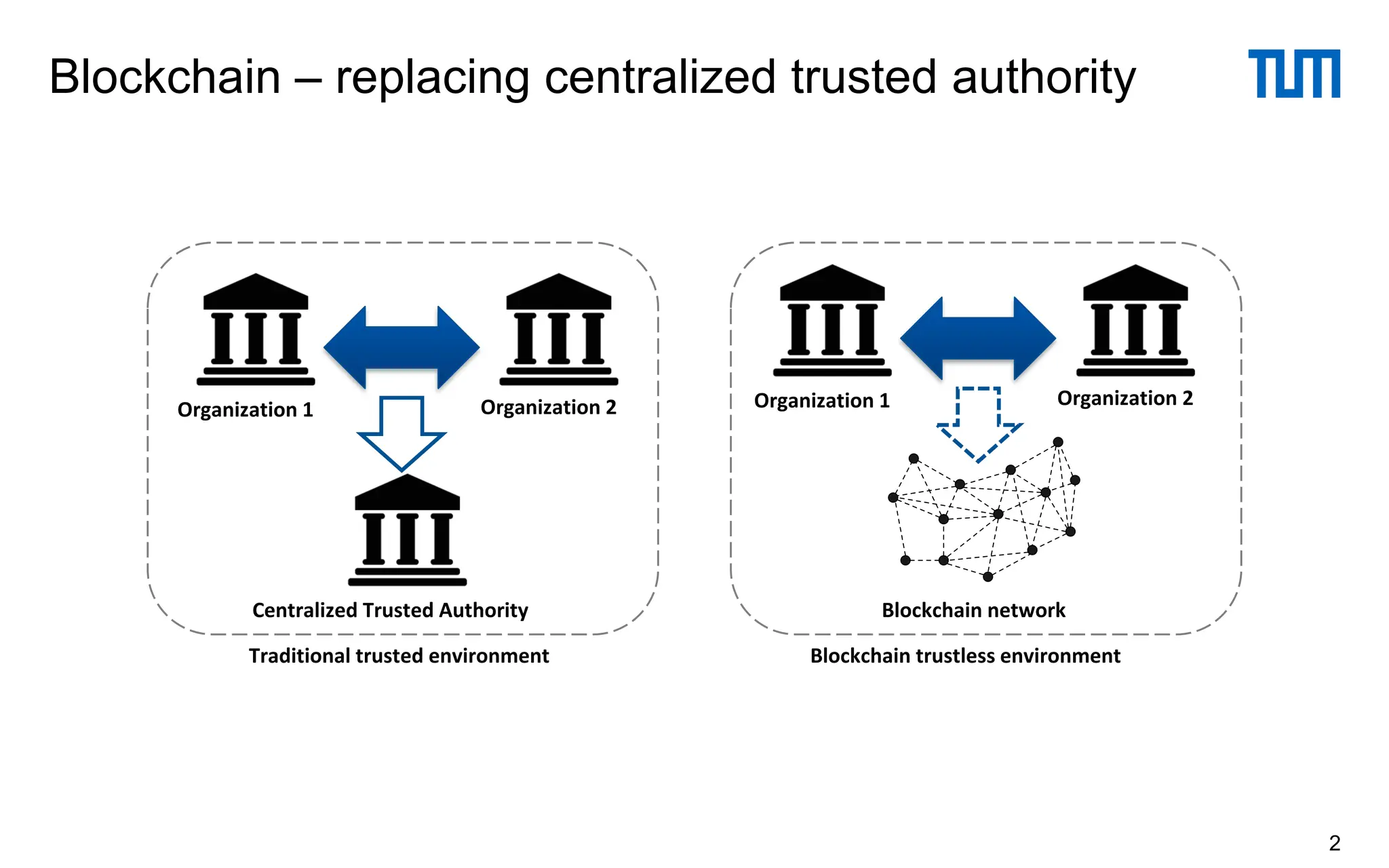
Blockchain – replacing centralized trusted authority
2
Organization 1 Organization 2 Organization 1 Organization 2
Centralized Trusted Authority
Traditional trusted environment Blockchain trustless environment
Blockchain network
How?
3
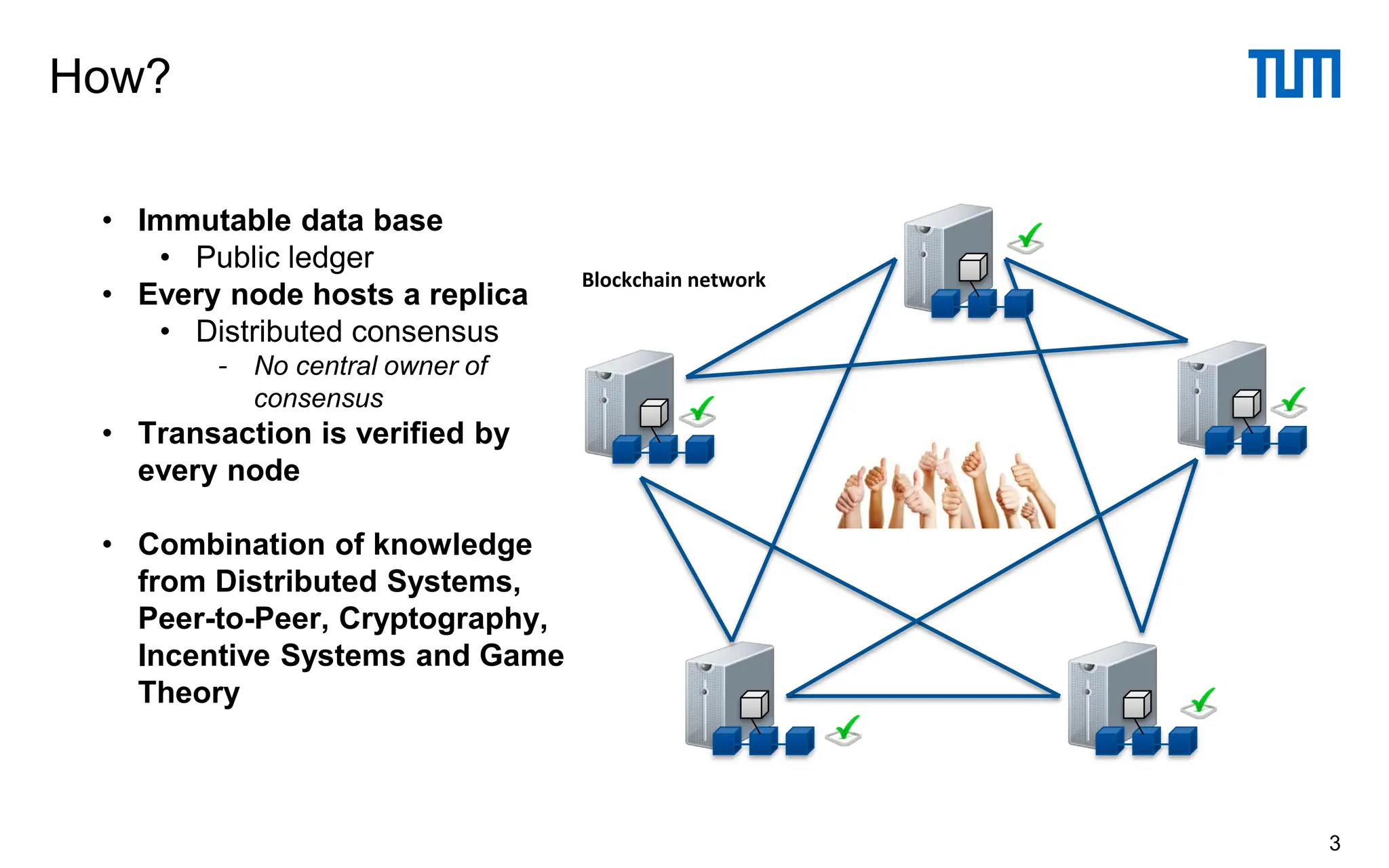
• Immutable data base
• Public ledger
• Every node hosts a replica
• Distributed consensus
- No central owner of
consensus
• Transaction is verified by
every node
• Combination of knowledge
from Distributed Systems,
Peer-to-Peer, Cryptography,
Incentive Systems and Game
Theory
Blockchain network
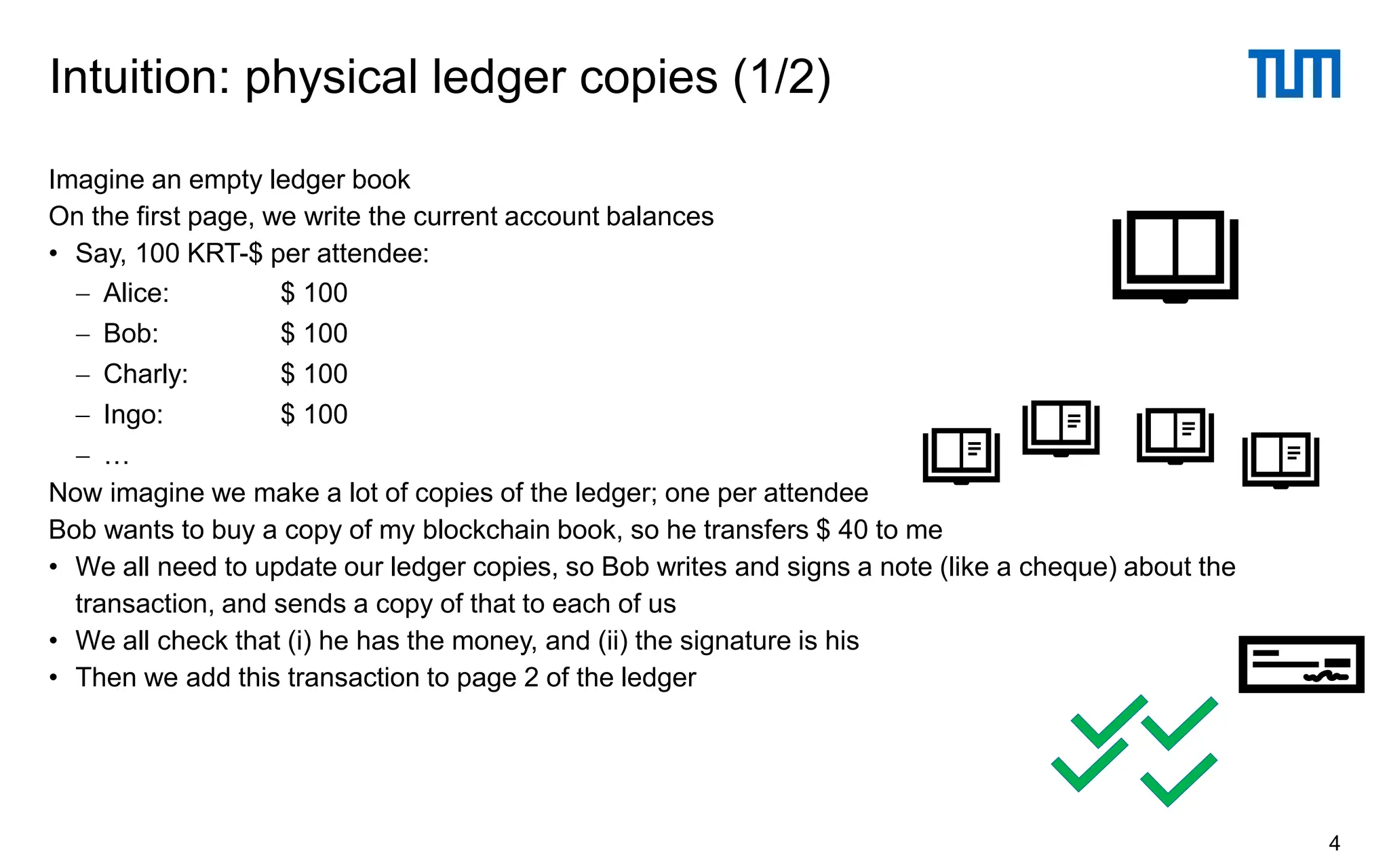
Imagine an empty ledger book
On the first page, we write the current account balances
• Say, 100 KRT-$ per attendee:
− Alice: $ 100
− Bob: $ 100
− Charly: $ 100
− Ingo: $ 100
− …
Now imagine we make a lot of copies of the ledger; one per attendee
Bob wants to buy a copy of my blockchain book, so he transfers $ 40 to me
• We all need to update our ledger copies, so Bob writes and signs a note (like a cheque) about the
transaction, and sends a copy of that to each of us
• We all check that (i) he has the money, and (ii) the signature is his
• Then we add this transaction to page 2 of the ledger
Intuition: physical ledger copies (1/2)
4
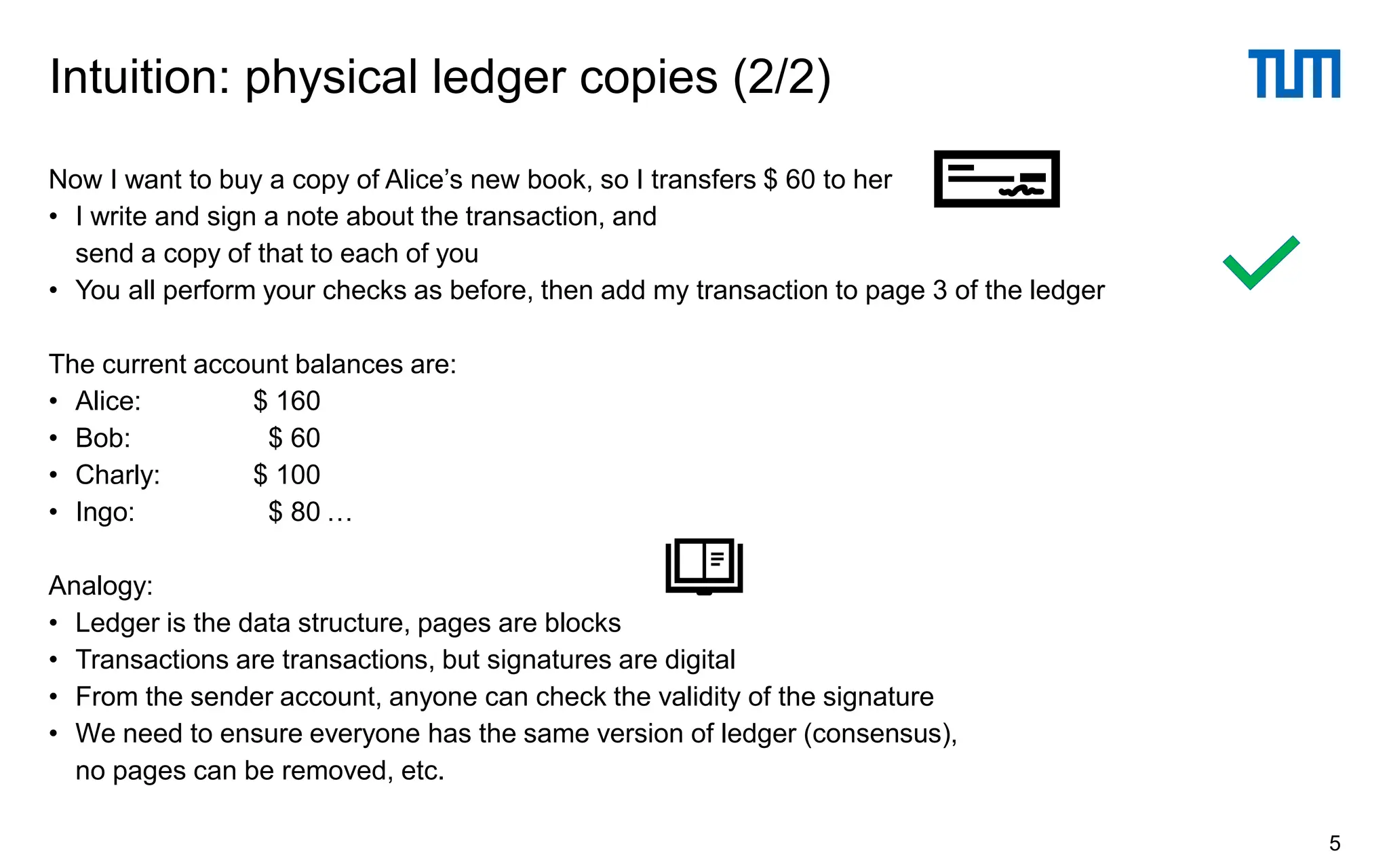
Now I want to buy a copy of Alice’s new book, so I transfers $ 60 to her
• I write and sign a note about the transaction, and
send a copy of that to each of you
• You all perform your checks as before, then add my transaction to page 3 of the ledger
The current account balances are:
• Alice: $ 160
• Bob: $ 60
• Charly: $ 100
• Ingo: $ 80 …
Analogy:
• Ledger is the data structure, pages are blocks
• Transactions are transactions, but signatures are digital
• From the sender account, anyone can check the validity of the signature
• We need to ensure everyone has the same version of ledger (consensus),
no pages can be removed, etc.
Intuition: physical ledger copies (2/2)
5
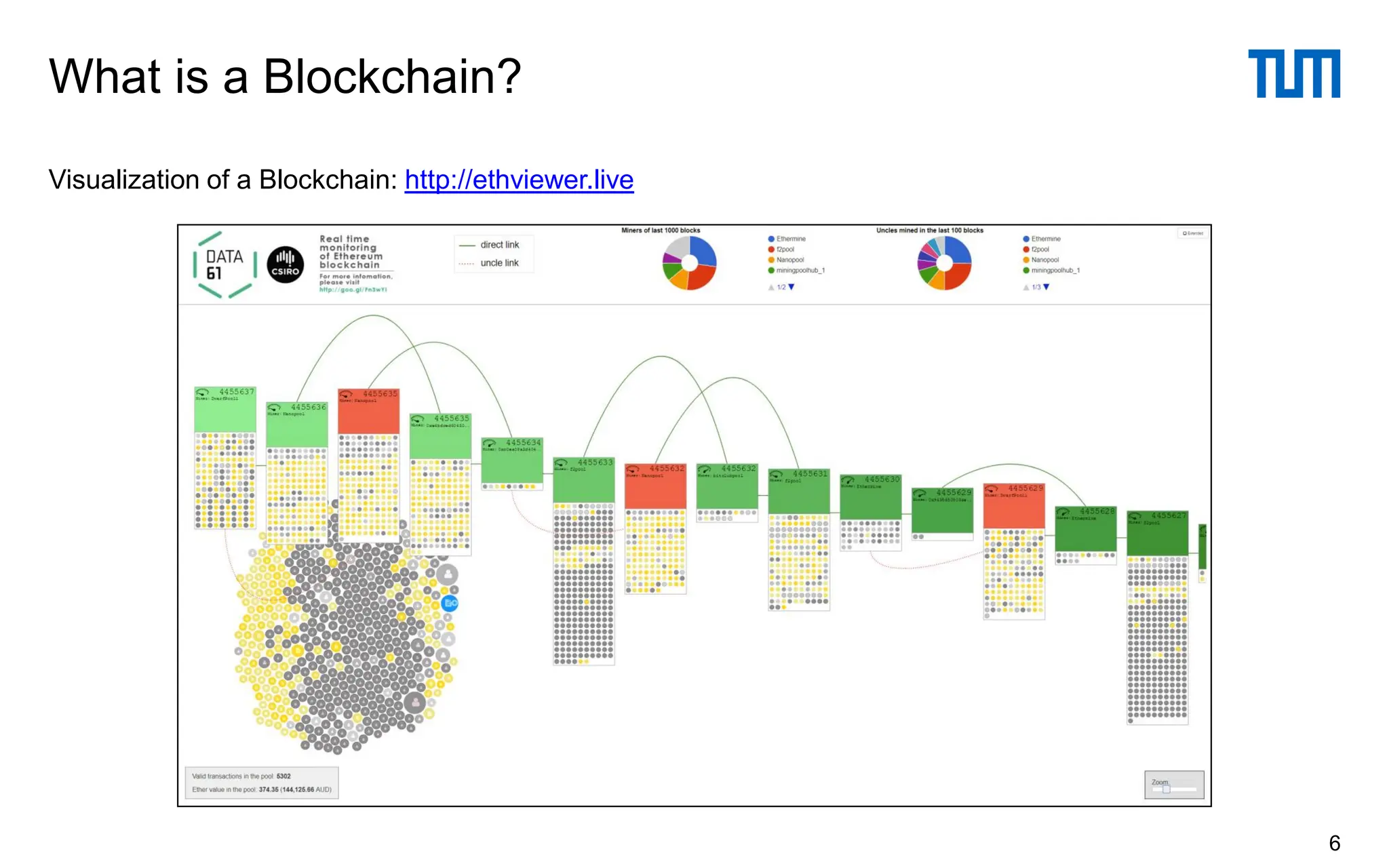
What is a Blockchain?
6
Visualization of a Blockchain: http://ethviewer.live
Blockchain 2nd gen – Smart Contracts
7
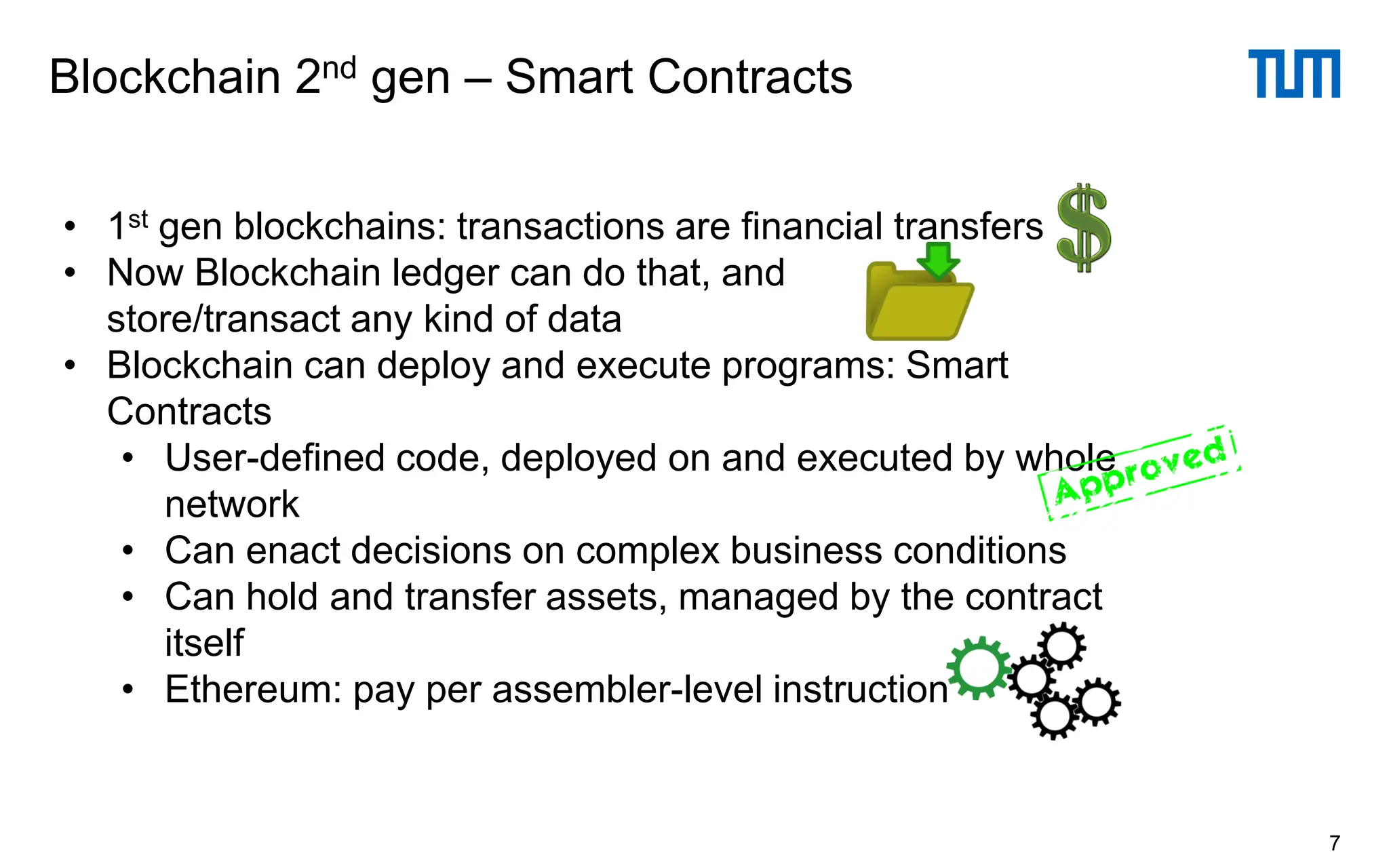
• 1st gen blockchains: transactions are financial transfers
• Now Blockchain ledger can do that, and
store/transact any kind of data
• Blockchain can deploy and execute programs: Smart
Contracts
• User-defined code, deployed on and executed by whole
network
• Can enact decisions on complex business conditions
• Can hold and transfer assets, managed by the contract
itself
• Ethereum: pay per assembler-level instruction
Well, blockchains are exciting because they can be used as a new
foundation for re-imagining systems:
• Neutral infrastructure for processing transactions and executing programs
• Potentially interesting for innovation at all touch-points between organizations or
individuals
➢Blockchain applications have the potential to disrupt the fabric of society,
industry, and government
Blockchains can also be used as a technology platform to handle hard
issues of data replication and system state synchronization with high
integrity.
So what?
8
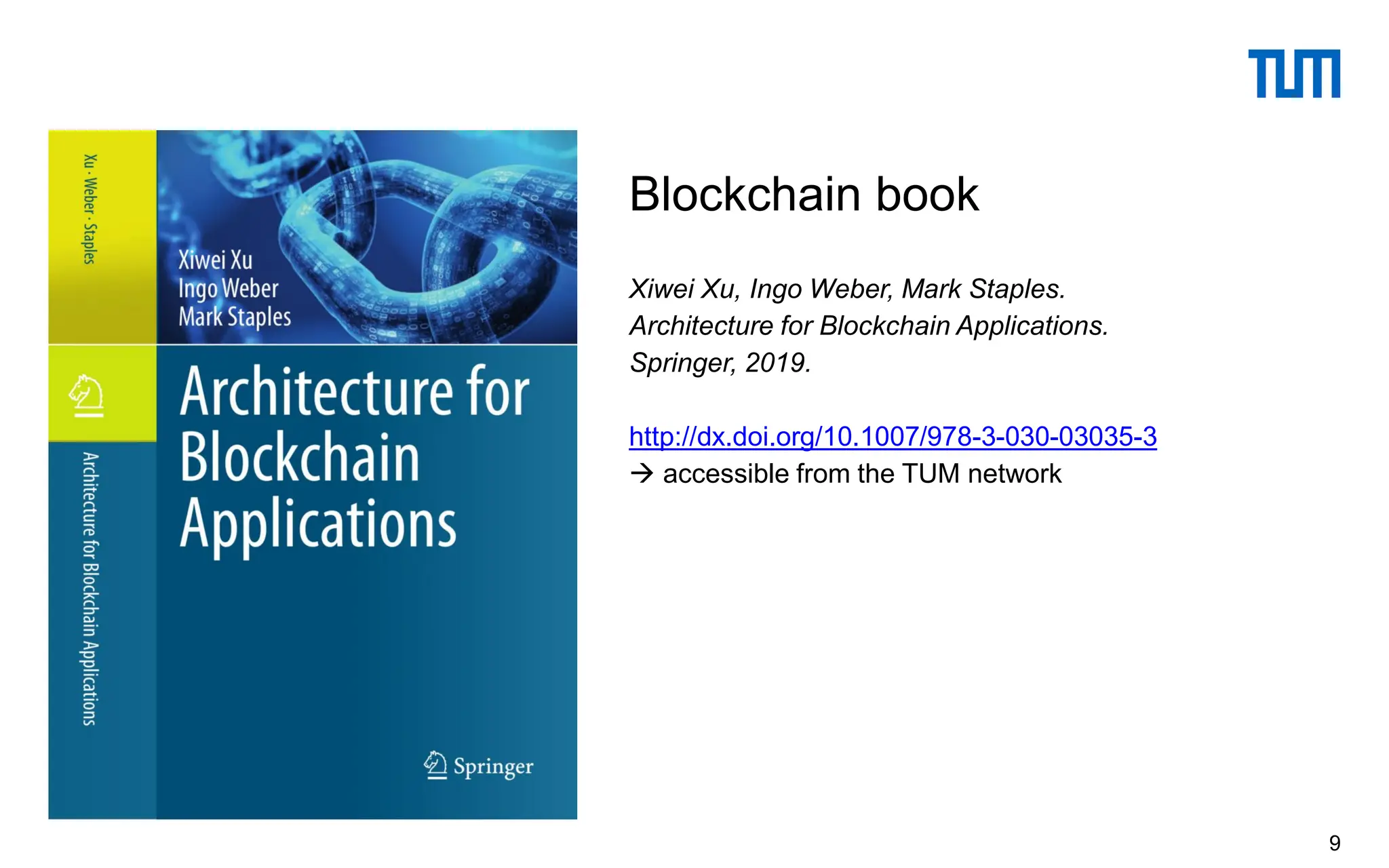
Xiwei Xu, Ingo Weber, Mark Staples.
Architecture for Blockchain Applications.
Springer, 2019.
http://dx.doi.org/10.1007/978-3-030-03035-3
→ accessible from the TUM network
Blockchain book
9
Cryptocurrencies
• ‘Baked in’ to the core platform of public blockchains
- base currency of blockchains
• Symbiotic relationship
− Blockchain keeps track of the ownership of portions of that currency,
e.g. Alice owned 2 Ether, transferred 1 Ether to Bob, offered 0.01
Ether to miner
− Cryptocurrency enables the incentive mechanism for blockchain
operations
Digital tokens
• Created and exchanged using smart contracts
• Represent assets
− Fungible asset: individual units are interchangeable, e.g. company share, gold
− Non-fungible asset: represents a unique asset, e.g. cryptokitties, car title
Not all applications are the same:
• Transferring coins / tokens vs. tracking movement of physical goods
• Core difference: where is the default version of the truth, on or off-chain?
Cryptocurrencies and Tokens
10
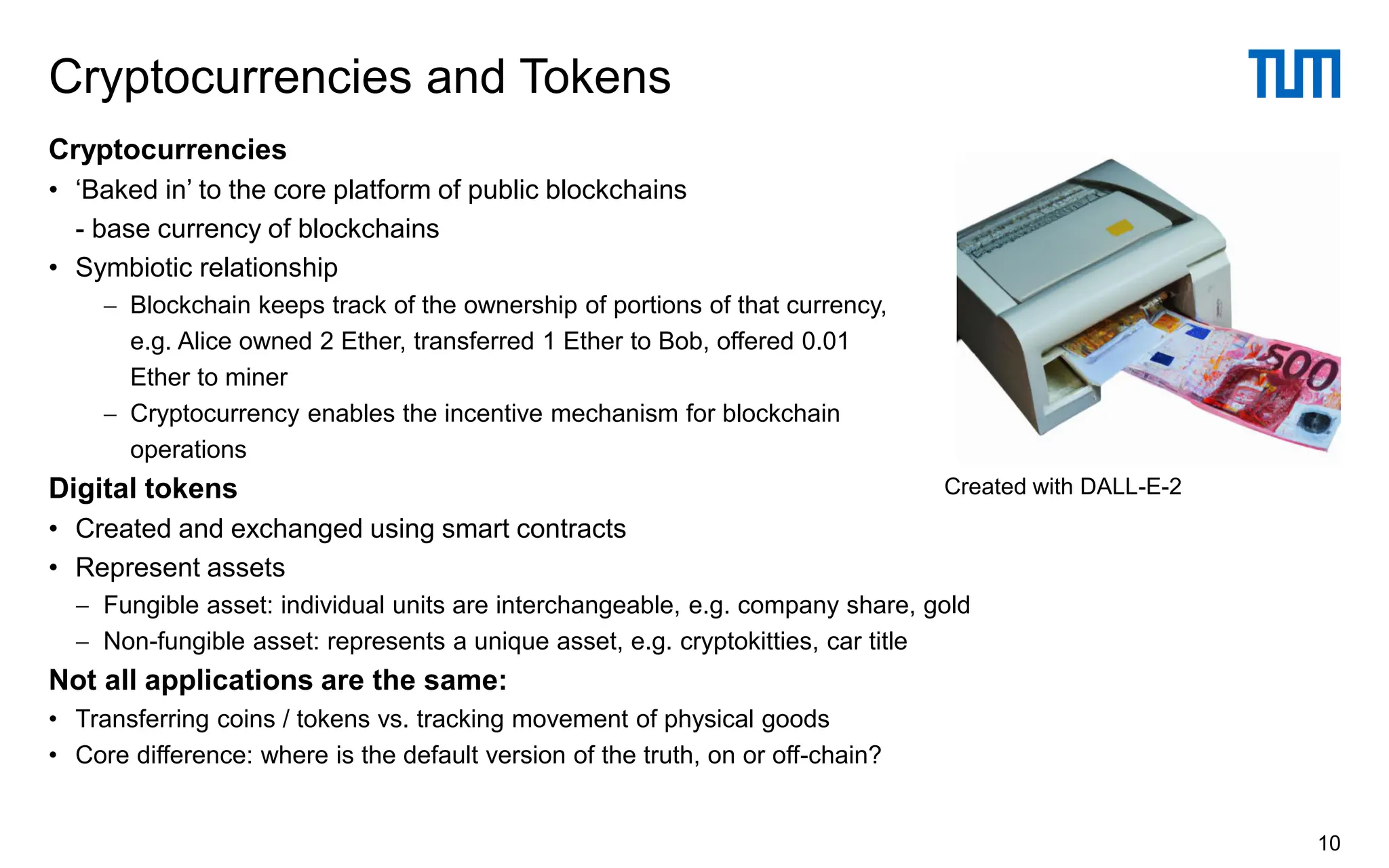
Created with DALL-E-2
Blockchain Technology:
a Sustainable Concept for the Future?
Proof-of-Work 1/2 (ex )
12
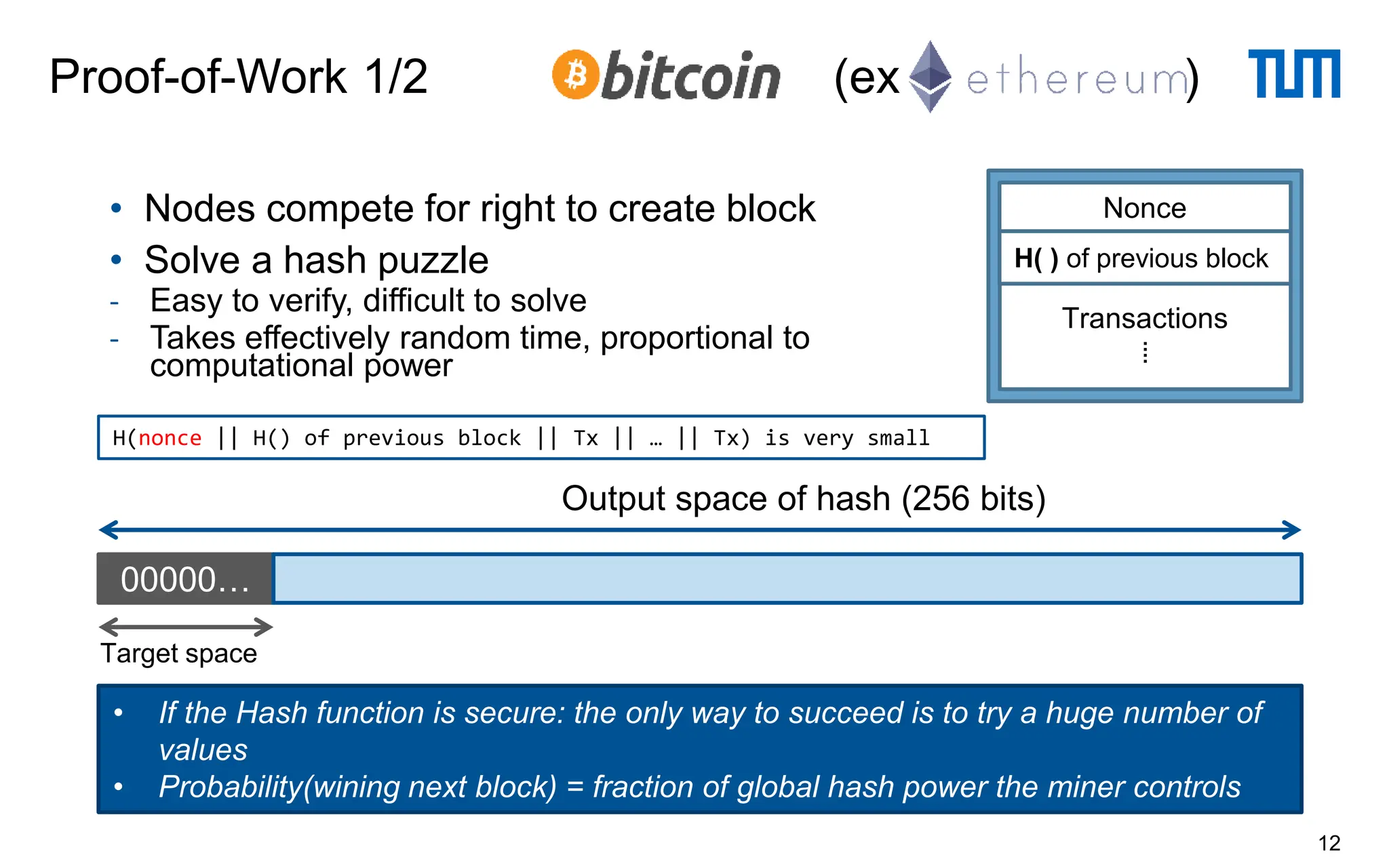
• Nodes compete for right to create block
• Solve a hash puzzle
- Easy to verify, difficult to solve
- Takes effectively random time, proportional to
computational power
H(nonce || H() of previous block || Tx || … || Tx) is very small
00000…
Output space of hash (256 bits)
Target space
• If the Hash function is secure: the only way to succeed is to try a huge number of
values
• Probability(wining next block) = fraction of global hash power the miner controls
Transactions
⁞
H( ) of previous block
Nonce
Not energy-efficient
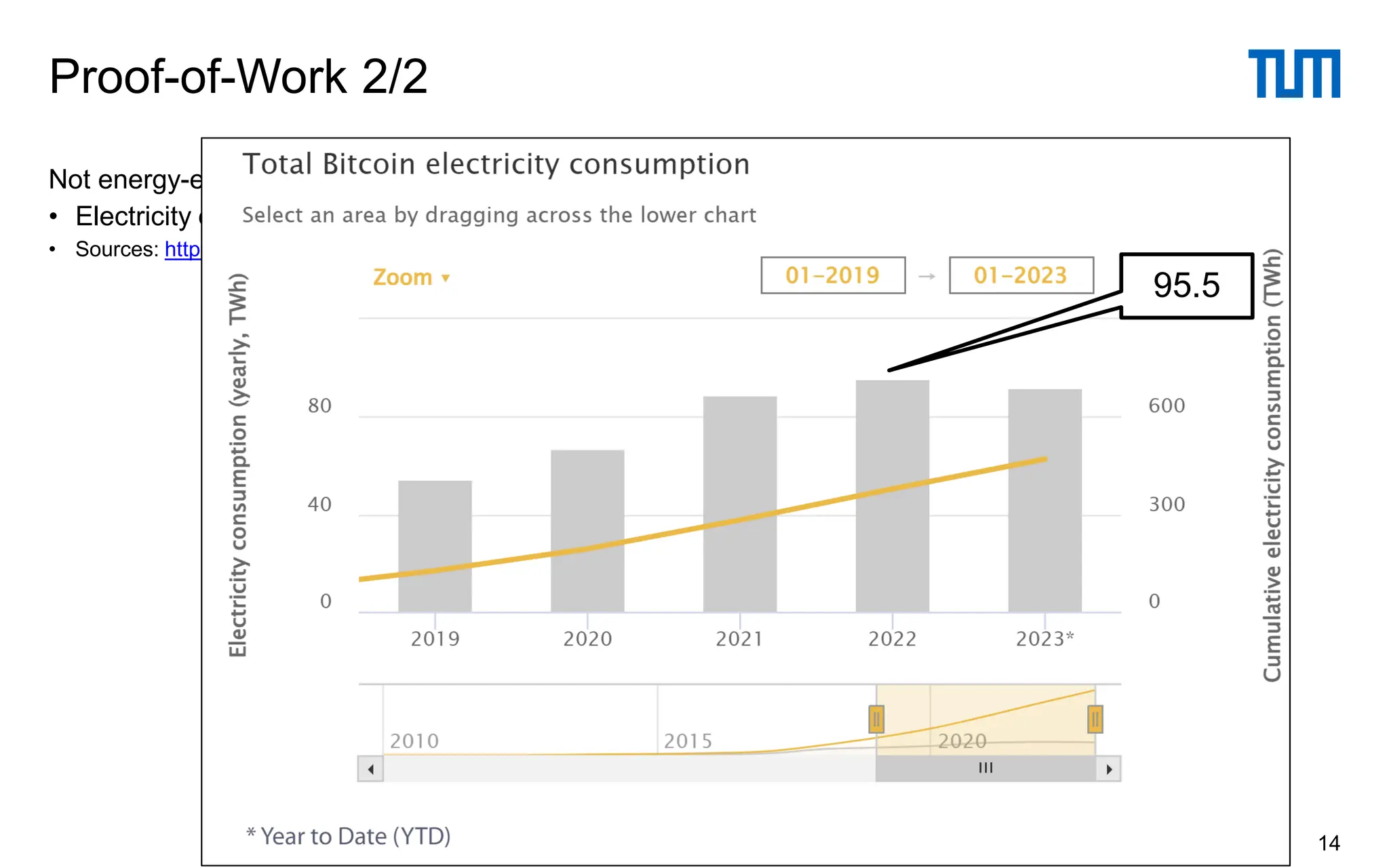
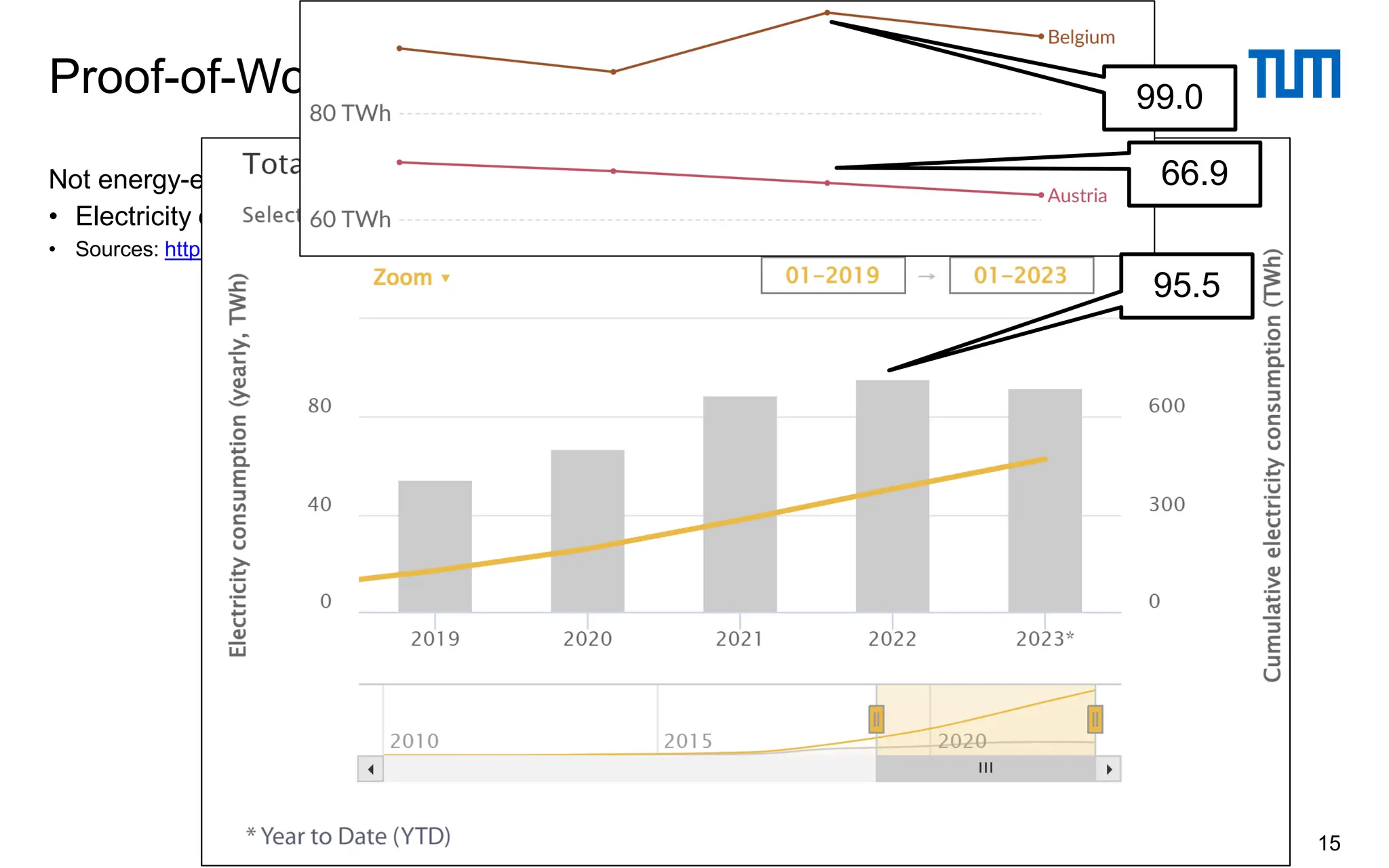
• Electricity consumption of Bitcoin is … high
• Sources: https://ccaf.io/cbnsi/cbeci and https://ourworldindata.org/energy/country/austria
Proof-of-Work 2/2
13
Not energy-efficient
• Electricity consumption of Bitcoin is … high
• Sources: https://ccaf.io/cbnsi/cbeci and https://ourworldindata.org/energy/country/austria
Proof-of-Work 2/2
14
95.5
Not energy-efficient
• Electricity consumption of Bitcoin is … high
• Sources: https://ccaf.io/cbnsi/cbeci and https://ourworldindata.org/energy/country/austria
Proof-of-Work 2/2
15
95.5
99.0
66.9
Not energy-efficient
• Electricity consumption of Bitcoin is … high
• Sources: https://ccaf.io/cbnsi/cbeci and https://ourworldindata.org/energy/country/austria
How about emissions?
• Much more difficult to estimate
• Bitcoin can be mined anywhere, in particular right next to a hydro plant – and be switched on only when
the price for hydro electricity is low
• Example from 2021: “In the wet season in Sichuan and Yunnan, enormous quantities of renewable
hydro energy are wasted every year. […] these provinces are the heartlands of mining in China,
responsible for almost 10% of global Bitcoin mining in the dry season and 50% in the wet season.”
− Source: https://hbr.org/2021/05/how-much-energy-does-bitcoin-actually-consume
• How much of the energy consumed by Bitcoin is carbon neutral? Estimates quoted in the above source
range from 39% to 73%
Proof-of-Work 2/2
16
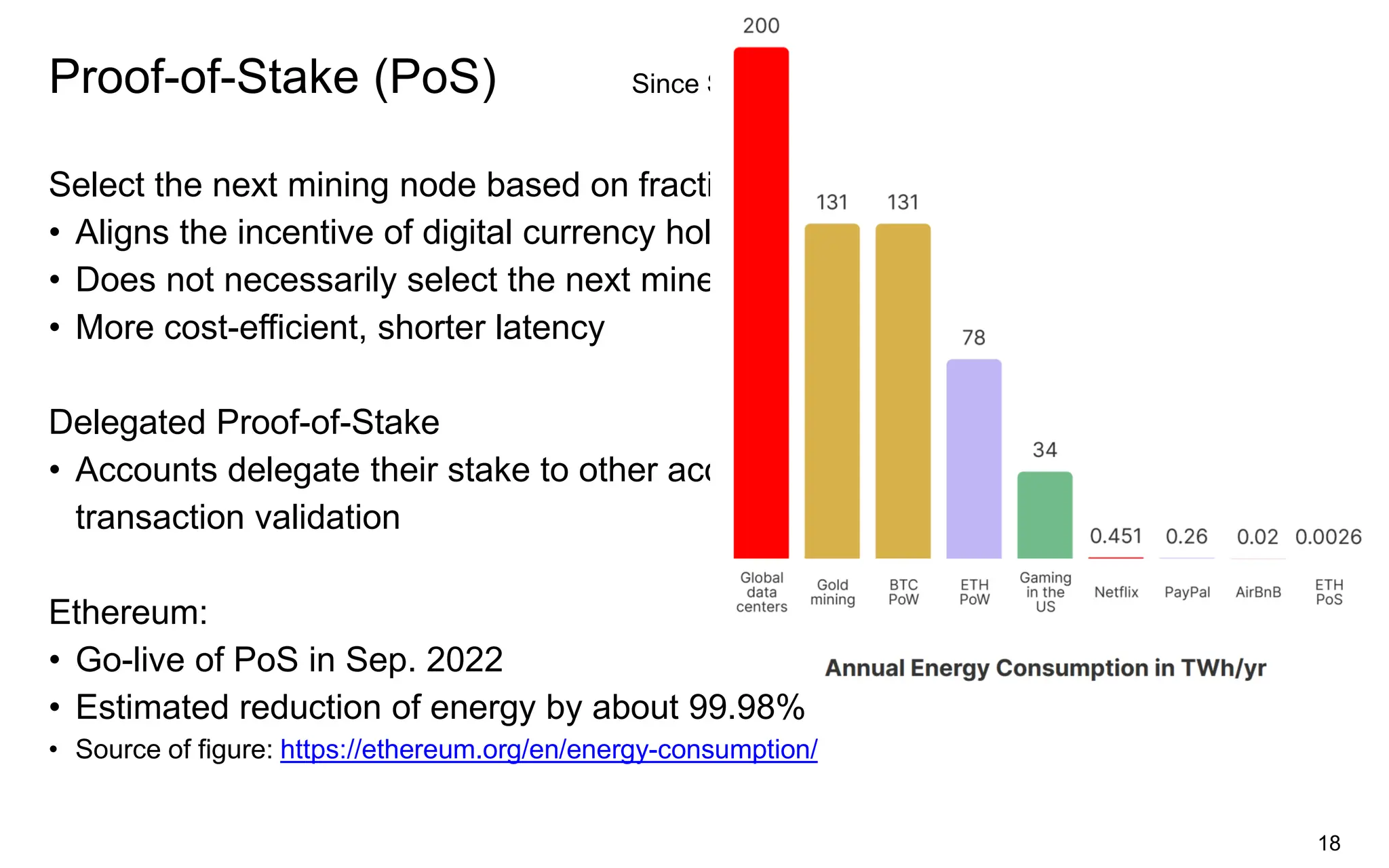
Select the next mining node based on fractional control of the native digital currency
• Aligns the incentive of digital currency holders with the good operation
• Does not necessarily select the next miner based on largest stakeholding
• More cost-efficient, shorter latency
Delegated Proof-of-Stake
• Accounts delegate their stake to other accounts rather than participating in
transaction validation
Ethereum:
• Go-live of PoS in Sep. 2022
• Estimated reduction of energy by about 99.98%
• Source of figure: https://ethereum.org/en/energy-consumption/
Proof-of-Stake (PoS) Since Sep. 2022:
17
Select the next mining node based on fractional control of the native digital currency
• Aligns the incentive of digital currency holders with the good operation
• Does not necessarily select the next miner based on largest stakeholding
• More cost-efficient, shorter latency
Delegated Proof-of-Stake
• Accounts delegate their stake to other accounts rather than participating in
transaction validation
Ethereum:
• Go-live of PoS in Sep. 2022
• Estimated reduction of energy by about 99.98%
• Source of figure: https://ethereum.org/en/energy-consumption/
Proof-of-Stake (PoS) Since Sep. 2022:
18
Some blockchain use cases related to sustainability
• Notarization / certification of properties, e.g., organic foodstuff,
use of renewable energy, etc.
• Caveat: most of these use cases create transparency, allow auditability, etc, but
data could be forged from the beginning, and fraud could often only be
detected with audits → trusted auditor required
• “Programmable money” allows attaching policies / rules to money on how it can
be spent [Weber & Staples, 2022]
• Could be used to limit organic supermarket to only buy certified organic food,
renewable energy, etc.
• Caveats: relies on certification as per above; the money
might be perceived as less attractive (1 € ≠ 1 prog.€);
high effort to implement
Sustainability beyond operational energy consumption
19
Created
with
DALL-E-2
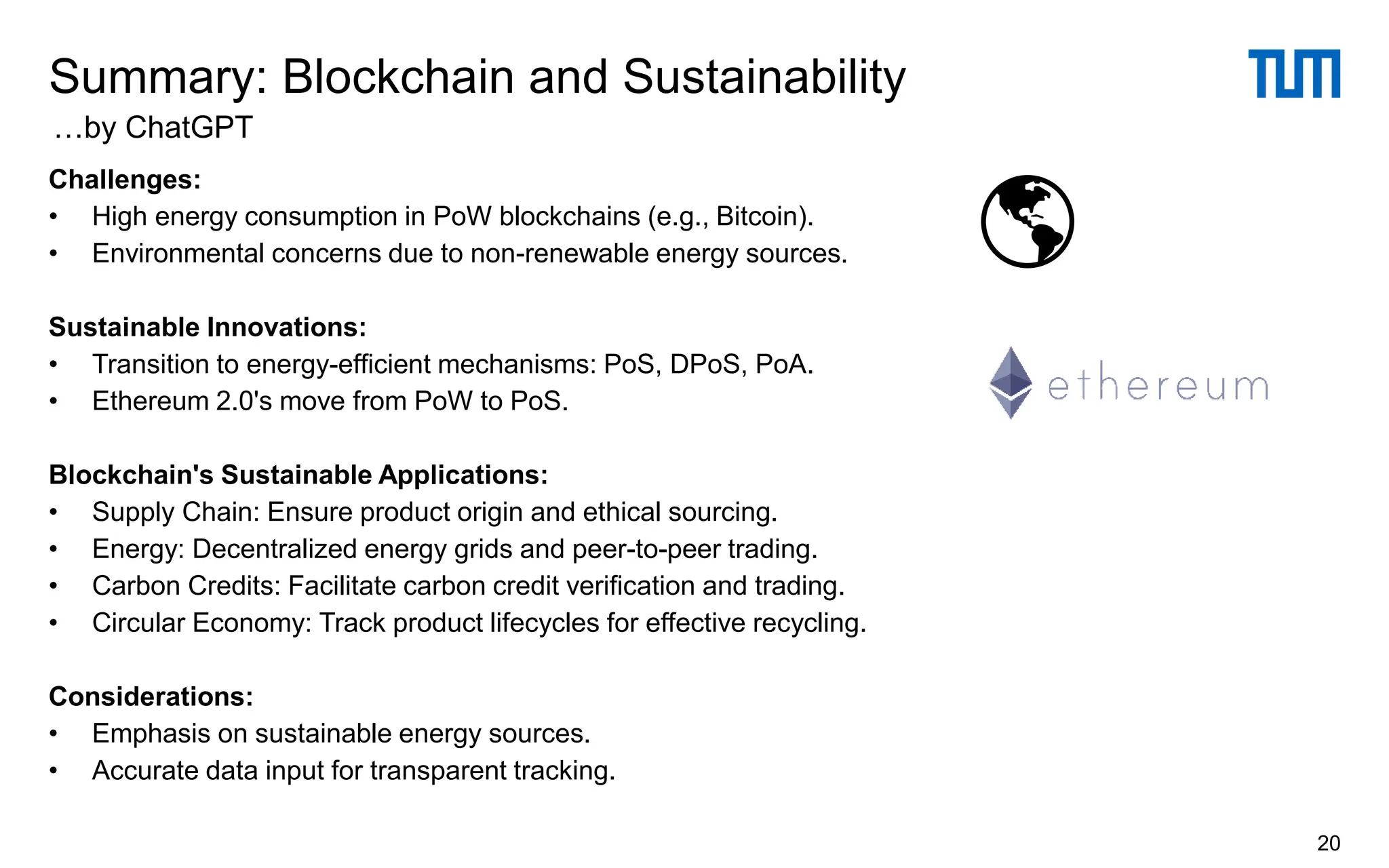
Challenges:
• High energy consumption in PoW blockchains (e.g., Bitcoin).
• Environmental concerns due to non-renewable energy sources.
Sustainable Innovations:
• Transition to energy-efficient mechanisms: PoS, DPoS, PoA.
• Ethereum 2.0's move from PoW to PoS.
Blockchain's Sustainable Applications:
• Supply Chain: Ensure product origin and ethical sourcing.
• Energy: Decentralized energy grids and peer-to-peer trading.
• Carbon Credits: Facilitate carbon credit verification and trading.
• Circular Economy: Track product lifecycles for effective recycling.
Considerations:
• Emphasis on sustainable energy sources.
• Accurate data input for transparent tracking.
Summary: Blockchain and Sustainability
20
…by ChatGPT
Blockchain Technology:
a Sustainable Concept for the Future?
“Die Blockchain-Technologie: Ein nachhaltiges Konzept für die Zukunft?“
Kryptorechtstag, October 2023
Prof. Dr. Ingo Weber
ingo.weber@tum.de
http://imweber.de/
Full professor at TUM and
Director IT infrastructure & digital transformation
at Fraunhofer

Keynote: Blockchain Technology: a Sustainable Concept for the Future?

  • 1.
    Blockchain Technology: a SustainableConcept for the Future? “Die Blockchain-Technologie: Ein nachhaltiges Konzept für die Zukunft?“ Kryptorechtstag, October 2023 Prof. Dr. Ingo Weber ingo.weber@tum.de http://imweber.de/ Full professor at TUM and Director IT infrastructure & digital transformation at Fraunhofer
  • 2.
    Blockchain – replacingcentralized trusted authority 2 Organization 1 Organization 2 Organization 1 Organization 2 Centralized Trusted Authority Traditional trusted environment Blockchain trustless environment Blockchain network
  • 3.
    How? 3 • Immutable database • Public ledger • Every node hosts a replica • Distributed consensus - No central owner of consensus • Transaction is verified by every node • Combination of knowledge from Distributed Systems, Peer-to-Peer, Cryptography, Incentive Systems and Game Theory Blockchain network
  • 4.
    Imagine an emptyledger book On the first page, we write the current account balances • Say, 100 KRT-$ per attendee: − Alice: $ 100 − Bob: $ 100 − Charly: $ 100 − Ingo: $ 100 − … Now imagine we make a lot of copies of the ledger; one per attendee Bob wants to buy a copy of my blockchain book, so he transfers $ 40 to me • We all need to update our ledger copies, so Bob writes and signs a note (like a cheque) about the transaction, and sends a copy of that to each of us • We all check that (i) he has the money, and (ii) the signature is his • Then we add this transaction to page 2 of the ledger Intuition: physical ledger copies (1/2) 4
  • 5.
    Now I wantto buy a copy of Alice’s new book, so I transfers $ 60 to her • I write and sign a note about the transaction, and send a copy of that to each of you • You all perform your checks as before, then add my transaction to page 3 of the ledger The current account balances are: • Alice: $ 160 • Bob: $ 60 • Charly: $ 100 • Ingo: $ 80 … Analogy: • Ledger is the data structure, pages are blocks • Transactions are transactions, but signatures are digital • From the sender account, anyone can check the validity of the signature • We need to ensure everyone has the same version of ledger (consensus), no pages can be removed, etc. Intuition: physical ledger copies (2/2) 5
  • 6.
    What is aBlockchain? 6 Visualization of a Blockchain: http://ethviewer.live
  • 7.
    Blockchain 2nd gen– Smart Contracts 7 • 1st gen blockchains: transactions are financial transfers • Now Blockchain ledger can do that, and store/transact any kind of data • Blockchain can deploy and execute programs: Smart Contracts • User-defined code, deployed on and executed by whole network • Can enact decisions on complex business conditions • Can hold and transfer assets, managed by the contract itself • Ethereum: pay per assembler-level instruction
  • 8.
    Well, blockchains areexciting because they can be used as a new foundation for re-imagining systems: • Neutral infrastructure for processing transactions and executing programs • Potentially interesting for innovation at all touch-points between organizations or individuals ➢Blockchain applications have the potential to disrupt the fabric of society, industry, and government Blockchains can also be used as a technology platform to handle hard issues of data replication and system state synchronization with high integrity. So what? 8
  • 9.
    Xiwei Xu, IngoWeber, Mark Staples. Architecture for Blockchain Applications. Springer, 2019. http://dx.doi.org/10.1007/978-3-030-03035-3 → accessible from the TUM network Blockchain book 9
  • 10.
    Cryptocurrencies • ‘Baked in’to the core platform of public blockchains - base currency of blockchains • Symbiotic relationship − Blockchain keeps track of the ownership of portions of that currency, e.g. Alice owned 2 Ether, transferred 1 Ether to Bob, offered 0.01 Ether to miner − Cryptocurrency enables the incentive mechanism for blockchain operations Digital tokens • Created and exchanged using smart contracts • Represent assets − Fungible asset: individual units are interchangeable, e.g. company share, gold − Non-fungible asset: represents a unique asset, e.g. cryptokitties, car title Not all applications are the same: • Transferring coins / tokens vs. tracking movement of physical goods • Core difference: where is the default version of the truth, on or off-chain? Cryptocurrencies and Tokens 10 Created with DALL-E-2
  • 11.
    Blockchain Technology: a SustainableConcept for the Future?
  • 12.
    Proof-of-Work 1/2 (ex) 12 • Nodes compete for right to create block • Solve a hash puzzle - Easy to verify, difficult to solve - Takes effectively random time, proportional to computational power H(nonce || H() of previous block || Tx || … || Tx) is very small 00000… Output space of hash (256 bits) Target space • If the Hash function is secure: the only way to succeed is to try a huge number of values • Probability(wining next block) = fraction of global hash power the miner controls Transactions ⁞ H( ) of previous block Nonce
  • 13.
    Not energy-efficient • Electricityconsumption of Bitcoin is … high • Sources: https://ccaf.io/cbnsi/cbeci and https://ourworldindata.org/energy/country/austria Proof-of-Work 2/2 13
  • 14.
    Not energy-efficient • Electricityconsumption of Bitcoin is … high • Sources: https://ccaf.io/cbnsi/cbeci and https://ourworldindata.org/energy/country/austria Proof-of-Work 2/2 14 95.5
  • 15.
    Not energy-efficient • Electricityconsumption of Bitcoin is … high • Sources: https://ccaf.io/cbnsi/cbeci and https://ourworldindata.org/energy/country/austria Proof-of-Work 2/2 15 95.5 99.0 66.9
  • 16.
    Not energy-efficient • Electricityconsumption of Bitcoin is … high • Sources: https://ccaf.io/cbnsi/cbeci and https://ourworldindata.org/energy/country/austria How about emissions? • Much more difficult to estimate • Bitcoin can be mined anywhere, in particular right next to a hydro plant – and be switched on only when the price for hydro electricity is low • Example from 2021: “In the wet season in Sichuan and Yunnan, enormous quantities of renewable hydro energy are wasted every year. […] these provinces are the heartlands of mining in China, responsible for almost 10% of global Bitcoin mining in the dry season and 50% in the wet season.” − Source: https://hbr.org/2021/05/how-much-energy-does-bitcoin-actually-consume • How much of the energy consumed by Bitcoin is carbon neutral? Estimates quoted in the above source range from 39% to 73% Proof-of-Work 2/2 16
  • 17.
    Select the nextmining node based on fractional control of the native digital currency • Aligns the incentive of digital currency holders with the good operation • Does not necessarily select the next miner based on largest stakeholding • More cost-efficient, shorter latency Delegated Proof-of-Stake • Accounts delegate their stake to other accounts rather than participating in transaction validation Ethereum: • Go-live of PoS in Sep. 2022 • Estimated reduction of energy by about 99.98% • Source of figure: https://ethereum.org/en/energy-consumption/ Proof-of-Stake (PoS) Since Sep. 2022: 17
  • 18.
    Select the nextmining node based on fractional control of the native digital currency • Aligns the incentive of digital currency holders with the good operation • Does not necessarily select the next miner based on largest stakeholding • More cost-efficient, shorter latency Delegated Proof-of-Stake • Accounts delegate their stake to other accounts rather than participating in transaction validation Ethereum: • Go-live of PoS in Sep. 2022 • Estimated reduction of energy by about 99.98% • Source of figure: https://ethereum.org/en/energy-consumption/ Proof-of-Stake (PoS) Since Sep. 2022: 18
  • 19.
    Some blockchain usecases related to sustainability • Notarization / certification of properties, e.g., organic foodstuff, use of renewable energy, etc. • Caveat: most of these use cases create transparency, allow auditability, etc, but data could be forged from the beginning, and fraud could often only be detected with audits → trusted auditor required • “Programmable money” allows attaching policies / rules to money on how it can be spent [Weber & Staples, 2022] • Could be used to limit organic supermarket to only buy certified organic food, renewable energy, etc. • Caveats: relies on certification as per above; the money might be perceived as less attractive (1 € ≠ 1 prog.€); high effort to implement Sustainability beyond operational energy consumption 19 Created with DALL-E-2
  • 20.
    Challenges: • High energyconsumption in PoW blockchains (e.g., Bitcoin). • Environmental concerns due to non-renewable energy sources. Sustainable Innovations: • Transition to energy-efficient mechanisms: PoS, DPoS, PoA. • Ethereum 2.0's move from PoW to PoS. Blockchain's Sustainable Applications: • Supply Chain: Ensure product origin and ethical sourcing. • Energy: Decentralized energy grids and peer-to-peer trading. • Carbon Credits: Facilitate carbon credit verification and trading. • Circular Economy: Track product lifecycles for effective recycling. Considerations: • Emphasis on sustainable energy sources. • Accurate data input for transparent tracking. Summary: Blockchain and Sustainability 20 …by ChatGPT
  • 21.
    Blockchain Technology: a SustainableConcept for the Future? “Die Blockchain-Technologie: Ein nachhaltiges Konzept für die Zukunft?“ Kryptorechtstag, October 2023 Prof. Dr. Ingo Weber ingo.weber@tum.de http://imweber.de/ Full professor at TUM and Director IT infrastructure & digital transformation at Fraunhofer