Blockchain
An Introduction
- Manish Chaitanya
Agenda
▪ Introduction
▪ Bitcoin
▪ Smart Contracts
▪ Blockchain for Business / Hyperledger
▪ Demo – Hyperledger
▪ Blockchain Use Case Decision Path
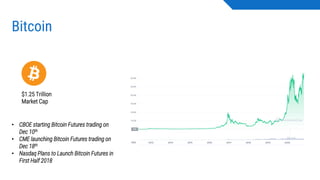
Bitcoin
$1.25 Trillion
Market Cap
• CBOE starting Bitcoin Futures trading on
Dec 10th
• CME launching Bitcoin Futures trading on
Dec 18th
• Nasdaq Plans to Launch Bitcoin Futures in
First Half 2018
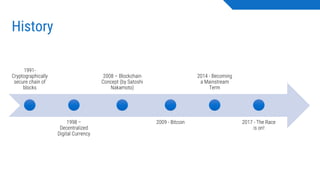
History
1991-
Cryptographically
secure chain of
blocks
1998 –
Decentralized
Digital Currency
2008 – Blockchain
Concept (by Satoshi
Nakamoto)
2009 - Bitcoin
2014 - Becoming
a Mainstream
Term
2017 - The Race
is on!
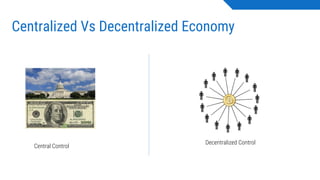
Centralized Vs Decentralized Economy
Central Control
Decentralized Control
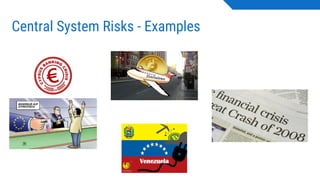
Central System Risks - Examples
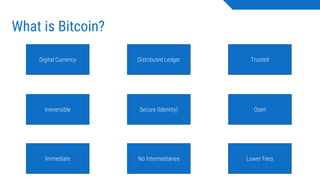
What is Bitcoin?
Digital Currency Distributed Ledger Trusted
Irreversible Open
Secure (Identity)
Immediate No Intermediaries Lower Fees
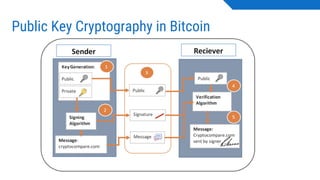
Public Key Cryptography in Bitcoin
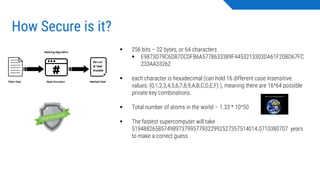
How Secure is it?
▪ 256 bits – 32 bytes, or 64 characters
▪ E9873D79C6D87DC0FB6A5778633389F4453213303DA61F20BD67FC
233AA33262
▪ each character is hexadecimal (can hold 16 different case insensitive
values: {0,1,2,3,4,5,6,7,8,9,A,B,C,D,E,F} ), meaning there are 16^64 possible
private key combinations.
▪ Total number of atoms in the world – 1.33 * 10^50
▪ The fastest supercomputer will take
5194882658574989737995779322992527357514014.0710380707 years
to make a correct guess
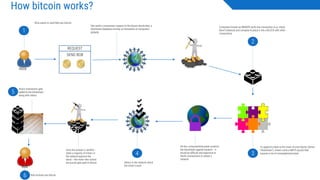
SEND BOB
REQUEST
1
Alice wants to send Bob two bitcoin.
Computers known as MINERS verify this transaction (e.g. check
Alice’s balance) and compete to place it into a BLOCK with other
transactions
2
3
To append a block to the chain of prior blocks (hence
“blockchain”), miners solve a MATH puzzle that
requires a lot of computational power
All this computational power protects
the blockchain against hackers – it
would be difficult and expensive to
falsify transactions or attack a
network
4
Others in the network check
the miner’s work
Once the answer is verified –
when a majority of miners in
the network approve the
block – the miner who solved
the puzzle gets paid in bitcoin
5
Alice’s transaction gets
added to the blockchain
along with others
6 Bob receives two bitcoin
How bitcoin works?
Alice
Bob
She sends a transaction request to the bitcoin blockchain, a
distributed database running on thousands of computers
globally
Bitcoin Facts
▪ To limit inflation, bitcoin creator Satoshi Nakamoto designed bitcoin to
ultimately have only 21 million bitcoins.
▪ Size of bitcoin block rewards is halved after the creation of every 210,000
blocks, which takes around four years.
▪ At bitcoin's inception in 2009, each block reward was worth 50 BTC. In May
2020, the block reward was halved a third time to 6.25 BTC.
▪ And as of May 2021, there were already 18.7 million bitcoins in existence,
or nearly 90% of the total planned supply.
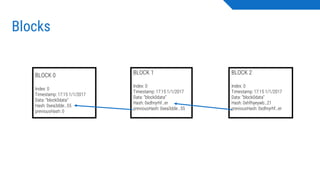
Blocks
BLOCK 0
Index: 0
Timestamp: 17:15 1/1/2017
Data: “block0data”
Hash: 0xea3dde…55
previousHash: 0
BLOCK 1
Index: 0
Timestamp: 17:15 1/1/2017
Data: “block0data”
Hash: 0xdhryrhf…er
previousHash: 0xea3dde…55
BLOCK 2
Index: 0
Timestamp: 17:15 1/1/2017
Data: “block0data”
Hash: 0xhfhyeywb…21
previousHash: 0xdhryrhf…er
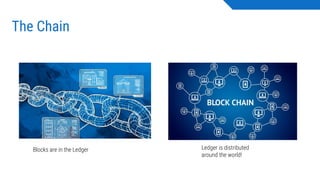
The Chain
Blocks are in the Ledger Ledger is distributed
around the world!
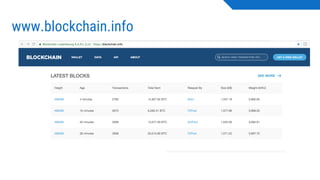
www.blockchain.info
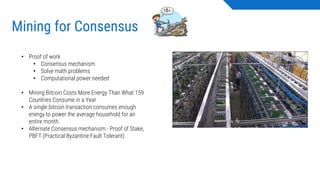
Mining for Consensus
• Proof of work
• Consensus mechanism
• Solve math problems
• Computational power needed
• Mining Bitcoin Costs More Energy Than What 159
Countries Consume in a Year
• A single bitcoin transaction consumes enough
energy to power the average household for an
entire month.
• Alternate Consensus mechanism - Proof of Stake,
PBFT (Practical Byzantine Fault Tolerant)
Types of Blockchain Networks
▪ Permissionless
▪ Bitcoin
▪ Ethereum
▪ Permissioned
▪ Hyperledger
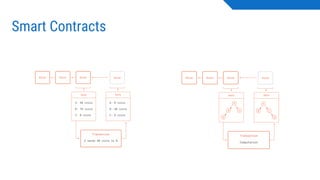
Smart Contracts
Ethereum & Smart Contracts
▪ Smart Contract is just a phrase used to describe computer code that can facilitate the exchange of money, content,
property, shares, or an
▪ When running on the blockchain a smart contract becomes like a self-operating computer program that automatically
executes when specific conditions are met.ything of value.
▪ Because smart contracts run on the blockchain, they run exactly as programmed without any possibility of censorship,
downtime, fraud or third party interference.
▪ Contracts lives on the Ethereum blockchain
▪ They have their own Ethereum address and balance
▪ They can send and receive transactions
▪ They are activated when they receive a transaction, and can be deactivated
▪ The Ethereum Virtual Machine runs a turing complete language
▪ They have a fee per CPU step, with extra for storage
Smart Contracts
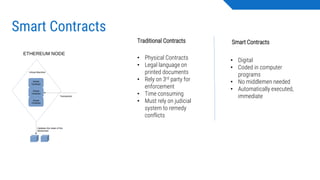
Traditional Contracts Smart Contracts
• Physical Contracts
• Legal language on
printed documents
• Rely on 3rd party for
enforcement
• Time consuming
• Must rely on judicial
system to remedy
conflicts
• Digital
• Coded in computer
programs
• No middlemen needed
• Automatically executed,
immediate
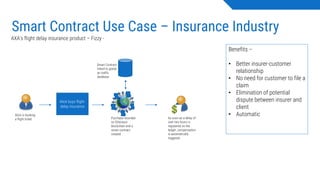
Smart Contract Use Case – Insurance Industry
AXA’s flight delay insurance product – Fizzy -
Alice is booking
a flight ticket
Alice buys flight-
delay insurance
Purchase recorded
on Ethereum
blockchain and a
smart contract
created
Smart Contract
linked to global
air traffic
database
As soon as a delay of
over two hours is
registered on the
ledger, compensation
is automatically
triggered.
Benefits –
• Better insurer-customer
relationship
• No need for customer to file a
claim
• Elimination of potential
dispute between insurer and
client
• Automatic
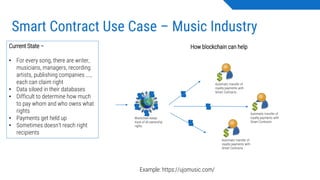
Smart Contract Use Case – Music Industry
Blockchain keeps
track of all ownership
rights
Automatic transfer of
royalty payments with
Smart Contracts
Current State –
• For every song, there are writer,
musicians, managers, recording
artists, publishing companies ….,
each can claim right
• Data siloed in their databases
• Difficult to determine how much
to pay whom and who owns what
rights
• Payments get held up
• Sometimes doesn’t reach right
recipients
Automatic transfer of
royalty payments with
Smart Contracts
Automatic transfer of
royalty payments with
Smart Contracts
How blockchain can help
Example: https://ujomusic.com/
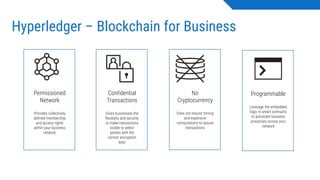
Hyperledger – Blockchain for Business
Permissioned
Network
Provides collectively
defined membership
and access rights
within your business
network
Confidential
Transactions
Gives businesses the
flexibility and security
to make transactions
visible to select
parties with the
correct encryption
keys
No
Cryptocurrency
Does not require mining
and expensive
computations to assure
transactions
Programmable
Leverage the embedded
logic in smart contracts
to automate business
processes across your
network
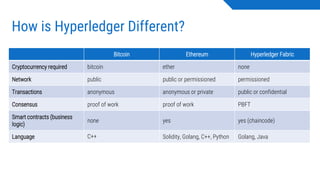
How is Hyperledger Different?
Bitcoin Ethereum Hyperledger Fabric
Cryptocurrency required bitcoin ether none
Network public public or permissioned permissioned
Transactions anonymous anonymous or private public or confidential
Consensus proof of work proof of work PBFT
Smart contracts (business
logic)
none yes yes (chaincode)
Language C++ Solidity, Golang, C++, Python Golang, Java
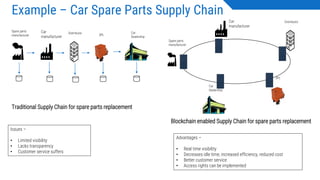
Issues –
• Limited visibility
• Lacks transparency
• Customer service suffers
Traditional Supply Chain for spare parts replacement
Example – Car Spare Parts Supply Chain
Spare parts
manufacturer
Car
manufacturer
Distributor
3PL
Car
Dealership
Spare parts
manufacturer
Car
manufacturer
Distributor
3PL
Car
Dealership
Blockchain enabled Supply Chain for spare parts replacement
Advantages –
• Real time visibility
• Decreases idle time, increased efficiency, reduced cost
• Better customer service
• Access rights can be implemented
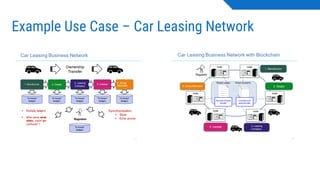
Example Use Case – Car Leasing Network
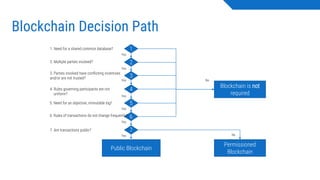
Blockchain Decision Path
1
2
3
4
5
6
7
Public Blockchain
Permissioned
Blockchain
Blockchain is not
required
No
No
Yes
Yes
Yes
Yes
Yes
Yes
Yes
1. Need for a shared common database?
2. Multiple parties involved?
3. Parties involved have conflicting incentives
and/or are not trusted?
4. Rules governing participants are not
uniform?
5. Need for an objective, immutable log?
6. Rules of transactions do not change frequently?
7. Are transactions public?
Thank you!!
Questions / Feedback??
Appendix – Use Cases
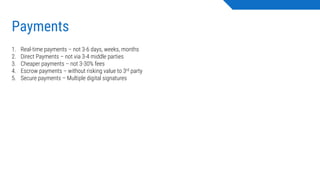
Payments
1. Real-time payments – not 3-6 days, weeks, months
2. Direct Payments – not via 3-4 middle parties
3. Cheaper payments – not 3-30% fees
4. Escrow payments – without risking value to 3rd party
5. Secure payments – Multiple digital signatures
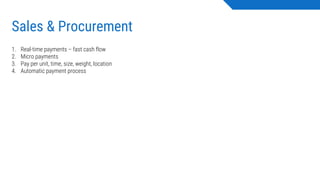
Sales & Procurement
1. Real-time payments – fast cash flow
2. Micro payments
3. Pay per unit, time, size, weight, location
4. Automatic payment process
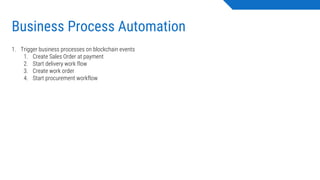
Business Process Automation
1. Trigger business processes on blockchain events
1. Create Sales Order at payment
2. Start delivery work flow
3. Create work order
4. Start procurement workflow
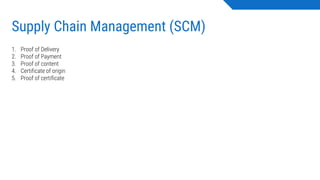
Supply Chain Management (SCM)
1. Proof of Delivery
2. Proof of Payment
3. Proof of content
4. Certificate of origin
5. Proof of certificate
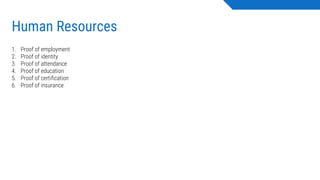
Human Resources
1. Proof of employment
2. Proof of identity
3. Proof of attendance
4. Proof of education
5. Proof of certification
6. Proof of insurance
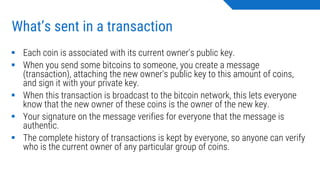
What’s sent in a transaction
▪ Each coin is associated with its current owner's public key.
▪ When you send some bitcoins to someone, you create a message
(transaction), attaching the new owner's public key to this amount of coins,
and sign it with your private key.
▪ When this transaction is broadcast to the bitcoin network, this lets everyone
know that the new owner of these coins is the owner of the new key.
▪ Your signature on the message verifies for everyone that the message is
authentic.
▪ The complete history of transactions is kept by everyone, so anyone can verify
who is the current owner of any particular group of coins.

Blockchain External.pdf

  • 1.
  • 2.
    Agenda ▪ Introduction ▪ Bitcoin ▪Smart Contracts ▪ Blockchain for Business / Hyperledger ▪ Demo – Hyperledger ▪ Blockchain Use Case Decision Path
  • 3.
    Bitcoin $1.25 Trillion Market Cap •CBOE starting Bitcoin Futures trading on Dec 10th • CME launching Bitcoin Futures trading on Dec 18th • Nasdaq Plans to Launch Bitcoin Futures in First Half 2018
  • 4.
    History 1991- Cryptographically secure chain of blocks 1998– Decentralized Digital Currency 2008 – Blockchain Concept (by Satoshi Nakamoto) 2009 - Bitcoin 2014 - Becoming a Mainstream Term 2017 - The Race is on!
  • 5.
    Centralized Vs DecentralizedEconomy Central Control Decentralized Control
  • 6.
  • 7.
    What is Bitcoin? DigitalCurrency Distributed Ledger Trusted Irreversible Open Secure (Identity) Immediate No Intermediaries Lower Fees
  • 8.
  • 9.
    How Secure isit? ▪ 256 bits – 32 bytes, or 64 characters ▪ E9873D79C6D87DC0FB6A5778633389F4453213303DA61F20BD67FC 233AA33262 ▪ each character is hexadecimal (can hold 16 different case insensitive values: {0,1,2,3,4,5,6,7,8,9,A,B,C,D,E,F} ), meaning there are 16^64 possible private key combinations. ▪ Total number of atoms in the world – 1.33 * 10^50 ▪ The fastest supercomputer will take 5194882658574989737995779322992527357514014.0710380707 years to make a correct guess
  • 10.
    SEND BOB REQUEST 1 Alice wantsto send Bob two bitcoin. Computers known as MINERS verify this transaction (e.g. check Alice’s balance) and compete to place it into a BLOCK with other transactions 2 3 To append a block to the chain of prior blocks (hence “blockchain”), miners solve a MATH puzzle that requires a lot of computational power All this computational power protects the blockchain against hackers – it would be difficult and expensive to falsify transactions or attack a network 4 Others in the network check the miner’s work Once the answer is verified – when a majority of miners in the network approve the block – the miner who solved the puzzle gets paid in bitcoin 5 Alice’s transaction gets added to the blockchain along with others 6 Bob receives two bitcoin How bitcoin works? Alice Bob She sends a transaction request to the bitcoin blockchain, a distributed database running on thousands of computers globally
  • 11.
    Bitcoin Facts ▪ Tolimit inflation, bitcoin creator Satoshi Nakamoto designed bitcoin to ultimately have only 21 million bitcoins. ▪ Size of bitcoin block rewards is halved after the creation of every 210,000 blocks, which takes around four years. ▪ At bitcoin's inception in 2009, each block reward was worth 50 BTC. In May 2020, the block reward was halved a third time to 6.25 BTC. ▪ And as of May 2021, there were already 18.7 million bitcoins in existence, or nearly 90% of the total planned supply.
  • 12.
    Blocks BLOCK 0 Index: 0 Timestamp:17:15 1/1/2017 Data: “block0data” Hash: 0xea3dde…55 previousHash: 0 BLOCK 1 Index: 0 Timestamp: 17:15 1/1/2017 Data: “block0data” Hash: 0xdhryrhf…er previousHash: 0xea3dde…55 BLOCK 2 Index: 0 Timestamp: 17:15 1/1/2017 Data: “block0data” Hash: 0xhfhyeywb…21 previousHash: 0xdhryrhf…er
  • 13.
    The Chain Blocks arein the Ledger Ledger is distributed around the world!
  • 14.
  • 15.
    Mining for Consensus •Proof of work • Consensus mechanism • Solve math problems • Computational power needed • Mining Bitcoin Costs More Energy Than What 159 Countries Consume in a Year • A single bitcoin transaction consumes enough energy to power the average household for an entire month. • Alternate Consensus mechanism - Proof of Stake, PBFT (Practical Byzantine Fault Tolerant)
  • 16.
    Types of BlockchainNetworks ▪ Permissionless ▪ Bitcoin ▪ Ethereum ▪ Permissioned ▪ Hyperledger
  • 17.
  • 18.
    Ethereum & SmartContracts ▪ Smart Contract is just a phrase used to describe computer code that can facilitate the exchange of money, content, property, shares, or an ▪ When running on the blockchain a smart contract becomes like a self-operating computer program that automatically executes when specific conditions are met.ything of value. ▪ Because smart contracts run on the blockchain, they run exactly as programmed without any possibility of censorship, downtime, fraud or third party interference. ▪ Contracts lives on the Ethereum blockchain ▪ They have their own Ethereum address and balance ▪ They can send and receive transactions ▪ They are activated when they receive a transaction, and can be deactivated ▪ The Ethereum Virtual Machine runs a turing complete language ▪ They have a fee per CPU step, with extra for storage
  • 19.
    Smart Contracts Traditional ContractsSmart Contracts • Physical Contracts • Legal language on printed documents • Rely on 3rd party for enforcement • Time consuming • Must rely on judicial system to remedy conflicts • Digital • Coded in computer programs • No middlemen needed • Automatically executed, immediate
  • 20.
    Smart Contract UseCase – Insurance Industry AXA’s flight delay insurance product – Fizzy - Alice is booking a flight ticket Alice buys flight- delay insurance Purchase recorded on Ethereum blockchain and a smart contract created Smart Contract linked to global air traffic database As soon as a delay of over two hours is registered on the ledger, compensation is automatically triggered. Benefits – • Better insurer-customer relationship • No need for customer to file a claim • Elimination of potential dispute between insurer and client • Automatic
  • 21.
    Smart Contract UseCase – Music Industry Blockchain keeps track of all ownership rights Automatic transfer of royalty payments with Smart Contracts Current State – • For every song, there are writer, musicians, managers, recording artists, publishing companies …., each can claim right • Data siloed in their databases • Difficult to determine how much to pay whom and who owns what rights • Payments get held up • Sometimes doesn’t reach right recipients Automatic transfer of royalty payments with Smart Contracts Automatic transfer of royalty payments with Smart Contracts How blockchain can help Example: https://ujomusic.com/
  • 22.
    Hyperledger – Blockchainfor Business Permissioned Network Provides collectively defined membership and access rights within your business network Confidential Transactions Gives businesses the flexibility and security to make transactions visible to select parties with the correct encryption keys No Cryptocurrency Does not require mining and expensive computations to assure transactions Programmable Leverage the embedded logic in smart contracts to automate business processes across your network
  • 23.
    How is HyperledgerDifferent? Bitcoin Ethereum Hyperledger Fabric Cryptocurrency required bitcoin ether none Network public public or permissioned permissioned Transactions anonymous anonymous or private public or confidential Consensus proof of work proof of work PBFT Smart contracts (business logic) none yes yes (chaincode) Language C++ Solidity, Golang, C++, Python Golang, Java
  • 24.
    Issues – • Limitedvisibility • Lacks transparency • Customer service suffers Traditional Supply Chain for spare parts replacement Example – Car Spare Parts Supply Chain Spare parts manufacturer Car manufacturer Distributor 3PL Car Dealership Spare parts manufacturer Car manufacturer Distributor 3PL Car Dealership Blockchain enabled Supply Chain for spare parts replacement Advantages – • Real time visibility • Decreases idle time, increased efficiency, reduced cost • Better customer service • Access rights can be implemented
  • 25.
    Example Use Case– Car Leasing Network
  • 26.
    Blockchain Decision Path 1 2 3 4 5 6 7 PublicBlockchain Permissioned Blockchain Blockchain is not required No No Yes Yes Yes Yes Yes Yes Yes 1. Need for a shared common database? 2. Multiple parties involved? 3. Parties involved have conflicting incentives and/or are not trusted? 4. Rules governing participants are not uniform? 5. Need for an objective, immutable log? 6. Rules of transactions do not change frequently? 7. Are transactions public?
  • 27.
  • 28.
  • 29.
    Payments 1. Real-time payments– not 3-6 days, weeks, months 2. Direct Payments – not via 3-4 middle parties 3. Cheaper payments – not 3-30% fees 4. Escrow payments – without risking value to 3rd party 5. Secure payments – Multiple digital signatures
  • 30.
    Sales & Procurement 1.Real-time payments – fast cash flow 2. Micro payments 3. Pay per unit, time, size, weight, location 4. Automatic payment process
  • 31.
    Business Process Automation 1.Trigger business processes on blockchain events 1. Create Sales Order at payment 2. Start delivery work flow 3. Create work order 4. Start procurement workflow
  • 32.
    Supply Chain Management(SCM) 1. Proof of Delivery 2. Proof of Payment 3. Proof of content 4. Certificate of origin 5. Proof of certificate
  • 33.
    Human Resources 1. Proofof employment 2. Proof of identity 3. Proof of attendance 4. Proof of education 5. Proof of certification 6. Proof of insurance
  • 34.
    What’s sent ina transaction ▪ Each coin is associated with its current owner's public key. ▪ When you send some bitcoins to someone, you create a message (transaction), attaching the new owner's public key to this amount of coins, and sign it with your private key. ▪ When this transaction is broadcast to the bitcoin network, this lets everyone know that the new owner of these coins is the owner of the new key. ▪ Your signature on the message verifies for everyone that the message is authentic. ▪ The complete history of transactions is kept by everyone, so anyone can verify who is the current owner of any particular group of coins.