1
History of Economic Thought I
Econ 3141
2
Chapter Four
Classical Economic Thought
Outline

Introduction

The Forerunners

Adam Smith

David Ricardo

Thomas Robert Malthus

J. Bentham, J. Mill and J. B. Say
3
Classical Economic Thought
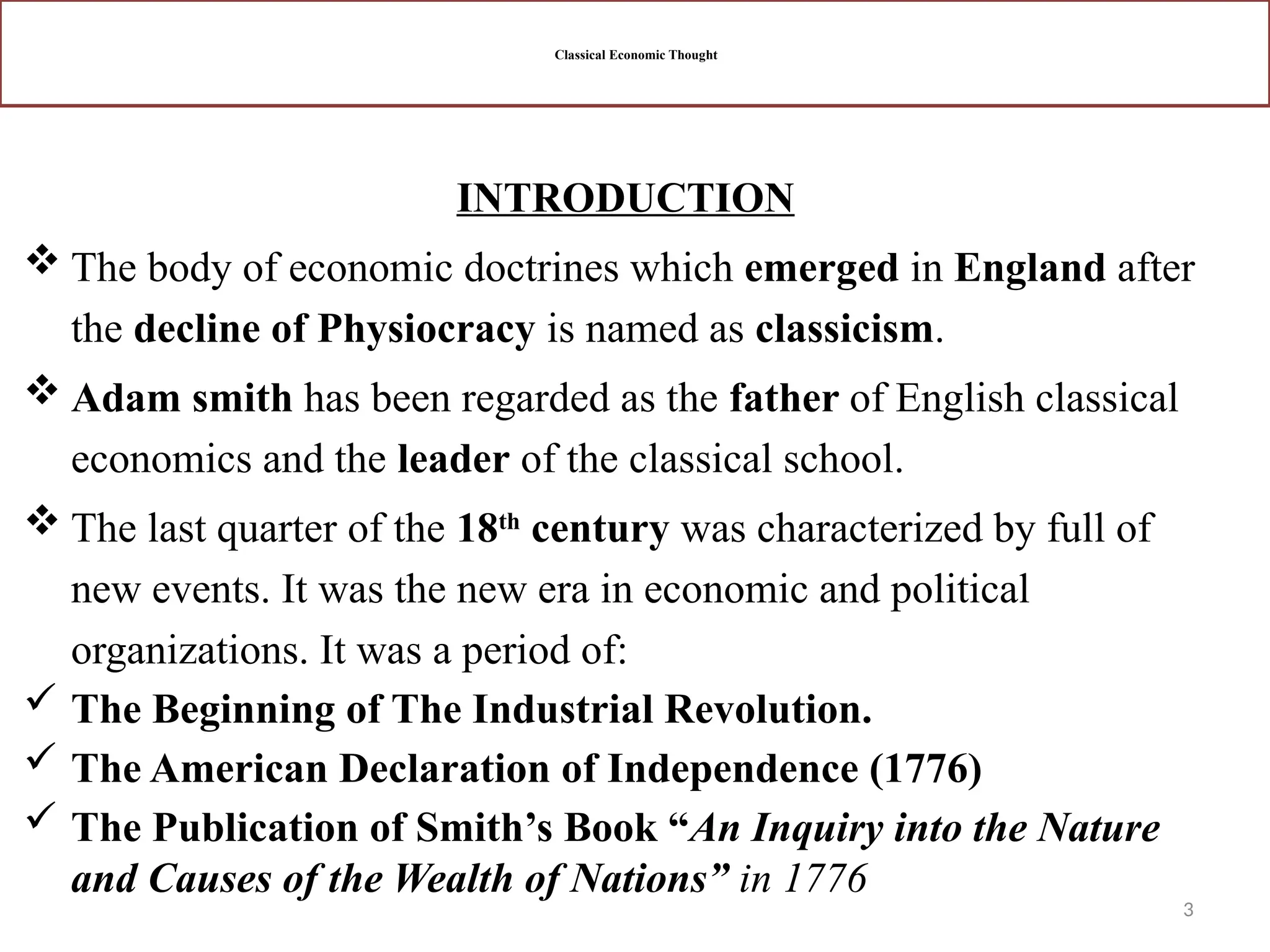
INTRODUCTION
 The body of economic doctrines which emerged in England after
the decline of Physiocracy is named as classicism.
 Adam smith has been regarded as the father of English classical
economics and the leader of the classical school.
 The last quarter of the 18th
century was characterized by full of
new events. It was the new era in economic and political
organizations. It was a period of:
 The Beginning of The Industrial Revolution.
 The American Declaration of Independence (1776)
 The Publication of Smith’s Book “An Inquiry into the Nature
and Causes of the Wealth of Nations” in 1776
4
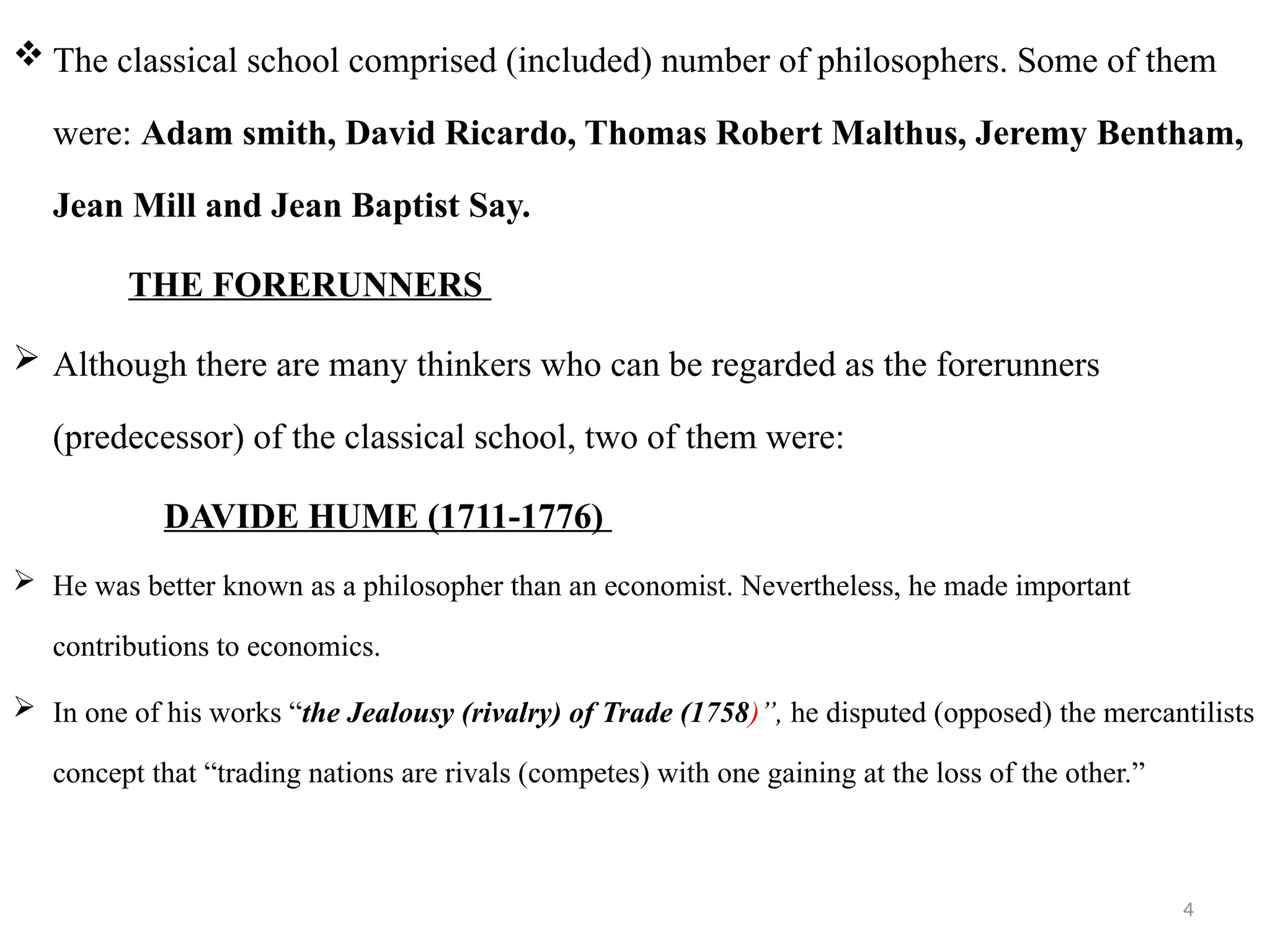
 The classical school comprised (included) number of philosophers. Some of them
were: Adam smith, David Ricardo, Thomas Robert Malthus, Jeremy Bentham,
Jean Mill and Jean Baptist Say.
THE FORERUNNERS
 Although there are many thinkers who can be regarded as the forerunners
(predecessor) of the classical school, two of them were:
DAVIDE HUME (1711-1776)
 He was better known as a philosopher than an economist. Nevertheless, he made important
contributions to economics.
 In one of his works “the Jealousy (rivalry) of Trade (1758)”, he disputed (opposed) the mercantilists
concept that “trading nations are rivals (competes) with one gaining at the loss of the other.”
5
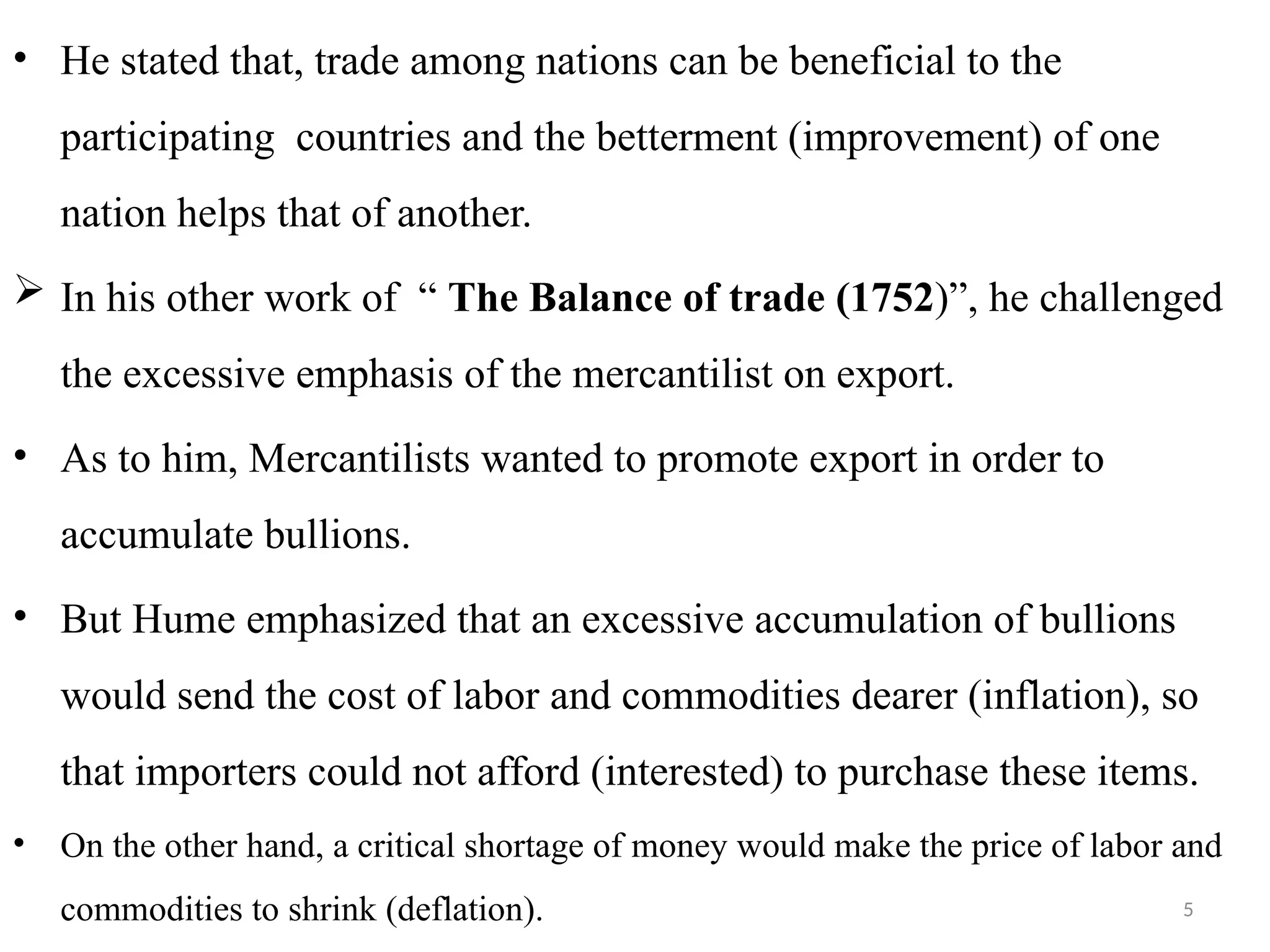
• He stated that, trade among nations can be beneficial to the
participating countries and the betterment (improvement) of one
nation helps that of another.
 In his other work of “ The Balance of trade (1752)”, he challenged
the excessive emphasis of the mercantilist on export.
• As to him, Mercantilists wanted to promote export in order to
accumulate bullions.
• But Hume emphasized that an excessive accumulation of bullions
would send the cost of labor and commodities dearer (inflation), so
that importers could not afford (interested) to purchase these items.
• On the other hand, a critical shortage of money would make the price of labor and
commodities to shrink (deflation).
6
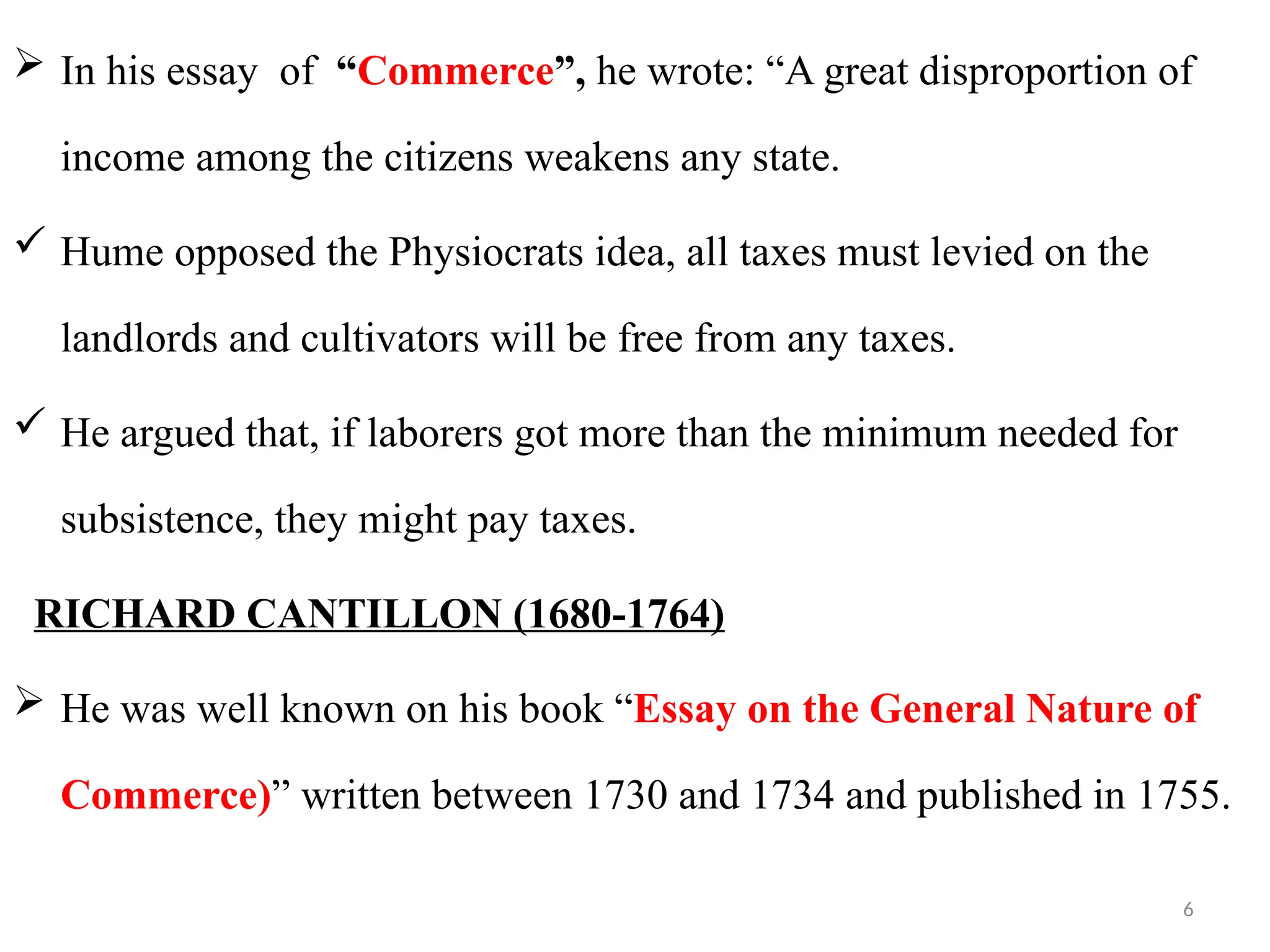
 In his essay of “Commerce”, he wrote: “A great disproportion of
income among the citizens weakens any state.
 Hume opposed the Physiocrats idea, all taxes must levied on the
landlords and cultivators will be free from any taxes.
 He argued that, if laborers got more than the minimum needed for
subsistence, they might pay taxes.
RICHARD CANTILLON (1680-1764)
 He was well known on his book “Essay on the General Nature of
Commerce)” written between 1730 and 1734 and published in 1755.
7
 Cantillon developed a theory of value and price. According to him:
“Price or intrinsic value (value in nature) of a thing measure the quality of
land and labor entering in to production, i.e. the fertility or productivity of
the land and the quality or the efficiency of labor measured by their
intrinsic value.
 But, it often happens that, many things which have actual intrinsic
value are not sold in the market, they will depend on the humours
(tendency) and fancies (desire) of the peoples and their consumption”.
 Cantillon recognized the importance of the velocity (circulation) of
money, with a faster circulation requiring a smaller quantity of money,
i.e. high quantity of money decreases its purchasing power.
8
 He explained „entrepreneur and emphasized the role of it in
‟
economic life. Economists theorized that, the only factors of
production were land, labor and capital, but Cantillon included
entrepreneur as a factors of production.
 Cantillon said, business men commit themselves to a definite payment
in expectation of uncertain receipts and risk taken by them, i.e. loss
will remunerated (compensated) by profit.
 He analyzed interest as a reward for the risk taken in lending, based
on profits, the entrepreneur can make borrowing and investing.
 Cantillon also anticipated (opposed) the Malthus's views on
population, i.e. if the popn grows rapidly than food supply, will leads
to poverty.
9
ADAM SMITH (1723 – 1790)
 Adam Smith was truly regarded as the patriarch/father of the
science of economics.
 He studied Mathematics and in 1751 he became a Professor of
Logic and by the end of the year, he was the chair of Moral
Philosophy.
 Adam Smith was the first academic economist who contributed:
 For the transformation of the subject matter of economics in to
science
 For the development and completion of economic thought and
transformed into science.
10
CONTRIBUTION OF ADAM SMITH
Analysis of the Wealth of Nations

Adam Smith`s thought regarding the origin of wealth was different from the
Mercantilist and Physiocrats thought.

To mercantilists wealth gained from the accumulation of precious metals, whereas
to physiocrats wealth originated from agriculture.

But on his famous book “wealth of nation”, he explained the nature and causes of
wealth of nation and he stated that, the origin of the national wealth lies not in
foreign trade (as mercantilist did) nor in land (as physiocrats did) but lies in labor.

Contents of wealth are the products of labor.
11
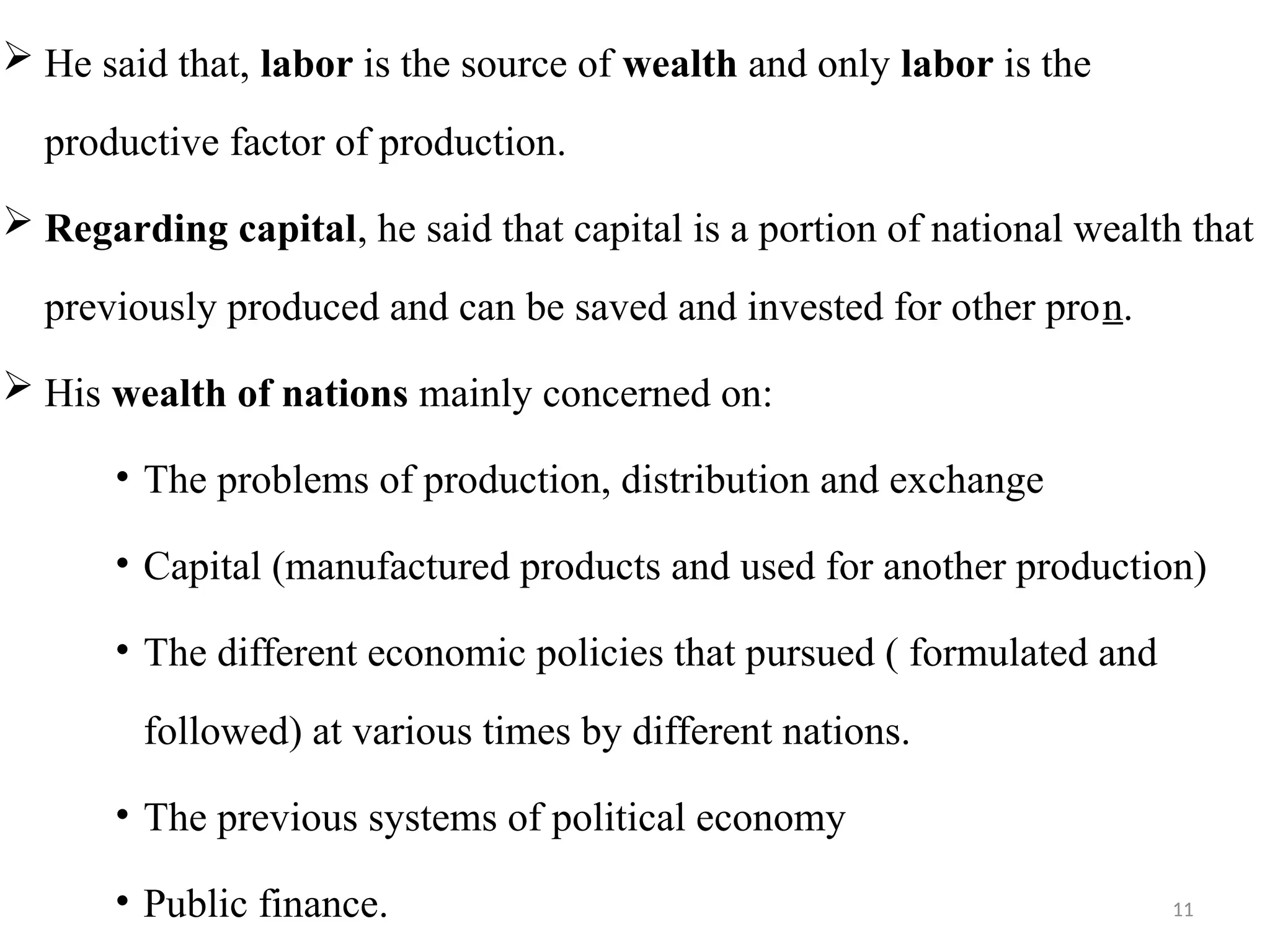
 He said that, labor is the source of wealth and only labor is the
productive factor of production.
 Regarding capital, he said that capital is a portion of national wealth that
previously produced and can be saved and invested for other pron.
 His wealth of nations mainly concerned on:
• The problems of production, distribution and exchange
• Capital (manufactured products and used for another production)
• The different economic policies that pursued ( formulated and
followed) at various times by different nations.
• The previous systems of political economy
• Public finance.
12
Self interest
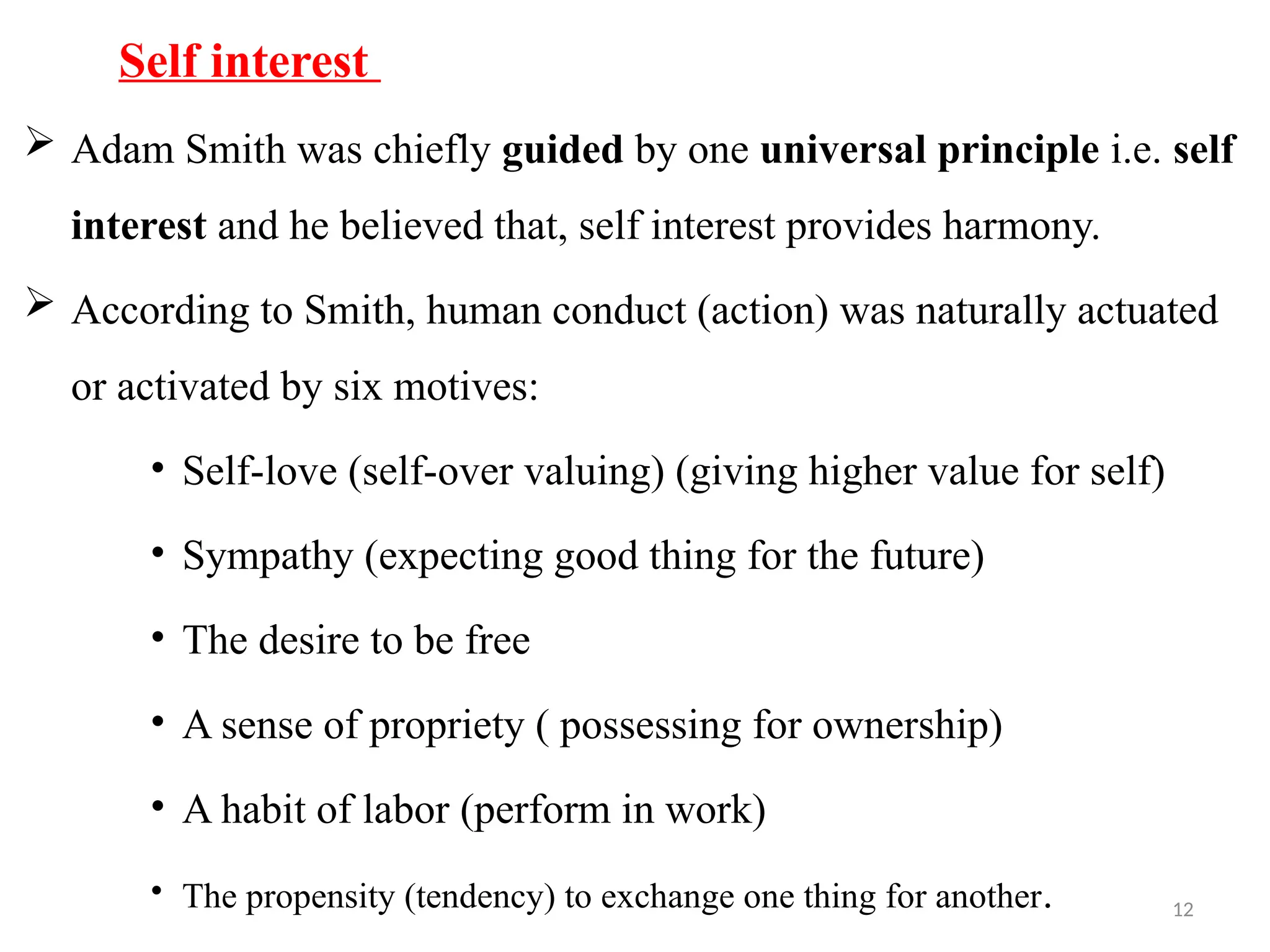
 Adam Smith was chiefly guided by one universal principle i.e. self
interest and he believed that, self interest provides harmony.
 According to Smith, human conduct (action) was naturally actuated
or activated by six motives:
• Self-love (self-over valuing) (giving higher value for self)
• Sympathy (expecting good thing for the future)
• The desire to be free
• A sense of propriety ( possessing for ownership)
• A habit of labor (perform in work)
• The propensity (tendency) to exchange one thing for another.
13
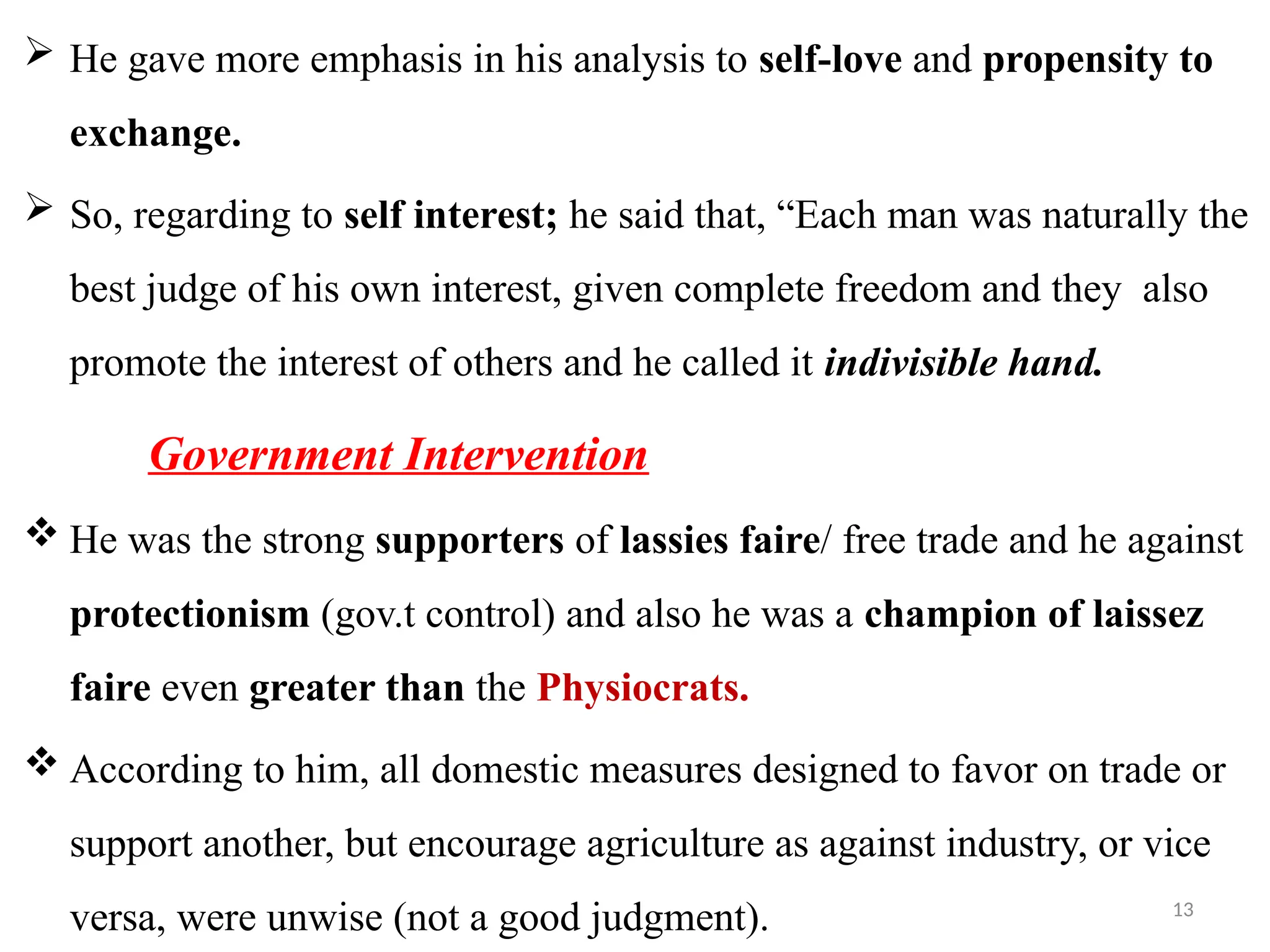
 He gave more emphasis in his analysis to self-love and propensity to
exchange.
 So, regarding to self interest; he said that, “Each man was naturally the
best judge of his own interest, given complete freedom and they also
promote the interest of others and he called it indivisible hand.
Government Intervention
 He was the strong supporters of lassies faire/ free trade and he against
protectionism (gov.t control) and also he was a champion of laissez
faire even greater than the Physiocrats.
 According to him, all domestic measures designed to favor on trade or
support another, but encourage agriculture as against industry, or vice
versa, were unwise (not a good judgment).
14
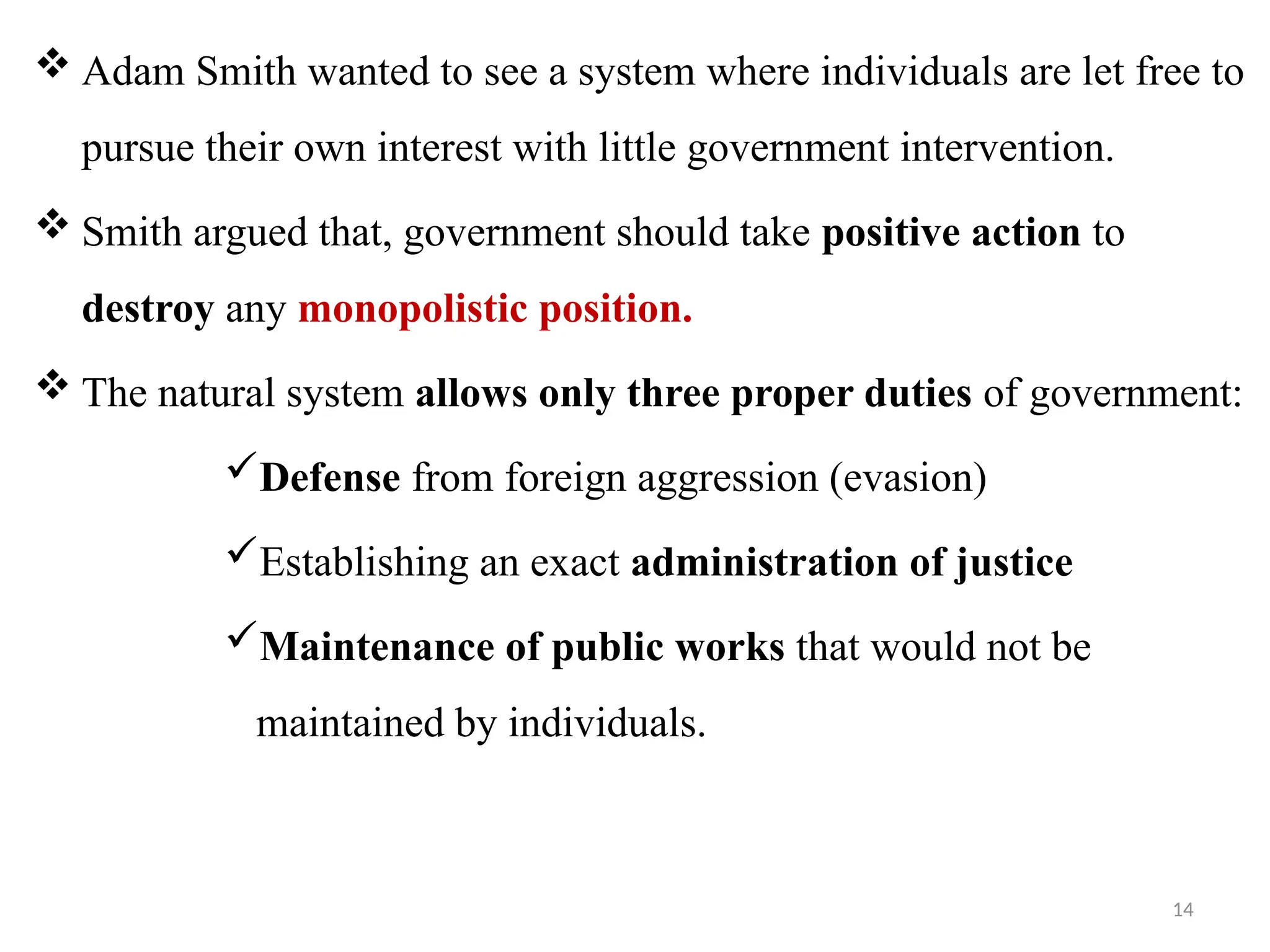
 Adam Smith wanted to see a system where individuals are let free to
pursue their own interest with little government intervention.
 Smith argued that, government should take positive action to
destroy any monopolistic position.
 The natural system allows only three proper duties of government:
Defense from foreign aggression (evasion)
Establishing an exact administration of justice
Maintenance of public works that would not be
maintained by individuals.
15
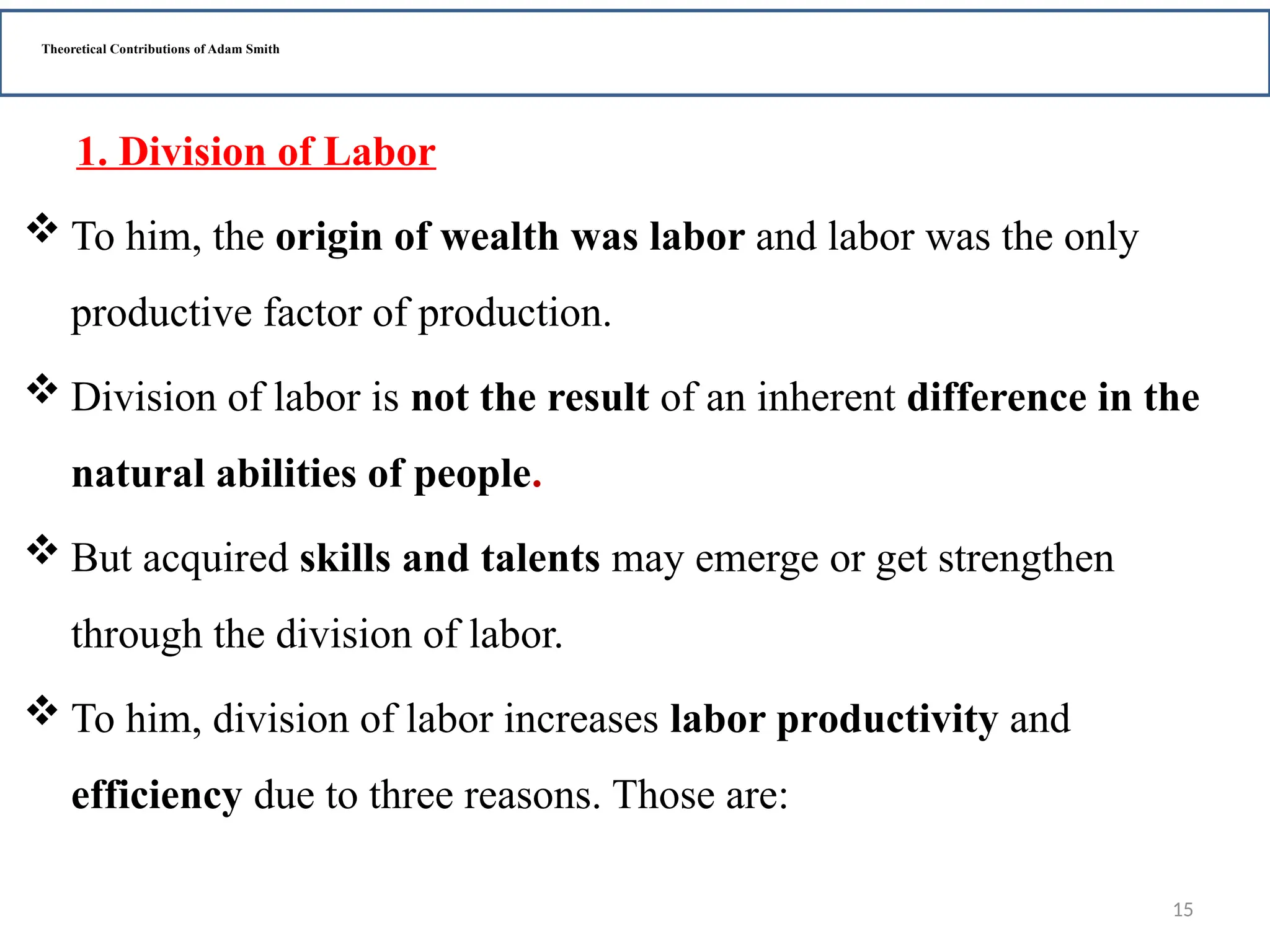
Theoretical Contributions of Adam Smith
1. Division of Labor
 To him, the origin of wealth was labor and labor was the only
productive factor of production.
 Division of labor is not the result of an inherent difference in the
natural abilities of people.
 But acquired skills and talents may emerge or get strengthen
through the division of labor.
 To him, division of labor increases labor productivity and
efficiency due to three reasons. Those are:
16
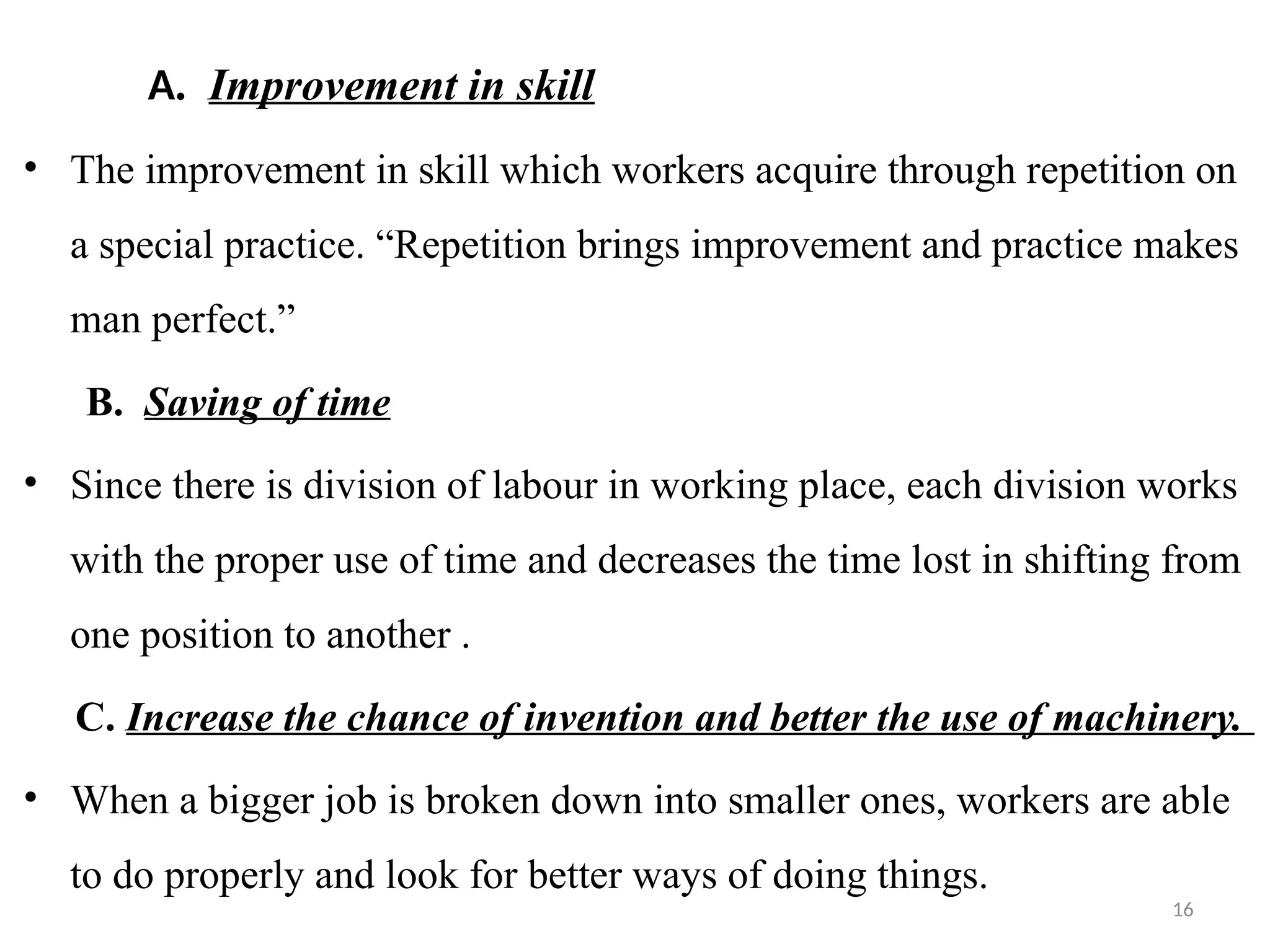
A. Improvement in skill
• The improvement in skill which workers acquire through repetition on
a special practice. “Repetition brings improvement and practice makes
man perfect.”
B. Saving of time
• Since there is division of labour in working place, each division works
with the proper use of time and decreases the time lost in shifting from
one position to another .
C. Increase the chance of invention and better the use of machinery.
• When a bigger job is broken down into smaller ones, workers are able
to do properly and look for better ways of doing things.
17
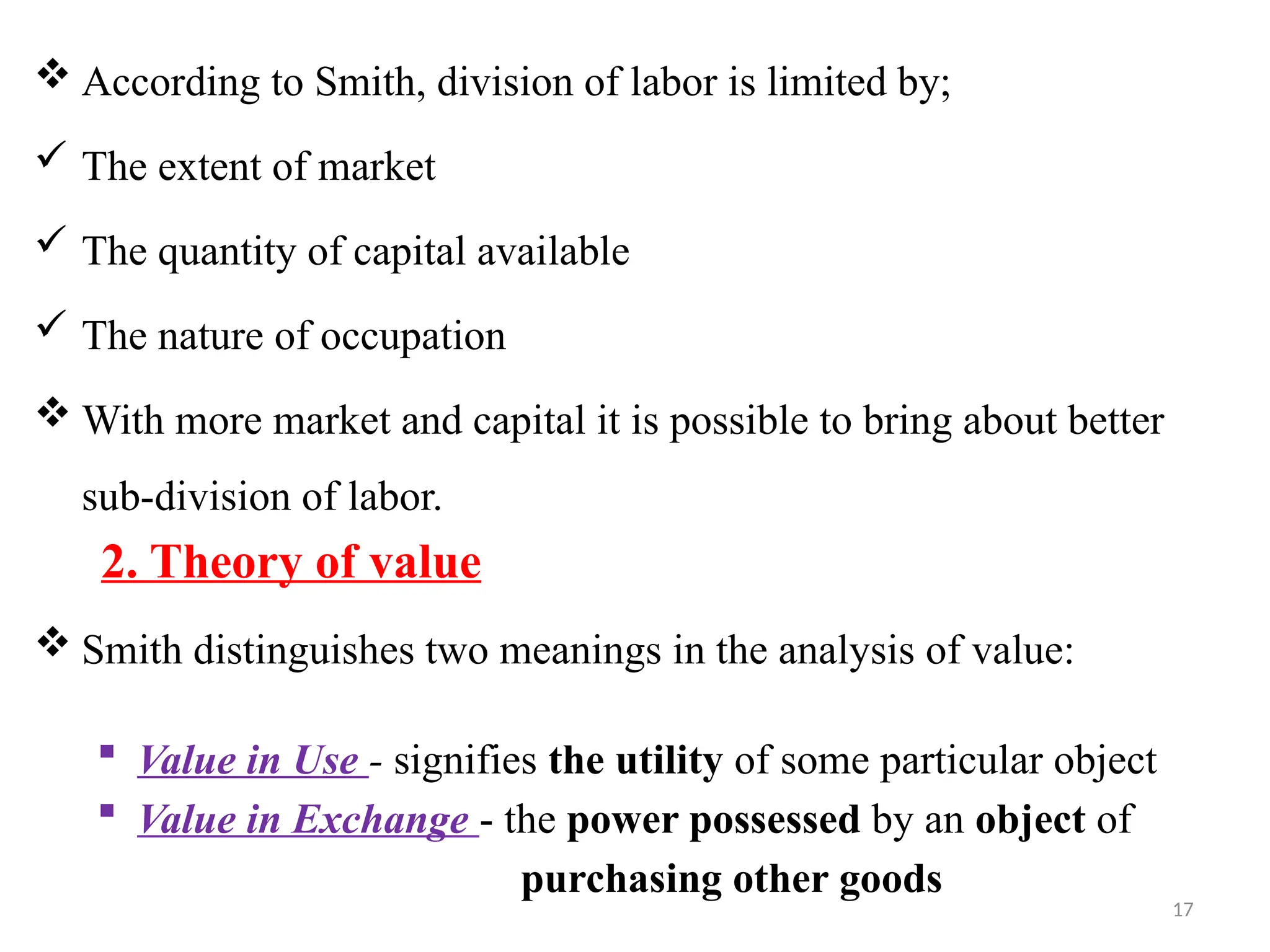
 According to Smith, division of labor is limited by;
 The extent of market
 The quantity of capital available
 The nature of occupation
 With more market and capital it is possible to bring about better
sub-division of labor.
2. Theory of value
 Smith distinguishes two meanings in the analysis of value:
 Value in Use - signifies the utility of some particular object
 Value in Exchange - the power possessed by an object of
purchasing other goods
18
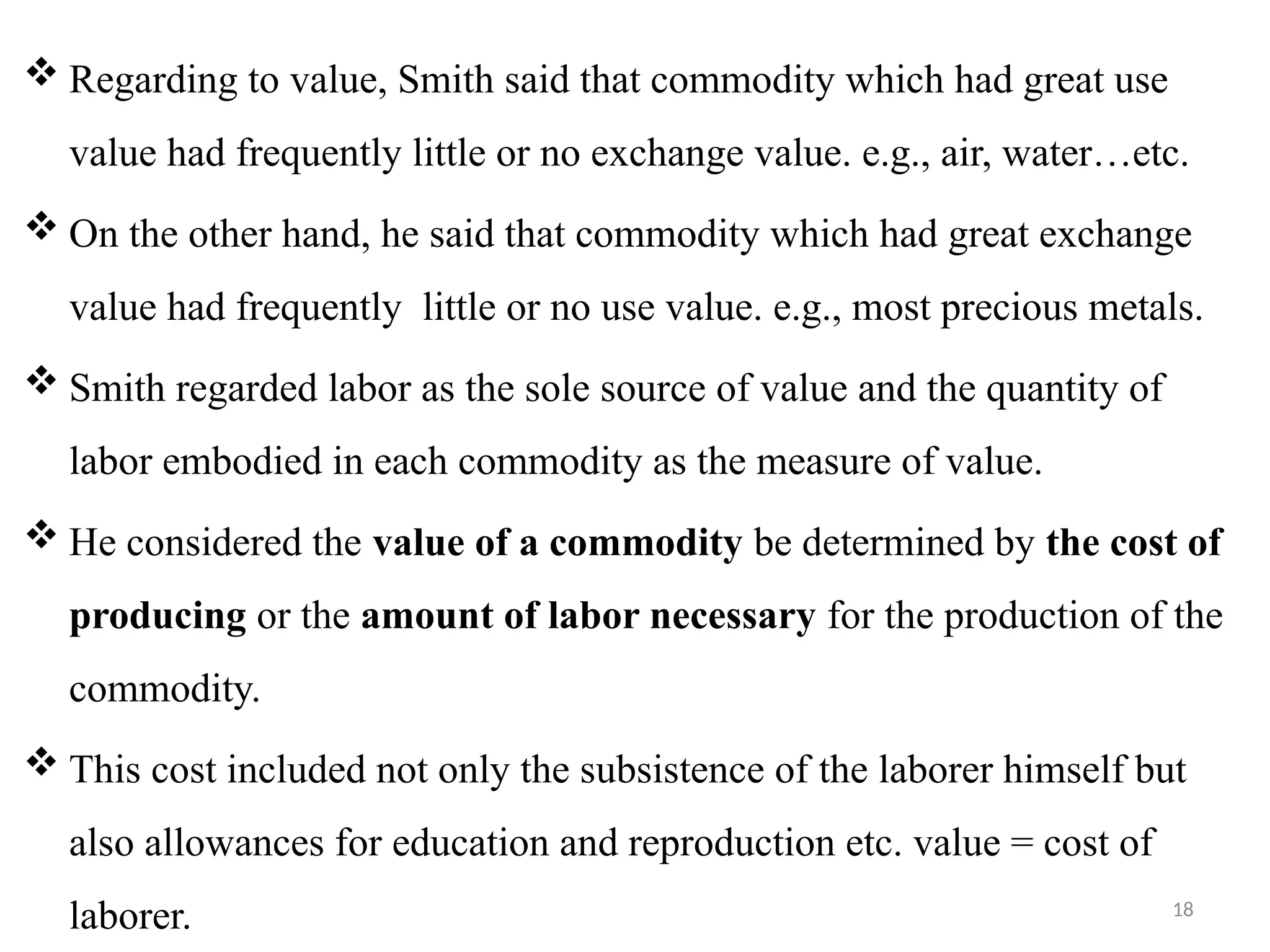
 Regarding to value, Smith said that commodity which had great use
value had frequently little or no exchange value. e.g., air, water…etc.
 On the other hand, he said that commodity which had great exchange
value had frequently little or no use value. e.g., most precious metals.
 Smith regarded labor as the sole source of value and the quantity of
labor embodied in each commodity as the measure of value.
 He considered the value of a commodity be determined by the cost of
producing or the amount of labor necessary for the production of the
commodity.
 This cost included not only the subsistence of the laborer himself but
also allowances for education and reproduction etc. value = cost of
laborer.
19
 Therefore, labor is the real (natural price) measure of the exchange
value of all commodities and money is the nominal (market price)
of the commodities.
3. Theory of Wages
 Smith enunciated (published) partly a labor theory and a cost of
production theory to lay the ground for determination of wage.
 According to him, wages are determined by the bargaining
(negotiation) strength of both the employers and employees, i.e.
based on the demand and supply of labor and then employers are
labor seekers and employees are supplier of labor
20
 In his labor theory, he regards the natural value of labor as determined
by the necessity to maintain the laborer, allowance to enable him/her
to rear (raise) a family and maintain the supply of labor.
 Smith stated the influences at work in the determination of wages
beyond the labor theory. These include:
• Contract (commitment or promise) between the employers and
the worker (employee)
• Consistency (reliability or continuity) of employment
• Trust (reliance or quality)
• The probability of success in work
 In expanding economy wages may go above the subsistence level.
21
 In a stagnant (stationary) economy, the increasing population
would soon be catching up with the high wage fund and wage level
gradually comes down to its subsistence level.
4. Theory of Rent
 With regard to rent, Smith expressed his opinion on the ground of:
» Monopoly
» Different fertility and location of land, and
» The bounty (gift) of nature.
 Smith assumes that land is a private property and that with the
progress (growth) of the society and an increase with population,
the demand for agricultural product keeps on increasing.
22
• This leads to a greater demand for land and gradually land prices will
rise, i.e. rent for land will be raise.
• In addition, lands which are less fertile and less accessible will also be
brought under plough and demand will decrease with decline in price, i.e.
rent for land will be fall.
• The rent of land is considered as the price paid for the use of the land
which is naturally a monopoly price as the land gift in nature.
• The landlords have the capacity to withhold (refuse to give) supply of
land unless they are paid rent for their land.
• The rent of land is determined by the excess of the agricultural product
over its cost of production (including the normal profit of the farmer),
i.e. if it is productive, the rent will be high & vise-verse
23
5. Profit

Smith makes a distinction between profit & interest and he defined:

Interest refers to earnings on capital lent to someone else (gain on
borrowed capital).

Whereas profit refers to earnings on self invested capital (gain on one's
own capital).

The rate of interest and rate of profit move together in the same
direction, however, they do not bear a definite proportion to each other.

In a progressing economy when wages rise, no one invested on own
capital and profit rate would fall.
6. Productive and Unproductive Labor

Smith made conceptual distinction between productive and
unproductive labor.
If a particular expenditure on labor employment was expected to
bring a return to the employer, it is a productive employment and the
labor so employed was considered to be productive labor.

Whereas if the labor employment was only meant to add to the
consumption of the employer i.e. the laborer doesn’t bring any return
or gain for the employer in addition to life subsistence, then such a
labor was termed to be unproductive labor. 24
The labor of a menial servant (employer hiring in lower wage), on
the contrary don't add any value.
 In smith's approach, there are three definitions of productive labor
Labor, which creates value
Labor, which creates surplus for the employer
Labor which accomplish in success in production
According to Smith, productive services such as accountants,
teachers, doctors, lawyers and so on would not add to the
productive capacity of the economy, which is to be termed as
unproductive, only labor is productive.
25
26
 Smith said that, man will be rich, if they employing in the
manufacturers, whereas they will be poor, if they employing in the
menial servants (hire low wage payables).
 In general, Smith regarded those activities which result in material
goods as productive and exclude all services, i.e. only activities that
produce visible outputs (material goods) are productive
7. Theory of Capital and Interest
• Smith covers the analysis of capital and interest both in terms of
physical capital and capital as manifested in money terms.
• According to Smith, types of capital are also distinguished into
circulating capital and fixed capital.
27
A. Circulating Capital (liquid capital.):
• It characterized by changing ownership and having periodic turnover,
i.e. if there is circulation of capital, its ownership will be change and
will have turnovers (receipts) in short period of time .
• Most of the time, capital in terms of money are considered to be
circulating capital and it is liquid (easily movable).
B. Fixed Capital
 It is a type of capital which is used for production without changing
its ownership, or without circulation.
 Mostly, physical capital is termed to be fixed capital and it is
difficult to be liquid.
 To Smith, "capitals are increased by parsimony (being economical),
and diminished by prodigality (extravagant or unwise use) and
misconduct".
28
 This shows the immediate source of capital accumulation is not the increase in
natural income but a parsimony (being careful and economical) in consumption.
 This implies saving is very important for capital accumulation of a wealth of
nation.
 National savings might be increased either through a shift from consumption into
savings, or through diversion (applying) of additional national income into savings.
 To his contribution on the theories of loans and interest, Smith claimed that loans
are given and taken in terms of money; and interest rate is determined by the
supply of funds (by the owners of the capital) and the demand for loans (by the
borrowers).
 If supply of capital increases faster than the demand, there will be a fall in the
rate of interest as well as the rate of profit.
29
8. Public Finance
 Smith deals with the problems of public finance in a systematic manner and
covers public expenditure, public revenue and public debt.
• He relates his discussion of public finance to the function of the gov.t.
 According to Smith's philosophy and analysis, the state should follow laissez faire
policy, but the gov.t confine itself to only three categories of functions, namely;
defense, justice (peace and order) and establishment and running of 'social
overheads‘. i.e. to provide social service (public service).
 According to his treatment, Public Expenditure divided into three parts:
1. Defense expenditure
2. Expense on justice
3. Expense on public works and institutions
30
Canons of Taxation
 Regarding to Public Revenue, Smith advised the state to collect
public revenue from two sources:
1. State property -(Funds, land and Capital of the state)
2. Revenue collected from the people in the form of taxes
 He showed that, all taxes must ultimately be paid out of the three
revenues of society: Rent, Profits and Wages, that means each class
of the society must pay tax from their revenue.
 In relation to taxes, Smith developed four cannons (principles) of
taxation. Such were canon of equity, canon of certainty, canon of
convenience and canon of economy (canon of cost).
31
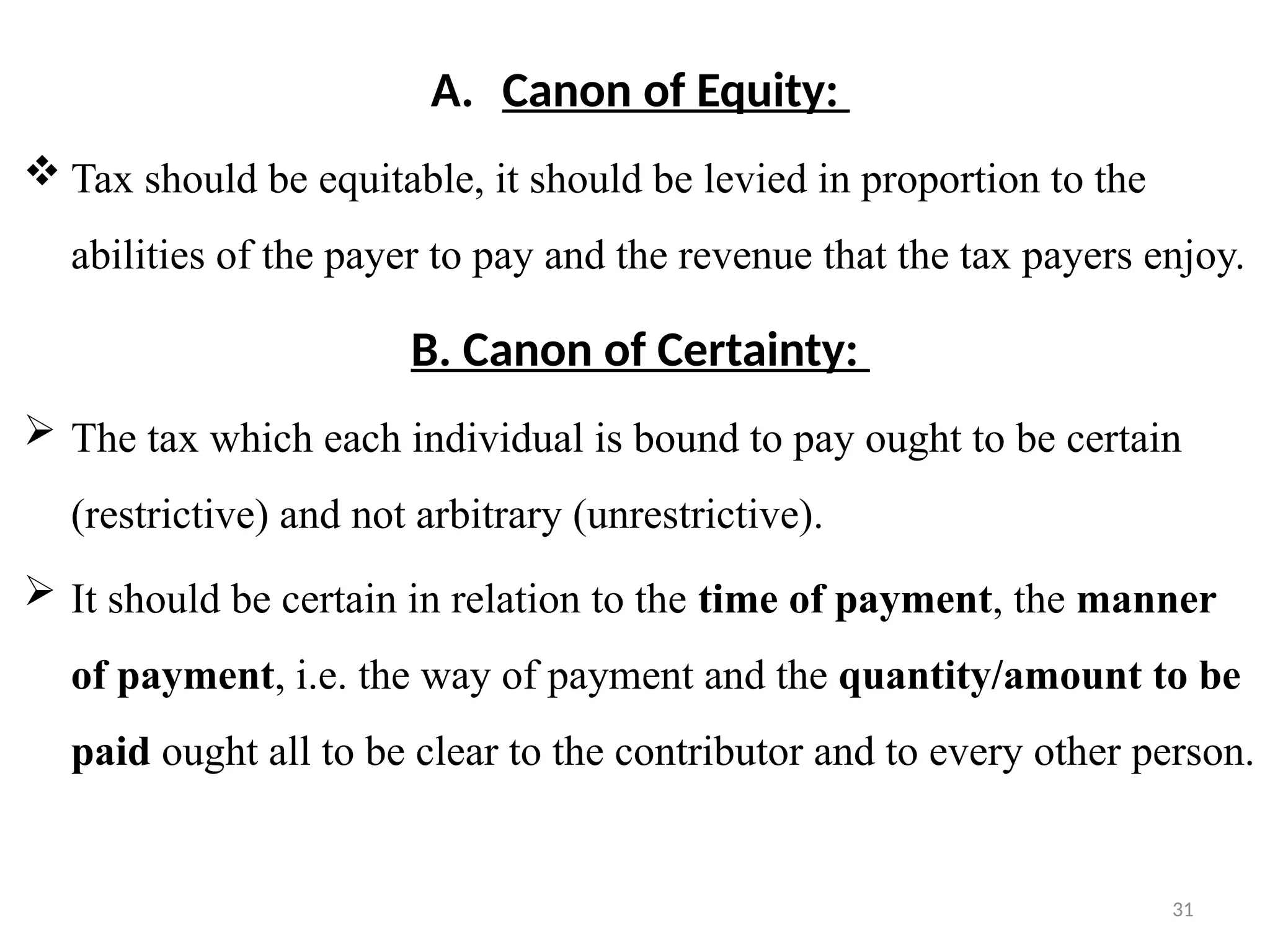
A. Canon of Equity:
 Tax should be equitable, it should be levied in proportion to the
abilities of the payer to pay and the revenue that the tax payers enjoy.
B. Canon of Certainty:
 The tax which each individual is bound to pay ought to be certain
(restrictive) and not arbitrary (unrestrictive).
 It should be certain in relation to the time of payment, the manner
of payment, i.e. the way of payment and the quantity/amount to be
paid ought all to be clear to the contributor and to every other person.
32
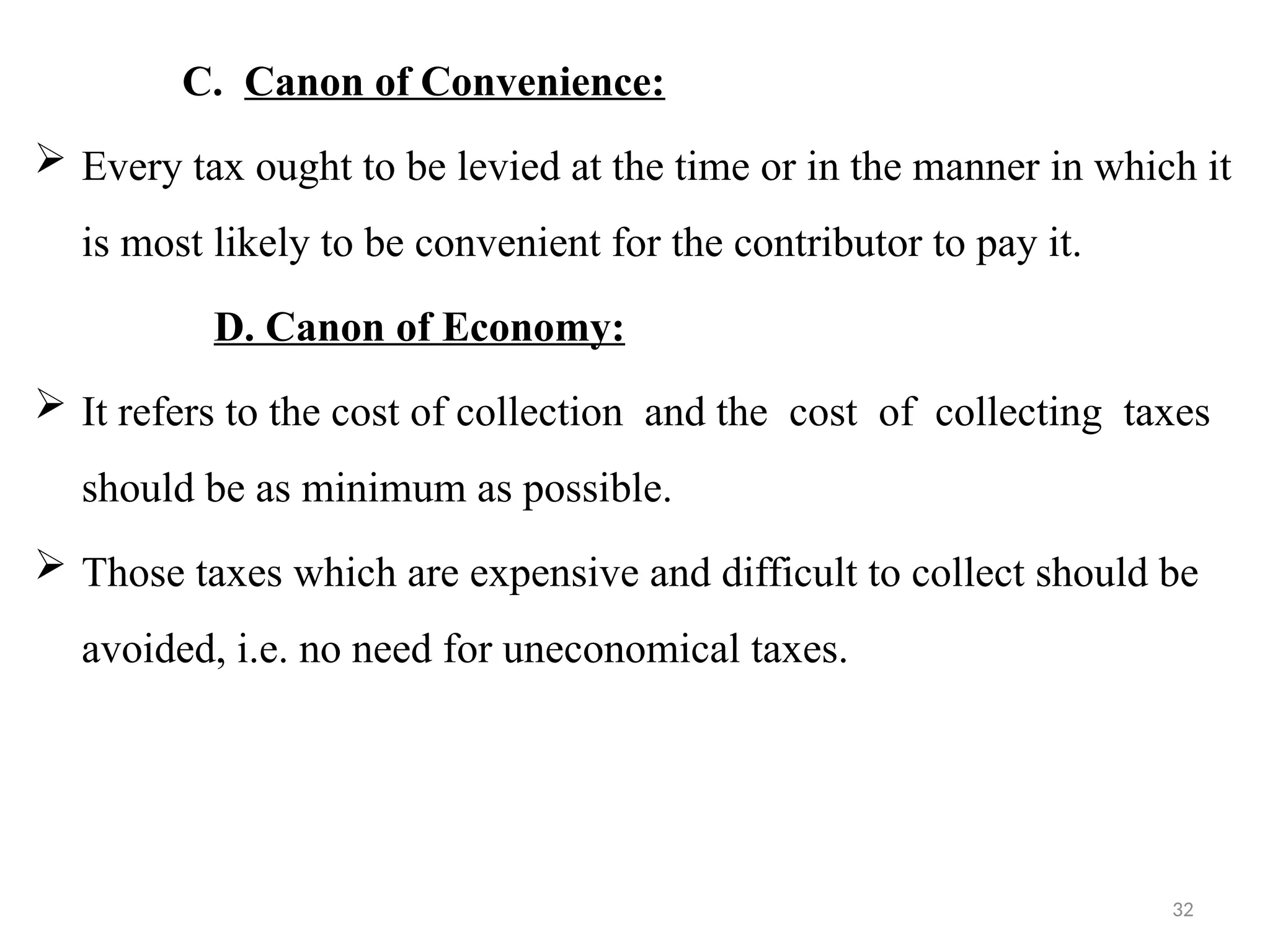
C. Canon of Convenience:
 Every tax ought to be levied at the time or in the manner in which it
is most likely to be convenient for the contributor to pay it.
D. Canon of Economy:
 It refers to the cost of collection and the cost of collecting taxes
should be as minimum as possible.
 Those taxes which are expensive and difficult to collect should be
avoided, i.e. no need for uneconomical taxes.
33
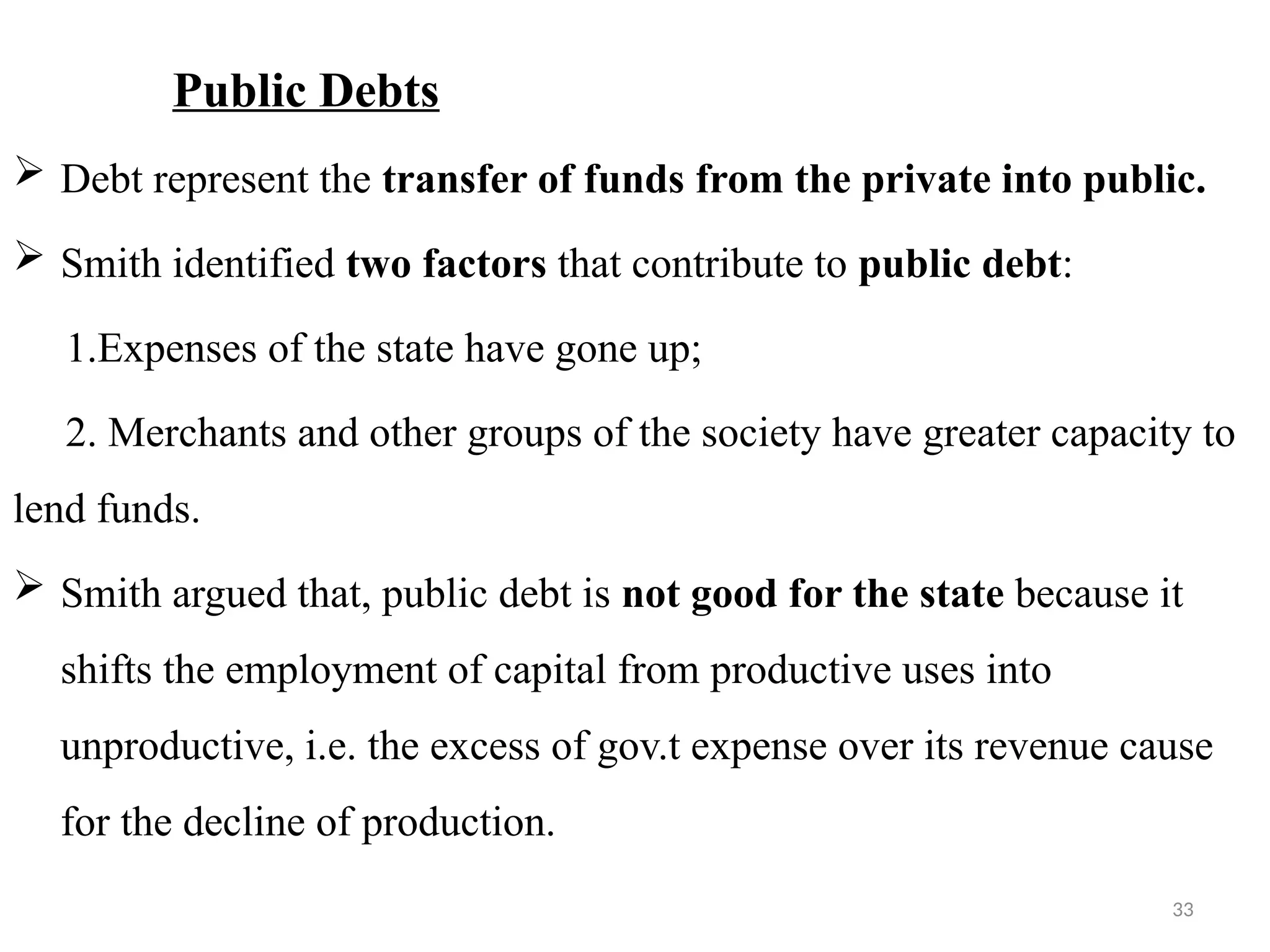
Public Debts
 Debt represent the transfer of funds from the private into public.
 Smith identified two factors that contribute to public debt:
1.Expenses of the state have gone up;
2. Merchants and other groups of the society have greater capacity to
lend funds.
 Smith argued that, public debt is not good for the state because it
shifts the employment of capital from productive uses into
unproductive, i.e. the excess of gov.t expense over its revenue cause
for the decline of production.
34
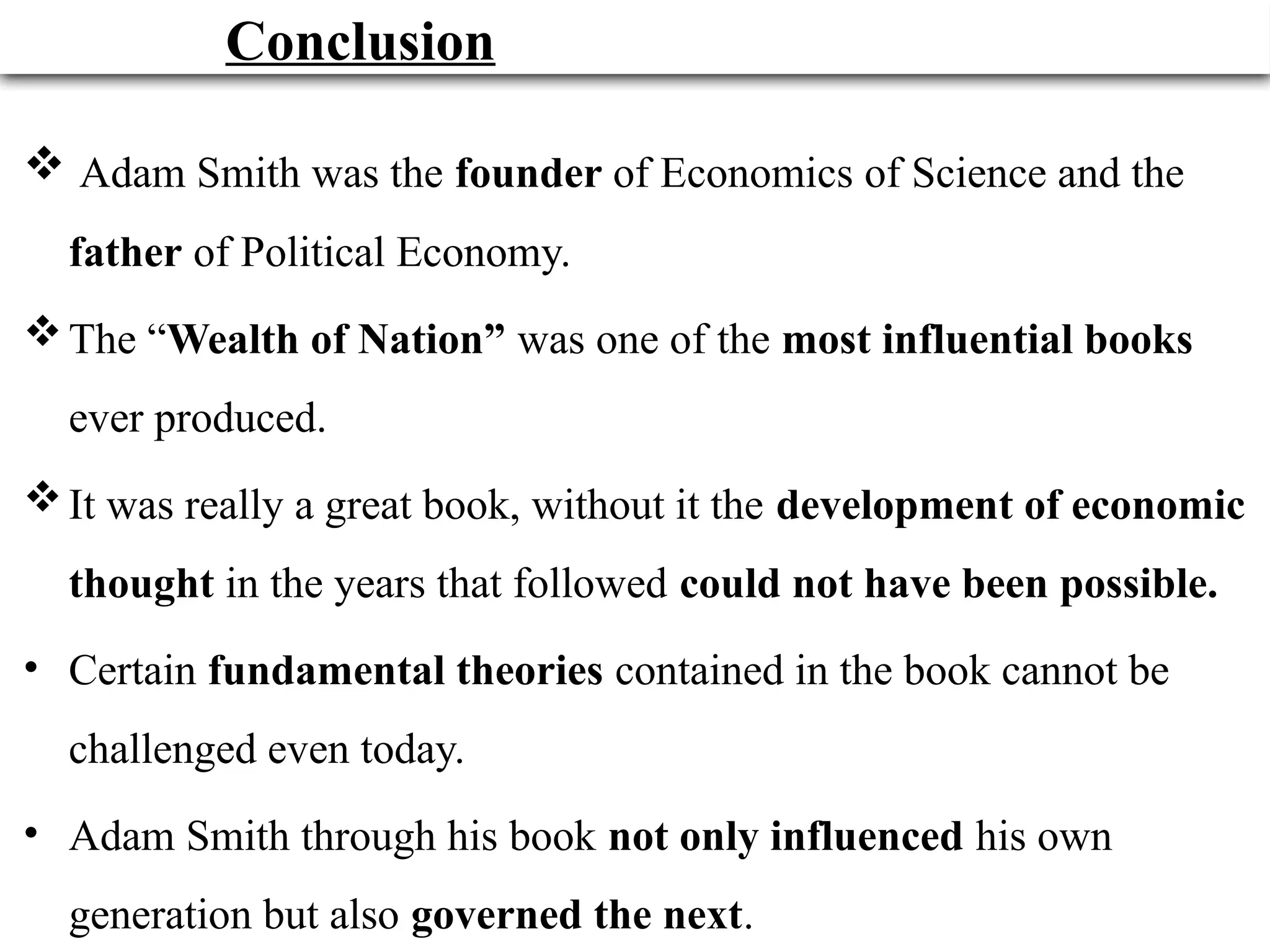
Conclusion
 Adam Smith was the founder of Economics of Science and the
father of Political Economy.
The “Wealth of Nation” was one of the most influential books
ever produced.
It was really a great book, without it the development of economic
thought in the years that followed could not have been possible.
• Certain fundamental theories contained in the book cannot be
challenged even today.
• Adam Smith through his book not only influenced his own
generation but also governed the next.
35
 Inspite of his important contributions, Adam Smith could not escape
from criticism.
 However, it remains a fact that Smith`s name is undoubtedly the
greatest in the history of economic thought.
 In other words, his place in economics cannot be challenged and has
not yet been challenged by anyone.
36
DAVID RICARDO (1772 – 1823)
• David Ricardo was the last but the greatest representative of the
English classical school.
• He had been one of the most controversial figures in the history of
economic thought.
• He has been regarded as the greatest economist of all times. In his
hands classical English political economy reaches its final and
complete form.
• Although Adam Smith was the founder of the classical school,
David Ricardo was the leading figure in further developing the
ideas in classical school thought.
37
• Ricardo is chiefly known for his masterpiece “Principles of Political
Economy and Taxation” which appeared in 1817.
• He was chiefly concerned with the study of the problems of wealth
distributions and their solution.
• Ricardo was responsible for giving rise to many other school of
thought in economics. Some were: the Historical, Austrian and
Marxian School.
• Formerly, he was interested to study Mathematics, Chemistry and
Biology, but when he studied the wealth of Nations in 1779, his
attention was wholly diverted to political economy.
38
Influences in shaping the ideas of David Ricardo
 David Ricardo like his forerunners was also affected by several multi-
dimensional factors prevailing at that time in England which shaped his
economic ideas.
 Most of the factors were related to the intellectual (moral) and
environmental influences. Some were:
1. Ricardo was greatly impressed (attracted) by the wealth of nation
wrote by Adam Smith. He went through it and mentioned several
criticisms in his book “the principle of political economy and
taxation.”
2. He entered in to debate with James Mill and Bentham, But Ricardo`s
Economic ideas have made him certainly superior to James Mill and
Bentham.
39
3. Ricardo also read the book of other writers and studied their
works, like Malthus, Say etc…
 To whom, he had acknowledged (recognize to continue) his debate
and expressed his gratitude in his book.
 From Malthus, he got economic ideas on population and rent,
whereas from J. B. Say the law of market, i.e. supply creates its own
demand.
4. Beside the intellectual influences, Ricardo was extremely affected
by the socio- economic environment/conditions of England, b/c he
was a migrant and he hadn't a citizenship in England.
40
Theoretical Contributions of David Ricardo
1. Theory of Value and price
• On his theory of value, he differentiated natural/normal value and
market value of a commodity.
• To him, Natural value is stable while the Market value is
variable ,but in the long run, they ultimately tends to equalize.
• David Ricardo has not given an accurate and clear conception for
natural value.
• He starts the analysis of natural value by distinguishing between
value in use and value in exchange.
41
• Ricardo said that, utility is not the measure of exchangeable value of a
commodity, but to possess utility, commodities derive their own
exchangeable value from two sources:
• Their scarcity (b/c of scarcity every thing derive their value)
• The degree/ quantity/ of labor required to produce the
commodity (the labor cost of production).
• Commodities whose exchangeable value is determined by their
characteristics of scarcity alone are non reproducible/ uncommon
commodities, i.e. they cannot be produce again, such as rare arts
(statues and pictures), scarce books and coins.
• Ricardo did not give much attention for these commodities in his
theory of value since these are so limited in number.
42
• Ricardo paid much attention for common commodities and he said
that, most commodities are reproducible/common commodities/.
• Ricardo assumed that, reproducible commodities are products which
produced without constraint under conditions of competition.
• The exchangeable value of these commodities is determined by the
labor embodied in them and depends on the labour time necessary to
produce it.
• The labour time includes not only the work done in making the
commodity itself, but also the work embodied in the raw materials
and capital goods used up in the process of production.
43
2. Profits and the Theory of Distribution
• The major contribution of David Ricardo to economic theory was
the emphasis which he laid on the distribution of the national
income, in extending the application of theory of value in the field of
distribution.
• To him, profit and wage work together in inverse proportion, i.e.
profits would be high or low in proportion as wages were low or
high, b/c production depends on the cost of labour.
• Wage depends on the price of necessaries and price of necessaries
depends on the price of food, i.e. if the cost of production for food
rise, the price for food rise and the wage also increase to sustain life.
44
• The exchange value of food is determined by its cost of
production in terms of labor.
• He said, in the long run wages tend to equal the exchange value
(price) of food and the rates of exchange are equalized by
competition.
• Ricardo prefers to describe profit and wage in terms of ratios or
relative values rather than absolute values.
• According to Ricardo, the wage rate must be sufficiently high to
provide the laboureres minimum subsistence/ minimum
requirement for living to sustain life.
45
• Ricardo said, like all other things that are bought and sold, labour
has its natural price and market price.
• The natural price of labour is that price which enables workers to
subsist and to perpetuate themselves and their families.
• The natural price of labour depends on the price of the necessities
of life required by the labour and their family.
• If the cost of necessities rises, money wages will rise, so that the
worker can continue to buy just enough to survive and perpetuate
themselves and their family.
• The market price of labour depends on supply and demand of
labour.
46
• When the market price of labour rises above the natural price, the
worker can rear (raise) a large and healthy family.
• As population increases, labour increase and wages fall to their
natural price and even below the natural price.
• When the market price of labour is below the natural price, the
worker faced misery (getting low wage) and reduces the working
population and wage rates rise and the worker receive the minimum
subsistence level of wage in the long-run.
• Ricardo said that, in the long run the worker only gets a minimum
subsistence level of wage known as "the iron law of wages''
47
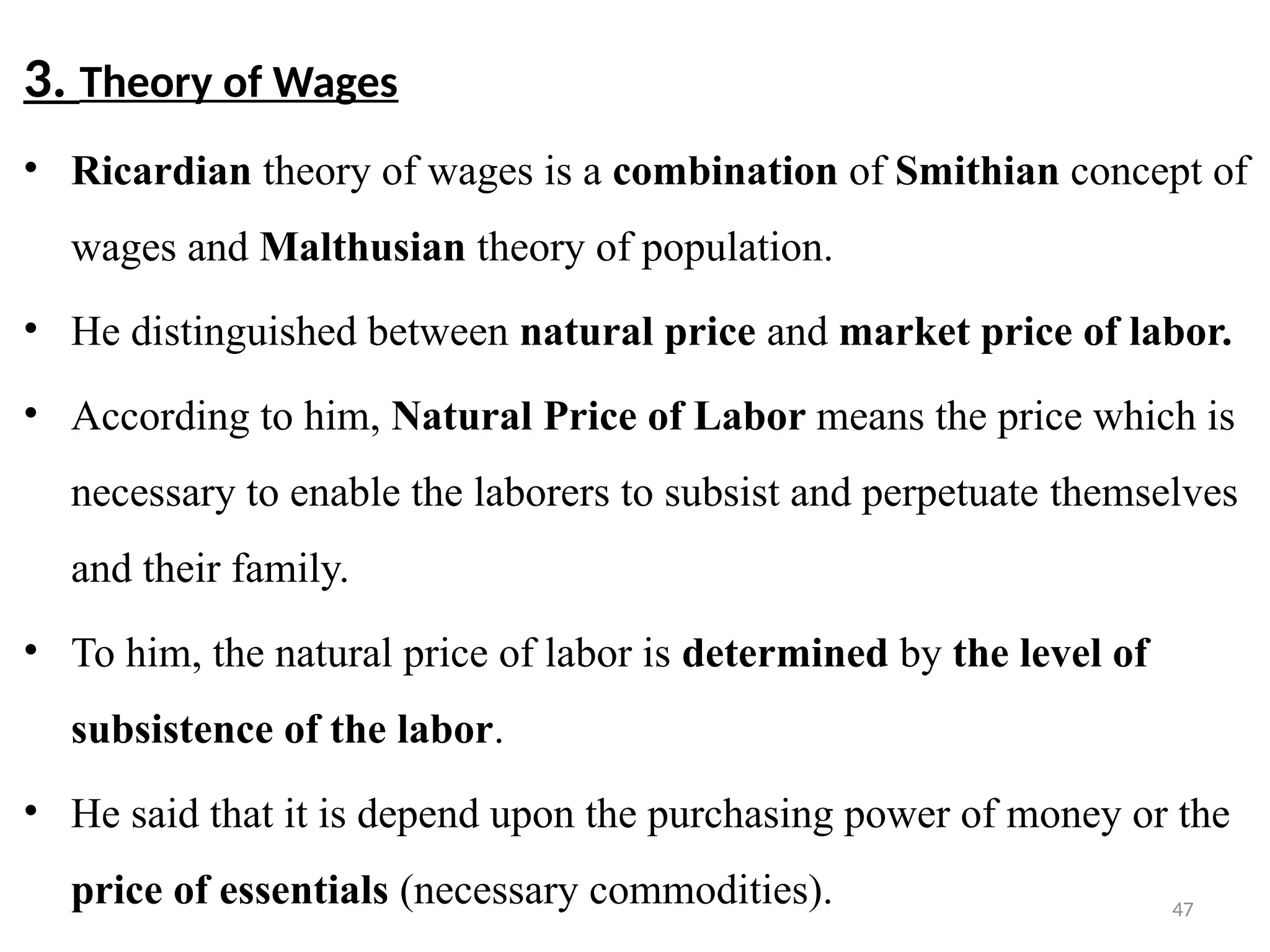
3. Theory of Wages
• Ricardian theory of wages is a combination of Smithian concept of
wages and Malthusian theory of population.
• He distinguished between natural price and market price of labor.
• According to him, Natural Price of Labor means the price which is
necessary to enable the laborers to subsist and perpetuate themselves
and their family.
• To him, the natural price of labor is determined by the level of
subsistence of the labor.
• He said that it is depend upon the purchasing power of money or the
price of essentials (necessary commodities).
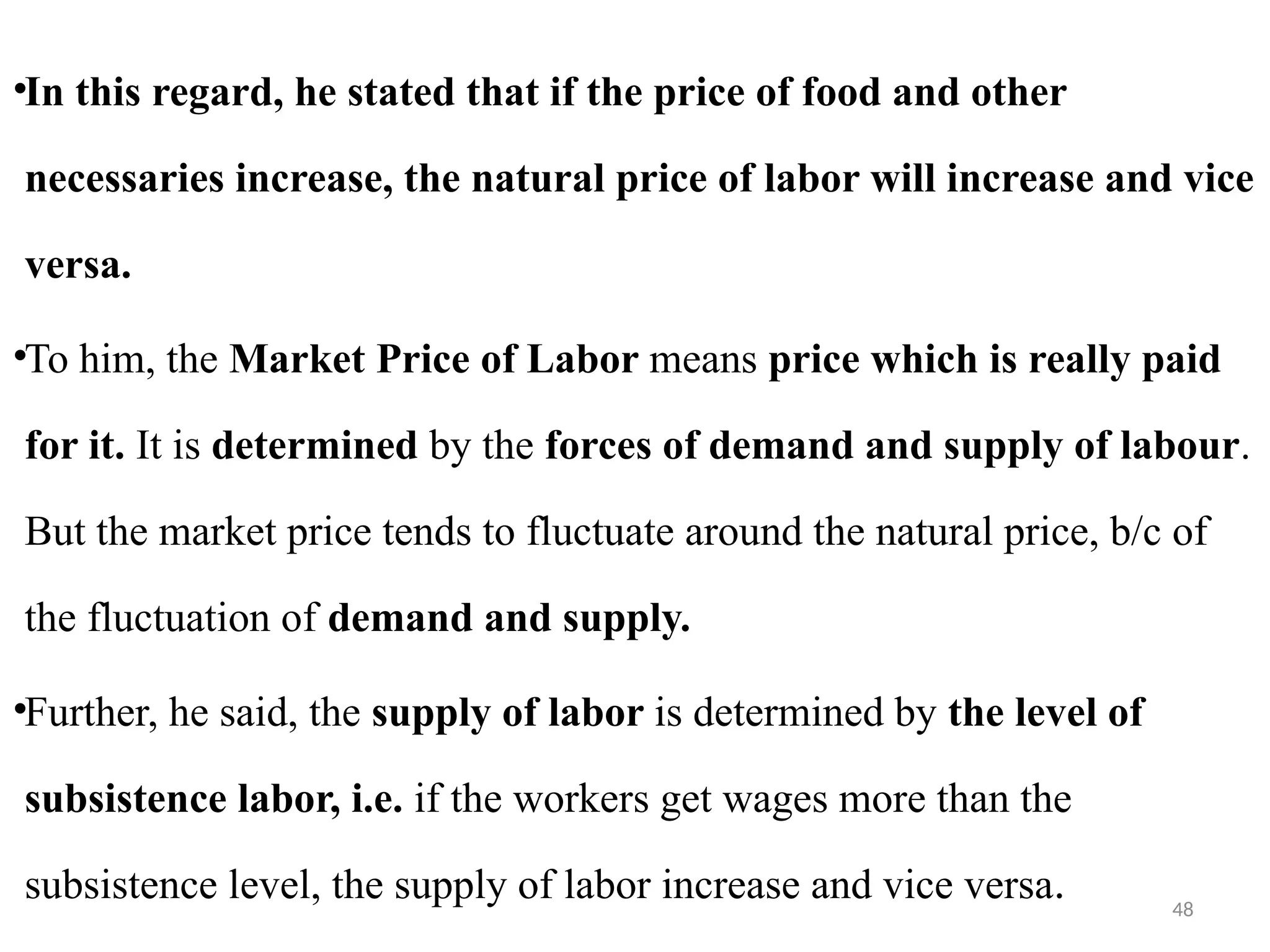
48
•In this regard, he stated that if the price of food and other
necessaries increase, the natural price of labor will increase and vice
versa.
•To him, the Market Price of Labor means price which is really paid
for it. It is determined by the forces of demand and supply of labour.
But the market price tends to fluctuate around the natural price, b/c of
the fluctuation of demand and supply.
•Further, he said, the supply of labor is determined by the level of
subsistence labor, i.e. if the workers get wages more than the
subsistence level, the supply of labor increase and vice versa.
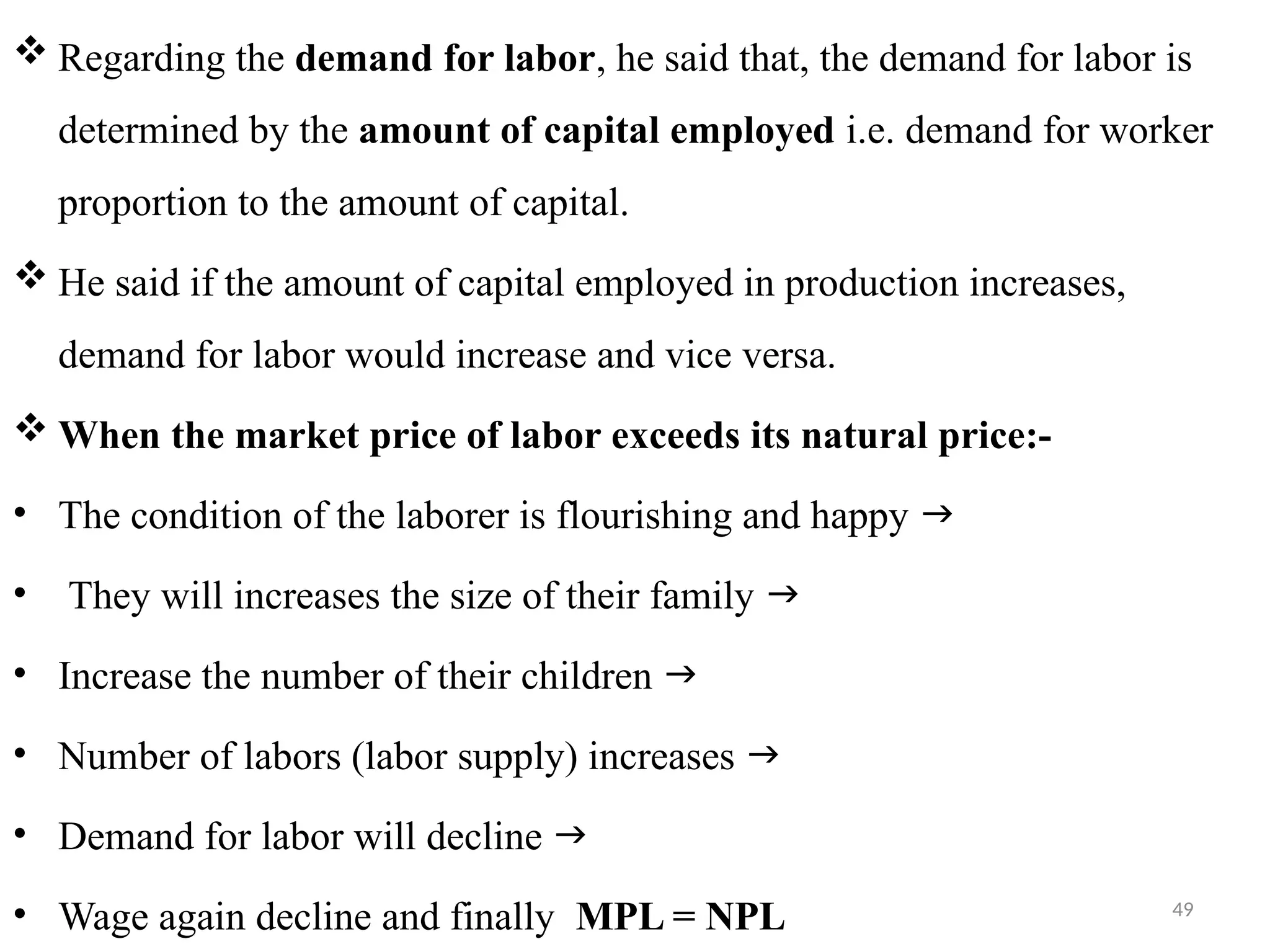
49
 Regarding the demand for labor, he said that, the demand for labor is
determined by the amount of capital employed i.e. demand for worker
proportion to the amount of capital.
 He said if the amount of capital employed in production increases,
demand for labor would increase and vice versa.
 When the market price of labor exceeds its natural price:-
• The condition of the laborer is flourishing and happy 
• They will increases the size of their family 
• Increase the number of their children 
• Number of labors (labor supply) increases 
• Demand for labor will decline 
• Wage again decline and finally MPL = NPL
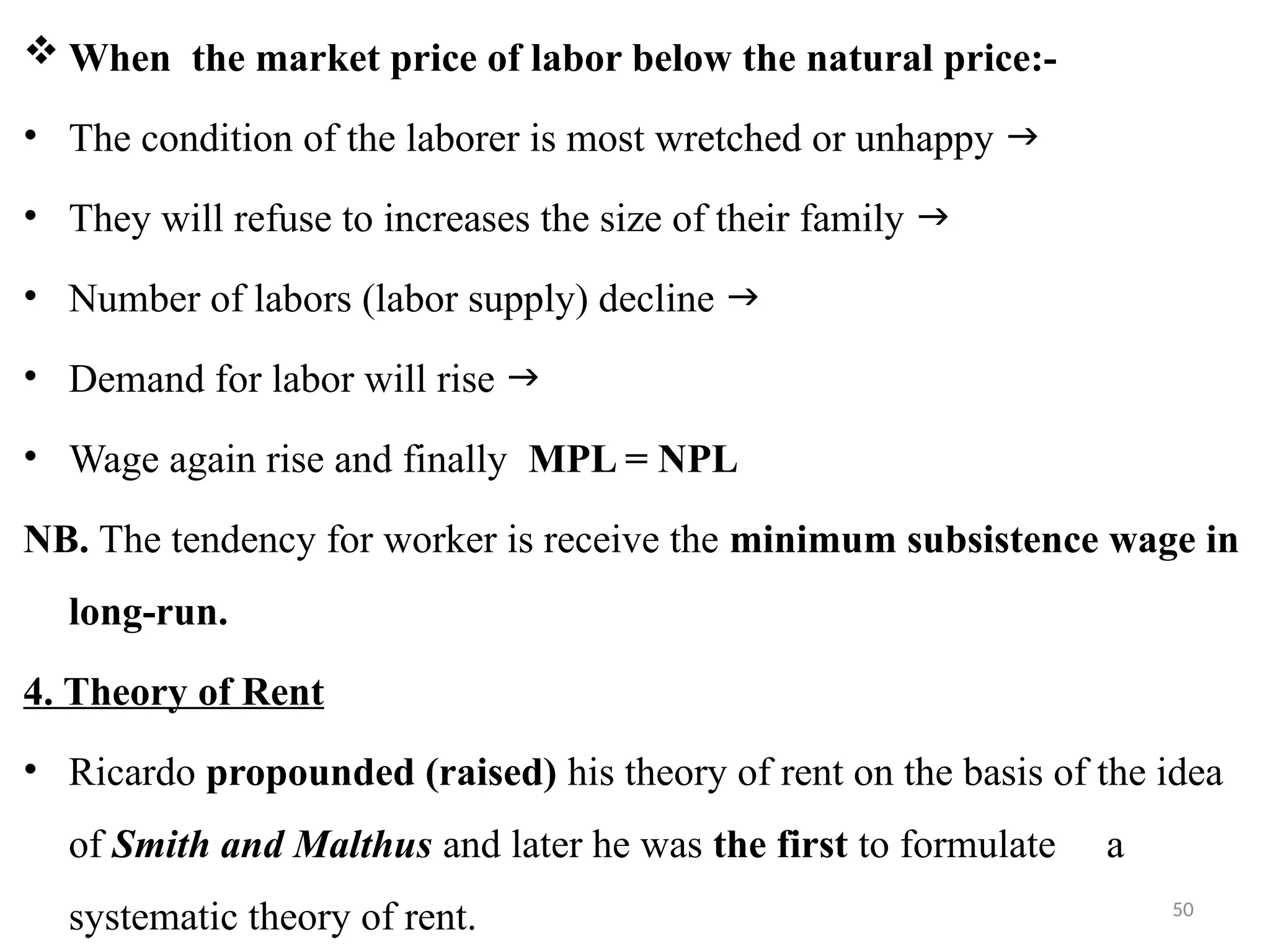
50
 When the market price of labor below the natural price:-
• The condition of the laborer is most wretched or unhappy 
• They will refuse to increases the size of their family 
• Number of labors (labor supply) decline 
• Demand for labor will rise 
• Wage again rise and finally MPL = NPL
NB. The tendency for worker is receive the minimum subsistence wage in
long-run.
4. Theory of Rent
• Ricardo propounded (raised) his theory of rent on the basis of the idea
of Smith and Malthus and later he was the first to formulate a
systematic theory of rent.
51
• According to Adam Smith “Rent was the price which the landlord
receives for the use of his land.
• Smith said that, land is the free gift of nature but, the rent of land
varies with its fertility.
• The Physiocrats regarded “rent” as the free gift of nature that was
likely to increase the national wealth. But they did not try to
determine the amount of rent to be paid to landlords.
• According to Ricardo “Rent is the portion of the product of the
land which is paid to the landlords for the use land.
• According to Ricardo, the land which was cultivated first is the most
fertile and favorable for production.
52
• Ricardo believed that, so long as the most fertile land was available, the
question of rent would not arise and less fertile land cultivated only
when the population of the country increases.
• Ricardo said that, when the population increases, demand for food
becomes increase and leads people to start cultivation even if the land is
less fertile and unfavorable/ inferior land.
 The Ricardian theory of rent assumes the operation of two principles:
the differential principle and the marginal principle.
1.Differential Principle – refers the fact that equal amounts of labor &
capital may produce different amount of output.
 In agriculture- equal quantities of capital and labor produce different
quantities of output in two ways.
53
 In the case of extensive cultivation - output differs when equal
quantities of labor and capital are employed on lands with different
qualities.
 Rent arises due to differences in soil fertility.
 In the case of intensive cultivation- Output differs when equal
quantities of capital and labor are used successively on the same land
due to the law of diminishing returns, i.e. if there is a successive use
of the same inputs on land, their productivity decrease and diminish
their returns and call it law of diminishing returns.
 Rent arises due to the law of diminishing returns.
54
2. The Marginal Principle- implies that the price of the product is
determined by the cost of production of the marginal producer, i.e.
produce under less favorable situation.
N.B: Ricardo assumes that, the most fertile and favorable lands are
cultivated first and the less fertile and less favorable lands will
follow.
• Ricardo explained rent by comparing the product of a first
grade land and a second grade land of equal area.
55
• He said, if the first grade land produced 6 quintals of grains and the
second grade land produce 5 quintals of grains, the difference i.e. one
quintals of gain would be the rent, the second grade land being the
marginal land which simply paid for labor and capital.
• If the third grade land was brought under cultivation under the
pressure of the population, and it yielded only 4 quintals of grains,
then rent would be as follow:
56
 On the first plot of land: 6 – 4 = 2 quintals
 On the second grade of land: 5 – 4 = 1 quintal.
 If on further pressure, the fourth grade land was cultivated which
yielded 3 quintals only, the rent would accrue on the first three plots
of land in the following quantities:
On the first plot of land: 6 – 3 = 3 quintals
 On the second plot of land: 5 – 3 = 2 quintals
On the third plot of land: 4 – 3 = 1 quintals
57
• As population and the demand for food increase less fertile lands
have the tendency to be put for cultivation. Consequently the
society will face both fertile and non-fertile land.
• The price of the product on non-fertile land must be high enough to
cover the highest cost of production.
• In a competitive environment, production with higher level of price
in the market will not have any demand for the product.
• Hence no producer has the tendency to look for non-fertile lands,
b/c of higher cost of production and price for the product. As the
result rent is absent on non-fertile land.
58
Criticisms for Ricardo's Theory of Rent:
• It does not appear sound to treat capital and labor as a single
homogeneous factor.
• Ricardo did not connect rent with any particular quantity of land. It is
the capital and labor applied to land which yields rent.
• His assumption that best lands are cultivated first is not supported by
any empirical evidence.
• The existence of marginal or no rent land is also challenged. In
practice it is difficult to find a land that earns no economic rent.
• Modern economists explain the concept of economic rent by the
scarcity principle and not by the differential principle.
• Like all other factors rent is paid because land is scarce in relation to
its demand. The scarcity principle explains why rent arises and the
differential principle explains why rent is different on different
grades of land.
59
5. Theory of Economic Development
• Smith had shown that, economic progress decreases the profits on
average, b/c the accumulation of capital increased competition
among capitalists which led to reduction in the rate of profits.
• But Ricardo showed that, not always accumulation of capital leads to
the reduction in profits,, but under certain conditions, accumulation
of capital will lead to reduction in profits if it is accompanied by
rising wages.
NB: He stated that, profits and wages move in inverse proportion
that the production depends on the cost of labour.
60
• Ricardo posited (assumed) that war, high taxation, adapted fashion
of production will alter the relative profitability of production both
in the country in which these factors operate and in the countries
maintain trading relations with it.
• He also indicated that, technological advancement is the major
weapon (tool) for the way out of a stationary state.
61
6. Theory of International/ Foreign/ Trade
• Ricardo like physiocrats and Adam Smith also supported the policy
of laissez faire/free trade without gov.t control/.
• Ricardo aware (informed) the benefit of free trade system and he
explained how the economic forces bring about the balance of trade
automatically in its equilibrium position.
• The chief contribution of David Ricardo to the theory of international
trade was his discovery of the laws governing the movements of
money from one country to the other country, i.e. circulation of
money.
62
• He observed that, if a country has an adverse balance of trade, i.e.
unfavorable BT, excessive money will be exported and the scarcity of
money will be experienced in the country. The scarcity of money will
leads to an increases the value of money and prices for a commodity
will fall.
• The low price of a commodity will stimulate exports and ultimately
the money which was sent abroad will come back. Consequently,
price would rise, export will be curtailed (stopped) and imports
will increase, thus leading to the export of money. The cycle will go
on (continue).
63
• Ricardo thus held that under automatic operation of the economic
forces, the balance of trade will itself come to a position of
equilibrium.
• But he thought that, this position of equilibrium may not be
established so quickly. It may take some time before prices may
rise or fall under the influence of quantity of money.
64
7. Theory of Comparative Cost
• To Adam Smith, international trade was based on differences in
absolute costs (i.e. absolute cost advantage), everybody buying in
the cheapest market.
• Smith said that, if there is no difference in absolute cost, trade b/n
the country is not favorable.
• To Adam Smith, trade between two countries will occur only if each
country has an absolute cost advantage over the other in one
commodity.
• Example: Smith Absolute cost advantage can be illustrated as
follows:
65
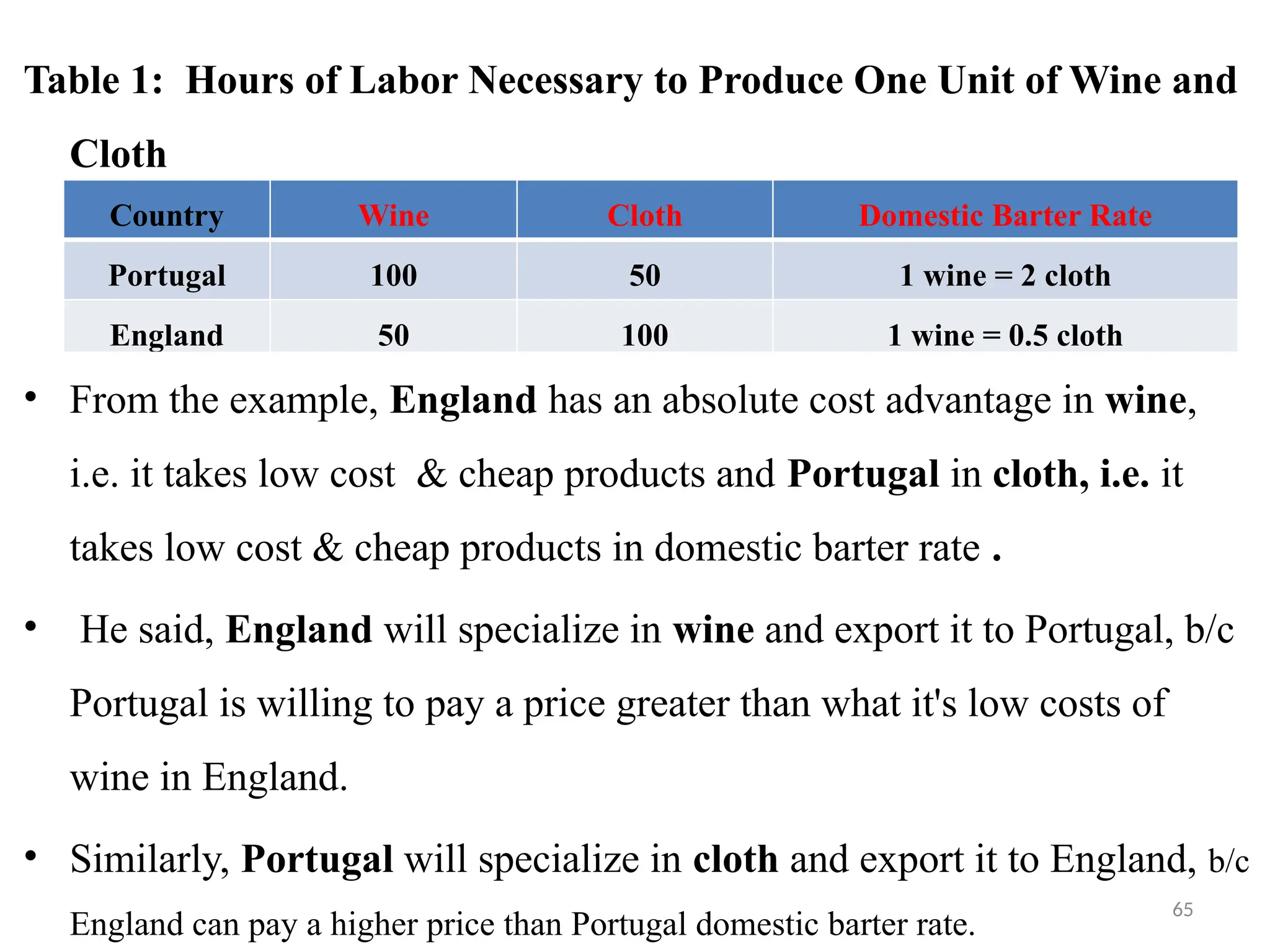
Table 1: Hours of Labor Necessary to Produce One Unit of Wine and
Cloth
• From the example, England has an absolute cost advantage in wine,
i.e. it takes low cost & cheap products and Portugal in cloth, i.e. it
takes low cost & cheap products in domestic barter rate .
• He said, England will specialize in wine and export it to Portugal, b/c
Portugal is willing to pay a price greater than what it's low costs of
wine in England.
• Similarly, Portugal will specialize in cloth and export it to England, b/c
England can pay a higher price than Portugal domestic barter rate.
Country Wine Cloth Domestic Barter Rate
Portugal 100 50 1 wine = 2 cloth
England 50 100 1 wine = 0.5 cloth
66
• David Ricardo made a brilliant and lasting contribution to economic
thought by developing the theory of comparative cost.
• He said that, foreign trade should be in relative cost ratio than costs
that must be considered absolutely.
• Unlike to Smith, Ricardo said that, if one country is more efficient than
another in producing all commodities, then trade between the two
nevertheless will be of mutual advantageous.
• The more efficient country should export those commodities whose
comparative cost is lowest and it should import those whose
comparative cost is highest.
• Lets illustrate Ricardo`s theory of comparative cost advantage using
his own example as follows:
67
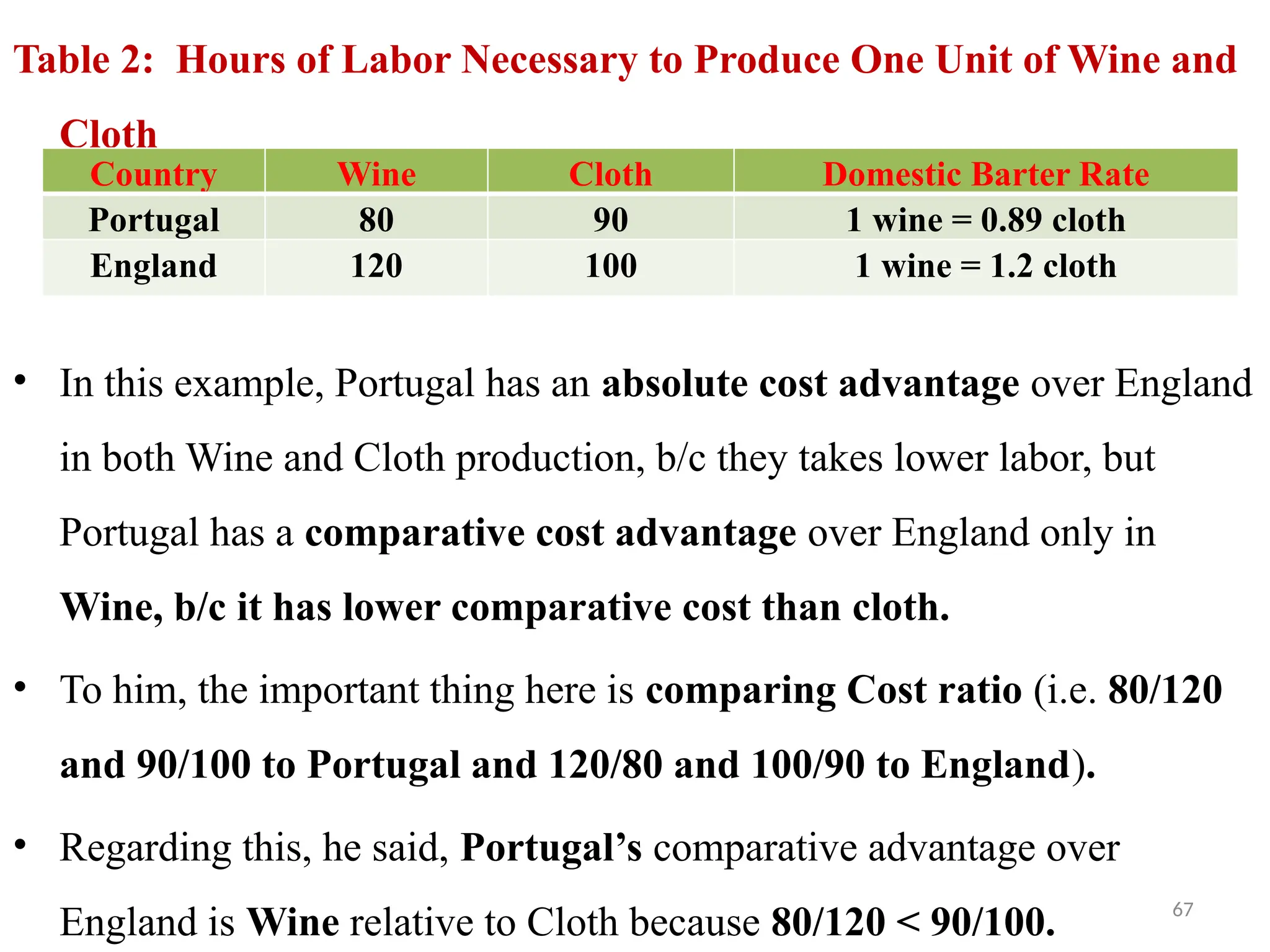
Table 2: Hours of Labor Necessary to Produce One Unit of Wine and
Cloth
• In this example, Portugal has an absolute cost advantage over England
in both Wine and Cloth production, b/c they takes lower labor, but
Portugal has a comparative cost advantage over England only in
Wine, b/c it has lower comparative cost than cloth.
• To him, the important thing here is comparing Cost ratio (i.e. 80/120
and 90/100 to Portugal and 120/80 and 100/90 to England).
• Regarding this, he said, Portugal’s comparative advantage over
England is Wine relative to Cloth because 80/120 < 90/100.
Country Wine Cloth Domestic Barter Rate
Portugal 80 90 1 wine = 0.89 cloth
England 120 100 1 wine = 1.2 cloth
68
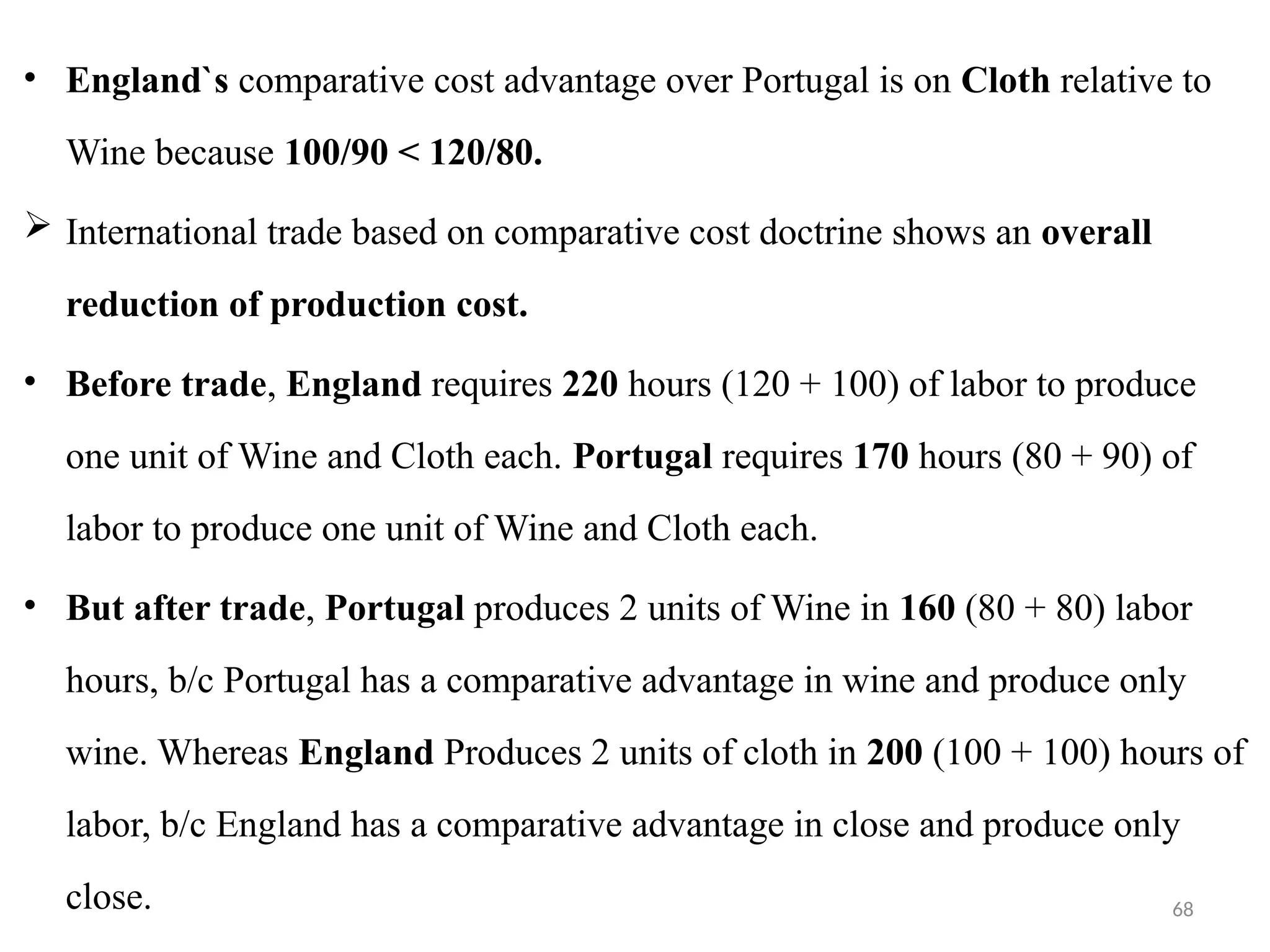
• England`s comparative cost advantage over Portugal is on Cloth relative to
Wine because 100/90 < 120/80.
 International trade based on comparative cost doctrine shows an overall
reduction of production cost.
• Before trade, England requires 220 hours (120 + 100) of labor to produce
one unit of Wine and Cloth each. Portugal requires 170 hours (80 + 90) of
labor to produce one unit of Wine and Cloth each.
• But after trade, Portugal produces 2 units of Wine in 160 (80 + 80) labor
hours, b/c Portugal has a comparative advantage in wine and produce only
wine. Whereas England Produces 2 units of cloth in 200 (100 + 100) hours of
labor, b/c England has a comparative advantage in close and produce only
close.
69
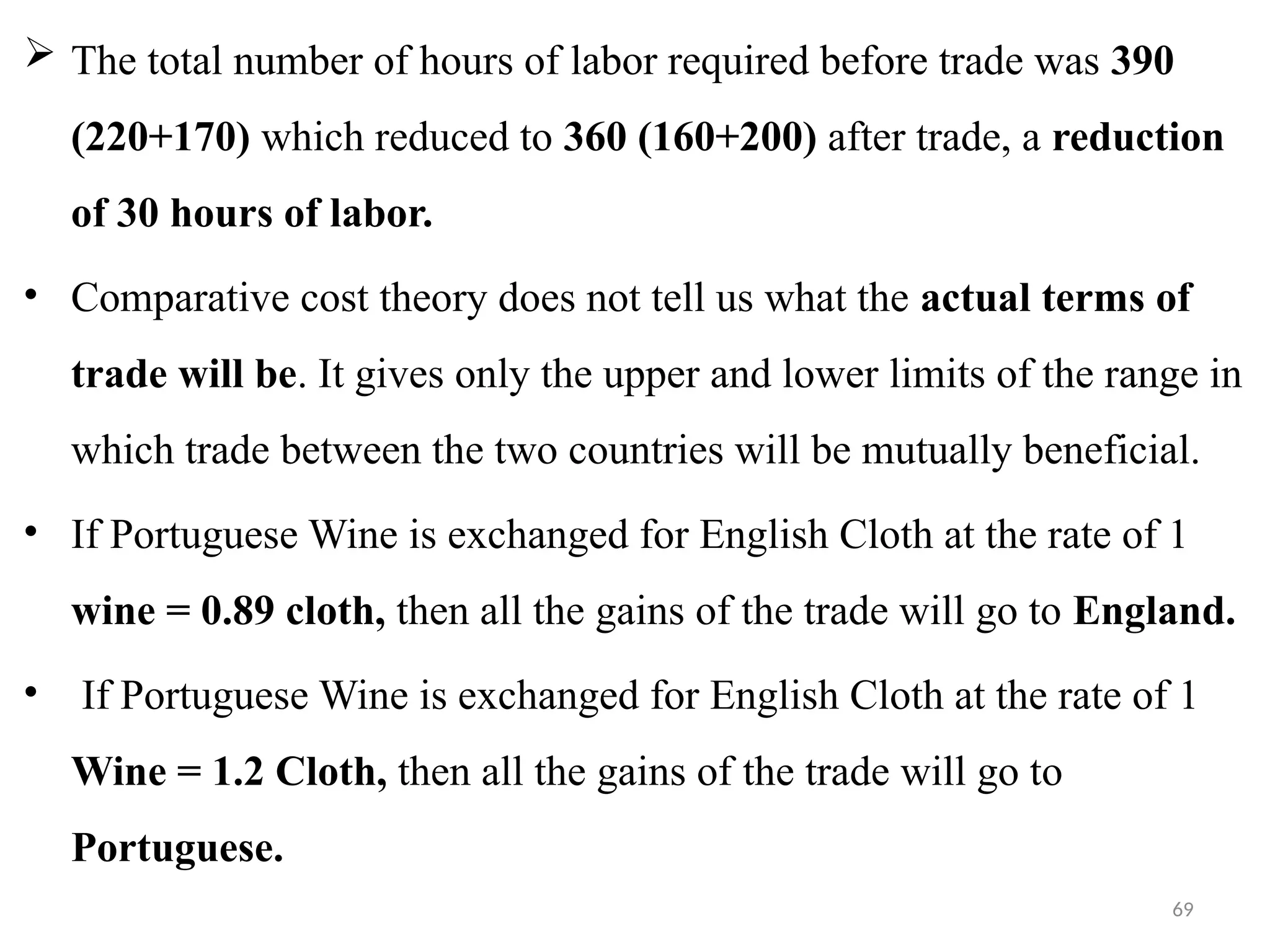
 The total number of hours of labor required before trade was 390
(220+170) which reduced to 360 (160+200) after trade, a reduction
of 30 hours of labor.
• Comparative cost theory does not tell us what the actual terms of
trade will be. It gives only the upper and lower limits of the range in
which trade between the two countries will be mutually beneficial.
• If Portuguese Wine is exchanged for English Cloth at the rate of 1
wine = 0.89 cloth, then all the gains of the trade will go to England.
• If Portuguese Wine is exchanged for English Cloth at the rate of 1
Wine = 1.2 Cloth, then all the gains of the trade will go to
Portuguese.
70
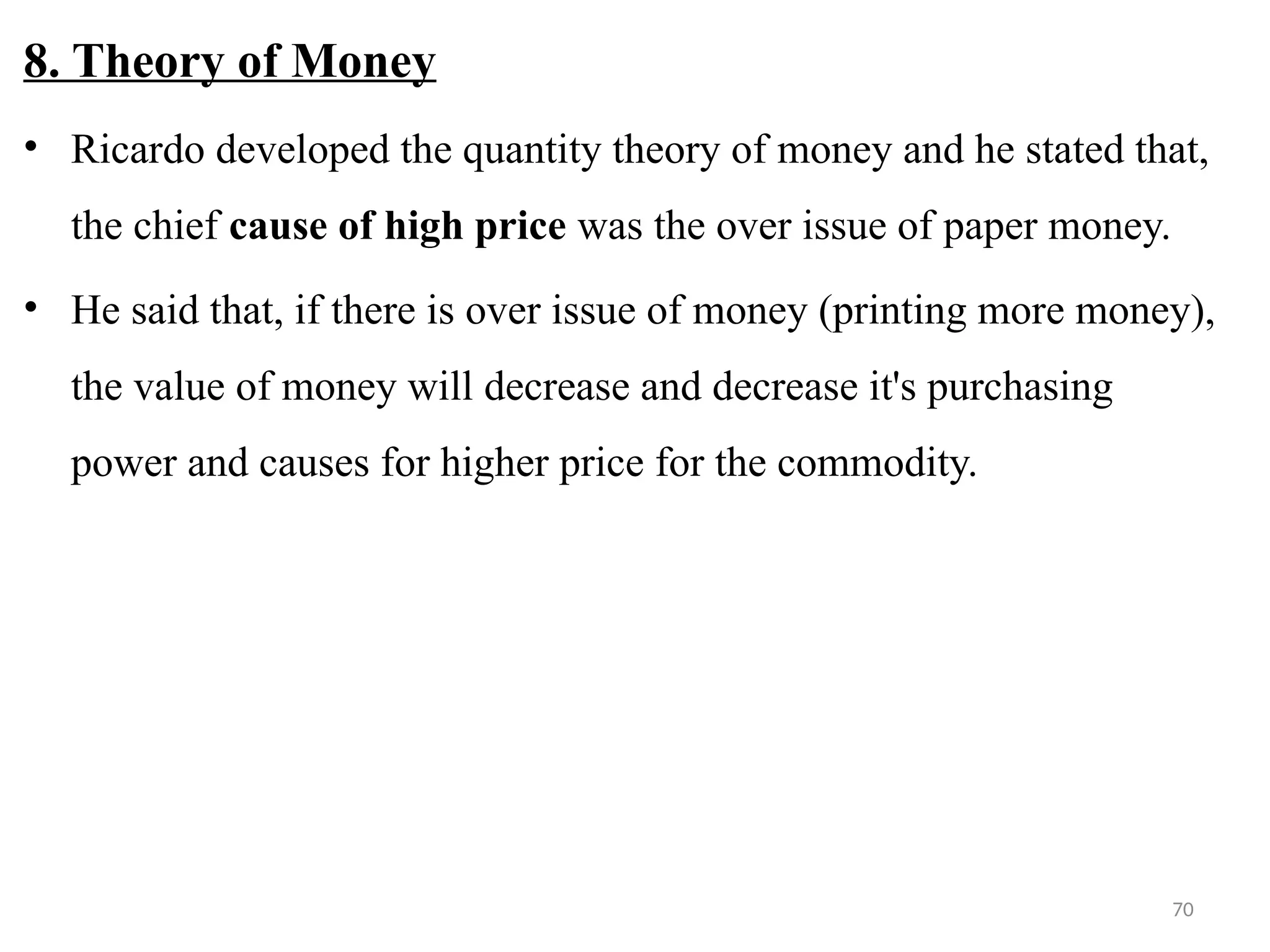
8. Theory of Money
• Ricardo developed the quantity theory of money and he stated that,
the chief cause of high price was the over issue of paper money.
• He said that, if there is over issue of money (printing more money),
the value of money will decrease and decrease it's purchasing
power and causes for higher price for the commodity.
71
Conclusion
• Ricardo was considered as a great economist next to Adam Smith.
• The Ricardian theory of rent affords a target for every Marxian in his
general attack upon private property.
• Ricardian theory of value is the starting point of modern socialism.
• He was one of the most powerful influences shaping the course of
development of economic science in the 19th
century.
• He succeeded even more than Smith in isolating the chief categories
of the economic system.
• He left his successors many unsolved problems, but he also indicated
ways in which they might be solved.
• Above all, Ricardo was responsible for giving rise to many schools
of thought in economics; viz, Historical School, Austrian School,
and the Marxian School.
72
Thomas Robert Malthus (1766 – 1834)
• Malthus studying Philosophy and Theology he was appointed a
Professor of History and Political Economy.
• Malthus was a pessimistic thinker (expect unfavorable results) and he
discouraged a dense population.
• He was known for his theory of population.
• Malthus`s thought was chiefly influenced/moulded by the socio-
economic conditions of England.
• He was impressed by the views of population in the wealth of nations
and the works of earlier writers and by the law of diminishing returns.
73
• Prior to Malthus, it was generally believed that a rapidly increasing
population necessarily leads to national economic prosperity and that
the wealthiest and the strongest countries were often the most
populous.
• After Malthus, rapidly increasing population became hindrance
(causes for delaying in progress) to economic development.
Malthus’s view on population
• Among classical economists, Malthus was the first person who
formulated his famous theory of population and presented in his
treatise (writing) “An Essay on the Principles of Population”.
74
 Malthus deduced that the power of population is infinitely greater
than the power in the earth to produce subsistence for the man.
• According to Malthus, the population when unchecked, increase in a
geometrical progression (i.e. 2, 4, 8, 16…) whereas food supply
/means of subsistence/ increased only in arithmetical progression
(i.e. 1, 2, 3, 4, 5, 6…).
• In his opinion, the population can exist only in proportion to the
available food supply.
• He said that, if the population in the country continues to increase
without restriction, soon it will be just more than the means of
subsistence.
75
 The three propositions proposed by Malthus were:
1. Population is necessarily limited by the means of subsistence.
2. Population invariably increases more than the means of subsistence
unless prevented by some powerful and obvious checks.
3. The checks which repress the superior power of population keep its
effects.
 Regarding the first proposition, Malthus said when population
unchecked goes on doubling itself every 25 years or increases in a
geometrical ratio.
 As regards to the second proposition, he has written: “it may fairly
pronounce that the means of subsistence could not possibly be made to
increase faster than in an arithmetical ratio.
76
 Regarding the third proposition he said that excess population could
be controlled by two kinds of checks: Preventive and Positive
Checks.
• By “Checks” Malthus, however mean the means of establishing an
adjustment between the population and the means of subsistence.
1. Preventive Checks:
• He also called it man made checks.
• These checks are applied by people consciously to limit the number of
children or
• All those checks which diminished the birth rate.
• These checks are divided in to two:
77
A. Moral Restraint: which includes:
• Postponement of marriage
• Abstinence from marriage/ self restraint
• Abstinence from sexual gratification
• Others
B. Artificial Restraints (Vices):
 Includes the acts of sexual intercourses that do not result in pregnancy
includes:
• Professional prostitution
• Promiscuous intercourse
• Use of contraceptives and etc
78
2. Positive Checks:
• Malthus called positive checks are natural checks.
• These checks are applied by nature compulsory, to increase the
death rate and resulting in a shorter life span. Example:
Wars
 Famine
 Diseases, Plague, Epidemics
 Earth quakes, Storms, cyclones
 Extreme poverty and etc.
• In his opinion, the preventive checks were better than the positive
checks to control the population.
79
• Since positive checks are harder/horrible and causes of miseries,
Malthus suggested adoption of preventive checks: like self
restraints, late marriage, and celibacy.
• Note: Malthus emphatically said self restraint and celibacy were the
better measure to control the number of births and he badly
criticized the artificial and unnatural modes of checking
population and he called them evils or vice like sex fraud, use of
contraceptives and free exercise of sexual relation.
• As a practical policy, Malthus proposed that, people should be
discouraged from helping to increase the population.
80
• They should be urged to exercise moral restraint and the poor in
particular should be enjoyed to exercise great prudence and not to
rush in to marriage and the creation of the family without due
regard for the future.
• As a consequence, Malthus was a strong opponent of poor relief.
• He advocated that the state should not recognize the right of the
poor to receive support and it should abolish the poor law.
81
Criticism of Malthusian Theory of population
• Malthus was afraid of increasing human population. He warned the
people against the rapidly increasing population which was causing a
lot of misery, poverty, and starvation.
• Malthus was badly criticized. The main criticisms of the Malthusian
doctrine are as follows:
 Malthus has tried to prove that the population doubles itself every 25
years. This condition is not correct.
 The concept that the means of subsistence increases in the
arithmetical ratio is wrong.
82
 The concept that the population increases in geometric progression
was also wrong.
 In view to critics, the means of subsistence include not only agricultural
products but also vegetables and meat that have been ignored by
Malthus theory of population.
 Malthus doctrine has been further attacked in respect to positive
checks.
 Malthus was also wrong not to differentiate between the desire of sex
and the desire of children.
 Malthus avoided migration.
 Malthus thought that the poor were responsible for their poverty and
starvation and suggested not to marry.
83
OTHER ECONOMIC VIEWS OF MALTHUS
On Rent
• Malthus did not enunciate any theory of rent.
• His views on rent are contained in “An Enquiry in to the Nature
and Progress of Rent”, in 1815.
• He stated that the cause of high prices of food was the population
growth and progress.
• The growth of population leads to the scarcity of good land.
• The scarcity of good land is a cause of scarcity of food.
• Prices of the produce raised from the already cultivated land
increases- an application of the law of diminishing returns.
84
• He said that, since rent arises due to the difference between the price of
the product and the cost of production.
• The rise in price was the sole cause for the origin and the rise of rent.
Malthus`s view towards Market Glut
• He departed (separate himself) from the classical school of thought by
criticizing Say's law of Markets (which says that supply creates its own
demand).
• He recognized the possibility of general overproduction due to the
deficiency of effective demand.
• Malthus said that, supply did not create its own demand and that
deficiency of effective demand may lead to general glut (excess in
amount) of commodities in the market.
85
• For Malthus, effective demand is that which establishes a price
high enough not only to cover cost but also to yield profits at the
current rate.
• Production is done only when it is profitable. Productive labour
brings profits into existence but these profits can be realized if there
is effective demand.
• Thus production depends upon effective demand and over-
production is the result of deficiency of effective demand.
• In his 'Principles of Political Economy' Malthus developed his
theory of the inadequacy of effective demand to maintain full
employment.
86
• As a result, there will be a general glut of commodities in the
market. This has been known as Malthus' theory of gluts.
• Malthus said, the workers are unable to purchase all the
commodities in the market. On the other hand, capitalists prefer to
save rather than to spend.
• Thus an unsold stock of commodities tends to pile up (excess) in
the market which can be purchased neither by the productive
laborers (because of insufficiency of income) nor by the capitalist
(because of their sawing habits).
• This is how the deficiency of effective demand creates the situation
of general over- production.
87
• As a solution to the problem of over-production, Malthus states
 The price for the commodity should be decrease.
 The excessive unproductive consumption financed by the
government should be avoided.
• Malthus also wrote in his 'Principles of political Economy , war
‟
is another stimulus that can eliminate gluts in highly productive
economies.
88
Conclusion
• Malthus holds a unique place in the history of economic thought.
• He was the first economist to throw light on the dangers of excessive
population, in such a style and in such a language, which were full of
exuberant sprit of the youth.
• He has rightly been called the founder of the science of demography.
• As an economist, he not only brought in to the field of economic science a
new subject of study but also made others to realize the economic
significance of the subject.
• According to Keynes, “I have long claimed Robert Malthus as the first
of the Cambridge Economists.”
89
Bentham, Say and Mill
• Towards the end of the 18th century and the beginning of the 19th
century the classical economic doctrines were under the heavy
weight of criticism from Historicists, Socialists, and the
Subjectivists started losing their sheen.
• New changes had started taking place in the economic conditions of
England and other countries of the world.
• People had started realizing that the classical doctrines were not
suited to the changing conditions and were devoid of
practicableness.
90
• The principles enunciated by Adam Smith, David Ricardo, and
Thomas Malthus, therefore, required revision and modifications in
the context of new problems.
• Bentham, Say and Mill took upon themselves the task of modifying
them.
• They were a forerunners for the socialist economic thought raised
by socialists specially K.H. Marx.
• Bentham, Say and Mill argued some of the classical economic
thought and criticize some doctrines of the classical thought.
91
Jeremy Bentham (1748 - 1832)
• The central theme of Bentham was the thought of “Utilitarianism”, or
“The principle of the greatest happiness”.
• In utilitarianism, Bentham said that, human conduct should be directed
toward promoting the greatest happiness of the greatest number of
people.
• For Bentham utility is a property in any object which tends to produce
pleasure or happiness or which prevents pain or unhappiness to the
party whose interest is considered (community or individual).
• He said, if government intervention enhances the happiness of a
community more than diminishes it, the intervention is justified.
92
• Bentham argued that, wealth is a measure of happiness, but that
wealth has diminishing marginal utility as it increases.
• He said: “The effect of wealth in the production of happiness goes
on diminishing, as the quantity by which the wealth of one man
exceeds that of another goes on increasing.”
93
Jean Baptist Say (1767 - 1832)
• His major work, “Treatise on political Economy” was published in
1803.
• Say added a fourth factor of production - the entrepreneur -to land,
labour and capital.
• Say's fame (being famous), however, rests on his theory which
asserts that general overproduction (market glut of Malthus) is
impossible because supply creates its own demand.
• This doctrine came to be known as Say's Law of Markets. Though
refuted by Malthus (among the classical economists) and Marx
(socialist).
94
John Stuart Mill (1806 - 1873)
• John Stuart Mill was the last great economist of the classical school
and the forerunners for the socialist economic thought.
• Mill made some significant contributions and he systematized and
popularized the whole body of economic thought of his predecessors.
• The classical school was already in decline during Mill's mature years.
He himself departed from some of the key concepts built into the
classical structure by Smith and Ricardo.
• Mills greatest work 'Principles of Political Economy' (first published
in 1848).
.
95
• He was introduced to Bentham's ethics and Ricardo's economics
during his child days.
• But, in the later stages of his mental development, he modified,
revised, and added many new things of his own to the classical
economic thought.
• A summary of some of the main ideas of J.S. Mill is here below
1. On Utilitarianism
• Mill followed Bentham's utilitarian philosophy which says that our
actions are right if they produce 'the greatest happiness of the
greatest number.'
• Bentham had reduced all distinctions among all pleasures to quantitative
differences and had ignored the qualitative differences.
96
• However, Mill modified the philosophy of Bentham by included the
qualitative difference of utility (satisfaction gained in consumption), i.e. the
utility gained from higher consumption is higher.
• Mill said that, an individual should, instead of seeking to satisfy all the current
wants in order to achieve maximum pleasure, try to satisfy only those wants
which yield the finest (greatest) pleasure.
2. On the doctrine of laissez faire
• J.S. Mill recognized a number of exceptions to the general rule of laissez fair
and felt the necessity of government intervention.
• He recommended government action in the following fields; education, factory
legislation, colonization, and public works.
97
3. On the Laws of production and Distribution
• Mill distinguished b/n the laws of production and the laws of distribution.
• The laws of production are universal and therefore cannot be altered by
changing social systems.
• The laws of distribution are man-made and can be changed as and when
desired.
• The laws of production are the law of population, the law of capital
accumulation and the law of diminishing returns.
• The laws of distribution are the law of profit, the law of wages and the
law of rent.
98
4. On the theory of rent
• Mill accepted Ricardo's theory of rent, according to him, rent is
regarded as a differential surplus that determined by productivity, i.e.
the returns greater than the cost of production.
5. On International Trade
• Mill further extended the theory of comparative cost as developed by
Ricardo by stating the conditions for equilibrium terms of trade.
• The equilibrium terms of trade are determined by the equation of
reciprocal demand (relative demand for one’s product by the other).
99
The End

Thought I unit 4 chapter four of thought I

  • 1.
    1 History of EconomicThought I Econ 3141
  • 2.
    2 Chapter Four Classical EconomicThought Outline  Introduction  The Forerunners  Adam Smith  David Ricardo  Thomas Robert Malthus  J. Bentham, J. Mill and J. B. Say
  • 3.
    3 Classical Economic Thought INTRODUCTION The body of economic doctrines which emerged in England after the decline of Physiocracy is named as classicism.  Adam smith has been regarded as the father of English classical economics and the leader of the classical school.  The last quarter of the 18th century was characterized by full of new events. It was the new era in economic and political organizations. It was a period of:  The Beginning of The Industrial Revolution.  The American Declaration of Independence (1776)  The Publication of Smith’s Book “An Inquiry into the Nature and Causes of the Wealth of Nations” in 1776
  • 4.
    4  The classicalschool comprised (included) number of philosophers. Some of them were: Adam smith, David Ricardo, Thomas Robert Malthus, Jeremy Bentham, Jean Mill and Jean Baptist Say. THE FORERUNNERS  Although there are many thinkers who can be regarded as the forerunners (predecessor) of the classical school, two of them were: DAVIDE HUME (1711-1776)  He was better known as a philosopher than an economist. Nevertheless, he made important contributions to economics.  In one of his works “the Jealousy (rivalry) of Trade (1758)”, he disputed (opposed) the mercantilists concept that “trading nations are rivals (competes) with one gaining at the loss of the other.”
  • 5.
    5 • He statedthat, trade among nations can be beneficial to the participating countries and the betterment (improvement) of one nation helps that of another.  In his other work of “ The Balance of trade (1752)”, he challenged the excessive emphasis of the mercantilist on export. • As to him, Mercantilists wanted to promote export in order to accumulate bullions. • But Hume emphasized that an excessive accumulation of bullions would send the cost of labor and commodities dearer (inflation), so that importers could not afford (interested) to purchase these items. • On the other hand, a critical shortage of money would make the price of labor and commodities to shrink (deflation).
  • 6.
    6  In hisessay of “Commerce”, he wrote: “A great disproportion of income among the citizens weakens any state.  Hume opposed the Physiocrats idea, all taxes must levied on the landlords and cultivators will be free from any taxes.  He argued that, if laborers got more than the minimum needed for subsistence, they might pay taxes. RICHARD CANTILLON (1680-1764)  He was well known on his book “Essay on the General Nature of Commerce)” written between 1730 and 1734 and published in 1755.
  • 7.
    7  Cantillon developeda theory of value and price. According to him: “Price or intrinsic value (value in nature) of a thing measure the quality of land and labor entering in to production, i.e. the fertility or productivity of the land and the quality or the efficiency of labor measured by their intrinsic value.  But, it often happens that, many things which have actual intrinsic value are not sold in the market, they will depend on the humours (tendency) and fancies (desire) of the peoples and their consumption”.  Cantillon recognized the importance of the velocity (circulation) of money, with a faster circulation requiring a smaller quantity of money, i.e. high quantity of money decreases its purchasing power.
  • 8.
    8  He explained„entrepreneur and emphasized the role of it in ‟ economic life. Economists theorized that, the only factors of production were land, labor and capital, but Cantillon included entrepreneur as a factors of production.  Cantillon said, business men commit themselves to a definite payment in expectation of uncertain receipts and risk taken by them, i.e. loss will remunerated (compensated) by profit.  He analyzed interest as a reward for the risk taken in lending, based on profits, the entrepreneur can make borrowing and investing.  Cantillon also anticipated (opposed) the Malthus's views on population, i.e. if the popn grows rapidly than food supply, will leads to poverty.
  • 9.
    9 ADAM SMITH (1723– 1790)  Adam Smith was truly regarded as the patriarch/father of the science of economics.  He studied Mathematics and in 1751 he became a Professor of Logic and by the end of the year, he was the chair of Moral Philosophy.  Adam Smith was the first academic economist who contributed:  For the transformation of the subject matter of economics in to science  For the development and completion of economic thought and transformed into science.
  • 10.
    10 CONTRIBUTION OF ADAMSMITH Analysis of the Wealth of Nations  Adam Smith`s thought regarding the origin of wealth was different from the Mercantilist and Physiocrats thought.  To mercantilists wealth gained from the accumulation of precious metals, whereas to physiocrats wealth originated from agriculture.  But on his famous book “wealth of nation”, he explained the nature and causes of wealth of nation and he stated that, the origin of the national wealth lies not in foreign trade (as mercantilist did) nor in land (as physiocrats did) but lies in labor.  Contents of wealth are the products of labor.
  • 11.
    11  He saidthat, labor is the source of wealth and only labor is the productive factor of production.  Regarding capital, he said that capital is a portion of national wealth that previously produced and can be saved and invested for other pron.  His wealth of nations mainly concerned on: • The problems of production, distribution and exchange • Capital (manufactured products and used for another production) • The different economic policies that pursued ( formulated and followed) at various times by different nations. • The previous systems of political economy • Public finance.
  • 12.
    12 Self interest  AdamSmith was chiefly guided by one universal principle i.e. self interest and he believed that, self interest provides harmony.  According to Smith, human conduct (action) was naturally actuated or activated by six motives: • Self-love (self-over valuing) (giving higher value for self) • Sympathy (expecting good thing for the future) • The desire to be free • A sense of propriety ( possessing for ownership) • A habit of labor (perform in work) • The propensity (tendency) to exchange one thing for another.
  • 13.
    13  He gavemore emphasis in his analysis to self-love and propensity to exchange.  So, regarding to self interest; he said that, “Each man was naturally the best judge of his own interest, given complete freedom and they also promote the interest of others and he called it indivisible hand. Government Intervention  He was the strong supporters of lassies faire/ free trade and he against protectionism (gov.t control) and also he was a champion of laissez faire even greater than the Physiocrats.  According to him, all domestic measures designed to favor on trade or support another, but encourage agriculture as against industry, or vice versa, were unwise (not a good judgment).
  • 14.
    14  Adam Smithwanted to see a system where individuals are let free to pursue their own interest with little government intervention.  Smith argued that, government should take positive action to destroy any monopolistic position.  The natural system allows only three proper duties of government: Defense from foreign aggression (evasion) Establishing an exact administration of justice Maintenance of public works that would not be maintained by individuals.
  • 15.
    15 Theoretical Contributions ofAdam Smith 1. Division of Labor  To him, the origin of wealth was labor and labor was the only productive factor of production.  Division of labor is not the result of an inherent difference in the natural abilities of people.  But acquired skills and talents may emerge or get strengthen through the division of labor.  To him, division of labor increases labor productivity and efficiency due to three reasons. Those are:
  • 16.
    16 A. Improvement inskill • The improvement in skill which workers acquire through repetition on a special practice. “Repetition brings improvement and practice makes man perfect.” B. Saving of time • Since there is division of labour in working place, each division works with the proper use of time and decreases the time lost in shifting from one position to another . C. Increase the chance of invention and better the use of machinery. • When a bigger job is broken down into smaller ones, workers are able to do properly and look for better ways of doing things.
  • 17.
    17  According toSmith, division of labor is limited by;  The extent of market  The quantity of capital available  The nature of occupation  With more market and capital it is possible to bring about better sub-division of labor. 2. Theory of value  Smith distinguishes two meanings in the analysis of value:  Value in Use - signifies the utility of some particular object  Value in Exchange - the power possessed by an object of purchasing other goods
  • 18.
    18  Regarding tovalue, Smith said that commodity which had great use value had frequently little or no exchange value. e.g., air, water…etc.  On the other hand, he said that commodity which had great exchange value had frequently little or no use value. e.g., most precious metals.  Smith regarded labor as the sole source of value and the quantity of labor embodied in each commodity as the measure of value.  He considered the value of a commodity be determined by the cost of producing or the amount of labor necessary for the production of the commodity.  This cost included not only the subsistence of the laborer himself but also allowances for education and reproduction etc. value = cost of laborer.
  • 19.
    19  Therefore, laboris the real (natural price) measure of the exchange value of all commodities and money is the nominal (market price) of the commodities. 3. Theory of Wages  Smith enunciated (published) partly a labor theory and a cost of production theory to lay the ground for determination of wage.  According to him, wages are determined by the bargaining (negotiation) strength of both the employers and employees, i.e. based on the demand and supply of labor and then employers are labor seekers and employees are supplier of labor
  • 20.
    20  In hislabor theory, he regards the natural value of labor as determined by the necessity to maintain the laborer, allowance to enable him/her to rear (raise) a family and maintain the supply of labor.  Smith stated the influences at work in the determination of wages beyond the labor theory. These include: • Contract (commitment or promise) between the employers and the worker (employee) • Consistency (reliability or continuity) of employment • Trust (reliance or quality) • The probability of success in work  In expanding economy wages may go above the subsistence level.
  • 21.
    21  In astagnant (stationary) economy, the increasing population would soon be catching up with the high wage fund and wage level gradually comes down to its subsistence level. 4. Theory of Rent  With regard to rent, Smith expressed his opinion on the ground of: » Monopoly » Different fertility and location of land, and » The bounty (gift) of nature.  Smith assumes that land is a private property and that with the progress (growth) of the society and an increase with population, the demand for agricultural product keeps on increasing.
  • 22.
    22 • This leadsto a greater demand for land and gradually land prices will rise, i.e. rent for land will be raise. • In addition, lands which are less fertile and less accessible will also be brought under plough and demand will decrease with decline in price, i.e. rent for land will be fall. • The rent of land is considered as the price paid for the use of the land which is naturally a monopoly price as the land gift in nature. • The landlords have the capacity to withhold (refuse to give) supply of land unless they are paid rent for their land. • The rent of land is determined by the excess of the agricultural product over its cost of production (including the normal profit of the farmer), i.e. if it is productive, the rent will be high & vise-verse
  • 23.
    23 5. Profit  Smith makesa distinction between profit & interest and he defined:  Interest refers to earnings on capital lent to someone else (gain on borrowed capital).  Whereas profit refers to earnings on self invested capital (gain on one's own capital).  The rate of interest and rate of profit move together in the same direction, however, they do not bear a definite proportion to each other.  In a progressing economy when wages rise, no one invested on own capital and profit rate would fall.
  • 24.
    6. Productive andUnproductive Labor  Smith made conceptual distinction between productive and unproductive labor. If a particular expenditure on labor employment was expected to bring a return to the employer, it is a productive employment and the labor so employed was considered to be productive labor.  Whereas if the labor employment was only meant to add to the consumption of the employer i.e. the laborer doesn’t bring any return or gain for the employer in addition to life subsistence, then such a labor was termed to be unproductive labor. 24
  • 25.
    The labor ofa menial servant (employer hiring in lower wage), on the contrary don't add any value.  In smith's approach, there are three definitions of productive labor Labor, which creates value Labor, which creates surplus for the employer Labor which accomplish in success in production According to Smith, productive services such as accountants, teachers, doctors, lawyers and so on would not add to the productive capacity of the economy, which is to be termed as unproductive, only labor is productive. 25
  • 26.
    26  Smith saidthat, man will be rich, if they employing in the manufacturers, whereas they will be poor, if they employing in the menial servants (hire low wage payables).  In general, Smith regarded those activities which result in material goods as productive and exclude all services, i.e. only activities that produce visible outputs (material goods) are productive 7. Theory of Capital and Interest • Smith covers the analysis of capital and interest both in terms of physical capital and capital as manifested in money terms. • According to Smith, types of capital are also distinguished into circulating capital and fixed capital.
  • 27.
    27 A. Circulating Capital(liquid capital.): • It characterized by changing ownership and having periodic turnover, i.e. if there is circulation of capital, its ownership will be change and will have turnovers (receipts) in short period of time . • Most of the time, capital in terms of money are considered to be circulating capital and it is liquid (easily movable). B. Fixed Capital  It is a type of capital which is used for production without changing its ownership, or without circulation.  Mostly, physical capital is termed to be fixed capital and it is difficult to be liquid.  To Smith, "capitals are increased by parsimony (being economical), and diminished by prodigality (extravagant or unwise use) and misconduct".
  • 28.
    28  This showsthe immediate source of capital accumulation is not the increase in natural income but a parsimony (being careful and economical) in consumption.  This implies saving is very important for capital accumulation of a wealth of nation.  National savings might be increased either through a shift from consumption into savings, or through diversion (applying) of additional national income into savings.  To his contribution on the theories of loans and interest, Smith claimed that loans are given and taken in terms of money; and interest rate is determined by the supply of funds (by the owners of the capital) and the demand for loans (by the borrowers).  If supply of capital increases faster than the demand, there will be a fall in the rate of interest as well as the rate of profit.
  • 29.
    29 8. Public Finance Smith deals with the problems of public finance in a systematic manner and covers public expenditure, public revenue and public debt. • He relates his discussion of public finance to the function of the gov.t.  According to Smith's philosophy and analysis, the state should follow laissez faire policy, but the gov.t confine itself to only three categories of functions, namely; defense, justice (peace and order) and establishment and running of 'social overheads‘. i.e. to provide social service (public service).  According to his treatment, Public Expenditure divided into three parts: 1. Defense expenditure 2. Expense on justice 3. Expense on public works and institutions
  • 30.
    30 Canons of Taxation Regarding to Public Revenue, Smith advised the state to collect public revenue from two sources: 1. State property -(Funds, land and Capital of the state) 2. Revenue collected from the people in the form of taxes  He showed that, all taxes must ultimately be paid out of the three revenues of society: Rent, Profits and Wages, that means each class of the society must pay tax from their revenue.  In relation to taxes, Smith developed four cannons (principles) of taxation. Such were canon of equity, canon of certainty, canon of convenience and canon of economy (canon of cost).
  • 31.
    31 A. Canon ofEquity:  Tax should be equitable, it should be levied in proportion to the abilities of the payer to pay and the revenue that the tax payers enjoy. B. Canon of Certainty:  The tax which each individual is bound to pay ought to be certain (restrictive) and not arbitrary (unrestrictive).  It should be certain in relation to the time of payment, the manner of payment, i.e. the way of payment and the quantity/amount to be paid ought all to be clear to the contributor and to every other person.
  • 32.
    32 C. Canon ofConvenience:  Every tax ought to be levied at the time or in the manner in which it is most likely to be convenient for the contributor to pay it. D. Canon of Economy:  It refers to the cost of collection and the cost of collecting taxes should be as minimum as possible.  Those taxes which are expensive and difficult to collect should be avoided, i.e. no need for uneconomical taxes.
  • 33.
    33 Public Debts  Debtrepresent the transfer of funds from the private into public.  Smith identified two factors that contribute to public debt: 1.Expenses of the state have gone up; 2. Merchants and other groups of the society have greater capacity to lend funds.  Smith argued that, public debt is not good for the state because it shifts the employment of capital from productive uses into unproductive, i.e. the excess of gov.t expense over its revenue cause for the decline of production.
  • 34.
    34 Conclusion  Adam Smithwas the founder of Economics of Science and the father of Political Economy. The “Wealth of Nation” was one of the most influential books ever produced. It was really a great book, without it the development of economic thought in the years that followed could not have been possible. • Certain fundamental theories contained in the book cannot be challenged even today. • Adam Smith through his book not only influenced his own generation but also governed the next.
  • 35.
    35  Inspite ofhis important contributions, Adam Smith could not escape from criticism.  However, it remains a fact that Smith`s name is undoubtedly the greatest in the history of economic thought.  In other words, his place in economics cannot be challenged and has not yet been challenged by anyone.
  • 36.
    36 DAVID RICARDO (1772– 1823) • David Ricardo was the last but the greatest representative of the English classical school. • He had been one of the most controversial figures in the history of economic thought. • He has been regarded as the greatest economist of all times. In his hands classical English political economy reaches its final and complete form. • Although Adam Smith was the founder of the classical school, David Ricardo was the leading figure in further developing the ideas in classical school thought.
  • 37.
    37 • Ricardo ischiefly known for his masterpiece “Principles of Political Economy and Taxation” which appeared in 1817. • He was chiefly concerned with the study of the problems of wealth distributions and their solution. • Ricardo was responsible for giving rise to many other school of thought in economics. Some were: the Historical, Austrian and Marxian School. • Formerly, he was interested to study Mathematics, Chemistry and Biology, but when he studied the wealth of Nations in 1779, his attention was wholly diverted to political economy.
  • 38.
    38 Influences in shapingthe ideas of David Ricardo  David Ricardo like his forerunners was also affected by several multi- dimensional factors prevailing at that time in England which shaped his economic ideas.  Most of the factors were related to the intellectual (moral) and environmental influences. Some were: 1. Ricardo was greatly impressed (attracted) by the wealth of nation wrote by Adam Smith. He went through it and mentioned several criticisms in his book “the principle of political economy and taxation.” 2. He entered in to debate with James Mill and Bentham, But Ricardo`s Economic ideas have made him certainly superior to James Mill and Bentham.
  • 39.
    39 3. Ricardo alsoread the book of other writers and studied their works, like Malthus, Say etc…  To whom, he had acknowledged (recognize to continue) his debate and expressed his gratitude in his book.  From Malthus, he got economic ideas on population and rent, whereas from J. B. Say the law of market, i.e. supply creates its own demand. 4. Beside the intellectual influences, Ricardo was extremely affected by the socio- economic environment/conditions of England, b/c he was a migrant and he hadn't a citizenship in England.
  • 40.
    40 Theoretical Contributions ofDavid Ricardo 1. Theory of Value and price • On his theory of value, he differentiated natural/normal value and market value of a commodity. • To him, Natural value is stable while the Market value is variable ,but in the long run, they ultimately tends to equalize. • David Ricardo has not given an accurate and clear conception for natural value. • He starts the analysis of natural value by distinguishing between value in use and value in exchange.
  • 41.
    41 • Ricardo saidthat, utility is not the measure of exchangeable value of a commodity, but to possess utility, commodities derive their own exchangeable value from two sources: • Their scarcity (b/c of scarcity every thing derive their value) • The degree/ quantity/ of labor required to produce the commodity (the labor cost of production). • Commodities whose exchangeable value is determined by their characteristics of scarcity alone are non reproducible/ uncommon commodities, i.e. they cannot be produce again, such as rare arts (statues and pictures), scarce books and coins. • Ricardo did not give much attention for these commodities in his theory of value since these are so limited in number.
  • 42.
    42 • Ricardo paidmuch attention for common commodities and he said that, most commodities are reproducible/common commodities/. • Ricardo assumed that, reproducible commodities are products which produced without constraint under conditions of competition. • The exchangeable value of these commodities is determined by the labor embodied in them and depends on the labour time necessary to produce it. • The labour time includes not only the work done in making the commodity itself, but also the work embodied in the raw materials and capital goods used up in the process of production.
  • 43.
    43 2. Profits andthe Theory of Distribution • The major contribution of David Ricardo to economic theory was the emphasis which he laid on the distribution of the national income, in extending the application of theory of value in the field of distribution. • To him, profit and wage work together in inverse proportion, i.e. profits would be high or low in proportion as wages were low or high, b/c production depends on the cost of labour. • Wage depends on the price of necessaries and price of necessaries depends on the price of food, i.e. if the cost of production for food rise, the price for food rise and the wage also increase to sustain life.
  • 44.
    44 • The exchangevalue of food is determined by its cost of production in terms of labor. • He said, in the long run wages tend to equal the exchange value (price) of food and the rates of exchange are equalized by competition. • Ricardo prefers to describe profit and wage in terms of ratios or relative values rather than absolute values. • According to Ricardo, the wage rate must be sufficiently high to provide the laboureres minimum subsistence/ minimum requirement for living to sustain life.
  • 45.
    45 • Ricardo said,like all other things that are bought and sold, labour has its natural price and market price. • The natural price of labour is that price which enables workers to subsist and to perpetuate themselves and their families. • The natural price of labour depends on the price of the necessities of life required by the labour and their family. • If the cost of necessities rises, money wages will rise, so that the worker can continue to buy just enough to survive and perpetuate themselves and their family. • The market price of labour depends on supply and demand of labour.
  • 46.
    46 • When themarket price of labour rises above the natural price, the worker can rear (raise) a large and healthy family. • As population increases, labour increase and wages fall to their natural price and even below the natural price. • When the market price of labour is below the natural price, the worker faced misery (getting low wage) and reduces the working population and wage rates rise and the worker receive the minimum subsistence level of wage in the long-run. • Ricardo said that, in the long run the worker only gets a minimum subsistence level of wage known as "the iron law of wages''
  • 47.
    47 3. Theory ofWages • Ricardian theory of wages is a combination of Smithian concept of wages and Malthusian theory of population. • He distinguished between natural price and market price of labor. • According to him, Natural Price of Labor means the price which is necessary to enable the laborers to subsist and perpetuate themselves and their family. • To him, the natural price of labor is determined by the level of subsistence of the labor. • He said that it is depend upon the purchasing power of money or the price of essentials (necessary commodities).
  • 48.
    48 •In this regard,he stated that if the price of food and other necessaries increase, the natural price of labor will increase and vice versa. •To him, the Market Price of Labor means price which is really paid for it. It is determined by the forces of demand and supply of labour. But the market price tends to fluctuate around the natural price, b/c of the fluctuation of demand and supply. •Further, he said, the supply of labor is determined by the level of subsistence labor, i.e. if the workers get wages more than the subsistence level, the supply of labor increase and vice versa.
  • 49.
    49  Regarding thedemand for labor, he said that, the demand for labor is determined by the amount of capital employed i.e. demand for worker proportion to the amount of capital.  He said if the amount of capital employed in production increases, demand for labor would increase and vice versa.  When the market price of labor exceeds its natural price:- • The condition of the laborer is flourishing and happy  • They will increases the size of their family  • Increase the number of their children  • Number of labors (labor supply) increases  • Demand for labor will decline  • Wage again decline and finally MPL = NPL
  • 50.
    50  When themarket price of labor below the natural price:- • The condition of the laborer is most wretched or unhappy  • They will refuse to increases the size of their family  • Number of labors (labor supply) decline  • Demand for labor will rise  • Wage again rise and finally MPL = NPL NB. The tendency for worker is receive the minimum subsistence wage in long-run. 4. Theory of Rent • Ricardo propounded (raised) his theory of rent on the basis of the idea of Smith and Malthus and later he was the first to formulate a systematic theory of rent.
  • 51.
    51 • According toAdam Smith “Rent was the price which the landlord receives for the use of his land. • Smith said that, land is the free gift of nature but, the rent of land varies with its fertility. • The Physiocrats regarded “rent” as the free gift of nature that was likely to increase the national wealth. But they did not try to determine the amount of rent to be paid to landlords. • According to Ricardo “Rent is the portion of the product of the land which is paid to the landlords for the use land. • According to Ricardo, the land which was cultivated first is the most fertile and favorable for production.
  • 52.
    52 • Ricardo believedthat, so long as the most fertile land was available, the question of rent would not arise and less fertile land cultivated only when the population of the country increases. • Ricardo said that, when the population increases, demand for food becomes increase and leads people to start cultivation even if the land is less fertile and unfavorable/ inferior land.  The Ricardian theory of rent assumes the operation of two principles: the differential principle and the marginal principle. 1.Differential Principle – refers the fact that equal amounts of labor & capital may produce different amount of output.  In agriculture- equal quantities of capital and labor produce different quantities of output in two ways.
  • 53.
    53  In thecase of extensive cultivation - output differs when equal quantities of labor and capital are employed on lands with different qualities.  Rent arises due to differences in soil fertility.  In the case of intensive cultivation- Output differs when equal quantities of capital and labor are used successively on the same land due to the law of diminishing returns, i.e. if there is a successive use of the same inputs on land, their productivity decrease and diminish their returns and call it law of diminishing returns.  Rent arises due to the law of diminishing returns.
  • 54.
    54 2. The MarginalPrinciple- implies that the price of the product is determined by the cost of production of the marginal producer, i.e. produce under less favorable situation. N.B: Ricardo assumes that, the most fertile and favorable lands are cultivated first and the less fertile and less favorable lands will follow. • Ricardo explained rent by comparing the product of a first grade land and a second grade land of equal area.
  • 55.
    55 • He said,if the first grade land produced 6 quintals of grains and the second grade land produce 5 quintals of grains, the difference i.e. one quintals of gain would be the rent, the second grade land being the marginal land which simply paid for labor and capital. • If the third grade land was brought under cultivation under the pressure of the population, and it yielded only 4 quintals of grains, then rent would be as follow:
  • 56.
    56  On thefirst plot of land: 6 – 4 = 2 quintals  On the second grade of land: 5 – 4 = 1 quintal.  If on further pressure, the fourth grade land was cultivated which yielded 3 quintals only, the rent would accrue on the first three plots of land in the following quantities: On the first plot of land: 6 – 3 = 3 quintals  On the second plot of land: 5 – 3 = 2 quintals On the third plot of land: 4 – 3 = 1 quintals
  • 57.
    57 • As populationand the demand for food increase less fertile lands have the tendency to be put for cultivation. Consequently the society will face both fertile and non-fertile land. • The price of the product on non-fertile land must be high enough to cover the highest cost of production. • In a competitive environment, production with higher level of price in the market will not have any demand for the product. • Hence no producer has the tendency to look for non-fertile lands, b/c of higher cost of production and price for the product. As the result rent is absent on non-fertile land.
  • 58.
    58 Criticisms for Ricardo'sTheory of Rent: • It does not appear sound to treat capital and labor as a single homogeneous factor. • Ricardo did not connect rent with any particular quantity of land. It is the capital and labor applied to land which yields rent. • His assumption that best lands are cultivated first is not supported by any empirical evidence. • The existence of marginal or no rent land is also challenged. In practice it is difficult to find a land that earns no economic rent. • Modern economists explain the concept of economic rent by the scarcity principle and not by the differential principle. • Like all other factors rent is paid because land is scarce in relation to its demand. The scarcity principle explains why rent arises and the differential principle explains why rent is different on different grades of land.
  • 59.
    59 5. Theory ofEconomic Development • Smith had shown that, economic progress decreases the profits on average, b/c the accumulation of capital increased competition among capitalists which led to reduction in the rate of profits. • But Ricardo showed that, not always accumulation of capital leads to the reduction in profits,, but under certain conditions, accumulation of capital will lead to reduction in profits if it is accompanied by rising wages. NB: He stated that, profits and wages move in inverse proportion that the production depends on the cost of labour.
  • 60.
    60 • Ricardo posited(assumed) that war, high taxation, adapted fashion of production will alter the relative profitability of production both in the country in which these factors operate and in the countries maintain trading relations with it. • He also indicated that, technological advancement is the major weapon (tool) for the way out of a stationary state.
  • 61.
    61 6. Theory ofInternational/ Foreign/ Trade • Ricardo like physiocrats and Adam Smith also supported the policy of laissez faire/free trade without gov.t control/. • Ricardo aware (informed) the benefit of free trade system and he explained how the economic forces bring about the balance of trade automatically in its equilibrium position. • The chief contribution of David Ricardo to the theory of international trade was his discovery of the laws governing the movements of money from one country to the other country, i.e. circulation of money.
  • 62.
    62 • He observedthat, if a country has an adverse balance of trade, i.e. unfavorable BT, excessive money will be exported and the scarcity of money will be experienced in the country. The scarcity of money will leads to an increases the value of money and prices for a commodity will fall. • The low price of a commodity will stimulate exports and ultimately the money which was sent abroad will come back. Consequently, price would rise, export will be curtailed (stopped) and imports will increase, thus leading to the export of money. The cycle will go on (continue).
  • 63.
    63 • Ricardo thusheld that under automatic operation of the economic forces, the balance of trade will itself come to a position of equilibrium. • But he thought that, this position of equilibrium may not be established so quickly. It may take some time before prices may rise or fall under the influence of quantity of money.
  • 64.
    64 7. Theory ofComparative Cost • To Adam Smith, international trade was based on differences in absolute costs (i.e. absolute cost advantage), everybody buying in the cheapest market. • Smith said that, if there is no difference in absolute cost, trade b/n the country is not favorable. • To Adam Smith, trade between two countries will occur only if each country has an absolute cost advantage over the other in one commodity. • Example: Smith Absolute cost advantage can be illustrated as follows:
  • 65.
    65 Table 1: Hoursof Labor Necessary to Produce One Unit of Wine and Cloth • From the example, England has an absolute cost advantage in wine, i.e. it takes low cost & cheap products and Portugal in cloth, i.e. it takes low cost & cheap products in domestic barter rate . • He said, England will specialize in wine and export it to Portugal, b/c Portugal is willing to pay a price greater than what it's low costs of wine in England. • Similarly, Portugal will specialize in cloth and export it to England, b/c England can pay a higher price than Portugal domestic barter rate. Country Wine Cloth Domestic Barter Rate Portugal 100 50 1 wine = 2 cloth England 50 100 1 wine = 0.5 cloth
  • 66.
    66 • David Ricardomade a brilliant and lasting contribution to economic thought by developing the theory of comparative cost. • He said that, foreign trade should be in relative cost ratio than costs that must be considered absolutely. • Unlike to Smith, Ricardo said that, if one country is more efficient than another in producing all commodities, then trade between the two nevertheless will be of mutual advantageous. • The more efficient country should export those commodities whose comparative cost is lowest and it should import those whose comparative cost is highest. • Lets illustrate Ricardo`s theory of comparative cost advantage using his own example as follows:
  • 67.
    67 Table 2: Hoursof Labor Necessary to Produce One Unit of Wine and Cloth • In this example, Portugal has an absolute cost advantage over England in both Wine and Cloth production, b/c they takes lower labor, but Portugal has a comparative cost advantage over England only in Wine, b/c it has lower comparative cost than cloth. • To him, the important thing here is comparing Cost ratio (i.e. 80/120 and 90/100 to Portugal and 120/80 and 100/90 to England). • Regarding this, he said, Portugal’s comparative advantage over England is Wine relative to Cloth because 80/120 < 90/100. Country Wine Cloth Domestic Barter Rate Portugal 80 90 1 wine = 0.89 cloth England 120 100 1 wine = 1.2 cloth
  • 68.
    68 • England`s comparativecost advantage over Portugal is on Cloth relative to Wine because 100/90 < 120/80.  International trade based on comparative cost doctrine shows an overall reduction of production cost. • Before trade, England requires 220 hours (120 + 100) of labor to produce one unit of Wine and Cloth each. Portugal requires 170 hours (80 + 90) of labor to produce one unit of Wine and Cloth each. • But after trade, Portugal produces 2 units of Wine in 160 (80 + 80) labor hours, b/c Portugal has a comparative advantage in wine and produce only wine. Whereas England Produces 2 units of cloth in 200 (100 + 100) hours of labor, b/c England has a comparative advantage in close and produce only close.
  • 69.
    69  The totalnumber of hours of labor required before trade was 390 (220+170) which reduced to 360 (160+200) after trade, a reduction of 30 hours of labor. • Comparative cost theory does not tell us what the actual terms of trade will be. It gives only the upper and lower limits of the range in which trade between the two countries will be mutually beneficial. • If Portuguese Wine is exchanged for English Cloth at the rate of 1 wine = 0.89 cloth, then all the gains of the trade will go to England. • If Portuguese Wine is exchanged for English Cloth at the rate of 1 Wine = 1.2 Cloth, then all the gains of the trade will go to Portuguese.
  • 70.
    70 8. Theory ofMoney • Ricardo developed the quantity theory of money and he stated that, the chief cause of high price was the over issue of paper money. • He said that, if there is over issue of money (printing more money), the value of money will decrease and decrease it's purchasing power and causes for higher price for the commodity.
  • 71.
    71 Conclusion • Ricardo wasconsidered as a great economist next to Adam Smith. • The Ricardian theory of rent affords a target for every Marxian in his general attack upon private property. • Ricardian theory of value is the starting point of modern socialism. • He was one of the most powerful influences shaping the course of development of economic science in the 19th century. • He succeeded even more than Smith in isolating the chief categories of the economic system. • He left his successors many unsolved problems, but he also indicated ways in which they might be solved. • Above all, Ricardo was responsible for giving rise to many schools of thought in economics; viz, Historical School, Austrian School, and the Marxian School.
  • 72.
    72 Thomas Robert Malthus(1766 – 1834) • Malthus studying Philosophy and Theology he was appointed a Professor of History and Political Economy. • Malthus was a pessimistic thinker (expect unfavorable results) and he discouraged a dense population. • He was known for his theory of population. • Malthus`s thought was chiefly influenced/moulded by the socio- economic conditions of England. • He was impressed by the views of population in the wealth of nations and the works of earlier writers and by the law of diminishing returns.
  • 73.
    73 • Prior toMalthus, it was generally believed that a rapidly increasing population necessarily leads to national economic prosperity and that the wealthiest and the strongest countries were often the most populous. • After Malthus, rapidly increasing population became hindrance (causes for delaying in progress) to economic development. Malthus’s view on population • Among classical economists, Malthus was the first person who formulated his famous theory of population and presented in his treatise (writing) “An Essay on the Principles of Population”.
  • 74.
    74  Malthus deducedthat the power of population is infinitely greater than the power in the earth to produce subsistence for the man. • According to Malthus, the population when unchecked, increase in a geometrical progression (i.e. 2, 4, 8, 16…) whereas food supply /means of subsistence/ increased only in arithmetical progression (i.e. 1, 2, 3, 4, 5, 6…). • In his opinion, the population can exist only in proportion to the available food supply. • He said that, if the population in the country continues to increase without restriction, soon it will be just more than the means of subsistence.
  • 75.
    75  The threepropositions proposed by Malthus were: 1. Population is necessarily limited by the means of subsistence. 2. Population invariably increases more than the means of subsistence unless prevented by some powerful and obvious checks. 3. The checks which repress the superior power of population keep its effects.  Regarding the first proposition, Malthus said when population unchecked goes on doubling itself every 25 years or increases in a geometrical ratio.  As regards to the second proposition, he has written: “it may fairly pronounce that the means of subsistence could not possibly be made to increase faster than in an arithmetical ratio.
  • 76.
    76  Regarding thethird proposition he said that excess population could be controlled by two kinds of checks: Preventive and Positive Checks. • By “Checks” Malthus, however mean the means of establishing an adjustment between the population and the means of subsistence. 1. Preventive Checks: • He also called it man made checks. • These checks are applied by people consciously to limit the number of children or • All those checks which diminished the birth rate. • These checks are divided in to two:
  • 77.
    77 A. Moral Restraint:which includes: • Postponement of marriage • Abstinence from marriage/ self restraint • Abstinence from sexual gratification • Others B. Artificial Restraints (Vices):  Includes the acts of sexual intercourses that do not result in pregnancy includes: • Professional prostitution • Promiscuous intercourse • Use of contraceptives and etc
  • 78.
    78 2. Positive Checks: •Malthus called positive checks are natural checks. • These checks are applied by nature compulsory, to increase the death rate and resulting in a shorter life span. Example: Wars  Famine  Diseases, Plague, Epidemics  Earth quakes, Storms, cyclones  Extreme poverty and etc. • In his opinion, the preventive checks were better than the positive checks to control the population.
  • 79.
    79 • Since positivechecks are harder/horrible and causes of miseries, Malthus suggested adoption of preventive checks: like self restraints, late marriage, and celibacy. • Note: Malthus emphatically said self restraint and celibacy were the better measure to control the number of births and he badly criticized the artificial and unnatural modes of checking population and he called them evils or vice like sex fraud, use of contraceptives and free exercise of sexual relation. • As a practical policy, Malthus proposed that, people should be discouraged from helping to increase the population.
  • 80.
    80 • They shouldbe urged to exercise moral restraint and the poor in particular should be enjoyed to exercise great prudence and not to rush in to marriage and the creation of the family without due regard for the future. • As a consequence, Malthus was a strong opponent of poor relief. • He advocated that the state should not recognize the right of the poor to receive support and it should abolish the poor law.
  • 81.
    81 Criticism of MalthusianTheory of population • Malthus was afraid of increasing human population. He warned the people against the rapidly increasing population which was causing a lot of misery, poverty, and starvation. • Malthus was badly criticized. The main criticisms of the Malthusian doctrine are as follows:  Malthus has tried to prove that the population doubles itself every 25 years. This condition is not correct.  The concept that the means of subsistence increases in the arithmetical ratio is wrong.
  • 82.
    82  The conceptthat the population increases in geometric progression was also wrong.  In view to critics, the means of subsistence include not only agricultural products but also vegetables and meat that have been ignored by Malthus theory of population.  Malthus doctrine has been further attacked in respect to positive checks.  Malthus was also wrong not to differentiate between the desire of sex and the desire of children.  Malthus avoided migration.  Malthus thought that the poor were responsible for their poverty and starvation and suggested not to marry.
  • 83.
    83 OTHER ECONOMIC VIEWSOF MALTHUS On Rent • Malthus did not enunciate any theory of rent. • His views on rent are contained in “An Enquiry in to the Nature and Progress of Rent”, in 1815. • He stated that the cause of high prices of food was the population growth and progress. • The growth of population leads to the scarcity of good land. • The scarcity of good land is a cause of scarcity of food. • Prices of the produce raised from the already cultivated land increases- an application of the law of diminishing returns.
  • 84.
    84 • He saidthat, since rent arises due to the difference between the price of the product and the cost of production. • The rise in price was the sole cause for the origin and the rise of rent. Malthus`s view towards Market Glut • He departed (separate himself) from the classical school of thought by criticizing Say's law of Markets (which says that supply creates its own demand). • He recognized the possibility of general overproduction due to the deficiency of effective demand. • Malthus said that, supply did not create its own demand and that deficiency of effective demand may lead to general glut (excess in amount) of commodities in the market.
  • 85.
    85 • For Malthus,effective demand is that which establishes a price high enough not only to cover cost but also to yield profits at the current rate. • Production is done only when it is profitable. Productive labour brings profits into existence but these profits can be realized if there is effective demand. • Thus production depends upon effective demand and over- production is the result of deficiency of effective demand. • In his 'Principles of Political Economy' Malthus developed his theory of the inadequacy of effective demand to maintain full employment.
  • 86.
    86 • As aresult, there will be a general glut of commodities in the market. This has been known as Malthus' theory of gluts. • Malthus said, the workers are unable to purchase all the commodities in the market. On the other hand, capitalists prefer to save rather than to spend. • Thus an unsold stock of commodities tends to pile up (excess) in the market which can be purchased neither by the productive laborers (because of insufficiency of income) nor by the capitalist (because of their sawing habits). • This is how the deficiency of effective demand creates the situation of general over- production.
  • 87.
    87 • As asolution to the problem of over-production, Malthus states  The price for the commodity should be decrease.  The excessive unproductive consumption financed by the government should be avoided. • Malthus also wrote in his 'Principles of political Economy , war ‟ is another stimulus that can eliminate gluts in highly productive economies.
  • 88.
    88 Conclusion • Malthus holdsa unique place in the history of economic thought. • He was the first economist to throw light on the dangers of excessive population, in such a style and in such a language, which were full of exuberant sprit of the youth. • He has rightly been called the founder of the science of demography. • As an economist, he not only brought in to the field of economic science a new subject of study but also made others to realize the economic significance of the subject. • According to Keynes, “I have long claimed Robert Malthus as the first of the Cambridge Economists.”
  • 89.
    89 Bentham, Say andMill • Towards the end of the 18th century and the beginning of the 19th century the classical economic doctrines were under the heavy weight of criticism from Historicists, Socialists, and the Subjectivists started losing their sheen. • New changes had started taking place in the economic conditions of England and other countries of the world. • People had started realizing that the classical doctrines were not suited to the changing conditions and were devoid of practicableness.
  • 90.
    90 • The principlesenunciated by Adam Smith, David Ricardo, and Thomas Malthus, therefore, required revision and modifications in the context of new problems. • Bentham, Say and Mill took upon themselves the task of modifying them. • They were a forerunners for the socialist economic thought raised by socialists specially K.H. Marx. • Bentham, Say and Mill argued some of the classical economic thought and criticize some doctrines of the classical thought.
  • 91.
    91 Jeremy Bentham (1748- 1832) • The central theme of Bentham was the thought of “Utilitarianism”, or “The principle of the greatest happiness”. • In utilitarianism, Bentham said that, human conduct should be directed toward promoting the greatest happiness of the greatest number of people. • For Bentham utility is a property in any object which tends to produce pleasure or happiness or which prevents pain or unhappiness to the party whose interest is considered (community or individual). • He said, if government intervention enhances the happiness of a community more than diminishes it, the intervention is justified.
  • 92.
    92 • Bentham arguedthat, wealth is a measure of happiness, but that wealth has diminishing marginal utility as it increases. • He said: “The effect of wealth in the production of happiness goes on diminishing, as the quantity by which the wealth of one man exceeds that of another goes on increasing.”
  • 93.
    93 Jean Baptist Say(1767 - 1832) • His major work, “Treatise on political Economy” was published in 1803. • Say added a fourth factor of production - the entrepreneur -to land, labour and capital. • Say's fame (being famous), however, rests on his theory which asserts that general overproduction (market glut of Malthus) is impossible because supply creates its own demand. • This doctrine came to be known as Say's Law of Markets. Though refuted by Malthus (among the classical economists) and Marx (socialist).
  • 94.
    94 John Stuart Mill(1806 - 1873) • John Stuart Mill was the last great economist of the classical school and the forerunners for the socialist economic thought. • Mill made some significant contributions and he systematized and popularized the whole body of economic thought of his predecessors. • The classical school was already in decline during Mill's mature years. He himself departed from some of the key concepts built into the classical structure by Smith and Ricardo. • Mills greatest work 'Principles of Political Economy' (first published in 1848). .
  • 95.
    95 • He wasintroduced to Bentham's ethics and Ricardo's economics during his child days. • But, in the later stages of his mental development, he modified, revised, and added many new things of his own to the classical economic thought. • A summary of some of the main ideas of J.S. Mill is here below 1. On Utilitarianism • Mill followed Bentham's utilitarian philosophy which says that our actions are right if they produce 'the greatest happiness of the greatest number.' • Bentham had reduced all distinctions among all pleasures to quantitative differences and had ignored the qualitative differences.
  • 96.
    96 • However, Millmodified the philosophy of Bentham by included the qualitative difference of utility (satisfaction gained in consumption), i.e. the utility gained from higher consumption is higher. • Mill said that, an individual should, instead of seeking to satisfy all the current wants in order to achieve maximum pleasure, try to satisfy only those wants which yield the finest (greatest) pleasure. 2. On the doctrine of laissez faire • J.S. Mill recognized a number of exceptions to the general rule of laissez fair and felt the necessity of government intervention. • He recommended government action in the following fields; education, factory legislation, colonization, and public works.
  • 97.
    97 3. On theLaws of production and Distribution • Mill distinguished b/n the laws of production and the laws of distribution. • The laws of production are universal and therefore cannot be altered by changing social systems. • The laws of distribution are man-made and can be changed as and when desired. • The laws of production are the law of population, the law of capital accumulation and the law of diminishing returns. • The laws of distribution are the law of profit, the law of wages and the law of rent.
  • 98.
    98 4. On thetheory of rent • Mill accepted Ricardo's theory of rent, according to him, rent is regarded as a differential surplus that determined by productivity, i.e. the returns greater than the cost of production. 5. On International Trade • Mill further extended the theory of comparative cost as developed by Ricardo by stating the conditions for equilibrium terms of trade. • The equilibrium terms of trade are determined by the equation of reciprocal demand (relative demand for one’s product by the other).
  • 99.