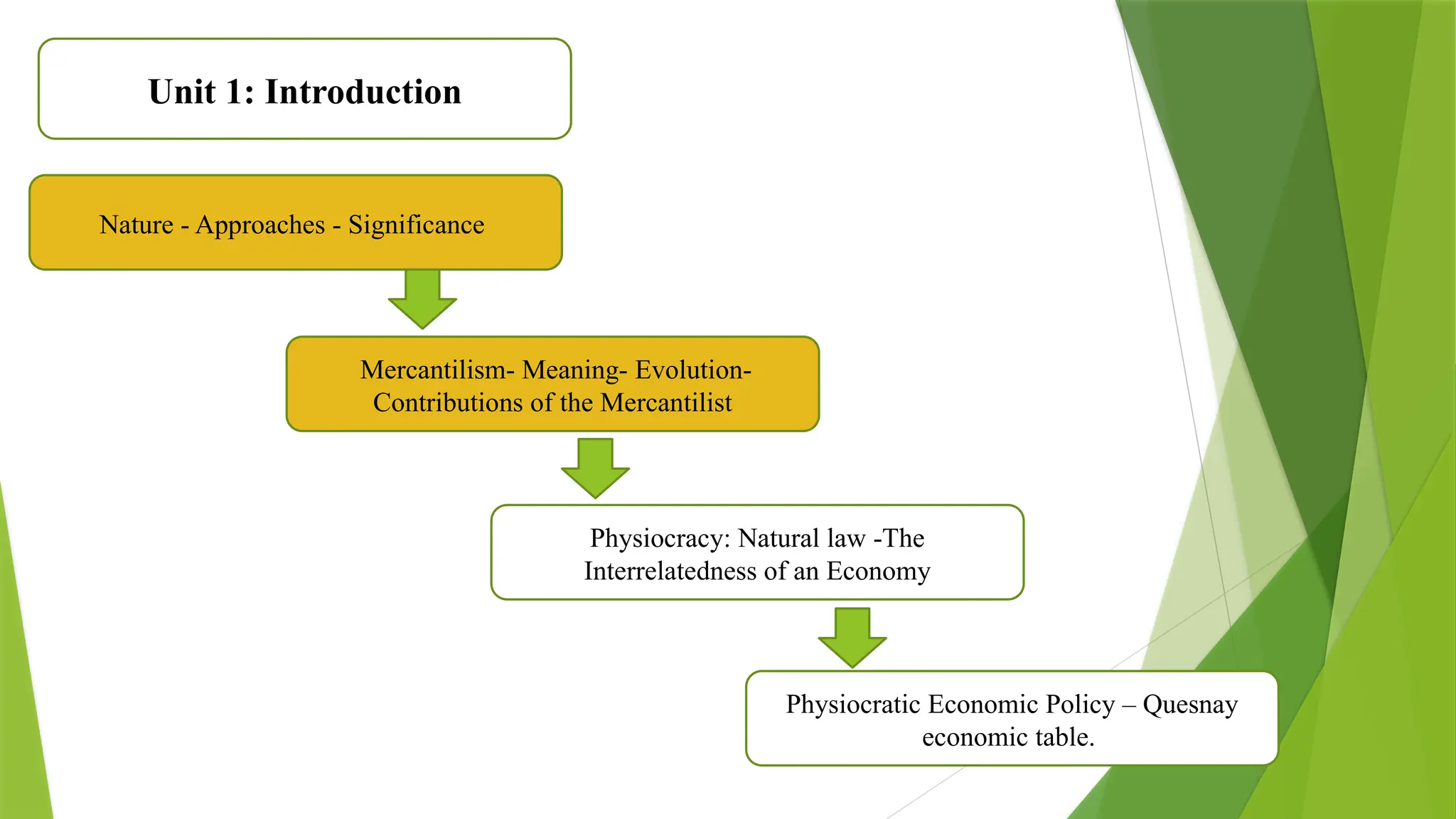
Unit 1: Introduction
Nature- Approaches - Significance
Mercantilism- Meaning- Evolution-
Contributions of the Mercantilist
Physiocracy: Natural law -The
Interrelatedness of an Economy
Physiocratic Economic Policy – Quesnay
economic table.
2.
History
• History isthe study of the past, including the events, people,
and societies that have shaped the present and future.
• History is the study of the past through written, visual, and
spoken sources, and the analysis and interpretation of those
sources.
• History aims to understand how people and societies have
changed over time, and how the past has shaped the present.
• History can teach lessons for the present.
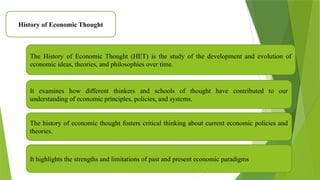
History of EconomicThought
The History of Economic Thought (HET) is the study of the development and evolution of
economic ideas, theories, and philosophies over time.
It examines how different thinkers and schools of thought have contributed to our
understanding of economic principles, policies, and systems.
The history of economic thought fosters critical thinking about current economic policies and
theories.
It highlights the strengths and limitations of past and present economic paradigms
5.
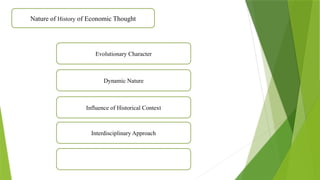
Nature of Historyof Economic Thought
Evolutionary Character
Dynamic Nature
Influence of Historical Context
Interdisciplinary Approach
6.
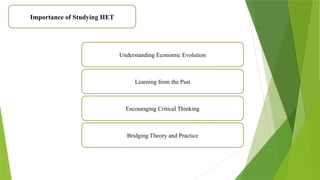
Importance of StudyingHET
Understanding Economic Evolution
Learning from the Past
Encouraging Critical Thinking
Bridging Theory and Practice
7.
The History ofEconomic Thought refers to the study of the development and
evolution of economic ideas, theories, and principles over time. It examines how
economic thinking has changed in response to historical, social, and political
contexts, and how different economists and schools of thought have contributed
to our understanding of economic concepts.
This field explores the contributions of key figures like Adam Smith, Karl Marx,
John Maynard Keynes, and others, and analyzes how their ideas have influenced
modern economic practices and policies.
Meaning of Mercantilism
Mercantilism is an economic policy that is designed to maximize the exports and minimize the imports for
an economy.
It promotes imperialism, tariffs and subsidies on traded goods to achieve that goal. These policies aim to
reduce a possible current account deficit or reach a current account surplus.
Mercantilism, also called "commercialism,” is a system in which a country attempts to amass wealth
through trade with other countries, exporting more than it imports and increasing stores of gold and
precious metals.
Mercantilism is an economic theory that was popular in Europe from the 16th to 18th centuries.
The purpose was to increase a nation's wealth by maximizing trade surplus and collecting gold and silver.
10.
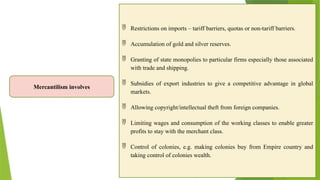
Mercantilism involves
Restrictionson imports – tariff barriers, quotas or non-tariff barriers.
Accumulation of gold and silver reserves.
Granting of state monopolies to particular firms especially those associated
with trade and shipping.
Subsidies of export industries to give a competitive advantage in global
markets.
Allowing copyright/intellectual theft from foreign companies.
Limiting wages and consumption of the working classes to enable greater
profits to stay with the merchant class.
Control of colonies, e.g. making colonies buy from Empire country and
taking control of colonies wealth.
11.
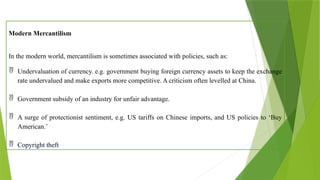
Modern Mercantilism
In themodern world, mercantilism is sometimes associated with policies, such as:
Undervaluation of currency. e.g. government buying foreign currency assets to keep the exchange
rate undervalued and make exports more competitive. A criticism often levelled at China.
Government subsidy of an industry for unfair advantage.
A surge of protectionist sentiment, e.g. US tariffs on Chinese imports, and US policies to ‘Buy
American.’
Copyright theft
12.
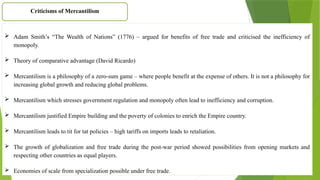
Adam Smith’s“The Wealth of Nations” (1776) – argued for benefits of free trade and criticised the inefficiency of
monopoly.
Theory of comparative advantage (David Ricardo)
Mercantilism is a philosophy of a zero-sum game – where people benefit at the expense of others. It is not a philosophy for
increasing global growth and reducing global problems.
Mercantilism which stresses government regulation and monopoly often lead to inefficiency and corruption.
Mercantilism justified Empire building and the poverty of colonies to enrich the Empire country.
Mercantilism leads to tit for tat policies – high tariffs on imports leads to retaliation.
The growth of globalization and free trade during the post-war period showed possibilities from opening markets and
respecting other countries as equal players.
Economies of scale from specialization possible under free trade.
Criticisms of Mercantilism
13.
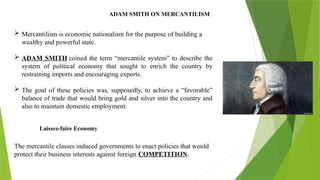
ADAM SMITH ONMERCANTILISM
Mercantilism is economic nationalism for the purpose of building a
wealthy and powerful state.
ADAM SMITH coined the term “mercantile system” to describe the
system of political economy that sought to enrich the country by
restraining imports and encouraging exports.
The goal of these policies was, supposedly, to achieve a “favorable”
balance of trade that would bring gold and silver into the country and
also to maintain domestic employment.
The mercantile classes induced governments to enact policies that would
protect their business interests against foreign COMPETITION.
Laissez-faire Economy
14.
Adam Smithrefuted the idea that the wealth of a nation is measured by the size of the
treasury in his famous treatise The Wealth of Nations, a book considered to be the
foundation of modern economic theory.
Smith made a number of important criticisms of mercantilist doctrine. First, he
demonstrated that trade, when freely initiated, benefits both parties.
Second, he argued that specialization in production allows for economies of scale, which
improves EFFICIENCY and growth.
Smith argued that the collusive relationship between government and industry was harmful
to the general POPULATION.
Physiocracy
Physiocracy isthe collective name of those economic principles and policies which developed in
France in the middle of the 18th century. Physiocracy is also known as the ‘Agricultural System’.
Economic thinkers who contributed to the growth and development of physiocracy have been called
as physiocrats.
Physiocracy is also remarked as the first school of economic thought. The term physiocracy means
“Rule of Nature’.
Physiocracy may be defined as a reaction against Mercantilism and its concepts. The physiocrats
believed that the mercantile policies instead of doing any good have done great harm to the nations. So
they revolted against the mercantile policies.
The influential French School of thinkers of the early 18th century was led by “Quesnay and Turgot”.
They believed in the existence of natural law which governs the universe. Their emphasis on agriculture
has earned for their system of thought, the name agricultural school.
17.
The Factors ThatGave Rise to Physiocracy
In 1750, France provided a favourable climate for the emergence of physiocratic ideas. There were many economic,
political and social factors that were responsible for the rise of physiocracy. Firstly, physiocracy was essentially a revolt
of the French against Mercantilism.
The tax system of France was corrupt, inefficient and unjust. The nobles and the clergymen, who owned nearly 2/3rd of
the lands, were exempted from direct taxation.
the finance of the French government was in a bad condition. The unnecessary wars and the luxurious court life of
King made the government bankrupt. So the government started borrowing loans.
The French farmers were exploited by the nobles and landlords in a number of ways. The landlords took large share of
the produce. The government levied heavy taxes upon the farmers.
The political and moral philosophers emphasised the importance of individual rather than wealth. They told that
man must be the centre of study
18.
• Physiocrats areimportant in the history of economic thought because they represented
the first school of economists.
• The mercantilists emphasised only foreign trade.
• But the physiocrats realised the importance of various economic activities and their
relation.
• In the physiocratic system all social factors like production and distribution are
connected.
• In short, the physiocrats were reformers.
19.
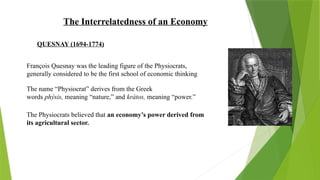
The Interrelatedness ofan Economy
QUESNAY (1694-1774)
François Quesnay was the leading figure of the Physiocrats,
generally considered to be the first school of economic thinking
The name “Physiocrat” derives from the Greek
words phýsis, meaning “nature,” and kràtos, meaning “power.”
The Physiocrats believed that an economy’s power derived from
its agricultural sector.
20.
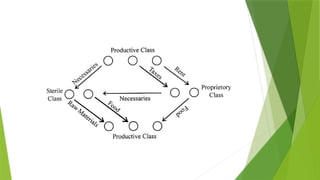
Tableau économique
In hisTableau économique, he detailed his famous zigzag diagram, a circular flow
diagram of the economy that showed who produced what and who spent what, in
an attempt to understand and explain the causes of growth.
Tableau defined three classes: landowners, farmers, and others—called “sterile”
classes—who consumed everything they produced and left no surplus for the next
period
Quesnay believed that only the agricultural sector could produce a surplus that
could then be used to produce more the next year—and therefore help growth
Quesnay advocated reforming these laws by consolidating and reducing taxes
22.
Natural law/Natural Order
The physiocrats had firm faith in the philosophy of natural order. Nemours called Physiocracy as “The
science of natural order”.
Natural order has been defined by the physiocrats as the providential order made by God for the
welfare of mankind. It is universal and unchangeable. The natural laws are the expression of the will of
God. To discover and to understand these laws is man’s first duty and to live according to them is his second
duty.
According to the physiocrats the natural order is an ideal order given by God. It is different from
the positive order made by men. In other words, the society which is governed by the laws of nature is an
ideal society and the society which is ruled by positive laws made by the Government is an imperfect
society.
The physiocrats believed that natural order maintained equilibrium in nature. The concept of natural order
produced certain important practical results. It implied that only under conditions of freedom, man can enjoy
the maximum happiness and derive maximum advantage in economic matters.