History of Economic
Thought
FAMOUS ECONOMISTS AND
THEIR MAIN IDEAS
Outline
 Adam Smith and The Wealth of Nations
 Classical political economy
 Capitalism and Marx
 Neoclassical thought
 Depression and Reconstruction
 The "American Way"
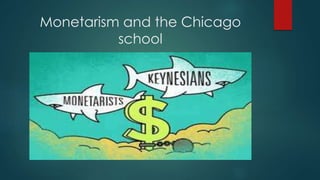
 Monetarism and the Chicago school
 Global times
 Contemporary economic thought
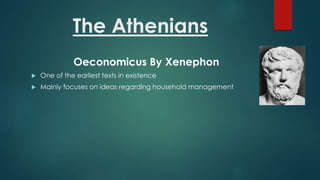
The Athenians
Oeconomicus By Xenephon
 One of the earliest texts in existence
 Mainly focuses on ideas regarding household management
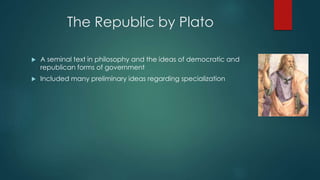
The Republic by Plato
 A seminal text in philosophy and the ideas of democratic and
republican forms of government
 Included many preliminary ideas regarding specialization
Politics by Aristotle
 Aristotles work criticizing many of Platos’s ideas regarding how
society should be run and examining different forms of governments
 It began a discussion of private property rights and incentives that
private property begins
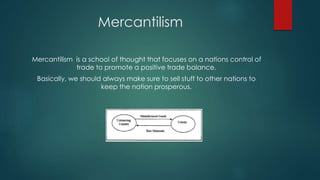
Mercantilism
Mercantilism is a school of thought that focuses on a nations control of
trade to promote a positive trade balance.
Basically, we should always make sure to sell stuff to other nations to
keep the nation prosperous.
Thomas Mun
 One of the Earliest Mercantilist
 Theorized that a country must export more than it imports to remain
prosperous and advocated for policy pushing frugality and land
utilization.
David Hume
 Agreed with north that Trade should not be interfered with
 Argued that a trade surplus would lead to an increase gold/silver
resulting in price inflation
 Hume was a major contributor to thought about morality and ethics.
Physiocrats
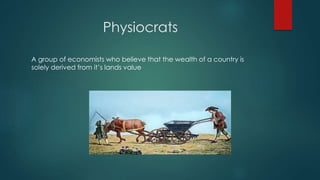
A group of economists who believe that the wealth of a country is
solely derived from it’s lands value
François Quesnay
 Wrote the Tableau Economique
 Theorized about the productivity of land and the net product of
land.
Anne-Robert-Jacques Turgot
 Developed many of the ideas of Fracois Quesnay
 Divided people into three classes , the land owners, agricultural,
and salaried classes.
 Said only the new product of land should be taxed
 Argued for economic Freedom
The Classics
Adam Smith
 British Philosopher
 Scottish Enlightenment
 Father of Modern Economics
 Wealth of Nations 1776
 Industrial Revolution
 Division of Labor
 Invisible Hand: Individual effort is the producer of social good
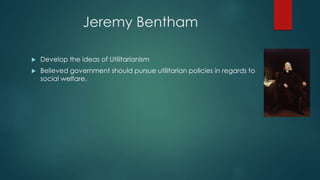
Jeremy Bentham
 Develop the ideas of Utilitarianism
 Believed government should pursue utilitarian policies in regards to
social welfare.
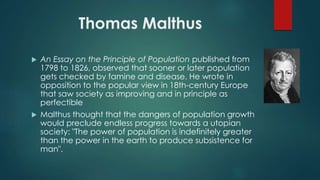
Thomas Malthus
 An Essay on the Principle of Population published from
1798 to 1826, observed that sooner or later population
gets checked by famine and disease. He wrote in
opposition to the popular view in 18th-century Europe
that saw society as improving and in principle as
perfectible
 Malthus thought that the dangers of population growth
would preclude endless progress towards a utopian
society: "The power of population is indefinitely greater
than the power in the earth to produce subsistence for
man".
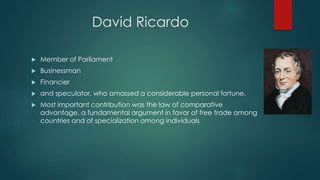
David Ricardo
 Member of Parliament
 Businessman
 Financier
 and speculator, who amassed a considerable personal fortune.
 Most important contribution was the law of comparative
advantage, a fundamental argument in favor of free trade among
countries and of specialization among individuals
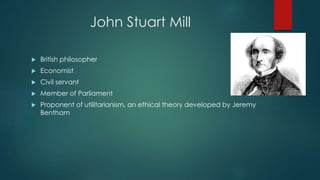
John Stuart Mill
 British philosopher
 Economist
 Civil servant
 Member of Parliament
 Proponent of utilitarianism, an ethical theory developed by Jeremy
Bentham
Karl Marx
 pre-eminent socialist economist
 Communist Manifesto
 Das Kapital 1867
 History of class struggles
 Hegalian Dialectic
Neoclassical Thought
 Marginal Utility
 application and development of Jeremy Bentham's utilitarianism
 determination of prices, outputs, and income distributions in markets
through supply and demand
 Mathematical Analysis
 Austrian School
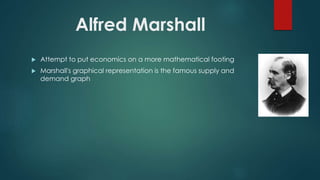
Alfred Marshall
 Attempt to put economics on a more mathematical footing
 Marshall's graphical representation is the famous supply and
demand graph
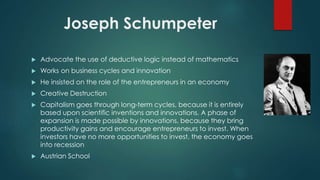
Joseph Schumpeter
 Advocate the use of deductive logic instead of mathematics
 Works on business cycles and innovation
 He insisted on the role of the entrepreneurs in an economy
 Creative Destruction
 Capitalism goes through long-term cycles, because it is entirely
based upon scientific inventions and innovations. A phase of
expansion is made possible by innovations, because they bring
productivity gains and encourage entrepreneurs to invest. When
investors have no more opportunities to invest, the economy goes
into recession
 Austrian School
Leon Walras
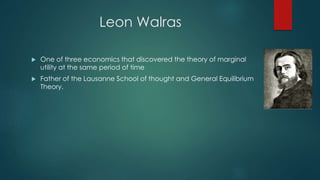
 One of three economics that discovered the theory of marginal
utility at the same period of time
 Father of the Lausanne School of thought and General Equilibrium
Theory.
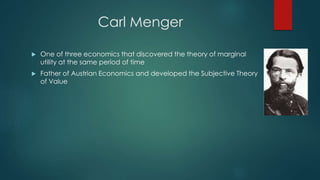
Carl Menger
 One of three economics that discovered the theory of marginal
utility at the same period of time
 Father of Austrian Economics and developed the Subjective Theory
of Value
Keynesian
John Maynard Keynes
 1930s: conditions necessitated public sector action
 General Theory provided conceptual reinforcement for New Deal
policies of FDR already being pursued to quell the Great Depression.
 ...this long run is a misleading guide to current affairs. In the long run
we are all dead. Economists set themselves too easy, too useless a
task if in tempestuous seasons they can only tell us that when the
storm is long past the ocean is flat again.
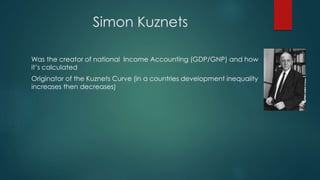
Simon Kuznets
Was the creator of national Income Accounting (GDP/GNP) and how
it’s calculated
Originator of the Kuznets Curve (in a countries development inequality
increases then decreases)
Monetarism and the Chicago
school
Milton Friedman
 School : Monetarist
 Father of Monetarist School of Economics
 One of the major libertarian icons of the 20th century
 Was against central banks and the gold standard
 Believed in the rule based monetary growth (money supply should
grow with productivity and population)
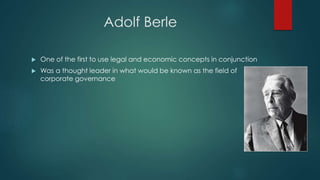
Adolf Berle
 One of the first to use legal and economic concepts in conjunction
 Was a thought leader in what would be known as the field of
corporate governance
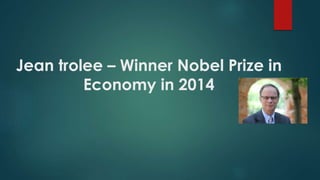
Jean trolee – Winner Nobel Prize in
Economy in 2014
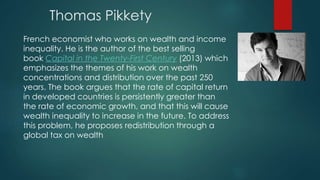
Thomas Pikkety
French economist who works on wealth and income
inequality. He is the author of the best selling
book Capital in the Twenty-First Century (2013) which
emphasizes the themes of his work on wealth
concentrations and distribution over the past 250
years. The book argues that the rate of capital return
in developed countries is persistently greater than
the rate of economic growth, and that this will cause
wealth inequality to increase in the future. To address
this problem, he proposes redistribution through a
global tax on wealth

Ietm history of economic thought

  • 1.
    History of Economic Thought FAMOUSECONOMISTS AND THEIR MAIN IDEAS
  • 2.
    Outline  Adam Smithand The Wealth of Nations  Classical political economy  Capitalism and Marx  Neoclassical thought  Depression and Reconstruction  The "American Way"  Monetarism and the Chicago school  Global times  Contemporary economic thought
  • 3.
    The Athenians Oeconomicus ByXenephon  One of the earliest texts in existence  Mainly focuses on ideas regarding household management
  • 4.
    The Republic byPlato  A seminal text in philosophy and the ideas of democratic and republican forms of government  Included many preliminary ideas regarding specialization
  • 5.
    Politics by Aristotle Aristotles work criticizing many of Platos’s ideas regarding how society should be run and examining different forms of governments  It began a discussion of private property rights and incentives that private property begins
  • 6.
    Mercantilism Mercantilism is aschool of thought that focuses on a nations control of trade to promote a positive trade balance. Basically, we should always make sure to sell stuff to other nations to keep the nation prosperous.
  • 7.
    Thomas Mun  Oneof the Earliest Mercantilist  Theorized that a country must export more than it imports to remain prosperous and advocated for policy pushing frugality and land utilization.
  • 8.
    David Hume  Agreedwith north that Trade should not be interfered with  Argued that a trade surplus would lead to an increase gold/silver resulting in price inflation  Hume was a major contributor to thought about morality and ethics.
  • 9.
    Physiocrats A group ofeconomists who believe that the wealth of a country is solely derived from it’s lands value
  • 10.
    François Quesnay  Wrotethe Tableau Economique  Theorized about the productivity of land and the net product of land.
  • 11.
    Anne-Robert-Jacques Turgot  Developedmany of the ideas of Fracois Quesnay  Divided people into three classes , the land owners, agricultural, and salaried classes.  Said only the new product of land should be taxed  Argued for economic Freedom
  • 12.
    The Classics Adam Smith British Philosopher  Scottish Enlightenment  Father of Modern Economics  Wealth of Nations 1776  Industrial Revolution  Division of Labor  Invisible Hand: Individual effort is the producer of social good
  • 13.
    Jeremy Bentham  Developthe ideas of Utilitarianism  Believed government should pursue utilitarian policies in regards to social welfare.
  • 14.
    Thomas Malthus  AnEssay on the Principle of Population published from 1798 to 1826, observed that sooner or later population gets checked by famine and disease. He wrote in opposition to the popular view in 18th-century Europe that saw society as improving and in principle as perfectible  Malthus thought that the dangers of population growth would preclude endless progress towards a utopian society: "The power of population is indefinitely greater than the power in the earth to produce subsistence for man".
  • 15.
    David Ricardo  Memberof Parliament  Businessman  Financier  and speculator, who amassed a considerable personal fortune.  Most important contribution was the law of comparative advantage, a fundamental argument in favor of free trade among countries and of specialization among individuals
  • 16.
    John Stuart Mill British philosopher  Economist  Civil servant  Member of Parliament  Proponent of utilitarianism, an ethical theory developed by Jeremy Bentham
  • 17.
    Karl Marx  pre-eminentsocialist economist  Communist Manifesto  Das Kapital 1867  History of class struggles  Hegalian Dialectic
  • 18.
    Neoclassical Thought  MarginalUtility  application and development of Jeremy Bentham's utilitarianism  determination of prices, outputs, and income distributions in markets through supply and demand  Mathematical Analysis  Austrian School
  • 19.
    Alfred Marshall  Attemptto put economics on a more mathematical footing  Marshall's graphical representation is the famous supply and demand graph
  • 20.
    Joseph Schumpeter  Advocatethe use of deductive logic instead of mathematics  Works on business cycles and innovation  He insisted on the role of the entrepreneurs in an economy  Creative Destruction  Capitalism goes through long-term cycles, because it is entirely based upon scientific inventions and innovations. A phase of expansion is made possible by innovations, because they bring productivity gains and encourage entrepreneurs to invest. When investors have no more opportunities to invest, the economy goes into recession  Austrian School
  • 21.
    Leon Walras  Oneof three economics that discovered the theory of marginal utility at the same period of time  Father of the Lausanne School of thought and General Equilibrium Theory.
  • 22.
    Carl Menger  Oneof three economics that discovered the theory of marginal utility at the same period of time  Father of Austrian Economics and developed the Subjective Theory of Value
  • 23.
    Keynesian John Maynard Keynes 1930s: conditions necessitated public sector action  General Theory provided conceptual reinforcement for New Deal policies of FDR already being pursued to quell the Great Depression.  ...this long run is a misleading guide to current affairs. In the long run we are all dead. Economists set themselves too easy, too useless a task if in tempestuous seasons they can only tell us that when the storm is long past the ocean is flat again.
  • 24.
    Simon Kuznets Was thecreator of national Income Accounting (GDP/GNP) and how it’s calculated Originator of the Kuznets Curve (in a countries development inequality increases then decreases)
  • 25.
    Monetarism and theChicago school
  • 26.
    Milton Friedman  School: Monetarist  Father of Monetarist School of Economics  One of the major libertarian icons of the 20th century  Was against central banks and the gold standard  Believed in the rule based monetary growth (money supply should grow with productivity and population)
  • 27.
    Adolf Berle  Oneof the first to use legal and economic concepts in conjunction  Was a thought leader in what would be known as the field of corporate governance
  • 28.
    Jean trolee –Winner Nobel Prize in Economy in 2014
  • 29.
    Thomas Pikkety French economistwho works on wealth and income inequality. He is the author of the best selling book Capital in the Twenty-First Century (2013) which emphasizes the themes of his work on wealth concentrations and distribution over the past 250 years. The book argues that the rate of capital return in developed countries is persistently greater than the rate of economic growth, and that this will cause wealth inequality to increase in the future. To address this problem, he proposes redistribution through a global tax on wealth