The Rise of Mass Education
During the twentieth century, educational
attainment replaced trade skill attainment
as a means of preparing children for their
future adult lives.
Compulsory education came with questions:
1. Whose values should be taught?
2. How do we ensure student success?
3. Does the money go to the school or follow
the student?
PRIMARY SOURCES:
HORACE MANN
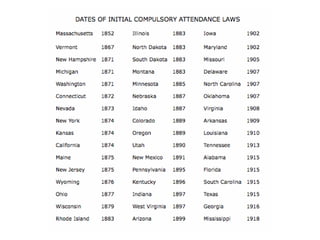
Massachusetts, 1852
An Act Concerning the Attendance of Children at School
Be it enacted by the Senate and the House of Representatives
Section 1. Every person who shall have any child under his control between
the ages of eight and fourteen years, shall send such child to some public
school within the town or city in which he resides, during at least twelve
weeks, if the public schools within such town or city shall be so long kept, in
each and every year during which such child shall be under his control, six
weeks of which shall be consecutive.
Developing the Modern School
• The professionalization of teachers
• Students progress by age and grades
• Longer, more regular school terms
• Larger buildings, many classrooms
• School administration
• Bells and efficiency
https://www.youtube.com/watch?v=3AGBa5eh
Z2o
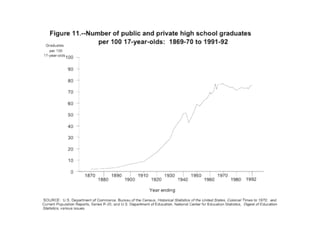
What are the consequences of
the emphasis we place on high
school graduation?
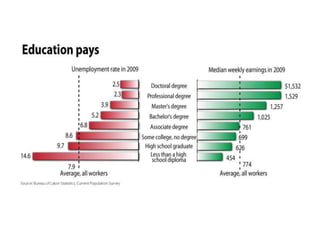
What factors make a student more
likely to complete high school and
attend college?
Who Controls What is Taught?
Why is there a separate Catholic
school system?
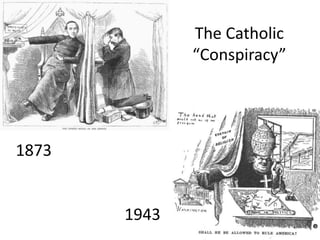
1873
1943
The Catholic
“Conspiracy”
Cincinnati Bible War of 1869
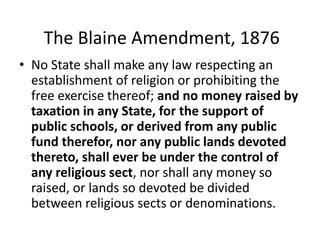
The Blaine Amendment, 1876
• No State shall make any law respecting an
establishment of religion or prohibiting the
free exercise thereof; and no money raised by
taxation in any State, for the support of
public schools, or derived from any public
fund therefor, nor any public lands devoted
thereto, shall ever be under the control of
any religious sect, nor shall any money so
raised, or lands so devoted be divided
between religious sects or denominations.
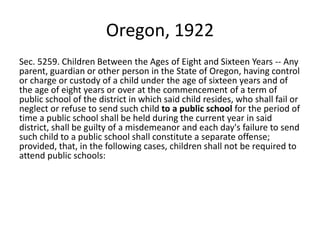
Oregon, 1922
Sec. 5259. Children Between the Ages of Eight and Sixteen Years -- Any
parent, guardian or other person in the State of Oregon, having control
or charge or custody of a child under the age of sixteen years and of
the age of eight years or over at the commencement of a term of
public school of the district in which said child resides, who shall fail or
neglect or refuse to send such child to a public school for the period of
time a public school shall be held during the current year in said
district, shall be guilty of a misdemeanor and each day's failure to send
such child to a public school shall constitute a separate offense;
provided, that, in the following cases, children shall not be required to
attend public schools:
PRIMARY SOURCES:
PIERCE V. SOCIETY OF SISTERS
Meyer v. Nebraska, 1923
“The power of the State to compel attendance at some school
and to make reasonable regulations for all schools, including a
requirement that they shall give instructions in English, is not
questioned. Nor has challenge been made of the State's
power to prescribe a curriculum for institutions which it
supports. Those matters are not within the present
controversy. . . . No emergency has arisen which renders
knowledge by a child of some language other than English so
clearly harmful as to justify its inhibition with the consequent
infringement of rights long freely enjoyed. We are constrained
to conclude that the statute as applied is arbitrary and
without reasonable relation to any end within the
competency of the State.”
Pierce v. Society of Sisters, 1925
“Under the doctrine of Meyer v. Nebraska, we think it entirely
plain that the Act of 1922 unreasonably interferes with the
liberty of parents and guardians to direct the upbringing and
education of children under their control: as often heretofore
pointed out, rights guaranteed by the Constitution may not be
abridged by legislation which has no reasonable relation to
some purpose within the competency of the State. The
fundamental theory of liberty upon which all governments in
this Union repose excludes any general power of the State to
standardize its children by forcing them to accept instruction
from public teachers only. The child is not the mere creature
of the State; those who nurture him and direct his destiny
have the right, coupled with the high duty, to recognize and
prepare him for additional obligations.”
Meyer & Pierce
• Parents have the right to direct the education
of their children (within certain constraints)
• The state cannot ban private schools or
unduly control what private schools teach
Evangelicals
and Public Education
Losing What Was Theirs
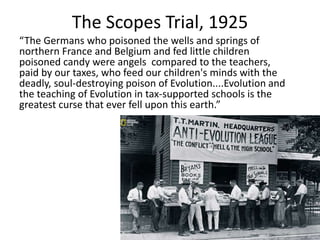
The Scopes Trial, 1925
“The Germans who poisoned the wells and springs of
northern France and Belgium and fed little children
poisoned candy were angels compared to the teachers,
paid by our taxes, who feed our children's minds with the
deadly, soul-destroying poison of Evolution....Evolution and
the teaching of Evolution in tax-supported schools is the
greatest curse that ever fell upon this earth.”
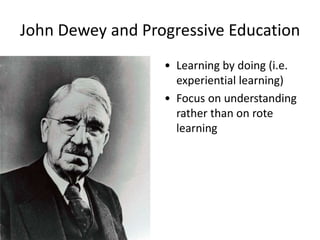
John Dewey and Progressive Education
• Learning by doing (i.e.
experiential learning)
• Focus on understanding
rather than on rote
learning
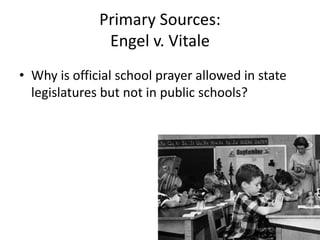
Primary Sources:
Engel v. Vitale
• Why is official school prayer allowed in state
legislatures but not in public schools?
Evangelical Concerns
• School prayer
• Sex education
• Evolution
• Values clarification
• Multicultural textbooks
Christian schools
Homeschooling
Educational Critics
& School Choice
Education, Competition, and National Security
“Decades after Sputnik burned in the atmosphere, we’re still
talking about science education as a means of security.”
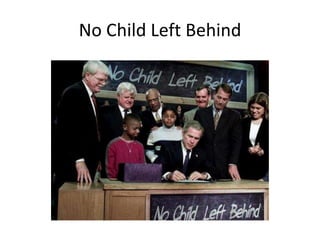
No Child Left Behind
School Choice
• Vouchers
• Charter schools
Public Schools & Child Poverty
http://www.washingtonpost.com/local/education/majority-of-us-public-
school-students-are-in-poverty/2015/01/15/df7171d0-9ce9-11e4-a7ee-
526210d665b4_story.html
Modern Education Issues
• What subjects and values should be taught in
public schools?
• How do we assess school performance and
ensure student success?
• Does state education money go to public
schools only, or does it follow the student?
Who has school choice?

Economics:education lecture 3

  • 1.
    The Rise ofMass Education
  • 2.
    During the twentiethcentury, educational attainment replaced trade skill attainment as a means of preparing children for their future adult lives. Compulsory education came with questions: 1. Whose values should be taught? 2. How do we ensure student success? 3. Does the money go to the school or follow the student?
  • 3.
  • 5.
    Massachusetts, 1852 An ActConcerning the Attendance of Children at School Be it enacted by the Senate and the House of Representatives Section 1. Every person who shall have any child under his control between the ages of eight and fourteen years, shall send such child to some public school within the town or city in which he resides, during at least twelve weeks, if the public schools within such town or city shall be so long kept, in each and every year during which such child shall be under his control, six weeks of which shall be consecutive.
  • 6.
    Developing the ModernSchool • The professionalization of teachers • Students progress by age and grades • Longer, more regular school terms • Larger buildings, many classrooms • School administration • Bells and efficiency
  • 9.
  • 10.
    What are theconsequences of the emphasis we place on high school graduation?
  • 11.
    What factors makea student more likely to complete high school and attend college?
  • 13.
  • 15.
    Why is therea separate Catholic school system?
  • 16.
  • 18.
  • 19.
    The Blaine Amendment,1876 • No State shall make any law respecting an establishment of religion or prohibiting the free exercise thereof; and no money raised by taxation in any State, for the support of public schools, or derived from any public fund therefor, nor any public lands devoted thereto, shall ever be under the control of any religious sect, nor shall any money so raised, or lands so devoted be divided between religious sects or denominations.
  • 20.
    Oregon, 1922 Sec. 5259.Children Between the Ages of Eight and Sixteen Years -- Any parent, guardian or other person in the State of Oregon, having control or charge or custody of a child under the age of sixteen years and of the age of eight years or over at the commencement of a term of public school of the district in which said child resides, who shall fail or neglect or refuse to send such child to a public school for the period of time a public school shall be held during the current year in said district, shall be guilty of a misdemeanor and each day's failure to send such child to a public school shall constitute a separate offense; provided, that, in the following cases, children shall not be required to attend public schools:
  • 21.
    PRIMARY SOURCES: PIERCE V.SOCIETY OF SISTERS
  • 22.
    Meyer v. Nebraska,1923 “The power of the State to compel attendance at some school and to make reasonable regulations for all schools, including a requirement that they shall give instructions in English, is not questioned. Nor has challenge been made of the State's power to prescribe a curriculum for institutions which it supports. Those matters are not within the present controversy. . . . No emergency has arisen which renders knowledge by a child of some language other than English so clearly harmful as to justify its inhibition with the consequent infringement of rights long freely enjoyed. We are constrained to conclude that the statute as applied is arbitrary and without reasonable relation to any end within the competency of the State.”
  • 23.
    Pierce v. Societyof Sisters, 1925 “Under the doctrine of Meyer v. Nebraska, we think it entirely plain that the Act of 1922 unreasonably interferes with the liberty of parents and guardians to direct the upbringing and education of children under their control: as often heretofore pointed out, rights guaranteed by the Constitution may not be abridged by legislation which has no reasonable relation to some purpose within the competency of the State. The fundamental theory of liberty upon which all governments in this Union repose excludes any general power of the State to standardize its children by forcing them to accept instruction from public teachers only. The child is not the mere creature of the State; those who nurture him and direct his destiny have the right, coupled with the high duty, to recognize and prepare him for additional obligations.”
  • 24.
    Meyer & Pierce •Parents have the right to direct the education of their children (within certain constraints) • The state cannot ban private schools or unduly control what private schools teach
  • 25.
  • 26.
    The Scopes Trial,1925 “The Germans who poisoned the wells and springs of northern France and Belgium and fed little children poisoned candy were angels compared to the teachers, paid by our taxes, who feed our children's minds with the deadly, soul-destroying poison of Evolution....Evolution and the teaching of Evolution in tax-supported schools is the greatest curse that ever fell upon this earth.”
  • 27.
    John Dewey andProgressive Education • Learning by doing (i.e. experiential learning) • Focus on understanding rather than on rote learning
  • 28.
    Primary Sources: Engel v.Vitale • Why is official school prayer allowed in state legislatures but not in public schools?
  • 29.
    Evangelical Concerns • Schoolprayer • Sex education • Evolution • Values clarification • Multicultural textbooks
  • 30.
  • 31.
  • 32.
  • 33.
    Education, Competition, andNational Security “Decades after Sputnik burned in the atmosphere, we’re still talking about science education as a means of security.”
  • 34.
  • 35.
  • 36.
    Public Schools &Child Poverty http://www.washingtonpost.com/local/education/majority-of-us-public- school-students-are-in-poverty/2015/01/15/df7171d0-9ce9-11e4-a7ee- 526210d665b4_story.html
  • 37.
    Modern Education Issues •What subjects and values should be taught in public schools? • How do we assess school performance and ensure student success? • Does state education money go to public schools only, or does it follow the student?
  • 38.