The 
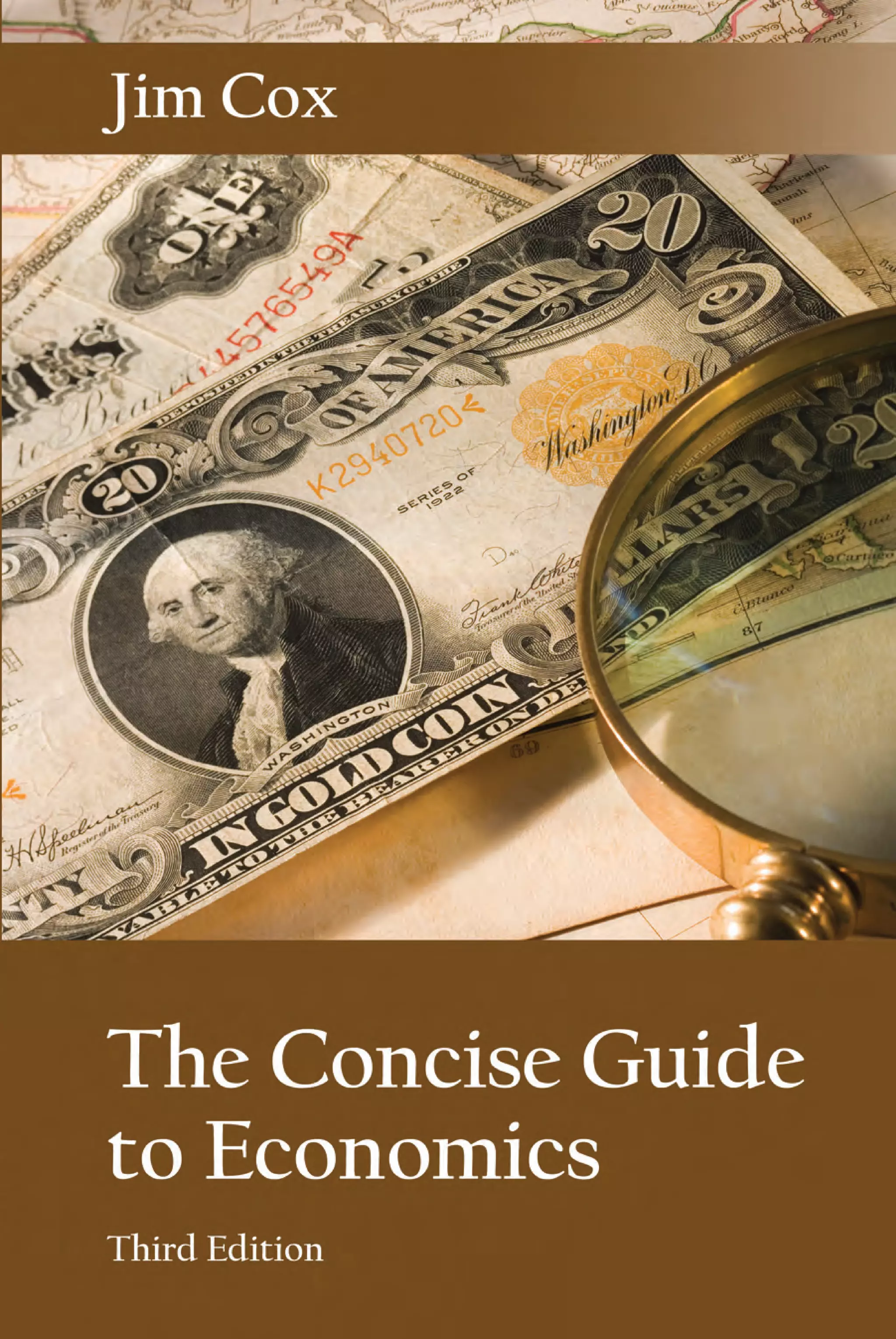
Concise Guide 
to Economics 
Third Edition 
Jim Cox 
Ludwig 
von Mises 
Institute 
AUBURN, ALABAMA
Underlying most arguments against the free market is a 
lack of belief in freedom itself. 
Milton Friedman 
Third edition © copyright 2007 by Jim Cox 
Second edition © copyright 1997 by Jim Cox 
First editon © copyright 1995 by Jim Cox 
All rights reserved. Written permission must be secured from the publisher to 
use or reporduce any part of this book, except for brief quotations in critical 
reviews or articles. 
Published by the Ludwig von Mises Institute, 518 West Magnolia Avenue, 
Auburn, Alabama 36832; www.mises.org. 
ISBN 978-1-933550-15-2
To my parents, 
Harry Maxey Cox 
and 
Helen Kelly Cox
Acknowledgments 
The clarity and accuracy of this writing has been much improved 
due to the many helpful comments of those who read it in manuscript 
form. Many thanks to Elliot Stroud, Carol Chappell, Nancy Stroud, 
Scott Phillips, and most importantly, and lovingly, the late Dawn Baker. 
I want to thank Judy Thommesen and William Harshbarger for their 
work, patience, and attention to detail in the preparation of this new edi-tion. 
Any errors remaining are of course of my own making.
Contents 
Preface by Llewellyn H. Rockwell, Jr. . . . . . . . . . . . . . . . . . . . . . .vii 
Introduction . . . . . . . . . . . . . . . . . . . . . . . . . . . . . . . . . . . . . . . . . . .ix 
Basics and Applications 
1. Overview of the Schools of Economic Thought . . . . . . .1 
2. Entrepreneurship . . . . . . . . . . . . . . . . . . . . . . . . . . . . . . . . .3 
3. Profit/Loss System . . . . . . . . . . . . . . . . . . . . . . . . . . . . . . . .5 
4. The Capitalist Function . . . . . . . . . . . . . . . . . . . . . . . . . . .9 
5. The Minimum Wage Law . . . . . . . . . . . . . . . . . . . . . . . .11 
6. Price Gouging . . . . . . . . . . . . . . . . . . . . . . . . . . . . . . . . . .15 
7. Price Controls . . . . . . . . . . . . . . . . . . . . . . . . . . . . . . . . . .19 
8. Regulation . . . . . . . . . . . . . . . . . . . . . . . . . . . . . . . . . . . . .23 
9. Licensing . . . . . . . . . . . . . . . . . . . . . . . . . . . . . . . . . . . . . .25 
10. Monopoly . . . . . . . . . . . . . . . . . . . . . . . . . . . . . . . . . . . . . .27 
11. Antitrust . . . . . . . . . . . . . . . . . . . . . . . . . . . . . . . . . . . . . . .29 
12. Unions . . . . . . . . . . . . . . . . . . . . . . . . . . . . . . . . . . . . . . . .33 
13. Advertising . . . . . . . . . . . . . . . . . . . . . . . . . . . . . . . . . . . . .35 
14. Speculators . . . . . . . . . . . . . . . . . . . . . . . . . . . . . . . . . . . . .41 
15. Heroic Insider Trading . . . . . . . . . . . . . . . . . . . . . . . . . . .45 
16. Owners vs. Managers . . . . . . . . . . . . . . . . . . . . . . . . . . . .49 
17. Market vs. Government Provision of Goods . . . . . . . . . .53 
18. Market vs. Command Economy . . . . . . . . . . . . . . . . . . .57 
19. Free Trade vs. Protectionism . . . . . . . . . . . . . . . . . . . . . . .59 
Money and Banking 
20. Money . . . . . . . . . . . . . . . . . . . . . . . . . . . . . . . . . . . . . . . . .65 
21. Inflation . . . . . . . . . . . . . . . . . . . . . . . . . . . . . . . . . . . . . . .67 
22. The Gold Standard . . . . . . . . . . . . . . . . . . . . . . . . . . . . . .71 
v
vi The Concise Guide to Economics 
23. The Federal Reserve System . . . . . . . . . . . . . . . . . . . . . . .75 
24. The Business Cycle . . . . . . . . . . . . . . . . . . . . . . . . . . . . . .77 
25. Black Tuesday . . . . . . . . . . . . . . . . . . . . . . . . . . . . . . . . . .81 
26. The Great Depression . . . . . . . . . . . . . . . . . . . . . . . . . . . .85 
Technicals 
27. Methodology . . . . . . . . . . . . . . . . . . . . . . . . . . . . . . . . . . .89 
28. Labor Theory of Value . . . . . . . . . . . . . . . . . . . . . . . . . . .93 
29. The Trade Deficit . . . . . . . . . . . . . . . . . . . . . . . . . . . . . . .97 
30. Economic Class Analysis . . . . . . . . . . . . . . . . . . . . . . . .101 
31. Justice, Property Rights, and Inheritance . . . . . . . . . . .103 
32. Cost Push . . . . . . . . . . . . . . . . . . . . . . . . . . . . . . . . . . . . .105 
33. The Phillips Curve . . . . . . . . . . . . . . . . . . . . . . . . . . . . .107 
34. Perfect Competition . . . . . . . . . . . . . . . . . . . . . . . . . . . .109 
35. The Multiplier . . . . . . . . . . . . . . . . . . . . . . . . . . . . . . . . .111 
36. The Calculation Debate . . . . . . . . . . . . . . . . . . . . . . . . .115 
37. The History of Economic Thought . . . . . . . . . . . . . . .117 
Chronology . . . . . . . . . . . . . . . . . . . . . . . . . . . . . . . . . . . . . . . . . .119 
Index . . . . . . . . . . . . . . . . . . . . . . . . . . . . . . . . . . . . . . . . . . . . . .121
Preface 
The Concise Guide to Economics came about for the same reason 
that Frédéric Bastiat wrote so passionately and dedicated his 
entire life to spreading the truths of economics. Some people, 
economist Jim Cox among them, are rightly seized with the desire to get 
the message out to the largest possible number of people. This way they 
will be intellectually prepared to combat bad ideas when they are pushed 
in public life to the ruin of society. 
Will most people ever get the message? Probably not, but this kind 
of book is essential to raising just enough skepticism to stop bad legisla-tion. 
Must we forever put up with widespread political errors, such as 
minimum wages and protectionism, that contradict basic economic 
laws? Probably so, but that means that there will always and forever be a 
hugely important role for economists. 
The beauty of Cox’s book comes from both its clear exposition and 
its brevity. He offers only a few paragraphs on each topic but that is 
enough for people to see both error and truth. Sometimes just mapping 
out the logic beyond the gut reaction is enough to highlight an economic 
truth. He does this for nearly all the topics that confront us daily. 
Think of the issue of third world poverty. Many people are convinced 
that not buying from large chain discount stores is a valid form of protest 
against the exploitation of the world’s poor. But how does it help anyone 
not to buy their products or services? If every Wal-Mart dried up, would 
workers in China and Indonesia be pleased? Quite the opposite, and it 
only takes a moment to realize why. 
Many people only have a moment. That’s why the guide is essential. 
It is probably the shortest and soundest guide to economic logic in print. 
May it be burned into the consciousness of every citizen now and in the 
future. 
Llewellyn H. Rockwell, Jr. 
April 2007 
vii
Introduction 
The purpose of this work is to allow the reader who is interested 
in some difficult economic topics to grasp them and the free-market 
viewpoint with very little effort. Having experienced the 
frustration of attempting to counter some of the statist viewpoints com-mon 
in economic texts, news stories, and other works and in discussions 
without such a reference guide, I decided to produce just such a work. 
The reader will find the topics to be some of the most common ones 
about which antifree market writers find fault, along with analysis of 
some technical items normally addressed in a modern economics course 
with which this author finds fault. It is hoped that in the space of one or 
two pages the reader will see the plausibility of the free-market perspec-tive 
and the fallacy of the opposite view. 
Here, in a short space the essence of the views will be presented, 
along with a reference listing for material which the reader can consult if 
interested in further pursuing the topic. This reference book provides an 
easy alternative source of information for those unfamiliar with all of the 
works and arguments advanced in regard to economic theory and the 
virtues of the free market. 
ix
BASICS AND APPLICATIONS 
1 
Overview of the Schools of 
Economic Thought 
There are four major schools of economic thought today. An 
understanding of these four schools of thought is necessary for 
an understanding of economics. The four schools are Marxist, 
Keynesian, Monetarist, and Austrian. 
Marxist economic thought is based on the writings of Karl Marx and 
Friedrich Engels, who wrote in the mid-to-late 1800s. Essentially, Marx-ist 
thought is based on economic determinism wherein societies go 
through the developmental stages of primitive communism, slave sys-tems, 
feudalism, capitalism, socialism, and finally communism. In each 
of these stages the economic system determines the views of those living 
during that system. Each includes a class struggle which leads inevitably 
to the next stage of societal development. Thus feudalism has a class 
struggle between landlord and serf which produces the next stage, capi-talism. 
In capitalism the two classes are capitalist and worker. The con-flict 
between capitalist and worker results in the overthrow of capitalism 
by the working class thus ushering in socialism and ending class con-flicts. 
Marxist theory concludes that socialism leads to the ultimate fate 
of humanity—communism. 
Keynesian views are named for the writings of John Maynard Keynes, 
particularly his 1936 book The General Theory of Employment, Interest, and 
Money. In this incredibly difficult book Keynes set forth an aggregated 
view of economic variables—total supply, total demand—working 
directly upon one another with no necessary tie to the actions of the indi-vidual 
decision-maker. Thus a “macro” economics was established. Key-nesians 
call for government to manage total demand—too little demand 
leads to unemployment while too much demand leads to inflation. Thus 
a dichotomy was established in theory: either the problem of inflation 
1
2 The Concise Guide to Economics 
would attend or the problem of unemployment, but never both simulta-neously. 
Keynes viewed the free market as generating either too much or 
too little demand, inherently. Thus the need (ever so conveniently for the 
job prospects of Keynesian economists!) for demand management by 
government informed by the wisdom of the Keynesians. 
Monetarist views are best represented by Milton Friedman and his 
followers who retained the Keynesian “macro” approach. However, 
while viewing the economy in this manner Monetarists lay the emphasis 
not on spending so much as on the total supply of money—thus the 
name Monetarist. In other than the macro economic issues—inflation, 
unemployment, and the ups and downs of the business cycle—Mone-tarists 
tend to take the individual actor as the basis of their economic rea-soning 
in areas such as regulation, function of prices, advertising, inter-national 
trade, etc. 
The Austrian School was begun by Carl Menger in the late 1800s 
and was ultimately developed to its fullest by Ludwig von Mises—both 
of Austria. The Austrian School developed a body of thought with a con-scious 
emphasis on the acting individual as the ultimate basis for making 
sense of all economic issues. Along with this individualist emphasis is a 
subjectivist view of value and an orientation that all action is inherently 
future-oriented. This book is written in the Austrian tradition. 
References 
Friedman, Milton. 1962. Capitalism and Freedom. Chicago: University of 
Chicago Press. 
Keynes, John Maynard. 1936. The General Theory of Employment, Inter-est 
and Money. New York: Harcourt, Brace. 
Marx, Karl, and Friedrich Engels. 1964. The Communist Manifesto. New 
York: Pocket Books. 
Mises, Ludwig von. 1984. The Historical Setting of the Austrian School of 
Economics. Auburn, Ala.: Ludwig von Mises Institute. 
Rothbard, Murray N. 1983. The Essential Ludwig von Mises. Auburn, 
Ala.: Ludwig von Mises Institute. 
Schumpeter, Joseph. 1978. History of Economic Analysis. New York: 
Oxford University Press.
2 
Entrepreneurship 
Entrepreneurship can be defined as acting on perceived opportu-nities 
in the market in an attempt to gain profits. This acting 
involves being alert to profit possibilities, arranging financing, 
managing resources and seeing a project through to completion. Entre-preneurs 
can be regarded as heroic characters in the economy as they 
bear the risks involved in bringing new goods and services to the con-sumer. 
To quote from Ludwig von Mises in Human Action: 
They are the leaders on the way to material progress. They 
are the first to understand that there is a discrepancy between 
what is done and what could be done. They guess what the 
consumers would like to have and are intent on providing 
them with these things. (1996, p. 336; 1998, p. 333) 
Entrepreneurship is an art, every bit as much as creating a painting 
or sculpture. In each case—running a business and producing a work of 
art—the same elements abound: Conceiving the undertaking, taking 
resources and combining them into something new and different, risking 
those valuable resources in producing something which may ultimately 
prove to be of less value. 
It is very common in economics textbooks to ignore the entrepreneur 
when the texts discuss markets and competition. Their treatment 
implies that this alertness to profit possibilities, arrangement of financ-ing, 
management of resources and seeing a project through to comple-tion 
are all automatic within the market economy. They are not. Real 
flesh and blood people must act (and not once, but continuously), and be 
motivated to take these risks in order for commerce to proceed. 
The theory of perfect competition entirely eliminates any role for 
such a person. One of the reasons the role of entrepreneurs has been 
3
4 The Concise Guide to Economics 
deemphasized is the methodology of positivism. This approach reduces 
economic phenomena to mathematics and graphs. Since the traits of 
alertness, energy, and enthusiasm so necessary for entrepreneurship do 
not lend themselves readily to mathematics and graphing, they are neg-lected 
by many economists. Here we have a method displacing real-world 
events. Which is it we should do—throw out parts of reality (such 
as the above named traits) which do not fit with a method, or find a 
method that acknowledges and deals with such significant parts of real-ity? 
References 
Dolan, Edwin G., and David E. Lindsay. 1991. Economics. 6th Ed. Hins-dale, 
Ill.: Dryden Press. Pp. 788–811. 
Folsom, Burt. 1987. Entrepreneurs vs. the State. Reston, Va.: Young Amer-ica’s 
Foundation. 
Gilder, George. 1984. The Spirit of Enterprise. New York: Simon and 
Schuster. Pp. 15–19. 
Kirzner, Israel. 1973. Competition and Entrepreneurship. Chicago: Uni-versity 
of Chicago Press. 
Mises, Ludwig von. 1966. Human Action. Chicago: Henry Regnery. Pp. 
335–38; 1998. Scholar’s Edition. Auburn, Ala.: Ludwig von Mises 
Institute. Pp. 332–35. 
Rothbard, Murray N. 2004. Man, Economy, and State with Power and 
Market. Auburn, Ala.: Ludwig von Mises Institute. Pp. 588–617; 
1970. Man, Economy, and State. Los Angeles: Nash. Pp. 528–55.
3 
Profit/Loss System 
The free-market economy is a profit and loss system. Typically, 
profits are emphasized but it should be understood that losses 
are equally necessary for an efficient economy. The nature of 
profits is sometimes misconstrued by the general public. Profits are not 
an excess charge or an act of meanness by firms. Profits are a reward to 
the capitalist-entrepreneur for creating value. To understand this we 
must first understand the nature of exchange. When two parties trade, 
they do so because they expect to receive something of greater value than 
that which they surrender, otherwise they would not waste their time 
engaging in exchanges. Now, what is the nature of a profit? 
A businessman takes input resources—land, labor, materials, etc.— 
and recombines them to produce something different. 
For example: A car manufacturer takes: 
$4,000 worth of materials 
$6,000 worth of labor 
$1,000 worth of overhead 
$11,000 total cost 
and produces a car which sells for $15,000. The only way the car will sell 
for this $15,000 is if a consumer willingly parts with the money for the 
car, and based on the nature of exchange he will do so only if he prefers 
the car to the money. So the entrepreneur has taken $11,000 worth of 
resources and refashioned them into a car worth $15,000, thereby mak-ing 
a profit of $4,000. Where did the $4,000 profit come from? The 
answer is, it was created by the manufacturer. He caused it to come into 
5
6 The Concise Guide to Economics 
existence. This is a creative act just as producing an artwork is a creative 
act. 
The worth or value of the materials, labor, and overhead is what 
those items will sell for to willing buyers. By refashioning them into the 
car, the manufacturer has produced more value than he found in the 
world. Profits are a sign of value creation; making profits deserves to be 
hailed and honored for benefitting mankind. 
Now, take the example of losses. Are losses an act of kindness in not 
charging too much? In essence: No. Taking the same example, with 
input costs of $11,000, what if the manufacturer had produced a car that 
no one would buy for more than $11,000? If the manufacturer could not 
sell the car until the price was say, $8,000, then what does this mean? It 
means he has taken perfectly good resources—materials, labor, and over-head— 
and recombined them in such a manner that they are now worth 
only $8,000 to buyers. He has destroyed value in the world. Such an act 
deserves condemnation for impoverishing humanity. Had the business-man 
not come on the scene the world would have been richer by $3,000 
in value. 
Fortunately, in the free market we do not have to rely on social honor 
or condemnation to motivate producers to produce those goods which 
consumers prefer. This occurs naturally as profits allow successful pro-ducers 
continued production and wider control of resources, while losses 
deprive others of control of resources and the ability to continue in pro-duction. 
Also, note the beauty of the market: Any failure in serving con-sumers, 
irrational pricing or choice of production is to that same degree 
an opportunity for profits. Thus, the market, while not perfect, is self-cor-recting. 
Reformers will better rectify any inadequacies they detect in the 
market by reaping the profits available from that inadequacy than by 
denouncing the very system which makes meaningful reform possible. 
Profits are a signal to use resources to produce items highly valued by 
consumers and losses are a signal to discontinue production of low-val-ued 
items. Losses are necessary to free up resources for use by those pro-ducing 
valued goods. Therefore we find that the interests of producers 
and consumers are harmonious, rather than at odds.
Basics and Applications 7 
References 
Friedman, Milton, and Rose Friedman. 1980. Free to Choose. New York: 
Harcourt Brace Jovanovich. Pp. 9–38. 
Gwartney, James D., and Richard L. Stroup. 1993. What Everyone Should 
Know About Economics and Prosperity. Tallahasee, Fla.: James Madi-son 
Institute. Pp. 21–23. 
Hazlitt, Henry. 1979. Economics in One Lesson. New Rochelle, N.Y.: 
Arlington House. Pp. 103–09. 
Mises, Ludwig von. 1974. Planning for Freedom. South Holland, Ill.: Lib-ertarian 
Press. Pp. 108–49. 
Rand, Ayn. 1957. Atlas Shrugged. New York: Random House. Pp. 478–81. 
Rothbard, Murray N. 2004. Man, Economy, and State with Power and 
Market. Auburn, Ala.: Ludwig von Mises Institute. Pp. 509–16; 1970. 
Man, Economy, and State. Los Angeles: Nash. Pp. 463–69.
4 
The Capitalist Function 
Socialist theory (predicated on the labor theory of value) concludes 
that profits are necessarily value stolen from workers by capitalists. 
This conclusion is mistaken. The function of the capitalist is as 
useful as the function of the worker; profits are as warranted as wages. 
The two functions the capitalist performs in the economy are the 
waiting function and the risk-bearing function. The waiting function 
occurs because all productive processes require time to complete. It is the 
capitalist who forgoes consumption by investing in the productive enter-prise. 
While the worker is paid his wages as he works, the capitalist bears 
the burden of receiving payment only once the completed product has 
been sold. 
The risk-bearing function is the entrepreneurial function of bearing 
the burden that a productive process may turn out to be counterproduc-tive— 
that is, the value of the good produced may be less than the value 
of resources used to produce it. While the worker is paid his wages for his 
work, the capitalist bears the burden of receiving payment only if the 
completed product is a success. 
Can either the waiting or the risk bearing function be abolished? No. 
Even in a socialist economy these two functions must take place. They 
are inherent in the nature of the productive process. The closest a social-ist 
economy could come to abolishing the capitalist function would be to 
force upon the workers themselves the waiting and the risking. Notice 
that most workers are not too terribly interested in this option. They 
freely choose to enjoy current consumption rather than holding out for 
the prospect of greater payment in the future and prefer to be paid for 
their work, specifically, rather than being paid only if the product suc-ceeds. 
9
10 The Concise Guide to Economics 
In stark contrast to the mistaken socialist theory, the relationship 
between workers and capitalists is harmonious. A division of labor occurs 
wherein each party specializes in a self-chosen manner, each reaping the 
benefits of the efforts of the other. 
References 
Block, Walter. 1976. Defending the Undefendable. New York: Fleet Press. 
Pp. 186–202. 
Hendrickson, Mark, ed. 1992. The Morality of Capitalism. Irvington-on- 
Hudson, N.Y.: Foundation for Economic Education. 
Lefevre, Robert. n.d. Lift Her Up, Tenderly. Orange, Calif.: Pinetree Press. 
Pp. 97–104. 
Mises, Ludwig von. 1975. “The Economic Role of Saving and Capital 
Goods.” In Free Market Economics: A Basic Reader. Bettina Bien 
Greaves, ed. Irvington-on-Hudson, N.Y.: Foundation for Economic 
Education. Pp. 74–76. 
——. 1966. Human Action. Chicago: Henry Regnery. Pp. 300–01. 
Rothbard, Murray N. 1983. The Essential Ludwig von Mises. Auburn, 
Ala.: Ludwig von Mises Institute. Pp. 12–13.
5 
The Minimum Wage 
Minimum wage legislation is one of the great civil wrongs per-petrated 
against the low-skilled who need the opportunities 
which middle-class workers, future professionals, and the self-employed 
can legally take for granted. What the minimum wage law 
does to the poor is to deny to them the same freely chosen opportunities 
others follow for their own well-being. 
A middle-class 20-year old college student, for example, can work 
part-time at $6.00 per hour for half the hours in a work week and attend 
classes to better his future employment prospects the other half. In effect, 
such a student is earning not $6.00 per hour for his efforts but a submin-imum 
wage of only $3.00 for the full work week of 40 hours (20 hours on 
the job at $6.00 and 20 hours in class and study time at $0). And if the 
costs of tuition, books, and gas are included the student is possibly earn-ing 
an effective wage which is negative! This is done by the student vol-untarily— 
a subminimum-wage effort is freely chosen as a civil right not 
denied by government. 
An up and coming 30-year old doctor chooses a similar route of eco-nomic 
well-being. The hours spent not only in undergraduate school as 
in the case of the 20-year old, but in medical school as well, pay no wage. 
In fact, both are paying to learn now in order to earn a much higher 
income later. Again, the future doctor exercises this option as a civil 
right—there are no laws preventing him from doing so. 
An enterprising individual starting his own business will often lose 
money for months, even years, prior to earning a profit on a new venture. 
Again, he is earning a wage much less than that mandated by minimum 
wage legislation. But, he is perfectly free, as an entrepreneur, to engage 
in such behavior—it is not illegal. 
11
12 The Concise Guide to Economics 
But what of the low-skilled citizen with no prospects of college train-ing 
or a medical career or of starting his own business? Here the heavy 
hand of government literally outlaws an option freely chosen by others. A 
worker whose production is worth only $4.00 an hour to an employer is 
denied the opportunity to accept this low wage for the opportunity to learn, 
not in the formal setting of a college classroom or a training hospital or as 
an actual business owner, but in the workplace itself. It’s a safe bet that most 
readers of this page made wage gains once on the job, not by way of formal 
training but by way of learning and proving themselves on their jobs. 
Anyone doubtful that the minimum wage law is a civil rights issue 
need only look at the unemployment statistics to see the truth of this 
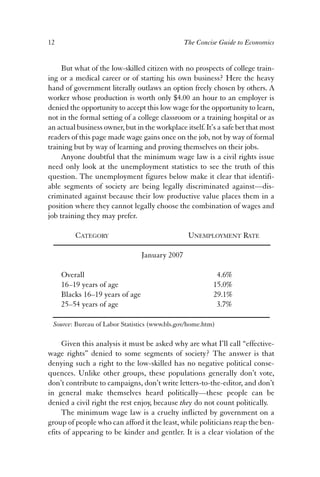
question. The unemployment figures below make it clear that identifi-able 
segments of society are being legally discriminated against—dis-criminated 
against because their low productive value places them in a 
position where they cannot legally choose the combination of wages and 
job training they may prefer. 
CATEGORY UNEMPLOYMENT RATE 
January 2007 
Overall 4.6% 
16–19 years of age 15.0% 
Blacks 16–19 years of age 29.1% 
25–54 years of age 3.7% 
Source: Bureau of Labor Statistics (www.bls.gov/home.htm) 
Given this analysis it must be asked why are what I’ll call “effective-wage 
rights” denied to some segments of society? The answer is that 
denying such a right to the low-skilled has no negative political conse-quences. 
Unlike other groups, these populations generally don’t vote, 
don’t contribute to campaigns, don’t write letters-to-the-editor, and don’t 
in general make themselves heard politically—these people can be 
denied a civil right the rest enjoy, because they do not count politically. 
The minimum wage law is a cruelty inflicted by government on a 
group of people who can afford it the least, while politicians reap the ben-efits 
of appearing to be kinder and gentler. It is a clear violation of the
Basics and Applications 13 
equal protection clause of the Fourteenth Amendment. In the name of 
the poor themselves, it is time to abolish this shameful civil wrong. 
References 
Brown, Susan, et al. 1974. The Incredible Bread Machine. San Diego, 
Calif.: World Research. Pp. 80–83. 
Friedman, Milton. 1983. Bright Promises, Dismal Performance. New York: 
Harcourt Brace Jovanovich. Pp. 16–19. 
Hazlitt, Henry. 1979. Economics in One Lesson. New Rochelle, N.Y.: 
Arlington House. Pp. 134–39. 
Schiff, Irwin. 1976. The Biggest Con: How the Government is Fleecing You. 
Hamden, Conn.: Freedom Books. Pp. 164–78. 
Sowell, Thomas. 1990. Preferential Policies. New York: William Morrow. 
Pp. 27–28. 
Williams, Walter. 1982. The State Against Blacks. New York: McGraw- 
Hill. Pp. 33–51.
6 
Price Gouging 
Price gouging—charging higher prices under emergency condi-tions— 
evokes strong emotional responses that are understand-able 
but terribly wrongheaded. 
In the words of economist Walter Williams, “passionate issues 
require dispassionate analysis.” The passion generated by price increases 
for necessities in an emergency is just such a case. Three lines of analysis 
demonstrate that “price gouging” is not only not offensive, but that pre-venting 
it would increase misery, and that it is even a desirable practice! 
Let’s take for example, the case of some hot item during an emer-gency, 
say plywood in the aftermath of a hurricane. Before the hurricane, 
plywood was selling for the nationwide price of $8.00. After the hurricane 
prices of $50.00 or more may not be uncommon. 
The first line of analysis should be the most meaningful for red, 
white, and blue, freedom-loving Americans. If one person (the seller) has 
plywood and is willing to part with it for $50.00, it is because he would 
prefer having the money to having the plywood. If another person (the 
buyer) has $50.00 and is willing to part with the money for the plywood, 
it is because he would prefer the plywood to the $50.00. No one is forced 
to engage in this transaction, individual freedom is preserved in this vol-untary 
exchange, and it results in a mutual benefit. Can anything be less 
objectionable than a free exchange of goods which results in a mutual 
benefit? 
Second, a successful effort to prevent price gouging would harm the 
very intended beneficiaries in our example. With thousands of needs, 
there is a vastly increased demand for plywood. At the same time, the 
storm has destroyed existing plywood (trapped under rubble, damaged, 
15
16 The Concise Guide to Economics 
or lost) and made it exceptionally difficult to transport additional sup-plies 
into the area. 
Preventing increased prices as a way of allocating the reduced supply 
with the increased demand would result in a more severe shortage, and 
plywood going to uses that are less than the most urgently needed ones. 
An example: If one could sell a sheet of plywood for a legal or socially-stigmated 
maximum of $8.00, he may well decide to keep it for some rel-atively 
trivial use rather than part with it for a use considered by the 
potential buyer to be of the most urgent importance. At $50.00 the choice 
is likely to be otherwise. Misery is thereby increased by the implementa-tion 
of measures to prevent price gouging. 
The point should also be made that the price of a good is determined 
by the actual conditions of supply and demand. The willingness and 
ability of buyers and sellers to trade is what establishes any particular 
price—before and after an emergency situation. In an emergency, the 
facts have obviously been changed. It is reactionary and a revolt against 
reality to demand a never-changing price forevermore in the ever-chang-ing 
world we inhabit. 
And last, the desirable effect of successful “price gouging” would be 
in the higher $50.00 price motivating sellers to increase the supply of ply-wood 
reaching the citizens in need. The fact is, the cost of sending goods 
into a disaster area is dramatically increased because of the damage. 
Trucks now take longer to reach their destination—time is money after 
all—the likelihood of driver and rig being trapped within the affected 
area is another increased cost, and the prospect of looters seizing mer-chants’ 
goods has also increased. All of these and other factors have the 
effect of discouraging shipments at the old $8.00 price; the supplier could 
do just as well in any other area. The increased price resulting from the 
misnamed price gouging should be harnessed to encourage the needed 
supply—it is one bit of salvation disaster victims can scarcely afford to do 
without. 
None of this analysis is intended to disparage the heroic efforts of 
charitable relief agencies, only to pause to consider that in addition to the 
relief efforts, higher prices are themselves a necessity to assure an 
increased flow of goods in time of need. These higher prices are not a 
matter of what is fair or unfair, regardless of anyone’s initial gut reaction, 
but a matter of what is, given the actual facts of the situation.
Basics and Applications 17 
References 
Block, Walter. 1976. Defending the Undefendable. New York: Fleet Press 
Pp. 192–202. 
Brown, Susan, et al. 1974. The Incredible Bread Machine. San Diego, 
Calif.: World Research. Pp. 29–43. 
Hazlitt, Henry. 1979. Economics in One Lesson. New Rochelle, N.Y.: 
Arlington House. Pp. 103–09. 
Rothbard, Murray N. 1977. Power and Market: Government and the Econ-omy. 
Auburn, Ala.: Ludwig von Mises Institute. Pp. 24–34. 
——. 1990. “Government and Hurricane Hugo: A Deadly Combina-tion.” 
In The Economics of Liberty. Llewellyn H. Rockwell, Jr., ed. 
Auburn, Ala.: Ludwig von Mises Institute. Pp. 136–40. 
Sowell, Thomas. 1981. Pink and Brown People. Stanford, Calif.: Hoover 
Institution Press. Pp. 72–74.
7 
Price Controls 
Price controls are the political solution enacted to stop price infla-tion. 
1 The controls do not work. Prices are determined by supply 
(willingness and ability to sell) and demand (willingness and abil-ity 
to buy). The price resulting from supply and demand which clears the 
market is not changed by a price control (a legal limit on price). The legal 
price is merely a misstatement of the actual conditions and is compara-ble 
to plugging a thermometer so that it never can read greater than 72 
degrees even though the actual temperature may be higher. The law of 
supply and demand cannot be repealed. 
People will call for price controls as a way to make goods available 
cheaper than they otherwise would be. The price controls do not make the 
goods cheaper and in fact cause a shortage of those goods as the demand 
quantity will be greater than the supply quantity. Not only do price con-trols 
cause shortages but they in fact make goods more expensive! 
How can this be? The shortage resulting from the price controls 
causes consumers to pay for the good in question in ways other than a 
price payment to the seller. To take an example from the experience in the 
U.S.: the price of gasoline was legally limited between August 1971 and 
February 1981. At a time when gasoline could not be legally sold for more 
than 40 cents a gallon, the estimated free market— supply and demand— 
clearing price was 80 cents a gallon. Using a 10 gallon fill-up it would 
appear that the consumer is saving $4.00 per tank full (10 gallons x 80 
cents versus 40 cents). While consumers are not paying as much to the 
seller for the gasoline directly, they are in fact paying dearly for the gaso-line 
in other ways. 
1See chapter 21 for an explanation of the cause of inflation. 
19
20 The Concise Guide to Economics 
Probably the greatest expense is in the form of the consumer’s time. 
The shortage results in extensive time spent waiting in line for the pur-chase. 
Time is money; a consumer’s time has value. Using a minimum 
figure of the consumer’s time being worth $2.00 per hour, a two-hour 
wait in line per fill-up wipes out any alleged saving from the price con-trols. 
But the consumer is not through paying. The idled gasoline used 
waiting in line is another form of consumer payment, say 10 cents per 
fill-up. Now we have the price controls actually costing the consumer an 
extra 10 cents per tank full. And there are yet more costs to the consumer. 
There is a difficulty in buying gasoline when there is a shortage in that it 
takes extra mental energy and planning which is an aggravation (that is, 
a cost) for the consumer that he would much rather avoid. (Doubt this 
last point? Check your own behavior: Do you call around to the gas sta-tions 
in your area before stopping for a fill-up, or do you avoid that aggra-vation 
although you know that not checking will often result in paying a 
higher price than necessary?) 
These extra expenses continue in the form of the violence and the 
fear of such violence that can result from tensions mounting while wait-ing 
in long lines for gasoline (shootings did occur in this situation dur-ing 
the 1970s price controls). Other expenses might include the purchase 
of a siphon hose for legitimate or even illegitimate gasoline transfers from 
one vehicle to another. Also, siphoning gasoline carries its own severe 
health and safety costs when poorly executed! 
The fact that there is more demand than supply of gasoline generates 
a further consumer cost in reversing the normal buyer-seller relationship. 
The normal buyer-seller relationship is one of the seller courting the con-sumer, 
attempting to please the consumer as a means to the seller’s finan-cial 
success. But with the price control-induced shortage it is the buyer 
who must please the seller to be among the favored whom the seller 
blesses with his limited stock of goods! In the 1970s this reversal was 
played out as sellers dropped services from their routine—no more tire 
pressure checks, oil checks, windshield cleaning, etc. 
All of these further consumer costs only make the expense of gaso-line 
that much greater than the free-market price. Consumers have the 
choice of paying the free-market price for gasoline in dollars directly to 
the seller or paying an even higher controlled price in a combination of 
dollars and other costs. But there is a difference in these two forms of pay-ment 
for gasoline. The difference is that the direct dollar payment to the
Basics and Applications 21 
seller is an inducement to supply gasoline. The payment by the con-sumer 
in other costs encourages no such supply. 
References 
Block, Walter, ed. 1981. Rent Control, Myths & Realities. Vancouver, B.C.: 
Fraser Institute. 
Katz, Howard. 1976. The Paper Aristocracy. New York: Books in Focus. 
Pp. 113–15, 117. 
Reisman, George. 1979. The Government Against the Economy. Ottawa, 
Ill.: Caroline House. Pp. 63–148. 
Rothbard, Murray N. 2004. Man, Economy, and State with Power and 
Market. Auburn, Ala.: Ludwig von Mises Institute. Pp. 588–617; 
1970. Man, Economy, and State. Los Angeles: Nash. Pp. 777–85. 
Schuettinger, Robert, and Eamonn F. Butler. 1979. Forty Centuries of 
Wage and Price Control: How Not to Fight Inflation. Washington, 
D.C.: Heritage Foundation. 
Skousen, Mark. 1977. Playing the Price Controls Game. New Rochelle, 
N.Y.: Arlington House. Pp. 67–86, 109–26.
8 
Regulation 
The conventional, but mistaken, understanding of regulation is 
that consumers or workers need protection from unscrupulous 
big businesses and that Congress wisely and compassionately 
responds to those needs to rein in nefarious businesses. Actually, business 
regulations were and are instigated at the behest of and for the benefit of 
the businesses so regulated. In effect, regulation is a teaming of business 
and government to the detriment of potential competitors—which the 
established businesses prefer not to face—and to the detriment of the 
consuming public. 
On a purely theoretical basis this is the fundamental status of regu-lation. 
This is because any business regulated by a government agency 
has a focused interest in the activities of that agency and will therefore 
spend a great deal of time and money making sure the regulations are 
enacted in such a way as to benefit the business. Consumers, on the other 
hand, have a myriad of interests and only a minor or passing concern 
about any particular industry and the regulations affecting it. In other 
words, businesses will naturally out-compete the consumer in the politi-cal 
realm where regulation originates. 
A few examples: The grandfather of regulatory bodies in the U.S. is 
the Interstate Commerce Commission (ICC) established in 1887 to reg-ulate 
railroads. The railroads had for years attempted to fix prices among 
themselves, only to discover that each individual company found it to its 
individual benefit to cheat on such an agreement—each individual rail-road 
firm hoping the others would stand by the agreed-upon higher price 
while it cut its own prices to increase business. 
Finally, the railroads themselves arranged for Congress to establish 
the ICC so that the power of law would guarantee that the prices were 
23
24 The Concise Guide to Economics 
not cut. When the new technology of trucks was available to compete— 
to the benefit of the consumers—with the railroads, the ICC began reg-ulating 
trucks in such a manner as to benefit the railroads. These truck 
regulations consisted of mandated routes (making trucks behave as if 
they were operating on tracks!), minimum prices and limits on what the 
trucks could carry and where they could carry it. 
Airlines were regulated beginning in 1938, and in the 40-year period 
from then until 1978 no new trunk airlines were granted a charter. These 
four decades saw a huge change in the airline business as airplane tech-nology 
advanced from propellers to jets, from 20 seaters to 400 seaters, 
from speeds of 120 mph to speeds of 600 mph. Yet, the Civil Aeronautics 
Board (CAB) found no need to allow new competitors into the growing 
industry. This fact alone makes it quite clear that the purpose of the reg-ulation 
was not to protect the consumer but to protect the market of the 
established airlines. 
The word regulation, properly understood, should evoke thoughts 
such as protection of businesses from competitors, special privileges for 
established firms, and government efforts to exploit consumers. 
References 
Fellmeth, Robert. 1970. The Interstate Commerce Omission. New York: 
Grossman. 
Friedman, Milton. 1983. Bright Promises, Dismal Performance. New York: 
Harcourt Brace Jovanovich. Pp. 127–37. 
Kolko, Gabriel. 1965. Railroads and Regulation, 1877–1916. New York: 
W.W. Norton. 
——. 1963. The Triumph of Conservatism. New York: Free Press. 
Stigler, George J. 1975. The Citizen and the State. Chicago: University of 
Chicago Press. Pp. 114–41. 
Twight, Charlotte. 1975. America’s Emerging Fascist Economy. New 
Rochelle, N.Y.: Arlington House. Pp. 70–112.
9 
Licensing 
Licensing is a subcategory of regulation and so all of the same 
basic points regarding regulation apply to licensing. Licensing is 
sold to the public on the basis that it protects consumers from low 
quality. What licensing in fact does is protect the licensed from lower 
prices for their services! Licensing is a means by which a special interest 
group—those licensed—restrict the supply of a service in order to gener-ate 
higher prices for themselves. 
Licensing overrides the preferences of consumers by setting the gov-ernment 
as the decision maker in quality standards for various services. 
In effect, a particular level of quality is established by law, thereby forbid-ding 
any lower quality services and depriving the consumer of his sover-eignty. 
Many would claim that it is necessary to have such quality stan-dards, 
but often the quality standards actually have very little to do with 
the service being rendered. The requirement of passing a “History of 
Barbering” course in order to get a license to barber is one such example. 
But further, consumers often prefer and need—due to income limi-tations— 
cheaper, lower quality services. High licensing standards often 
require the equivalent of a Cadillac when many are better served by a 
Ford. Also, the resulting higher prices which consumers face result in 
more do-it-yourself efforts and deferred work, often endangering the 
consumer more than licensing protects him. Besides, there are alterna-tives 
to coercive licensing. Quality standards voluntarily certified allow 
the consumer to shop for his preferred level of service (Underwriters 
Laboratories [UL], Good Housekeeping seals, and insurance require-ments 
are examples). Government licensing has preempted a vast array 
of certifications which would otherwise exist. These certifications would 
be driven by consumer demand rather than political pull—undeniably a 
more satisfactory arrangement for the consumer. 
25
26 The Concise Guide to Economics 
References 
Friedman, David. 1996. Hidden Order: The Economics of Everyday Life. 
New York: HarperCollins. Pp. 164–65, 214. 
Friedman, Milton. 1975. Capitalism and Freedom. Chicago: University of 
Chicago Press. Pp. 137–61. 
Rottenberg, Simon. 1980. Occupational Licensure and Regulation. Wash-ington, 
D.C.: American Enterprise Institute. 
Williams, Walter. 1982. The State Against Blacks. New York: McGraw- 
Hill. Pp. 67–107. 
Young, David. 1987. The Rule of Experts. Washington, D.C.: Cato Insti-tute.
10 
Monopoly 
In the conventional positivist-based methodology found in today’s 
textbooks, the term “monopoly” has been warped into referring to 
any firm facing a falling demand curve. Since all firms face a falling 
demand curve, the word “monopoly” has been rendered meaningless. 
The original concept of monopoly meant an exclusive privilege granted 
by the state, or literally one seller. Even the textbooks acknowledge these 
as types or sources of monopoly. 
Some pertinent examples of monopoly, correctly understood, would 
include the postal monopoly (it is illegal for anyone else to deliver first 
class mail for under $3.00 per letter), most power companies and cable 
television companies (it is illegal for anyone else to sell these services in 
their territory—much like the Mafia turf concept!), taxis in many cities 
(it is illegal to run without an expensive medallion which the state limits 
in quantity), and public schools (which force property owners to pay for 
them regardless of use). 
The irony of so many reformers who agonize over alleged monopo-lies 
generated in the free market is that they never complain of the hordes 
of government monopolies. See for example Ralph Nader’s The Monop-oly 
Makers for a confirmation of this point. One can only conclude that 
what so upsets these people is not monopolies but private property, busi-nesses, 
and the free market. For surely the monopoly power the U.S. 
Postal Service exercises on a daily basis and for decades now is far, far 
greater than any monopoly power a business may enjoy from voluntary 
consumer patronage. No market-earned business monopoly (in the sense 
of one seller) can forcibly eliminate its competitors or forcibly require 
revenues from its customers the way the United States Post Office and 
other government-granted monopolies do as a matter of routine. 
27
28 The Concise Guide to Economics 
References 
Armentano, D.T. 1982. Antitrust and Monopoly: Anatomy of a Policy Fail-ure. 
New York: John Wiley and Sons. 
Branden, Nathaniel. 1967. “Common Fallacies about Capitalism.” In 
Capitalism: The Unknown Ideal. Ayn Rand, ed. New York: New 
American Library. Pp. 72–77. 
Brown, Susan, et. al. 1974. The Incredible Bread Machine. San Diego, 
Calif.: World Research. Pp. 66–79. 
Brozen, Yale. 1979. Is Government the Source of Monopoly? San Francisco: 
Cato Institute. 
Burris, Alan. 1983. A Liberty Primer. Rochester, N.Y.: Society for Individ-ual 
Liberty. Pp. 226–37. 
Rothbard, Murray N. 2004. Man, Economy, and State with Power and 
Market. Auburn, Ala.: Ludwig von Mises Institute. Pp. 661–704; 
1970. Man, Economy, and State. Los Angeles: Nash. Pp. 587–620.
11 
Antitrust 
The conventional theory of antitrust laws (laws against monopo-lies) 
is that after the Civil War with the rise of large scale enter-prises, 
businesses had power over consumers in being able to 
corner their markets. Responding to a public need, Congress passed the 
Sherman Antitrust Act and the laws have been beneficial ever since. This 
conventional view is grossly mistaken. 
Actually, the origins of the antitrust laws lie in politically influential 
businesses getting a national law passed to preempt state laws, to use the 
power of the state against their business rivals, and from a political 
vendetta by the bill’s author against the head of a major firm. In truth, 
the laws have not served the consumer but have done the exact opposite, 
harming productive, cost and price-cutting businesses to the detriment of 
consumers. 
Two famous antitrust cases illustrate these points: The 1911 Stan-dard 
Oil Case divided the company into 33 separate organizations. What 
was Standard Oil guilty of? The judge decided that by integrating stages 
of the oil business—wells, pipelines, refineries, etc.—and by buying 
small unintegrated stages, Standard was preventing these separate busi-nesses 
from competing with one another. Nowhere was it found that 
Standard had raised prices (prices fell continuously), or had restricted 
output (output rose continuously)—the classical complaints against a 
monopoly. Standard Oil had earned its position as the largest domestic 
oil producer by serving the needs of consumers and serving them very 
well. 
By the time the court case was settled, Standard had dropped from a 
90 percent market share to a 60 percent market share because of the nat-ural 
developments in the market itself. Even assuming that the court case 
29
30 The Concise Guide to Economics 
was originally necessary, it was made obsolete due to free competition 
from the Texas oil discoveries and by the move from kerosene to other 
petroleum products as well as the advent of electricity. There was noth-ing 
Standard Oil could do to stop these events—compare that to a gov-ernment- 
authorized monopoly! 
The Standard Oil Case set the precedent for a theory in antitrust law 
known as the “rule of reason.” But, as D.T. Armentano has explained, 
how can this be reasonable when there is no reference to the facts? 
The 1945 Alcoa Aluminum Case is equally absurd. Alcoa had been 
the dominant primary aluminum producer for decades, having first 
begun production when aluminum was so rare and unknown that it was 
more valuable than gold! Over the years Alcoa developed its facilities and 
methods enabling it to lower the price with its lowered costs and to 
expand its market. As in the Standard Oil Case, there was no claim that 
Alcoa was charging high prices or restricting output. So what did the 
judge find offensive? The judge’s verdict included this incredible para-graph: 
It was not inevitable that it [Alcoa] should always anticipate 
increases in the demand for ingot and be prepared to supply 
them. Nothing compelled it to keep doubling and redoubling 
its capacity before others entered the field. It insists that it 
never excluded competitors; but we can think of no more 
effective exclusion than progressively to embrace each oppor-tunity 
as it opened, and to face every newcomer with new 
capacity already geared into a great organization, having the 
advantage of experience, trade connections and the elite of 
personnel. (Quoted in Armentano, Antitrust: The Case for 
Repeal, p. 62) 
Clearly, antitrust theory had been turned literally on its head with 
good service to the consumer becoming a black mark in the courtroom. 
Imagine if, instead, Alcoa had been an incompetently run organization, 
never gaining a significant share of the market, the judge (had he had 
occasion to rule on Alcoa) would have found Alcoa to be the very essence 
of a good citizen company, patted it on its head and sent it on its way to 
continue its blunders, all obviously to the detriment of consumers. At the 
same time the judge was finding Alcoa guilty, the U.S. Congress was 
granting a commendation to Alcoa for doing such a fine job during the 
effort of World War II.
Basics and Applications 31 
Notice further that the markets these companies were found guilty of 
monopolizing were the domestic oil market—overlooking the competi-tion 
from imported oil—and the primary aluminum market—overlook-ing 
the competition from reprocessed aluminum. In other words, the 
courts had to first artificially narrow the market in order to find these 
companies guilty! 
Other equally absurd tales could be told of cases such as Brown 
Shoe, Von’s Grocery, IBM and the shared monopoly in ready-to-eat 
breakfast cereals and can all be found in Armentano’s Antitrust and 
Monopoly. Suffice it to say here that most other advanced countries do 
not have antitrust laws and think it very strange indeed that the U.S. gov-ernment 
would spend its time beating up on the businesses in its own 
jurisdiction. And notice as well, that crippling these companies would 
benefit their rivals who were better connected politically—one of the real 
motives behind this law. 
Now the vendetta story: Senator Sherman had his heart set on being 
president of the United States and appeared destined for the Republican 
nomination in 1888. His life’s ambition was thwarted when Russell 
Alger—of the Diamond Match Company—threw his support to Ben-jamin 
Harrison, the eventual president. In an effort to get Alger, Sher-man 
sponsored the antitrust law. As President Harrison signed the bill 
into law he is reported to have said, “Ah, I see Sherman is getting back at 
his old friend Russell Alger!” By the way, Diamond Match was never 
indicted and Sherman’s true position was revealed soon afterward as he 
sponsored a bill to levy a tax on imported consumer goods. Thus the 
Sherman Act was a mere smokescreen for Congress to hide behind while 
it did its dirty business of sacrificing the consumer to political pull among 
businesses via the power of law. 
With all of the anticompetitive, monopoly-creating regulations and 
laws, the only proper place for antitrust indictments is against govern-ment 
agencies—a practice which Congress has managed to outlaw. 
References 
Armentano, D.T. 1986. Antitrust: The Case for Repeal. Washington, D.C.: 
Cato Institute; 2nd Rev. Ed. 1999. Auburn, Ala.: Ludwig von Mises 
Institute.
32 The Concise Guide to Economics 
——. 1982. Antitrust and Monopoly: Anatomy of a Policy Failure. New 
York: John Wiley and Sons. 
Bork, Robert. 1978. The Antitrust Paradox: A Policy at War with Itself. New 
York: Basic Books. 
Burris, Alan. 1983. A Liberty Primer. Rochester, N.Y.: Society for Individ-ual 
Liberty. Pp. 209–25. 
Greenspan, Alan. 1967. “Antitrust.” In Capitalism: The Unknown Ideal. 
Ayn Rand, ed. New York: New American Library. Pp. 63–71. 
Rothbard, Murray N. 2004. Man, Economy, and State with Power and 
Market. Auburn, Ala.: Ludwig von Mises Institute. Pp. 906–07; 1970. 
Man, Economy, and State. Los Angeles: Nash. P. 790.
12 
Unions 
Unions are a matter of pitting one group of workers against other 
workers; it is not a worker versus manager phenomenon. Suc-cessful 
unions are those which are able to exclude workers, and 
the unions most able to exclude workers are those composed of skilled 
workers. Skilled workers are more difficult to replace than unskilled 
workers and thus are better able to succeed in a strike. As Milton Fried-man 
has stated, “unions don’t cause high wages, high wages cause 
unions.” 
When unions strike they are not merely refusing to work but are pre-venting 
any labor from being offered to the employer. Those workers 
who do cross a union picket line are called “scabs,” thereby illustrating 
the lack of working class solidarity and clarifying the fact that the issue is 
one group of workers against other workers. 
When unions are successful they raise the wages of their member-ship 
but do so only at the expense of reducing the number of workers 
employed by the firm. Those workers unable to find employment in the 
unionized sector must seek work in the nonunionized sector, thereby 
depressing the wages for the nonunion workers. Unions do not raise 
wages, they increase wages for one group of (unionized) workers at the 
expense of lowering wages for the remaining (nonunionized) workers. 
The problem with unions in modern America is that like businesses 
which enjoy government protection through regulation, unions have 
been granted legal privileges. These legal privileges include the Wagner 
Act, the Norris-LaGuardia Act and lenient courts which treat job-related 
violence as somehow legitimate. In a free market, the limited role of 
unions would be beneficial as they might act as job clearinghouses and 
standards-certifying boards. 
33
34 The Concise Guide to Economics 
Anyone truly concerned with the welfare of workers should first ana-lyze 
the source of wages. Wages are determined by worker productivity. 
Worker productivity is determined by the availability of capital goods 
(tools) to the worker to help him in his production. The availability of 
capital goods is determined by the prospect of profiting from such an 
investment. And the appropriate mix of investment in capital goods 
results from freedom in the marketplace. Thus anyone concerned with 
the welfare of workers should be the greatest advocate of free markets. 
If this sounds too theoretical, consider the action of real-world work-ers 
concerned with their personal welfare without regard to theory or ide-ology. 
The experience the world over is one of workers constantly seek-ing 
out freer economies, escaping from East Berlin to West Berlin, from 
China to Hong Kong, from Mexico to the U.S. The world has yet to see 
such a mass migration of workers from the freer economies to the less 
free economies. 
References 
Branden, Nathaniel. 1967. “Common Fallacies about Capitalism.” In 
Capitalism: The Unknown Ideal. Ayn Rand, ed. New York: New 
American Library. Pp. 83–88. 
Friedman, Milton, and Rose Friedman. 1980. Free to Choose. New York: 
Harcourt Brace Jovanovich. Pp. 228–47. 
Mises, Ludwig von. 1966. Human Action. Chicago: Henry Regnery. Pp. 
777–79; 1998. Scholar’s Edition. Auburn, Ala.: Ludwig von Mises 
Institute. Pp. 771–73. 
Reynolds, Morgan O. 1987. Making America Poorer: The Cost of Labor 
Law. Washington, D.C.: Cato Institute. 
Rockwell, Llewellyn H., Jr. 1989. “The Scourge of Unionism.” In The 
Economics of Liberty. Llewellyn H. Rockwell, Jr., ed. Auburn, Ala.: 
Ludwig von Mises Institute. Pp. 27–31. 
Schiff, Irwin. 1976. The Biggest Con: How the Government is Fleecing You. 
Hamden, Conn.: Freedom Books. Pp. 185–92.
13 
Advertising 
Advertising has been given a bum rap in economic theory. Aside 
from any inherent bias against the free market itself, the reason 
for this is the theory of perfect competition. Once the economist 
perceives the world through “perfect competition colored glasses” it nat-urally 
follows to disparage advertising. Given the fanciful assumptions of 
perfect competition—perfectly homogeneous products, perfect mobility 
of resources, perfect knowledge, and all firms so small that none can 
influence price—advertising is purely wasteful. What valuable economic 
role could advertising play in such a world? All consumers know the 
attributes and availabilities of the products, products are equally readily 
(instantaneously) available in regard to location, and the prices for these 
products are all the same. 
So much for advertising in a world of perfect competition. What 
about in reality? In reality, in the real world of actual competition—rival-rous 
attempts among firms to attract consumers—advertising does 
indeed play a useful, beneficial economic role. The three major points of 
contention regarding advertising are persuasion versus information, 
waste versus efficiency and concentration versus competition. 
Persuasion vs. Information 
The claim that much of advertising is only persuasive rather than 
informative is based on such examples as “Coke is it!” Critics of advertis-ing 
claim that there is no information in such an advertising slogan; there 
is only hoopla in an attempt to persuade a poor consumer to part with his 
cash. It should be understood that just because advertising is of no value 
to a particular critic, someone else may find the advertising to be of value. 
35
36 The Concise Guide to Economics 
For any one person most advertising is in fact not directed at him. Many 
of us will agree that the above slogan is lacking in information—what’s 
the price?, where can it be bought?, what’s the nutritional content?, etc. 
But for someone on their way home who has promised to pick up a six 
pack of Coke for the evening’s company the slogan is in fact a welcomed 
reminder. People are busy with a multitude of activities and cannot keep 
everything in mind; reminders are often necessary. 
I suspect everyone reading this page can cite an example wherein 
they had neglected the consumption of some favored product only to spot 
it or a simple advertising slogan again and thought, in effect: “Oh yes, I 
used to enjoy X, I’ll have to buy it again!” People in such situations are 
glad to have had the reminder. 
Further, newcomers need to be introduced to products which are 
familiar to the rest of us. Newcomers would include infants, immigrants, 
and populations where the product is first being introduced. The reason 
the particular product in that slogan strikes us as needing no further 
advertising is because the company has done such a thorough job of con-stantly 
keeping the product before us that we perceive it as unnecessary. 
The anti-advertisers have set up a false dichotomy between persua-sion 
and information; the two are actually and necessarily intertwined. 
The only way to inform someone is to first persuade them to direct their 
attention to that information, thus the clever slogans, bright colors, 
catchy tunes, etc. And the only way to persuade someone is with infor-mation, 
however limited. 
But, let’s grant the anti-advertisers their point: consumers at times 
buy products only because of a purely persuasive advertisement. The very 
proper response to such a charge is: SO WHAT? If a consumer wants to 
buy a product purely based on the persuasion of an advertisement that’s 
his right as a consumer to spend his money as he chooses. Besides, how 
many wants are inherent, beyond the persuasion from anyone? Very few 
purchases or human preferences are for inherent wants—and certainly 
being filled with animosity toward advertising is not one of them! 
Waste vs. Efficiency 
The second claim against advertising is that it increases production 
costs—undeniably producing a product and then spending money on
Basics and Applications 37 
advertising is more costly than spending nothing on advertising. But this 
is also true of every feature of any product—producing an automobile 
with an engine versus one without an engine, for example. The real issue 
is: are the extra costs (advertising, the auto engine, etc.) a value to the 
consumer he is willing to pay for? If not, generic-type nonadvertised 
goods will out-compete flashy, heavily advertised goods; the consumer 
ultimately decides. Since heavily advertised products are in fact the norm, 
what is it that advertising provides that is of value to the consumer? 
Information as to the existence of the product, its special features, where 
it is available, etc. Anyone who doubts that the consumer values the 
information in advertising can just think of the last time he bought a 
newspaper to check movie schedules or perused the flyers in the Sunday 
newspaper searching for a purchase. 
A different line of argument which claims advertising is wasteful is 
based on the notion that many products are the same except for the adver-tising— 
examples often cited are detergents, soft drinks, aspirin, etc.— 
and thus the advertising is an unnecessary extra cost. The truth is exactly 
the opposite: the more one knows and cares about the subtle differences 
between different brands, the more obvious the differences are. What the 
advertising critic is really saying here is that the differences between, say 
Coke and Pepsi, are unknown to him and he really does not care about 
any such differences. This is the argument from snobbery or what Mur-ray 
N. Rothbard has called “the sustained sneer.” Imagine telling a major 
critic of advertising like John Kenneth Galbraith that all economics books 
are the same: they all cover prices, costs, supply, demand, and so on. The 
only one who could honestly believe such a statement is someone unfa-miliar 
with and uninterested in economics—the way Galbraith is unfa-miliar 
with and uninterested in the differences between Coke and Pepsi. 
Given the actual though subtle differences among products, advertising 
alerts consumers to the availability of products which may more closely 
match the consumers’ preferences—a valuable service, indeed. 
Concentration vs. Competition 
The last claim against advertising is that it encourages concentration in 
industries, that the high cost of advertising locks out newcomers who 
can’t afford to compete with established heavy advertisers. Actually
38 The Concise Guide to Economics 
advertising—getting consumers’ attention—makes it possible for the 
newcomer to attract consumers away from their established habits. The 
elimination of all advertising would secure the position of the large, 
established firms. 
Notice that new products, new malls, new restaurants, new gas sta-tions 
are advertised heavily, and with the most glaring, loud, and obtru-sive 
means. Some examples: could Wendy’s have ever broken through to 
successfully compete with McDonald’s without advertising, could Diet 
Coke have succeeded without celebrity endorsements, could Wal-Mart 
have surpassed Sears in total sales if they could not have widely and 
repeatedly advertised their prices and very existence as an alternative? 
The lack of advertising (or the outlawing of it as has been done and is 
advocated by the critics) plays right into the hands of the dominant firms 
and products. Other than the anti-advertising theorists these established 
firms are the biggest champions for ending advertising. The advertising 
of legal services, eyeglass, and vitamin advertising has all been outlawed 
at various times at the behest of the sellers of these goods and services. 
What freedom of advertising does is allow the consumer to shop for low 
prices in advance of entering these places of business; without advertis-ing 
the consumer must go “blindly” in search of the best deals. 
The desire to shut out newcomers’ ability to reach potential con-sumers 
is a broader sociological law with widespread applications. Exam-ples: 
Incumbent candidates rarely debate their newcomer challengers 
willingly, established authorities ignore the arguments of their lesser-known 
critics, old money élites have no regard for the nouveau-riche. 
Finally, the coup de grâce in this entire argument: Anti-advertisers . . . 
themselves, advertise! Yes, in trying to convince others of the evils they 
see in advertising they do all of the very things they condemn: They use 
clever phrases and examples to persuade others, incur costs in the cre-ation 
of new arguments with subtle distinctions, and attempt to break 
through to reach followers who may be content with their existing under-standing 
of the value of advertising!
Basics and Applications 39 
References 
Armentano, D.T. 1986. Antitrust: The Case for Repeal. Washington, D.C.: 
Cato Institute. Pp. 35–38; 1999. 2nd Rev. Ed. Auburn, Ala.: Ludwig 
von Mises Institute. Pp. 57–60. 
——. 1982. Antitrust and Monopoly: Anatomy of a Policy Failure. New 
York: John Wiley and Sons. Pp. 37–39, 256–57, 262. 
Block, Walter. 1976. Defending the Undefendable. New York: Fleet Press. 
Pp. 68–79. 
Brozen, Yale, ed. 1974. Advertising and Society. New York: New York Uni-versity 
Press. Pp. 25–109. 
Hayek, F.A. 1967. Studies in Philosophy, Politics and Economics. Chicago: 
University of Chicago Press. Pp. 313–17. 
Rothbard, Murray N. 2004. Man, Economy, and State with Power and 
Market. Auburn, Ala.: Ludwig von Mises Institute. Pp. 977–82; 1970. 
Man, Economy, and State. Los Angeles: Nash. Pp. 843–46.
14 
Speculators 
Speculators—those attempting to gain by guessing future condi-tions 
(in particular prices)—are a subcategory of entrepreneurs; 
everything written in the previous chapter about entrepreneurs 
applies as well to speculators. However, while the public will often have 
sympathy and understanding for the role of entrepreneurs, there is a gen-eral 
disdain for speculators. 
In redeeming the reputation of speculators let me first point out that 
everyone speculates. Consumers speculate when they decide to buy a 
house now rather than wait for lowering prices or mortgage rates, stu-dents 
speculate when they choose a major in college, etc. But beyond not-ing 
the universal practice of speculating there are other redeeming qual-ities 
to speculators. 
If, for instance, someone is speculating in the future price of sugar 
then he will pay much more attention to the weather conditions, technol-ogy, 
and political influences on sugar than will the consumer. For the 
consumer, sugar is a passing and minor part of his life; for the speculator 
it is his means of livelihood. To use an example, at a time when the price 
of sugar is $1.00 per pound a speculator will begin buying sugar if he has 
reason to anticipate a future lack of supply. His speculative demand— 
added to that of consumer demand—will increase the price to say, $1.50 
per pound. This is one source of the animosity typically directed by the 
public toward speculators. 
The higher price will have two effects: First, the consumer will begin 
to economize on sugar, treating it as more valuable than before. And sec-ond, 
suppliers will be encouraged to produce more sugar than before. 
The speculator is, in effect, acting as an early warning signal notifying 
others of the impending future reduction in supply—much like a smoke 
41
42 The Concise Guide to Economics 
detector alerts otherwise distracted residents about a spreading fire. Then 
when the reduced supply becomes evident to all, the speculator will sell 
the sugar at the now even higher price of say, $2.00, reaping a $.50 profit 
per pound. This is another source of the animosity typically directed by 
the public toward speculators. 
But what has the speculator actually done? He has taken the plenti-ful 
sugar away from consumers when they were ignorant of its future 
higher value and returned it to them just when they needed additional 
supply the most—he has provided a marvelous service to others in the 
pursuit of his personal gain. He should be cheered for his actions; he is a 
benefactor of consumers. 
Another way in which speculators do good but are condemned for it 
is in futures contracts. Take the example wherein a farmer has planted his 
peanut crop in April when the price of peanuts is $2.00 per pound. The 
farmer will not reap his harvest until September, by which time the price 
of peanuts may have changed dramatically. For instance, a speculator 
comes along and offers the farmer $2.20 for every pound he can deliver 
in September. 
If the farmer accepts the deal in April then he can concentrate on his 
farming without worrying about some uncertain future price for his 
peanuts. He can sleep peacefully at night, certain of his price because the 
speculator has agreed to shoulder the burden of future price changes. A 
division of labor has occurred with the farmer specializing in farming 
and the speculator in risk-bearing. If the price of peanuts in September 
falls to $1.50 then the farmer will be overjoyed that the speculator has 
saved him from such a catastrophe and will think speculators are the best 
people on earth. 
But if the price in September goes to $3.00 per pound the farmer will 
curse the name of the fast-talking slick salesperson of a speculator who 
deprived him of the high profits. The farmer will forget all about the 
peaceful sleep he enjoyed due to the speculator’s guaranteed price, and 
he’ll forget all about the fact that he freely chose to enter into the agree-ment 
in the first place. This is yet another reason for the public’s nega-tive 
view of speculators. 
But, which speculator will be around to speculate again? The one so 
popular with the farmer has lost a fortune and cannot or will not care to 
try his hand again. The successful speculator, the one the farmer has such 
disdain for, has made a major profit and will be able and interested in
Basics and Applications 43 
pursuing another contract. On the surface it at least makes some sense 
that speculators are unpopular, but in evaluating their role in the eco-nomic 
system they should properly be regarded with the same apprecia-tion 
as all other productive parties. 
References 
Arneyon, Eitina. 1988. Dictionary of Finance. New York: MacMillan. P. 430. 
Block, Walter. 1976. Defending the Undefendable. New York: Fleet Press. 
Pp. 171–75. 
Friedman, David D. 1986. Price Theory. Cincinnati, Ohio: South-West-ern. 
Pp. 296–97. 
Greaves, Percy L. 1975. “Why Speculators.” In Free Market Economics: A 
Basic Reader. Bettina Bien Greaves, ed. Irvington-on-Hudson, N.Y.: 
Foundation for Economic Education. Pp. 94–98. 
Mises, Ludwig von. 1966. Human Action. Chicago: Henry Regnery. P. 
457; 1998. Scholar’s Edition. Auburn, Ala.: Ludwig von Mises Insti-tute. 
Pp. 453–54. 
Rothbard, Murray N. 2004. Man, Economy, and State with Power and 
Market. Auburn, Ala.: Ludwig von Mises Institue. Pp. 1200–03; 
1970. Power and Market. Kansas City: Sheed Andrews and McMeel. 
Pp. 125–26.
15 
Heroic Insider Trading 
Insider trading—making profits in financial markets from knowledge 
not available to the general public—has been a universally scorned 
activity of late. But what is the nature of this alleged crime? Making 
financial gains on superior knowledge is exactly what the stock market is 
all about. 
In fact, this is what all business activity is about. Doesn’t Home 
Depot make a success of its home improvement business because it 
knows better than others how to run a business? Doesn’t Coca-Cola 
make a success of its soft drink business because it knows the ins and outs 
of production, distribution, marketing, and consumer demand better 
than other producers? Certainly, Home Depot and Coca-Cola don’t 
reveal to competitors their insider’s knowledge of their businesses. 
But beyond the universal nature of insider trading what are its effects 
on the stock market? 
Let’s say Investor A has knowledge that Acme is about to be bought 
by Ajax and therefore buys Investor B’s stock at the current price of $20. 
The takeover occurs, and the price shoots up to $40. Investor B would 
have sold the stock anyway, whether Investor A had his knowledge or not. 
But, somehow in inside-trader-hater logic, ignorant but lucky Investor C, 
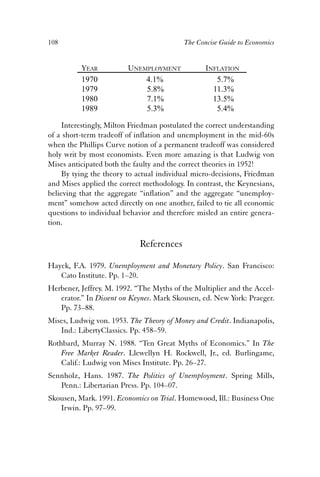
the one who would have made the purchase from Investor B if Investor 
A had no superior knowledge on which to act, could have legitimately 
been the one to make the quick $20 profit. 
But we must ask: Why is C’s ignorance a legitimate means of earning 
profits but A’s knowledge an illegitimate one? This boils down to scorn-ing 
the knowledgeable for being knowledgeable and elevating the igno-rant 
for being ignorant—hardly a desirable trait for social well-being. 
Besides, the very act of traders making stock purchases on the basis 
of their insider knowledge trading helps to reveal to the world, through 
45
46 The Concise Guide to Economics 
the higher stock prices, that these stocks are currently undervalued. 
Thus, economic information is actually spread through markets more 
quickly when insider trading occurs than when it is effectively outlawed. 
And every economic theory I’m aware of says more information sooner 
is better than less information later. 
There’s a rule of thumb popular among investment advisors which 
says the amateur investor should not buy individual stocks because indi-vidual 
stock investing is a full-time job; likewise one should realize when 
undertaking stock investments that there are bound to be people with 
more knowledge than he has about the prospects of future stock values. 
Insider trading is a victimless crime, and its prohibition should be 
viewed as nothing more than a welfare program for SEC lawyers. This 
becomes all the more obvious when it is realized that “insider trading” is 
not even defined in the laws. It is in fact so vague that it could be used 
against virtually any investor. 
The one type of insider trading which can legitimately be regarded 
as wrong is where someone uses “inside” knowledge in violation of a 
contract or explicit trust. In such cases, civil law ought to apply, with 
damages to those wronged, rather than criminal law with fines paid to 
the U.S. Treasury. 
“OK,” you may be thinking “there really isn’t anything so evil about 
insider trading, and all of the recent legal activity is no better than a witch 
hunt, but why call them heroes?” 
Well as stated (in regard to other alleged scoundrels) in Walter 
Block’s, Defending the Undefendable: 
others are generally allowed to go about their business unmo-lested, 
and indeed earn respect and prestige . . . [but] not so 
these scapegoats; for not only are their economic services 
unrecognized, but they face the universal bile, scorn and 
wrath of virtually [all] . . . plus the additional restrictions and 
prohibitions of governments. . . . They are heroes indeed; 
made so by their unjust treatment at the hands of society. 
(Foreword, pp. 6–7) 
Further, since they act on a legitimate, but unacknowledged right, 
they help secure the liberties of all, while more timid souls shrink from 
the battle. Inside traders should be granted the respect they truly do 
deserve.
Basics and Applications 47 
References 
Block, Walter. 1976. “Foreword.” Defending the Undefendable. New York: 
Fleet Press. 
Fischel, Daniel. 1995. Payback: The Conspiracy to Destroy Michael Milken 
and His Financial Revolution. New York: HarperCollins. Pp. 40–68, 
301. 
Frantz, Douglas. 1987. Levine and Co.: Wall Street’s Insider Trading Scan-dal. 
New York: Henry Holt. Pp. 54–55, 219–21. 
Levine, Dennis B. 1991. Inside Out, An Insider’s Account of Wall Street. 
New York: G.P. Putnam’s Sons. Pp. 124–25. 
Rockwell, Llewellyn H., Jr. 1990. “Michael R. Milken: Political Prisoner.” 
In The Economics of Liberty. Llewellyn H. Rockwell, Jr., ed. Auburn, 
Ala.: Ludwig von Mises Institute. Pp. 70–72. 
Taylor, John. 1987. Storming the Magic Kingdom. New York: Alfred A. 
Knopf. Pp. 243–48.
16 
Owners vs. Managers 
In the relentless attack on economic freedom waged by statists, the 
modern corporation has been targeted for scorn. The perfectly valid 
theory that a profit-maximizing firm will generate efficient produc-tion 
for consumers has been turned into a “judo” argument against the 
free market. This theory states that the old nineteenth century firm was 
an efficient producer since the owner (who wanted to maximize his prof-its) 
was one in the same with the manager (who made actual day-to-day 
decisions). However, today the modern corporation is run by “hired gun” 
managers who are not the owners of the firm and its assets, and thus are 
less interested in profit maximization than in a comfortable existence for 
themselves, while the owners are often passive investors uninvolved in the 
decisions of running the business. 
Thus, according to these critics the firm will not be efficiently man-aged 
for consumer benefit but will result in management taking advan-tage 
of the owners for their (the managers’) personal benefit. From this 
viewpoint the statists argue for regulation and denunciation of the free-market 
process—a process which often results in these large, corporate 
business enterprises.1 
1First, let me acknowledge the dichotomy of interests which does exist between 
the owners and the managers; a dichotomy which also exists even with a single 
owner and a single-employee sized firm. The owner will be diligent in his 
behavior, whereas the employee does gain personal benefits from slacking. Obvi-ously, 
the benefits of having employees outweigh the negatives of having 
employees since we find a world of firms with employees instead of one-man 
enterprises. 
49
50 The Concise Guide to Economics 
The free market has inherent remedies for such ill-behavior on the 
part of the “hired-gun” managers. At least four offsetting influences will 
tend to mitigate the dichotomy of interests: 
First, any abused passive investor can always sell his share of stock in 
such a corporation. While this will not save the investor from past per-sonal 
losses he can at least extricate himself from the abuse. But if this 
response is widespread, the effect of many small investors selling their 
stock will put downward pressure on the price of the stock. A reduction in 
the price of the stock will surely get the attention of the major investors 
who do involve themselves in the decision making of the corporation— 
the board of directors, if no one else—who can take meaningful action! 
Second, it is very, very common for managers to be paid in stock or 
stock options in a corporation. Thus the managers are owners who will 
benefit from an increase in the stock value—as the passive investors pre-fer— 
and lose the opportunity for gain from a decrease in the stock value; 
a conjoining of interests! 
Third, who would the board of directors—as owners interested in 
profit-maximization—choose to manage their corporate assets? A “natu-ral 
selection” process will occur in the market as those managers who 
have shown their determination and ability to create profits will be pro-moted 
to the pinnacles of corporate management, while those more 
interested in personal comfort at the expense of the stockholders will be 
passed over. 
Admittedly, none of these three listed influences will totally over-come 
the dichotomy of interests problem, but as usual, the free market 
inherently has appropriate motives for efficiency. The final solution to 
any remaining negatives can be and is overcome by the effects of corpo-rate 
raiders. Corporate raiders—the misanalyzed and underappreciated 
cleansing acid of the corporate community—can be relied on to serve the 
interests of consumers and efficiency. 
Any poorly managed firm will, to that degree, be ripe for a buyout by 
those specializing in profiting from the spread between the actual and the 
potential value of a firm’s assets. Corporate raiders will approach current 
owners of undervalued assets with the offer of a better price in order for 
the corporate raider to reap the profits available from a change in man-agement 
of those assets. A well-managed firm—one whose potential 
stock value and actual stock value are already in line—will be passed over 
as a target of a buyout.
Basics and Applications 51 
The problem of owners versus managers is therefore most acute 
when there is no marketable stock share as in citizens’ “ownership” of 
government enterprises. Rather than agonizing over for-profit corpora-tion 
management, the theorists of management’s abuse of owners should 
instead direct their attention to government enterprises. 
References 
Fischel, Daniel. 1995. Payback: The Conspiracy to Destroy Michael Milken 
and his Financial Revolution. New York: HarperCollins. Pp. 9–39. 
Friedman, Milton. 1977. From Galbraith to Economic Freedom. West Sus-sex, 
U.K.: Institute of Economic Affairs. Pp. 16–29. 
Hoppe, Hans-Hermann. 1988. “Why Socialism Must Fail.” In The Free 
Market Reader. Llewellyn H. Rockwell, Jr., ed. Burlingame, Calif.: 
Ludwig von Mises Institute. Pp. 244–49. 
Mises, Ludwig von. 1969. Bureaucracy. New Rochelle, N.Y.: Arlington 
House. Pp. 40–53. 
Rothbard, Murray N. 2004. Man, Economy, and State with Power and 
Market. Auburn, Ala.: Ludwig von Mises Institute. Pp. 564–66; 1970. 
Man, Economy, and State. Los Angeles: Nash. Pp. 508–09. 
Taylor, John. 1987. Storming the Magic Kingdom. New York: Alfred A. 
Knopf. Pp. 243–48.
17 
Market vs. Government 
Provision of Goods 
It’s often heard that government is not as efficient as business. This is 
not a knee-jerk ideological reaction. It is grounded in the real differ-ences 
of the incentives facing government and private enterprises. 
In the market, a private enterprise is dependent on the flow of con-sumer 
dollars into the organization for its success. Thus a tight link exists 
between consumer satisfaction and business success. In contrast, a gov-ernment 
enterprise has a second source of income available to it—tax 
revenues. With an alternate source of income to support it, a government 
enterprise will necessarily have a lesser incentive in serving consumers. 
Realize, this is not a matter of good people in management of private 
enterprises and bad people in management of government enterprises, 
but a different incentive structure in the two arenas. 
Most people attempt to please their bosses on the job as a means of 
generating an income. Winning the lottery often reveals the employee’s 
true underlying attitude toward working at the behest of the boss. Gov-ernment 
enterprises have won the lottery, so to speak, and thus treat the 
consumer not as the end all and be all for the organization but as a nui-sance 
interfering in the peace and tranquility of the day. Additionally, 
many government enterprises hold a legal monopoly relieving them of 
the fear of loss of customers to rivals, unlike private businesses in a free 
market. 
An easy example to illustrate these points is the U.S. Postal monop-oly. 
With tax dollars available to make up for any shortfalls from con-sumer- 
derived revenues, the Postal Service can afford to treat its cus-tomers 
as an unwanted interference. The Postal Service is notorious for 
its lack of innovations. For instance, while private enterprises in the free 
53
54 The Concise Guide to Economics 
market offer customers bags in which to secure their purchases (even in 
the case of minimally priced purchases) the Postal Service does not 
bother to stock and offer bags to its customers regardless of the value of 
what they buy. 
Advertisements in your Sunday newspaper will typically offer return 
address labels with a more expensive peel off option as well as a cheaper 
lick and stick option. Until quite recently, stamps were lick and stick only. 
Why should the Postal Service go to such trouble when the taxpayers 
make up losses and it is illegal for others to deliver first class mail? 
Federal Express began offering urgent overnight delivery years 
before the Postal Service. Why should the Postal Service take chances on 
such innovations which may or may not pan out? 
Fast food restaurants, banks, dry cleaners, liquor stores, and other 
businesses offer drive-thru service. But again, why should the Postal Ser-vice 
take chances on such innovations which may or may not succeed? 
(The latest example of the lethargic Postal Service following the lead of 
the innovative private sector is in the form of Postal Stores imitating 
express mail service companies.) 
But, the grand example which clearly illustrates these differences is 
late fall with the approach of the Christmas buying season. While busi-nesses 
take out ads virtually begging customers to shop with them—even 
late in the season—the Postal Service is haranguing the hapless public to 
“mail early!” In effect, what the Postal Service is spending money to do 
is to tell their potential customers not to bring their damned Christmas 
cards in for delivery at an inconvenient time. Customer satisfaction takes 
a back seat to the convenience of the Postal organization. 
A summary statement concerning market provision of goods is the 
well-known phrase, “the customer is always right.” Notice there is no 
such similar phrase “the voter is always right,” or “the taxpayer is always 
right” in describing the attitude of government enterprises. 
A further approach to these issues can be delineated as five signifi-cant 
differences between the two means of providing for consumers. 
First, the market provision of goods is based on a voluntary relationship 
between firm and customer. Government provision of goods is based on 
a coerced relationship between enterprise and customer. This difference 
alone is all the difference in the world as far as consumer satisfaction is 
concerned. It is the difference between employment and slavery, charity 
and robbery, seduction and rape.
Basics and Applications 55 
Second, in the market there is proportional representation; that is, 
consumers get the goods they “vote” for in proportion to their “votes.” If 
10 percent demand green cars then 10 percent will get green cars. With 
government provision it is a winner takes all deal; either we all have the 
Social Security program or none of us has it, regardless of our prefer-ences. 
Third, in the market there are small individual choices. Just because 
you buy a Sears refrigerator does not mean you then have to buy a Sears 
washer and dryer and TV, etc. With government provision, there is a 
package deal arrangement. Mixing and matching is unavailable with 
government provision of goods. It’s either the Democrat’s policies on 
taxes, the environment, and foreign policy or it’s the Republican’s poli-cies 
on these issues. 
Fourth, choice in the market is continual. One can replace unsatis-factory 
goods at any time. Tired of the car you thought would be so great? 
Sell it and get a different model. No longer happy with your detergent, 
buy a different brand. Realize the first brand was good after all? Re-replace 
it at your discretion. Now compare this to government. Want to 
drop out of the Social Security program—go to jail. Tired of the presi-dent. 
Four more years. 
And fifth, a private firm is held liable for damages to those it may 
harm. Suing companies for compensation is the norm. Government 
enterprises often enjoy “sovereign immunity,” placing them above 
reproach (an ill carried forward to America from the European theory 
that the king could do no wrong). Government enterprises can and do 
wreak havoc with people’s lives without suffering any financial conse-quences. 
In a real sense it is dangerous to have government enterprises 
providing consumer goods since an absence of potential liability will 
result in a reduced emphasis on safety. Private firms facing potential lia-bilities 
for their damages have a financial incentive to be safe. 
Yet another reason to conclude market provision will be superior to 
government provision of goods for consumers is that in the case of gov-ernment 
enterprise there is no ownership of the resources of the enter-prise. 
(As noted in the last chapter, citizens’ ownership of their govern-ment’s 
assets is a pale form of ownership at the very best.) Government 
managers are temporary with no stake in the assest value of such enter-prises. 
(This is very much like the fact that rented autos are typically 
driven harder than autos owned by the driver, but fortunately, there is an
56 The Concise Guide to Economics 
actual owner—the car rental company which will exercise some care in 
preserving the asset value of the auto.) 
References 
Friedman, Milton. 1977. From Galbraith to Economic Freedom. West Sus-sex, 
U.K.: Institute of Economic Affairs. 
McConnell, Campbell R. 1996. Economics. 13th Ed. New York: 
McGraw-Hill. Pp. 622–25. 
Mises, Ludwig von. 1969. Bureaucracy. New Rochelle, N.Y.: Arlington 
House. Pp. 40–53. 
——. 1966. Human Action. Chicago: Henry Regnery. Pp. 303–11; 1998. 
Scholar’s Edition. Auburn, Ala.: Ludwig von Mises Institute. Pp. 
300–07. 
Rockwell, Llewellyn H., Jr. 1990. “Why Bureaucracy Must Fail.” In The 
Economics of Liberty. Llewellyn H. Rockwell, Jr., ed. Auburn, Ala.: 
Ludwig von Mises Institute. Pp. 119–23. 
Rothbard, Murray N. 1974. Egalitarianism as a Revolt Against Nature. 
Washington, D.C.: New Libertarian Review Press. Pp. 81–87; 2000 
Auburn, Ala.: Ludwig von Mises Institute. Pp. 133–43.
18 
Market vs. Command Economy 
There are two polar opposite approaches to an economy’s opera-tion. 
The command economy is the top-down, centrally-planned 
economy of socialism. The market economy is the 
decentralized economy of the free market. The most fundamental dis-tinction 
between the two is the existence of private property in the free 
market and the absence of private property in the command economy. 
The alleged virtue of the command economy is that it is planned in 
contrast to the unplanned-market economy. The error in this view is that 
the market economy is actually very rationally planned by means of con-sumer 
demand through the price system. Additionally, the command 
economy will be deficient for four basic reasons. 
First, an attempt to plan an entire economy by a central committee is 
bound to be inefficient just because the task is so large. There is no way 
that a committee of say, 300 planners can know the needs, conditions of 
resource availability, and localized knowledge spread throughout an 
economy. 
Second, the command economy ultimately rests on coercion as its 
means of motivation. Socialists will typically claim that resorting to coer-cion 
(the Berlin Wall, Russian gulags, etc.) is not part of their system, but 
only an unfortunate bad choice in political leaders and that socialism 
only attempts to control the economy, not people’s individual lives. But, 
of course the main element in an economic system is in fact people; 
therefore controlling an economy is first and foremost control of peo-ple— 
the Berlin Wall was no peculiar misfortune. Suffice it to say further 
that human motivation is diminished when coerced. 
Third, the command economy is a collectivized system. All work for 
the benefit of their quotal share of total production. Individual incentives 
57
58 The Concise Guide to Economics 
are absent. As an example, with 100 workers in an economy each will 
receive 1/100 of total production. If one worker shirks, his loss is only 
1/100 of the production he otherwise would have generated. (Imagine 
the incentives when this system is broadened to a nation of 200 million!) 
Each ends up attempting to live at the expense of others and total pro-duction 
plummets. 
And fourth, the incentive of production is to please the political 
authorities who have life and death control over the workers. In contrast 
to the market, where production is predicated on consumer demand, the 
consumer is the forgotten being in a command economy. 
References 
Barron, John. 1980. Mig Pilot. New York: McGraw-Hill. 
Friedman, Milton, and Rose Friedman. 1979. Free to Choose. New York: 
Harcourt Brace Jovanovich. Pp. 9–37, 54–69. 
Hayek, F.A. 1988. The Fatal Conceit. Chicago: University of Chicago 
Press. 
Rand, Ayn. 1957. Atlas Shrugged. New York: Random House. Pp. 660–70. 
Roberts, Paul Craig, and Karen LaFollette. 1990. Meltdown: Inside the 
Soviet Economy. Washington, D.C.: Cato Institute. 
Steele, David Ramsay. 1992. From Marx to Mises. LaSalle, Ill.: Open 
Court. Pp. 255–94.
19 
Free Trade vs. Protectionism 
Economists of all schools recognize the value of free trade: greater 
overall production. This greater production is due to the freedom 
of each producer to specialize in that line where he or she has a 
natural advantage. The natural advantage of each trading partner results 
from the differences among people and locations. A major reason the 
U.S. economy is as productive as it is, is that there is a large geographic 
area of free trade (the U.S. Constitution wisely prohibits protectionist tar-iffs 
and quotas among the various states). 
Adam Smith enunciated the principle that it is foolish to produce at 
home that which can be obtained more cheaply abroad. This is true not 
only literally of the home, but of the city, county, state, region, and coun-try 
as well. 
This emphasizes that there is no distinction between trade and inter-national 
trade in principle—one “exports” his labor to “import” goods 
consumed, as it is a cheaper means of obtaining goods than producing 
the consumed goods directly. 
Despite the value of free trade there are continuous calls for disrup-tion 
of an international division of labor by way of taxes on imports (tar-iffs) 
and numerical limitations on imports (quotas). Such arguments are 
ultimately special-interest pleadings advanced for the sake of a transfer of 
income to the special interest at the expense of the rest of the economy. 
Henry George summarized the fallacy of protectionism this way: 
“What protection teaches us, is to do to ourselves in time of peace what 
enemies seek to do to us in time of war.” 
A review of the seven most common protectionist arguments and 
their rebuttals follows: 
59
60 The Concise Guide to Economics 
Military Self-Sufficiency 
This argument claims that some vital military goods may be unavailable 
from other countries in time of war and therefore a viable domestic 
industry is necessary for defense. A true concern with such a scenario, 
however, can be dealt with by means of stockpiling the needed goods. 
Such a stockpiling program would leave the consumer still free to shop 
the world and not disrupt the international division of labor. One must 
be suspicious of many such arguments when those making the argu-ments 
are the very firms supplying those goods. Examples in recent U.S. 
experience include even wool socks and steel—goods with easy substi-tutes 
and existing viable U.S. production. 
Further, a program of reducing taxes and regulations would allow 
continued viable U.S. production. As is so often the case, any concerns 
should recognize the violence done to the U.S. economy by current poli-cies 
and the fact that it is economically more efficient and just to reduce, 
not compound government interference in the market. 
Protection of Domestic Industry 
The fallacy of such claims is that the protection of any U.S. industry is to 
that same extent a detriment to other U.S. industries. Protectionism 
against steel imports, for example, harms American firms which use steel 
as an input in their production process—automakers, washing machine 
manufacturers, all firm’s transportation expenses, etc. 
Employment Protection 
As Milton Friedman has stated, “we work to live, we do not live to work.” 
The concern should be with our production, not its means—employment. 
Tariffs and quotas to protect American employment reduce our standard 
of living as we engage in lines of production that are not the most efficient 
in providing for ourselves. The move to free trade which would reconfig-ure 
employment patterns in the U.S. would not be necessary except for the 
artificial pattern currently existing due to those tariffs and quotas. In other 
words, the loss of employment in certain lines of work which would unde-niably 
occur with a movement to free trade are due to the current absence
Basics and Applications 61 
of free trade. These particular jobs would not have been created in the U.S. 
if policy had been one of free trade in the first place. 
Diversification for Stability 
Though this argument has little application to the U.S. economy, it is 
often used for a country such as Chile, which is heavily dependent on 
copper exports. The fallacy is that Chile has a strong advantage in cop-per 
production and to forcibly diversify would be to pay dearly in oppor-tunity 
costs. Individual entrepreneurs should make these decisions 
according to their own assessments.1 
Infant Industry 
Again this is not a currently fashionable argument for modern day Amer-ica. 
But the basic notion of protecting new industries competing with 
established foreign firms until they can “mature” and compete toe-to-toe 
is still false. In effect, this suggests the substitution of government officials’ 
judgment for that of private investors. A truly viable firm can find investors 
who will be willing to absorb losses—as a form of investment—for the 
sake of the future profits to be earned. This is in fact routine in the market 
as most new businesses or products earn losses in the early stages yet 
investors still see merit in such investments. The fact that such firms are 
not currently successful in attracting investors voluntarily is strong evi-dence 
that there are no future profits to be earned. Whose judgment would 
be superior: private investors with their own money to lose or government 
officials with no personal financial stake in the outcome? If in fact this was 
a truly valid argument for protectionism, it would logically be applicable 
not just to domestic firms competing with established foreign firms but to 
domestic firms competing with established domestic firms—a special tax 
on United for the sake of newcomer AirTran, for example? 
1On an individual basis this may be like cautioning a surgeon to find other 
means of making a living. While this would offer protection against the risks of 
being unable to perform as a surgeon the lost income in pursuing training as a 
lawyer would be vast.
62 The Concise Guide to Economics 
Dumping 
There are two versions of dumping. The first is selling products abroad 
at lower prices than at home. But this is to be expected. Buyers are nor-mally 
more loyal to domestically produced goods (all other things held 
constant of course) than to foreign made goods. The only way to success-fully 
sell to foreigners is therefore with price concessions. (Because of this 
loyalty factor, it would be strange if dumping was not the norm.) 
A second version of dumping is a subsidy to firms to sell abroad. Nat-urally, 
American firms complain about such practices by other nations. 
(And this is not to say that American firms receive no such subsidies—as 
it is common for special interests to use the power of government for their 
own financial gain.) If other countries do subsidize their sales in the U.S. 
then they are making a gift to American consumers. While this is not 
wise for the sake of the economy doing the subsidizing, it is not right to 
correct the situation by punishing the American consumer with tariffs 
and quotas. A consistent application of a prohibition of gifts would pro-hibit 
samples! The analogy often cited in other countries resorting to this 
form of dumping is to consider each economy to be a man in a lifeboat. 
The lifeboat is the overall standard of living in the world. If one person 
in the lifeboat foolishly takes out a gun and fires a hole into the bottom 
of the boat, the last thing others should do is to retaliate likewise with 
additional blasts to the boat bottom! Compounding mistakes is not a 
solution. 
Cheap Foreign Labor 
This argument claims that American workers should not have to com-pete 
unfairly with low paid foreigners. (Everyone comes up with some 
reason to exempt themselves from free competition; low paid foreign 
workers claim it is unfair for them to have to compete with high skilled 
American workers!) As do all protectionist arguments this one violates 
the principle of not producing at home that which can be obtained more 
cheaply abroad. Besides this self-interest argument against protection-ism, 
it is anything but humane to call for sacrificing the living conditions 
of already poor foreigners to that of relatively very wealthy American 
workers.
Basics and Applications 63 
References 
Bovard, James. 1991. The Fair Trade Fraud. New York: St. Martin’s Press. 
Ebeling, Richard, and Jacob Hornberger, eds. 1995. The Case for Free 
Trade and Open Immigration. Fairfax, Va.: Future of Freedom Foun-dation. 
Friedman, Milton. 1983. Bright Promises, Dismal Performance. New York: 
Harcourt Brace Jovanovich. Pp. 357–72. 
Friedman, Milton, and Rose Friedman. 1979. Free to Choose. New York: 
Harcourt Brace Jovanovich. Pp. 38–54. 
Roberts, Russell D. 1994. The Choice. Englewood Cliffs, N.J.: Prentice 
Hall. 
Taylor, Joan Kennedy, ed. 1986. Free Trade: The Necessary Foundation for 
World Peace. Irvington-on-Hudson, N.Y.: Foundation for Economic 
Education.
MONEY AND BANKING 
20 
Money 
As did language and customs, money evolved—evolved from the 
process of trade in barter (trading goods directly for goods). It 
did not arise via vote or social contract or government decree. 
(This last statement may seem in conflict with the current experience 
wherein fiat money—money by government decree—is the norm. Is this 
not an exception to money arising from a good in trade? No. The bril-liant 
“regression theorem” of Ludwig von Mises demonstrates the origi-nal 
truth: If one regresses through the history of our money it can be seen 
that the value of our fiat money is based upon the commodity value of 
gold. The U.S. dollar was severed from gold in the international arena in 
1971 and in the domestic arena in 1933. Prior to these dates U.S. dollars 
were redeemable in gold at $35 and $20 to the ounce, respectively. With-out 
the experience of full gold redeemability a paper dollar could never 
have become a money.) 
Barter however, had the problem of a double coincidence of wants— 
each party to the trade must have and be willing to trade for that which 
the other party has and is willing to trade. As barter proceeded it was dis-covered 
by the traders themselves that certain goods were more readily 
accepted in trade than other goods, thus making those more readily 
accepted goods even more readily accepted in trade. A snowball effect 
took place. As this good became a standard in trade because of its wide-spread 
acceptance the problem of a double coincidence of wants was 
solved as money became half of all trades. Having a money—a medium 
of exchange—facilitated trade and complex business arrangements. 
Effectively, this means money is important for human progress compara-ble 
to the wheel and fire. 
65
66 The Concise Guide to Economics 
Money makes possible comparisons of value—a shirt can be bought 
for one gram of gold, and a camera for five grams of gold, for instance. 
Having a common denominator measure of value engendered profit and 
loss assessment; without money one would have to list the entire period’s 
exchanges under barter resulting in a huge array of exchanges with no 
common value. Lastly, money serves as a store of value, carrying value 
comparisons over time, lengthening the time horizon available in carry-ing 
out productive work. Notice that to the degree an economy suffers 
from inflation, money is a poorer gauge, distorting value comparisons, 
undermining it as a store of value and ultimately—during hyperinfla-tion— 
failing as the medium of exchange as traders revert to a barter rela-tionship. 
References 
Mises, Ludwig von. 1966. Human Action. Chicago: Henry Regnery. Pp. 
408–12; 1998. Scholar’s Edition. Auburn, Ala.: Ludwig von Mises 
Institute. Pp. 405–09. 
Paul, Ron. 1983. Ten Myths About Paper Money. Lake Jackson, Tex.: Foun-dation 
for Rational Economics and Education. 
Rand, Ayn. 1957. Atlas Shrugged. New York: Random House. Pp. 410–15. 
Rothbard, Murray N. 2004. Man, Economy, and State with Power and 
Market. Auburn, Ala.: Ludwig von Mises Institute. Pp. 268–76; 1970. 
Man, Economy, and State. Los Angeles: Nash. Pp. 231–37. 
——. 1990. What Has Government Done to Our Money? Auburn, Ala.: 
Praxeology Press. Pp. 15–63; 2005. What Has Government Done to 
Our Money? and The Case for a 100 Percent Gold Dollar. 5th Ed. 
Auburn, Ala.: Ludwig von Mises Institute. Pp. 23–61. 
Sutton, Anthony. 1977. The War on Gold. Seal Beach, Calif.: ’76 Press.
21 
Inflation 
Inflation results from an increase in the money supply. The tradi-tional 
definition is “a rise in the general price level,” but this is actu-ally 
an effect, not the cause. Most economists have given up trying to 
explain the difference in common discussion, partly because most people 
see the world through “Keynesian-colored glasses.” Keynesian theory 
says there can’t be inflation caused by an increase in the money supply 
(or from any other cause other than supply shocks reducing total supply) 
at the same time that there is unemployment. Any increase in the money 
supply, they say, will not cause inflation—it will just put people to work, 
not cause prices to go up. 
The theory of inflation as an increase in the money supply, causing 
prices to go up, is consistent with basic supply and demand analysis. 
When there is an increase in the supply of a good, the value of each unit 
has got to go down. It is consistent with the law of diminishing marginal 
utility. It is consistent with our history—inflation in the United States 
has occurred at the same time that the money supply has increased (like-wise 
in other countries). 
A point that has been grossly underemphasized in economic theory 
is that people steal through the money system, and inflation is a means 
of doing that—by creating more new money, the value of everyone’s 
existing money is undermined to the benefit of those receiving the newly 
created money. These would be the Federal Reserve first, then the banks, 
the government when it borrows the money from them, and so on down 
the line to the point where the dollar is worth much less when it gets to 
the average citizen. Inflation, then, is a result of special interest influence. 
Stealing through the money supply is done today through the eso-teric 
Federal Reserve System’s open market purchases and fractional 
67
68 The Concise Guide to Economics 
reserve banking. (The third way of stealing through the money supply is 
appropriately illegal—counterfeiting—but is in principle no different.) 
Thus Keynes’s famous quote of Lenin is entirely correct: 
Lenin was certainly right. There is no subtler, nor surer 
means of overturning the existing basis of society than to 
debauch the currency. The process engages all the hidden 
forces of economic law on the side of destruction, and does it 
in a manner which not one man in a million is able to diag-nose. 
The Federal Reserve’s modern method of stealing through the 
money system is the parallel to the less sophisticated earlier means. The 
two primary former means were coin clipping and debasement. Coin 
clipping was the practice of filing the outer edge off a gold or silver coin 
and passing it on as if it still contained its full face value weight while 
keeping the filings as an ill-gotten gain. Mill marks on coins (tread on the 
outer edge) were used as protection against such stealing. Debasement is 
passing on a coin with all of the same look of a full weight of precious 
metal but with a cheaper base metal in place of the valuable precious 
metal. As can readily be verified, current U.S. coinage (properly called 
“tokens” not coins) has been totally devalued—the silver in a pre-1965 
quarter is worth more than 1/4 of a dollar, and the zinc and copper in a 
post-1964 quarter is worth less than 1/4 of a dollar. These “coins” are 
made of cheap metals such as zinc and copper and the mill marks are 
there only out of nostalgia or attempted deceit! 
The effect of this increase in the money supply is an increase in 
prices in general, but this is not the most troublesome effect of inflation. 
More problematic is the effect on morality as people realize hard work 
and saving are self-defeating, and the generation of the boom-bust of the 
business cycle due to the distortion of relative prices. 
References 
Alford, Tucker. 1988. “Fiat Paper Money: Tyranny’s Credit Card.” In The 
Free Market Reader. Llewellyn H. Rockwell, Jr., ed. Burlingame, 
Calif.: Ludwig von Mises Institute Pp. 105–08. 
Hazlitt, Henry. 1983. The Inflation Crisis and How to Resolve It. Lanham, 
Md.: University Press of America. Pp. 138–43.
Money and Banking 69 
Katz, Howard. 1976. The Paper Aristocracy. New York: Books in Focus. 
Pp. 5–60. 
Maybury, Richard J. 1989. Whatever Happened to Penny Candy? Plac-erville, 
Calif.: Bluestocking Press. 
Mises, Ludwig von. 1979. Economic Policy. South Bend, Ind.: 
Regnery/Gateway. Pp. 55–74; 2006. 3rd Ed. Auburn, Ala.: Ludwig 
von Mises Institute. Pp. 55–74. 
Rothbard, Murray N. 1990. What Has Government Done to Our Money? 
Auburn, Ala.: Ludwig von Mises Institute. Pp. 38–44; 2005. What 
Has Government Done to Our Money? and the Case for a 100 Percent 
Gold Dollar. Auburn, Ala.: Ludwig von Mises Institute. Pp. 46–52.
22 
The Gold Standard 
Anumber of different goods have been used as money across the 
globe and human history—sea shells, cows, cigarettes, beer, cab-bage, 
tobacco, beads, etc.—but the most commonly used money 
has been the precious metals of gold and silver. Such goods arose as a 
money not by democratic election or government fiat but by the free 
interaction of consumers in the market. 
Money serves as a medium of exchange facilitating trade, a meas-ure 
of value and as a store of value. The qualities that made gold and 
silver the first choice in money over the numerous others are inherent 
in the precious metals and is comparable to using cotton for shirts and 
ceramics for coffee cups. Just as cotton has the qualities which make it 
a good material for shirts—light weight, breathability, washability, 
etc.—and ceramic has the qualities which make it a good material for 
coffee mugs—insulation, nonleaking, etc.—gold is a good material for 
money. 
Gold has four qualities in the right combination to be money. These 
qualities are: durability—a 100-year-old coin is still recognizable and 
functional as a coin; widespread acceptance—people the world over 
value gold; high value per unit—one ounce of gold is worth about $690 
today; and divisibility—cutting an ounce of gold in half results in two 
fully 1/2 ounces of gold. Other goods which have been used as money do 
not have the same mix of appropriate qualities as does gold. Thus, gold 
as money is all quite rational, logical, and reasonable in contrast to John 
Maynard Keynes’s famous edict that “gold is a barbarous relic.” 
Ironically, it was the former chairman of the Federal Reserve System, 
Alan Greenspan, who enunciated the correct view on the animosity 
toward gold in Capitalism: The Unknown Ideal: 
71
72 The Concise Guide to Economics 
An almost hysterical antagonism toward the gold standard is 
one issue which unites statists of all persuasions. They seem 
to sense—perhaps more clearly and subtly than many consis-tent 
defenders of laissez-faire—that gold and economic free-dom 
are inseparable, that the gold standard is an instrument 
of laissez-faire and that each implies and requires the other. 
(p. 96) 
One of the claims against a gold standard money—currency units 
denominated in a weight of gold with gold coins circulating and paper 
currency fully redeemable upon demand—is that it is silly to mine gold 
from the earth only to rebury much of it in bank vaults and incur signif-icant 
costs in the process—unfortunately, Milton Friedman is in this 
camp. These critics claim that it would be much less expensive to just 
establish a pure paper money standard. While this claim is true as stated, 
it does not recognize the costs that are generated. A gold standard puts a 
check on the creation of money since all paper and credit must be 
redeemable in actual gold bullion or coin. The problem with a paper 
money standard is that there is no way to stop the creation of ever greater 
quantities of money once the authority to do so is granted. 
As an analogy, it could be claimed that it is silly to go to all of the 
trouble and expense of making locks out of hard metal when paper locks 
would be cheaper! But of course the reason for metal locks is that thieves 
would not be deterred by the paper locks and refrain from theft. Nor will 
those in authority of money creation refrain from the theft inherent in 
additional paper money creation. Contrary to the notion that unlike a 
paper money supply, gold cannot be readily created in mass quantities 
and therefore is undesirable, this in fact is one of the major virtues of 
gold! 
In a choice between the integrity of politicians and the stability of 
gold, George Bernard Shaw is reported to have advised: “With all due 
respect to those gentlemen, I advise the voter to vote for gold.” 
Yet another ridiculous claim against gold is that the price of gold is 
too volatile—having run up from $70 in the early 1970s to $850 in 1980 
and now selling in 2007 at $690. But this line of analysis exactly reverses 
the true cause and effect. Gold in terms of paper dollars soared in the late 
1970s due to the growing distrust in the paper money when inflation hit 
double-digits. With the disinflation of the 1980s fears subsided and the 
price of gold declined. Gold is seen as the safe haven, the hedge against
Money and Banking 73 
inflation. The actual volatility was in the confidence of the paper dollar; 
the price of gold in terms of those dollars was an effect. 
An additional commonly cited claim against gold as money is that our 
economy would be at the mercy of the world’s major gold producers— 
Russia and South Africa. What this argument conveniently overlooks is 
that the annual production of these two countries is tiny compared to the 
existing stock of gold. Additionally, it is costly to mine gold and will be 
done only if the price is high enough to warrant the costs. But increasing 
production of gold reduces the price, thereby undermining the intended 
outcome of a country hell-bent on overproduction. However, for the sake 
of argument, let’s assume both countries do engage in mass production to 
whatever degree possible and “flood” the world with gold. Is this some-thing 
to be upset about? After all, gold is a valuable commodity in indus-try 
and for consumers—would this be such a tragedy? I’ll worry about 
this in the same way I lose sleep worrying that Russia may sacrifice itself 
by massively producing oil or wheat thereby reducing my cost of driving 
and eating! 
One last claim against gold is that there just is not enough gold to 
reestablish the U.S. dollar’s redeemability. It is true that the number of 
paper and credit dollars created has been so vast that there is not enough 
gold to redeem dollars at the original rate of $20 to the ounce. But, we can 
recognize reality and reestablish the dollar at an appropriate rate of 
approximately $2,000 to the ounce. Murray N. Rothbard has proposed 
just such a program in The Mystery of Banking: 
1. That the dollar be defined as 1/1696 gold ounce. 
2. That the Fed take the gold out of Fort Knox and the other Trea-sury 
depositories, and that the gold then be used (a) to redeem 
outright all Federal Reserve Notes, and (b) to be given to the 
commercial banks, liquidating in return all their deposit 
accounts at the Fed. . . . I propose that the most convenient def-inition 
is one that will enable us, at one and the same time as 
returning to a gold standard, to denationalize gold and to abol-ish 
the Federal Reserve System. (pp. 264–65)
74 The Concise Guide to Economics 
References 
Greenspan, Alan. 1967. “Gold and Economic Freedom.” In Capitalism: 
The Unknown Ideal. Ayn Rand, ed. New York: New American 
Library. Pp. 96–101. 
Hazlitt, Henry. 1959. The Failure of the New Economics. New Rochelle, 
N.Y.: Arlington House. Pp. 153–55; 2007. Reprinted by the Ludwig 
von Mises Institute. 
Katz, Howard. 1976. The Paper Aristocracy. New York: Books in Focus. 
Pp. 5–18. 
Paul, Ron. 1982. The Case for Gold. Washington, D.C.: Cato Institute. 
Rockwell, Llewellyn, H., Jr., ed. 1985. The Gold Standard. Lexington, 
Mass.: D.C. Heath. 
Rothbard, Murray N. 1983. The Mystery of Banking. New York: Richard-son 
and Snyder. Pp. 263–69.
23 
The Federal Reserve System 
The Federal Reserve is the third central banking system in U.S. 
history. The first two, called the First Bank of the United States 
and the Second Bank of the United States, were chartered for the 
periods of 1792–1812 and 1816–1836, respectively. 
The bank panic of 1907 motivated the major banking interests to 
assure that such difficulties would not plague them in the future. In 1910 
a group of such bankers, pretending to be on a duck hunting trip to Jekyll 
Island, Georgia, designed the future central bank. After supporting the 
banking bill they had designed, it was defeated in Congress by suspicious 
rural and midwestern Congressmen. So biding their time, they had the 
bill reintroduced—with a different title but now with their feigned oppo-sition. 
In 1913, while many members of Congress were on Christmas 
break, the remaining “in’s” passed the Federal Reserve Act and rushed it 
over for Woodrow Wilson’s signature on December 23. Although the Fed 
was established by an act of Congress it is a privately owned—by banks 
in the twelve districts—organization which can be found in the white 
pages of your phone book. 
The Federal Reserve System thus had its origin in underhanded 
dealings at the behest of the special interests of bankers. The point of the 
Fed was to authorize a central bank which could generate an elastic 
money supply in times of bankers’s needs. In other words, it allows them 
to create money out of thin air without suffering the consequences of 
another panic or bank run. The Fed was thus created as a cartelizing 
agency for banks the same as the Interstate Commerce Commission 
(ICC) was for railroads, and the Civil Aeronautics Board (CAB) for air-lines. 
In addition, the Fed is an outlet for the sale of government bonds— 
government debt—and thus facilitates the deficit financing of the federal 
government. 
75
76 The Concise Guide to Economics 
The Fed coordinates the inflationary practices of banks, keeping 
each from the pressures of note redemption which would otherwise keep 
their artificial money creation in check. Since the founding of the Fed in 
1913 the value of the dollar has fallen by more than 95 percent! So much 
for the conventional wisdom alleging that the Fed leads the fight against 
inflation. 
Creation of the Fed should be understood as an important step in a 
number of steps in the undermining of an honest money based on gold. 
Other steps in this process include the legal tender laws; the shift from 
Federal Reserve Notes redeemable in gold, to redeemability in gold or 
lawful money, to redeemability in lawful money only, to no redeemabil-ity 
at all; replacement of all bank notes with Federal Reserve Notes; 
abandonment of the gold standard domestically in 1933; and abandon-ment 
of the gold standard internationally in 1971. Since the Federal 
Reserve Notes in your wallet are not redeemable in gold or anything else, 
it must be asked: In what sense are they notes? A note is a promise to pay. 
The Fed promises to pay nothing more than another promise to pay! 
References 
Paul, Ron. 1982. The Case for Gold. Washington, D.C.: Cato Institute. 
Rockwell, Llewellyn H., Jr., ed. 1993. The Fed. Auburn, Ala.: Ludwig von 
Mises Institute. 
——. 1988. “The Real Secrets of the Temple.” In The Free Market 
Reader. Llewellyn H. Rockwell, Jr., ed. Burlingame, Calif.: Ludwig 
von Mises Institute. Pp. 116–22. 
Rothbard, Murray N. 1994. The Case Against the Fed. Auburn, Ala.: Lud-wig 
von Mises Institute. 
——. 1983. The Mystery of Banking. New York: Richardson and Snyder. 
Schiff, Irwin. 1976. The Biggest Con: How the Government is Fleecing You. 
Camden, Conn.: Freedom Books. Pp. 254–89.
24 
The Business Cycle 
The business cycle is the recurring waves of prosperity and depres-sion 
seen over economic history. Before the modern age of 
advanced industrialism the prosperity could be accounted for by 
events such as good weather yielding bountiful crops or the spoils of war 
from a military victory. Likewise, depression could be accounted for by 
harsh weather resulting in poor crops or from a military defeat. In each 
case the causes were fairly evident. 
The modern business cycle, however, needs a more sophisticated 
explanation as it is a more complex phenomenon. Marxists believed that 
business cycles were the inevitable collapsing of capitalism, but this the-ory 
can be discarded since capitalism has not collapsed though socialism 
has. Keynesians account for the business cycle by an appropriate level of 
spending (prosperity) or underspending (depression) or overspending 
(inflation) but have been baffled by the simultaneous occurrence of both 
inflation and depression—a condition their theory treats as being as 
likely as a square circle. 
The Friedmanite monetarists appropriately look to the money sup-ply 
as the causal factor in the business cycle though they fail to realize the 
ill effects of their favored policy of a slow but steady increase in that 
money supply. (Friedmanites also fail to consider the ethical aspects of 
such artificial increases in the money supply which create involuntary 
transfers of wealth.) 
The correct Austrian theory of the business cycle also focuses on the 
money supply as the causal factor, but does recognize the intervention in 
the economy that an artificial increase in money and credit in fact is. 
Basically, the Austrian theory recognizes that there is some voluntarily 
chosen ratio of consumption to saving by the total of individuals compris-ing 
the economy. 
77
78 The Concise Guide to Economics 
When an artificial increase in the money supply through the banks 
occurs, this increases the available money in savings and depresses the 
interest rate, thereby encouraging an artificial increase in spending which 
is highly sensitive to the interest rate—capital spending. This run-up in 
the capital goods industry is the boom, and the subsequent depression 
results when consumers reestablish their consumption to saving ratio— 
thus revealing that the capital goods boom was indeed artificial. The only 
way to prevent the depression is to pump another dose of new money into 
the system to maintain the higher savings ratio, but eventually this must 
end or there will be a runaway inflation. 
The artificial increase in the money supply therefore is a government 
subsidy—through monetary policy—to the capital goods industry. Nat-urally 
the subsidy stimulates production in the capital goods industry. 
Once that subsidy is removed by consumers reestablishing their preferred 
saving ratio, there is a crash in the capital goods industry. 
The Austrians, in contrast to all other schools of thought, do not 
regard the depression as bad news, for it is the necessary correction to put 
production back in line with consumers’ preferences. This view regards 
the preceding inflation as the ill setting the stage for the needed correc-tion. 
Two analogies follow to clarify this theory: 
Everyone understands that a drug addict will need higher and 
higher doses of his drug to get the same kick. This is comparable to the 
growth in the money supply causing a capital goods industry boom. The 
addict has the choice of increasing his doses of his drug until it kills him 
or of going cold turkey and suffering the withdrawal pains. The with-drawal 
pains are similar to the economy’s depression adjustment. 
Second analogy: If a person ingests poison into his system he will 
need to rid himself of that poison, say through vomiting. It’s obvious that 
the unpleasant vomiting is the necessary cure for the evil of the poison 
ingestion. In this analogy the poison is the inflation and the vomiting the 
depression. 
From the Austrian perspective the cure for the business cycle is a lais-sez- 
faire policy for the money supply, letting the money supply be deter-mined 
by the free choice of individuals in the market. The alternative to 
this Austrian policy is government involvement in money and banking 
which inevitably results in special interest pressure to increase the money 
supply to the benefit of those first receiving the new money—the bank-ing 
system itself.
Money and Banking 79 
References 
Brown, Susan, et al. 1974. The Incredible Bread Machine. San Diego, 
Calif.: World Research. Pp. 30–33. 
Browne, Harry. 1978. New Profits from the Monetary Crisis. New York: 
William Morrow. Pp. 40–52. 
Ebeling, Richard. 1983. The Austrian Theory of the Business Cycle and 
Other Essays. Burlingame, Calif.: Center for Libertarian Studies. 
Mises, Ludwig von. 1978. On the Manipulation of Money and Credit. 
Dobbs Ferry, N.Y.: Free Market Books. Pp. 57–107. 
Rothbard, Murray N. 1972. America’s Great Depression. Los Angeles: 
Nash. Pp. 11–77; 2005. 5th Ed. Auburn, Ala.: Ludwig von Mises 
Institute. Pp. 3–81. 
Skousen, Mark. 1990. The Structure of Production. New York: New York 
University Press.
25 
Black Tuesday 
October 29, 1929 is the day the stock market crashed and is com-monly 
viewed as the day that the Great Depression started. The 
usual explanations for this crash are theories such as overinvest-ment, 
an imbalance in the distribution of income and hence a lack of 
consumption spending, or just a crack-up of the free market. 
The overinvestment theory is not fundamental enough to be mean-ingful— 
one must ask: What caused the overinvestment itself? The 
imbalance of income and lack of consumption spending is not only an 
irrelevancy but also factually incorrect—consumption increased from 73 
percent of GNP in 1925 to 75 percent in 1929. Quoting Rothbard in 
America’s Great Depression: 
If underconsumption were a valid explanation of any crisis, 
there would be depression in the consumer goods industries, 
where surpluses pile up, and at least relative prosperity in the 
producers’ goods industries. Yet, it is generally admitted that 
it is the producers’, not the consumers’ goods industries that 
suffer most during a depression. Underconsumptionism can-not 
explain this phenomenon. . . . Every crisis is marked by 
malinvestment and undersaving, not underconsumption. (p. 
58) 
The failure of the free market is wrong theoretically and historically. 
The U.S. was not a free-market economy; interventions in the economy 
abounded most importantly in the form of a centralized banking system. 
In addition, subsidies, income taxes, regulations, tariffs, and creation of 
money out of thin air by the governmentally established central banking 
system were exceptions to a genuinely free-market economy. 
81
82 The Concise Guide to Economics 
The events that did cause the stock market crash are the delibera-tions 
relating to the Smoot-Hawley Tariff (which became law in June 
1930) being considered by the interventionist Congress beginning in 
March 1929. (On May 5th of that year, 1,028 economists signed a petition 
asking Hoover not to sign the tariff.) If one tracks the day to day news 
regarding the tariff—as has been done by Jude Wanniski—the pattern is 
that the stock market dropped every time it appeared the tariff would be 
imposed and rallied every time it appeared that the tariff would be 
defeated. And it became clear the tariff would indeed pass on Monday, 
October 28th, destroying vast value in stock market shares which then 
revealed itself when the exchanges opened the next day. 
You may wonder how a law enacted in June could cause an event the 
previous October. One of the determinants of demand for a good (includ-ing 
a stock share) is expectations. The expectations of a severe tariff to be 
placed on imports reduced the demand for stock shares. The reason an 
import tariff would reduce the value of an American firm’s stock is that 
investors could understand that the likely result of American tariffs on 
imports would be a reduction in exports. Quoting from the economists’ 
petition: 
Countries cannot permanently buy from us unless they are 
permitted to sell to us, and the more we restrict the importa-tion 
of goods from them by means of even higher tariffs, the 
more we reduce the possibility of our exporting to them . . . 
In other words, trade is a two way street and a barrier stops the traf-fic 
in both directions. Additionally, retaliatory tariffs by other countries 
would further destroy American export sales which would reduce profits 
of those same American firms. Also, high import tariffs would increase 
American firms’ costs since many were buying foreign products as inputs 
in their manufacturing processes; again reducing the asset value of the 
firm. 
References 
Anderson, Benjamin M. 1979. Economics and the Public Welfare: A Finan-cial 
and Economic History of the United States, 1914–1946. Indi-anapolis, 
Ind.: LibertyPress. Pp. 192–204.
Money and Banking 83 
Brown, Susan, et al. 1974. The Incredible Bread Machine. San Diego, 
Calif.: World Research. Pp. 29–43. 
Mises, Ludwig von. 1978. On the Manipulation of Money and Credit. 
Dobbs Ferry, N.Y.: Free Market Books. Pp. 57–107. 
Rothbard, Murray N. 1963. America’s Great Depression. Los Angeles: 
Nash. Pp. 57–60. 
Temin, Peter. 1976. Did Monetary Forces Cause the Great Depression? New 
York. Pp. 4, 32. 
Wanniski, Jude. 1983. The Way the World Works. New York: Simon and 
Schuster. Pp. 139–51.
26 
The Great Depression 
The Great Depression, just as previous and subsequent down-turns 
in the economy, was brought on by an artificial increase in 
the money supply, in this case engineered by the Federal Reserve 
during the 1920s. The increased money supply resulted in an artificially 
low interest rate and stimulated investment in capital projects—in par-ticular 
the stock market and real estate. 
The necessary adjustment began in 1929 as such malinvestments 
were being liquidated and production was once again shifting to that 
based on genuine consumer demand. Unfortunately, unlike many previ-ous 
downturns, this one was fought tooth and nail by the Hoover admin-istration 
thus turning it into the GREAT depression. (There was a sharp 
depression in the U.S. in 1921–1922 which cleared quickly in the absence 
of any Hoover/Rossevelt New Deal-type government actions.) Hoover’s 
first intervention thwarting the needed adjustment was in calling in the 
major industrialists of the day and extracting guarantees of continued 
high wages for their employees on the faulty theory that high wages 
cause prosperity (rather than prosperity causing high wages). Also, the 
Smoot-Hawley tariff signed by Hoover in June 1930 resulted in a 50 per-cent 
tariff wall against trade with other countries thereby interrupting the 
international division of labor. 
In 1932 Hoover managed an increase in the income tax from a top 
rate of 25 percent to 64 percent, further burdening a weakened economy. 
Hoover was thus no laissez-faire champion. Additionally, the feds created 
a new agency to prop up failing large businesses with the Reconstruction 
Finance Corporation (RFC) in 1930. As Hoover stated in 1932: “I have 
waged the most gigantic program of economic defense and counter-attack 
ever evolved in the history of the Republic.” Rather than allowing 
the recovery to proceed, the federal government took numerous measures 
85
86 The Concise Guide to Economics 
which prolonged the conditions and prevented the much needed recov-ery. 
Against this massive series of interventions, the Democrats offered a 
candidate for president committed to reduced intervention, lower taxes, 
less federal spending, and maintenance of the gold standard. Unfortu-nately, 
once in office Franklin Roosevelt governed very differently than he 
had campaigned. Within a month gold had been confiscated from the 
American people upon penalty of a 10 year prison sentence and a $10,000 
fine. The dollar was devalued by 40 percent, and the National Recovery 
Administration (NRA) was established to reduce competition and out-put. 
The NRA cartelized industries with councils establishing codes for 
minimum prices, including minimum wages, the net effect of which was 
to increase business costs by 50 percent. In addition, the Agricultural 
Adjustment Act (AAA) authorized crop destruction as a way to boost 
farm prices (reducing output during time of need is surely among the 
most heartless acts one could imagine!). 
Fortunately, the Supreme Court began finding much of this central 
planning for favored businesses unconstitutional in 1935 and these offen-sive 
programs were ended. 
But Roosevelt was not through with his social engineering. In 1937 
an undistributed profits tax was signed, Securities and Exchange regula-tions 
were increased and the Wagner Act of 1935 went into effect. The 
Wagner Act undermined free labor relations, empowered unions, and 
generated greater misery for those in search of employment. Also, Roo-sevelt 
brought back a less constitutionally offensive version of the Agri-cultural 
Adjustment Act in 1936 and 1938. 
In 1937–38 the economy experienced a sharp drop as the first known 
depression within a depression occurred. To further compound the mis-ery, 
the Wage and Hours Act became law in 1938. This act mandated 46 
hour pay while reducing the workweek to 40 hours, thereby increasing 
business costs and limiting the freedom of labor to contract. The 1930s 
downturn became the Great Depression because of massive government 
intervention, the climate of uncertainty all businesses faced as new laws 
were passed at breakneck speed and then struck down and then reestab-lished 
in altered form, higher taxes, mandated costs, and currency 
manipulation (and this recounting is only a fraction of the innumerable 
interventions). As Hans Sennholz has stated, “the 1930s was a case of 
politics running wild in economic life.”
Money and Banking 87 
Those economists who blame the Great Depression on the free mar-ket 
are playing wildly loose with the facts; there has been no other period 
in American history when markets were less free and when intervention 
was more rampant and swift. When Keynesians say the free market failed 
and demonstrated the need for widescale government management of 
the economy they are doing so while oblivious to the facts. The two 
major camps are in effect talking past one another as the free marketeer 
explains that a free market is stable, only to have the Keynesian respond 
with a proof to the contrary based on an episode lacking a free market. 
References 
Anderson, Benjamin M. 1949. Economics and the Public Welfare. Indi-anapolis, 
Ind.: LibertyPress. Pp. 224–483. 
Brown, Susan, et al. 1974. The Incredible Bread Machine. San Diego, 
Calif.: World Research. Pp. 30–53. 
Hospers, John. 1971. Libertarianism. Santa Barbara, Calif.: Reason. Pp. 
335–44. 
Rothbard, Murray N. 1972. America’s Great Depression. Los Angeles: 
Nash. Pp. 167–296; 2000. 5th Ed. Auburn, Ala.: Ludwig von Mises 
Institute. Pp. 185–337. 
Sennholz, Hans. 1993. The Great Depression: Will We Repeat It? Irving-ton- 
on-Hudson, N.Y.: Foundation for Economic Education. 
——. 1987. The Politics of Unemployment. Spring Mills, Penn.: Libertar-ian 
Press.
27 
Methodology 
The proper methodology—the system of principles, procedures 
and practices applied to a branch of knowledge—in the social 
sciences is to begin with self-evident axioms regarding the sub-ject 
to be studied.1 
Economics studies the actions of human beings transforming 
nature-given scarce resources into usable products. The axioms are there-fore 
that human beings act to pursue ends (or goals) in the face of scarce 
resources. Therefore by logical deduction, one can begin with the unde-niable 
axioms of purposeful human action and scarcity and proceed. The 
procession runs from human action and scarcity to choice; realizing from 
choice the truth of opportunity costs and continuing in like fashion to the 
entire field of knowledge embodying “economics.” By this method, eco-nomic 
truths are ascertained as long as there is no break in the chain of 
logical deductive reasoning. This method is appropriate for the social sci-ences 
because in studying human behavior we can understand the 
motive driving human beings. 
Notice that this method is inappropriate for the natural sciences 
which deals with inanimate objects—inanimate objects pursue no ends. 
In the natural sciences one does not deduce from axioms the next truth, 
but must ascertain truth by empirical studies. 
The common mistaken methodological approach is “positivism” or 
“empiricism”—defined as gathering and studying facts. This approach is 
appropriate for inanimate objects and consciousless living matter and is 
1Self-evident meaning a proposition must be true since to deny that proposition 
one must employ that very proposition itself in the denial, e.g., the axiom of 
human action cannot be denied with out carrying out the action of the denial! 
89 
TECHNICALS
90 The Concise Guide to Economics 
often imitated by economists in an attempt to gain a similar prestige of 
“serious science” as is held by the hard sciences—physics, astronomy, etc. 
Among those championing the free market are the economists of the 
Chicago School; but the Chicago School approach in particular is some-times 
known as the “open the horse’s mouth and count teeth” method 
(the empirical approach). While this is quite appropriate for counting 
teeth it does not lend itself to the study of goal-directed human action. 
An example: Let’s say we want to know if the law of demand (more 
will be bought at a lower price and vice versa) is true or false. The empiri-cist 
will watch actual sales figures to test the law of demand. But of course 
a lot of factors other than price influence the quantity demanded. If the 
study results in a greater quantity demanded at a higher price do we dis-card 
the law of demand as false or do we know from logical deduction 
that it must be true and therefore other factors overwhelmed the influ-ence 
of the higher price? As stated by Murray N. Rothbard in Man, Econ-omy, 
and State: 
in human action, as contrasted with the natural sciences, 
ideas can be refuted only by other ideas; events themselves are 
complex resultants which need to be interpreted by correct 
ideas. (1970, p. 840; 1998, p. 975) 
There is no way to carefully control for all variables in such a study 
of human behavior, and even when done “thoroughly” one never knows 
what one does not know—a relevant factor may have been overlooked. 
Notice further, that the empiricists must have some logic-based theory to 
go out and test in the first place—one cannot be a pure empiricist gath-ering 
every conceivable fact and statistic waiting for a theory to reveal 
itself. Quoting Rothbard in Individualism and the Philosophy of the Social 
Sciences: 
The [mental experiment] is the economic theorist’s substitute 
for the natural scientist’s controlled laboratory experiment. 
Since the relevant variables of the social world cannot actu-ally 
be held constant, the economist holds them constant in 
his imagination. Using the tool of verbal logic, he mentally 
investigates the causal influence of one variable on another. 
(p. 38) 
Deduction from axioms was a common method having been enun-ciated 
by John Baptiste Say (Say’s Law), Nassau Senior (capital and
Technicals 91 
value theory), John E. Cairnes (the last of the classical economists), Carl 
Menger (marginal utility analysis), and other major economists over the 
past 200 years. This method has been neglected only in the last several 
decades with the rush to positivism. 
A second aspect of methodology is the individualist perspective. 
Since it is individuals who act in pursuit of goals, the proper method is to 
study individual human behavior. This methodological individualism 
does not preclude group actions; it just reminds us that ultimately the 
group is composed of individual human beings acting.2 
References 
Hayek, F.A. 1948. Individualism and Economic Order. Chicago: Univer-sity 
of Chicago Press. Pp. 39–91. 
Hoppe, Hans-Hermann. 1988. Praxeology and Economic Science. 
Auburn, Ala.: Ludwig von Mises Institute. Pp. 8–24. 
Kirzner, Israel M. 1976. “On the Method of Austrian Economics.” In The 
Foundations of Modern Austrian Economics. Edwin G. Dolan, ed. 
Kansas City: Sheed Andrews and McNeel. Pp. 40–51. 
Littlechild, Stephen C. 1979. The Fallacy of the Mixed Economy. San 
Francisco: Cato Institute. Pp. 14–20. 
Rothbard, Murray N. 2004. Man, Economy, and State with Power and 
Market. Auburn, Ala.: Ludwig von Mises Institute. Pp. 1–69, 974; 
1970. Man, Economy, and State. Los Angeles: Nash. Pp. 1–60, 840. 
——. 1978. Individualism and the Philosophy of the Social Sciences. San 
Francisco, Calif.: Cato Institute. Pp. 19–61. 
2The standard definition of economics given is the allocation of scarce resources 
for use in the satisfaction of society’s unlimited wants. Notice the collectivist 
approach in this definition in contrast to the method described here.
28 
Labor Theory of Value 
The labor theory of value is the bedrock basis of Marxist or social-ist 
economic theory. Disagreements between the socialist theory 
and that of the free marketeer can ultimately be traced back to 
the question of the theory of value. 
The labor theory of value states that all value is a result of human 
labor. The theory has a certain initial plausibility since laboring does 
commonly result in additional value. However, a closer brief analysis 
reveals the obvious errors in such a theory. 
If the labor theory of value was correct then a diamond found in a 
diamond mine would be of no greater value than a rock found right next 
to it since each would require the same “amount” of labor-time. A photo 
of a loved one would have the same value as a photo of a total stranger or 
of a hated enemy—check your wallets or desktops to test this theory. 
According to the labor theory of value if you have a slice of pizza for 
lunch, valued because of the labor-time required to produce it, you must 
necessarily value the next slice the same. The labor theory of value is a 
denial of the well-established law of diminishing marginal utility which 
states that the value to the consumer falls with additional consumption 
of the good in question. How a true believer in Marxism ever justifies 
ceasing pizza eating is still a mystery. 
One has to wonder what two Marxists attending a movie do as they 
leave together. Is each timid in expressing his opinion as to the pleasure 
or displeasure of the experience since he may disagree with his compan-ion? 
After all, the movie required the same amount of labor-time in its 
production. How in this theory can the value of land space, a nature-given 
resource, ever be explained? According to the labor theory of value, 
if a skilled carpenter produces a solid, comfortable chair which is useful 
93
94 The Concise Guide to Economics 
for decades in a mere four hours, whereas a klutz in four days produces 
a chair which collapses with the first attempted use, the latter chair is 
more valuable.1 
The labor theory of value resulted from the mistake of David 
Ricardo, who proceeded from Adam Smith’s error in ascribing value to 
the total costs of production. Marx understandably built on Ricardo’s the-ory 
and concluded that these costs can be traced back to the costs of 
labor—capital equipment being “frozen labor.” 
The alternate theory, the correct theory of value, is that value is sub-jective. 
The subjective theory of value concludes that goods have no 
inherent value, that goods are valuable only to the degree that there is a 
valuer desiring the good. 
Returning to the examples above, the diamond is more valuable 
because people enjoy a diamond more than a rock, a photo of someone 
dear is more important to the photo owner than a photo of a stranger. 
People stop eating pizza after a few slices because the (necessarily subjec-tive) 
pleasure diminishes with additional consumption; different movies 
appeal to different patrons’ tastes. A working chair is preferred to a pile 
of chair pieces. 
More fundamentally, Marx came to his labor theory of value from 
searching for an equality in the two goods which are exchanged for one 
another. Of course, Marx thought that the labor embodied in each good 
was that equality (rather than other factors he first discarded, such as 
weight, volume, etc.). But the nature of exchange is such that trade only 
occurs when there is an inequality in the subjective value of the good 
received and the good exchanged. If equality were indeed the basis of 
exchange, and say an orange was exchanged for a fish due to the equal 
amount of labor embodied in each, then logically, the two parties would 
immediately trade the two goods back again since they are still equal in 
labor. This would become a never ending process until the two traders 
collapsed dead! As another example, and to test this theory, how many 
times have you traded a dollar bill for a dollar bill, and then traded them 
back, and then again? 
1Marx had an escape hatch for this last dilemma: Only “socially necessary labor” 
creates value; however, Marx defines socially necessary in terms of the competi-tive 
market itself—thus we are right back to the market values Marx so vehe-mently 
abhorred!
Technicals 95 
In short, the whole of socialist economic theory is derived from the 
mistaken labor theory of value—it collapses for lack of a base; the whole 
of free-market economic theory is derived from the solid base of the valid 
subjective theory of value. 
References 
Burris, Alan. 1983. A Liberty Primer. Rochester, N.Y.: Society for Individ-ual 
Liberty. Pp. 181–82. 
Hazlitt, Henry. 1986. Time Will Run Back. Lanham, Md.: University 
Press of America. Pp. 166–75. 
Littlechild, Stephen C. 1979. The Fallacy of the Mixed Economy. San 
Francisco: Cato Institute. Pp. 11–13. 
North, Gary. 1975. “The Fallacy of Intrinsic Value.” In Free Market Eco-nomics: 
A Basic Reader. Bettina Bien Greaves, ed. Irvington-on- 
Hudson, N.Y.: Foundation for Economic Education. Pp. 212–21. 
Nozick, Robert. 1974. Anarchy, State, and Utopia. New York: Basic Books. 
Pp. 259–60. 
Rothbard, Murray N. 1983. The Essential Ludwig von Mises. 
Auburn, Ala.: Ludwig von Mises Institute. Pp. 6–13.
29 
The Trade Deficit 
There is no such thing as a trade deficit. The nature of trade is 
such that each party will make an exchange only if the good 
received is of greater value to the trader than the good surren-dered. 
Therefore, all trade generates a surplus; each party gains from a 
voluntary transaction. The theory of the trade deficit is a misapplication 
of accounting to economic theory. 
In accounting, everything must balance or be equal. For instance, if 
a firm buys office supplies for $100 it will record the transaction as a debit 
(or increase) of $100 in its Office Supplies account and as a credit (or 
decrease) of $100 in its Cash account. Obviously, the only reason the firm 
would make such a purchase is if it prefers the office supplies to the cash. 
Unfortunately, this perfectly valid accounting practice has been used 
in such a way as to obscure the underlying economic phenomenon 
occurring. With this correct understanding, the trade deficit becomes a 
nonissue, a meaningless—and false—statistic. 
Further, historically the U.S. economy has enjoyed prosperity during 
the most significant trade deficits recorded and has suffered bad times 
during the largest trade surpluses recorded—in other words, the exact 
opposite one would expect if the trade deficit were a valid economic sta-tistic 
warranting concern. The prosperous 1980s showed a growing trade 
deficit and the most recent trade surplus occurred when the U.S. was 
experiencing the 1974–75 recession. Before that, a trade surplus occurred 
during the Great Depression of the 1930s. A trade deficit was also the 
norm during the first 150 years of this country’s history—a period of 
tremendous economic growth. 
One has to be grateful that trade statistics are not kept between 
individual states or the eastern and western U.S., for surely at any given 
97
98 The Concise Guide to Economics 
time one of these designated groups is experiencing a trade deficit! If 
such statistics were tracked, politicians and special interests would 
bemoan the fact and attempt to direct government policy to remedy 
them, in the process robbing the average citizen to the benefit of the spe-cial 
interests. 
During the 1990s, the hysteria over this phony trade deficit directed 
its wrath at Japan. And sure enough, the Japanese had been running a 
trade surplus with the U.S. What this actually means is that the Japanese 
were working to produce goods for Americans at a faster total rate than 
Americans had been working to produce goods for Japanese. Does that 
really sound so bad? If so, you are more than welcome to create a mas-sive 
trade surplus with this author—send the goods on, and I promise not 
to reciprocate. 
But further still, the trade statistics for 1990 showed a value of goods 
from Japan to the U.S. of $93 billion and a value of goods from the U.S. 
to Japan of $48 billion—a trade deficit for the U.S. with Japan. But hold 
on. The U.S. population was 250 million while the Japanese population 
was only 120 million. Therefore, each Japanese was in fact buying more 
American products ($400) than each American was buying Japanese 
products ($360). Even by their own standards, there can be no remaining 
gripe with the Japanese by those so inclined. 
The trade deficit deserves the same treatment from the economics 
profession as the theory of the just price, mercantilism, and the labor the-ory 
of value—total repudiation. 
References 
Allen, William R. 1981. Midnight Economist: Broadcast Essays. Ottawa, 
Ill.: Green Hill. Pp. 61–62. 
Mises, Ludwig von. 1966. Human Action. Chicago: Henry Regnery. P. 
325; 1998. Scholar’s Edition. Auburn, Ala.: Ludwig von Mises Insti-tute. 
Pp. 321–22. 
North, Gary. 1986. “Tariff War, Libertarian Style.” In Free Trade: The 
Necessary Foundation for World Peace. Joan Kennedy Taylor, ed. Irv-ington- 
on-Hudson, N.Y.: Foundation for Economic Education. Pp. 
109–16.
Technicals 99 
Rothbard, Murray N. 2004. Man, Economy, and State with Power and 
Market. Auburn, Ala.: Ludwig von Mises Institute. Pp. 822–26; 1970. 
Man, Economy, and State. Los Angeles: Nash. Pp. 719–22. 
——. 1988. “Protectionism and the Destruction of Prosperity.” In The 
Free Market Reader. Llewellyn H. Rockwell, Jr., ed. Burlingame, 
Calif.: Ludwig von Mises Institute. Pp. 148–61. 
Wells, Sam. 1988. “The Myth of the Trade Deficit.” In The Free Market 
Reader. Llewellyn H. Rockwell, Jr., ed. Burlingame, Calif.: Ludwig 
von Mises Institute. Pp. 138–43.
30 
Economic Class Analysis 
Though the false Marxist theory of economic class analysis is bet-ter 
known today, it was derived (in the mid-1800s) from the cor-rect 
theory of economic class analysis originated by the French 
intellectuals of the late 1700s. This correct analysis was emulated by 
James Mill in the English speaking world of the early 1800s in England. 
Mill’s analysis saw the economic classes as the state rulers and those 
exploited by them. In other words, what American statesman John Cal-houn 
later called the taxpayers and the tax consumers. Quoting Calhoun 
in his Disquisition on Government: 
The necessary result . . . is to divide the community into two 
great classes: one consisting of those who, in reality, pay the 
taxes and, of course, bear exclusively the burden of support-ing 
the government; and the other, of those who are the recip-ients 
of their proceeds through disbursements, and who are, 
in fact, supported by the government; or, in fewer words, to 
divide into tax-payers and tax-consumers. . . The effect . . . is 
to enrich; and strengthen the one, and impoverish and 
weaken the other. (p. 18) 
Marx took this valid theory and misapplied it to the relations 
between employers and the employed. The Marxian version suggests an 
inherent antagonism between the interests of the owners of the means of 
production and those who sell their labor to those owners. The truth is 
that there is a mutually beneficial relationship between employers and 
employed—with each specializing in their own chosen pursuits and 
reaping the benefits of the efforts of the other (savers and investors in the 
means of production and laborers selling their labor for current income). 
101
102 The Concise Guide to Economics 
References 
Hoppe, Hans-Hermann. 1993. “Marxist and Austrian Class Analysis.” 
In Requiem For Marx. Yuri N. Maltsev, ed. Auburn, Ala.: Ludwig von 
Mises Institute. Pp. 51–73. 
Marx, Karl, and Friedrich Engels. 1964. The Communist Manifesto. New 
York: Pocket Books. Pp. 57–79. 
Mises, Ludwig von. 1978. The Clash of Group Interests and Other Essays. 
New York: Center for Libertarian Studies. Pp. 1–12. 
Raico, Ralph. 1993. “Classical Liberal Roots of the Marxist Doctrine of 
Classes.” In Requiem For Marx. Yuri N. Maltsev, ed. Auburn, Ala.: 
Ludwig von Mises Institute. Pp. 189–220. 
Rothbard, Murray N. Classical Economics. 1995. Brookfield, Vt.: Edward 
Elgar. Pp. 75–78, 385–91. Reprinted in 2006 by the Ludwig von 
Mises Institute. 
——. 1976. Conceived in Liberty, Vol. 3. New Rochelle, N.Y.: Arlington 
House. Pp. 350–56. Reprinted in 1999 by the Ludwig von Mises 
Institute.
31 
Justice, Property Rights, 
and Inheritance 
If property which is justly acquired is later stolen, the corrective action 
is for that property to be returned to the owner from the thief, with 
additional compensation from the thief for the aggravation and effort 
of recovering it. 
If the original owner should die before the property is returned, does 
this change the corrective action? No. The property should be returned 
to his heirs just as never-stolen property is passed to his heirs. 
Does this conclusion change if there are numerous generations? 
Again, the answer is no, for the principle is the same. 
What if the thief has died or has sold the stolen property, is the cor-rective 
action altered? No, the property still should be returned to the 
original owners or his heirs, regardless. (It should be noted that this is the 
very reason for title insurance which is so common in real estate transac-tions.) 
Now we can apply this theory to an actual issue—reparations to 
Blacks due to slavery. 
Were the slaves victims of theft? Yes, of both their liberties and their 
production. Therefore, the corrective action is for the slaveowner to 
restore the property to the slave with compensation for the aggravation 
and the effort of recovery. 
What if the slaveowner has died? Then his heirs have received stolen 
goods which should be returned to the slaves, again regardless of the 
number of generations which have passed. 
What if the slave has died? Then the stolen goods should be returned 
to the slave’s heirs, again, regardless of the number of generations which 
have passed. 
103
104 The Concise Guide to Economics 
Does this theory conclude that a victim of theft has the right to loot 
innocent bystanders? The answer is no, for that would be to further com-pound 
the original injustice. A victim has no claim on humanity at large 
if property is unrecoverable because it cannot be traced or if the thief has 
died and left nothing to reappropriate, nor does the slave victim and his 
heirs. (Buyers who unknowingly purchase stolen goods can be protected 
in the market by title insurance.) 
There is no need, nor justification, for a collective payment of repa-rations; 
only the wealth identifiable as being stolen should be subject to 
the claims of the identifiable heirs of slaves, nothing less, but nothing 
more, either. 
References 
Burris, Alan. 1983. A Liberty Primer. Rochester, N.Y.: Society for Individ-ual 
Liberty. Pp. 80–82. 
Locke, John. 1952. The Second Treatise of Government. New York: Bobs 
Merrill. Pp. 16–18. 
Oubre, Claude F. 1978. Forty Acres and a Mule: The Freedman’s Bureau 
and Black Land Ownership. Baton Rouge: Louisiana State University 
Press. 
Rothbard, Murray N. [1982] 1998. The Ethics of Liberty. Atlantic High-lands, 
N.J.: Humanities Press. Pp. 51–73. 
——. 1974. Egalitarianism as a Revolt Against Nature. Washington, 
D.C.: New Libertarian Review Press. Pp. 65–69; 2000. 2nd Ed. Lud-wig 
von Mises Institute. Pp. 107–13. 
Sowell, Thomas. 1980. Knowledge and Decisions. New York: Basic Books. 
Pp. 266–69.
32 
Cost Push 
One particularly popular theory among economists antagonistic 
to the free economy is that inflation is caused by a cost push in 
the form of a reduction in aggregate or total supply in the econ-omy. 
In a straightforward analysis wherein aggregate supply and aggre-gate 
demand in the economy determine the price level, a reduced supply 
would have the effect of increasing prices in general. Thankfully though, 
the world we live in, including the persistent inflation, is not one of 
reduced supplies but ever greater production. Still, this theory is typically 
claimed to be applicable in the U.S. during the 1970s—the decade when 
Keynesian theory was revealed as clashing with actual experience. 
The die-hard Keynesians claim that reduced crop yields from poor 
weather and the Arab oil embargo effected a supply shock on the U.S. 
economy, thereby driving inflation up into double digits. The problem 
with this theory is that it also does not fit with the facts: 
1970 1979 INCREASE 
Real GDP $2875.8B $3796.8B 32.02% 
CPI (1982–84=100) 38.8 72.6 87.11% 
Clearly, production was increasing during the 1970s while inflation 
was also increasing—the inflation must be explained by the demand 
side. In actual practice Milton Friedman’s famous phrase is entirely cor-rect—“ 
Inflation is everywhere and always a monetary phenomenon.” 
105
106 The Concise Guide to Economics 
References 
Friedman, Milton, and Rose Friedman. 1980. Free to Choose. New York: 
Harcourt Brace Jovanovich. Pp. 263–64. 
Hazlitt, Henry. 1983. The Inflation Crisis and How to Resolve It. Lanham, 
Md.: University Press of America. Pp. 23–26. 
——. 1968. What You Should Know About Inflation. New York: Funk 
and Wagnalls. Pp. 82–84. 
Katz, Howard. 1976. The Paper Aristocracy. New York: Books in Focus. 
Pp. 112–13. 
Skousen, Mark. 1991. Economics on Trial. Homewood, Ill.: Business One 
Irwin. Pp. 97–99. 
Smith, Jerome. 1980. The Coming Currency Collapse. New York: Bantam 
Books.
33 
The Phillips Curve 
The Phillips Curve asserts a permanent tradeoff between unem-ployment 
and inflation based on empirical data and the strict 
Keynesian theory that an economy can suffer either from infla-tion 
or unemployment problems but never both simultaneously. In fact, 
there is no permanent or long-term tradeoff between the two. 
The only reason that a temporary or short-term tradeoff does occur 
is because of a lack of understanding of actual conditions by workers. 
When inflation unexpectedly increases, workers are caught off guard and 
continue to engage in a job search based on a now-mistaken understand-ing 
of the value of money. Once workers realize that inflation has under-mined 
the value of money they then adjust their wage requirements 
upward to compensate for the reduced dollar value and thereby lengthen 
the duration of the job search and increase the unemployment rate itself. 
The reverse occurs in times of disinflation (consecutively lower rates 
of inflation). A temporary or short-term tradeoff results from workers 
being caught off guard as they now seek unrealistic wage rates. Once 
workers realize that inflation is not undermining the value of money as 
rapidly as they had anticipated, they lower their wage expectations 
thereby shortening the duration of the job search and reducing the 
unemployment rate. 
The historical statistics demonstrate the truth of the above as infla-tion 
and unemployment increased during the 1970s and then both 
decreased during the 1980s: 
107
108 The Concise Guide to Economics 
YEAR UNEMPLOYMENT INFLATION 
1970 4.1% 5.7% 
1979 5.8% 11.3% 
1980 7.1% 13.5% 
1989 5.3% 5.4% 
Interestingly, Milton Friedman postulated the correct understanding 
of a short-term tradeoff of inflation and unemployment in the mid-60s 
when the Phillips Curve notion of a permanent tradeoff was considered 
holy writ by most economists. Even more amazing is that Ludwig von 
Mises anticipated both the faulty and the correct theories in 1952! 
By tying the theory to actual individual micro-decisions, Friedman 
and Mises applied the correct methodology. In contrast, the Keynesians, 
believing that the aggregate “inflation” and the aggregate “unemploy-ment” 
somehow acted directly on one another, failed to tie all economic 
questions to individual behavior and therefore misled an entire genera-tion. 
References 
Hayek, F.A. 1979. Unemployment and Monetary Policy. San Francisco: 
Cato Institute. Pp. 1–20. 
Herbener, Jeffrey. M. 1992. “The Myths of the Multiplier and the Accel-erator.” 
In Dissent on Keynes. Mark Skousen, ed. New York: Praeger. 
Pp. 73–88. 
Mises, Ludwig von. 1953. The Theory of Money and Credit. Indianapolis, 
Ind.: LibertyClassics. Pp. 458–59. 
Rothbard, Murray N. 1988. “Ten Great Myths of Economics.” In The 
Free Market Reader. Llewellyn H. Rockwell, Jr., ed. Burlingame, 
Calif.: Ludwig von Mises Institute. Pp. 26–27. 
Sennholz, Hans. 1987. The Politics of Unemployment. Spring Mills, 
Penn.: Libertarian Press. Pp. 104–07. 
Skousen, Mark. 1991. Economics on Trial. Homewood, Ill.: Business One 
Irwin. Pp. 97–99.
34 
Perfect Competition 
Perfect competition is the perverse theory modern economics has 
developed in dealing with firms, prices, and resource allocation. 
Competition is normally, and correctly, understood to mean 
rivalry between firms in attracting consumer patronage. The theory of 
perfect competition reflects the influence that positivism and mathemat-ics 
have had on economics. 
In perfect competition, all firms produce the same identical goods, 
charge the same price for those goods, face a perfectly horizontal demand 
curve, experience no transaction costs, and buyers and sellers have per-fect 
knowledge. Aside from the appalling lack of reality embodied in this 
theory—which alone should warrant its discard—the theory is also self-contradictory. 
A perfectly horizontal demand curve is self-contradictory 
on the very grounds of its propositions. A perfectly horizontal demand 
curve depicts ongoing sales at the same price, however to supply that 
increasing number of sales is to add to total supply, and an increase in 
total supply depresses prices! A perfectly elastic demand curve is there-fore 
a theoretical impossibility. 
Additionally, the theory of perfect competition is said to maximize 
consumer welfare as the marginal cost of production will equate exactly 
with the value the consumer places on that production as revealed by 
price. But in its quest to find competition in the large number of firms 
the consumer welfare-enhancing economies of large scale production are 
lost. Not many consumers will be delighted to know that the firm’s mar-ginal 
cost is equal to the price paid when that price is high due to the 
small scale production necessary to meet the conditions of perfect com-petition. 
109
110 The Concise Guide to Economics 
An example: In perfect competition, a million auto producers might 
each produce 10 cars per year at a marginal cost of $200,000. But with 
economies of large scale production 40 auto companies may each pro-duce 
250,000 cars per year at a marginal cost of $15,000 while charging 
more than its marginal cost, say $20,000. It is undeniable that a consumer 
is better off buying the auto for the $20,000 than for the $200,000. As far 
as the consumer is concerned equating marginal costs and price is totally 
irrelevant; only economists pursuing mathematical tangents instead of 
human action would come to any other conclusion. 
Given the assumption of perfect knowledge those looking at the 
world through “perfect competition colored glasses” have naturally con-demned 
advertising—this condemnation is yet another perversity result-ing 
from this theory. 
Not only is perfect competition unrealistic but it is also undesirable 
since only an extremely limited variety of goods could even conceivably 
be produced under such conditions! Are there any other aspects of 
human life where one would set as a standard both an unrealistic and 
undesirable state of affairs? 
References 
Armentano, D.T. 1982. Antitrust and Monopoly: Anatomy of a Policy Fail-ure. 
New York: John Wiley. Pp. 37–39, 256–57, 262. 
Hayek, F.A. 1972. Individualism and Economic Order. Chicago: Henry 
Regnery. Pp. 92–106. 
Kirzner, Israel. 1976. “Equilibrium versus the Market Process.” In The 
Foundations of Modern Austrian Economics. Edwin G. Dolan, ed. 
Kansas City: Sheed Andrews and McNeel. Pp. 115–25. 
Littlechild, Stephen C. 1978. The Fallacy of the Mixed Economy. London: 
Institute of Economic Affairs. Pp. 27–30. 
Rothbard, Murray N. 2004. Man, Economy, and State with Power and 
Market. Auburn, Ala.: Ludwig von Mises Institute. Pp. 720–21; 1970. 
Man, Economy, and State. Auburn, Ala.: Ludwig von Mises Institute. 
Pp. 633–34. 
Skousen, Mark. 1991. Economics on Trial. Homewood, Ill.: Business One 
Irwin. Pp. 238–53.
35 
The Multiplier 
The Multiplier is one of the major components of Keynesian 
analysis and policy. The multiplier effect can be defined as the 
greater resulting income generated from an initial increase in 
spending. (For example, an increase in spending of $100 will generate a 
total increase in income received of $500 as the initial income is respent 
by each succeeding recipient—these figures are based on an assumption 
that each income receiver spends 80 percent of his additional income and 
saves 20 percent, the formula being Multiplier = 1 / percent change in 
saving.) 
Fundamentally, the multiplier is theory run amok, as Henry Hazlitt 
has explained in The Failure of the New Economics: 
If a community’s income, by definition, is equal to what it con-sumes 
plus what it invests, and if that community spends 
nine-tenths of its income on consumption and invests one-tenth, 
then its income must be ten times as great as its invest-ment. 
If it spends nineteen-twentieths on consumption and 
invests one-twentieth, then its income must be twenty times as 
great as its investment. . . . And so ad infinitum. These things 
are true simply because they are different ways of saying the 
same thing. The ordinary man in the street would understand 
this. But suppose you have a subtle man, trained in mathe-matics. 
He will then see that, given the fraction of the commu-nity’s 
income that goes into investment, the income itself can 
mathematically be called a “function” of that fraction. If 
investment is one-tenth of income, income will be ten times 
investment, etc. Then, by some wild leap, this “functional” 
and purely formal or terminological relationship is confused 
with a causal relationship. Next the causal relationship is stood 
111
112 The Concise Guide to Economics 
on its head and the amazing conclusion emerges that the 
greater the proportion of income spent, and the smaller the 
fraction that represents investment, the more this investment 
must “multiply” itself to create the total income! (p. 139) 
A bizarre but necessary implication of this theory is that a commu-nity 
which spends 100 percent of its income (and thus saves 0 percent) 
will have an infinite increase in its income—sure beats working! 
A further reductio ad absurdum is provided by Hazlitt: 
Let Y equal the income of the whole community. Let R equal 
your (the reader’s) income. Let V equal the income of every-body 
else. Then we find that V is a completely stable function 
of Y; whereas your income is the active, volatile, uncertain ele-ment 
in the social income. Let us say the equation arrived at 
is: 
V = .99999 Y 
Then, Y = .99999 Y + R 
.00001 Y = R 
Y = 100,000 R 
Thus we see that your own personal multiplier is far more 
powerful than the investment multiplier. . . . [I]t is only nec-essary 
for the government to print a certain number of dollars 
and give them to you. Your spending will prime the pump for 
an increase in the national income 100,000 times as great as 
the amount of your spending itself. (pp. 150 –51) 
The multiplier is based on a faulty theory of causation and is there-fore 
in actuality nonexistent. Keynesians today will often admit to this 
but cling to their multiplier by citing the fact that it has a regional effect. 
Without them saying so explicitly, what this means is that if income is 
taken from citizens of Georgia and spent in Massachusetts it will benefit 
the Massachusetts economy! Of course, this does not increase total 
income as postulated by the original theory of the multiplier. 
The multiplier is an elaborate attempt to obfuscate the issues to 
excuse government spending. It and Keynesian theory are nothing more
Technicals 113 
than an elaborate version of any monetary crank’s call for inflation; 
Keynes managed to dredge up the mercantilist fallacies of the seven-teenth 
century only to relabel them as the “new economics”! 
References 
Hazlitt, Henry. 1959. The Failure of the New Economics. New Rochelle, 
N.Y.: Arlington House. Pp. 139, 151, 337–73. Reprinted in 2007 by 
the Ludwig von Mises Institute. 
Keynes, John Maynard. 1936. The General Theory of Employment, Inter-est, 
and Money. New York: Harcourt Brace Javanovich. Chap. 23. 
Mantoux, Etionne. 1977. “Mr. Keynes’ ‘General Theory’.” In The Critics 
of Keynesian Economics. Henry Hazlitt, ed. New Rochelle, N.Y.: 
Arlingtion House. Pp. 107–09. 
Mises, Ludwig von. 1977. “Stones into Bread, the Keynesian Miracle.” In 
The Critics of Keynesian Economics. Henry Hazlitt, ed. New 
Rochelle, N.Y.: Arlington House. Pp. 304–14. 
Rothbard, Murray N. 2004. Man, Economy, and State with Power and 
Market. Auburn, Ala.: Ludwig von Mises Institute. Pp. 866–68; 1970. 
Man, Economy, and State. Auburn, Ala.: Ludwig von Mises Institute. 
Pp. 757–59. 
Skousen, Mark. 1991. Economics on Trial. Homewood, Ill.: Business One 
Irwin. Pp. 63–71.
36 
The Calculation Debate 
The original socialist theories envisioned an abolition of not only 
privately owned property but also money and prices. However, 
in 1920 Ludwig von Mises shocked the socialists with his 
demonstration that such a socialist economy would be unable to ration-ally 
allocate production. Production in a socialist economy without 
money and prices would be arbitrary and lacking any rational founda-tion. 
Money and prices provide a value measure with which to choose 
between competing options. 
As an example, in deciding whether or not to insulate your attic, you 
must compare the price of the insulation with the price of the energy to 
be saved. In an economy without money and prices to convey relative val-ues— 
that is, an economy with just the goods, insulation, and natural gas, 
you would not know if it made sense to insulate or not. Should you repair 
your old lawnmower or buy a new one? Obviously, what makes good 
economic sense depends on the prices of the repair and the new mower. 
An absence of money and prices wreaks havoc with consumer deci-sions— 
that alone is bad enough for economic well-being. 
But even more dramatically disruptive is this same absence at the 
production level of the economy. Does it make sense to add a bakery to 
the city—the socialists would have no way of knowing since, again, all 
they have before them are the goods: land, concrete, flour, the anticapted 
future bread, etc. Taken a step further in the production process, should 
the socialist managers build a bulldozer to move dirt rather than using 
men with shovels; should the bulldozer be made of steel, or iron, or some 
parts wood? Should the steel be made of newly mined ore, or from 
reprocessed steel; should the mine work be powered by natural gas, 
steam, or electricity? Should the natural gas be transported by truck, 
train, or pipeline? There’s a nearly endless number of economic decisions 
115
116 The Concise Guide to Economics 
to be made in an advanced industrial economy. In the moneyless and 
priceless socialist economy, these decisions could not be made in any 
rational manner. 
After thanking Mises for pointing out a flaw in their theory (and sug-gesting 
the erection of a statue of Mises in a future socialist square for his 
contribution!), the socialists attempted to solve this problem. What was 
their ultimate answer? Quoting from any Dave Barry column: “I’m not 
making this up!”: The socialist’s ultimate answer to the calculation prob-lem 
was to have the socialist factory managers “play” market—that is, to 
pretend that the resources and outputs had prices and then adjust pro-duction 
accordingly! 
Of course this was no answer (though the socialists quickly then 
retired from the debate feeling they had fully addressed the issue). Play-ing 
at business decision making will come nowhere near to that of actu-ally 
investing real privately owned money and resources—money and 
resources which have a real impact on the well-being of the decision 
maker. 
References 
Hayek, F.A. Individualism and Economic Order. 1972. Chicago: Henry 
Regnery. Pp. 119–208. 
Hoff, Trygve J.B. 1981. Economic Calculation in the Socialist Society. Indi-anapolis, 
Ind.: LibertyPress. 
Mises, Ludwig von. 1990. Economic Calculation in the Socialist Common-wealth. 
Auburn, Ala.: Ludwig von Mises Institute. 
——. 1966. Human Action. Chicago: Henry Regnery. Pp. 698–715; 
1998. Scholar’s Edition. Auburn, Ala.: Ludwig von Mises Institute. 
Pp. 694–711. 
Rothbard, Murray N. 2004. Man, Economy, and State with Power and 
Market. Auburn, Ala.: Ludwig von Mises Institute. Pp. 613–16. 1970. 
Man, Economy, and State. Auburn, Ala.: Ludwig von Mises Institute. 
Pp. 548–49. 
——. 1976. “Ludwig von Mises and Economic Calculation under 
Socialism.” In The Economics of Ludwig von Mises. Laurence S. 
Moss, ed. Kansas City: Sheed and Ward. Pp. 67–78.
37 
The History of Economic Thought 
The Spanish Scholastics of fourteenth through seventeenth cen-tury 
Spain had produced a body of thought largely similar to our 
modern understanding of economics. The work of these schol-ars 
was largely lost to the English-speaking world we’ve inherited. The 
French Physiocrats carried the discipline forward in the eighteenth cen-tury 
with prominent economists of the time including A.R.J. Turgot and 
Richard Cantillon. A strategic error was made by these French advocates 
of laissez-faire as they attempted to change policy by influencing the King 
to embrace free markets, only to have the institution of monarchy itself 
delegitimized. Thus a guilt by association undermined the credibility of 
the laissez-faire theorists. 
In 1776 Scotsman Adam Smith published The Wealth of Nations only 
to set the discipline back with his cost of production theory of value.1 The 
correct subjective theory of value had been understood by both the Span-ish 
Scholastics and the French laissez-faire school. Why Adam Smith 
chose the faulty cost of production theory over subjectivism is a mighty 
mystery as it is clear from Smith’s lecture notes that he had endorsed 
marginal utility analysis prior to the publication of his book. The mar-ginal 
revolution of the 1870s—with Carl Menger in Austria, William 
Stanley Jevons in England, and Léon Walras in Switzerland each writing 
independently and in differing languages—reestablished the correct 
marginal approach. As stated by Joseph Schumpeter in The History of 
Economic Thought: 
It is not too much to say that analytic economics took a cen-tury 
to get where it could have got in twenty years after the 
1Smith did properly emphasize specialization and the division of labor in his 
analysis. 
117
118 The Concise Guide to Economics 
publication of Turgot’s treatise had its content been properly 
understood and absorbed by an alert profession. (p. 249) 
Unfortunately, the theory was perverted into a mathematized 
method with the rush to positivism in the twentieth century. 
The Austrian tradition of Menger was completed in the theories of 
Ludwig von Mises with the application of marginal utility analysis 
applied for the first time to money, which in turn led to the correct busi-ness 
cycle approach during the 1920s. This approach was gaining head-way 
in the English-speaking world with F.A. Hayek’s appearance in 
England in the early 1930s. But in the late 30s the well-named Keynesian 
Revolution displaced the Austrian theories—not by refutation, but by 
neglect—taking economic theory to the bizarre point of splitting macro-theory 
from an underlying micro-emphasis; a point where it still is today. 
References 
Chafuen, Alejandro. 1986. Christians for Freedom. San Francisco: 
Ignatius Press. 
Rothbard, Murray N. 1995. Economic Thought Before Adam Smith. 
Brookfield, Vt.: Edward Elgar. Pp. 67–133, 435–71. Reprinted in 
2006 by the Ludwig von Mises Institute. 
——. 1974. Egalitarianism as a Revolt Against Nature. Washington, 
D.C.: New Libertarian Review Press; 2nd Ed. 2000. Auburn, Ala.: 
Ludwig von Mises Institute. 
Schumpeter, Joseph. 1995. The History of Economic Thought. Brookfield, 
Vt.: Edward Elgar. 
Spiegel, Henry William. 1971. The Growth of Economic Thought. 
Durham, N.C.: Duke University Press. Pp. 215–17. 
Tucker, Jeffrey. 1990. “The Economic Wisdom of the Late Scholastics.” 
In The Economics of Liberty. Llewellyn H. Rockwell, Jr., ed. Auburn, 
Ala.: Ludwig von Mises Institute.
Chronology 
1350–1700 Spanish Scholastics 
1766 Reflections 
A.R.J. Turgot (1727–1781) 
1776 The Wealth of Nations 
Adam Smith (1723–1790) 
1848 The Communist Manifesto 
Karl Marx (1818–1883) 
1912 The Theory of Money and Credit 
Ludwig von Mises (1881–1973) 
1936 The General Theory 
John Maynard Keynes (1883–1946) 
1962 Capitalism and Freedom 
Milton Friedman (1912–2006) 
1962 Man, Economy, and State 
Murray N. Rothbard (1926–1995) 
119
Index 
Berlin Wall, 34, 57 
Biggest Con, The: How the Federal 
Government is Fleecing You, 13, 34, 76 
Black Tuesday, 81–84 
Block, Walter, 10, 17, 21, 39, 43, 46, 47 
Bork, Robert, 32 
Bovard, James, 63 
Branden, Nathaniel, 28, 34 
Bright Promises, Dismal Performance, 13, 
24, 63 
Brown Shoe, 31 
Brown, Susan Love, 13, 17, 28, 79, 83, 87 
Browne, Harry, 79 
Brozen, Yale, 28, 39 
Bureaucracy, 51, 56 
Burris, Alan, 28, 32, 95, 104 
Business cycle, 2, 68, 77–79, 118 
Butler, Eammon, 21 
Cairnes, John E., 91 
Calhoun, John, 101 
Cantillon, Richard, 117 
Capitalism: The Unknown Ideal, 28, 32, 
34, 71–72, 74 
Capitalist function, 9–10 
Case Against the Fed, The, 76 
Case for Free Trade and Open Immigration, 
The, 63 
Case for Gold, The, 74, 76 
Chafuen, Alejandro, 118 
Chile, 61 
121 
Advertising, 2, 35–39, 54, 110 
Accounting, 97 
Advertising and Society, 39 
Age of Inflation, The, 69 
Agricultural Adjustment Act, 86 
Airlines, 24, 75 
Alcoa, 30 
Alford, Tucker, 68 
Alger, Russell, 31 
Allen, William R., 98 
America’s Emerging Fascist Economy, 24 
America’s Great Depression, 79, 81, 83, 87 
Anarchy, State, and Utopia, 95 
Anderson, Benjamin, 82, 87 
Antitrust and Monopoly: Anatomy of a 
Policy Failure, 28, 32, 39, 110 
Antitrust laws, 29–32 
Antitrust Paradox, The, 32 
Antitrust: The Case for Repeal, 30–31, 39 
Armentano, D.T., 28, 30–32, 39, 110 
Arneyon, Eitina, 43 
Art, 3, 6 
Atlas Shrugged, 7, 58, 66 
Austrian School of economics, 1, 2, 77, 
78, 118 
Austrian Theory of the Business Cycle and 
Other Essays, 79 
Barron, John, 58 
Barry, Dave, 116 
Barter, 65–66
122 The Concise Guide to Economics 
Choice, 6, 16, 20, 55, 57, 63, 71, 72, 78, 89 
Choice, The, 63 
Christians for Freedom, 118 
Citizen and the State, The, 24 
Civil Aeronautics Board (CAB), 24, 75 
Civil War, 29 
Clash of Group Interests and Other Essays, 
The, 102 
Classical Economics, 102 
Coin clipping, 68 
Coins, 68, 71–72 
Coming Currency Collapse, The, 106 
Communism, 1 
Communist Manifesto, The, 2, 102, 119 
Competition, 3, 30, 31, 35, 62, 86, 109–10 
Competition and Entrepreneurship, 4 
Conceived in Liberty, 102 
Congress, 23, 29, 30, 31, 75, 82 
Corporate raiders, 50 
Cost push, 105 
CPI, 105 
Critics of Keynesian Economics, The, 113 
Debasement, 68 
Defending the Undefendable, 10, 17, 39, 
43, 46, 47 
Demand, 1–2, 15–16, 19, 20, 25, 27, 30, 
37, 41, 45, 55, 57, 58, 67, 72, 82, 85, 90, 
105, 109 
Depression, 77–78, 81, 85–87, 97 
Diamond Match, 31 
Dictionary of Finance, 43 
Did Monetary Forces Cause the Great 
Depression?, 83 
Diminishing Marginal Utility, 67, 93 
Disinflation, 72, 107 
Disquisition on Government, 101 
Dissent on Keynes, 108 
Division of labor, 10, 42, 59, 60, 85, 117 
Dolan, Edwin, 4, 91, 110 
Ebeling, Richard, 63, 79 
Economic Calculation in the Socialist 
Commonwealth, 116 
Economic Policy, 69 
Economic Thought Before Adam Smith, 
118 
Economics, 4, 56 
Economics and the Public Welfare, 82, 87 
Economics in One Lesson, 7, 13, 17, 63 
Economics of Liberty, The, 17, 34, 47, 56, 
118 
Economics of Ludwig von Mises, The, 116 
Economics on Trial, 106, 108, 110, 113 
Egalitarianism as a Revolt Against Nature, 
56, 104, 118 
Engels, Friedrich, 1, 2, 102 
Entrepreneur, 3–4, 5, 9, 11, 41, 61 
Entrepreneurs vs. the State, 4 
Essential Ludwig von Mises, The, 2, 10, 95 
Ethics of Liberty, The, 104 
Exports, 59, 61, 82 
Failure of the New Economics, The, 74, 
111, 113 
Fair Trade Fraud, The, 63 
Fallacy of the Mixed Economy, The, 91, 95, 
110 
Fatal Conceit, The, 58 
Fed, The, 76 
Federal Reserve Notes, 73, 76 
Federal Reserve System, 67–68, 71, 73, 
75–76, 85–86 
Fellmeth, Robert, 24 
Fiat money, 65, 68, 71 
First Bank of the U.S., 75 
Fischel, Daniel, 47, 51 
Folsom, Burt, 4 
Forty Acres and a Mule: The Freedman’s 
Bureau and Black Land Ownership, 104 
Forty Centuries of Wage and Price Controls: 
How Not to Fight Inflation, 21 
Foundations of Modern Austrian Econom-ics, 
The, 110 
Frantz, Douglas, 47 
Free Market Economics: A Basic Reader, 
10, 43, 95 
Free Market Reader, The, 51, 68, 76, 99, 
108 
Free to Choose, 7, 34, 58, 63, 106 
Free Trade: The Necessary Foundation for 
World Peace, 63, 98 
French Laissez-Faire School, 117
Index 123 
Friedman, David D., 26, 43 
Friedman, Milton, 2, 7, 13, 24, 26, 33, 34, 
51, 56, 58, 60, 63, 72, 105, 106, 108, 119 
Friedman, Rose, 7, 34, 58, 63, 106 
From Galbraith to Economic Freedom, 51, 
56 
From Marx to Mises, 58 
Galbraith, John, 37, 51, 56 
GDP, 105 
General Theory of Employment, Interest, 
and Money, The, 1, 2, 113 
George, Henry, 59 
Gilder, George, 4 
Gold, 30, 65–66, 68, 69, 71–73, 74, 76, 86 
Gold Standard, The, 74 
Government Against the Economy, The, 21 
Great Depression: Will We Repeat It?, 87 
Greaves, Percy L., 43 
Greenspan, Alan, 32, 71, 74 
Growth of Economic Thought, The, 118 
Gwartney, James D., 7 
Hayek, F.A., 39, 58, 91, 108, 110, 116, 118 
Hazlitt, Henry, 7, 13, 17, 68, 74, 95, 106, 
111, 112, 113 
Herbener, Jeffrey, 108 
Hidden Order, the Economics of Everyday 
Life, 26 
Historical Setting of the Austrian School of 
Economics, 2 
History of Economic Analysis, The, 2 
History of Economic Thought, 117–18 
Hoff, Trgyve J.B., 116 
Hoover, 82, 85 
Hoppe, Hans-Hermann, 51, 91, 102 
Hornberger, Jacob, 63 
Hospers, John, 87 
Human Action, 3, 4, 10, 34, 43, 56, 66, 89, 
90, 98, 110, 116 
IBM, 31 
Imports, 31, 59, 60, 65, 82 
Incredible Bread Machine, The, 13, 17, 28, 
79, 83, 87 
Individualism and Economic Order, 91, 
110, 116 
Individualism and the Philosophy of the 
Social Sciences, 90, 91 
Inflation, 1, 2, 19, 21, 66, 67–68, 69, 
72–73, 76, 77–78, 105, 106, 107–08, 113 
Inflation Crisis and How to Resolve It, 
The, 68, 106 
Inside Out, an Insider’s Account of Wall 
Street, 47 
Insider trading, 45–46, 47 
Interstate Commerce Commission (ICC), 
23, 24, 75 
Interstate Commerce Omission, The, 24 
Is Government the Source of Monopoly?, 
28 
Japan, 98 
Jekyll Island, Georgia, 75 
Jevons, William Stanley, 117 
Katz, Howard, 21, 69, 74, 106 
Keynes, John Maynard, 1–2, 67–68, 71, 
77, 87, 105, 107, 108, 111, 112, 113, 118, 
119 
Keynesian Economics, 113 
Kirzner, Israel, 4, 91, 110 
Knowledge and Decisions, 104 
Kolko, Gabriel, 24 
LaFollette, Karen, 58 
Lefevre, Robert, 10 
Lenin, 68 
Levine and Co.: Wall Street’s Insider Trad-ing 
Scandal, 47 
Levine, Dennis B., 47 
Libertarianism, 87 
Liberty Primer, A, 26, 28, 32, 95, 104 
Licensing, 25–26 
Lift Her Up, Tenderly, 10 
Lindsay, David E., 4 
Littlechild, Stephen, 91, 95, 110 
Locke, John, 104 
Making America Poorer: The Cost of Labor 
Law, 34 
Man, Economy, and State, 4, 7, 21, 28, 32, 
39, 43, 51, 66, 90, 91, 99, 110, 113, 116, 
119 
Marginal utility, 67, 91, 93, 117–18 
Marx, Karl, 1, 2, 58, 94, 101, 102, 119
124 The Concise Guide to Economics 
Marxism, 1, 77, 93, 101, 102 
Maybury, Richard J., 69 
McConnell, Campbell R., 56 
McDonald’s, 38 
Measure of value, 66, 71, 115 
Medium of exchange, 65, 66, 71 
Meltdown: Inside the Soviet Economy, 58 
Menger, Carl, 2, 91, 117, 118 
Mercantilist, 98, 113 
Methodology, 4, 27, 89, 91, 108 
Midnight Economist: Broadcast Essays, 98 
Mig Pilot, 58 
Mill, James, 101 
Minimum Wage Law, 11, 12 
Mises, Ludwig von, 2, 3, 4, 7, 10, 34, 43, 
51, 56, 58, 65, 66, 69, 79, 83, 91, 98, 102, 
108, 113, 115, 116, 118, 119 
Monetarist, 1, 2, 77 
Money, 1, 2, 5, 11, 15, 16, 20, 23, 36, 38, 
54, 61, 65–66, 67–68, 69, 71, 72, 73, 75, 
76, 77–78, 79, 81, 83, 85, 107, 108, 113, 
115, 116, 118, 119 
Money supply, 67–68, 72, 75, 77–78, 85 
Monopoly, 27, 28, 29, 30, 31, 32, 39, 53, 
110, 27–28, 29–31 
Monopoly Makers, The, 27 
Morality of Capitalism, The, 10 
Multiplier, 108, 111–12 
Mystery of Banking, The, 73, 74, 76 
Nader, Ralph, 27 
National Recovery Administration 
(NRA), 86 
New Deal, 85 
New Profits from the Monetary Crisis, 79 
Normal buyer-seller relationship, 20 
North, Gary, 95, 98 
Nozick, Robert, 95 
Occupational Licensure and Regulation, 26 
On the Manipulation of Money and Credit, 
79, 83 
Opportunity costs, 61, 89 
Oubre, Claude F., 104 
Paper Aristocracy, The, 21, 69, 74, 106 
Paul, Ron, 66, 74, 76 
Payback: The Conspiracy to Destroy 
Michael Milken and His Financial 
Revolution, 47, 51 
Perfect competition, 3, 35, 109–10 
Phillips Curve, 107–08 
Pink and Brown People, 17 
Planning for Freedom, 7 
Playing the Price Controls Game, 21 
Politics of Unemployment, The, 87, 108 
Positivism, 4, 89, 91, 109, 118 
Postal Service, 27, 53–54 
Power and Market: Government and the 
Economy, 4, 7, 17, 21, 28, 32, 39, 43, 51, 
66, 91, 99, 110, 113, 116 
Praxeology and Economic Science, 91 
Preferential Policies, 13 
Price controls, 19–20, 21 
Price gouging, 15–16 
Price Theory, 43 
Raico, Ralph, 102 
Railroads and Regulation, 1877–1916, 24 
Rand, Ayn, 7, 28, 32, 34, 58, 66, 74 
Real GDP, 105 
Recession, 97 
Reconstruction Finance Corporation 
(RFC), 85 
Reflections, 119 
Regulation, 2, 23–24, 25, 26, 31, 33, 49, 
60, 81, 86 
Rent Control, Myths and Realities, 21 
Requiem for Marx, 102 
Reynolds, Morgan, 34 
Ricardo, David, 94 
Roberts, Paul Craig, 58 
Roberts, Russell D., 63 
Rockwell, Lewellyn H., Jr., 17, 34, 47, 51, 
56, 68, 74, 76, 99, 108, 118 
Roosevelt, Franklin, 86 
Rothbard, Murray N., 2, 4, 7, 10, 17, 21, 
28, 32, 37, 39, 43, 51, 56, 66, 69, 73, 74, 
76, 79, 81, 83, 87, 90, 91, 95, 99, 102, 
104, 108, 110, 113, 116, 118, 119 
Rottenberg, Simon, 26 
Rule of Experts, 26 
Russian gulags, 57 
Say, J.B., 90 
Scabs, 33 
Scarcity, 89 
Schiff, Irwin, 13, 34, 76 
Schuettinger, Herbert, 21
Index 125 
Schumpeter, Joseph, 2, 117, 118 
Sears, 38, 55 
Second Bank of the U.S., 75 
Second Treatise of Government, The, 104 
Securities and Exchange Commission 
(SEC), 46, 86 
Senior, Nassau, 90 
Sennholz, Hans, 86, 87, 108 
Shaw, George Bernard, 72 
Sherman Anti-trust Act, 29, 31 
Silver, 68, 71 
Skousen, Mark, 21, 79, 106, 108, 110, 113 
Slavery, 54, 103 
Smith, Adam, 59, 94, 117, 118, 119 
Smith, Jerome, 106 
Smoot-Hawley Tariff, 82, 85 
Socialist, 9–10, 57, 93, 95, 115–16 
South Africa, 73 
Sovereign immunity, 55 
Sowell, Thomas, 13, 17, 104 
Spanish Scholastics, 117, 119 
Speculators, 41–43 
Spiegel, Henry William, 118 
Spirit of Democratic Capitalism, The, 26 
Spirit of Enterprise, The, 4 
Standard Oil, 29–30 
State Against Blacks, The, 13, 26 
Steele, David Ramsay, 58 
Stigler, George, 24 
Store of value, 66, 71 
Storming the Magic Kingdom, 47, 51 
Stroup, Richard L., 7 
Structure of Production, The, 79 
Studies in Philosophy, Politics and 
Economics, 39 
Subjective theory of value, 94, 95, 117 
Supply, 1, 2, 16, 19, 20, 21, 25, 30, 37, 41, 
42, 60, 67, 68, 72, 75, 77–78, 85, 105, 
109 
Supreme Court, 86 
Sutton, Anthony, 66 
Tariffs, 59, 60, 62, 81, 82 
Taylor, Joan Kennedy, 63, 98 
Taylor, John, 47, 51 
Temin, Peter, 83 
Ten Myths About Paper Money, 66 
Theory of Money and Credit, The, 108, 119 
Time Will Run Back, 95 
Title insurance, 103, 104 
Tokens, 68 
Trade deficit, 97–98, 99 
Trade surplus, 97–98 
Triumph of Conservatism, The, 24 
Tucker, Jeffrey, 118 
Turgot, A.R.J., 117, 118, 119 
Twight, Charlotte, 24 
U.S. Constitution, 59, 86 
Unemployment, 1, 2, 12, 67, 87, 107, 108 
Unemployment and Monetary Policy, 108 
Unions, 33 
Von’s Grocery, 31 
Wage and Hours Act, 86 
Wages, 9, 12, 33–34 85, 86 
Wagner Act, 33, 86 
Wal-Mart, 38 
Walras, Léon, 117 
Wanniski, Jude, 82, 83 
War on Gold, The, 66 
Way the World Works, The, 83 
Wealth of Nations, The, 117, 119 
Wells, Sam, 99 
Wendy’s, 38 
What Everyone Should Know About 
Economics and Prosperity, 7 
What Has Government Done to Our 
Money?, 66, 69 
What You Should Know About Inflation, 
106 
Whatever Happened to Penny Candy?, 69 
Williams, Walter, 13, 15, 26 
Wilson, Woodrow, 75 
Young, David, 26
About the Author 
Jim Cox is an associate professor of economics and political science at 
Georgia Perimeter College in Clarkston. As a Fellow of the Institute for 
Humane Studies his commentaries have been published in The Cleve-land 
Plain Dealer, The Wichita Journal, The Orange County Register, The San 
Diego Business Journal, and The Justice Times as well as other newspapers. 
His articles have also appeared in The Atlanta Journal and Constitution, The 
Margin Magazine, Creative Loafing, The LP News, The Georgia Libertarian, 
The Gwinnett Daily News, The Atlanta Business Chronicle, and APC News. 
Cox has previously served as a member of the Academic Board of Advisors 
for the Georgia Public Policy Foundation, and is currently a member of the 
Board of Scholars for the Virginia Institute for Public Policy and an adjunct 
faculty member for the Ludwig von Mises Institute. He is the author of Min-imum 
Wage, Maximum Damage, How the Minimum Wage Law Destroys Jobs, 
Perpetuates Poverty, and Erodes Freedom. He can be contacted at 
jcox@gpc.edu; visit his website at gpc .edu/~jcox.

Economic concise

  • 2.
    The Concise Guide to Economics Third Edition Jim Cox Ludwig von Mises Institute AUBURN, ALABAMA
  • 3.
    Underlying most argumentsagainst the free market is a lack of belief in freedom itself. Milton Friedman Third edition © copyright 2007 by Jim Cox Second edition © copyright 1997 by Jim Cox First editon © copyright 1995 by Jim Cox All rights reserved. Written permission must be secured from the publisher to use or reporduce any part of this book, except for brief quotations in critical reviews or articles. Published by the Ludwig von Mises Institute, 518 West Magnolia Avenue, Auburn, Alabama 36832; www.mises.org. ISBN 978-1-933550-15-2
  • 4.
    To my parents, Harry Maxey Cox and Helen Kelly Cox
  • 5.
    Acknowledgments The clarityand accuracy of this writing has been much improved due to the many helpful comments of those who read it in manuscript form. Many thanks to Elliot Stroud, Carol Chappell, Nancy Stroud, Scott Phillips, and most importantly, and lovingly, the late Dawn Baker. I want to thank Judy Thommesen and William Harshbarger for their work, patience, and attention to detail in the preparation of this new edi-tion. Any errors remaining are of course of my own making.
  • 6.
    Contents Preface byLlewellyn H. Rockwell, Jr. . . . . . . . . . . . . . . . . . . . . . .vii Introduction . . . . . . . . . . . . . . . . . . . . . . . . . . . . . . . . . . . . . . . . . . .ix Basics and Applications 1. Overview of the Schools of Economic Thought . . . . . . .1 2. Entrepreneurship . . . . . . . . . . . . . . . . . . . . . . . . . . . . . . . . .3 3. Profit/Loss System . . . . . . . . . . . . . . . . . . . . . . . . . . . . . . . .5 4. The Capitalist Function . . . . . . . . . . . . . . . . . . . . . . . . . . .9 5. The Minimum Wage Law . . . . . . . . . . . . . . . . . . . . . . . .11 6. Price Gouging . . . . . . . . . . . . . . . . . . . . . . . . . . . . . . . . . .15 7. Price Controls . . . . . . . . . . . . . . . . . . . . . . . . . . . . . . . . . .19 8. Regulation . . . . . . . . . . . . . . . . . . . . . . . . . . . . . . . . . . . . .23 9. Licensing . . . . . . . . . . . . . . . . . . . . . . . . . . . . . . . . . . . . . .25 10. Monopoly . . . . . . . . . . . . . . . . . . . . . . . . . . . . . . . . . . . . . .27 11. Antitrust . . . . . . . . . . . . . . . . . . . . . . . . . . . . . . . . . . . . . . .29 12. Unions . . . . . . . . . . . . . . . . . . . . . . . . . . . . . . . . . . . . . . . .33 13. Advertising . . . . . . . . . . . . . . . . . . . . . . . . . . . . . . . . . . . . .35 14. Speculators . . . . . . . . . . . . . . . . . . . . . . . . . . . . . . . . . . . . .41 15. Heroic Insider Trading . . . . . . . . . . . . . . . . . . . . . . . . . . .45 16. Owners vs. Managers . . . . . . . . . . . . . . . . . . . . . . . . . . . .49 17. Market vs. Government Provision of Goods . . . . . . . . . .53 18. Market vs. Command Economy . . . . . . . . . . . . . . . . . . .57 19. Free Trade vs. Protectionism . . . . . . . . . . . . . . . . . . . . . . .59 Money and Banking 20. Money . . . . . . . . . . . . . . . . . . . . . . . . . . . . . . . . . . . . . . . . .65 21. Inflation . . . . . . . . . . . . . . . . . . . . . . . . . . . . . . . . . . . . . . .67 22. The Gold Standard . . . . . . . . . . . . . . . . . . . . . . . . . . . . . .71 v
  • 7.
    vi The ConciseGuide to Economics 23. The Federal Reserve System . . . . . . . . . . . . . . . . . . . . . . .75 24. The Business Cycle . . . . . . . . . . . . . . . . . . . . . . . . . . . . . .77 25. Black Tuesday . . . . . . . . . . . . . . . . . . . . . . . . . . . . . . . . . .81 26. The Great Depression . . . . . . . . . . . . . . . . . . . . . . . . . . . .85 Technicals 27. Methodology . . . . . . . . . . . . . . . . . . . . . . . . . . . . . . . . . . .89 28. Labor Theory of Value . . . . . . . . . . . . . . . . . . . . . . . . . . .93 29. The Trade Deficit . . . . . . . . . . . . . . . . . . . . . . . . . . . . . . .97 30. Economic Class Analysis . . . . . . . . . . . . . . . . . . . . . . . .101 31. Justice, Property Rights, and Inheritance . . . . . . . . . . .103 32. Cost Push . . . . . . . . . . . . . . . . . . . . . . . . . . . . . . . . . . . . .105 33. The Phillips Curve . . . . . . . . . . . . . . . . . . . . . . . . . . . . .107 34. Perfect Competition . . . . . . . . . . . . . . . . . . . . . . . . . . . .109 35. The Multiplier . . . . . . . . . . . . . . . . . . . . . . . . . . . . . . . . .111 36. The Calculation Debate . . . . . . . . . . . . . . . . . . . . . . . . .115 37. The History of Economic Thought . . . . . . . . . . . . . . .117 Chronology . . . . . . . . . . . . . . . . . . . . . . . . . . . . . . . . . . . . . . . . . .119 Index . . . . . . . . . . . . . . . . . . . . . . . . . . . . . . . . . . . . . . . . . . . . . .121
  • 8.
    Preface The ConciseGuide to Economics came about for the same reason that Frédéric Bastiat wrote so passionately and dedicated his entire life to spreading the truths of economics. Some people, economist Jim Cox among them, are rightly seized with the desire to get the message out to the largest possible number of people. This way they will be intellectually prepared to combat bad ideas when they are pushed in public life to the ruin of society. Will most people ever get the message? Probably not, but this kind of book is essential to raising just enough skepticism to stop bad legisla-tion. Must we forever put up with widespread political errors, such as minimum wages and protectionism, that contradict basic economic laws? Probably so, but that means that there will always and forever be a hugely important role for economists. The beauty of Cox’s book comes from both its clear exposition and its brevity. He offers only a few paragraphs on each topic but that is enough for people to see both error and truth. Sometimes just mapping out the logic beyond the gut reaction is enough to highlight an economic truth. He does this for nearly all the topics that confront us daily. Think of the issue of third world poverty. Many people are convinced that not buying from large chain discount stores is a valid form of protest against the exploitation of the world’s poor. But how does it help anyone not to buy their products or services? If every Wal-Mart dried up, would workers in China and Indonesia be pleased? Quite the opposite, and it only takes a moment to realize why. Many people only have a moment. That’s why the guide is essential. It is probably the shortest and soundest guide to economic logic in print. May it be burned into the consciousness of every citizen now and in the future. Llewellyn H. Rockwell, Jr. April 2007 vii
  • 10.
    Introduction The purposeof this work is to allow the reader who is interested in some difficult economic topics to grasp them and the free-market viewpoint with very little effort. Having experienced the frustration of attempting to counter some of the statist viewpoints com-mon in economic texts, news stories, and other works and in discussions without such a reference guide, I decided to produce just such a work. The reader will find the topics to be some of the most common ones about which antifree market writers find fault, along with analysis of some technical items normally addressed in a modern economics course with which this author finds fault. It is hoped that in the space of one or two pages the reader will see the plausibility of the free-market perspec-tive and the fallacy of the opposite view. Here, in a short space the essence of the views will be presented, along with a reference listing for material which the reader can consult if interested in further pursuing the topic. This reference book provides an easy alternative source of information for those unfamiliar with all of the works and arguments advanced in regard to economic theory and the virtues of the free market. ix
  • 12.
    BASICS AND APPLICATIONS 1 Overview of the Schools of Economic Thought There are four major schools of economic thought today. An understanding of these four schools of thought is necessary for an understanding of economics. The four schools are Marxist, Keynesian, Monetarist, and Austrian. Marxist economic thought is based on the writings of Karl Marx and Friedrich Engels, who wrote in the mid-to-late 1800s. Essentially, Marx-ist thought is based on economic determinism wherein societies go through the developmental stages of primitive communism, slave sys-tems, feudalism, capitalism, socialism, and finally communism. In each of these stages the economic system determines the views of those living during that system. Each includes a class struggle which leads inevitably to the next stage of societal development. Thus feudalism has a class struggle between landlord and serf which produces the next stage, capi-talism. In capitalism the two classes are capitalist and worker. The con-flict between capitalist and worker results in the overthrow of capitalism by the working class thus ushering in socialism and ending class con-flicts. Marxist theory concludes that socialism leads to the ultimate fate of humanity—communism. Keynesian views are named for the writings of John Maynard Keynes, particularly his 1936 book The General Theory of Employment, Interest, and Money. In this incredibly difficult book Keynes set forth an aggregated view of economic variables—total supply, total demand—working directly upon one another with no necessary tie to the actions of the indi-vidual decision-maker. Thus a “macro” economics was established. Key-nesians call for government to manage total demand—too little demand leads to unemployment while too much demand leads to inflation. Thus a dichotomy was established in theory: either the problem of inflation 1
  • 13.
    2 The ConciseGuide to Economics would attend or the problem of unemployment, but never both simulta-neously. Keynes viewed the free market as generating either too much or too little demand, inherently. Thus the need (ever so conveniently for the job prospects of Keynesian economists!) for demand management by government informed by the wisdom of the Keynesians. Monetarist views are best represented by Milton Friedman and his followers who retained the Keynesian “macro” approach. However, while viewing the economy in this manner Monetarists lay the emphasis not on spending so much as on the total supply of money—thus the name Monetarist. In other than the macro economic issues—inflation, unemployment, and the ups and downs of the business cycle—Mone-tarists tend to take the individual actor as the basis of their economic rea-soning in areas such as regulation, function of prices, advertising, inter-national trade, etc. The Austrian School was begun by Carl Menger in the late 1800s and was ultimately developed to its fullest by Ludwig von Mises—both of Austria. The Austrian School developed a body of thought with a con-scious emphasis on the acting individual as the ultimate basis for making sense of all economic issues. Along with this individualist emphasis is a subjectivist view of value and an orientation that all action is inherently future-oriented. This book is written in the Austrian tradition. References Friedman, Milton. 1962. Capitalism and Freedom. Chicago: University of Chicago Press. Keynes, John Maynard. 1936. The General Theory of Employment, Inter-est and Money. New York: Harcourt, Brace. Marx, Karl, and Friedrich Engels. 1964. The Communist Manifesto. New York: Pocket Books. Mises, Ludwig von. 1984. The Historical Setting of the Austrian School of Economics. Auburn, Ala.: Ludwig von Mises Institute. Rothbard, Murray N. 1983. The Essential Ludwig von Mises. Auburn, Ala.: Ludwig von Mises Institute. Schumpeter, Joseph. 1978. History of Economic Analysis. New York: Oxford University Press.
  • 14.
    2 Entrepreneurship Entrepreneurshipcan be defined as acting on perceived opportu-nities in the market in an attempt to gain profits. This acting involves being alert to profit possibilities, arranging financing, managing resources and seeing a project through to completion. Entre-preneurs can be regarded as heroic characters in the economy as they bear the risks involved in bringing new goods and services to the con-sumer. To quote from Ludwig von Mises in Human Action: They are the leaders on the way to material progress. They are the first to understand that there is a discrepancy between what is done and what could be done. They guess what the consumers would like to have and are intent on providing them with these things. (1996, p. 336; 1998, p. 333) Entrepreneurship is an art, every bit as much as creating a painting or sculpture. In each case—running a business and producing a work of art—the same elements abound: Conceiving the undertaking, taking resources and combining them into something new and different, risking those valuable resources in producing something which may ultimately prove to be of less value. It is very common in economics textbooks to ignore the entrepreneur when the texts discuss markets and competition. Their treatment implies that this alertness to profit possibilities, arrangement of financ-ing, management of resources and seeing a project through to comple-tion are all automatic within the market economy. They are not. Real flesh and blood people must act (and not once, but continuously), and be motivated to take these risks in order for commerce to proceed. The theory of perfect competition entirely eliminates any role for such a person. One of the reasons the role of entrepreneurs has been 3
  • 15.
    4 The ConciseGuide to Economics deemphasized is the methodology of positivism. This approach reduces economic phenomena to mathematics and graphs. Since the traits of alertness, energy, and enthusiasm so necessary for entrepreneurship do not lend themselves readily to mathematics and graphing, they are neg-lected by many economists. Here we have a method displacing real-world events. Which is it we should do—throw out parts of reality (such as the above named traits) which do not fit with a method, or find a method that acknowledges and deals with such significant parts of real-ity? References Dolan, Edwin G., and David E. Lindsay. 1991. Economics. 6th Ed. Hins-dale, Ill.: Dryden Press. Pp. 788–811. Folsom, Burt. 1987. Entrepreneurs vs. the State. Reston, Va.: Young Amer-ica’s Foundation. Gilder, George. 1984. The Spirit of Enterprise. New York: Simon and Schuster. Pp. 15–19. Kirzner, Israel. 1973. Competition and Entrepreneurship. Chicago: Uni-versity of Chicago Press. Mises, Ludwig von. 1966. Human Action. Chicago: Henry Regnery. Pp. 335–38; 1998. Scholar’s Edition. Auburn, Ala.: Ludwig von Mises Institute. Pp. 332–35. Rothbard, Murray N. 2004. Man, Economy, and State with Power and Market. Auburn, Ala.: Ludwig von Mises Institute. Pp. 588–617; 1970. Man, Economy, and State. Los Angeles: Nash. Pp. 528–55.
  • 16.
    3 Profit/Loss System The free-market economy is a profit and loss system. Typically, profits are emphasized but it should be understood that losses are equally necessary for an efficient economy. The nature of profits is sometimes misconstrued by the general public. Profits are not an excess charge or an act of meanness by firms. Profits are a reward to the capitalist-entrepreneur for creating value. To understand this we must first understand the nature of exchange. When two parties trade, they do so because they expect to receive something of greater value than that which they surrender, otherwise they would not waste their time engaging in exchanges. Now, what is the nature of a profit? A businessman takes input resources—land, labor, materials, etc.— and recombines them to produce something different. For example: A car manufacturer takes: $4,000 worth of materials $6,000 worth of labor $1,000 worth of overhead $11,000 total cost and produces a car which sells for $15,000. The only way the car will sell for this $15,000 is if a consumer willingly parts with the money for the car, and based on the nature of exchange he will do so only if he prefers the car to the money. So the entrepreneur has taken $11,000 worth of resources and refashioned them into a car worth $15,000, thereby mak-ing a profit of $4,000. Where did the $4,000 profit come from? The answer is, it was created by the manufacturer. He caused it to come into 5
  • 17.
    6 The ConciseGuide to Economics existence. This is a creative act just as producing an artwork is a creative act. The worth or value of the materials, labor, and overhead is what those items will sell for to willing buyers. By refashioning them into the car, the manufacturer has produced more value than he found in the world. Profits are a sign of value creation; making profits deserves to be hailed and honored for benefitting mankind. Now, take the example of losses. Are losses an act of kindness in not charging too much? In essence: No. Taking the same example, with input costs of $11,000, what if the manufacturer had produced a car that no one would buy for more than $11,000? If the manufacturer could not sell the car until the price was say, $8,000, then what does this mean? It means he has taken perfectly good resources—materials, labor, and over-head— and recombined them in such a manner that they are now worth only $8,000 to buyers. He has destroyed value in the world. Such an act deserves condemnation for impoverishing humanity. Had the business-man not come on the scene the world would have been richer by $3,000 in value. Fortunately, in the free market we do not have to rely on social honor or condemnation to motivate producers to produce those goods which consumers prefer. This occurs naturally as profits allow successful pro-ducers continued production and wider control of resources, while losses deprive others of control of resources and the ability to continue in pro-duction. Also, note the beauty of the market: Any failure in serving con-sumers, irrational pricing or choice of production is to that same degree an opportunity for profits. Thus, the market, while not perfect, is self-cor-recting. Reformers will better rectify any inadequacies they detect in the market by reaping the profits available from that inadequacy than by denouncing the very system which makes meaningful reform possible. Profits are a signal to use resources to produce items highly valued by consumers and losses are a signal to discontinue production of low-val-ued items. Losses are necessary to free up resources for use by those pro-ducing valued goods. Therefore we find that the interests of producers and consumers are harmonious, rather than at odds.
  • 18.
    Basics and Applications7 References Friedman, Milton, and Rose Friedman. 1980. Free to Choose. New York: Harcourt Brace Jovanovich. Pp. 9–38. Gwartney, James D., and Richard L. Stroup. 1993. What Everyone Should Know About Economics and Prosperity. Tallahasee, Fla.: James Madi-son Institute. Pp. 21–23. Hazlitt, Henry. 1979. Economics in One Lesson. New Rochelle, N.Y.: Arlington House. Pp. 103–09. Mises, Ludwig von. 1974. Planning for Freedom. South Holland, Ill.: Lib-ertarian Press. Pp. 108–49. Rand, Ayn. 1957. Atlas Shrugged. New York: Random House. Pp. 478–81. Rothbard, Murray N. 2004. Man, Economy, and State with Power and Market. Auburn, Ala.: Ludwig von Mises Institute. Pp. 509–16; 1970. Man, Economy, and State. Los Angeles: Nash. Pp. 463–69.
  • 20.
    4 The CapitalistFunction Socialist theory (predicated on the labor theory of value) concludes that profits are necessarily value stolen from workers by capitalists. This conclusion is mistaken. The function of the capitalist is as useful as the function of the worker; profits are as warranted as wages. The two functions the capitalist performs in the economy are the waiting function and the risk-bearing function. The waiting function occurs because all productive processes require time to complete. It is the capitalist who forgoes consumption by investing in the productive enter-prise. While the worker is paid his wages as he works, the capitalist bears the burden of receiving payment only once the completed product has been sold. The risk-bearing function is the entrepreneurial function of bearing the burden that a productive process may turn out to be counterproduc-tive— that is, the value of the good produced may be less than the value of resources used to produce it. While the worker is paid his wages for his work, the capitalist bears the burden of receiving payment only if the completed product is a success. Can either the waiting or the risk bearing function be abolished? No. Even in a socialist economy these two functions must take place. They are inherent in the nature of the productive process. The closest a social-ist economy could come to abolishing the capitalist function would be to force upon the workers themselves the waiting and the risking. Notice that most workers are not too terribly interested in this option. They freely choose to enjoy current consumption rather than holding out for the prospect of greater payment in the future and prefer to be paid for their work, specifically, rather than being paid only if the product suc-ceeds. 9
  • 21.
    10 The ConciseGuide to Economics In stark contrast to the mistaken socialist theory, the relationship between workers and capitalists is harmonious. A division of labor occurs wherein each party specializes in a self-chosen manner, each reaping the benefits of the efforts of the other. References Block, Walter. 1976. Defending the Undefendable. New York: Fleet Press. Pp. 186–202. Hendrickson, Mark, ed. 1992. The Morality of Capitalism. Irvington-on- Hudson, N.Y.: Foundation for Economic Education. Lefevre, Robert. n.d. Lift Her Up, Tenderly. Orange, Calif.: Pinetree Press. Pp. 97–104. Mises, Ludwig von. 1975. “The Economic Role of Saving and Capital Goods.” In Free Market Economics: A Basic Reader. Bettina Bien Greaves, ed. Irvington-on-Hudson, N.Y.: Foundation for Economic Education. Pp. 74–76. ——. 1966. Human Action. Chicago: Henry Regnery. Pp. 300–01. Rothbard, Murray N. 1983. The Essential Ludwig von Mises. Auburn, Ala.: Ludwig von Mises Institute. Pp. 12–13.
  • 22.
    5 The MinimumWage Minimum wage legislation is one of the great civil wrongs per-petrated against the low-skilled who need the opportunities which middle-class workers, future professionals, and the self-employed can legally take for granted. What the minimum wage law does to the poor is to deny to them the same freely chosen opportunities others follow for their own well-being. A middle-class 20-year old college student, for example, can work part-time at $6.00 per hour for half the hours in a work week and attend classes to better his future employment prospects the other half. In effect, such a student is earning not $6.00 per hour for his efforts but a submin-imum wage of only $3.00 for the full work week of 40 hours (20 hours on the job at $6.00 and 20 hours in class and study time at $0). And if the costs of tuition, books, and gas are included the student is possibly earn-ing an effective wage which is negative! This is done by the student vol-untarily— a subminimum-wage effort is freely chosen as a civil right not denied by government. An up and coming 30-year old doctor chooses a similar route of eco-nomic well-being. The hours spent not only in undergraduate school as in the case of the 20-year old, but in medical school as well, pay no wage. In fact, both are paying to learn now in order to earn a much higher income later. Again, the future doctor exercises this option as a civil right—there are no laws preventing him from doing so. An enterprising individual starting his own business will often lose money for months, even years, prior to earning a profit on a new venture. Again, he is earning a wage much less than that mandated by minimum wage legislation. But, he is perfectly free, as an entrepreneur, to engage in such behavior—it is not illegal. 11
  • 23.
    12 The ConciseGuide to Economics But what of the low-skilled citizen with no prospects of college train-ing or a medical career or of starting his own business? Here the heavy hand of government literally outlaws an option freely chosen by others. A worker whose production is worth only $4.00 an hour to an employer is denied the opportunity to accept this low wage for the opportunity to learn, not in the formal setting of a college classroom or a training hospital or as an actual business owner, but in the workplace itself. It’s a safe bet that most readers of this page made wage gains once on the job, not by way of formal training but by way of learning and proving themselves on their jobs. Anyone doubtful that the minimum wage law is a civil rights issue need only look at the unemployment statistics to see the truth of this question. The unemployment figures below make it clear that identifi-able segments of society are being legally discriminated against—dis-criminated against because their low productive value places them in a position where they cannot legally choose the combination of wages and job training they may prefer. CATEGORY UNEMPLOYMENT RATE January 2007 Overall 4.6% 16–19 years of age 15.0% Blacks 16–19 years of age 29.1% 25–54 years of age 3.7% Source: Bureau of Labor Statistics (www.bls.gov/home.htm) Given this analysis it must be asked why are what I’ll call “effective-wage rights” denied to some segments of society? The answer is that denying such a right to the low-skilled has no negative political conse-quences. Unlike other groups, these populations generally don’t vote, don’t contribute to campaigns, don’t write letters-to-the-editor, and don’t in general make themselves heard politically—these people can be denied a civil right the rest enjoy, because they do not count politically. The minimum wage law is a cruelty inflicted by government on a group of people who can afford it the least, while politicians reap the ben-efits of appearing to be kinder and gentler. It is a clear violation of the
  • 24.
    Basics and Applications13 equal protection clause of the Fourteenth Amendment. In the name of the poor themselves, it is time to abolish this shameful civil wrong. References Brown, Susan, et al. 1974. The Incredible Bread Machine. San Diego, Calif.: World Research. Pp. 80–83. Friedman, Milton. 1983. Bright Promises, Dismal Performance. New York: Harcourt Brace Jovanovich. Pp. 16–19. Hazlitt, Henry. 1979. Economics in One Lesson. New Rochelle, N.Y.: Arlington House. Pp. 134–39. Schiff, Irwin. 1976. The Biggest Con: How the Government is Fleecing You. Hamden, Conn.: Freedom Books. Pp. 164–78. Sowell, Thomas. 1990. Preferential Policies. New York: William Morrow. Pp. 27–28. Williams, Walter. 1982. The State Against Blacks. New York: McGraw- Hill. Pp. 33–51.
  • 26.
    6 Price Gouging Price gouging—charging higher prices under emergency condi-tions— evokes strong emotional responses that are understand-able but terribly wrongheaded. In the words of economist Walter Williams, “passionate issues require dispassionate analysis.” The passion generated by price increases for necessities in an emergency is just such a case. Three lines of analysis demonstrate that “price gouging” is not only not offensive, but that pre-venting it would increase misery, and that it is even a desirable practice! Let’s take for example, the case of some hot item during an emer-gency, say plywood in the aftermath of a hurricane. Before the hurricane, plywood was selling for the nationwide price of $8.00. After the hurricane prices of $50.00 or more may not be uncommon. The first line of analysis should be the most meaningful for red, white, and blue, freedom-loving Americans. If one person (the seller) has plywood and is willing to part with it for $50.00, it is because he would prefer having the money to having the plywood. If another person (the buyer) has $50.00 and is willing to part with the money for the plywood, it is because he would prefer the plywood to the $50.00. No one is forced to engage in this transaction, individual freedom is preserved in this vol-untary exchange, and it results in a mutual benefit. Can anything be less objectionable than a free exchange of goods which results in a mutual benefit? Second, a successful effort to prevent price gouging would harm the very intended beneficiaries in our example. With thousands of needs, there is a vastly increased demand for plywood. At the same time, the storm has destroyed existing plywood (trapped under rubble, damaged, 15
  • 27.
    16 The ConciseGuide to Economics or lost) and made it exceptionally difficult to transport additional sup-plies into the area. Preventing increased prices as a way of allocating the reduced supply with the increased demand would result in a more severe shortage, and plywood going to uses that are less than the most urgently needed ones. An example: If one could sell a sheet of plywood for a legal or socially-stigmated maximum of $8.00, he may well decide to keep it for some rel-atively trivial use rather than part with it for a use considered by the potential buyer to be of the most urgent importance. At $50.00 the choice is likely to be otherwise. Misery is thereby increased by the implementa-tion of measures to prevent price gouging. The point should also be made that the price of a good is determined by the actual conditions of supply and demand. The willingness and ability of buyers and sellers to trade is what establishes any particular price—before and after an emergency situation. In an emergency, the facts have obviously been changed. It is reactionary and a revolt against reality to demand a never-changing price forevermore in the ever-chang-ing world we inhabit. And last, the desirable effect of successful “price gouging” would be in the higher $50.00 price motivating sellers to increase the supply of ply-wood reaching the citizens in need. The fact is, the cost of sending goods into a disaster area is dramatically increased because of the damage. Trucks now take longer to reach their destination—time is money after all—the likelihood of driver and rig being trapped within the affected area is another increased cost, and the prospect of looters seizing mer-chants’ goods has also increased. All of these and other factors have the effect of discouraging shipments at the old $8.00 price; the supplier could do just as well in any other area. The increased price resulting from the misnamed price gouging should be harnessed to encourage the needed supply—it is one bit of salvation disaster victims can scarcely afford to do without. None of this analysis is intended to disparage the heroic efforts of charitable relief agencies, only to pause to consider that in addition to the relief efforts, higher prices are themselves a necessity to assure an increased flow of goods in time of need. These higher prices are not a matter of what is fair or unfair, regardless of anyone’s initial gut reaction, but a matter of what is, given the actual facts of the situation.
  • 28.
    Basics and Applications17 References Block, Walter. 1976. Defending the Undefendable. New York: Fleet Press Pp. 192–202. Brown, Susan, et al. 1974. The Incredible Bread Machine. San Diego, Calif.: World Research. Pp. 29–43. Hazlitt, Henry. 1979. Economics in One Lesson. New Rochelle, N.Y.: Arlington House. Pp. 103–09. Rothbard, Murray N. 1977. Power and Market: Government and the Econ-omy. Auburn, Ala.: Ludwig von Mises Institute. Pp. 24–34. ——. 1990. “Government and Hurricane Hugo: A Deadly Combina-tion.” In The Economics of Liberty. Llewellyn H. Rockwell, Jr., ed. Auburn, Ala.: Ludwig von Mises Institute. Pp. 136–40. Sowell, Thomas. 1981. Pink and Brown People. Stanford, Calif.: Hoover Institution Press. Pp. 72–74.
  • 30.
    7 Price Controls Price controls are the political solution enacted to stop price infla-tion. 1 The controls do not work. Prices are determined by supply (willingness and ability to sell) and demand (willingness and abil-ity to buy). The price resulting from supply and demand which clears the market is not changed by a price control (a legal limit on price). The legal price is merely a misstatement of the actual conditions and is compara-ble to plugging a thermometer so that it never can read greater than 72 degrees even though the actual temperature may be higher. The law of supply and demand cannot be repealed. People will call for price controls as a way to make goods available cheaper than they otherwise would be. The price controls do not make the goods cheaper and in fact cause a shortage of those goods as the demand quantity will be greater than the supply quantity. Not only do price con-trols cause shortages but they in fact make goods more expensive! How can this be? The shortage resulting from the price controls causes consumers to pay for the good in question in ways other than a price payment to the seller. To take an example from the experience in the U.S.: the price of gasoline was legally limited between August 1971 and February 1981. At a time when gasoline could not be legally sold for more than 40 cents a gallon, the estimated free market— supply and demand— clearing price was 80 cents a gallon. Using a 10 gallon fill-up it would appear that the consumer is saving $4.00 per tank full (10 gallons x 80 cents versus 40 cents). While consumers are not paying as much to the seller for the gasoline directly, they are in fact paying dearly for the gaso-line in other ways. 1See chapter 21 for an explanation of the cause of inflation. 19
  • 31.
    20 The ConciseGuide to Economics Probably the greatest expense is in the form of the consumer’s time. The shortage results in extensive time spent waiting in line for the pur-chase. Time is money; a consumer’s time has value. Using a minimum figure of the consumer’s time being worth $2.00 per hour, a two-hour wait in line per fill-up wipes out any alleged saving from the price con-trols. But the consumer is not through paying. The idled gasoline used waiting in line is another form of consumer payment, say 10 cents per fill-up. Now we have the price controls actually costing the consumer an extra 10 cents per tank full. And there are yet more costs to the consumer. There is a difficulty in buying gasoline when there is a shortage in that it takes extra mental energy and planning which is an aggravation (that is, a cost) for the consumer that he would much rather avoid. (Doubt this last point? Check your own behavior: Do you call around to the gas sta-tions in your area before stopping for a fill-up, or do you avoid that aggra-vation although you know that not checking will often result in paying a higher price than necessary?) These extra expenses continue in the form of the violence and the fear of such violence that can result from tensions mounting while wait-ing in long lines for gasoline (shootings did occur in this situation dur-ing the 1970s price controls). Other expenses might include the purchase of a siphon hose for legitimate or even illegitimate gasoline transfers from one vehicle to another. Also, siphoning gasoline carries its own severe health and safety costs when poorly executed! The fact that there is more demand than supply of gasoline generates a further consumer cost in reversing the normal buyer-seller relationship. The normal buyer-seller relationship is one of the seller courting the con-sumer, attempting to please the consumer as a means to the seller’s finan-cial success. But with the price control-induced shortage it is the buyer who must please the seller to be among the favored whom the seller blesses with his limited stock of goods! In the 1970s this reversal was played out as sellers dropped services from their routine—no more tire pressure checks, oil checks, windshield cleaning, etc. All of these further consumer costs only make the expense of gaso-line that much greater than the free-market price. Consumers have the choice of paying the free-market price for gasoline in dollars directly to the seller or paying an even higher controlled price in a combination of dollars and other costs. But there is a difference in these two forms of pay-ment for gasoline. The difference is that the direct dollar payment to the
  • 32.
    Basics and Applications21 seller is an inducement to supply gasoline. The payment by the con-sumer in other costs encourages no such supply. References Block, Walter, ed. 1981. Rent Control, Myths & Realities. Vancouver, B.C.: Fraser Institute. Katz, Howard. 1976. The Paper Aristocracy. New York: Books in Focus. Pp. 113–15, 117. Reisman, George. 1979. The Government Against the Economy. Ottawa, Ill.: Caroline House. Pp. 63–148. Rothbard, Murray N. 2004. Man, Economy, and State with Power and Market. Auburn, Ala.: Ludwig von Mises Institute. Pp. 588–617; 1970. Man, Economy, and State. Los Angeles: Nash. Pp. 777–85. Schuettinger, Robert, and Eamonn F. Butler. 1979. Forty Centuries of Wage and Price Control: How Not to Fight Inflation. Washington, D.C.: Heritage Foundation. Skousen, Mark. 1977. Playing the Price Controls Game. New Rochelle, N.Y.: Arlington House. Pp. 67–86, 109–26.
  • 34.
    8 Regulation Theconventional, but mistaken, understanding of regulation is that consumers or workers need protection from unscrupulous big businesses and that Congress wisely and compassionately responds to those needs to rein in nefarious businesses. Actually, business regulations were and are instigated at the behest of and for the benefit of the businesses so regulated. In effect, regulation is a teaming of business and government to the detriment of potential competitors—which the established businesses prefer not to face—and to the detriment of the consuming public. On a purely theoretical basis this is the fundamental status of regu-lation. This is because any business regulated by a government agency has a focused interest in the activities of that agency and will therefore spend a great deal of time and money making sure the regulations are enacted in such a way as to benefit the business. Consumers, on the other hand, have a myriad of interests and only a minor or passing concern about any particular industry and the regulations affecting it. In other words, businesses will naturally out-compete the consumer in the politi-cal realm where regulation originates. A few examples: The grandfather of regulatory bodies in the U.S. is the Interstate Commerce Commission (ICC) established in 1887 to reg-ulate railroads. The railroads had for years attempted to fix prices among themselves, only to discover that each individual company found it to its individual benefit to cheat on such an agreement—each individual rail-road firm hoping the others would stand by the agreed-upon higher price while it cut its own prices to increase business. Finally, the railroads themselves arranged for Congress to establish the ICC so that the power of law would guarantee that the prices were 23
  • 35.
    24 The ConciseGuide to Economics not cut. When the new technology of trucks was available to compete— to the benefit of the consumers—with the railroads, the ICC began reg-ulating trucks in such a manner as to benefit the railroads. These truck regulations consisted of mandated routes (making trucks behave as if they were operating on tracks!), minimum prices and limits on what the trucks could carry and where they could carry it. Airlines were regulated beginning in 1938, and in the 40-year period from then until 1978 no new trunk airlines were granted a charter. These four decades saw a huge change in the airline business as airplane tech-nology advanced from propellers to jets, from 20 seaters to 400 seaters, from speeds of 120 mph to speeds of 600 mph. Yet, the Civil Aeronautics Board (CAB) found no need to allow new competitors into the growing industry. This fact alone makes it quite clear that the purpose of the reg-ulation was not to protect the consumer but to protect the market of the established airlines. The word regulation, properly understood, should evoke thoughts such as protection of businesses from competitors, special privileges for established firms, and government efforts to exploit consumers. References Fellmeth, Robert. 1970. The Interstate Commerce Omission. New York: Grossman. Friedman, Milton. 1983. Bright Promises, Dismal Performance. New York: Harcourt Brace Jovanovich. Pp. 127–37. Kolko, Gabriel. 1965. Railroads and Regulation, 1877–1916. New York: W.W. Norton. ——. 1963. The Triumph of Conservatism. New York: Free Press. Stigler, George J. 1975. The Citizen and the State. Chicago: University of Chicago Press. Pp. 114–41. Twight, Charlotte. 1975. America’s Emerging Fascist Economy. New Rochelle, N.Y.: Arlington House. Pp. 70–112.
  • 36.
    9 Licensing Licensingis a subcategory of regulation and so all of the same basic points regarding regulation apply to licensing. Licensing is sold to the public on the basis that it protects consumers from low quality. What licensing in fact does is protect the licensed from lower prices for their services! Licensing is a means by which a special interest group—those licensed—restrict the supply of a service in order to gener-ate higher prices for themselves. Licensing overrides the preferences of consumers by setting the gov-ernment as the decision maker in quality standards for various services. In effect, a particular level of quality is established by law, thereby forbid-ding any lower quality services and depriving the consumer of his sover-eignty. Many would claim that it is necessary to have such quality stan-dards, but often the quality standards actually have very little to do with the service being rendered. The requirement of passing a “History of Barbering” course in order to get a license to barber is one such example. But further, consumers often prefer and need—due to income limi-tations— cheaper, lower quality services. High licensing standards often require the equivalent of a Cadillac when many are better served by a Ford. Also, the resulting higher prices which consumers face result in more do-it-yourself efforts and deferred work, often endangering the consumer more than licensing protects him. Besides, there are alterna-tives to coercive licensing. Quality standards voluntarily certified allow the consumer to shop for his preferred level of service (Underwriters Laboratories [UL], Good Housekeeping seals, and insurance require-ments are examples). Government licensing has preempted a vast array of certifications which would otherwise exist. These certifications would be driven by consumer demand rather than political pull—undeniably a more satisfactory arrangement for the consumer. 25
  • 37.
    26 The ConciseGuide to Economics References Friedman, David. 1996. Hidden Order: The Economics of Everyday Life. New York: HarperCollins. Pp. 164–65, 214. Friedman, Milton. 1975. Capitalism and Freedom. Chicago: University of Chicago Press. Pp. 137–61. Rottenberg, Simon. 1980. Occupational Licensure and Regulation. Wash-ington, D.C.: American Enterprise Institute. Williams, Walter. 1982. The State Against Blacks. New York: McGraw- Hill. Pp. 67–107. Young, David. 1987. The Rule of Experts. Washington, D.C.: Cato Insti-tute.
  • 38.
    10 Monopoly Inthe conventional positivist-based methodology found in today’s textbooks, the term “monopoly” has been warped into referring to any firm facing a falling demand curve. Since all firms face a falling demand curve, the word “monopoly” has been rendered meaningless. The original concept of monopoly meant an exclusive privilege granted by the state, or literally one seller. Even the textbooks acknowledge these as types or sources of monopoly. Some pertinent examples of monopoly, correctly understood, would include the postal monopoly (it is illegal for anyone else to deliver first class mail for under $3.00 per letter), most power companies and cable television companies (it is illegal for anyone else to sell these services in their territory—much like the Mafia turf concept!), taxis in many cities (it is illegal to run without an expensive medallion which the state limits in quantity), and public schools (which force property owners to pay for them regardless of use). The irony of so many reformers who agonize over alleged monopo-lies generated in the free market is that they never complain of the hordes of government monopolies. See for example Ralph Nader’s The Monop-oly Makers for a confirmation of this point. One can only conclude that what so upsets these people is not monopolies but private property, busi-nesses, and the free market. For surely the monopoly power the U.S. Postal Service exercises on a daily basis and for decades now is far, far greater than any monopoly power a business may enjoy from voluntary consumer patronage. No market-earned business monopoly (in the sense of one seller) can forcibly eliminate its competitors or forcibly require revenues from its customers the way the United States Post Office and other government-granted monopolies do as a matter of routine. 27
  • 39.
    28 The ConciseGuide to Economics References Armentano, D.T. 1982. Antitrust and Monopoly: Anatomy of a Policy Fail-ure. New York: John Wiley and Sons. Branden, Nathaniel. 1967. “Common Fallacies about Capitalism.” In Capitalism: The Unknown Ideal. Ayn Rand, ed. New York: New American Library. Pp. 72–77. Brown, Susan, et. al. 1974. The Incredible Bread Machine. San Diego, Calif.: World Research. Pp. 66–79. Brozen, Yale. 1979. Is Government the Source of Monopoly? San Francisco: Cato Institute. Burris, Alan. 1983. A Liberty Primer. Rochester, N.Y.: Society for Individ-ual Liberty. Pp. 226–37. Rothbard, Murray N. 2004. Man, Economy, and State with Power and Market. Auburn, Ala.: Ludwig von Mises Institute. Pp. 661–704; 1970. Man, Economy, and State. Los Angeles: Nash. Pp. 587–620.
  • 40.
    11 Antitrust Theconventional theory of antitrust laws (laws against monopo-lies) is that after the Civil War with the rise of large scale enter-prises, businesses had power over consumers in being able to corner their markets. Responding to a public need, Congress passed the Sherman Antitrust Act and the laws have been beneficial ever since. This conventional view is grossly mistaken. Actually, the origins of the antitrust laws lie in politically influential businesses getting a national law passed to preempt state laws, to use the power of the state against their business rivals, and from a political vendetta by the bill’s author against the head of a major firm. In truth, the laws have not served the consumer but have done the exact opposite, harming productive, cost and price-cutting businesses to the detriment of consumers. Two famous antitrust cases illustrate these points: The 1911 Stan-dard Oil Case divided the company into 33 separate organizations. What was Standard Oil guilty of? The judge decided that by integrating stages of the oil business—wells, pipelines, refineries, etc.—and by buying small unintegrated stages, Standard was preventing these separate busi-nesses from competing with one another. Nowhere was it found that Standard had raised prices (prices fell continuously), or had restricted output (output rose continuously)—the classical complaints against a monopoly. Standard Oil had earned its position as the largest domestic oil producer by serving the needs of consumers and serving them very well. By the time the court case was settled, Standard had dropped from a 90 percent market share to a 60 percent market share because of the nat-ural developments in the market itself. Even assuming that the court case 29
  • 41.
    30 The ConciseGuide to Economics was originally necessary, it was made obsolete due to free competition from the Texas oil discoveries and by the move from kerosene to other petroleum products as well as the advent of electricity. There was noth-ing Standard Oil could do to stop these events—compare that to a gov-ernment- authorized monopoly! The Standard Oil Case set the precedent for a theory in antitrust law known as the “rule of reason.” But, as D.T. Armentano has explained, how can this be reasonable when there is no reference to the facts? The 1945 Alcoa Aluminum Case is equally absurd. Alcoa had been the dominant primary aluminum producer for decades, having first begun production when aluminum was so rare and unknown that it was more valuable than gold! Over the years Alcoa developed its facilities and methods enabling it to lower the price with its lowered costs and to expand its market. As in the Standard Oil Case, there was no claim that Alcoa was charging high prices or restricting output. So what did the judge find offensive? The judge’s verdict included this incredible para-graph: It was not inevitable that it [Alcoa] should always anticipate increases in the demand for ingot and be prepared to supply them. Nothing compelled it to keep doubling and redoubling its capacity before others entered the field. It insists that it never excluded competitors; but we can think of no more effective exclusion than progressively to embrace each oppor-tunity as it opened, and to face every newcomer with new capacity already geared into a great organization, having the advantage of experience, trade connections and the elite of personnel. (Quoted in Armentano, Antitrust: The Case for Repeal, p. 62) Clearly, antitrust theory had been turned literally on its head with good service to the consumer becoming a black mark in the courtroom. Imagine if, instead, Alcoa had been an incompetently run organization, never gaining a significant share of the market, the judge (had he had occasion to rule on Alcoa) would have found Alcoa to be the very essence of a good citizen company, patted it on its head and sent it on its way to continue its blunders, all obviously to the detriment of consumers. At the same time the judge was finding Alcoa guilty, the U.S. Congress was granting a commendation to Alcoa for doing such a fine job during the effort of World War II.
  • 42.
    Basics and Applications31 Notice further that the markets these companies were found guilty of monopolizing were the domestic oil market—overlooking the competi-tion from imported oil—and the primary aluminum market—overlook-ing the competition from reprocessed aluminum. In other words, the courts had to first artificially narrow the market in order to find these companies guilty! Other equally absurd tales could be told of cases such as Brown Shoe, Von’s Grocery, IBM and the shared monopoly in ready-to-eat breakfast cereals and can all be found in Armentano’s Antitrust and Monopoly. Suffice it to say here that most other advanced countries do not have antitrust laws and think it very strange indeed that the U.S. gov-ernment would spend its time beating up on the businesses in its own jurisdiction. And notice as well, that crippling these companies would benefit their rivals who were better connected politically—one of the real motives behind this law. Now the vendetta story: Senator Sherman had his heart set on being president of the United States and appeared destined for the Republican nomination in 1888. His life’s ambition was thwarted when Russell Alger—of the Diamond Match Company—threw his support to Ben-jamin Harrison, the eventual president. In an effort to get Alger, Sher-man sponsored the antitrust law. As President Harrison signed the bill into law he is reported to have said, “Ah, I see Sherman is getting back at his old friend Russell Alger!” By the way, Diamond Match was never indicted and Sherman’s true position was revealed soon afterward as he sponsored a bill to levy a tax on imported consumer goods. Thus the Sherman Act was a mere smokescreen for Congress to hide behind while it did its dirty business of sacrificing the consumer to political pull among businesses via the power of law. With all of the anticompetitive, monopoly-creating regulations and laws, the only proper place for antitrust indictments is against govern-ment agencies—a practice which Congress has managed to outlaw. References Armentano, D.T. 1986. Antitrust: The Case for Repeal. Washington, D.C.: Cato Institute; 2nd Rev. Ed. 1999. Auburn, Ala.: Ludwig von Mises Institute.
  • 43.
    32 The ConciseGuide to Economics ——. 1982. Antitrust and Monopoly: Anatomy of a Policy Failure. New York: John Wiley and Sons. Bork, Robert. 1978. The Antitrust Paradox: A Policy at War with Itself. New York: Basic Books. Burris, Alan. 1983. A Liberty Primer. Rochester, N.Y.: Society for Individ-ual Liberty. Pp. 209–25. Greenspan, Alan. 1967. “Antitrust.” In Capitalism: The Unknown Ideal. Ayn Rand, ed. New York: New American Library. Pp. 63–71. Rothbard, Murray N. 2004. Man, Economy, and State with Power and Market. Auburn, Ala.: Ludwig von Mises Institute. Pp. 906–07; 1970. Man, Economy, and State. Los Angeles: Nash. P. 790.
  • 44.
    12 Unions Unionsare a matter of pitting one group of workers against other workers; it is not a worker versus manager phenomenon. Suc-cessful unions are those which are able to exclude workers, and the unions most able to exclude workers are those composed of skilled workers. Skilled workers are more difficult to replace than unskilled workers and thus are better able to succeed in a strike. As Milton Fried-man has stated, “unions don’t cause high wages, high wages cause unions.” When unions strike they are not merely refusing to work but are pre-venting any labor from being offered to the employer. Those workers who do cross a union picket line are called “scabs,” thereby illustrating the lack of working class solidarity and clarifying the fact that the issue is one group of workers against other workers. When unions are successful they raise the wages of their member-ship but do so only at the expense of reducing the number of workers employed by the firm. Those workers unable to find employment in the unionized sector must seek work in the nonunionized sector, thereby depressing the wages for the nonunion workers. Unions do not raise wages, they increase wages for one group of (unionized) workers at the expense of lowering wages for the remaining (nonunionized) workers. The problem with unions in modern America is that like businesses which enjoy government protection through regulation, unions have been granted legal privileges. These legal privileges include the Wagner Act, the Norris-LaGuardia Act and lenient courts which treat job-related violence as somehow legitimate. In a free market, the limited role of unions would be beneficial as they might act as job clearinghouses and standards-certifying boards. 33
  • 45.
    34 The ConciseGuide to Economics Anyone truly concerned with the welfare of workers should first ana-lyze the source of wages. Wages are determined by worker productivity. Worker productivity is determined by the availability of capital goods (tools) to the worker to help him in his production. The availability of capital goods is determined by the prospect of profiting from such an investment. And the appropriate mix of investment in capital goods results from freedom in the marketplace. Thus anyone concerned with the welfare of workers should be the greatest advocate of free markets. If this sounds too theoretical, consider the action of real-world work-ers concerned with their personal welfare without regard to theory or ide-ology. The experience the world over is one of workers constantly seek-ing out freer economies, escaping from East Berlin to West Berlin, from China to Hong Kong, from Mexico to the U.S. The world has yet to see such a mass migration of workers from the freer economies to the less free economies. References Branden, Nathaniel. 1967. “Common Fallacies about Capitalism.” In Capitalism: The Unknown Ideal. Ayn Rand, ed. New York: New American Library. Pp. 83–88. Friedman, Milton, and Rose Friedman. 1980. Free to Choose. New York: Harcourt Brace Jovanovich. Pp. 228–47. Mises, Ludwig von. 1966. Human Action. Chicago: Henry Regnery. Pp. 777–79; 1998. Scholar’s Edition. Auburn, Ala.: Ludwig von Mises Institute. Pp. 771–73. Reynolds, Morgan O. 1987. Making America Poorer: The Cost of Labor Law. Washington, D.C.: Cato Institute. Rockwell, Llewellyn H., Jr. 1989. “The Scourge of Unionism.” In The Economics of Liberty. Llewellyn H. Rockwell, Jr., ed. Auburn, Ala.: Ludwig von Mises Institute. Pp. 27–31. Schiff, Irwin. 1976. The Biggest Con: How the Government is Fleecing You. Hamden, Conn.: Freedom Books. Pp. 185–92.
  • 46.
    13 Advertising Advertisinghas been given a bum rap in economic theory. Aside from any inherent bias against the free market itself, the reason for this is the theory of perfect competition. Once the economist perceives the world through “perfect competition colored glasses” it nat-urally follows to disparage advertising. Given the fanciful assumptions of perfect competition—perfectly homogeneous products, perfect mobility of resources, perfect knowledge, and all firms so small that none can influence price—advertising is purely wasteful. What valuable economic role could advertising play in such a world? All consumers know the attributes and availabilities of the products, products are equally readily (instantaneously) available in regard to location, and the prices for these products are all the same. So much for advertising in a world of perfect competition. What about in reality? In reality, in the real world of actual competition—rival-rous attempts among firms to attract consumers—advertising does indeed play a useful, beneficial economic role. The three major points of contention regarding advertising are persuasion versus information, waste versus efficiency and concentration versus competition. Persuasion vs. Information The claim that much of advertising is only persuasive rather than informative is based on such examples as “Coke is it!” Critics of advertis-ing claim that there is no information in such an advertising slogan; there is only hoopla in an attempt to persuade a poor consumer to part with his cash. It should be understood that just because advertising is of no value to a particular critic, someone else may find the advertising to be of value. 35
  • 47.
    36 The ConciseGuide to Economics For any one person most advertising is in fact not directed at him. Many of us will agree that the above slogan is lacking in information—what’s the price?, where can it be bought?, what’s the nutritional content?, etc. But for someone on their way home who has promised to pick up a six pack of Coke for the evening’s company the slogan is in fact a welcomed reminder. People are busy with a multitude of activities and cannot keep everything in mind; reminders are often necessary. I suspect everyone reading this page can cite an example wherein they had neglected the consumption of some favored product only to spot it or a simple advertising slogan again and thought, in effect: “Oh yes, I used to enjoy X, I’ll have to buy it again!” People in such situations are glad to have had the reminder. Further, newcomers need to be introduced to products which are familiar to the rest of us. Newcomers would include infants, immigrants, and populations where the product is first being introduced. The reason the particular product in that slogan strikes us as needing no further advertising is because the company has done such a thorough job of con-stantly keeping the product before us that we perceive it as unnecessary. The anti-advertisers have set up a false dichotomy between persua-sion and information; the two are actually and necessarily intertwined. The only way to inform someone is to first persuade them to direct their attention to that information, thus the clever slogans, bright colors, catchy tunes, etc. And the only way to persuade someone is with infor-mation, however limited. But, let’s grant the anti-advertisers their point: consumers at times buy products only because of a purely persuasive advertisement. The very proper response to such a charge is: SO WHAT? If a consumer wants to buy a product purely based on the persuasion of an advertisement that’s his right as a consumer to spend his money as he chooses. Besides, how many wants are inherent, beyond the persuasion from anyone? Very few purchases or human preferences are for inherent wants—and certainly being filled with animosity toward advertising is not one of them! Waste vs. Efficiency The second claim against advertising is that it increases production costs—undeniably producing a product and then spending money on
  • 48.
    Basics and Applications37 advertising is more costly than spending nothing on advertising. But this is also true of every feature of any product—producing an automobile with an engine versus one without an engine, for example. The real issue is: are the extra costs (advertising, the auto engine, etc.) a value to the consumer he is willing to pay for? If not, generic-type nonadvertised goods will out-compete flashy, heavily advertised goods; the consumer ultimately decides. Since heavily advertised products are in fact the norm, what is it that advertising provides that is of value to the consumer? Information as to the existence of the product, its special features, where it is available, etc. Anyone who doubts that the consumer values the information in advertising can just think of the last time he bought a newspaper to check movie schedules or perused the flyers in the Sunday newspaper searching for a purchase. A different line of argument which claims advertising is wasteful is based on the notion that many products are the same except for the adver-tising— examples often cited are detergents, soft drinks, aspirin, etc.— and thus the advertising is an unnecessary extra cost. The truth is exactly the opposite: the more one knows and cares about the subtle differences between different brands, the more obvious the differences are. What the advertising critic is really saying here is that the differences between, say Coke and Pepsi, are unknown to him and he really does not care about any such differences. This is the argument from snobbery or what Mur-ray N. Rothbard has called “the sustained sneer.” Imagine telling a major critic of advertising like John Kenneth Galbraith that all economics books are the same: they all cover prices, costs, supply, demand, and so on. The only one who could honestly believe such a statement is someone unfa-miliar with and uninterested in economics—the way Galbraith is unfa-miliar with and uninterested in the differences between Coke and Pepsi. Given the actual though subtle differences among products, advertising alerts consumers to the availability of products which may more closely match the consumers’ preferences—a valuable service, indeed. Concentration vs. Competition The last claim against advertising is that it encourages concentration in industries, that the high cost of advertising locks out newcomers who can’t afford to compete with established heavy advertisers. Actually
  • 49.
    38 The ConciseGuide to Economics advertising—getting consumers’ attention—makes it possible for the newcomer to attract consumers away from their established habits. The elimination of all advertising would secure the position of the large, established firms. Notice that new products, new malls, new restaurants, new gas sta-tions are advertised heavily, and with the most glaring, loud, and obtru-sive means. Some examples: could Wendy’s have ever broken through to successfully compete with McDonald’s without advertising, could Diet Coke have succeeded without celebrity endorsements, could Wal-Mart have surpassed Sears in total sales if they could not have widely and repeatedly advertised their prices and very existence as an alternative? The lack of advertising (or the outlawing of it as has been done and is advocated by the critics) plays right into the hands of the dominant firms and products. Other than the anti-advertising theorists these established firms are the biggest champions for ending advertising. The advertising of legal services, eyeglass, and vitamin advertising has all been outlawed at various times at the behest of the sellers of these goods and services. What freedom of advertising does is allow the consumer to shop for low prices in advance of entering these places of business; without advertis-ing the consumer must go “blindly” in search of the best deals. The desire to shut out newcomers’ ability to reach potential con-sumers is a broader sociological law with widespread applications. Exam-ples: Incumbent candidates rarely debate their newcomer challengers willingly, established authorities ignore the arguments of their lesser-known critics, old money élites have no regard for the nouveau-riche. Finally, the coup de grâce in this entire argument: Anti-advertisers . . . themselves, advertise! Yes, in trying to convince others of the evils they see in advertising they do all of the very things they condemn: They use clever phrases and examples to persuade others, incur costs in the cre-ation of new arguments with subtle distinctions, and attempt to break through to reach followers who may be content with their existing under-standing of the value of advertising!
  • 50.
    Basics and Applications39 References Armentano, D.T. 1986. Antitrust: The Case for Repeal. Washington, D.C.: Cato Institute. Pp. 35–38; 1999. 2nd Rev. Ed. Auburn, Ala.: Ludwig von Mises Institute. Pp. 57–60. ——. 1982. Antitrust and Monopoly: Anatomy of a Policy Failure. New York: John Wiley and Sons. Pp. 37–39, 256–57, 262. Block, Walter. 1976. Defending the Undefendable. New York: Fleet Press. Pp. 68–79. Brozen, Yale, ed. 1974. Advertising and Society. New York: New York Uni-versity Press. Pp. 25–109. Hayek, F.A. 1967. Studies in Philosophy, Politics and Economics. Chicago: University of Chicago Press. Pp. 313–17. Rothbard, Murray N. 2004. Man, Economy, and State with Power and Market. Auburn, Ala.: Ludwig von Mises Institute. Pp. 977–82; 1970. Man, Economy, and State. Los Angeles: Nash. Pp. 843–46.
  • 52.
    14 Speculators Speculators—thoseattempting to gain by guessing future condi-tions (in particular prices)—are a subcategory of entrepreneurs; everything written in the previous chapter about entrepreneurs applies as well to speculators. However, while the public will often have sympathy and understanding for the role of entrepreneurs, there is a gen-eral disdain for speculators. In redeeming the reputation of speculators let me first point out that everyone speculates. Consumers speculate when they decide to buy a house now rather than wait for lowering prices or mortgage rates, stu-dents speculate when they choose a major in college, etc. But beyond not-ing the universal practice of speculating there are other redeeming qual-ities to speculators. If, for instance, someone is speculating in the future price of sugar then he will pay much more attention to the weather conditions, technol-ogy, and political influences on sugar than will the consumer. For the consumer, sugar is a passing and minor part of his life; for the speculator it is his means of livelihood. To use an example, at a time when the price of sugar is $1.00 per pound a speculator will begin buying sugar if he has reason to anticipate a future lack of supply. His speculative demand— added to that of consumer demand—will increase the price to say, $1.50 per pound. This is one source of the animosity typically directed by the public toward speculators. The higher price will have two effects: First, the consumer will begin to economize on sugar, treating it as more valuable than before. And sec-ond, suppliers will be encouraged to produce more sugar than before. The speculator is, in effect, acting as an early warning signal notifying others of the impending future reduction in supply—much like a smoke 41
  • 53.
    42 The ConciseGuide to Economics detector alerts otherwise distracted residents about a spreading fire. Then when the reduced supply becomes evident to all, the speculator will sell the sugar at the now even higher price of say, $2.00, reaping a $.50 profit per pound. This is another source of the animosity typically directed by the public toward speculators. But what has the speculator actually done? He has taken the plenti-ful sugar away from consumers when they were ignorant of its future higher value and returned it to them just when they needed additional supply the most—he has provided a marvelous service to others in the pursuit of his personal gain. He should be cheered for his actions; he is a benefactor of consumers. Another way in which speculators do good but are condemned for it is in futures contracts. Take the example wherein a farmer has planted his peanut crop in April when the price of peanuts is $2.00 per pound. The farmer will not reap his harvest until September, by which time the price of peanuts may have changed dramatically. For instance, a speculator comes along and offers the farmer $2.20 for every pound he can deliver in September. If the farmer accepts the deal in April then he can concentrate on his farming without worrying about some uncertain future price for his peanuts. He can sleep peacefully at night, certain of his price because the speculator has agreed to shoulder the burden of future price changes. A division of labor has occurred with the farmer specializing in farming and the speculator in risk-bearing. If the price of peanuts in September falls to $1.50 then the farmer will be overjoyed that the speculator has saved him from such a catastrophe and will think speculators are the best people on earth. But if the price in September goes to $3.00 per pound the farmer will curse the name of the fast-talking slick salesperson of a speculator who deprived him of the high profits. The farmer will forget all about the peaceful sleep he enjoyed due to the speculator’s guaranteed price, and he’ll forget all about the fact that he freely chose to enter into the agree-ment in the first place. This is yet another reason for the public’s nega-tive view of speculators. But, which speculator will be around to speculate again? The one so popular with the farmer has lost a fortune and cannot or will not care to try his hand again. The successful speculator, the one the farmer has such disdain for, has made a major profit and will be able and interested in
  • 54.
    Basics and Applications43 pursuing another contract. On the surface it at least makes some sense that speculators are unpopular, but in evaluating their role in the eco-nomic system they should properly be regarded with the same apprecia-tion as all other productive parties. References Arneyon, Eitina. 1988. Dictionary of Finance. New York: MacMillan. P. 430. Block, Walter. 1976. Defending the Undefendable. New York: Fleet Press. Pp. 171–75. Friedman, David D. 1986. Price Theory. Cincinnati, Ohio: South-West-ern. Pp. 296–97. Greaves, Percy L. 1975. “Why Speculators.” In Free Market Economics: A Basic Reader. Bettina Bien Greaves, ed. Irvington-on-Hudson, N.Y.: Foundation for Economic Education. Pp. 94–98. Mises, Ludwig von. 1966. Human Action. Chicago: Henry Regnery. P. 457; 1998. Scholar’s Edition. Auburn, Ala.: Ludwig von Mises Insti-tute. Pp. 453–54. Rothbard, Murray N. 2004. Man, Economy, and State with Power and Market. Auburn, Ala.: Ludwig von Mises Institue. Pp. 1200–03; 1970. Power and Market. Kansas City: Sheed Andrews and McMeel. Pp. 125–26.
  • 56.
    15 Heroic InsiderTrading Insider trading—making profits in financial markets from knowledge not available to the general public—has been a universally scorned activity of late. But what is the nature of this alleged crime? Making financial gains on superior knowledge is exactly what the stock market is all about. In fact, this is what all business activity is about. Doesn’t Home Depot make a success of its home improvement business because it knows better than others how to run a business? Doesn’t Coca-Cola make a success of its soft drink business because it knows the ins and outs of production, distribution, marketing, and consumer demand better than other producers? Certainly, Home Depot and Coca-Cola don’t reveal to competitors their insider’s knowledge of their businesses. But beyond the universal nature of insider trading what are its effects on the stock market? Let’s say Investor A has knowledge that Acme is about to be bought by Ajax and therefore buys Investor B’s stock at the current price of $20. The takeover occurs, and the price shoots up to $40. Investor B would have sold the stock anyway, whether Investor A had his knowledge or not. But, somehow in inside-trader-hater logic, ignorant but lucky Investor C, the one who would have made the purchase from Investor B if Investor A had no superior knowledge on which to act, could have legitimately been the one to make the quick $20 profit. But we must ask: Why is C’s ignorance a legitimate means of earning profits but A’s knowledge an illegitimate one? This boils down to scorn-ing the knowledgeable for being knowledgeable and elevating the igno-rant for being ignorant—hardly a desirable trait for social well-being. Besides, the very act of traders making stock purchases on the basis of their insider knowledge trading helps to reveal to the world, through 45
  • 57.
    46 The ConciseGuide to Economics the higher stock prices, that these stocks are currently undervalued. Thus, economic information is actually spread through markets more quickly when insider trading occurs than when it is effectively outlawed. And every economic theory I’m aware of says more information sooner is better than less information later. There’s a rule of thumb popular among investment advisors which says the amateur investor should not buy individual stocks because indi-vidual stock investing is a full-time job; likewise one should realize when undertaking stock investments that there are bound to be people with more knowledge than he has about the prospects of future stock values. Insider trading is a victimless crime, and its prohibition should be viewed as nothing more than a welfare program for SEC lawyers. This becomes all the more obvious when it is realized that “insider trading” is not even defined in the laws. It is in fact so vague that it could be used against virtually any investor. The one type of insider trading which can legitimately be regarded as wrong is where someone uses “inside” knowledge in violation of a contract or explicit trust. In such cases, civil law ought to apply, with damages to those wronged, rather than criminal law with fines paid to the U.S. Treasury. “OK,” you may be thinking “there really isn’t anything so evil about insider trading, and all of the recent legal activity is no better than a witch hunt, but why call them heroes?” Well as stated (in regard to other alleged scoundrels) in Walter Block’s, Defending the Undefendable: others are generally allowed to go about their business unmo-lested, and indeed earn respect and prestige . . . [but] not so these scapegoats; for not only are their economic services unrecognized, but they face the universal bile, scorn and wrath of virtually [all] . . . plus the additional restrictions and prohibitions of governments. . . . They are heroes indeed; made so by their unjust treatment at the hands of society. (Foreword, pp. 6–7) Further, since they act on a legitimate, but unacknowledged right, they help secure the liberties of all, while more timid souls shrink from the battle. Inside traders should be granted the respect they truly do deserve.
  • 58.
    Basics and Applications47 References Block, Walter. 1976. “Foreword.” Defending the Undefendable. New York: Fleet Press. Fischel, Daniel. 1995. Payback: The Conspiracy to Destroy Michael Milken and His Financial Revolution. New York: HarperCollins. Pp. 40–68, 301. Frantz, Douglas. 1987. Levine and Co.: Wall Street’s Insider Trading Scan-dal. New York: Henry Holt. Pp. 54–55, 219–21. Levine, Dennis B. 1991. Inside Out, An Insider’s Account of Wall Street. New York: G.P. Putnam’s Sons. Pp. 124–25. Rockwell, Llewellyn H., Jr. 1990. “Michael R. Milken: Political Prisoner.” In The Economics of Liberty. Llewellyn H. Rockwell, Jr., ed. Auburn, Ala.: Ludwig von Mises Institute. Pp. 70–72. Taylor, John. 1987. Storming the Magic Kingdom. New York: Alfred A. Knopf. Pp. 243–48.
  • 60.
    16 Owners vs.Managers In the relentless attack on economic freedom waged by statists, the modern corporation has been targeted for scorn. The perfectly valid theory that a profit-maximizing firm will generate efficient produc-tion for consumers has been turned into a “judo” argument against the free market. This theory states that the old nineteenth century firm was an efficient producer since the owner (who wanted to maximize his prof-its) was one in the same with the manager (who made actual day-to-day decisions). However, today the modern corporation is run by “hired gun” managers who are not the owners of the firm and its assets, and thus are less interested in profit maximization than in a comfortable existence for themselves, while the owners are often passive investors uninvolved in the decisions of running the business. Thus, according to these critics the firm will not be efficiently man-aged for consumer benefit but will result in management taking advan-tage of the owners for their (the managers’) personal benefit. From this viewpoint the statists argue for regulation and denunciation of the free-market process—a process which often results in these large, corporate business enterprises.1 1First, let me acknowledge the dichotomy of interests which does exist between the owners and the managers; a dichotomy which also exists even with a single owner and a single-employee sized firm. The owner will be diligent in his behavior, whereas the employee does gain personal benefits from slacking. Obvi-ously, the benefits of having employees outweigh the negatives of having employees since we find a world of firms with employees instead of one-man enterprises. 49
  • 61.
    50 The ConciseGuide to Economics The free market has inherent remedies for such ill-behavior on the part of the “hired-gun” managers. At least four offsetting influences will tend to mitigate the dichotomy of interests: First, any abused passive investor can always sell his share of stock in such a corporation. While this will not save the investor from past per-sonal losses he can at least extricate himself from the abuse. But if this response is widespread, the effect of many small investors selling their stock will put downward pressure on the price of the stock. A reduction in the price of the stock will surely get the attention of the major investors who do involve themselves in the decision making of the corporation— the board of directors, if no one else—who can take meaningful action! Second, it is very, very common for managers to be paid in stock or stock options in a corporation. Thus the managers are owners who will benefit from an increase in the stock value—as the passive investors pre-fer— and lose the opportunity for gain from a decrease in the stock value; a conjoining of interests! Third, who would the board of directors—as owners interested in profit-maximization—choose to manage their corporate assets? A “natu-ral selection” process will occur in the market as those managers who have shown their determination and ability to create profits will be pro-moted to the pinnacles of corporate management, while those more interested in personal comfort at the expense of the stockholders will be passed over. Admittedly, none of these three listed influences will totally over-come the dichotomy of interests problem, but as usual, the free market inherently has appropriate motives for efficiency. The final solution to any remaining negatives can be and is overcome by the effects of corpo-rate raiders. Corporate raiders—the misanalyzed and underappreciated cleansing acid of the corporate community—can be relied on to serve the interests of consumers and efficiency. Any poorly managed firm will, to that degree, be ripe for a buyout by those specializing in profiting from the spread between the actual and the potential value of a firm’s assets. Corporate raiders will approach current owners of undervalued assets with the offer of a better price in order for the corporate raider to reap the profits available from a change in man-agement of those assets. A well-managed firm—one whose potential stock value and actual stock value are already in line—will be passed over as a target of a buyout.
  • 62.
    Basics and Applications51 The problem of owners versus managers is therefore most acute when there is no marketable stock share as in citizens’ “ownership” of government enterprises. Rather than agonizing over for-profit corpora-tion management, the theorists of management’s abuse of owners should instead direct their attention to government enterprises. References Fischel, Daniel. 1995. Payback: The Conspiracy to Destroy Michael Milken and his Financial Revolution. New York: HarperCollins. Pp. 9–39. Friedman, Milton. 1977. From Galbraith to Economic Freedom. West Sus-sex, U.K.: Institute of Economic Affairs. Pp. 16–29. Hoppe, Hans-Hermann. 1988. “Why Socialism Must Fail.” In The Free Market Reader. Llewellyn H. Rockwell, Jr., ed. Burlingame, Calif.: Ludwig von Mises Institute. Pp. 244–49. Mises, Ludwig von. 1969. Bureaucracy. New Rochelle, N.Y.: Arlington House. Pp. 40–53. Rothbard, Murray N. 2004. Man, Economy, and State with Power and Market. Auburn, Ala.: Ludwig von Mises Institute. Pp. 564–66; 1970. Man, Economy, and State. Los Angeles: Nash. Pp. 508–09. Taylor, John. 1987. Storming the Magic Kingdom. New York: Alfred A. Knopf. Pp. 243–48.
  • 64.
    17 Market vs.Government Provision of Goods It’s often heard that government is not as efficient as business. This is not a knee-jerk ideological reaction. It is grounded in the real differ-ences of the incentives facing government and private enterprises. In the market, a private enterprise is dependent on the flow of con-sumer dollars into the organization for its success. Thus a tight link exists between consumer satisfaction and business success. In contrast, a gov-ernment enterprise has a second source of income available to it—tax revenues. With an alternate source of income to support it, a government enterprise will necessarily have a lesser incentive in serving consumers. Realize, this is not a matter of good people in management of private enterprises and bad people in management of government enterprises, but a different incentive structure in the two arenas. Most people attempt to please their bosses on the job as a means of generating an income. Winning the lottery often reveals the employee’s true underlying attitude toward working at the behest of the boss. Gov-ernment enterprises have won the lottery, so to speak, and thus treat the consumer not as the end all and be all for the organization but as a nui-sance interfering in the peace and tranquility of the day. Additionally, many government enterprises hold a legal monopoly relieving them of the fear of loss of customers to rivals, unlike private businesses in a free market. An easy example to illustrate these points is the U.S. Postal monop-oly. With tax dollars available to make up for any shortfalls from con-sumer- derived revenues, the Postal Service can afford to treat its cus-tomers as an unwanted interference. The Postal Service is notorious for its lack of innovations. For instance, while private enterprises in the free 53
  • 65.
    54 The ConciseGuide to Economics market offer customers bags in which to secure their purchases (even in the case of minimally priced purchases) the Postal Service does not bother to stock and offer bags to its customers regardless of the value of what they buy. Advertisements in your Sunday newspaper will typically offer return address labels with a more expensive peel off option as well as a cheaper lick and stick option. Until quite recently, stamps were lick and stick only. Why should the Postal Service go to such trouble when the taxpayers make up losses and it is illegal for others to deliver first class mail? Federal Express began offering urgent overnight delivery years before the Postal Service. Why should the Postal Service take chances on such innovations which may or may not pan out? Fast food restaurants, banks, dry cleaners, liquor stores, and other businesses offer drive-thru service. But again, why should the Postal Ser-vice take chances on such innovations which may or may not succeed? (The latest example of the lethargic Postal Service following the lead of the innovative private sector is in the form of Postal Stores imitating express mail service companies.) But, the grand example which clearly illustrates these differences is late fall with the approach of the Christmas buying season. While busi-nesses take out ads virtually begging customers to shop with them—even late in the season—the Postal Service is haranguing the hapless public to “mail early!” In effect, what the Postal Service is spending money to do is to tell their potential customers not to bring their damned Christmas cards in for delivery at an inconvenient time. Customer satisfaction takes a back seat to the convenience of the Postal organization. A summary statement concerning market provision of goods is the well-known phrase, “the customer is always right.” Notice there is no such similar phrase “the voter is always right,” or “the taxpayer is always right” in describing the attitude of government enterprises. A further approach to these issues can be delineated as five signifi-cant differences between the two means of providing for consumers. First, the market provision of goods is based on a voluntary relationship between firm and customer. Government provision of goods is based on a coerced relationship between enterprise and customer. This difference alone is all the difference in the world as far as consumer satisfaction is concerned. It is the difference between employment and slavery, charity and robbery, seduction and rape.
  • 66.
    Basics and Applications55 Second, in the market there is proportional representation; that is, consumers get the goods they “vote” for in proportion to their “votes.” If 10 percent demand green cars then 10 percent will get green cars. With government provision it is a winner takes all deal; either we all have the Social Security program or none of us has it, regardless of our prefer-ences. Third, in the market there are small individual choices. Just because you buy a Sears refrigerator does not mean you then have to buy a Sears washer and dryer and TV, etc. With government provision, there is a package deal arrangement. Mixing and matching is unavailable with government provision of goods. It’s either the Democrat’s policies on taxes, the environment, and foreign policy or it’s the Republican’s poli-cies on these issues. Fourth, choice in the market is continual. One can replace unsatis-factory goods at any time. Tired of the car you thought would be so great? Sell it and get a different model. No longer happy with your detergent, buy a different brand. Realize the first brand was good after all? Re-replace it at your discretion. Now compare this to government. Want to drop out of the Social Security program—go to jail. Tired of the presi-dent. Four more years. And fifth, a private firm is held liable for damages to those it may harm. Suing companies for compensation is the norm. Government enterprises often enjoy “sovereign immunity,” placing them above reproach (an ill carried forward to America from the European theory that the king could do no wrong). Government enterprises can and do wreak havoc with people’s lives without suffering any financial conse-quences. In a real sense it is dangerous to have government enterprises providing consumer goods since an absence of potential liability will result in a reduced emphasis on safety. Private firms facing potential lia-bilities for their damages have a financial incentive to be safe. Yet another reason to conclude market provision will be superior to government provision of goods for consumers is that in the case of gov-ernment enterprise there is no ownership of the resources of the enter-prise. (As noted in the last chapter, citizens’ ownership of their govern-ment’s assets is a pale form of ownership at the very best.) Government managers are temporary with no stake in the assest value of such enter-prises. (This is very much like the fact that rented autos are typically driven harder than autos owned by the driver, but fortunately, there is an
  • 67.
    56 The ConciseGuide to Economics actual owner—the car rental company which will exercise some care in preserving the asset value of the auto.) References Friedman, Milton. 1977. From Galbraith to Economic Freedom. West Sus-sex, U.K.: Institute of Economic Affairs. McConnell, Campbell R. 1996. Economics. 13th Ed. New York: McGraw-Hill. Pp. 622–25. Mises, Ludwig von. 1969. Bureaucracy. New Rochelle, N.Y.: Arlington House. Pp. 40–53. ——. 1966. Human Action. Chicago: Henry Regnery. Pp. 303–11; 1998. Scholar’s Edition. Auburn, Ala.: Ludwig von Mises Institute. Pp. 300–07. Rockwell, Llewellyn H., Jr. 1990. “Why Bureaucracy Must Fail.” In The Economics of Liberty. Llewellyn H. Rockwell, Jr., ed. Auburn, Ala.: Ludwig von Mises Institute. Pp. 119–23. Rothbard, Murray N. 1974. Egalitarianism as a Revolt Against Nature. Washington, D.C.: New Libertarian Review Press. Pp. 81–87; 2000 Auburn, Ala.: Ludwig von Mises Institute. Pp. 133–43.
  • 68.
    18 Market vs.Command Economy There are two polar opposite approaches to an economy’s opera-tion. The command economy is the top-down, centrally-planned economy of socialism. The market economy is the decentralized economy of the free market. The most fundamental dis-tinction between the two is the existence of private property in the free market and the absence of private property in the command economy. The alleged virtue of the command economy is that it is planned in contrast to the unplanned-market economy. The error in this view is that the market economy is actually very rationally planned by means of con-sumer demand through the price system. Additionally, the command economy will be deficient for four basic reasons. First, an attempt to plan an entire economy by a central committee is bound to be inefficient just because the task is so large. There is no way that a committee of say, 300 planners can know the needs, conditions of resource availability, and localized knowledge spread throughout an economy. Second, the command economy ultimately rests on coercion as its means of motivation. Socialists will typically claim that resorting to coer-cion (the Berlin Wall, Russian gulags, etc.) is not part of their system, but only an unfortunate bad choice in political leaders and that socialism only attempts to control the economy, not people’s individual lives. But, of course the main element in an economic system is in fact people; therefore controlling an economy is first and foremost control of peo-ple— the Berlin Wall was no peculiar misfortune. Suffice it to say further that human motivation is diminished when coerced. Third, the command economy is a collectivized system. All work for the benefit of their quotal share of total production. Individual incentives 57
  • 69.
    58 The ConciseGuide to Economics are absent. As an example, with 100 workers in an economy each will receive 1/100 of total production. If one worker shirks, his loss is only 1/100 of the production he otherwise would have generated. (Imagine the incentives when this system is broadened to a nation of 200 million!) Each ends up attempting to live at the expense of others and total pro-duction plummets. And fourth, the incentive of production is to please the political authorities who have life and death control over the workers. In contrast to the market, where production is predicated on consumer demand, the consumer is the forgotten being in a command economy. References Barron, John. 1980. Mig Pilot. New York: McGraw-Hill. Friedman, Milton, and Rose Friedman. 1979. Free to Choose. New York: Harcourt Brace Jovanovich. Pp. 9–37, 54–69. Hayek, F.A. 1988. The Fatal Conceit. Chicago: University of Chicago Press. Rand, Ayn. 1957. Atlas Shrugged. New York: Random House. Pp. 660–70. Roberts, Paul Craig, and Karen LaFollette. 1990. Meltdown: Inside the Soviet Economy. Washington, D.C.: Cato Institute. Steele, David Ramsay. 1992. From Marx to Mises. LaSalle, Ill.: Open Court. Pp. 255–94.
  • 70.
    19 Free Tradevs. Protectionism Economists of all schools recognize the value of free trade: greater overall production. This greater production is due to the freedom of each producer to specialize in that line where he or she has a natural advantage. The natural advantage of each trading partner results from the differences among people and locations. A major reason the U.S. economy is as productive as it is, is that there is a large geographic area of free trade (the U.S. Constitution wisely prohibits protectionist tar-iffs and quotas among the various states). Adam Smith enunciated the principle that it is foolish to produce at home that which can be obtained more cheaply abroad. This is true not only literally of the home, but of the city, county, state, region, and coun-try as well. This emphasizes that there is no distinction between trade and inter-national trade in principle—one “exports” his labor to “import” goods consumed, as it is a cheaper means of obtaining goods than producing the consumed goods directly. Despite the value of free trade there are continuous calls for disrup-tion of an international division of labor by way of taxes on imports (tar-iffs) and numerical limitations on imports (quotas). Such arguments are ultimately special-interest pleadings advanced for the sake of a transfer of income to the special interest at the expense of the rest of the economy. Henry George summarized the fallacy of protectionism this way: “What protection teaches us, is to do to ourselves in time of peace what enemies seek to do to us in time of war.” A review of the seven most common protectionist arguments and their rebuttals follows: 59
  • 71.
    60 The ConciseGuide to Economics Military Self-Sufficiency This argument claims that some vital military goods may be unavailable from other countries in time of war and therefore a viable domestic industry is necessary for defense. A true concern with such a scenario, however, can be dealt with by means of stockpiling the needed goods. Such a stockpiling program would leave the consumer still free to shop the world and not disrupt the international division of labor. One must be suspicious of many such arguments when those making the argu-ments are the very firms supplying those goods. Examples in recent U.S. experience include even wool socks and steel—goods with easy substi-tutes and existing viable U.S. production. Further, a program of reducing taxes and regulations would allow continued viable U.S. production. As is so often the case, any concerns should recognize the violence done to the U.S. economy by current poli-cies and the fact that it is economically more efficient and just to reduce, not compound government interference in the market. Protection of Domestic Industry The fallacy of such claims is that the protection of any U.S. industry is to that same extent a detriment to other U.S. industries. Protectionism against steel imports, for example, harms American firms which use steel as an input in their production process—automakers, washing machine manufacturers, all firm’s transportation expenses, etc. Employment Protection As Milton Friedman has stated, “we work to live, we do not live to work.” The concern should be with our production, not its means—employment. Tariffs and quotas to protect American employment reduce our standard of living as we engage in lines of production that are not the most efficient in providing for ourselves. The move to free trade which would reconfig-ure employment patterns in the U.S. would not be necessary except for the artificial pattern currently existing due to those tariffs and quotas. In other words, the loss of employment in certain lines of work which would unde-niably occur with a movement to free trade are due to the current absence
  • 72.
    Basics and Applications61 of free trade. These particular jobs would not have been created in the U.S. if policy had been one of free trade in the first place. Diversification for Stability Though this argument has little application to the U.S. economy, it is often used for a country such as Chile, which is heavily dependent on copper exports. The fallacy is that Chile has a strong advantage in cop-per production and to forcibly diversify would be to pay dearly in oppor-tunity costs. Individual entrepreneurs should make these decisions according to their own assessments.1 Infant Industry Again this is not a currently fashionable argument for modern day Amer-ica. But the basic notion of protecting new industries competing with established foreign firms until they can “mature” and compete toe-to-toe is still false. In effect, this suggests the substitution of government officials’ judgment for that of private investors. A truly viable firm can find investors who will be willing to absorb losses—as a form of investment—for the sake of the future profits to be earned. This is in fact routine in the market as most new businesses or products earn losses in the early stages yet investors still see merit in such investments. The fact that such firms are not currently successful in attracting investors voluntarily is strong evi-dence that there are no future profits to be earned. Whose judgment would be superior: private investors with their own money to lose or government officials with no personal financial stake in the outcome? If in fact this was a truly valid argument for protectionism, it would logically be applicable not just to domestic firms competing with established foreign firms but to domestic firms competing with established domestic firms—a special tax on United for the sake of newcomer AirTran, for example? 1On an individual basis this may be like cautioning a surgeon to find other means of making a living. While this would offer protection against the risks of being unable to perform as a surgeon the lost income in pursuing training as a lawyer would be vast.
  • 73.
    62 The ConciseGuide to Economics Dumping There are two versions of dumping. The first is selling products abroad at lower prices than at home. But this is to be expected. Buyers are nor-mally more loyal to domestically produced goods (all other things held constant of course) than to foreign made goods. The only way to success-fully sell to foreigners is therefore with price concessions. (Because of this loyalty factor, it would be strange if dumping was not the norm.) A second version of dumping is a subsidy to firms to sell abroad. Nat-urally, American firms complain about such practices by other nations. (And this is not to say that American firms receive no such subsidies—as it is common for special interests to use the power of government for their own financial gain.) If other countries do subsidize their sales in the U.S. then they are making a gift to American consumers. While this is not wise for the sake of the economy doing the subsidizing, it is not right to correct the situation by punishing the American consumer with tariffs and quotas. A consistent application of a prohibition of gifts would pro-hibit samples! The analogy often cited in other countries resorting to this form of dumping is to consider each economy to be a man in a lifeboat. The lifeboat is the overall standard of living in the world. If one person in the lifeboat foolishly takes out a gun and fires a hole into the bottom of the boat, the last thing others should do is to retaliate likewise with additional blasts to the boat bottom! Compounding mistakes is not a solution. Cheap Foreign Labor This argument claims that American workers should not have to com-pete unfairly with low paid foreigners. (Everyone comes up with some reason to exempt themselves from free competition; low paid foreign workers claim it is unfair for them to have to compete with high skilled American workers!) As do all protectionist arguments this one violates the principle of not producing at home that which can be obtained more cheaply abroad. Besides this self-interest argument against protection-ism, it is anything but humane to call for sacrificing the living conditions of already poor foreigners to that of relatively very wealthy American workers.
  • 74.
    Basics and Applications63 References Bovard, James. 1991. The Fair Trade Fraud. New York: St. Martin’s Press. Ebeling, Richard, and Jacob Hornberger, eds. 1995. The Case for Free Trade and Open Immigration. Fairfax, Va.: Future of Freedom Foun-dation. Friedman, Milton. 1983. Bright Promises, Dismal Performance. New York: Harcourt Brace Jovanovich. Pp. 357–72. Friedman, Milton, and Rose Friedman. 1979. Free to Choose. New York: Harcourt Brace Jovanovich. Pp. 38–54. Roberts, Russell D. 1994. The Choice. Englewood Cliffs, N.J.: Prentice Hall. Taylor, Joan Kennedy, ed. 1986. Free Trade: The Necessary Foundation for World Peace. Irvington-on-Hudson, N.Y.: Foundation for Economic Education.
  • 76.
    MONEY AND BANKING 20 Money As did language and customs, money evolved—evolved from the process of trade in barter (trading goods directly for goods). It did not arise via vote or social contract or government decree. (This last statement may seem in conflict with the current experience wherein fiat money—money by government decree—is the norm. Is this not an exception to money arising from a good in trade? No. The bril-liant “regression theorem” of Ludwig von Mises demonstrates the origi-nal truth: If one regresses through the history of our money it can be seen that the value of our fiat money is based upon the commodity value of gold. The U.S. dollar was severed from gold in the international arena in 1971 and in the domestic arena in 1933. Prior to these dates U.S. dollars were redeemable in gold at $35 and $20 to the ounce, respectively. With-out the experience of full gold redeemability a paper dollar could never have become a money.) Barter however, had the problem of a double coincidence of wants— each party to the trade must have and be willing to trade for that which the other party has and is willing to trade. As barter proceeded it was dis-covered by the traders themselves that certain goods were more readily accepted in trade than other goods, thus making those more readily accepted goods even more readily accepted in trade. A snowball effect took place. As this good became a standard in trade because of its wide-spread acceptance the problem of a double coincidence of wants was solved as money became half of all trades. Having a money—a medium of exchange—facilitated trade and complex business arrangements. Effectively, this means money is important for human progress compara-ble to the wheel and fire. 65
  • 77.
    66 The ConciseGuide to Economics Money makes possible comparisons of value—a shirt can be bought for one gram of gold, and a camera for five grams of gold, for instance. Having a common denominator measure of value engendered profit and loss assessment; without money one would have to list the entire period’s exchanges under barter resulting in a huge array of exchanges with no common value. Lastly, money serves as a store of value, carrying value comparisons over time, lengthening the time horizon available in carry-ing out productive work. Notice that to the degree an economy suffers from inflation, money is a poorer gauge, distorting value comparisons, undermining it as a store of value and ultimately—during hyperinfla-tion— failing as the medium of exchange as traders revert to a barter rela-tionship. References Mises, Ludwig von. 1966. Human Action. Chicago: Henry Regnery. Pp. 408–12; 1998. Scholar’s Edition. Auburn, Ala.: Ludwig von Mises Institute. Pp. 405–09. Paul, Ron. 1983. Ten Myths About Paper Money. Lake Jackson, Tex.: Foun-dation for Rational Economics and Education. Rand, Ayn. 1957. Atlas Shrugged. New York: Random House. Pp. 410–15. Rothbard, Murray N. 2004. Man, Economy, and State with Power and Market. Auburn, Ala.: Ludwig von Mises Institute. Pp. 268–76; 1970. Man, Economy, and State. Los Angeles: Nash. Pp. 231–37. ——. 1990. What Has Government Done to Our Money? Auburn, Ala.: Praxeology Press. Pp. 15–63; 2005. What Has Government Done to Our Money? and The Case for a 100 Percent Gold Dollar. 5th Ed. Auburn, Ala.: Ludwig von Mises Institute. Pp. 23–61. Sutton, Anthony. 1977. The War on Gold. Seal Beach, Calif.: ’76 Press.
  • 78.
    21 Inflation Inflationresults from an increase in the money supply. The tradi-tional definition is “a rise in the general price level,” but this is actu-ally an effect, not the cause. Most economists have given up trying to explain the difference in common discussion, partly because most people see the world through “Keynesian-colored glasses.” Keynesian theory says there can’t be inflation caused by an increase in the money supply (or from any other cause other than supply shocks reducing total supply) at the same time that there is unemployment. Any increase in the money supply, they say, will not cause inflation—it will just put people to work, not cause prices to go up. The theory of inflation as an increase in the money supply, causing prices to go up, is consistent with basic supply and demand analysis. When there is an increase in the supply of a good, the value of each unit has got to go down. It is consistent with the law of diminishing marginal utility. It is consistent with our history—inflation in the United States has occurred at the same time that the money supply has increased (like-wise in other countries). A point that has been grossly underemphasized in economic theory is that people steal through the money system, and inflation is a means of doing that—by creating more new money, the value of everyone’s existing money is undermined to the benefit of those receiving the newly created money. These would be the Federal Reserve first, then the banks, the government when it borrows the money from them, and so on down the line to the point where the dollar is worth much less when it gets to the average citizen. Inflation, then, is a result of special interest influence. Stealing through the money supply is done today through the eso-teric Federal Reserve System’s open market purchases and fractional 67
  • 79.
    68 The ConciseGuide to Economics reserve banking. (The third way of stealing through the money supply is appropriately illegal—counterfeiting—but is in principle no different.) Thus Keynes’s famous quote of Lenin is entirely correct: Lenin was certainly right. There is no subtler, nor surer means of overturning the existing basis of society than to debauch the currency. The process engages all the hidden forces of economic law on the side of destruction, and does it in a manner which not one man in a million is able to diag-nose. The Federal Reserve’s modern method of stealing through the money system is the parallel to the less sophisticated earlier means. The two primary former means were coin clipping and debasement. Coin clipping was the practice of filing the outer edge off a gold or silver coin and passing it on as if it still contained its full face value weight while keeping the filings as an ill-gotten gain. Mill marks on coins (tread on the outer edge) were used as protection against such stealing. Debasement is passing on a coin with all of the same look of a full weight of precious metal but with a cheaper base metal in place of the valuable precious metal. As can readily be verified, current U.S. coinage (properly called “tokens” not coins) has been totally devalued—the silver in a pre-1965 quarter is worth more than 1/4 of a dollar, and the zinc and copper in a post-1964 quarter is worth less than 1/4 of a dollar. These “coins” are made of cheap metals such as zinc and copper and the mill marks are there only out of nostalgia or attempted deceit! The effect of this increase in the money supply is an increase in prices in general, but this is not the most troublesome effect of inflation. More problematic is the effect on morality as people realize hard work and saving are self-defeating, and the generation of the boom-bust of the business cycle due to the distortion of relative prices. References Alford, Tucker. 1988. “Fiat Paper Money: Tyranny’s Credit Card.” In The Free Market Reader. Llewellyn H. Rockwell, Jr., ed. Burlingame, Calif.: Ludwig von Mises Institute Pp. 105–08. Hazlitt, Henry. 1983. The Inflation Crisis and How to Resolve It. Lanham, Md.: University Press of America. Pp. 138–43.
  • 80.
    Money and Banking69 Katz, Howard. 1976. The Paper Aristocracy. New York: Books in Focus. Pp. 5–60. Maybury, Richard J. 1989. Whatever Happened to Penny Candy? Plac-erville, Calif.: Bluestocking Press. Mises, Ludwig von. 1979. Economic Policy. South Bend, Ind.: Regnery/Gateway. Pp. 55–74; 2006. 3rd Ed. Auburn, Ala.: Ludwig von Mises Institute. Pp. 55–74. Rothbard, Murray N. 1990. What Has Government Done to Our Money? Auburn, Ala.: Ludwig von Mises Institute. Pp. 38–44; 2005. What Has Government Done to Our Money? and the Case for a 100 Percent Gold Dollar. Auburn, Ala.: Ludwig von Mises Institute. Pp. 46–52.
  • 82.
    22 The GoldStandard Anumber of different goods have been used as money across the globe and human history—sea shells, cows, cigarettes, beer, cab-bage, tobacco, beads, etc.—but the most commonly used money has been the precious metals of gold and silver. Such goods arose as a money not by democratic election or government fiat but by the free interaction of consumers in the market. Money serves as a medium of exchange facilitating trade, a meas-ure of value and as a store of value. The qualities that made gold and silver the first choice in money over the numerous others are inherent in the precious metals and is comparable to using cotton for shirts and ceramics for coffee cups. Just as cotton has the qualities which make it a good material for shirts—light weight, breathability, washability, etc.—and ceramic has the qualities which make it a good material for coffee mugs—insulation, nonleaking, etc.—gold is a good material for money. Gold has four qualities in the right combination to be money. These qualities are: durability—a 100-year-old coin is still recognizable and functional as a coin; widespread acceptance—people the world over value gold; high value per unit—one ounce of gold is worth about $690 today; and divisibility—cutting an ounce of gold in half results in two fully 1/2 ounces of gold. Other goods which have been used as money do not have the same mix of appropriate qualities as does gold. Thus, gold as money is all quite rational, logical, and reasonable in contrast to John Maynard Keynes’s famous edict that “gold is a barbarous relic.” Ironically, it was the former chairman of the Federal Reserve System, Alan Greenspan, who enunciated the correct view on the animosity toward gold in Capitalism: The Unknown Ideal: 71
  • 83.
    72 The ConciseGuide to Economics An almost hysterical antagonism toward the gold standard is one issue which unites statists of all persuasions. They seem to sense—perhaps more clearly and subtly than many consis-tent defenders of laissez-faire—that gold and economic free-dom are inseparable, that the gold standard is an instrument of laissez-faire and that each implies and requires the other. (p. 96) One of the claims against a gold standard money—currency units denominated in a weight of gold with gold coins circulating and paper currency fully redeemable upon demand—is that it is silly to mine gold from the earth only to rebury much of it in bank vaults and incur signif-icant costs in the process—unfortunately, Milton Friedman is in this camp. These critics claim that it would be much less expensive to just establish a pure paper money standard. While this claim is true as stated, it does not recognize the costs that are generated. A gold standard puts a check on the creation of money since all paper and credit must be redeemable in actual gold bullion or coin. The problem with a paper money standard is that there is no way to stop the creation of ever greater quantities of money once the authority to do so is granted. As an analogy, it could be claimed that it is silly to go to all of the trouble and expense of making locks out of hard metal when paper locks would be cheaper! But of course the reason for metal locks is that thieves would not be deterred by the paper locks and refrain from theft. Nor will those in authority of money creation refrain from the theft inherent in additional paper money creation. Contrary to the notion that unlike a paper money supply, gold cannot be readily created in mass quantities and therefore is undesirable, this in fact is one of the major virtues of gold! In a choice between the integrity of politicians and the stability of gold, George Bernard Shaw is reported to have advised: “With all due respect to those gentlemen, I advise the voter to vote for gold.” Yet another ridiculous claim against gold is that the price of gold is too volatile—having run up from $70 in the early 1970s to $850 in 1980 and now selling in 2007 at $690. But this line of analysis exactly reverses the true cause and effect. Gold in terms of paper dollars soared in the late 1970s due to the growing distrust in the paper money when inflation hit double-digits. With the disinflation of the 1980s fears subsided and the price of gold declined. Gold is seen as the safe haven, the hedge against
  • 84.
    Money and Banking73 inflation. The actual volatility was in the confidence of the paper dollar; the price of gold in terms of those dollars was an effect. An additional commonly cited claim against gold as money is that our economy would be at the mercy of the world’s major gold producers— Russia and South Africa. What this argument conveniently overlooks is that the annual production of these two countries is tiny compared to the existing stock of gold. Additionally, it is costly to mine gold and will be done only if the price is high enough to warrant the costs. But increasing production of gold reduces the price, thereby undermining the intended outcome of a country hell-bent on overproduction. However, for the sake of argument, let’s assume both countries do engage in mass production to whatever degree possible and “flood” the world with gold. Is this some-thing to be upset about? After all, gold is a valuable commodity in indus-try and for consumers—would this be such a tragedy? I’ll worry about this in the same way I lose sleep worrying that Russia may sacrifice itself by massively producing oil or wheat thereby reducing my cost of driving and eating! One last claim against gold is that there just is not enough gold to reestablish the U.S. dollar’s redeemability. It is true that the number of paper and credit dollars created has been so vast that there is not enough gold to redeem dollars at the original rate of $20 to the ounce. But, we can recognize reality and reestablish the dollar at an appropriate rate of approximately $2,000 to the ounce. Murray N. Rothbard has proposed just such a program in The Mystery of Banking: 1. That the dollar be defined as 1/1696 gold ounce. 2. That the Fed take the gold out of Fort Knox and the other Trea-sury depositories, and that the gold then be used (a) to redeem outright all Federal Reserve Notes, and (b) to be given to the commercial banks, liquidating in return all their deposit accounts at the Fed. . . . I propose that the most convenient def-inition is one that will enable us, at one and the same time as returning to a gold standard, to denationalize gold and to abol-ish the Federal Reserve System. (pp. 264–65)
  • 85.
    74 The ConciseGuide to Economics References Greenspan, Alan. 1967. “Gold and Economic Freedom.” In Capitalism: The Unknown Ideal. Ayn Rand, ed. New York: New American Library. Pp. 96–101. Hazlitt, Henry. 1959. The Failure of the New Economics. New Rochelle, N.Y.: Arlington House. Pp. 153–55; 2007. Reprinted by the Ludwig von Mises Institute. Katz, Howard. 1976. The Paper Aristocracy. New York: Books in Focus. Pp. 5–18. Paul, Ron. 1982. The Case for Gold. Washington, D.C.: Cato Institute. Rockwell, Llewellyn, H., Jr., ed. 1985. The Gold Standard. Lexington, Mass.: D.C. Heath. Rothbard, Murray N. 1983. The Mystery of Banking. New York: Richard-son and Snyder. Pp. 263–69.
  • 86.
    23 The FederalReserve System The Federal Reserve is the third central banking system in U.S. history. The first two, called the First Bank of the United States and the Second Bank of the United States, were chartered for the periods of 1792–1812 and 1816–1836, respectively. The bank panic of 1907 motivated the major banking interests to assure that such difficulties would not plague them in the future. In 1910 a group of such bankers, pretending to be on a duck hunting trip to Jekyll Island, Georgia, designed the future central bank. After supporting the banking bill they had designed, it was defeated in Congress by suspicious rural and midwestern Congressmen. So biding their time, they had the bill reintroduced—with a different title but now with their feigned oppo-sition. In 1913, while many members of Congress were on Christmas break, the remaining “in’s” passed the Federal Reserve Act and rushed it over for Woodrow Wilson’s signature on December 23. Although the Fed was established by an act of Congress it is a privately owned—by banks in the twelve districts—organization which can be found in the white pages of your phone book. The Federal Reserve System thus had its origin in underhanded dealings at the behest of the special interests of bankers. The point of the Fed was to authorize a central bank which could generate an elastic money supply in times of bankers’s needs. In other words, it allows them to create money out of thin air without suffering the consequences of another panic or bank run. The Fed was thus created as a cartelizing agency for banks the same as the Interstate Commerce Commission (ICC) was for railroads, and the Civil Aeronautics Board (CAB) for air-lines. In addition, the Fed is an outlet for the sale of government bonds— government debt—and thus facilitates the deficit financing of the federal government. 75
  • 87.
    76 The ConciseGuide to Economics The Fed coordinates the inflationary practices of banks, keeping each from the pressures of note redemption which would otherwise keep their artificial money creation in check. Since the founding of the Fed in 1913 the value of the dollar has fallen by more than 95 percent! So much for the conventional wisdom alleging that the Fed leads the fight against inflation. Creation of the Fed should be understood as an important step in a number of steps in the undermining of an honest money based on gold. Other steps in this process include the legal tender laws; the shift from Federal Reserve Notes redeemable in gold, to redeemability in gold or lawful money, to redeemability in lawful money only, to no redeemabil-ity at all; replacement of all bank notes with Federal Reserve Notes; abandonment of the gold standard domestically in 1933; and abandon-ment of the gold standard internationally in 1971. Since the Federal Reserve Notes in your wallet are not redeemable in gold or anything else, it must be asked: In what sense are they notes? A note is a promise to pay. The Fed promises to pay nothing more than another promise to pay! References Paul, Ron. 1982. The Case for Gold. Washington, D.C.: Cato Institute. Rockwell, Llewellyn H., Jr., ed. 1993. The Fed. Auburn, Ala.: Ludwig von Mises Institute. ——. 1988. “The Real Secrets of the Temple.” In The Free Market Reader. Llewellyn H. Rockwell, Jr., ed. Burlingame, Calif.: Ludwig von Mises Institute. Pp. 116–22. Rothbard, Murray N. 1994. The Case Against the Fed. Auburn, Ala.: Lud-wig von Mises Institute. ——. 1983. The Mystery of Banking. New York: Richardson and Snyder. Schiff, Irwin. 1976. The Biggest Con: How the Government is Fleecing You. Camden, Conn.: Freedom Books. Pp. 254–89.
  • 88.
    24 The BusinessCycle The business cycle is the recurring waves of prosperity and depres-sion seen over economic history. Before the modern age of advanced industrialism the prosperity could be accounted for by events such as good weather yielding bountiful crops or the spoils of war from a military victory. Likewise, depression could be accounted for by harsh weather resulting in poor crops or from a military defeat. In each case the causes were fairly evident. The modern business cycle, however, needs a more sophisticated explanation as it is a more complex phenomenon. Marxists believed that business cycles were the inevitable collapsing of capitalism, but this the-ory can be discarded since capitalism has not collapsed though socialism has. Keynesians account for the business cycle by an appropriate level of spending (prosperity) or underspending (depression) or overspending (inflation) but have been baffled by the simultaneous occurrence of both inflation and depression—a condition their theory treats as being as likely as a square circle. The Friedmanite monetarists appropriately look to the money sup-ply as the causal factor in the business cycle though they fail to realize the ill effects of their favored policy of a slow but steady increase in that money supply. (Friedmanites also fail to consider the ethical aspects of such artificial increases in the money supply which create involuntary transfers of wealth.) The correct Austrian theory of the business cycle also focuses on the money supply as the causal factor, but does recognize the intervention in the economy that an artificial increase in money and credit in fact is. Basically, the Austrian theory recognizes that there is some voluntarily chosen ratio of consumption to saving by the total of individuals compris-ing the economy. 77
  • 89.
    78 The ConciseGuide to Economics When an artificial increase in the money supply through the banks occurs, this increases the available money in savings and depresses the interest rate, thereby encouraging an artificial increase in spending which is highly sensitive to the interest rate—capital spending. This run-up in the capital goods industry is the boom, and the subsequent depression results when consumers reestablish their consumption to saving ratio— thus revealing that the capital goods boom was indeed artificial. The only way to prevent the depression is to pump another dose of new money into the system to maintain the higher savings ratio, but eventually this must end or there will be a runaway inflation. The artificial increase in the money supply therefore is a government subsidy—through monetary policy—to the capital goods industry. Nat-urally the subsidy stimulates production in the capital goods industry. Once that subsidy is removed by consumers reestablishing their preferred saving ratio, there is a crash in the capital goods industry. The Austrians, in contrast to all other schools of thought, do not regard the depression as bad news, for it is the necessary correction to put production back in line with consumers’ preferences. This view regards the preceding inflation as the ill setting the stage for the needed correc-tion. Two analogies follow to clarify this theory: Everyone understands that a drug addict will need higher and higher doses of his drug to get the same kick. This is comparable to the growth in the money supply causing a capital goods industry boom. The addict has the choice of increasing his doses of his drug until it kills him or of going cold turkey and suffering the withdrawal pains. The with-drawal pains are similar to the economy’s depression adjustment. Second analogy: If a person ingests poison into his system he will need to rid himself of that poison, say through vomiting. It’s obvious that the unpleasant vomiting is the necessary cure for the evil of the poison ingestion. In this analogy the poison is the inflation and the vomiting the depression. From the Austrian perspective the cure for the business cycle is a lais-sez- faire policy for the money supply, letting the money supply be deter-mined by the free choice of individuals in the market. The alternative to this Austrian policy is government involvement in money and banking which inevitably results in special interest pressure to increase the money supply to the benefit of those first receiving the new money—the bank-ing system itself.
  • 90.
    Money and Banking79 References Brown, Susan, et al. 1974. The Incredible Bread Machine. San Diego, Calif.: World Research. Pp. 30–33. Browne, Harry. 1978. New Profits from the Monetary Crisis. New York: William Morrow. Pp. 40–52. Ebeling, Richard. 1983. The Austrian Theory of the Business Cycle and Other Essays. Burlingame, Calif.: Center for Libertarian Studies. Mises, Ludwig von. 1978. On the Manipulation of Money and Credit. Dobbs Ferry, N.Y.: Free Market Books. Pp. 57–107. Rothbard, Murray N. 1972. America’s Great Depression. Los Angeles: Nash. Pp. 11–77; 2005. 5th Ed. Auburn, Ala.: Ludwig von Mises Institute. Pp. 3–81. Skousen, Mark. 1990. The Structure of Production. New York: New York University Press.
  • 92.
    25 Black Tuesday October 29, 1929 is the day the stock market crashed and is com-monly viewed as the day that the Great Depression started. The usual explanations for this crash are theories such as overinvest-ment, an imbalance in the distribution of income and hence a lack of consumption spending, or just a crack-up of the free market. The overinvestment theory is not fundamental enough to be mean-ingful— one must ask: What caused the overinvestment itself? The imbalance of income and lack of consumption spending is not only an irrelevancy but also factually incorrect—consumption increased from 73 percent of GNP in 1925 to 75 percent in 1929. Quoting Rothbard in America’s Great Depression: If underconsumption were a valid explanation of any crisis, there would be depression in the consumer goods industries, where surpluses pile up, and at least relative prosperity in the producers’ goods industries. Yet, it is generally admitted that it is the producers’, not the consumers’ goods industries that suffer most during a depression. Underconsumptionism can-not explain this phenomenon. . . . Every crisis is marked by malinvestment and undersaving, not underconsumption. (p. 58) The failure of the free market is wrong theoretically and historically. The U.S. was not a free-market economy; interventions in the economy abounded most importantly in the form of a centralized banking system. In addition, subsidies, income taxes, regulations, tariffs, and creation of money out of thin air by the governmentally established central banking system were exceptions to a genuinely free-market economy. 81
  • 93.
    82 The ConciseGuide to Economics The events that did cause the stock market crash are the delibera-tions relating to the Smoot-Hawley Tariff (which became law in June 1930) being considered by the interventionist Congress beginning in March 1929. (On May 5th of that year, 1,028 economists signed a petition asking Hoover not to sign the tariff.) If one tracks the day to day news regarding the tariff—as has been done by Jude Wanniski—the pattern is that the stock market dropped every time it appeared the tariff would be imposed and rallied every time it appeared that the tariff would be defeated. And it became clear the tariff would indeed pass on Monday, October 28th, destroying vast value in stock market shares which then revealed itself when the exchanges opened the next day. You may wonder how a law enacted in June could cause an event the previous October. One of the determinants of demand for a good (includ-ing a stock share) is expectations. The expectations of a severe tariff to be placed on imports reduced the demand for stock shares. The reason an import tariff would reduce the value of an American firm’s stock is that investors could understand that the likely result of American tariffs on imports would be a reduction in exports. Quoting from the economists’ petition: Countries cannot permanently buy from us unless they are permitted to sell to us, and the more we restrict the importa-tion of goods from them by means of even higher tariffs, the more we reduce the possibility of our exporting to them . . . In other words, trade is a two way street and a barrier stops the traf-fic in both directions. Additionally, retaliatory tariffs by other countries would further destroy American export sales which would reduce profits of those same American firms. Also, high import tariffs would increase American firms’ costs since many were buying foreign products as inputs in their manufacturing processes; again reducing the asset value of the firm. References Anderson, Benjamin M. 1979. Economics and the Public Welfare: A Finan-cial and Economic History of the United States, 1914–1946. Indi-anapolis, Ind.: LibertyPress. Pp. 192–204.
  • 94.
    Money and Banking83 Brown, Susan, et al. 1974. The Incredible Bread Machine. San Diego, Calif.: World Research. Pp. 29–43. Mises, Ludwig von. 1978. On the Manipulation of Money and Credit. Dobbs Ferry, N.Y.: Free Market Books. Pp. 57–107. Rothbard, Murray N. 1963. America’s Great Depression. Los Angeles: Nash. Pp. 57–60. Temin, Peter. 1976. Did Monetary Forces Cause the Great Depression? New York. Pp. 4, 32. Wanniski, Jude. 1983. The Way the World Works. New York: Simon and Schuster. Pp. 139–51.
  • 96.
    26 The GreatDepression The Great Depression, just as previous and subsequent down-turns in the economy, was brought on by an artificial increase in the money supply, in this case engineered by the Federal Reserve during the 1920s. The increased money supply resulted in an artificially low interest rate and stimulated investment in capital projects—in par-ticular the stock market and real estate. The necessary adjustment began in 1929 as such malinvestments were being liquidated and production was once again shifting to that based on genuine consumer demand. Unfortunately, unlike many previ-ous downturns, this one was fought tooth and nail by the Hoover admin-istration thus turning it into the GREAT depression. (There was a sharp depression in the U.S. in 1921–1922 which cleared quickly in the absence of any Hoover/Rossevelt New Deal-type government actions.) Hoover’s first intervention thwarting the needed adjustment was in calling in the major industrialists of the day and extracting guarantees of continued high wages for their employees on the faulty theory that high wages cause prosperity (rather than prosperity causing high wages). Also, the Smoot-Hawley tariff signed by Hoover in June 1930 resulted in a 50 per-cent tariff wall against trade with other countries thereby interrupting the international division of labor. In 1932 Hoover managed an increase in the income tax from a top rate of 25 percent to 64 percent, further burdening a weakened economy. Hoover was thus no laissez-faire champion. Additionally, the feds created a new agency to prop up failing large businesses with the Reconstruction Finance Corporation (RFC) in 1930. As Hoover stated in 1932: “I have waged the most gigantic program of economic defense and counter-attack ever evolved in the history of the Republic.” Rather than allowing the recovery to proceed, the federal government took numerous measures 85
  • 97.
    86 The ConciseGuide to Economics which prolonged the conditions and prevented the much needed recov-ery. Against this massive series of interventions, the Democrats offered a candidate for president committed to reduced intervention, lower taxes, less federal spending, and maintenance of the gold standard. Unfortu-nately, once in office Franklin Roosevelt governed very differently than he had campaigned. Within a month gold had been confiscated from the American people upon penalty of a 10 year prison sentence and a $10,000 fine. The dollar was devalued by 40 percent, and the National Recovery Administration (NRA) was established to reduce competition and out-put. The NRA cartelized industries with councils establishing codes for minimum prices, including minimum wages, the net effect of which was to increase business costs by 50 percent. In addition, the Agricultural Adjustment Act (AAA) authorized crop destruction as a way to boost farm prices (reducing output during time of need is surely among the most heartless acts one could imagine!). Fortunately, the Supreme Court began finding much of this central planning for favored businesses unconstitutional in 1935 and these offen-sive programs were ended. But Roosevelt was not through with his social engineering. In 1937 an undistributed profits tax was signed, Securities and Exchange regula-tions were increased and the Wagner Act of 1935 went into effect. The Wagner Act undermined free labor relations, empowered unions, and generated greater misery for those in search of employment. Also, Roo-sevelt brought back a less constitutionally offensive version of the Agri-cultural Adjustment Act in 1936 and 1938. In 1937–38 the economy experienced a sharp drop as the first known depression within a depression occurred. To further compound the mis-ery, the Wage and Hours Act became law in 1938. This act mandated 46 hour pay while reducing the workweek to 40 hours, thereby increasing business costs and limiting the freedom of labor to contract. The 1930s downturn became the Great Depression because of massive government intervention, the climate of uncertainty all businesses faced as new laws were passed at breakneck speed and then struck down and then reestab-lished in altered form, higher taxes, mandated costs, and currency manipulation (and this recounting is only a fraction of the innumerable interventions). As Hans Sennholz has stated, “the 1930s was a case of politics running wild in economic life.”
  • 98.
    Money and Banking87 Those economists who blame the Great Depression on the free mar-ket are playing wildly loose with the facts; there has been no other period in American history when markets were less free and when intervention was more rampant and swift. When Keynesians say the free market failed and demonstrated the need for widescale government management of the economy they are doing so while oblivious to the facts. The two major camps are in effect talking past one another as the free marketeer explains that a free market is stable, only to have the Keynesian respond with a proof to the contrary based on an episode lacking a free market. References Anderson, Benjamin M. 1949. Economics and the Public Welfare. Indi-anapolis, Ind.: LibertyPress. Pp. 224–483. Brown, Susan, et al. 1974. The Incredible Bread Machine. San Diego, Calif.: World Research. Pp. 30–53. Hospers, John. 1971. Libertarianism. Santa Barbara, Calif.: Reason. Pp. 335–44. Rothbard, Murray N. 1972. America’s Great Depression. Los Angeles: Nash. Pp. 167–296; 2000. 5th Ed. Auburn, Ala.: Ludwig von Mises Institute. Pp. 185–337. Sennholz, Hans. 1993. The Great Depression: Will We Repeat It? Irving-ton- on-Hudson, N.Y.: Foundation for Economic Education. ——. 1987. The Politics of Unemployment. Spring Mills, Penn.: Libertar-ian Press.
  • 100.
    27 Methodology Theproper methodology—the system of principles, procedures and practices applied to a branch of knowledge—in the social sciences is to begin with self-evident axioms regarding the sub-ject to be studied.1 Economics studies the actions of human beings transforming nature-given scarce resources into usable products. The axioms are there-fore that human beings act to pursue ends (or goals) in the face of scarce resources. Therefore by logical deduction, one can begin with the unde-niable axioms of purposeful human action and scarcity and proceed. The procession runs from human action and scarcity to choice; realizing from choice the truth of opportunity costs and continuing in like fashion to the entire field of knowledge embodying “economics.” By this method, eco-nomic truths are ascertained as long as there is no break in the chain of logical deductive reasoning. This method is appropriate for the social sci-ences because in studying human behavior we can understand the motive driving human beings. Notice that this method is inappropriate for the natural sciences which deals with inanimate objects—inanimate objects pursue no ends. In the natural sciences one does not deduce from axioms the next truth, but must ascertain truth by empirical studies. The common mistaken methodological approach is “positivism” or “empiricism”—defined as gathering and studying facts. This approach is appropriate for inanimate objects and consciousless living matter and is 1Self-evident meaning a proposition must be true since to deny that proposition one must employ that very proposition itself in the denial, e.g., the axiom of human action cannot be denied with out carrying out the action of the denial! 89 TECHNICALS
  • 101.
    90 The ConciseGuide to Economics often imitated by economists in an attempt to gain a similar prestige of “serious science” as is held by the hard sciences—physics, astronomy, etc. Among those championing the free market are the economists of the Chicago School; but the Chicago School approach in particular is some-times known as the “open the horse’s mouth and count teeth” method (the empirical approach). While this is quite appropriate for counting teeth it does not lend itself to the study of goal-directed human action. An example: Let’s say we want to know if the law of demand (more will be bought at a lower price and vice versa) is true or false. The empiri-cist will watch actual sales figures to test the law of demand. But of course a lot of factors other than price influence the quantity demanded. If the study results in a greater quantity demanded at a higher price do we dis-card the law of demand as false or do we know from logical deduction that it must be true and therefore other factors overwhelmed the influ-ence of the higher price? As stated by Murray N. Rothbard in Man, Econ-omy, and State: in human action, as contrasted with the natural sciences, ideas can be refuted only by other ideas; events themselves are complex resultants which need to be interpreted by correct ideas. (1970, p. 840; 1998, p. 975) There is no way to carefully control for all variables in such a study of human behavior, and even when done “thoroughly” one never knows what one does not know—a relevant factor may have been overlooked. Notice further, that the empiricists must have some logic-based theory to go out and test in the first place—one cannot be a pure empiricist gath-ering every conceivable fact and statistic waiting for a theory to reveal itself. Quoting Rothbard in Individualism and the Philosophy of the Social Sciences: The [mental experiment] is the economic theorist’s substitute for the natural scientist’s controlled laboratory experiment. Since the relevant variables of the social world cannot actu-ally be held constant, the economist holds them constant in his imagination. Using the tool of verbal logic, he mentally investigates the causal influence of one variable on another. (p. 38) Deduction from axioms was a common method having been enun-ciated by John Baptiste Say (Say’s Law), Nassau Senior (capital and
  • 102.
    Technicals 91 valuetheory), John E. Cairnes (the last of the classical economists), Carl Menger (marginal utility analysis), and other major economists over the past 200 years. This method has been neglected only in the last several decades with the rush to positivism. A second aspect of methodology is the individualist perspective. Since it is individuals who act in pursuit of goals, the proper method is to study individual human behavior. This methodological individualism does not preclude group actions; it just reminds us that ultimately the group is composed of individual human beings acting.2 References Hayek, F.A. 1948. Individualism and Economic Order. Chicago: Univer-sity of Chicago Press. Pp. 39–91. Hoppe, Hans-Hermann. 1988. Praxeology and Economic Science. Auburn, Ala.: Ludwig von Mises Institute. Pp. 8–24. Kirzner, Israel M. 1976. “On the Method of Austrian Economics.” In The Foundations of Modern Austrian Economics. Edwin G. Dolan, ed. Kansas City: Sheed Andrews and McNeel. Pp. 40–51. Littlechild, Stephen C. 1979. The Fallacy of the Mixed Economy. San Francisco: Cato Institute. Pp. 14–20. Rothbard, Murray N. 2004. Man, Economy, and State with Power and Market. Auburn, Ala.: Ludwig von Mises Institute. Pp. 1–69, 974; 1970. Man, Economy, and State. Los Angeles: Nash. Pp. 1–60, 840. ——. 1978. Individualism and the Philosophy of the Social Sciences. San Francisco, Calif.: Cato Institute. Pp. 19–61. 2The standard definition of economics given is the allocation of scarce resources for use in the satisfaction of society’s unlimited wants. Notice the collectivist approach in this definition in contrast to the method described here.
  • 104.
    28 Labor Theoryof Value The labor theory of value is the bedrock basis of Marxist or social-ist economic theory. Disagreements between the socialist theory and that of the free marketeer can ultimately be traced back to the question of the theory of value. The labor theory of value states that all value is a result of human labor. The theory has a certain initial plausibility since laboring does commonly result in additional value. However, a closer brief analysis reveals the obvious errors in such a theory. If the labor theory of value was correct then a diamond found in a diamond mine would be of no greater value than a rock found right next to it since each would require the same “amount” of labor-time. A photo of a loved one would have the same value as a photo of a total stranger or of a hated enemy—check your wallets or desktops to test this theory. According to the labor theory of value if you have a slice of pizza for lunch, valued because of the labor-time required to produce it, you must necessarily value the next slice the same. The labor theory of value is a denial of the well-established law of diminishing marginal utility which states that the value to the consumer falls with additional consumption of the good in question. How a true believer in Marxism ever justifies ceasing pizza eating is still a mystery. One has to wonder what two Marxists attending a movie do as they leave together. Is each timid in expressing his opinion as to the pleasure or displeasure of the experience since he may disagree with his compan-ion? After all, the movie required the same amount of labor-time in its production. How in this theory can the value of land space, a nature-given resource, ever be explained? According to the labor theory of value, if a skilled carpenter produces a solid, comfortable chair which is useful 93
  • 105.
    94 The ConciseGuide to Economics for decades in a mere four hours, whereas a klutz in four days produces a chair which collapses with the first attempted use, the latter chair is more valuable.1 The labor theory of value resulted from the mistake of David Ricardo, who proceeded from Adam Smith’s error in ascribing value to the total costs of production. Marx understandably built on Ricardo’s the-ory and concluded that these costs can be traced back to the costs of labor—capital equipment being “frozen labor.” The alternate theory, the correct theory of value, is that value is sub-jective. The subjective theory of value concludes that goods have no inherent value, that goods are valuable only to the degree that there is a valuer desiring the good. Returning to the examples above, the diamond is more valuable because people enjoy a diamond more than a rock, a photo of someone dear is more important to the photo owner than a photo of a stranger. People stop eating pizza after a few slices because the (necessarily subjec-tive) pleasure diminishes with additional consumption; different movies appeal to different patrons’ tastes. A working chair is preferred to a pile of chair pieces. More fundamentally, Marx came to his labor theory of value from searching for an equality in the two goods which are exchanged for one another. Of course, Marx thought that the labor embodied in each good was that equality (rather than other factors he first discarded, such as weight, volume, etc.). But the nature of exchange is such that trade only occurs when there is an inequality in the subjective value of the good received and the good exchanged. If equality were indeed the basis of exchange, and say an orange was exchanged for a fish due to the equal amount of labor embodied in each, then logically, the two parties would immediately trade the two goods back again since they are still equal in labor. This would become a never ending process until the two traders collapsed dead! As another example, and to test this theory, how many times have you traded a dollar bill for a dollar bill, and then traded them back, and then again? 1Marx had an escape hatch for this last dilemma: Only “socially necessary labor” creates value; however, Marx defines socially necessary in terms of the competi-tive market itself—thus we are right back to the market values Marx so vehe-mently abhorred!
  • 106.
    Technicals 95 Inshort, the whole of socialist economic theory is derived from the mistaken labor theory of value—it collapses for lack of a base; the whole of free-market economic theory is derived from the solid base of the valid subjective theory of value. References Burris, Alan. 1983. A Liberty Primer. Rochester, N.Y.: Society for Individ-ual Liberty. Pp. 181–82. Hazlitt, Henry. 1986. Time Will Run Back. Lanham, Md.: University Press of America. Pp. 166–75. Littlechild, Stephen C. 1979. The Fallacy of the Mixed Economy. San Francisco: Cato Institute. Pp. 11–13. North, Gary. 1975. “The Fallacy of Intrinsic Value.” In Free Market Eco-nomics: A Basic Reader. Bettina Bien Greaves, ed. Irvington-on- Hudson, N.Y.: Foundation for Economic Education. Pp. 212–21. Nozick, Robert. 1974. Anarchy, State, and Utopia. New York: Basic Books. Pp. 259–60. Rothbard, Murray N. 1983. The Essential Ludwig von Mises. Auburn, Ala.: Ludwig von Mises Institute. Pp. 6–13.
  • 108.
    29 The TradeDeficit There is no such thing as a trade deficit. The nature of trade is such that each party will make an exchange only if the good received is of greater value to the trader than the good surren-dered. Therefore, all trade generates a surplus; each party gains from a voluntary transaction. The theory of the trade deficit is a misapplication of accounting to economic theory. In accounting, everything must balance or be equal. For instance, if a firm buys office supplies for $100 it will record the transaction as a debit (or increase) of $100 in its Office Supplies account and as a credit (or decrease) of $100 in its Cash account. Obviously, the only reason the firm would make such a purchase is if it prefers the office supplies to the cash. Unfortunately, this perfectly valid accounting practice has been used in such a way as to obscure the underlying economic phenomenon occurring. With this correct understanding, the trade deficit becomes a nonissue, a meaningless—and false—statistic. Further, historically the U.S. economy has enjoyed prosperity during the most significant trade deficits recorded and has suffered bad times during the largest trade surpluses recorded—in other words, the exact opposite one would expect if the trade deficit were a valid economic sta-tistic warranting concern. The prosperous 1980s showed a growing trade deficit and the most recent trade surplus occurred when the U.S. was experiencing the 1974–75 recession. Before that, a trade surplus occurred during the Great Depression of the 1930s. A trade deficit was also the norm during the first 150 years of this country’s history—a period of tremendous economic growth. One has to be grateful that trade statistics are not kept between individual states or the eastern and western U.S., for surely at any given 97
  • 109.
    98 The ConciseGuide to Economics time one of these designated groups is experiencing a trade deficit! If such statistics were tracked, politicians and special interests would bemoan the fact and attempt to direct government policy to remedy them, in the process robbing the average citizen to the benefit of the spe-cial interests. During the 1990s, the hysteria over this phony trade deficit directed its wrath at Japan. And sure enough, the Japanese had been running a trade surplus with the U.S. What this actually means is that the Japanese were working to produce goods for Americans at a faster total rate than Americans had been working to produce goods for Japanese. Does that really sound so bad? If so, you are more than welcome to create a mas-sive trade surplus with this author—send the goods on, and I promise not to reciprocate. But further still, the trade statistics for 1990 showed a value of goods from Japan to the U.S. of $93 billion and a value of goods from the U.S. to Japan of $48 billion—a trade deficit for the U.S. with Japan. But hold on. The U.S. population was 250 million while the Japanese population was only 120 million. Therefore, each Japanese was in fact buying more American products ($400) than each American was buying Japanese products ($360). Even by their own standards, there can be no remaining gripe with the Japanese by those so inclined. The trade deficit deserves the same treatment from the economics profession as the theory of the just price, mercantilism, and the labor the-ory of value—total repudiation. References Allen, William R. 1981. Midnight Economist: Broadcast Essays. Ottawa, Ill.: Green Hill. Pp. 61–62. Mises, Ludwig von. 1966. Human Action. Chicago: Henry Regnery. P. 325; 1998. Scholar’s Edition. Auburn, Ala.: Ludwig von Mises Insti-tute. Pp. 321–22. North, Gary. 1986. “Tariff War, Libertarian Style.” In Free Trade: The Necessary Foundation for World Peace. Joan Kennedy Taylor, ed. Irv-ington- on-Hudson, N.Y.: Foundation for Economic Education. Pp. 109–16.
  • 110.
    Technicals 99 Rothbard,Murray N. 2004. Man, Economy, and State with Power and Market. Auburn, Ala.: Ludwig von Mises Institute. Pp. 822–26; 1970. Man, Economy, and State. Los Angeles: Nash. Pp. 719–22. ——. 1988. “Protectionism and the Destruction of Prosperity.” In The Free Market Reader. Llewellyn H. Rockwell, Jr., ed. Burlingame, Calif.: Ludwig von Mises Institute. Pp. 148–61. Wells, Sam. 1988. “The Myth of the Trade Deficit.” In The Free Market Reader. Llewellyn H. Rockwell, Jr., ed. Burlingame, Calif.: Ludwig von Mises Institute. Pp. 138–43.
  • 112.
    30 Economic ClassAnalysis Though the false Marxist theory of economic class analysis is bet-ter known today, it was derived (in the mid-1800s) from the cor-rect theory of economic class analysis originated by the French intellectuals of the late 1700s. This correct analysis was emulated by James Mill in the English speaking world of the early 1800s in England. Mill’s analysis saw the economic classes as the state rulers and those exploited by them. In other words, what American statesman John Cal-houn later called the taxpayers and the tax consumers. Quoting Calhoun in his Disquisition on Government: The necessary result . . . is to divide the community into two great classes: one consisting of those who, in reality, pay the taxes and, of course, bear exclusively the burden of support-ing the government; and the other, of those who are the recip-ients of their proceeds through disbursements, and who are, in fact, supported by the government; or, in fewer words, to divide into tax-payers and tax-consumers. . . The effect . . . is to enrich; and strengthen the one, and impoverish and weaken the other. (p. 18) Marx took this valid theory and misapplied it to the relations between employers and the employed. The Marxian version suggests an inherent antagonism between the interests of the owners of the means of production and those who sell their labor to those owners. The truth is that there is a mutually beneficial relationship between employers and employed—with each specializing in their own chosen pursuits and reaping the benefits of the efforts of the other (savers and investors in the means of production and laborers selling their labor for current income). 101
  • 113.
    102 The ConciseGuide to Economics References Hoppe, Hans-Hermann. 1993. “Marxist and Austrian Class Analysis.” In Requiem For Marx. Yuri N. Maltsev, ed. Auburn, Ala.: Ludwig von Mises Institute. Pp. 51–73. Marx, Karl, and Friedrich Engels. 1964. The Communist Manifesto. New York: Pocket Books. Pp. 57–79. Mises, Ludwig von. 1978. The Clash of Group Interests and Other Essays. New York: Center for Libertarian Studies. Pp. 1–12. Raico, Ralph. 1993. “Classical Liberal Roots of the Marxist Doctrine of Classes.” In Requiem For Marx. Yuri N. Maltsev, ed. Auburn, Ala.: Ludwig von Mises Institute. Pp. 189–220. Rothbard, Murray N. Classical Economics. 1995. Brookfield, Vt.: Edward Elgar. Pp. 75–78, 385–91. Reprinted in 2006 by the Ludwig von Mises Institute. ——. 1976. Conceived in Liberty, Vol. 3. New Rochelle, N.Y.: Arlington House. Pp. 350–56. Reprinted in 1999 by the Ludwig von Mises Institute.
  • 114.
    31 Justice, PropertyRights, and Inheritance If property which is justly acquired is later stolen, the corrective action is for that property to be returned to the owner from the thief, with additional compensation from the thief for the aggravation and effort of recovering it. If the original owner should die before the property is returned, does this change the corrective action? No. The property should be returned to his heirs just as never-stolen property is passed to his heirs. Does this conclusion change if there are numerous generations? Again, the answer is no, for the principle is the same. What if the thief has died or has sold the stolen property, is the cor-rective action altered? No, the property still should be returned to the original owners or his heirs, regardless. (It should be noted that this is the very reason for title insurance which is so common in real estate transac-tions.) Now we can apply this theory to an actual issue—reparations to Blacks due to slavery. Were the slaves victims of theft? Yes, of both their liberties and their production. Therefore, the corrective action is for the slaveowner to restore the property to the slave with compensation for the aggravation and the effort of recovery. What if the slaveowner has died? Then his heirs have received stolen goods which should be returned to the slaves, again regardless of the number of generations which have passed. What if the slave has died? Then the stolen goods should be returned to the slave’s heirs, again, regardless of the number of generations which have passed. 103
  • 115.
    104 The ConciseGuide to Economics Does this theory conclude that a victim of theft has the right to loot innocent bystanders? The answer is no, for that would be to further com-pound the original injustice. A victim has no claim on humanity at large if property is unrecoverable because it cannot be traced or if the thief has died and left nothing to reappropriate, nor does the slave victim and his heirs. (Buyers who unknowingly purchase stolen goods can be protected in the market by title insurance.) There is no need, nor justification, for a collective payment of repa-rations; only the wealth identifiable as being stolen should be subject to the claims of the identifiable heirs of slaves, nothing less, but nothing more, either. References Burris, Alan. 1983. A Liberty Primer. Rochester, N.Y.: Society for Individ-ual Liberty. Pp. 80–82. Locke, John. 1952. The Second Treatise of Government. New York: Bobs Merrill. Pp. 16–18. Oubre, Claude F. 1978. Forty Acres and a Mule: The Freedman’s Bureau and Black Land Ownership. Baton Rouge: Louisiana State University Press. Rothbard, Murray N. [1982] 1998. The Ethics of Liberty. Atlantic High-lands, N.J.: Humanities Press. Pp. 51–73. ——. 1974. Egalitarianism as a Revolt Against Nature. Washington, D.C.: New Libertarian Review Press. Pp. 65–69; 2000. 2nd Ed. Lud-wig von Mises Institute. Pp. 107–13. Sowell, Thomas. 1980. Knowledge and Decisions. New York: Basic Books. Pp. 266–69.
  • 116.
    32 Cost Push One particularly popular theory among economists antagonistic to the free economy is that inflation is caused by a cost push in the form of a reduction in aggregate or total supply in the econ-omy. In a straightforward analysis wherein aggregate supply and aggre-gate demand in the economy determine the price level, a reduced supply would have the effect of increasing prices in general. Thankfully though, the world we live in, including the persistent inflation, is not one of reduced supplies but ever greater production. Still, this theory is typically claimed to be applicable in the U.S. during the 1970s—the decade when Keynesian theory was revealed as clashing with actual experience. The die-hard Keynesians claim that reduced crop yields from poor weather and the Arab oil embargo effected a supply shock on the U.S. economy, thereby driving inflation up into double digits. The problem with this theory is that it also does not fit with the facts: 1970 1979 INCREASE Real GDP $2875.8B $3796.8B 32.02% CPI (1982–84=100) 38.8 72.6 87.11% Clearly, production was increasing during the 1970s while inflation was also increasing—the inflation must be explained by the demand side. In actual practice Milton Friedman’s famous phrase is entirely cor-rect—“ Inflation is everywhere and always a monetary phenomenon.” 105
  • 117.
    106 The ConciseGuide to Economics References Friedman, Milton, and Rose Friedman. 1980. Free to Choose. New York: Harcourt Brace Jovanovich. Pp. 263–64. Hazlitt, Henry. 1983. The Inflation Crisis and How to Resolve It. Lanham, Md.: University Press of America. Pp. 23–26. ——. 1968. What You Should Know About Inflation. New York: Funk and Wagnalls. Pp. 82–84. Katz, Howard. 1976. The Paper Aristocracy. New York: Books in Focus. Pp. 112–13. Skousen, Mark. 1991. Economics on Trial. Homewood, Ill.: Business One Irwin. Pp. 97–99. Smith, Jerome. 1980. The Coming Currency Collapse. New York: Bantam Books.
  • 118.
    33 The PhillipsCurve The Phillips Curve asserts a permanent tradeoff between unem-ployment and inflation based on empirical data and the strict Keynesian theory that an economy can suffer either from infla-tion or unemployment problems but never both simultaneously. In fact, there is no permanent or long-term tradeoff between the two. The only reason that a temporary or short-term tradeoff does occur is because of a lack of understanding of actual conditions by workers. When inflation unexpectedly increases, workers are caught off guard and continue to engage in a job search based on a now-mistaken understand-ing of the value of money. Once workers realize that inflation has under-mined the value of money they then adjust their wage requirements upward to compensate for the reduced dollar value and thereby lengthen the duration of the job search and increase the unemployment rate itself. The reverse occurs in times of disinflation (consecutively lower rates of inflation). A temporary or short-term tradeoff results from workers being caught off guard as they now seek unrealistic wage rates. Once workers realize that inflation is not undermining the value of money as rapidly as they had anticipated, they lower their wage expectations thereby shortening the duration of the job search and reducing the unemployment rate. The historical statistics demonstrate the truth of the above as infla-tion and unemployment increased during the 1970s and then both decreased during the 1980s: 107
  • 119.
    108 The ConciseGuide to Economics YEAR UNEMPLOYMENT INFLATION 1970 4.1% 5.7% 1979 5.8% 11.3% 1980 7.1% 13.5% 1989 5.3% 5.4% Interestingly, Milton Friedman postulated the correct understanding of a short-term tradeoff of inflation and unemployment in the mid-60s when the Phillips Curve notion of a permanent tradeoff was considered holy writ by most economists. Even more amazing is that Ludwig von Mises anticipated both the faulty and the correct theories in 1952! By tying the theory to actual individual micro-decisions, Friedman and Mises applied the correct methodology. In contrast, the Keynesians, believing that the aggregate “inflation” and the aggregate “unemploy-ment” somehow acted directly on one another, failed to tie all economic questions to individual behavior and therefore misled an entire genera-tion. References Hayek, F.A. 1979. Unemployment and Monetary Policy. San Francisco: Cato Institute. Pp. 1–20. Herbener, Jeffrey. M. 1992. “The Myths of the Multiplier and the Accel-erator.” In Dissent on Keynes. Mark Skousen, ed. New York: Praeger. Pp. 73–88. Mises, Ludwig von. 1953. The Theory of Money and Credit. Indianapolis, Ind.: LibertyClassics. Pp. 458–59. Rothbard, Murray N. 1988. “Ten Great Myths of Economics.” In The Free Market Reader. Llewellyn H. Rockwell, Jr., ed. Burlingame, Calif.: Ludwig von Mises Institute. Pp. 26–27. Sennholz, Hans. 1987. The Politics of Unemployment. Spring Mills, Penn.: Libertarian Press. Pp. 104–07. Skousen, Mark. 1991. Economics on Trial. Homewood, Ill.: Business One Irwin. Pp. 97–99.
  • 120.
    34 Perfect Competition Perfect competition is the perverse theory modern economics has developed in dealing with firms, prices, and resource allocation. Competition is normally, and correctly, understood to mean rivalry between firms in attracting consumer patronage. The theory of perfect competition reflects the influence that positivism and mathemat-ics have had on economics. In perfect competition, all firms produce the same identical goods, charge the same price for those goods, face a perfectly horizontal demand curve, experience no transaction costs, and buyers and sellers have per-fect knowledge. Aside from the appalling lack of reality embodied in this theory—which alone should warrant its discard—the theory is also self-contradictory. A perfectly horizontal demand curve is self-contradictory on the very grounds of its propositions. A perfectly horizontal demand curve depicts ongoing sales at the same price, however to supply that increasing number of sales is to add to total supply, and an increase in total supply depresses prices! A perfectly elastic demand curve is there-fore a theoretical impossibility. Additionally, the theory of perfect competition is said to maximize consumer welfare as the marginal cost of production will equate exactly with the value the consumer places on that production as revealed by price. But in its quest to find competition in the large number of firms the consumer welfare-enhancing economies of large scale production are lost. Not many consumers will be delighted to know that the firm’s mar-ginal cost is equal to the price paid when that price is high due to the small scale production necessary to meet the conditions of perfect com-petition. 109
  • 121.
    110 The ConciseGuide to Economics An example: In perfect competition, a million auto producers might each produce 10 cars per year at a marginal cost of $200,000. But with economies of large scale production 40 auto companies may each pro-duce 250,000 cars per year at a marginal cost of $15,000 while charging more than its marginal cost, say $20,000. It is undeniable that a consumer is better off buying the auto for the $20,000 than for the $200,000. As far as the consumer is concerned equating marginal costs and price is totally irrelevant; only economists pursuing mathematical tangents instead of human action would come to any other conclusion. Given the assumption of perfect knowledge those looking at the world through “perfect competition colored glasses” have naturally con-demned advertising—this condemnation is yet another perversity result-ing from this theory. Not only is perfect competition unrealistic but it is also undesirable since only an extremely limited variety of goods could even conceivably be produced under such conditions! Are there any other aspects of human life where one would set as a standard both an unrealistic and undesirable state of affairs? References Armentano, D.T. 1982. Antitrust and Monopoly: Anatomy of a Policy Fail-ure. New York: John Wiley. Pp. 37–39, 256–57, 262. Hayek, F.A. 1972. Individualism and Economic Order. Chicago: Henry Regnery. Pp. 92–106. Kirzner, Israel. 1976. “Equilibrium versus the Market Process.” In The Foundations of Modern Austrian Economics. Edwin G. Dolan, ed. Kansas City: Sheed Andrews and McNeel. Pp. 115–25. Littlechild, Stephen C. 1978. The Fallacy of the Mixed Economy. London: Institute of Economic Affairs. Pp. 27–30. Rothbard, Murray N. 2004. Man, Economy, and State with Power and Market. Auburn, Ala.: Ludwig von Mises Institute. Pp. 720–21; 1970. Man, Economy, and State. Auburn, Ala.: Ludwig von Mises Institute. Pp. 633–34. Skousen, Mark. 1991. Economics on Trial. Homewood, Ill.: Business One Irwin. Pp. 238–53.
  • 122.
    35 The Multiplier The Multiplier is one of the major components of Keynesian analysis and policy. The multiplier effect can be defined as the greater resulting income generated from an initial increase in spending. (For example, an increase in spending of $100 will generate a total increase in income received of $500 as the initial income is respent by each succeeding recipient—these figures are based on an assumption that each income receiver spends 80 percent of his additional income and saves 20 percent, the formula being Multiplier = 1 / percent change in saving.) Fundamentally, the multiplier is theory run amok, as Henry Hazlitt has explained in The Failure of the New Economics: If a community’s income, by definition, is equal to what it con-sumes plus what it invests, and if that community spends nine-tenths of its income on consumption and invests one-tenth, then its income must be ten times as great as its invest-ment. If it spends nineteen-twentieths on consumption and invests one-twentieth, then its income must be twenty times as great as its investment. . . . And so ad infinitum. These things are true simply because they are different ways of saying the same thing. The ordinary man in the street would understand this. But suppose you have a subtle man, trained in mathe-matics. He will then see that, given the fraction of the commu-nity’s income that goes into investment, the income itself can mathematically be called a “function” of that fraction. If investment is one-tenth of income, income will be ten times investment, etc. Then, by some wild leap, this “functional” and purely formal or terminological relationship is confused with a causal relationship. Next the causal relationship is stood 111
  • 123.
    112 The ConciseGuide to Economics on its head and the amazing conclusion emerges that the greater the proportion of income spent, and the smaller the fraction that represents investment, the more this investment must “multiply” itself to create the total income! (p. 139) A bizarre but necessary implication of this theory is that a commu-nity which spends 100 percent of its income (and thus saves 0 percent) will have an infinite increase in its income—sure beats working! A further reductio ad absurdum is provided by Hazlitt: Let Y equal the income of the whole community. Let R equal your (the reader’s) income. Let V equal the income of every-body else. Then we find that V is a completely stable function of Y; whereas your income is the active, volatile, uncertain ele-ment in the social income. Let us say the equation arrived at is: V = .99999 Y Then, Y = .99999 Y + R .00001 Y = R Y = 100,000 R Thus we see that your own personal multiplier is far more powerful than the investment multiplier. . . . [I]t is only nec-essary for the government to print a certain number of dollars and give them to you. Your spending will prime the pump for an increase in the national income 100,000 times as great as the amount of your spending itself. (pp. 150 –51) The multiplier is based on a faulty theory of causation and is there-fore in actuality nonexistent. Keynesians today will often admit to this but cling to their multiplier by citing the fact that it has a regional effect. Without them saying so explicitly, what this means is that if income is taken from citizens of Georgia and spent in Massachusetts it will benefit the Massachusetts economy! Of course, this does not increase total income as postulated by the original theory of the multiplier. The multiplier is an elaborate attempt to obfuscate the issues to excuse government spending. It and Keynesian theory are nothing more
  • 124.
    Technicals 113 thanan elaborate version of any monetary crank’s call for inflation; Keynes managed to dredge up the mercantilist fallacies of the seven-teenth century only to relabel them as the “new economics”! References Hazlitt, Henry. 1959. The Failure of the New Economics. New Rochelle, N.Y.: Arlington House. Pp. 139, 151, 337–73. Reprinted in 2007 by the Ludwig von Mises Institute. Keynes, John Maynard. 1936. The General Theory of Employment, Inter-est, and Money. New York: Harcourt Brace Javanovich. Chap. 23. Mantoux, Etionne. 1977. “Mr. Keynes’ ‘General Theory’.” In The Critics of Keynesian Economics. Henry Hazlitt, ed. New Rochelle, N.Y.: Arlingtion House. Pp. 107–09. Mises, Ludwig von. 1977. “Stones into Bread, the Keynesian Miracle.” In The Critics of Keynesian Economics. Henry Hazlitt, ed. New Rochelle, N.Y.: Arlington House. Pp. 304–14. Rothbard, Murray N. 2004. Man, Economy, and State with Power and Market. Auburn, Ala.: Ludwig von Mises Institute. Pp. 866–68; 1970. Man, Economy, and State. Auburn, Ala.: Ludwig von Mises Institute. Pp. 757–59. Skousen, Mark. 1991. Economics on Trial. Homewood, Ill.: Business One Irwin. Pp. 63–71.
  • 126.
    36 The CalculationDebate The original socialist theories envisioned an abolition of not only privately owned property but also money and prices. However, in 1920 Ludwig von Mises shocked the socialists with his demonstration that such a socialist economy would be unable to ration-ally allocate production. Production in a socialist economy without money and prices would be arbitrary and lacking any rational founda-tion. Money and prices provide a value measure with which to choose between competing options. As an example, in deciding whether or not to insulate your attic, you must compare the price of the insulation with the price of the energy to be saved. In an economy without money and prices to convey relative val-ues— that is, an economy with just the goods, insulation, and natural gas, you would not know if it made sense to insulate or not. Should you repair your old lawnmower or buy a new one? Obviously, what makes good economic sense depends on the prices of the repair and the new mower. An absence of money and prices wreaks havoc with consumer deci-sions— that alone is bad enough for economic well-being. But even more dramatically disruptive is this same absence at the production level of the economy. Does it make sense to add a bakery to the city—the socialists would have no way of knowing since, again, all they have before them are the goods: land, concrete, flour, the anticapted future bread, etc. Taken a step further in the production process, should the socialist managers build a bulldozer to move dirt rather than using men with shovels; should the bulldozer be made of steel, or iron, or some parts wood? Should the steel be made of newly mined ore, or from reprocessed steel; should the mine work be powered by natural gas, steam, or electricity? Should the natural gas be transported by truck, train, or pipeline? There’s a nearly endless number of economic decisions 115
  • 127.
    116 The ConciseGuide to Economics to be made in an advanced industrial economy. In the moneyless and priceless socialist economy, these decisions could not be made in any rational manner. After thanking Mises for pointing out a flaw in their theory (and sug-gesting the erection of a statue of Mises in a future socialist square for his contribution!), the socialists attempted to solve this problem. What was their ultimate answer? Quoting from any Dave Barry column: “I’m not making this up!”: The socialist’s ultimate answer to the calculation prob-lem was to have the socialist factory managers “play” market—that is, to pretend that the resources and outputs had prices and then adjust pro-duction accordingly! Of course this was no answer (though the socialists quickly then retired from the debate feeling they had fully addressed the issue). Play-ing at business decision making will come nowhere near to that of actu-ally investing real privately owned money and resources—money and resources which have a real impact on the well-being of the decision maker. References Hayek, F.A. Individualism and Economic Order. 1972. Chicago: Henry Regnery. Pp. 119–208. Hoff, Trygve J.B. 1981. Economic Calculation in the Socialist Society. Indi-anapolis, Ind.: LibertyPress. Mises, Ludwig von. 1990. Economic Calculation in the Socialist Common-wealth. Auburn, Ala.: Ludwig von Mises Institute. ——. 1966. Human Action. Chicago: Henry Regnery. Pp. 698–715; 1998. Scholar’s Edition. Auburn, Ala.: Ludwig von Mises Institute. Pp. 694–711. Rothbard, Murray N. 2004. Man, Economy, and State with Power and Market. Auburn, Ala.: Ludwig von Mises Institute. Pp. 613–16. 1970. Man, Economy, and State. Auburn, Ala.: Ludwig von Mises Institute. Pp. 548–49. ——. 1976. “Ludwig von Mises and Economic Calculation under Socialism.” In The Economics of Ludwig von Mises. Laurence S. Moss, ed. Kansas City: Sheed and Ward. Pp. 67–78.
  • 128.
    37 The Historyof Economic Thought The Spanish Scholastics of fourteenth through seventeenth cen-tury Spain had produced a body of thought largely similar to our modern understanding of economics. The work of these schol-ars was largely lost to the English-speaking world we’ve inherited. The French Physiocrats carried the discipline forward in the eighteenth cen-tury with prominent economists of the time including A.R.J. Turgot and Richard Cantillon. A strategic error was made by these French advocates of laissez-faire as they attempted to change policy by influencing the King to embrace free markets, only to have the institution of monarchy itself delegitimized. Thus a guilt by association undermined the credibility of the laissez-faire theorists. In 1776 Scotsman Adam Smith published The Wealth of Nations only to set the discipline back with his cost of production theory of value.1 The correct subjective theory of value had been understood by both the Span-ish Scholastics and the French laissez-faire school. Why Adam Smith chose the faulty cost of production theory over subjectivism is a mighty mystery as it is clear from Smith’s lecture notes that he had endorsed marginal utility analysis prior to the publication of his book. The mar-ginal revolution of the 1870s—with Carl Menger in Austria, William Stanley Jevons in England, and Léon Walras in Switzerland each writing independently and in differing languages—reestablished the correct marginal approach. As stated by Joseph Schumpeter in The History of Economic Thought: It is not too much to say that analytic economics took a cen-tury to get where it could have got in twenty years after the 1Smith did properly emphasize specialization and the division of labor in his analysis. 117
  • 129.
    118 The ConciseGuide to Economics publication of Turgot’s treatise had its content been properly understood and absorbed by an alert profession. (p. 249) Unfortunately, the theory was perverted into a mathematized method with the rush to positivism in the twentieth century. The Austrian tradition of Menger was completed in the theories of Ludwig von Mises with the application of marginal utility analysis applied for the first time to money, which in turn led to the correct busi-ness cycle approach during the 1920s. This approach was gaining head-way in the English-speaking world with F.A. Hayek’s appearance in England in the early 1930s. But in the late 30s the well-named Keynesian Revolution displaced the Austrian theories—not by refutation, but by neglect—taking economic theory to the bizarre point of splitting macro-theory from an underlying micro-emphasis; a point where it still is today. References Chafuen, Alejandro. 1986. Christians for Freedom. San Francisco: Ignatius Press. Rothbard, Murray N. 1995. Economic Thought Before Adam Smith. Brookfield, Vt.: Edward Elgar. Pp. 67–133, 435–71. Reprinted in 2006 by the Ludwig von Mises Institute. ——. 1974. Egalitarianism as a Revolt Against Nature. Washington, D.C.: New Libertarian Review Press; 2nd Ed. 2000. Auburn, Ala.: Ludwig von Mises Institute. Schumpeter, Joseph. 1995. The History of Economic Thought. Brookfield, Vt.: Edward Elgar. Spiegel, Henry William. 1971. The Growth of Economic Thought. Durham, N.C.: Duke University Press. Pp. 215–17. Tucker, Jeffrey. 1990. “The Economic Wisdom of the Late Scholastics.” In The Economics of Liberty. Llewellyn H. Rockwell, Jr., ed. Auburn, Ala.: Ludwig von Mises Institute.
  • 130.
    Chronology 1350–1700 SpanishScholastics 1766 Reflections A.R.J. Turgot (1727–1781) 1776 The Wealth of Nations Adam Smith (1723–1790) 1848 The Communist Manifesto Karl Marx (1818–1883) 1912 The Theory of Money and Credit Ludwig von Mises (1881–1973) 1936 The General Theory John Maynard Keynes (1883–1946) 1962 Capitalism and Freedom Milton Friedman (1912–2006) 1962 Man, Economy, and State Murray N. Rothbard (1926–1995) 119
  • 132.
    Index Berlin Wall,34, 57 Biggest Con, The: How the Federal Government is Fleecing You, 13, 34, 76 Black Tuesday, 81–84 Block, Walter, 10, 17, 21, 39, 43, 46, 47 Bork, Robert, 32 Bovard, James, 63 Branden, Nathaniel, 28, 34 Bright Promises, Dismal Performance, 13, 24, 63 Brown Shoe, 31 Brown, Susan Love, 13, 17, 28, 79, 83, 87 Browne, Harry, 79 Brozen, Yale, 28, 39 Bureaucracy, 51, 56 Burris, Alan, 28, 32, 95, 104 Business cycle, 2, 68, 77–79, 118 Butler, Eammon, 21 Cairnes, John E., 91 Calhoun, John, 101 Cantillon, Richard, 117 Capitalism: The Unknown Ideal, 28, 32, 34, 71–72, 74 Capitalist function, 9–10 Case Against the Fed, The, 76 Case for Free Trade and Open Immigration, The, 63 Case for Gold, The, 74, 76 Chafuen, Alejandro, 118 Chile, 61 121 Advertising, 2, 35–39, 54, 110 Accounting, 97 Advertising and Society, 39 Age of Inflation, The, 69 Agricultural Adjustment Act, 86 Airlines, 24, 75 Alcoa, 30 Alford, Tucker, 68 Alger, Russell, 31 Allen, William R., 98 America’s Emerging Fascist Economy, 24 America’s Great Depression, 79, 81, 83, 87 Anarchy, State, and Utopia, 95 Anderson, Benjamin, 82, 87 Antitrust and Monopoly: Anatomy of a Policy Failure, 28, 32, 39, 110 Antitrust laws, 29–32 Antitrust Paradox, The, 32 Antitrust: The Case for Repeal, 30–31, 39 Armentano, D.T., 28, 30–32, 39, 110 Arneyon, Eitina, 43 Art, 3, 6 Atlas Shrugged, 7, 58, 66 Austrian School of economics, 1, 2, 77, 78, 118 Austrian Theory of the Business Cycle and Other Essays, 79 Barron, John, 58 Barry, Dave, 116 Barter, 65–66
  • 133.
    122 The ConciseGuide to Economics Choice, 6, 16, 20, 55, 57, 63, 71, 72, 78, 89 Choice, The, 63 Christians for Freedom, 118 Citizen and the State, The, 24 Civil Aeronautics Board (CAB), 24, 75 Civil War, 29 Clash of Group Interests and Other Essays, The, 102 Classical Economics, 102 Coin clipping, 68 Coins, 68, 71–72 Coming Currency Collapse, The, 106 Communism, 1 Communist Manifesto, The, 2, 102, 119 Competition, 3, 30, 31, 35, 62, 86, 109–10 Competition and Entrepreneurship, 4 Conceived in Liberty, 102 Congress, 23, 29, 30, 31, 75, 82 Corporate raiders, 50 Cost push, 105 CPI, 105 Critics of Keynesian Economics, The, 113 Debasement, 68 Defending the Undefendable, 10, 17, 39, 43, 46, 47 Demand, 1–2, 15–16, 19, 20, 25, 27, 30, 37, 41, 45, 55, 57, 58, 67, 72, 82, 85, 90, 105, 109 Depression, 77–78, 81, 85–87, 97 Diamond Match, 31 Dictionary of Finance, 43 Did Monetary Forces Cause the Great Depression?, 83 Diminishing Marginal Utility, 67, 93 Disinflation, 72, 107 Disquisition on Government, 101 Dissent on Keynes, 108 Division of labor, 10, 42, 59, 60, 85, 117 Dolan, Edwin, 4, 91, 110 Ebeling, Richard, 63, 79 Economic Calculation in the Socialist Commonwealth, 116 Economic Policy, 69 Economic Thought Before Adam Smith, 118 Economics, 4, 56 Economics and the Public Welfare, 82, 87 Economics in One Lesson, 7, 13, 17, 63 Economics of Liberty, The, 17, 34, 47, 56, 118 Economics of Ludwig von Mises, The, 116 Economics on Trial, 106, 108, 110, 113 Egalitarianism as a Revolt Against Nature, 56, 104, 118 Engels, Friedrich, 1, 2, 102 Entrepreneur, 3–4, 5, 9, 11, 41, 61 Entrepreneurs vs. the State, 4 Essential Ludwig von Mises, The, 2, 10, 95 Ethics of Liberty, The, 104 Exports, 59, 61, 82 Failure of the New Economics, The, 74, 111, 113 Fair Trade Fraud, The, 63 Fallacy of the Mixed Economy, The, 91, 95, 110 Fatal Conceit, The, 58 Fed, The, 76 Federal Reserve Notes, 73, 76 Federal Reserve System, 67–68, 71, 73, 75–76, 85–86 Fellmeth, Robert, 24 Fiat money, 65, 68, 71 First Bank of the U.S., 75 Fischel, Daniel, 47, 51 Folsom, Burt, 4 Forty Acres and a Mule: The Freedman’s Bureau and Black Land Ownership, 104 Forty Centuries of Wage and Price Controls: How Not to Fight Inflation, 21 Foundations of Modern Austrian Econom-ics, The, 110 Frantz, Douglas, 47 Free Market Economics: A Basic Reader, 10, 43, 95 Free Market Reader, The, 51, 68, 76, 99, 108 Free to Choose, 7, 34, 58, 63, 106 Free Trade: The Necessary Foundation for World Peace, 63, 98 French Laissez-Faire School, 117
  • 134.
    Index 123 Friedman,David D., 26, 43 Friedman, Milton, 2, 7, 13, 24, 26, 33, 34, 51, 56, 58, 60, 63, 72, 105, 106, 108, 119 Friedman, Rose, 7, 34, 58, 63, 106 From Galbraith to Economic Freedom, 51, 56 From Marx to Mises, 58 Galbraith, John, 37, 51, 56 GDP, 105 General Theory of Employment, Interest, and Money, The, 1, 2, 113 George, Henry, 59 Gilder, George, 4 Gold, 30, 65–66, 68, 69, 71–73, 74, 76, 86 Gold Standard, The, 74 Government Against the Economy, The, 21 Great Depression: Will We Repeat It?, 87 Greaves, Percy L., 43 Greenspan, Alan, 32, 71, 74 Growth of Economic Thought, The, 118 Gwartney, James D., 7 Hayek, F.A., 39, 58, 91, 108, 110, 116, 118 Hazlitt, Henry, 7, 13, 17, 68, 74, 95, 106, 111, 112, 113 Herbener, Jeffrey, 108 Hidden Order, the Economics of Everyday Life, 26 Historical Setting of the Austrian School of Economics, 2 History of Economic Analysis, The, 2 History of Economic Thought, 117–18 Hoff, Trgyve J.B., 116 Hoover, 82, 85 Hoppe, Hans-Hermann, 51, 91, 102 Hornberger, Jacob, 63 Hospers, John, 87 Human Action, 3, 4, 10, 34, 43, 56, 66, 89, 90, 98, 110, 116 IBM, 31 Imports, 31, 59, 60, 65, 82 Incredible Bread Machine, The, 13, 17, 28, 79, 83, 87 Individualism and Economic Order, 91, 110, 116 Individualism and the Philosophy of the Social Sciences, 90, 91 Inflation, 1, 2, 19, 21, 66, 67–68, 69, 72–73, 76, 77–78, 105, 106, 107–08, 113 Inflation Crisis and How to Resolve It, The, 68, 106 Inside Out, an Insider’s Account of Wall Street, 47 Insider trading, 45–46, 47 Interstate Commerce Commission (ICC), 23, 24, 75 Interstate Commerce Omission, The, 24 Is Government the Source of Monopoly?, 28 Japan, 98 Jekyll Island, Georgia, 75 Jevons, William Stanley, 117 Katz, Howard, 21, 69, 74, 106 Keynes, John Maynard, 1–2, 67–68, 71, 77, 87, 105, 107, 108, 111, 112, 113, 118, 119 Keynesian Economics, 113 Kirzner, Israel, 4, 91, 110 Knowledge and Decisions, 104 Kolko, Gabriel, 24 LaFollette, Karen, 58 Lefevre, Robert, 10 Lenin, 68 Levine and Co.: Wall Street’s Insider Trad-ing Scandal, 47 Levine, Dennis B., 47 Libertarianism, 87 Liberty Primer, A, 26, 28, 32, 95, 104 Licensing, 25–26 Lift Her Up, Tenderly, 10 Lindsay, David E., 4 Littlechild, Stephen, 91, 95, 110 Locke, John, 104 Making America Poorer: The Cost of Labor Law, 34 Man, Economy, and State, 4, 7, 21, 28, 32, 39, 43, 51, 66, 90, 91, 99, 110, 113, 116, 119 Marginal utility, 67, 91, 93, 117–18 Marx, Karl, 1, 2, 58, 94, 101, 102, 119
  • 135.
    124 The ConciseGuide to Economics Marxism, 1, 77, 93, 101, 102 Maybury, Richard J., 69 McConnell, Campbell R., 56 McDonald’s, 38 Measure of value, 66, 71, 115 Medium of exchange, 65, 66, 71 Meltdown: Inside the Soviet Economy, 58 Menger, Carl, 2, 91, 117, 118 Mercantilist, 98, 113 Methodology, 4, 27, 89, 91, 108 Midnight Economist: Broadcast Essays, 98 Mig Pilot, 58 Mill, James, 101 Minimum Wage Law, 11, 12 Mises, Ludwig von, 2, 3, 4, 7, 10, 34, 43, 51, 56, 58, 65, 66, 69, 79, 83, 91, 98, 102, 108, 113, 115, 116, 118, 119 Monetarist, 1, 2, 77 Money, 1, 2, 5, 11, 15, 16, 20, 23, 36, 38, 54, 61, 65–66, 67–68, 69, 71, 72, 73, 75, 76, 77–78, 79, 81, 83, 85, 107, 108, 113, 115, 116, 118, 119 Money supply, 67–68, 72, 75, 77–78, 85 Monopoly, 27, 28, 29, 30, 31, 32, 39, 53, 110, 27–28, 29–31 Monopoly Makers, The, 27 Morality of Capitalism, The, 10 Multiplier, 108, 111–12 Mystery of Banking, The, 73, 74, 76 Nader, Ralph, 27 National Recovery Administration (NRA), 86 New Deal, 85 New Profits from the Monetary Crisis, 79 Normal buyer-seller relationship, 20 North, Gary, 95, 98 Nozick, Robert, 95 Occupational Licensure and Regulation, 26 On the Manipulation of Money and Credit, 79, 83 Opportunity costs, 61, 89 Oubre, Claude F., 104 Paper Aristocracy, The, 21, 69, 74, 106 Paul, Ron, 66, 74, 76 Payback: The Conspiracy to Destroy Michael Milken and His Financial Revolution, 47, 51 Perfect competition, 3, 35, 109–10 Phillips Curve, 107–08 Pink and Brown People, 17 Planning for Freedom, 7 Playing the Price Controls Game, 21 Politics of Unemployment, The, 87, 108 Positivism, 4, 89, 91, 109, 118 Postal Service, 27, 53–54 Power and Market: Government and the Economy, 4, 7, 17, 21, 28, 32, 39, 43, 51, 66, 91, 99, 110, 113, 116 Praxeology and Economic Science, 91 Preferential Policies, 13 Price controls, 19–20, 21 Price gouging, 15–16 Price Theory, 43 Raico, Ralph, 102 Railroads and Regulation, 1877–1916, 24 Rand, Ayn, 7, 28, 32, 34, 58, 66, 74 Real GDP, 105 Recession, 97 Reconstruction Finance Corporation (RFC), 85 Reflections, 119 Regulation, 2, 23–24, 25, 26, 31, 33, 49, 60, 81, 86 Rent Control, Myths and Realities, 21 Requiem for Marx, 102 Reynolds, Morgan, 34 Ricardo, David, 94 Roberts, Paul Craig, 58 Roberts, Russell D., 63 Rockwell, Lewellyn H., Jr., 17, 34, 47, 51, 56, 68, 74, 76, 99, 108, 118 Roosevelt, Franklin, 86 Rothbard, Murray N., 2, 4, 7, 10, 17, 21, 28, 32, 37, 39, 43, 51, 56, 66, 69, 73, 74, 76, 79, 81, 83, 87, 90, 91, 95, 99, 102, 104, 108, 110, 113, 116, 118, 119 Rottenberg, Simon, 26 Rule of Experts, 26 Russian gulags, 57 Say, J.B., 90 Scabs, 33 Scarcity, 89 Schiff, Irwin, 13, 34, 76 Schuettinger, Herbert, 21
  • 136.
    Index 125 Schumpeter,Joseph, 2, 117, 118 Sears, 38, 55 Second Bank of the U.S., 75 Second Treatise of Government, The, 104 Securities and Exchange Commission (SEC), 46, 86 Senior, Nassau, 90 Sennholz, Hans, 86, 87, 108 Shaw, George Bernard, 72 Sherman Anti-trust Act, 29, 31 Silver, 68, 71 Skousen, Mark, 21, 79, 106, 108, 110, 113 Slavery, 54, 103 Smith, Adam, 59, 94, 117, 118, 119 Smith, Jerome, 106 Smoot-Hawley Tariff, 82, 85 Socialist, 9–10, 57, 93, 95, 115–16 South Africa, 73 Sovereign immunity, 55 Sowell, Thomas, 13, 17, 104 Spanish Scholastics, 117, 119 Speculators, 41–43 Spiegel, Henry William, 118 Spirit of Democratic Capitalism, The, 26 Spirit of Enterprise, The, 4 Standard Oil, 29–30 State Against Blacks, The, 13, 26 Steele, David Ramsay, 58 Stigler, George, 24 Store of value, 66, 71 Storming the Magic Kingdom, 47, 51 Stroup, Richard L., 7 Structure of Production, The, 79 Studies in Philosophy, Politics and Economics, 39 Subjective theory of value, 94, 95, 117 Supply, 1, 2, 16, 19, 20, 21, 25, 30, 37, 41, 42, 60, 67, 68, 72, 75, 77–78, 85, 105, 109 Supreme Court, 86 Sutton, Anthony, 66 Tariffs, 59, 60, 62, 81, 82 Taylor, Joan Kennedy, 63, 98 Taylor, John, 47, 51 Temin, Peter, 83 Ten Myths About Paper Money, 66 Theory of Money and Credit, The, 108, 119 Time Will Run Back, 95 Title insurance, 103, 104 Tokens, 68 Trade deficit, 97–98, 99 Trade surplus, 97–98 Triumph of Conservatism, The, 24 Tucker, Jeffrey, 118 Turgot, A.R.J., 117, 118, 119 Twight, Charlotte, 24 U.S. Constitution, 59, 86 Unemployment, 1, 2, 12, 67, 87, 107, 108 Unemployment and Monetary Policy, 108 Unions, 33 Von’s Grocery, 31 Wage and Hours Act, 86 Wages, 9, 12, 33–34 85, 86 Wagner Act, 33, 86 Wal-Mart, 38 Walras, Léon, 117 Wanniski, Jude, 82, 83 War on Gold, The, 66 Way the World Works, The, 83 Wealth of Nations, The, 117, 119 Wells, Sam, 99 Wendy’s, 38 What Everyone Should Know About Economics and Prosperity, 7 What Has Government Done to Our Money?, 66, 69 What You Should Know About Inflation, 106 Whatever Happened to Penny Candy?, 69 Williams, Walter, 13, 15, 26 Wilson, Woodrow, 75 Young, David, 26
  • 137.
    About the Author Jim Cox is an associate professor of economics and political science at Georgia Perimeter College in Clarkston. As a Fellow of the Institute for Humane Studies his commentaries have been published in The Cleve-land Plain Dealer, The Wichita Journal, The Orange County Register, The San Diego Business Journal, and The Justice Times as well as other newspapers. His articles have also appeared in The Atlanta Journal and Constitution, The Margin Magazine, Creative Loafing, The LP News, The Georgia Libertarian, The Gwinnett Daily News, The Atlanta Business Chronicle, and APC News. Cox has previously served as a member of the Academic Board of Advisors for the Georgia Public Policy Foundation, and is currently a member of the Board of Scholars for the Virginia Institute for Public Policy and an adjunct faculty member for the Ludwig von Mises Institute. He is the author of Min-imum Wage, Maximum Damage, How the Minimum Wage Law Destroys Jobs, Perpetuates Poverty, and Erodes Freedom. He can be contacted at jcox@gpc.edu; visit his website at gpc .edu/~jcox.