The Evolution of E-Commerce

             History Repeats Itself (again)

                       Daniel V. Klein
                        dan@klein.com


12 January 2012      The Evolution of E-Commerce   1
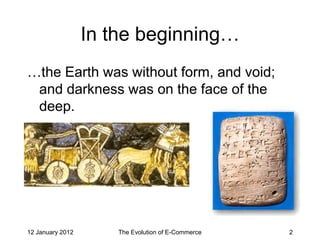
In the beginning…
…the Earth was without form, and void;
 and darkness was on the face of the
 deep.


12 January 2012       The Evolution of E-Commerce   2
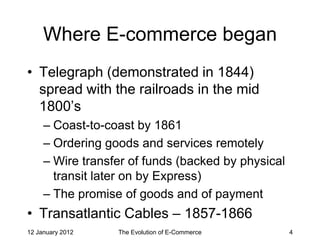
Where E-commerce began
• Telegraph (demonstrated in 1844)
  spread with the railroads in the mid
  1800’s
     – Coast-to-coast by 1861
     – Ordering goods and services remotely
     – Wire transfer of funds (backed by physical
       transit later on by Express)
     – The promise of goods and of payment
• Transatlantic Cables – 1857-1866
12 January 2012   The Evolution of E-Commerce       4
Electronic Genesis
• Until very recently, only computer
  people had computers
• Started to change in the 1980’s
• Paradigm shift in 1995 – the World
  Wide Web


12 January 2012       The Evolution of E-Commerce   5
Checks & Credit Cards
• In the early 19th Century, there were
  cheques
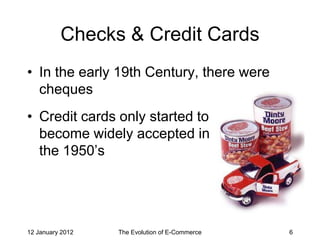
• Credit cards only started to
  become widely accepted in
  the 1950’s


12 January 2012   The Evolution of E-Commerce   6
Evolution & Natural Selection
• Natural selection works in nature
• It also works in computers & business
     – Digital Equipment Corporation
     – Microsoft
     – Linux

• It also works in politics and e-commerce


12 January 2012    The Evolution of E-Commerce   7
12 January 2012   The Evolution of E-Commerce   8
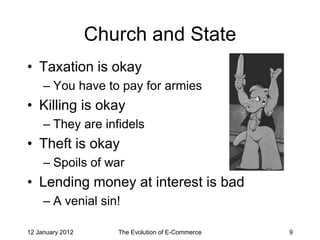
Church and State
• Taxation is okay
     – You have to pay for armies
• Killing is okay
     – They are infidels
• Theft is okay
     – Spoils of war
• Lending money at interest is bad
     – A venial sin!

12 January 2012      The Evolution of E-Commerce   9
You’ll do it my way
• Big companies try to set rules
• Need special accounts with special
  banks, everyone uses my bank (or pay
  extra)
• Special hardware attached to your
  computer
• Place order online, call company with
  credit card information, exchange PIN
12 January 2012       The Evolution of E-Commerce   10
Company Store, Company
             Scrip
• People work, are paid in company scrip
• Can use scrip to shop at company store
• Scrip has theoretical cash value
     – Cannot readily exchange for dollars
     – Company store engages in price gouging
     – Employees are slaves


12 January 2012   The Evolution of E-Commerce   11
Cybercash / Cyberwallet

• You buy cyberdollars with real dollars
• Clients buy services with cyberdollars
• Companies accept cyberdollars as
  payment
• Companies sell cyberdollars to get real
  dollars
• 12 January 2012
   Transaction fees when you exchange
                  The Evolution of E-Commerce   12
Private Banks
• In 17th – 19th centuries, banks were
  private
• Uninsured
   – If your bank was robbed, you lost your
     money
   – If your bank folded or absconded, you lost

• Largely unrelated
     – No ATMs, elaborately coded letters of
        credit
12 January 2012  The Evolution of E-Commerce      13
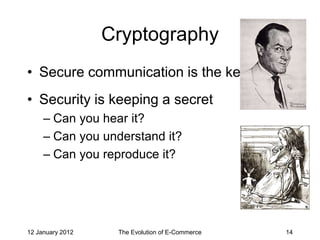
Cryptography
• Secure communication is the key
• Security is keeping a secret
     – Can you hear it?
     – Can you understand it?
     – Can you reproduce it?


12 January 2012    The Evolution of E-Commerce   14
Purchasing Agents
• You hire agent, give letter of credit
• Agent goes on road
     – Sees goodies
     – Sends samples
     – You send okay
     – Buys on credit, ships goodies
     – Credit cleared later


12 January 2012       The Evolution of E-Commerce   15
First Virtual
• Client signs up with credit card
     – By telephone

• When buying, submits form
     – Server sends email to FV
     – FV sends email to client
     – Client sends email to FV
     – FV sends email to server
     – (Can view product before paying!)

12 January 2012    The Evolution of E-Commerce   16
Industrial Revolution
• You make stuff, you want to sell it
• Unless you are big, you get robbed
     – Hire thugs
     – Cost of doing business

• Unless you are big, transactions are
  small
     – and local or highly specialized

• Wholesalers / retailers
12 January 2012    The Evolution of E-Commerce   17
E-Commerce Revolution
• If you want to sell, you need a merchant
  account
     – Have to be big, need credit history, nope -
       sell on trust, send me a check, get screwed
     – Don’t have to be big, just pay a lot, hard to
       interface to banks
• Wholesalers
     – Have merchant account, take 15%, take
       risks
     – Enable lower class to sell to world
12 January 2012    The Evolution of E-Commerce    18
Same Problems, Different
             People
• Large number of credit card wholesalers
     – Requires lots of work
     – Requires lots of security

• Mergers and acquisitions
• Survival of the fittest, fattest, fastest


12 January 2012    The Evolution of E-Commerce   19
What’s Next?
• Microtransactions
     – Pay as you go (or use)
     – Utility service analogy
     – Rent with utilities included
• Currently not cost effective
     – Credit card transactions too expensive
     – Tracking and reporting issues


12 January 2012    The Evolution of E-Commerce   20
So, nu?
• There is no difference between
  commerce and e-commerce
• Electronic transactions are just a
  different type of payment
• Protocols have to fit human needs and
  human models – not the other way
  around
• Your customers are not geniuses
12 January 2012   The Evolution of E-Commerce   21
12 January 2012   The Evolution of E-Commerce   22
Okay, what is for sale?
• Physical media
     – Books, parts, cars, music, antiques,
       junque, etc.
• Virtual media
     – Programs, memberships, searches,
       greeting cards, money, etc.
• Advertising
     – Anyone can be a publisher!

12 January 2012   The Evolution of E-Commerce   23
Physical
• Barnes & Noble, L.L.Bean, LandsEnd,
  Clinique, Camera World
• Books.com, buy.com, pets.com,
  groceries.com, wine.com, sparks.com
• Amazon.com, PayPal.com


12 January 2012   The Evolution of E-Commerce   24
Virtual Media
• Sell once
     – Buy a program (or picture, or license)
• Sell repeatedly (monthly/annually)
     – Buy a membership in a site
     – Mainly adult-site memberships, others exist
• Sell sporadically (access/use)
     – Buy information per search
     – Moving money (PayPal, IBill)

12 January 2012    The Evolution of E-Commerce   25
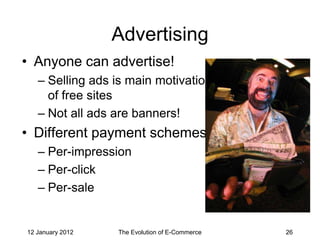
Advertising
• Anyone can advertise!
   – Selling ads is main motivation
     of free sites
   – Not all ads are banners!
• Different payment schemes
   – Per-impression
   – Per-click
   – Per-sale


12 January 2012   The Evolution of E-Commerce   26
Paying for Ads
• Per-impression
     – Fairest to advertiser (bandwidth costs), but
       advertiser must trust publisher
• Per-click
     – Fairest to both (both can track traffic, publisher
       can pull unsuccessful ads), but susceptible to
       abuse by both sides (click-bots and trimming by
       “uniques”)
• Per-conversion
     – Fairest to advertiser (pay only for results), but
       publisher must trust advertiser
12 January 2012       The Evolution of E-Commerce           27
Two Distinct Marketplaces
• “Adult”
     – 5–15% click-through rate
     – 0.1–1% conversion rate
     – Lots of traffic from little advertisers
• “Mainstream”
     – 0.25–1% click-through rate
     – 2–10% conversion rate
     – Most traffic through big advertisers

12 January 2012     The Evolution of E-Commerce   28
Payment Schemes
• Per Impression
     – Only way on big mainstream advertisers
• Per Click
     – Few adult sites use it any more – lots of
       abuse
     – Many mainstream sites use it
• Per Conversion
     – Mainstream and adult

12 January 2012      The Evolution of E-Commerce   29
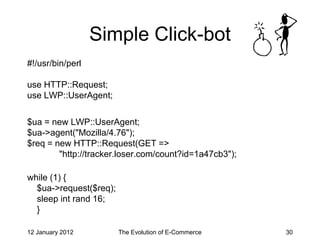
Simple Click-bot
#!/usr/bin/perl

use HTTP::Request;
use LWP::UserAgent;

$ua = new LWP::UserAgent;
$ua->agent("Mozilla/4.76");
$req = new HTTP::Request(GET =>
        "http://tracker.loser.com/count?id=1a47cb3");

while (1) {
  $ua->request($req);
  sleep int rand 16;
  }

12 January 2012         The Evolution of E-Commerce     30
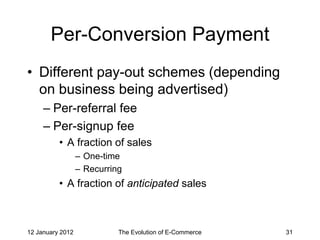
Per-Conversion Payment
• Different pay-out schemes (depending
  on business being advertised)
     – Per-referral fee
     – Per-signup fee
          • A fraction of sales
                  – One-time
                  – Recurring
          • A fraction of anticipated sales


12 January 2012             The Evolution of E-Commerce   31
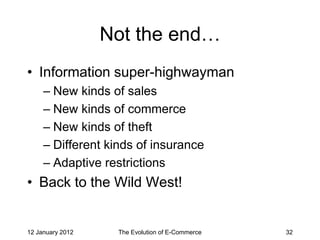
Not the end…
• Information super-highwayman
     – New kinds of sales
     – New kinds of commerce
     – New kinds of theft
     – Different kinds of insurance
     – Adaptive restrictions
• Back to the Wild West!


12 January 2012    The Evolution of E-Commerce   32
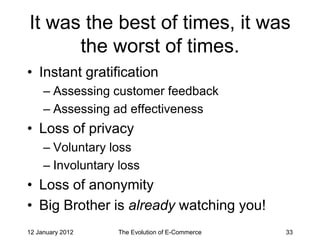
It was the best of times, it was
      the worst of times.
• Instant gratification
     – Assessing customer feedback
     – Assessing ad effectiveness
• Loss of privacy
     – Voluntary loss
     – Involuntary loss
• Loss of anonymity
• Big Brother is already watching you!
12 January 2012    The Evolution of E-Commerce   33
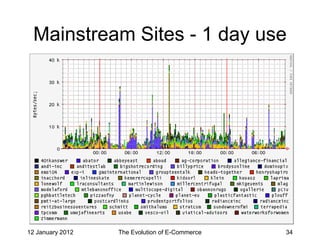
Mainstream Sites - 1 day use


12 January 2012   The Evolution of E-Commerce   34
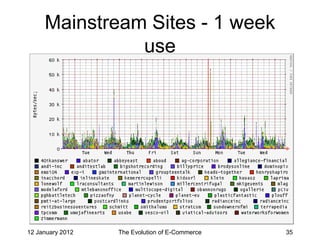
Mainstream Sites - 1 week
               use


12 January 2012   The Evolution of E-Commerce   35
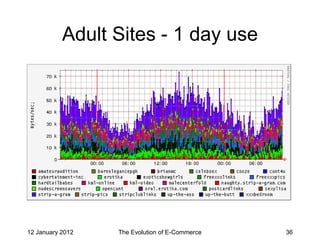
Adult Sites - 1 day use


12 January 2012   The Evolution of E-Commerce   36
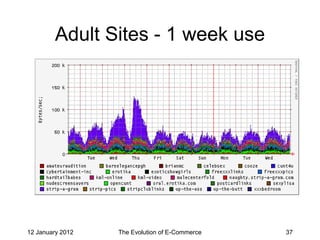
Adult Sites - 1 week use


12 January 2012   The Evolution of E-Commerce   37
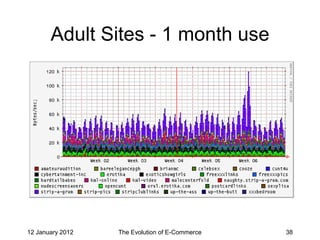
Adult Sites - 1 month use


12 January 2012   The Evolution of E-Commerce   38
So… what’s next?
• Read science fiction!
     – Chester Gould (<1935) – wrist radio
     – Frederick Pohl (1965) – joymaker
     – John Brunner (1974) – information society
     – Robert Heinlein (1959) – computer
       immersion

     – implanted computers, crypto, global
       networks, intelligent agents, nanobots…
12 January 2012      The Evolution of E-Commerce   39
12 January 2012   The Evolution of E-Commerce   40
The Evolution of E-Commerce

             History Repeats Itself (again)

                       Daniel V. Klein
                        dan@klein.com


12 January 2012      The Evolution of E-Commerce   41

Ecommerce2

  • 1.
    The Evolution ofE-Commerce History Repeats Itself (again) Daniel V. Klein dan@klein.com 12 January 2012 The Evolution of E-Commerce 1
  • 2.
    In the beginning… …theEarth was without form, and void; and darkness was on the face of the deep. 12 January 2012 The Evolution of E-Commerce 2
  • 3.
    Where E-commerce began •Telegraph (demonstrated in 1844) spread with the railroads in the mid 1800’s – Coast-to-coast by 1861 – Ordering goods and services remotely – Wire transfer of funds (backed by physical transit later on by Express) – The promise of goods and of payment • Transatlantic Cables – 1857-1866 12 January 2012 The Evolution of E-Commerce 4
  • 4.
    Electronic Genesis • Untilvery recently, only computer people had computers • Started to change in the 1980’s • Paradigm shift in 1995 – the World Wide Web 12 January 2012 The Evolution of E-Commerce 5
  • 5.
    Checks & CreditCards • In the early 19th Century, there were cheques • Credit cards only started to become widely accepted in the 1950’s 12 January 2012 The Evolution of E-Commerce 6
  • 6.
    Evolution & NaturalSelection • Natural selection works in nature • It also works in computers & business – Digital Equipment Corporation – Microsoft – Linux • It also works in politics and e-commerce 12 January 2012 The Evolution of E-Commerce 7
  • 7.
    12 January 2012 The Evolution of E-Commerce 8
  • 8.
    Church and State •Taxation is okay – You have to pay for armies • Killing is okay – They are infidels • Theft is okay – Spoils of war • Lending money at interest is bad – A venial sin! 12 January 2012 The Evolution of E-Commerce 9
  • 9.
    You’ll do itmy way • Big companies try to set rules • Need special accounts with special banks, everyone uses my bank (or pay extra) • Special hardware attached to your computer • Place order online, call company with credit card information, exchange PIN 12 January 2012 The Evolution of E-Commerce 10
  • 10.
    Company Store, Company Scrip • People work, are paid in company scrip • Can use scrip to shop at company store • Scrip has theoretical cash value – Cannot readily exchange for dollars – Company store engages in price gouging – Employees are slaves 12 January 2012 The Evolution of E-Commerce 11
  • 11.
    Cybercash / Cyberwallet •You buy cyberdollars with real dollars • Clients buy services with cyberdollars • Companies accept cyberdollars as payment • Companies sell cyberdollars to get real dollars • 12 January 2012 Transaction fees when you exchange The Evolution of E-Commerce 12
  • 12.
    Private Banks • In17th – 19th centuries, banks were private • Uninsured – If your bank was robbed, you lost your money – If your bank folded or absconded, you lost • Largely unrelated – No ATMs, elaborately coded letters of credit 12 January 2012 The Evolution of E-Commerce 13
  • 13.
    Cryptography • Secure communicationis the key • Security is keeping a secret – Can you hear it? – Can you understand it? – Can you reproduce it? 12 January 2012 The Evolution of E-Commerce 14
  • 14.
    Purchasing Agents • Youhire agent, give letter of credit • Agent goes on road – Sees goodies – Sends samples – You send okay – Buys on credit, ships goodies – Credit cleared later 12 January 2012 The Evolution of E-Commerce 15
  • 15.
    First Virtual • Clientsigns up with credit card – By telephone • When buying, submits form – Server sends email to FV – FV sends email to client – Client sends email to FV – FV sends email to server – (Can view product before paying!) 12 January 2012 The Evolution of E-Commerce 16
  • 16.
    Industrial Revolution • Youmake stuff, you want to sell it • Unless you are big, you get robbed – Hire thugs – Cost of doing business • Unless you are big, transactions are small – and local or highly specialized • Wholesalers / retailers 12 January 2012 The Evolution of E-Commerce 17
  • 17.
    E-Commerce Revolution • Ifyou want to sell, you need a merchant account – Have to be big, need credit history, nope - sell on trust, send me a check, get screwed – Don’t have to be big, just pay a lot, hard to interface to banks • Wholesalers – Have merchant account, take 15%, take risks – Enable lower class to sell to world 12 January 2012 The Evolution of E-Commerce 18
  • 18.
    Same Problems, Different People • Large number of credit card wholesalers – Requires lots of work – Requires lots of security • Mergers and acquisitions • Survival of the fittest, fattest, fastest 12 January 2012 The Evolution of E-Commerce 19
  • 19.
    What’s Next? • Microtransactions – Pay as you go (or use) – Utility service analogy – Rent with utilities included • Currently not cost effective – Credit card transactions too expensive – Tracking and reporting issues 12 January 2012 The Evolution of E-Commerce 20
  • 20.
    So, nu? • Thereis no difference between commerce and e-commerce • Electronic transactions are just a different type of payment • Protocols have to fit human needs and human models – not the other way around • Your customers are not geniuses 12 January 2012 The Evolution of E-Commerce 21
  • 21.
    12 January 2012 The Evolution of E-Commerce 22
  • 22.
    Okay, what isfor sale? • Physical media – Books, parts, cars, music, antiques, junque, etc. • Virtual media – Programs, memberships, searches, greeting cards, money, etc. • Advertising – Anyone can be a publisher! 12 January 2012 The Evolution of E-Commerce 23
  • 23.
    Physical • Barnes &Noble, L.L.Bean, LandsEnd, Clinique, Camera World • Books.com, buy.com, pets.com, groceries.com, wine.com, sparks.com • Amazon.com, PayPal.com 12 January 2012 The Evolution of E-Commerce 24
  • 24.
    Virtual Media • Sellonce – Buy a program (or picture, or license) • Sell repeatedly (monthly/annually) – Buy a membership in a site – Mainly adult-site memberships, others exist • Sell sporadically (access/use) – Buy information per search – Moving money (PayPal, IBill) 12 January 2012 The Evolution of E-Commerce 25
  • 25.
    Advertising • Anyone canadvertise! – Selling ads is main motivation of free sites – Not all ads are banners! • Different payment schemes – Per-impression – Per-click – Per-sale 12 January 2012 The Evolution of E-Commerce 26
  • 26.
    Paying for Ads •Per-impression – Fairest to advertiser (bandwidth costs), but advertiser must trust publisher • Per-click – Fairest to both (both can track traffic, publisher can pull unsuccessful ads), but susceptible to abuse by both sides (click-bots and trimming by “uniques”) • Per-conversion – Fairest to advertiser (pay only for results), but publisher must trust advertiser 12 January 2012 The Evolution of E-Commerce 27
  • 27.
    Two Distinct Marketplaces •“Adult” – 5–15% click-through rate – 0.1–1% conversion rate – Lots of traffic from little advertisers • “Mainstream” – 0.25–1% click-through rate – 2–10% conversion rate – Most traffic through big advertisers 12 January 2012 The Evolution of E-Commerce 28
  • 28.
    Payment Schemes • PerImpression – Only way on big mainstream advertisers • Per Click – Few adult sites use it any more – lots of abuse – Many mainstream sites use it • Per Conversion – Mainstream and adult 12 January 2012 The Evolution of E-Commerce 29
  • 29.
    Simple Click-bot #!/usr/bin/perl use HTTP::Request; useLWP::UserAgent; $ua = new LWP::UserAgent; $ua->agent("Mozilla/4.76"); $req = new HTTP::Request(GET => "http://tracker.loser.com/count?id=1a47cb3"); while (1) { $ua->request($req); sleep int rand 16; } 12 January 2012 The Evolution of E-Commerce 30
  • 30.
    Per-Conversion Payment • Differentpay-out schemes (depending on business being advertised) – Per-referral fee – Per-signup fee • A fraction of sales – One-time – Recurring • A fraction of anticipated sales 12 January 2012 The Evolution of E-Commerce 31
  • 31.
    Not the end… •Information super-highwayman – New kinds of sales – New kinds of commerce – New kinds of theft – Different kinds of insurance – Adaptive restrictions • Back to the Wild West! 12 January 2012 The Evolution of E-Commerce 32
  • 32.
    It was thebest of times, it was the worst of times. • Instant gratification – Assessing customer feedback – Assessing ad effectiveness • Loss of privacy – Voluntary loss – Involuntary loss • Loss of anonymity • Big Brother is already watching you! 12 January 2012 The Evolution of E-Commerce 33
  • 33.
    Mainstream Sites -1 day use 12 January 2012 The Evolution of E-Commerce 34
  • 34.
    Mainstream Sites -1 week use 12 January 2012 The Evolution of E-Commerce 35
  • 35.
    Adult Sites -1 day use 12 January 2012 The Evolution of E-Commerce 36
  • 36.
    Adult Sites -1 week use 12 January 2012 The Evolution of E-Commerce 37
  • 37.
    Adult Sites -1 month use 12 January 2012 The Evolution of E-Commerce 38
  • 38.
    So… what’s next? •Read science fiction! – Chester Gould (<1935) – wrist radio – Frederick Pohl (1965) – joymaker – John Brunner (1974) – information society – Robert Heinlein (1959) – computer immersion – implanted computers, crypto, global networks, intelligent agents, nanobots… 12 January 2012 The Evolution of E-Commerce 39
  • 39.
    12 January 2012 The Evolution of E-Commerce 40
  • 40.
    The Evolution ofE-Commerce History Repeats Itself (again) Daniel V. Klein dan@klein.com 12 January 2012 The Evolution of E-Commerce 41