Macro-economic Factors affecting
E-Commerce Industry
Group-3
Kartik Balaji
Jayant Nabhar
Manish Jindal
Leelakrishna Chinnareddi
Jagdish Prasad Sinha
Muskan Sharma
1
Introduction to the Industry
1
2
3
4
The term e-commerce was coined back in the
1960s, with the rise of electronic commerce – the
buying and selling of goods through the
transmission of data – which was made possible by
the introduction of the electronic data
interchange.
E-commerce has grown rapidly and
changed significantly over the years, as
such there is plenty for buyers, investors
and entrepreneurs to be mindful of.
Much of the growth for the industry has been
triggered by an increase in internet and
smartphone penetration.
E-commerce has transformed the way
business is done in India. The Indian E-
commerce market is expected to grow to
US$ 200 billion by 2026 from US$ 38.5
billion as of 2017.
2
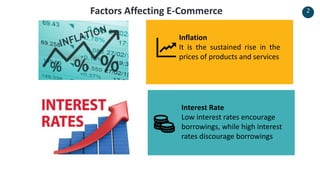
Inflation
It is the sustained rise in the
prices of products and services
Interest Rate
Low interest rates encourage
borrowings, while high interest
rates discourage borrowings
Factors Affecting E-Commerce
3
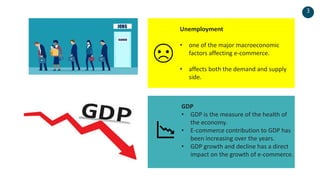
Unemployment
• one of the major macroeconomic
factors affecting e-commerce.
• affects both the demand and supply
side.
GDP
• GDP is the measure of the health of
the economy.
• E-commerce contribution to GDP has
been increasing over the years.
• GDP growth and decline has a direct
impact on the growth of e-commerce.
4
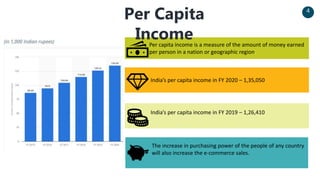
Per capita income is a measure of the amount of money earned
per person in a nation or geographic region.
The increase in purchasing power of the people of any country
will also increase the e-commerce sales.
India’s per capita income in FY 2020 – 1,35,050
India’s per capita income in FY 2019 – 1,26,410
Per Capita
Income
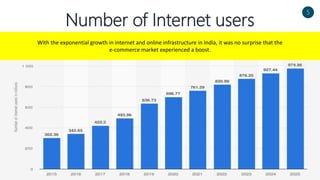
Number of Internet users
With the exponential growth in internet and online infrastructure in India, it was no surprise that the
e-commerce market experienced a boost.
5
6
Plays an important role in developing the country’s economy
Govt of India is trying to boost the economy
Easy expansion in developed countries
Making E-commerce more accessible in developing countries
Setting up frameworks for data leakage
Government and Political factors
7
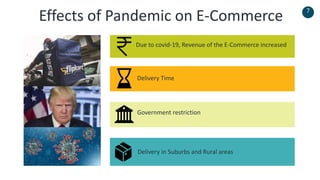
Due to covid-19, Revenue of the E-Commerce increased
Effects of Pandemic on E-Commerce
Government restriction
Delivery in Suburbs and Rural areas
Delivery Time
8
CONCLUSION
1
2
3
4
Even though the unemployment increased
throughout the country it didn’t hamper
the E-Commerce industry.
As people aren’t willing to
go out due to Covid-19,
most of them preferred E-
Commerce.
As these are new internet
age, E-Commerce always
increases their market
every year.
E-commerce is of immense
importance due to its
contribution in the GDP of
our country.
Macro Factor Affecting E-Commerce Industry

Macro Factor Affecting E-Commerce Industry

  • 1.
    Macro-economic Factors affecting E-CommerceIndustry Group-3 Kartik Balaji Jayant Nabhar Manish Jindal Leelakrishna Chinnareddi Jagdish Prasad Sinha Muskan Sharma
  • 2.
    1 Introduction to theIndustry 1 2 3 4 The term e-commerce was coined back in the 1960s, with the rise of electronic commerce – the buying and selling of goods through the transmission of data – which was made possible by the introduction of the electronic data interchange. E-commerce has grown rapidly and changed significantly over the years, as such there is plenty for buyers, investors and entrepreneurs to be mindful of. Much of the growth for the industry has been triggered by an increase in internet and smartphone penetration. E-commerce has transformed the way business is done in India. The Indian E- commerce market is expected to grow to US$ 200 billion by 2026 from US$ 38.5 billion as of 2017.
  • 3.
    2 Inflation It is thesustained rise in the prices of products and services Interest Rate Low interest rates encourage borrowings, while high interest rates discourage borrowings Factors Affecting E-Commerce
  • 4.
    3 Unemployment • one ofthe major macroeconomic factors affecting e-commerce. • affects both the demand and supply side. GDP • GDP is the measure of the health of the economy. • E-commerce contribution to GDP has been increasing over the years. • GDP growth and decline has a direct impact on the growth of e-commerce.
  • 5.
    4 Per capita incomeis a measure of the amount of money earned per person in a nation or geographic region. The increase in purchasing power of the people of any country will also increase the e-commerce sales. India’s per capita income in FY 2020 – 1,35,050 India’s per capita income in FY 2019 – 1,26,410 Per Capita Income
  • 6.
    Number of Internetusers With the exponential growth in internet and online infrastructure in India, it was no surprise that the e-commerce market experienced a boost. 5
  • 7.
    6 Plays an importantrole in developing the country’s economy Govt of India is trying to boost the economy Easy expansion in developed countries Making E-commerce more accessible in developing countries Setting up frameworks for data leakage Government and Political factors
  • 8.
    7 Due to covid-19,Revenue of the E-Commerce increased Effects of Pandemic on E-Commerce Government restriction Delivery in Suburbs and Rural areas Delivery Time
  • 9.
    8 CONCLUSION 1 2 3 4 Even though theunemployment increased throughout the country it didn’t hamper the E-Commerce industry. As people aren’t willing to go out due to Covid-19, most of them preferred E- Commerce. As these are new internet age, E-Commerce always increases their market every year. E-commerce is of immense importance due to its contribution in the GDP of our country.