Rodríguez, F. , León-López, J. , Calderón, C. ,
Feriche, B. , Pérez-Sánchez, M. , Iglesias, X.
Oxidative stress markers in different altitude
training strategies in elite athletes. 18th Annual
Congress of the European College of Sport Science,
INEFC Barcelona. (Barcelona).
xiglesias@gmail.com
Sport Sciences Research Group INEFC Barcelona
Grup de Recerca en Ciències de l'Esport INEFC Barcelona
Grup Consolidat (SGR 2014–1665 GRC)
Institut Nacional d’Educació Física de Catalunya
Av. de l’Estadi, 12-22
08038 Barcelona (Spain)
+34 93 425 54 45
http://inefcresearch.wordpress.com/
http://www.slideshare.net/ResearchINEFC
gruprecercainefc@gmail.com
@Recerca_INEFC
OXIDATIVE STRESS MARKERS IN DIFFERENT ALTITUDE TRAINING STRATEGIES IN ELITE ATHLETES
Rodríguez F.A.1, León-López J.2, Calderón, C.3, Feriche, B.4, Pérez-Sánchez, M.5, Iglesias, X.1
1 GRCE, INEFC-Barcelona, Universitat de Barcelona (Barcelona, Spain), 2 Hospital Universitario San Cecilio (Granada, Spain), 3 CAR Sierra Nevada (Granada, Spain)
4 FCAFD, University of Granada (Granada, Spain), 5 Hospital Universitario Virgen de las Nieves (Granada, Spain)
Aim
Hypoxia is known to induce oxidative stress in animal models and humans
due to increased oxygen uptake and electron drain at the mitochondrial
respiratory chain, resulting in increased biological tissue oxidation (Guzy &
Schumacker 2006).
During altitude training exposure two independent stimuli (intense exercise
and hypoxia) may have a cumulative effect on oxidative stress (Pialoux et
al., 2006).
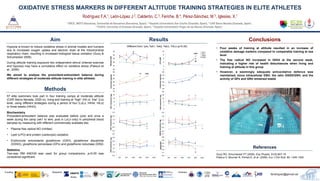
We aimed to analyse the prooxidant-antioxidant balance during
different strategies of moderate altitude training in elite athletes.
Methods
57 elite swimmers took part in four training camps at moderate altitude
(CAR Sierra Nevada, 2320 m), living and training at “high” (Hi) or “low” (Lo)
level, using different strategies during a period of four (LoLo, HiHi4, HiLo)
or three weeks (HiHi3).
Biochemistry
Prooxidant-antioxidant balance was evaluated before (pre) and once a
week during the camp (wk1 to wk4, post in LoLo only) in peripheral blood
samples by measuring with different commercially available kits:
•  Plasma free radical NO (nitrites)
•  Lipid (LPO) and protein (carbonyls) oxidation
•  Erythrocyte antioxidants glutathione (GSH), glutathione disulphide
(GSSG), glutathione peroxidase (GPx) and glutathione reductase (GRd)
Statistics
Two-way RM ANOVA was used for group comparisons. p<0.05 was
considered significant.
Results Conclusions
•  Four weeks of training at altitude resulted in an increase of
oxidative damage markers compared to comparable training at sea
level
•  The free radical NO increased in HiHi4 at the second week,
indicating a higher risk of health disturbances when living and
training at altitude in this group
•  However, a seemingly adequate antioxidative defence was
maintained, since intracellular GSH, the ratio GSSG/GSH, and the
activity of GPx and GRd remained stable
References
Guzy RD, Schumacker PT (2006). Exp Physiol, 91(5):807-19
Pialoux V, Mounier R, Ponsot E, et al. (2006). Eur J Clin Nutr, 60, 1345-1354.
farodriguez@gencat.cat
Funding
Institute for Exercise and
Environmental Medicine
Research Partners
20
24
28
32
36
40
Nitrates(µM)
0
2
4
6
8
10
LPO(µM)
LoLo
HiLo
HiHi3
HiHi4
30
40
50
60
70
80
Carbonyls(µg/mg)
30
40
50
60
70
80
Carbonyls(µg/mg)
0
4
8
12
16
20
GRd(nmol/minmg)
0,0
0,5
1,0
1,5
2,0
2,5
GST(nmol/minmg)
0,0
0,5
1,0
1,5
2,0
2,5
3,0
pre wk1 wk2 wk3 wk4 post
GSH(nmol/minmg)
0,0
0,4
0,8
1,2
1,6
2,0
GSSG(nmol/minmg)
0,0
0,1
0,2
0,3
0,4
0,5
0,6
0,7
pre wk1 wk2 wk3 wk4 post
GSSG/GST
0
4
8
12
16
20
GPx(nmol/minmg)
Different from *pre, #wk1, $wk2, &wk3, †HiLo (p<0.05)
#
*#$&
#$
*# *#$&
*
††
*
* #
*
#

Oxidative stress markers in different altitude training strategies in elite athletes.

  • 1.
    Rodríguez, F. ,León-López, J. , Calderón, C. , Feriche, B. , Pérez-Sánchez, M. , Iglesias, X. Oxidative stress markers in different altitude training strategies in elite athletes. 18th Annual Congress of the European College of Sport Science, INEFC Barcelona. (Barcelona). xiglesias@gmail.com Sport Sciences Research Group INEFC Barcelona Grup de Recerca en Ciències de l'Esport INEFC Barcelona Grup Consolidat (SGR 2014–1665 GRC) Institut Nacional d’Educació Física de Catalunya Av. de l’Estadi, 12-22 08038 Barcelona (Spain) +34 93 425 54 45 http://inefcresearch.wordpress.com/ http://www.slideshare.net/ResearchINEFC gruprecercainefc@gmail.com @Recerca_INEFC
  • 2.
    OXIDATIVE STRESS MARKERSIN DIFFERENT ALTITUDE TRAINING STRATEGIES IN ELITE ATHLETES Rodríguez F.A.1, León-López J.2, Calderón, C.3, Feriche, B.4, Pérez-Sánchez, M.5, Iglesias, X.1 1 GRCE, INEFC-Barcelona, Universitat de Barcelona (Barcelona, Spain), 2 Hospital Universitario San Cecilio (Granada, Spain), 3 CAR Sierra Nevada (Granada, Spain) 4 FCAFD, University of Granada (Granada, Spain), 5 Hospital Universitario Virgen de las Nieves (Granada, Spain) Aim Hypoxia is known to induce oxidative stress in animal models and humans due to increased oxygen uptake and electron drain at the mitochondrial respiratory chain, resulting in increased biological tissue oxidation (Guzy & Schumacker 2006). During altitude training exposure two independent stimuli (intense exercise and hypoxia) may have a cumulative effect on oxidative stress (Pialoux et al., 2006). We aimed to analyse the prooxidant-antioxidant balance during different strategies of moderate altitude training in elite athletes. Methods 57 elite swimmers took part in four training camps at moderate altitude (CAR Sierra Nevada, 2320 m), living and training at “high” (Hi) or “low” (Lo) level, using different strategies during a period of four (LoLo, HiHi4, HiLo) or three weeks (HiHi3). Biochemistry Prooxidant-antioxidant balance was evaluated before (pre) and once a week during the camp (wk1 to wk4, post in LoLo only) in peripheral blood samples by measuring with different commercially available kits: •  Plasma free radical NO (nitrites) •  Lipid (LPO) and protein (carbonyls) oxidation •  Erythrocyte antioxidants glutathione (GSH), glutathione disulphide (GSSG), glutathione peroxidase (GPx) and glutathione reductase (GRd) Statistics Two-way RM ANOVA was used for group comparisons. p<0.05 was considered significant. Results Conclusions •  Four weeks of training at altitude resulted in an increase of oxidative damage markers compared to comparable training at sea level •  The free radical NO increased in HiHi4 at the second week, indicating a higher risk of health disturbances when living and training at altitude in this group •  However, a seemingly adequate antioxidative defence was maintained, since intracellular GSH, the ratio GSSG/GSH, and the activity of GPx and GRd remained stable References Guzy RD, Schumacker PT (2006). Exp Physiol, 91(5):807-19 Pialoux V, Mounier R, Ponsot E, et al. (2006). Eur J Clin Nutr, 60, 1345-1354. farodriguez@gencat.cat Funding Institute for Exercise and Environmental Medicine Research Partners 20 24 28 32 36 40 Nitrates(µM) 0 2 4 6 8 10 LPO(µM) LoLo HiLo HiHi3 HiHi4 30 40 50 60 70 80 Carbonyls(µg/mg) 30 40 50 60 70 80 Carbonyls(µg/mg) 0 4 8 12 16 20 GRd(nmol/minmg) 0,0 0,5 1,0 1,5 2,0 2,5 GST(nmol/minmg) 0,0 0,5 1,0 1,5 2,0 2,5 3,0 pre wk1 wk2 wk3 wk4 post GSH(nmol/minmg) 0,0 0,4 0,8 1,2 1,6 2,0 GSSG(nmol/minmg) 0,0 0,1 0,2 0,3 0,4 0,5 0,6 0,7 pre wk1 wk2 wk3 wk4 post GSSG/GST 0 4 8 12 16 20 GPx(nmol/minmg) Different from *pre, #wk1, $wk2, &wk3, †HiLo (p<0.05) # *#$& #$ *# *#$& * †† * * # * #