Barrero, A., Cadefau, J.A., Irurtia, A., Chaverri, D.,
Guerrero, M., Carmona, G., Cussó, R., Iglesias, X.,
Rodríguez, F.A. Muscle damage induced by an ultra-
endurance triathlon affects slow fibres and is
related to dehydration. 18th Annual Congress of the
European College of Sport Science, INEFC Barcelona.
(Barcelona).
xiglesias@gmail.com
Sport Sciences Research Group INEFC Barcelona
Grup de Recerca en Ciències de l'Esport INEFC Barcelona
Grup Consolidat (SGR 2014–1665 GRC)
Institut Nacional d’Educació Física de Catalunya
Av. de l’Estadi, 12-22
08038 Barcelona (Spain)
+34 93 425 54 45
http://inefcresearch.wordpress.com/
http://www.slideshare.net/ResearchINEFC
gruprecercainefc@gmail.com
@Recerca_INEFC
Introduction & Aim
Ultra-endurance triathlon (UET) races (3.8-km swim, 180-km cycle, 42.2-
km run) induce muscle damage (Neubauer et al., 2008). The evaluation of
fast (FM) and slow myosin (SM) levels in blood 48 h after exercise is a
useful aid for the detection of muscle damage in particular since FM is an
exclusive skeletal muscle marker (Guerrero et al., 2008).
We aimed to assess muscle damage after an UET race through the
evaluation of FM and SM and creatine kinase (CK) serum levels and
relate them with the hydration status.
Materials & Methods
•Subjects. 11 well-trained non-professional ultra-endurance triathletes
(mean ± SD: age 37.2 ± 4.6 years, body mass 74.3 ± 6.7 kg, height 174 ±
6 cm, BMI 24.5 ± 1.9 kg·m2, VO2max 67.5 ± 4.2 mL·kg-1·min-1)
•Triathlon race. The Extreme Man Salou–Costa Daurada triathlon, held in
Salou (Spain) on 5 June 2011 was the chosen ultra-endurance triathlon.
Environmental conditions registered during the race indicated that the
average ambient air temperature was 26ºC (range 13–30ºC), the water
temperature was 20 21 ºC (range: 20.8–21.2 ºC), and the relative humidity
was 77% (range: 64–94%). The average wind speed was 1.3 m·s-1 (range:
0.3–5 m·s-1).
•Analytical procedures. Blood samples were taken before the UET and
48h after the race. ELISA method was used to determine myosin
concentration in serum. Body mass (BM) and bioimpedance (BIA)
bioelectrical variables (Z-Metrix®, BioparHom Co, France) were obtained
before, 30 min post-race (to avoid skin temperature effect on BIA), and 48 h
after. Total body water (TBW), intracellular (ICW), and extracellular body
water (ECW) were estimated using the instrument software.
MUSCLE DAMAGE INDUCED BY AN ULTRA-ENDURANCE TRIATHLON AFFECTS SLOW FIBRES AND IS RELATED TO DEHYDRATION
Barrero A.1, Cadefau JA.1, Irurtia A.1, Chaverri D.1, Guerrero M.2, Carmona G.1, Cussó R.2 Iglesias X.1, Rodríguez FA.1
1INEFC-Barcelona Sport Sciences Research Group, Institut Nacional d’Educació Física de Catalunya, Universitat de Barcelona (Barcelona, Spain)
2Faculty of Medicine, Universitat de Barcelona (Barcelona, Spain)
Results
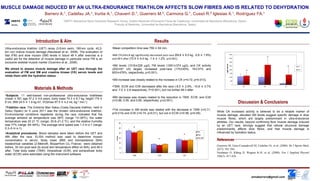
•Mean competition time was 759 ± 64 min.
•BM (74.0±6.8 kg) significantly decreased post-race (69.6 ± 6.5 kg, -5.8 ± 1.9%)
and 48 h after (72.9 ± 6.4 kg, -1.4 ± 1.2%, p<0.001).
•SM levels (1016±228 µg/l), FM levels (1091±374 µg/l), and CK activity
(202±87 U/l) largely increased post-race (170±93%, 16±37% and
600±476%, respectively, p<0.001).
•SM increase was closely related to the increase in CK (r=0.72, p=0.013).
•TBW, ECW and ICW decreased after the race (-8.5 ± 2.9%, -10.8 ± 3.7%
and -7.0 ± 2.8 respectively, P<0.001), but not further 48 h after.
•BM decrease was closely related to the reduction in TBW, ECW, and ICW
(r=0,98, 0.95, and 0.85, respectively, p≤0.001).
•The increase in SM levels was related with the decrease in TBW (r=0.71,
p=0.014) and ICW (r=0.74, p=0.01), but not in ECW (r=0.56, p=0.08).
Discussion & Conclusions
While CK increased activity is believed to be a reliable marker of
muscle damage, elevated SM levels suggest specific damage in slow
muscle fibres, which are largely predominant in ultra-endurance
athletes. Our results, beyond confirming fibre muscle damage induced
by an UET race, strongly suggest that cellular structural damage
predominantly affects slow fibres, and that muscle damage is
influenced by hydration status.
References
Guerrero M, Guiu-Comadevall M, Cadefau JA, et al. (2008). Br J Sports Med,
42(7): 581-584.
Neubauer O, König D, Wagner K-H, et al. (2008). Eur J Applied Physiol
104(3): 417-426.
annabarrero@gmail.com
0
500
1000
1500
2000
2500
3000
3500
4000
FM SM CK
ug/Lserum
Pre
Post
0
10
20
30
40
50
60
TBW ECW ICW
Litres
Pre
Post
Post 48h
*
*
*
*
*
*

Muscle damage induced by an ultra-endurance triathlon affects slow fibres and is related to dehydration.

  • 1.
    Barrero, A., Cadefau,J.A., Irurtia, A., Chaverri, D., Guerrero, M., Carmona, G., Cussó, R., Iglesias, X., Rodríguez, F.A. Muscle damage induced by an ultra- endurance triathlon affects slow fibres and is related to dehydration. 18th Annual Congress of the European College of Sport Science, INEFC Barcelona. (Barcelona). xiglesias@gmail.com Sport Sciences Research Group INEFC Barcelona Grup de Recerca en Ciències de l'Esport INEFC Barcelona Grup Consolidat (SGR 2014–1665 GRC) Institut Nacional d’Educació Física de Catalunya Av. de l’Estadi, 12-22 08038 Barcelona (Spain) +34 93 425 54 45 http://inefcresearch.wordpress.com/ http://www.slideshare.net/ResearchINEFC gruprecercainefc@gmail.com @Recerca_INEFC
  • 2.
    Introduction & Aim Ultra-endurancetriathlon (UET) races (3.8-km swim, 180-km cycle, 42.2- km run) induce muscle damage (Neubauer et al., 2008). The evaluation of fast (FM) and slow myosin (SM) levels in blood 48 h after exercise is a useful aid for the detection of muscle damage in particular since FM is an exclusive skeletal muscle marker (Guerrero et al., 2008). We aimed to assess muscle damage after an UET race through the evaluation of FM and SM and creatine kinase (CK) serum levels and relate them with the hydration status. Materials & Methods •Subjects. 11 well-trained non-professional ultra-endurance triathletes (mean ± SD: age 37.2 ± 4.6 years, body mass 74.3 ± 6.7 kg, height 174 ± 6 cm, BMI 24.5 ± 1.9 kg·m2, VO2max 67.5 ± 4.2 mL·kg-1·min-1) •Triathlon race. The Extreme Man Salou–Costa Daurada triathlon, held in Salou (Spain) on 5 June 2011 was the chosen ultra-endurance triathlon. Environmental conditions registered during the race indicated that the average ambient air temperature was 26ºC (range 13–30ºC), the water temperature was 20 21 ºC (range: 20.8–21.2 ºC), and the relative humidity was 77% (range: 64–94%). The average wind speed was 1.3 m·s-1 (range: 0.3–5 m·s-1). •Analytical procedures. Blood samples were taken before the UET and 48h after the race. ELISA method was used to determine myosin concentration in serum. Body mass (BM) and bioimpedance (BIA) bioelectrical variables (Z-Metrix®, BioparHom Co, France) were obtained before, 30 min post-race (to avoid skin temperature effect on BIA), and 48 h after. Total body water (TBW), intracellular (ICW), and extracellular body water (ECW) were estimated using the instrument software. MUSCLE DAMAGE INDUCED BY AN ULTRA-ENDURANCE TRIATHLON AFFECTS SLOW FIBRES AND IS RELATED TO DEHYDRATION Barrero A.1, Cadefau JA.1, Irurtia A.1, Chaverri D.1, Guerrero M.2, Carmona G.1, Cussó R.2 Iglesias X.1, Rodríguez FA.1 1INEFC-Barcelona Sport Sciences Research Group, Institut Nacional d’Educació Física de Catalunya, Universitat de Barcelona (Barcelona, Spain) 2Faculty of Medicine, Universitat de Barcelona (Barcelona, Spain) Results •Mean competition time was 759 ± 64 min. •BM (74.0±6.8 kg) significantly decreased post-race (69.6 ± 6.5 kg, -5.8 ± 1.9%) and 48 h after (72.9 ± 6.4 kg, -1.4 ± 1.2%, p<0.001). •SM levels (1016±228 µg/l), FM levels (1091±374 µg/l), and CK activity (202±87 U/l) largely increased post-race (170±93%, 16±37% and 600±476%, respectively, p<0.001). •SM increase was closely related to the increase in CK (r=0.72, p=0.013). •TBW, ECW and ICW decreased after the race (-8.5 ± 2.9%, -10.8 ± 3.7% and -7.0 ± 2.8 respectively, P<0.001), but not further 48 h after. •BM decrease was closely related to the reduction in TBW, ECW, and ICW (r=0,98, 0.95, and 0.85, respectively, p≤0.001). •The increase in SM levels was related with the decrease in TBW (r=0.71, p=0.014) and ICW (r=0.74, p=0.01), but not in ECW (r=0.56, p=0.08). Discussion & Conclusions While CK increased activity is believed to be a reliable marker of muscle damage, elevated SM levels suggest specific damage in slow muscle fibres, which are largely predominant in ultra-endurance athletes. Our results, beyond confirming fibre muscle damage induced by an UET race, strongly suggest that cellular structural damage predominantly affects slow fibres, and that muscle damage is influenced by hydration status. References Guerrero M, Guiu-Comadevall M, Cadefau JA, et al. (2008). Br J Sports Med, 42(7): 581-584. Neubauer O, König D, Wagner K-H, et al. (2008). Eur J Applied Physiol 104(3): 417-426. annabarrero@gmail.com 0 500 1000 1500 2000 2500 3000 3500 4000 FM SM CK ug/Lserum Pre Post 0 10 20 30 40 50 60 TBW ECW ICW Litres Pre Post Post 48h * * * * * *